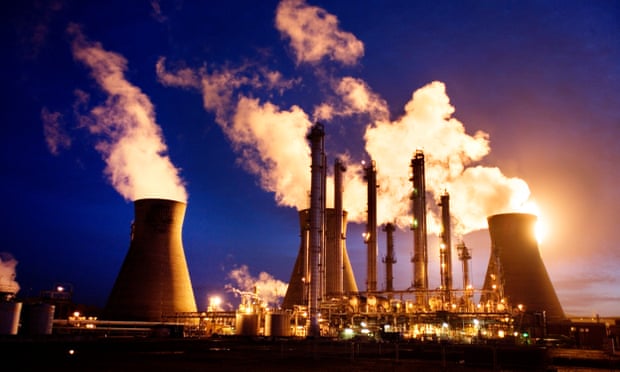
Gas flares at BP’s Grangemouth oil refinery at dusk in Scotland. Photograph: Murdo Macleod/The Guardian
Despite splashy climate pledges, firms including BP and Saudi Aramco have plans to expand fossil fuel production, says analysis
In recent years, virtually all of the world’s largest oil companies have made splashy climate pledges. But when it comes to actually slashing emissions, those firms are “way off track”, a new report has found.
The analysis from the thinktank Carbon Tracker assessed the production and transition plans of 25 of the world’s largest oil and gas companies. None align with the central goal of the 2015 Paris climate agreement to keep global warming “well under” 2 degrees above pre-industrial levels, the report found.
“Companies worldwide are publicly stating they are supportive of the goals of the Paris-Agreement, and claim to be part of the solution in accelerating the energy transition,” said Maeve O’Connor, analyst at Carbon Tracker and co-author of the report. “Unfortunately, however, we see that none are currently aligned with the goals of the Paris agreement.”
…
The analysis comes as oil and gas companies are publicly reneging on their climate commitments. Shell last week watered down earlier emissions targets, following BP, which made a similar announcement last year. In October, ExxonMobil also made a deal to buy the shale group Pioneer Natural Resources, while Chevron announced plans to acquire the Texas oil company Hess – markingtwo of the country’s largest oil and gas deals in decades.
When environmental defenders are tried in future they will be barred from giving evidence of climate impacts to the jury to explain their motives, writes Tim Crosland, director of climate justice charity Plan B Earth.
Environmental activist Trudi Warner is ejected from the Royal Courts of Justice on February 21. Credit: Defend Our Juries
The Court of Appeal this week delivered another blow to the rights of climate activists to defend themselves in court.
The case centred on a jury’s decision to acquit a group of activists last year after hearing evidence of the consequences of climate breakdown as part of the defence.
It was one of a number of “not guilty” verdicts in similar cases, which showed how seriously juries take such evidence – as long as they are allowed to hear it.
For the climate movement, It was a major boost to see that the public, in the form of juries, was on its side.
But on Monday, following an appeal by Attorney General Victoria Prentis, Lady Justice Carr delivered a ruling to the effect that the juries should not be allowed to hear that evidence in the future.
What this amounts to is that from now on, when environmental defenders are tried for criminal damage in the future, they will no longer be able to give climate impacts as evidence to explain their motives.
‘Show Trials’
This defence was one of the last available to activists in an increasingly hostile climate that has seen the UK, under Rishi Sunak’s administration, dish out some of the most punitive sentencing for peaceful protest in recent history.
The implications are grave. From now on, we will see jury trials turn into show trials, in which the defendants are banned from explaining to the jury their principled motivation for taking action.
Lady Justice Carr’s ruling was made even though the relevant legislation (the Criminal Damage Act of 1971) expressly provides for a jury to take into account the “circumstances” of environmentalists’ action.
The key question here is what counts as the “circumstances” of criminal damage, which is often the crime of which peaceful protestors stand accused. That might take the form of causing damage to property with graffiti, say by spray-painting #ShellKnows onto the oil company’s headquarters.
In this example, climate activists would argue they do this in order to hold those responsible for climate breakdown – and that the message serves to highlight the company’s decades-long knowledge and obfuscation of the impacts of fossil fuels on global heating.
The legal ‘logic’ of the new ruling is that “circumstances” refers to objective matters and therefore excludes a defendant’s beliefs. In the words of Lady Justice Carr, who read out the ruling of the court:
“The circumstances would not include the political or philosophical beliefs of the person causing the damage … Evidence from the defendant about the facts or effects of climate change would be inadmissible.”
The flaw in this logic is obvious. The climate crisis is not a matter of belief. It is a terrifying and objective reality. Not just according to scientists or the British parliament, but as evidenced by the well-documented destruction and mass loss of life that is already occurring across Europe and around the world.
Lady Justice Carr might try explaining that the climate crisis is all in their minds to the UK home-owners, whose properties are now uninsurable due to repeat flooding, or the mothers whose children’s bodies washed up on a Libyan shore after dams collapsed in the wake of heavy rains.
Sadly, this ruling, which is based on such obviously flawed reasoning, was widely predicted.
That’s because the ruling perpetuates an antagonism within the justice British system that has become impossible to ignore.
‘Embarrassment to the State’
On the one hand you have the juries, who represent our communities. They keep acquitting environmental defenders when they hear the full story.
And then you have some judges, paid by the state, who are taking increasingly bizarre measures to prevent the juries from giving not guilty verdicts (Judge Silas Reid has even banned the use of the words ‘climate change’ in court proceedings).
In February 2023, a jury acquitted campaigners who had splashed pink paint over Conservative and Labour Party HQs. In October, another acquitted a group who sprayed the Treasury with fake blood; and in November, yet another acquitted the HSBC 9, who broke windows to protest the bank’s £80 billion investments in fossil fuels since the Paris Agreement.
Such jury acquittals come as an embarrassment to the state. Since juries are composed of randomly selected members of the public, they expose a media-constructed fiction. The public doesn’t want the government to get tough on those taking measures against climate breakdown, they want it to take measures to stop climate breakdown.
As long as juries are allowed to hear evidence about a) the extreme danger of the climate crisis, b) the government’s systematic failure to follow the pathways that science dictates, and c) the efficacy of nonviolent direct action, it follows that those activists who are acting on the science are acquitted.
The British legal system, however, seems increasingly determined to prevent juries hearing the full facts. Judge Silas Reid has not only banned the words, he has sent people to prison simply for saying “climate change”.
At the end of February, almost as if he’d been tipped off on the Court of Appeal’s likely ruling, he used his office to cast doubt on the objective reality of the climate crisis:
“The circumstances of the damage do not include any climate crisis which may or may not exist in the world at the moment… Whether climate change is as dangerous as each of the defendants may clearly and honestly believe or is not, is irrelevant and does not form any part of the circumstances of the damage.”
But such oppressive rulings are backfiring. The public, as evidenced by jury acquittals, knows that the climate crisis is real and urgent. When courts suggest otherwise the legal system loses public support, undermining the social contract and the rule of law.
Last year hundreds of people demonstrated outside Crown Courts across England and Wales in solidarity with Trudi Warner, who was arrested for holding a sign outside court that explained the right of juries to acquit a defendant as a matter of conscience. Many actively invited the Attorney General to prosecute them for contempt of court.
In February, more than a hundred members of the public staged a ‘peaceful makeover’ of the Royal Courts of Justice, conducting a lawful assembly into the courts’ erosion of democratic freedoms, until they were forcefully ejected by court security.
For as long as judges believe they can rule away our collective desire to live and to protect those we love, the situation will only escalate.
Tim Crosland is a former government lawyer and director of the climate justice charity Plan B.Earth.
dizzy: The climate crisis is of course a matter of established fact. 2023 is the warmest year ever, climate records are getting broken monthly, they’ll be getting broken daily again in the summer. Capitalism has destroyed the climate and intends to destroy it more, fossil fool companies are pursuing more oil and gas extraction ignoring the established fact that it’s destroying the climate – so that rich cnuts get richer. Courts are supposedly independent, impartial and separate from the state instead of clearly part of it.
7.30am Equinox update: It’s a totally irrational denial of reality mirroring Rishi Sunak UK government’s own legislating that black is white, up is down, in is out. There’s a psychological term – reaction formation – that applies. The problem is that judges are meant to make wise, considered decisions and here they are instead behaving totally irrationally.
Image of InBedWithBigOil by Not Here To Be Liked + Hex Prints from Just Stop Oil’s You May Find Yourself… art auction. Featuring Rishi Sunak, Fossil Fuels and Rupert Murdoch.
Al Gore, former vice president of the United States, speaks onstage at The New York Times Climate Forward Summit 2023 at The Times Center on September 21, 2023, in New York City. (Photo: Bennett Raglin/Getty Images for The New York Times)
“They are continuing to do similar things today to try to fool people and pull the wool over people’s eyes just in the name of greed,” the former vice president said.
In reflecting on nearly 50 years of climate advocacy, former Vice President Al Gore said that he had “underestimated” the greed of the fossil fuel industry.
The remarks came in an interview published in USA Today on Sunday. When asked if he had any regrets, Gore responded that he had “put every ounce of energy” he had into climate advocacy, but added:
“I was pretty slow to recognize how important the massive funding of anti-climate messaging was going on. I underestimated the power of greed in the fossil fuel industry, the shamelessness in putting out the lies.”
“They are continuing to do similar things today to try to fool people and pull the wool over people’s eyes just in the name of greed,” Gore continued.
“What’s at stake is so incredible.”
Gore, who tried to raise awareness about the climate crisis in the U.S. House of Representatives as early as 1981 and brought the issue to national attention in 2006’s documentary An Inconvenient Truth, has taken a harsher tone against oil, gas, and coal companies in recent months. In August 2023, he said that the “climate crisis is a fossil fuel crisis,” and in September, he implored the industry to “get out of the way.” In December, he lamented that the industry had “captured the COP process,” referring to the appointment of the United Arab Emirates national oil company CEO Sultan Ahmed Al Jaber to preside over the United Nations’ COP28 climate conference in that country.
In the USA Today interview, Gore also named the fossil fuel industry when asked about his greatest frustration.
“Well, that we haven’t made more progress,” Gore answered, “and that some of the fossil fuel companies have been shameless in providing, continuing to provide lavish funding for disinformation and misinformation.”
“What’s at stake is so incredible,” he added.
However, Gore told USA Today that he tried not to focus on his anger, but instead on continuing to raise awareness about the crisis and what can be done about it. And he remained hopeful that his grandchildren would live in a world in which people had come together and acted in time.
“We’ve got all the solutions we need right now to cut emissions in half before the end of this decade,” he said. “We’ve got a clear line of sight to how we can cut the other 50% of emissions by mid century.”
He also encouraged more people to get involved with the climate movement.
“I would say the greatest need is for more grassroots advocates because the most persuasive advocates are those in your own community,” he said.
The UK has withdrawn from an international treaty that lets fossil-fuel companies sue governments pursuing climate policies for billions in compensation for lost profits.
The Energy Charter Treaty (ECT) is meant to make it easier and cheaper to trade energy between countries.
But signatories have struggled to reform it – and late on Wednesday, the UK quit the treaty calling it “outdated”.
Green campaigners welcomed the news.
Energy Security and Net Zero Minister Graham Stuart said: “Remaining a member would not support our transition to cleaner, cheaper energy and could even penalise us for our world-leading efforts to deliver net zero.”
Large volumes of mercury, radioactive lead and polonium-210 could be released into the sea if pipelines are left to decay. Photograph: Jane Barlow/PA
Decaying oil and gas pipelines left to fall apart in the North Sea could release large volumes of poisons such as mercury, radioactive lead and polonium-210, notorious for its part in the poisoning of Russian defector Alexander Litvinenko, scientists are warning.
Mercury, an extremely toxic element, occurs naturally in oil and gas. It sticks to the inside of pipelines and builds up over time, being released into the sea when the pipeline corrodes.
Some methylmercury, the most toxic form of the metal, is released by the pipelines although other forms can be converted into it. The international Minamata convention on mercury states that high levels in dolphins, whales and seals can lead to “reproductive failure, behavioural changes and even death”. Seabirds and large predatory fish such as tuna and swordfish are also particularly vulnerable.
Lhiam Paton, a researcher from the Institute for Analytical Chemistry at the University of Graz who has raised the alarm over the mercury pollution, told the Guardian and Watershed Investigations that “even a small increase in mercury levels in the sea will have a dramatic impact on the animals at the top of the food web”.
There are about 27,000km (16,800 miles) of gas pipelines in the North Sea, and scientists predict the amount of the metal in the sea could increase anywhere from 3% up to 160% from existing levels. In some countries, such as Australia, companies are required to remove them when the oil well stops operating. But in the North Sea companies are allowed to leave them to rot away.