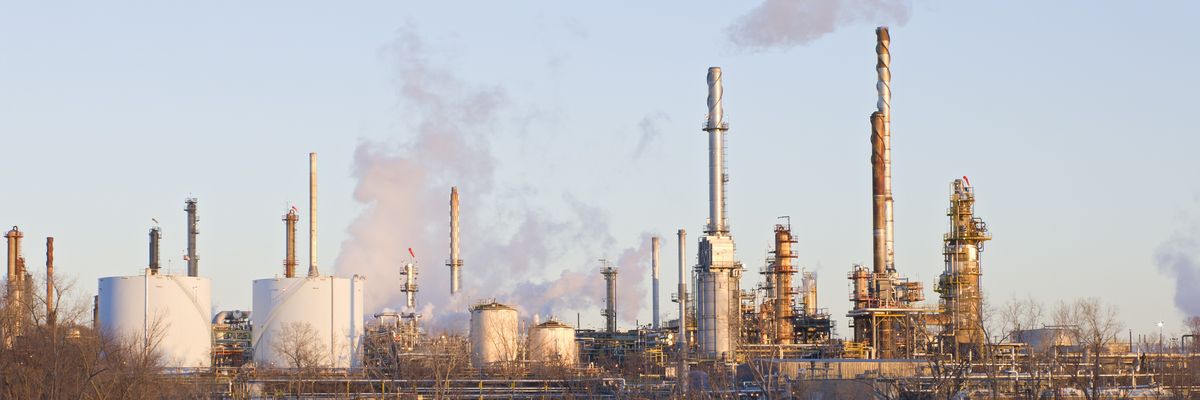
Two-thirds of U.S. voters surveyed by Data for Progress support making fossil fuel companies pay for the damage their products cause to the climate. (Photo: rmitsch/Getty Images)
“Voters resoundingly endorse fossil fuel companies contributing their fair share to address a crisis they helped manufacture and still refuse to help fix,” said one campaigner.
As yet another United Nations Climate Change Conference winds down without a meaningful agreement on phasing out fossil fuels, polling released Tuesday by Data for Progress revealed strong bipartisan support among U.S. voters for legislation forcing oil and gas companies to pay for their role in fueling the planetary emergency.
The survey of 1,279 U.S. voters, conducted November 3-6, found that around two-thirds of all likely voters support such legislation, a +40-point net margin. Among Democrats, support for the proposed bill is 88%, while 61% of Independent and 46% of Republicans either strongly or somewhat back the proposal.
“In a resounding call for accountability, two-thirds of the American people support legislation demanding industry titans like Exxon and Shell shoulder their fair share of the climate damages inflicted by fossil fuels.”
Asked if they were more or less likely to support elected officials who prioritize making Big Oil pay for its climate pollution, 64% of overall respondents, 89% of Democrats, and 58% of Independents answered “more likely.” Republicans were the only group whose members were less likely to back officials who would make oil and gas companies pay for their pollution.
“In a resounding call for accountability, two-thirds of the American people support legislation demanding industry titans like Exxon and Shell shoulder their fair share of the climate damages inflicted by fossil fuels,” Fossil Free Media communications director Cassidy DiPaola said in a statement.
“With COP spotlighting the towering price tag of climate change, voters resoundingly endorse fossil fuel companies contributing their fair share to address a crisis they helped manufacture and still refuse to help fix,” she added, referencing the U.N. summit.
The poll follows the September launch of the “Make Polluters Pay” campaign, a public relations blitz meant to drum up public support for suing fossil fuel corporations—which knew that their products caused climate change decades before publicly saying so.
That month, California joined dozens of states and municipalities that have targeted fossil fuel giants in court,suing five fossil fuel giants—ExxonMobil, Shell, BP, ConocoPhillips, and Chevron—over their decadeslong effort to deceive the public about their products’ role in fueling global heating.
The new survey’s findings also came as so-called “loss and damage”—the harm caused by anthropogenic climate change—features prominently at COP28. However, climate campaigners were once again disappointed as the United States and other top polluters failed to make meaningful contributions to the fund.
The rich nations most responsible for the climate catastrophe pledged just $700 million between them, the equivalent of under 0.2% of the irreversible losses Global South countries suffer each year during the worsening planetary crisis. The United States pledged a paltry $17.5 million.
“Every year, we travel across oceans to come to these negotiations and we continue to get only drops of ambition,” Drue Slatter, a Fijian climate campaigner attending COP28, wrote in an opinion piece published Tuesday by Common Dreams.
“Facing the catastrophic effects of extreme weather at home and watching the slow progress of the negotiations, it was hard not to be pessimistic before we even arrived at COP28,” Slatter added. “But the point is that we can’t afford not to be here, we can’t afford to stop fighting because what’s at stake is our very survival.”
Scientists protest at UK Parliament 5 September 2023.
In response to the final agreement at the COP28 UN climate talks in Dubai, Romain Ioualalen, Global Policy Manager at Oil Change International, said:
“People power put a full, fast, fair, and funded fossil fuel phaseout at the top of the UN agenda. While we didn’t get there, we secured the first UN climate agreement that calls on all countries to ‘transition away from fossil fuels,’ sending an unprecedented signal to the fossil fuel industry that its days are numbered. This progress has only been achieved by decades of struggle by frontline communities, Indigenous Peoples, and the most affected countries.
“This agreement does not deliver the full, fast, fair, funded phaseout of fossil fuels that global communities urgently demand for a just energy transition. Rich countries must pay their fair share to enable the transition from fossil fuels to renewable energy in the Global South.
“Disgracefully, the agreement is littered with loopholes, leaving escape hatches for the fossil fuel industry that could undermine the transition away from fossil fuels. This risks giving big polluters a free pass to continue extraction at a time when swift and coordinated action is desperately needed. This can only lead to climate and economic chaos.
“But this doesn’t take away from the fact that people power across the world has forced leaders to finally accept that we must move away from fossil fuels if we are to have a livable future. We will keep holding firm — at COP, in the streets, and wherever fossil fuels and the climate crisis threaten communities and the planet — until we have a full, fast, fair, funded, phaseout of all fossil fuels.“
“Climate Crisis” only identifies the symptoms of oil and gas dependence. As time runs out, we need a term that focuses on what — and who — is to blame.
This article by Capital & Main is published here as part of the global journalism collaboration Covering Climate Now.
There’s always a lag between a rupture of the status quo and settling on a word for it. The planet is heating at a life-threatening pace. And yet the two words we use to describe this rupture — “climate” and “change” — are beginning to seem too stiff and one-dimensional for conveying the violence to life-sustaining ecosystems that threaten the world as we have known it.
As delegates from 196 countries attempt, for the 28th time, to reach a global agreement to reduce greenhouse gases, it is time for a new language. The violence of the atmospheric shifts, their deeply uneven impacts and the implications of mass extinctions that are expected at current emission levels, add up to much more than “climate change.” The 28th United Nations Conference of the Parties (COP28) in the United Arab Emirates is being held in a region much of which could, according to current climate modeling, be uninhabitable by mid-century. It is time to more sharply focus the attention on those responsible for the violence of the changes underway.
Linguistic theory holds that words enable us to imagine a thing; it’s the words that come first. First there was the “greenhouse effect” — a phenomenon identified as early as 1856 by a largely unheralded woman scientist, Eunice Foote, who reported at the time that glass jars filled with air laced with carbon dioxide heated up much quicker than air without it. More than a century later, at a 1988 congressional hearing, James Hansen, then director of NASA’s Institute for Space Studies, would testify about the links between rising temperatures on Earth and rising CO2 levels in the atmosphere, and point the finger at those responsible: humans. The term “global warming” stuck. Over the 170 years since Foote’s discovery, the concentration of CO2 in the atmosphere has leapt from 290 parts per million to more than 400 ppm today.
By the early 21st century, the effects of all that extra CO2 began to be widely felt. Scientists came to recognize that “warming” sets off a cascade of changes — from shifts in rainfall patterns to volatile swings between rain and drought, and heat and cold, as well as major disruptions to the flow of ocean currents. “Climate change” seemed to encompass more possibilities for derangements of the global ecosystem. And that term is rapidly being outrun by the speed of the changes.
“Climate emergency” was chosen as the Oxford English Dictionary’s “Word of the Year’’ in 2019. That was two years after the Guardianled the world’s newspapers in adopting the term “climate crisis,” to be used interchangeably with “emergency.” The Guardian was far ahead of the curve in evoking the urgency of reporting on the scale of disruptions triggered by greenhouse gases. That tonal change drove home the point that this was not merely a phenomenon to be described, but a tectonic shift demanding ongoing reporting. Nothing, however, can stay ahead of the curve for long; soon enough the curve curves. It’s time for journalists, and everyone else, to consider some additional words and subordinate clauses that evoke the violence of the changes in the present, and identify those accountable for the upending of the status quo now underway in full throttle.
We are living in the climate warp. Yet it is admittedly difficult to clarify in a word or a phrase the vast scope of impacts, which range from the epic to the highly specific. Climate-induced drought was one of the triggers to the Syrian civil war and also fuels the current battle between California and its neighbors over access to the Colorado River. It is helping drive the decimation of farmer livelihoods that is leading to the crush of new immigrants on America’s and Europe’s borders. It contributed to the record-breaking heat that caused the untimely death of a Taylor Swift fan in Rio de Janeiro. Such conflicts and record-breakers are happening hourly somewhere in the world.
“Climate change” describes only the result of fossil fuel-based greenhouse gases. A term like “fossil fueled-destruction” would name the cause as well as the effect.
There are two tools now available to journalists to more clearly show who can be held accountable for the devastating impacts of the changing climate. Major advances in the attribution sciences provide ever-more sensitive understanding of how the overheated atmosphere is disrupting conditions here on Earth. And, critically, ever more precise research into the history of greenhouse gas emissions establishes who can be held accountable.
During this last season of record-breaking summer and fall temperatures, one meteorologist suggested naming the heat waves after those responsible, as in, the “Amoco heatwave,” or the “Exxon hurricane” or the “Chevron drought.” While droughts have been in California’s backbeat for as long as there are historical records, Chevron’s global emissions of some 725 million tons of greenhouse gases including CO2 in 2022 directly contribute to their increasing breadth and duration, as they do to increasing water scarcity pressures in other parts of the world. (The company’s “offsets” of those emissions were found recently to be “mostly junk.”)
We know who is responsible for the overwhelming share of greenhouse gas emissions, and thus for the massive chaos being wrought. They are not hidden behind tax shelters or front companies. They are polluting in plain sight. A new language might incorporate that knowledge: At least one of the 90 companies responsible for practically all greenhouse gas emissions since 1850 is operating a refinery near you, or distributing its greenhouse gas emitting products at a gas station, seaport or airport in the neighborhood.
Cognitive Dissonance Ahead
We consumers also bear some responsibility; we’ve been driving around in those gas-powered cars since James Hansen delivered the news 25 years ago. But we’ve also been driving through a fog of disinformation. The fossil fuel industry hid for decades what it knew about the impacts of its products. Those “deceptions,” California alleges in a historic lawsuit against the top five oil companies in the state, “caused a delayed societal response to global warming. And their misconduct has resulted in tremendous costs to people, property, and natural resources, which continue to unfold each day.”
A recent study of the four largest U.S. and European oil companies (ExxonMobil and Chevron, BP and Shell) in the science journal PLOS One found a widening gap between what they say they are doing in response to the climate crisis and what they continue to do to cause it. The study concludes with a classic of scientific understatement: “[T]he magnitude of investments and actions does not match the discourse.” In the climate lexicon, it is hard to beat the term “greenwashing,” which is no doubt on abundant display in Dubai. But that study and countless others like it are a warning shot for journalists and the public to cast a wary eye on fossil fuel companies’ claim that they are working towards the “energy transition” away from the old dinosaur bones they’ve been mining that are polluting the world.
While COP28 in Dubai is awash in fossil fuel lobbyists, it has also established the world’s first “loss and damage” fund, and will likely be coming up with some actual money to assist the 90% of the world’s population that did not produce the greenhouse gas emissions but are suffering their consequences. A new word may also soon enter the popular lexicon, if it’s not there already: “incremental.” Which may not be revolutionary, but also has real impacts. Every incremental reduction in greenhouse gases, or incremental increase in funding, could mean the difference between a coastal community being inundated or not, of another year saved from a 10th of a degree Celsius increase, of another year spent on a sub-Saharan grassland before it turns to desert. Such increments are the new climate currency.
And for those of us in the fortunate climes, it means more fall seasons that feel like spring, more 65 Fahrenheit winters that should no longer be termed “unseasonably warm.” The writer Stevie Chedid calls it “warning weather.” A disquieting warning in the humid warming air.
A DeSmog review of 12 large-scale projects reveals a litany of cost-overruns and missed targets, with a net increase in emissions.
Most of the 12 largest carbon capture and storage projects around the world are in the United States. Credit: Sabrina Bedford.
Carbon capture and storage (CCS) was high on the agenda at New York Climate Week last week, where critics of the technology raised concerns it would be used to extend the life of the fossil fuel industry.
For years, experts have pointed out that CCS has been primarily used to pump more oil out of the earth, using a process known as enhanced oil recovery (EOR). Burning that oil emits far more carbon dioxide (CO2) than what is captured, and therefore CCS doesn’t represent a viable solution to tackle climate change, critics argue.
At a news conference after the one-day UN Climate Ambition Summit on September 20, Tzeporah Berman, chair of the Fossil Fuel Nonproliferation Treaty Initiative, said: “The oil companies acknowledged this year that they will not meet their bogus net zero commitments. The data showed us that their carbon capture plans are not working at scale.”
Below is a DeSmog review of the climate impact of 12 large-scale CCS projects around the world; what the fossil fuel industry promised, and what actually happened. Findings include a litany of missed carbon capture targets; cost-overruns, and billions of dollars of costs to taxpayers in the form of subsidies.
The data is drawn from various sources, including the Global CCS Institute; the International Energy Agency; the Institute for Energy Economics and Financial Analysis; the Geoengineering Monitor, and DeSmog research. Data on subsidies was provided by Oil Change International, which plans to launch a database of government support for CCS in 2024. Currency conversions were made in respect to exchange rates when subsidies were first announced or given.
1. Terrell Natural Gas Processing Plant (“Val Verde”)
Operator: Occidental Petroleum, 1972-present
Location: Southeast of Ft. Stockton, Texas, USA
Stated maximum capacity: 0.5 million tonnes of CO2/year
Storage method: Enhanced oil recovery in the Permian Basin
Public subsidies: None
What they said would happen: More crude oil would be extracted using injected CO2.
What actually happened: It worked.Val Verde’s success served as a replicable model enabling the oil industry to pump more oil while claiming to be helping the climate.
Background: The world’s first industrial carbon capture facility began siphoning CO2 from a complex of West Texas gas processing plants in 1972. The gas was then piped across the region to boost the productivity of oil wells. Now owned by Occidental Petroleum and re-named the Terrell Natural Gas Processing Plant, the facility has aided in the production of millions of additional barrels of crude.
Val Verde’s success helped the oil and gas sector develop a business model enabling them to profit long into the future. It simultaneously acted as a potential solution to the worsening greenhouse gas crisis, while still remaining the biggest source of that pollution.
The first dedicated facility to use injected CO2 to produce more oil, Val Verde was instrumental in pioneering enhanced oil recovery (EOR). The technique proved so successful that within a decade drillers had built thousands of miles of dedicated pipelines sending naturally occurring CO2 into oil fields in Texas, elsewhere in the U.S., and eventually other nations.
Based upon Val Verde, since the 1970s, U.S. oil firms have led in the development of ever more efficient EOR-CCS technologies. Though now practiced globally, Texas’ Permian has the largest concentration of EOR operations.
As awareness grew that burning fossil fuels was increasingly harmful to the environment, petroleum scientists began looking for industry-friendly solutions. Given that a fraction of the CO2 injected during EOR remains underground, as early as 1977 proponents suggested rebranding EOR into climate-friendlier carbon capture and sequestration (CCS). Envisioning installing capture units on fossil fuel-burning generation plants, particularly coal-fired power stations, backers saw this as an elegant response to growing concerns over carbon emissions.
Fifty years later, Val Verde still serves as the industry’s model for “beneficial” CO2 usage, and EOR remains the main driver and successful business model for CCS.
2. Shute Creek Treating Facility
Operator: ExxonMobil, 1986-present
Location: East of Kemmerer, Wyoming, USA
Stated maximum capacity: 7 million tonnes of CO2/year
Storage methods: Enhanced oil recovery in Wyoming and neighboring states, limited geologic storage.
Public subsidies: None
What they said would happen: ExxonMobil points to Shute Creek to demonstrate its commitment to capturing ever more carbon.
What actually happened: Almost half the captured CO2 has been used to pump more oil; the rest has simply been vented into the atmosphere, in part because the plant failed to meet about a third of its capture targets.
Background: Owner ExxonMobil claims to have “cumulatively captured more anthropogenic CO2 than any other company” and estimates that its Shute Creek plant is responsible for 20 percent of the world’s yearly sequestered carbon. However, the plant — at Wyoming’s LaBarge gas field — wasn’t designed with climate targets in mind, but rather to produce gas, oil, and a fifth of the world’s helium supply.
Most of the C02 captured in CCS plants are used to pump more oil. Credit: Buchsbaum Media.
Wyoming’s LaBarge gas field remained unexploited for decades due to its very high levels of CO2, making it a less than ideal source for natural gas production. Nonetheless, in the 1980s Exxon found that capturing carbon during gas processing and selling it for enhanced oil recovery in the surrounding region would make the Shute Creek operation profitable. As global oil prices fluctuated over the following years, carbon capture was paused at the plant during periods when CO2 demand for oil extraction dropped.
According to a report from the Institute for Energy Economics and Financial Analysis (IEFFA), a nonprofit think tank, 47 percent of all CO2 captured by the plant has been sold for enhanced oil recovery over its lifetime, with only three percent of CO2 sequestered. The remaining 50 percent of CO2 produced by the plant — 120 million tonnes — has simply been vented to the atmosphere, making it a major source of greenhouse gas emissions. While some of this venting was planned, the plant has failed to meet about a third of its total carbon capture targets throughout its history, according to IEEFA.
3. Sleipner and Snøhvit Projects
Operator: Equinor (Statoil),1996-present; Snøhvit since 2008
Location: Offshore (North Sea Sleipner West field), Norway
Stated maximum capacity: Sleipner 1 million tonnes of CO2/year
Stated maximum capacity: Snøhvit 0.7 million tonnes of CO2/year
Storage methods: Geologic storage in the North Sea
Public subsidies: $175,000
What they said would happen: Often cited as evidence that the oil industry has already perfected carbon capture and storage techniques.
What actually happened: Studies suggest the projects’ CO2 storage modeling is faulty, underscoring concerns that CO2 behavior remains highly unpredictable.
Background: The world’s first industrial-scale CCS project constructed for supposed carbon emissions abatement, Sleipner went into operation in 1996 after Norway’s pioneering carbon taxes came into effect.
Given the relatively high CO2 volume contained within raw gas from the Sleipner West field, to ensure profitability under the new carbon taxes it became necessary to bury the gas. Storing this waste product underground continues to save Equinor hundreds of millions in annual taxes.
In near continuous operation since the mid-90s, and the largest CCS project yet conceived in the North Sea and Europe, Sleipner has a capacity to sequester almost a million tonnes of CO2 annually.
However, stripping out and pumping all this CO2 back underground doesn’t render the refined gas as carbon neutral. Just the opposite: By some estimates, burning it has created roughly 25 times more CO2 than all that Equinor has sequestered.
Envisioned as a model enabling long-term oil and gas exploration despite emissions, since conception Sleipner has served as an international center of learning and a laboratory for generations of petroleum engineers. The knowledge gained continues to help Equinor and partners such as ExxonMobil expand and implement more CCS and EOR projects worldwide.
However, though Sleipner was used as a guide for the 2009 EU directive on geological storage of carbon dioxide — now being reviewed to enable expanded CO2 storage and usage, IEEFA studies based on Norwegian reporting reveals evidence that both Sleipner and Snøhvit’sCO2 storage modeling is faulty, showcasing how CO2 behavior remains highly unpredictable, with potentially disastrous consequences.
4. Kemper Project
Operator: Mississippi Power (Southern Energy Company), 2010-2021 (closed; renamed Plant Ratcliffe)
Location: North of Meridian, Mississippi, USA
Stated maximum capacity during operations: 3 million tonnes of CO2/year
Storage method: Enhanced oil recovery in the Gulf of Mexico
Public subsidies: $407 million
What they said would happen: Coal would be burned “cleanly” to produce power.
What actually happened: Costs more than doubled from initial estimates to $7.5 billion; leaks were found during testing and the carbon capture plant was eventually mothballed, then demolished.
Background: As climate policies began to call for a coal power phase-out in the early 2000s, carbon capture became a means to keep the coal industry alive in a “cleaner” form. Building upon a Bush Administration program, in 2008, the Kemper CCS facility was proposed as the flagship project of the U.S. government’s Clean Coal Power Initiative, receiving $407 million in federal subsidies. The plant, operated by Southern Energy company, was designed to gasify lignite (brown coal) and capture the carbon before combustion.
However, the plant never reached its target of capturing 65 percent of its carbon emissions, which would have amounted to 3.0 million tonnes of CO2 per year. First, construction was delayed, and the initially estimated cost of $3 billion ballooned to $7.5 billion. Despite this massive increase in investment, the project’s coal gasification process did not operate reliably during testing as leaks were discovered.
In 2017, carbon capture operations were suspended as ongoing problems made the venture unprofitable. In 2021, the mothballed carbon capture unit was demolished. Today, the remaining Kemper power plant simply burns fossil gas, and “clean coal” remains an expensive and unproven emissions-reduction measure worldwide.
5. Century Gas Processing Plant
Operator: Occidental Petroleum, 2010-present
Location: East of Fort Stockton, Texas, USA
Stated maximum capacity: 8.4 million tonnes of CO2/year
Note: The industry-backed Global CCS Institute says five million tonnes of CO2/ year, which was the plant’s actual operating capacity in 2022.
Storage method: Enhanced oil recovery
Public subsidies: None
What they said would happen: The project will help usher in a new era of “net-zero oil.”
What’s actually happening: The plant could enable the development of approximately 500 million barrels of oil reserves more cheaply.
Background: With 25,000 miles of CO2 pipelines; 6,000 carbon injection wells spread over 1.4 million acres; and over 50 years of experience, Occidental Petroleum is perhaps the global leader in enhanced oil recovery.
Boasting a capacity of over eight million tonnes of CO2 per year following a 2012 expansion, the $1.1 billion Century Gas Processing Plant in West Texas has the most storage potential in the U.S., though only about 60 percent of this was used last year, according to the Global CCS Institute.
Despite its ambitions to expand its oil operations — Occidental Petroleum claims that its CO2-enhanced oil recovery could release the energy equivalent of two billion barrels of oil – the company is billing itself as a climate leader. Citing its “vast legacy” and core competency of CO2-enhanced oil recovery operations, the company says that using new technologies to capture carbon capture could be a “game changer” for the climate. Last year, Occidental started selling its first “Net Zero” oil to a Singapore-based commodities trader, based on direct air capture capacity yet to be installed, and earlier this year it began pre-selling carbon credits based on its eventual “low carbon” jet fuel to Airbus.
The legacy of EOR-linked facilities, including the Century Gas Processing Plant, has so far been a net increase in global emissions. Various sources show that the oil and gas operations in the Permian Basin, where the plant is located, is the largest “climate bomb” in North America, and one of the world’s leading contributors to climate change.
According to the Massachusetts Institute of Technology’s research entry on the Century Gas Processing Plant, it allows Occidental Petroleum to “develop approximately 500 million barrels of reserves from currently owned assets at an attractive cost.”
6. Petra Nova
Operator: Previously NRG Energy in partnership with JX Nippon Oil, 2017-2020; shut down in 2020 and now wholly only owned by JX Nippon, restarted September 2023
Location: Attached to one unit at the WA Parish Power Plant, Richmond, Texas, USA
Stated maximum capacity during operations: 1.4 million tonnes of CO2/year
Storage method: Enhanced oil recovery in the West Ranch oil field
Public subsidies: $190 million
What they said would happen: Game-changing solution to fossil emissions.
What actually happened: Failed to meet capture targets; barely reduced overall carbon pollution.
Background: Petra Nova restarted just this September, two years after it was shut down in the early days of the COVID-19 pandemic when the price of West Texas crude oil crashed. The only CCS unit attached to a coal-fired power plant in the United States, during its first short operating period it proved adept at EOR. However, independent analyses reveal that it both failed to meet its capture targets and, when taking lifecycle emissions into consideration, it barely reduced any overall carbon pollution.
Hailed as a game-changing solution to rising greenhouse emissions from the fossil fuel industry, co-owners NRG Energy and Japan’s JX Nippon promised at the time that Petra Nova would revolutionize the sector and rescue the future of fossil fuel electricity generation.
The $1 billion project (including a $190 million U.S. Department of Energy grant under the Clean Coal Initiative and a $250 million loan from the Japanese government) is attached to one 654 megawatt coal-unit of the monster NRG-owned W.A. Parish power facility near Houston, Texas.
Ranked in 2019 as the ninth most carbon-emitting power plant in the U.S., Parish’s combined eight coal and fossil gas units annually belch over 15.1 million tonnes of CO2 into the atmosphere.
After capture and compression, CO2 is piped over 80 miles away to the West Ranch oil field for EOR. Before Petra Nova came online, only a measly 300 barrels a day were oozing from the field. But during Petra Nova’s first year of operations, that figure jumped to 4,000 a day. As pressure built, production soared by a factor of 50 to over 15,000 barrels per day.
But when West Texas oil prices crashed at the end of March 2020, capturing and sequestering CO2 for EOR stopped making economic sense, and its owners mothballed the plant until oil markets improved.
As to whether Petra Nova itself was actually capturing at 90 percent as project-backers claim, IEEFA’s research shows it rarely captured as much as 75 percent of passing CO2. Officially the U.S. Department of Energy states it captured only approximately 3.9 million short tons of CO2 during its first three years, shy of the 4.6 million tons developers had expected.
The Petra Nova CCS plant just restarted in September. Credit: NDLA, CC BY-NC-ND 2.0
Sole owner JX Nippon Oil & Gas Exploration Corp., Japan’s largest oil producer, proudly states that the restarted project will simultaneously achieve a dramatic increase in production from aging oil fields as well as cut atmospheric CO2 emissions in Texas.
Continuing to masquerade as a climate-benefitting project, with oil prices currently inching towards $100 per barrel, the finances of running Petra Nova once again make sense. Going forward, EOR operations will again pay for CCS system operations while extending another chance to demonstrate how the technology can be viable at scale in what many see as a major test of efforts to sequester CO2 and store it permanently underground.
That Petra Nova did virtually nothing previously to actually reduce overall CO2 emissions — more likely increasing them, is not seen as a bug, but a feature given that its sole purpose is to capture a portion of the plant’s pollution in order to produce more oil — a task it has demonstrably excelled in doing.
Location: Barrow Island, Western Australia, Australia
Stated maximum capacity during operations: 4 million tonnes of CO2/year
Public subsidies: $60 million Australian ($47 million U.S.)
What they said would happen: A flagship plant to store CO2 produced by drilling for offshore gas.
What actually happened: Project started years after drilling began; plagued by technical problems that meant it captured less than a quarter of what was promised.
Background: Chevron and its partners were allowed to build the $5.5 billion Gorgon LNG plant on the Barrow Island nature reserve for one reason only: to bury millions of tonnes of produced CO2 from offshore gas reservoirs into a formation deep under the island.
Although Gorgon’s gas plant produced its first LNG cargo in March 2016, the first CO2 injection didn’t begin until August 2019 — three and a half years behind schedule. And since then it’s only sequestered, on average, less than 1 million tonnes per year.
With barely a day going by when all elements of Gorgon’s CO2 injection system worked at the same time, a 2022 report by IEEFA found that Gorgon had missed its storage and emissions targets by some 50 percent during its first five years of operation.
With CO2 leaking out of Gorgon’s assigned CO2 storage reservoir, in December 2020, regulators cut the permitted injection rate to 30 percent of maximum capacity until Chevron could fix its pressure management system without fracturing the rock around the injection wells and permanently damaging the system’s performance.
According to Australian and other publications: Gorgon failed to bury 9.5 million tonnes of carbon dioxide in its first five years of operations. In response to the shortfall, in 2021 Chevron announced it would buy 5.23 million tonnes of carbon offsets (many of which have subsequently proven to be junk).
By all accounts Chevron continues to fall even further behind on its CO2 capture and storage targets, but the fossil fuel behemoth is being less than open about by how much.
What is certain is that Chevron’s gas refining has produced tremendous volumes of CO2 — little if any of which have been “sequestered”.
Nevertheless, the Australian government has since approved two new massive offshore greenhouse gas storage areas, saying CCS “has a vital role to play” to help the country meet its net zero targets.
Stated maximum capacity during operations: 0.8 million tonnes of CO2/year
Storage method: Enhanced oil recovery
Public subsidies: N/A
What they said would happen: Asteel plant would be made climate-friendly.
What actually happened: The captured CO2 was used to pump more oil.
Background: The world’s only large-scale facility to capture emissions from steel production, the project promises to store up to 90 percent of all CO2 originating from the Emirates Steel plant near Abu Dhabi. From there, a pipeline carries the compressed gas to onshore oil fields, where it is used for enhanced oil recovery. The plant follows a trend of focusing carbon capture technology on “hard-to-abate” emissions from industrial sectors such as steel, cement and chemical production.
“The success of this project will definitely be a catalyst for similar projects in the UAE and across the region,” said ADNOC head Sultan Ahmed Al Jaber, during a video interview promoting the project in 2014. Since the construction of the Al Reyadah Project, the UAE has announced new projects which would increase the country’s carbon capture capacity by over five times. ADNOC states that it will invest $15 billion in “low-carbon solutions,” with a heavy focus on CO2-enhanced oil recovery.
ADNOC’s plans are helping to drive a CO2-enhanced oil recovery boom on the Arabian Peninsula. In 2019, Qatar announced a large-scale project to capture CO2 from liquified natural gas refining and storing it in geologic formations, but which has also been linked to eventual use for oil extraction. Neighboring Saudi Arabia built its first carbon capture plant in 2015 to extract oil from declining oil wells, and declared last year that a new carbon capture facility planned to start operations in 2027 would become the world’s largest, eventually aiming to capture 44 million tonnes of carbon dioxide per year by 2035.
9. Boundary Dam
Operator: Saskatchewan Power, 2014-present
Location: Estevan, Saskatchewan, Canada
Stated maximum capacity during operations: 1 million tonnes of CO2/year
Storage method: Enhanced oil recovery in the Weyburn oil field (90 percent), geologic storage (10 percent)
Public subsidies: $240 million Canadian ($217 million U.S.)
What they said would happen: A world-leading “clean coal” facility.
What actually happened: Consistent failure to hit capture targets; captured CO2 used to pump more oil.
Background: When a carbon capture unit was attached to an aging section of a lignite-burning power station in Canada, expectations were high that the plant would become a world-leading “clean coal facility.” To fund the construction, the Canadian government gave $240 million CAD for the carbon capture venture. The plant would also solve the problem posed by a Canadian law passed in 2012, which mandated that all 50-year and older coal power stations be shut down unless they had a carbon capture retrofit. In the case of the targeted Boundary Dam unit, its operating life would have expired by 2019.
Rather than meeting its yearly target of one million tonnes of CO2 captured per year, the plant has consistently underperformed. By the company’s own accounting, the plant is on track to capture 750,000 tonnes of CO2 in 2023, matching similar results from 2022. In 2021, the carbon capture facility stored only about 442,000 tonnes, less than half of its intended annual capacity.
This follows a similar trend of underperformance since Boundary Dam started running in 2016, according to an analysis from IEEFA. The report authors identified the project as “struggling” and found that it had barely reached its targeted 90 percent storage target on “any single day.” Most CO2 that was captured was sent to the nearby Weyburn oil field for enhanced oil recovery.
10. Quest CCS
Operator: Shell PLC, 2015 – present
Location: Edmonton, Alberta, Canada
Stated maximum capacity during operations: 1.3 million tonnes of CO2/year
Storage method: Enhanced oil recovery
Public subsidies: $745 million Canadian ($654 million U.S.)
What they said would happen: Touted as a “thriving example” of oil industry success in reducing emissions.
What actually happened: Less than 50 percent of emissions captured, relative to 90 percent target; overall emissions offset the carbon captured.
Background: Designed to capture carbon emissions from Canadian Tar Sands operations and store them underground, Shell’s Quest plant is the world’s first to commercially produce so-called “blue hydrogen.” Blue hydrogen is the industry’s term for hydrogen produced by burning fossil gas through steam methane reformation. The process itself produces tremendous volumes of CO2 — hence the need to turn the hydrogen “blue” by burying the produced pollution underground.
With $654 million of the $1 billion cost of Quest coming from Canadian government subsidies, the plant’s operator, Shell, claimed it would help them reach its “net zero” target by 2050 while heralding the “exciting work” there to reduce emissions from industrial sources.
Though touted as a “thriving example” of how CCS is working to significantly reduce carbon emissions, a 2022 investigation by Global Witness showed that despite 5 million tonnes of CO2 capture from 2015 to 2021, Quest released a further 7.5 million tonnes of GHG over the same period, and that just 48 percent of the plant’s carbon emissions were being captured, far short of the 90 percent carbon capture rate promised.
Global Witness’ study found that the capture rate drops to only 39 percent when including other greenhouse gas emissions from Shell’s project.
11. Great Plains Synfuels Plant
Operator: (Basin Electric), 2000 -to present
Location: Near Beulah, North Dakota, USA
Stated maximum capacity during operations: 3 million tonnes of CO2/year
Storage method: Enhanced oil recovery in the Weyburn and Midvale oil fields
Public subsidies: $1.5 billion from the U.S. Department of Energy
What they said would happen: World’sbiggest project to capture carbon produced by burning coal.
What actually happened: The captured CO2 is being used to extend the life of oilfields in Canada by 25 years.
Background: Dakota Gasification Company’s Great Plains Synfuels Plant boasts that it captures more CO2 from coal conversion than any facility in the world.
Starting with 18,000 tonnes of regionally mined lignite, the dirtiest of all coals, the Great Plains Synfuels Plant cooks and converts the lignite into methane gas, which it then transforms into ammonia for fertilizer, as well as other chemical products, while stripping out produced CO2 for eventual use in enhanced oil recovery.
Since 2000, Great Plains Synfuels Plant remains the only CCS project to sell its CO2 cross border, compressing CO2 into a liquid and transporting it via a 320-kilometer pipeline to the Weyburn and Midale oil fields in Alberta. Each ton of injected CO2 increases oil production in Weyburn by almost three barrels.
CO2 enhanced oil recovery operation will enable an additional 130 million barrels of oil to be produced, extending the field’s commercial life by around 25 years.
Inside the Great Plains Synfuel Plant in 2009. Credit: Buchsbaum
One of the most Republican-leaning states in the U.S., where many consider climate change a hoax, North Dakota’s state government has been more than happy to take advantage of the Biden administration’s Inflation Reduction Act, given its tax credits for capturing and storing CO2 emissions.
Seeking to take advantage of those credits to increase revenue, North Dakota’s Industrial Commission recently unanimously approved a 32-square-mile expansion of the subterranean storage area for carbon from the synfuels plant.
Even though Great Plains sends 2 million tonnes of CO2 a year into the Weyburn Field for EOR, “there’s another 1.5 million potential of CO2 that’s produced at that plant today that’s not being captured, so they have the opportunity to capture that extra 1.5 million right there and get paid,” North Dakota Governor and State Industrial Commission Chair Doug Burgam has argued.
State Department of Mineral Resources Director Lynn Helms also said that more CO2 will be needed to sustain regional oil production for the long term. Calling for more CCS or CO2 pipelines, Helms lamented that current CO2 production only meets about 10 percent of what is needed for enhanced oil recovery.
“We’ve got to find a way for carbon capture and utilization to become a part of North Dakota’s economy or we will leave billions of barrels of oil in the ground,” Helms said in August.
12. Santos Basin Pre-Salt Oil Field CCS
Operator: Petrobras, 2012-present
Location: Atlantic Ocean (300 km west of Rio de Janeiro state), Brazil
Stated maximum capacity during operations: 10.6 million tonnes of CO2/year
Storage method: Enhanced oil recovery in the offshore Santos Basin
Public subsidies: N/A
What they said would happen: World’s biggest offshore CCS project would slash industry’s carbon footprint.
What actually happened: Successful use of captured CO2 to dramatically expand offshore oil production is triggering a new oil boom.
Background: Operating at over a hundred wells in Brazil’s vast ultra-deep water oil fields, Petrobras boasted the highest amount of CO2 stored in 2022, about a quarter of total human-built carbon sequestration capacity The first project of its kind globally, the company claims that offshore carbon capture has reduced the lifecycle carbon footprint of a barrel of oil by 39 percent. The CO2 used to extract oil in the Santos Basin comes from the natural gas also produced by the field, which is separated on specialized floating platforms, and repurposed for additional profit.
Petrobras’ experiment has paid off handsomely. CO2 injection has boosted productivity in the Santos Basin, even though it once was deemed a difficult area to extract oil due to hard-to-drill salt formations on the ocean floor. In 2022, Petrobras reinjected a world-leading 10.6 Mt of CO2 directing the gas to extract more oil, which will be refined, transported, and burned to emit more CO2 into the atmosphere. Recently, the company announced its new target of approximately 80 million metric tonnes of CO2 reinjection by 2025 in CCS projects.
Other major oil companies operating in the deep sea region might be taking notes, leading to an offshore oil boom in Brazil. These international firms include Norway’s Equinor, which aims to boost its Brazil-based oil production by more than fivefold over the next 10 years.
Additional reporting by Dana Drugmand in New York.
Synopsis by dizzy: Enhanced Oil Recovery rebranded as Carbon Capture and Storage as a public relations exercise.
As awareness grew that burning fossil fuels was increasingly harmful to the environment, petroleum scientists began looking for industry-friendly solutions. Given that a fraction of the CO2 injected during EOR remains underground, as early as 1977 proponents suggested rebranding EOR into climate-friendlier carbon capture and sequestration (CCS). Envisioning installing capture units on fossil fuel-burning generation plants, particularly coal-fired power stations, backers saw this as an elegant response to growing concerns over carbon emissions.
Business leader says government tax credit for oil and gas ‘extends the life of Canada’s largest industrial sector.’
The government of Alberta, home to the tar sands pictured here, has announced taxpayer funding in the range of $3.5 billion to $5.3 billion for CCS projects. Credit: (CC BY-NC-ND 2.0)
As world leaders meet in Dubai for the COP28 climate negotiations, federal and provincial governments in Canada are preparing to give an estimated $15.3 billion in new subsidies to oil and gas companies, and other heavy emitters, for expanding the production of fossil fuels, according to climate experts.
Those subsidies are taking the form of massive new tax credits for carbon capture and storage (CCS), which is a technology that companies use to grow their extraction of oil and gas while burying a fraction of their greenhouse gas emissions underground.
“I completely agree that Canada’s tax credit for carbon capture and storage is a subsidy to the oil and gas industry,” Jason MacLean, an adjunct professor who studies climate policy at the University of Saskatchewan, told DeSmog in an email.
The federal Canadian government is close to announcing details on a tax credit that will go to top oil and gas companies like Suncor, Cenovus, and Imperial Oil, along with other major industrial polluters. Policymakers previously estimated the value of these investment tax credits to be $10 billion. The government of Alberta, home to the tar sands, has meanwhile announced taxpayer funding in the range of $3.5 billion to $5.3 billion for CCS projects.
The Pathways Alliance, an industry lobbying and marketing group representing 95 percent of tar sands production, says these tax credits are essential for oil and gas producers to lower their emissions in line with achieving “net-zero emissions” by 2050. Reaching “net-zero” entails stabilizing global temperature rise at 1.5 degrees Celsius, a level beyond which scientists warn the impacts to humankind could be catastrophic.
Yet, in submissions to the federal government, the Pathways Alliance explained that lowering a portion of oil sands emissions via carbon capture will create opportunities for the industry to expand globally — even as other countries move away from fossil fuels. “We believe Canada should seek to increase its market share for responsibly produced, lower emissions energy, even if global market demand, as a whole, begins to decline,” the group said in one submission.
“We need to keep in mind that this is about reducing emissions and not reducing production,” the organization said last year in a separate submission, as revealed by DeSmog.
Representatives of the Pathways Alliance are among the 35 people with ties to the fossil fuel sector who are part of Canada’s official delegation to COP28 this year. At the climate talks, they are pushing for policies supporting global deployment of carbon capture, which will allow companies to keep producing oil as countries get stricter about regulating emissions.
“It is really important for the energy industry in Canada because it extends the life of Canada’s largest industrial sector and maintains our competitiveness over the long term,” Scott Crockatt of the Business Council of Alberta told the Calgary Herald last month.
However, tax credits supporting carbon capture risk accelerating already dangerous levels of global temperature rise, MacLean argues. Even if the technology can fully capture emissions from the production of oil and gas in Canada — which is an expensive and uncertain proposition — the vast majority of climate impacts occur when fossil fuels are burned in places like car and truck engines and house furnaces.
“No possible innovation or improvement to [carbon capture technology] can change the fact that it applies only to the direct and upstream greenhouse gas emissions arising from the production of oil and gas, not the downstream emissions resulting from the combustion of oil and gas, which represent approximately 85 percent of the total emissions,” MacLean told DeSmog.
Allowing oil and gas to expand while relying on carbon capture could result in the release of 86 billion additional tonnes of greenhouse gas emissions worldwide between 2020 and 2050, according to a new analysis from the organization Climate Analytics. This “86 billion tonne carbon bomb” could derail efforts to keep global warming from exceeding dangerous thresholds, the group argues.
The Canadian government earlier this year unveiled detailed plans to remove “inefficient” oil and gas subsidies, with Environment and Climate Minister Steven Guilbeault saying at the time that “the simple reality is that it’s no longer free to pollute in Canada.”
But climate campaigners say that promise risks being completely undermined by the new carbon capture tax credits.