Tag: fossil fuel industry

  • Extinction Rebellion scientists: why we glued ourselves to a government department

    Spread the love

    Charlie Gardner, University of Kent; Emily Cox, Cardiff University, and Stuart Capstick, Cardiff University

    One recent Wednesday, while most scientists around the world were carrying out their research, we stepped away from our day jobs to engage in a more direct form of communication.

    Along with more than 20 others from Scientists for Extinction Rebellion and assisted in our efforts by Doctors for Extinction Rebellion, we pasted scientific papers to the UK government’s Department of Business, Energy and Industrial Strategy (BEIS). A group of us glued ourselves to the building, and nine scientists were arrested.

    This kind of action may seem extreme for a scientist, but these are no ordinary times. As most members of the UK public now recognise, addressing the climate crisis requires drastic changes across society. In 2019, the UK parliament itself declared a climate emergency – and in an emergency, one must take urgent action.

    Seemingly endless academic papers and reports highlight the need for the immediate and rapid decarbonisation of the global economy if we are to avert climate change so serious that it risks the collapse of human civilisation. The International Energy Agency, a respected policy advisory body to countries around the world, warned in 2021 that “if governments are serious about the climate crisis, there can be no new investments in oil, gas and coal, from now – from this year”.

    Prime Minister Boris Johnson has stated that “it is time for us to listen to the warnings of the scientists” on the climate emergency. But despite this, the UK government is choosing not to wind down the fossil fuel industry, but instead to expand it.

    The government recently published its energy security strategy. However, rather than focusing on home insulation, energy efficiency and onshore wind as most experts suggest, the strategy promotes the expansion of oil and gas production.

    Such measures do very little to address the pressing issues of rising fuel bills or heavy imports of Russian oil and coal. And as a self-proclaimed leader in global climate action, the UK’s doubling down on fossil fuels also sends a dangerous message to the rest of the world.

    Evidence alone is easily ignored

    In a choice between fossil fuels and a liveable planet, the government has chosen oil and gas. For scientists who have dedicated their lives to research, this is hard to take. Many of us do our work in the belief that, if we provide scientific information to decision-makers, they will use it to make wise decisions in the public interest.

    Yet the global response to the climate crisis, despite decades of increasingly dire warnings, shows this to be naive. The reason is as simple as it is obvious: governments don’t respond to science on these matters, but to the corporate interests that invest so heavily in political donations and lobbying.

    Scientists must face a difficult truth that doesn’t come easily to those of us who are most comfortable working diligently on experiments and journal articles: evidence alone, even if expertly communicated, is very easily ignored by those that do not wish to hear it.

    If we are to help bring about the transition away from fossil fuels that the world so urgently needs, we are going to have to become much harder to ignore. This does not mean disregarding the evidence or abandoning our integrity: quite the opposite. We must treat the scientific warnings on the climate crisis with the seriousness that they deserve.

    Become hard to ignore

    History suggests that one of the most powerful ways to become hard to ignore – and one of the few options available to those who do not have deep pockets or the ear of politicians – may be through nonviolent civil disobedience, the refusal to obey certain laws in order to bring public and media attention to an unjust situation.

    From universal suffrage to civil rights for people of colour and action on the Aids pandemic, many of the most progressive social changes of the 20th century were brought about in this way. Many would likely agree that such actions are morally justified in a planetary emergency.

    The recent blossoming of environmental civil disobedience movements around the world, led by Extinction Rebellion and the Greta Thunberg-inspired youth strikes, has been hugely influential in changing the global conversation on climate. These movements have been linked to an unprecedented surge of public concern and awareness about the climate crisis.

    The scientists arrested on that Wednesday included an expert in energy policy, an air pollution specialist, three ecologists and two psychologists, across all career stages from junior researchers to established professors. Some work on the planetary crisis itself, others on our societal responses to it, but none of us took our actions lightly.

    Our understanding of our planetary peril obliges us to take action to sound the alarm, even if it means risking our civil liberties. And we are not alone. On April 6 more than 1,200 scientists in 26 countries participated in a global Scientist Rebellion, which included pasting scientific papers to the UK headquarters of oil giant Shell.

    Civil disobedience doesn’t always need a particular target to be effective, because the main objective is to ring the alarm by generating media and wider public attention. Extinction Rebellion protests, for example, has targeted fossil fuel infrastructure, media and finance institutions and airports used by private jets, in addition to the general disruption caused by roadblocks.

    But we went to BEIS because, as the government department responsible for climate change, it should be leading the transition away from fossil fuels. Instead, through enabling and promoting new fossil fuel extraction, it is doing the opposite.

    Recent acts of law-breaking by scientists may seem radical, but the world’s most senior diplomat disagrees. On the release of the IPCC’s latest report, the UN Secretary General António Guterres said: “Climate activists are sometimes depicted as dangerous radicals. But the truly dangerous radicals are the countries that are increasing the production of fossil fuels.”

    He could not have said it more clearly: while we scientists may have been breaking the law, it is the government that’s placing us all in danger.

    The Conversation

    Charlie Gardner, Associate Senior Lecturer, Durrell Institute for Conservation and Ecology, University of Kent; Emily Cox, Research Associate, Environmental Policy, Cardiff University, and Stuart Capstick, Senior Research Fellow in Psychology, Cardiff University

    This article is republished from The Conversation under a Creative Commons license. Read the original article.

  • As Biden Touts the IRA Anniversary, Here Are 5 Carbon Bombs He Leaves Out

    Spread the love
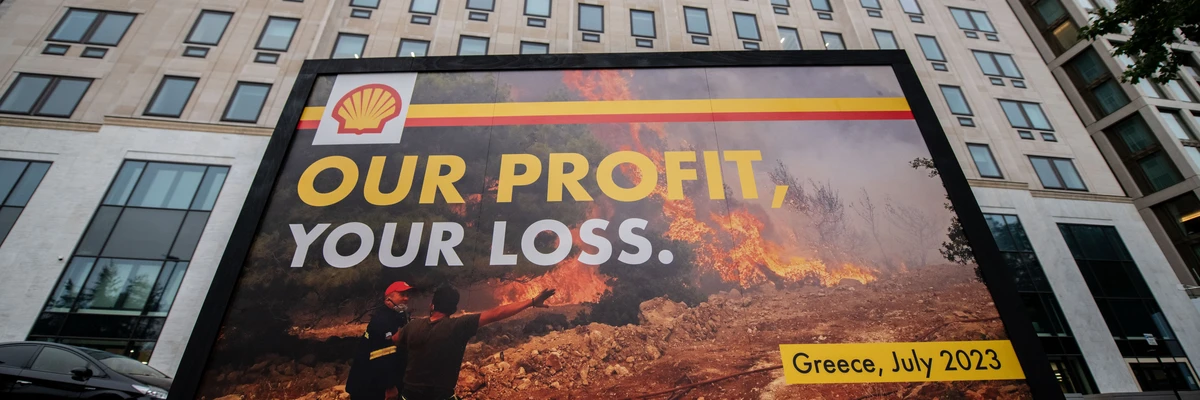
    Greenpeace activists display a billboard during a protest outside Shell headquarters on July 27, 2023 in London.
    Greenpeace activists display a billboard during a protest outside Shell headquarters on July 27, 2023 in London. (Photo: Handout/Chris J. Ratcliffe for Greenpeace via Getty Images)

    https://www.commondreams.org/opinion/biden-5-carbon-bombs

    Despite his big talk on climate, when it comes to fossil fuels, President Biden’s policies just build on previous expansion.

    A slew of White House actions are undermining efforts to address climate change, and under Biden, the country is producing more energy from fossil fuels than it did under former President Donald Trump.

    The science is clear: Building any new fossil fuel infrastructure is incompatible with a livable climate. Yet, while President Joe Biden touts the Inflation Reduction Act, or IRA, as the country’s biggest climate law ever, he’s glossing over all the ways his administration has advanced fossil fuels, including in the IRA.

    A slew of White House actions are undermining efforts to address climate change. And under Biden, the country is producing more energy from fossil fuels than it did under former President Donald Trump. In 2022, the U.S. broke its record for most fossil fuels produced in a year. Worse, it’s on track to break that record for 2023.

    We know that to stem the tide of climate chaos, we need to move off fossil fuels, period. Instead, the Biden administration has approved and supported several projects that will unleash carbon bombs on our climate and lock in decades of drilling, burning, and emitting.

    https://www.commondreams.org/opinion/biden-5-carbon-bombs

  • Spoof ads of Sunak shaking oil-soaked hand appear across London

    Spread the love

    https://morningstaronline.co.uk/article/b/spoof-ads-sunak-shaking-oil-soaked-hand-appear-across-london

    A spoof ad of Sunak shaking oil-soaked hand Photo: Fossil Free London

    PARODY adverts mocking Rishi Sunak for giving public money to oil giants have appeared across London’s bus stops.

    The Prime Minister is shown shaking an oil-soaked hand next to a Conservative logo with the words: “A helping hand for those in need: £3.75 billion public money to oil company Equinor if Rosebank oil field goes ahead.”

    The spoof ads have been spotted in Hackney, Southwark and Tower Hamlets so far, and come after Fossil Free London campaigners last week delivered giant gifts to the Norwegian embassy to represent the £3.75bn tax breaks developers of the North Sea’s Rosebank field could receive.

    Norway’s state-backed oil and gas giant Equinor would be among the firms set to profit while the taxpayer picks up almost all the costs of the development.

    Earlier this month Mr Sunak claimed a planned expansion of oil and gas drilling in the North Sea was “entirely consistent” with the government’s goal to reach net zero by 2050.

    https://morningstaronline.co.uk/article/b/spoof-ads-sunak-shaking-oil-soaked-hand-appear-across-london

  • The oil industry has succumbed to a dangerous new climate denialism

    Spread the love
    Opec predicts oil demand will be 10% higher by the 2040s.
    Iurii

    Adi Imsirovic, University of Surrey

    If we have not been warned of the dangers of climate change this summer, we never will be. Extreme heat, forest fires and floods have been all over news reports. Yet the oil and gas industry remains largely in denial.

    The International Energy Agency (IEA) says steep cuts in oil and gas production are necessary to reach the Paris (COP 21) goal of keeping global warming at 1.5℃. However, only a tiny fraction of the industry, accounting for less than 5% of oil and gas output, has targets aligned with the IEA’s “net zero” requirements.

    The current secretary general of production cartel Opec, Haitham al-Ghais, expects global oil demand to rise by about 10% to 110 million barrels a day by 2045, a volume incompatible with the Paris goals. The UK government has just offered a helping hand, granting around 100 new North Sea licences. What are we to make of this mismatch?

    The new denialism

    Typical of the new breed of climate denialism is a recent report by the Energy Policy Research Foundation (ERPF), a body funded by the US government and various undisclosed corporate interests and foundations. It sees the IEA’s requirements as a “seal of approval … to block investment in oil and gas production by western companies”. The report views meeting the targets as too costly, too harsh on poor countries and too bad for the energy security of the west.

    In fact, it is wrong on each account. Many eminent economists and scientists use the concept of the social cost of carbon (SCC), which is defined as the cost to society of releasing an additional tonne of CO₂. Expert estimates from 2019 put this at between US$171 and US$310 (£133 to £241). If we go with, say, US$240 per tonne, the social cost of continued carbon equivalent emissions comes out at almost US$8.5 trillion every year.

    A recent study has factored into the calculation climate feedback loops. This is where one problem caused by global warming leads to others, such as melting permafrost unleashing stores of methane.

    When the study estimated the economic damage that this could cause, it produced an SCC in excess of US$5,000. That implies annual costs of more like US$170 trillion a year, which makes the US$4 trillion investment into clean energy that the IEA thinks necessary to meet the Paris climate goals look like a drop in the ocean.

    It may help to break this down to one barrel of oil. A special IEA report for COP28 estimates that on average, each barrel of oil emits 0.53 tonnes of CO₂ equivalent in greenhouse gas across its life cycle, 20% of which comes from production.

    Going back to our average SSC per tonne of US$240, that points to a social cost of US$126 per barrel. With oil currently at US$85 per barrel, the societal damage from producing, transporting, refining and consuming it is far greater – and that’s before including climate feedbacks.

    Meanwhile, the arguments by the EPRF and like-minded supporters about energy security are laughable. The history of the oil and gas industry is a history of wars and geopolitical tensions. Transitioning to cleaner fuels can only increase our energy security and reduce the need to police remote autocracies.

    The argument that poor countries need to continue burning carbon for development reasons is no better. In its latest report from 2022, the Intergovernmental Panel on Climate Change (IPCC) said climate change would probably see an increase in “losses and damages, strongly concentrated among the poorest vulnerable populations”.

    Equally, the World Health Organization estimates that: “Between 2030 and 2050, climate change is expected to cause approximately 250,000 additional deaths per year from malnutrition, malaria, diarrhoea and heat stress.”

    How to respond

    The denialists offer no alternatives to cutting carbon emissions, and often simply ignore climate change altogether. The recent ERPF report mentions climate change only four times. It is as if heatwaves, forest fires, flooding, rising sea levels and the demise of natural habitat caused by climate inaction were happening on another planet.

    We still have time to limit global warming below 1.5℃. It is true that we will need oil and gas for many years, and that there are currently no alternatives for certain sectors such as air travel, shipping and some industries. Nonetheless, there is still much that can be done now to make a substantial difference.

    To incentivise the transition to cleaner energy, governments need to end fossil fuel subsidies, which the IMF estimates amounted to US$5.9 trillion in 2020 alone. We also need to put a proper price on carbon – only 40 countries have attempted this so far, and none has it anywhere near the estimated social cost of emitting carbon.

    Countries that resist charging their own polluters should face a carbon border adjustment mechanism, which is a tariff that effectively puts the polluter on the same footing as local players. If all the actors in the fossil fuel supply chain had to face the cost of the damage they cause, the need to phase out long-term investments in fossil fuels would become more obvious.

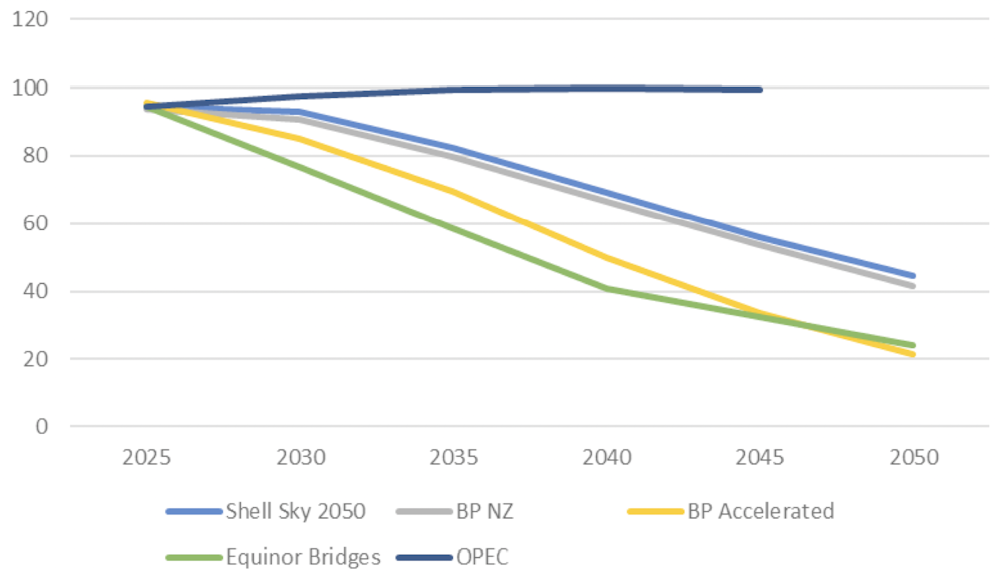
    The IEA requirements for “net zero” are just one of the pathways towards meeting the Paris goal of 1.5℃ warming. Others are explored by some of the more credible actors in the petroleum industry, such as Shell, BP and Norway’s Equinor, but all require a substantial decline in oil demand and production by 2050.

    Required production cuts

    Graph showing the required production cuts to meet net zero
    I left the IEA’s scenario off the graph because it published so few datapoints, but it is broadly in line with the others. Meanwhile, the Opec data is for reference and not a net zero scenario.
    BP, Shell, Equinor and Opec

    Instead of criticising efforts to slow climate change and sponsoring ridiculous reports calling for more fossil fuels, the oil industry should eliminate leakages, venting and flaring of methane, and electrify as many processes as possible using renewable power. It should also employ carbon capture, usage and storage technologies over the next ten years – yes this will increase the price of fossil fuels, but that is exactly what we need to make clean sources of energy competitive across the board and speed up the energy transition.

    The sooner the industry starts facing up to the realities of climate change, the more chance it has to survive. The companies and even countries that produce fossil fuels will have to face and pay the cost for the damage they cause. Those costs are already massive and will grow. Those that survive will do so only as a provider of clean and sustainable energy.


    Imagine weekly climate newsletter

    Don’t have time to read about climate change as much as you’d like?

    Get a weekly roundup in your inbox instead. Every Wednesday, The Conversation’s environment editor writes Imagine, a short email that goes a little deeper into just one climate issue. Join the 20,000+ readers who’ve subscribed so far.The Conversation


    Adi Imsirovic, Fellow, University of Surrey

    This article is republished from The Conversation under a Creative Commons license. Read the original article.

  • Climbers drape Sunak’s £2m mansion in oil-black fabric as PM commits to fossil fuel frenzy

    Climbers drape Sunak’s £2m mansion in oil-black fabric as PM commits to fossil fuel frenzy

    Spread the love

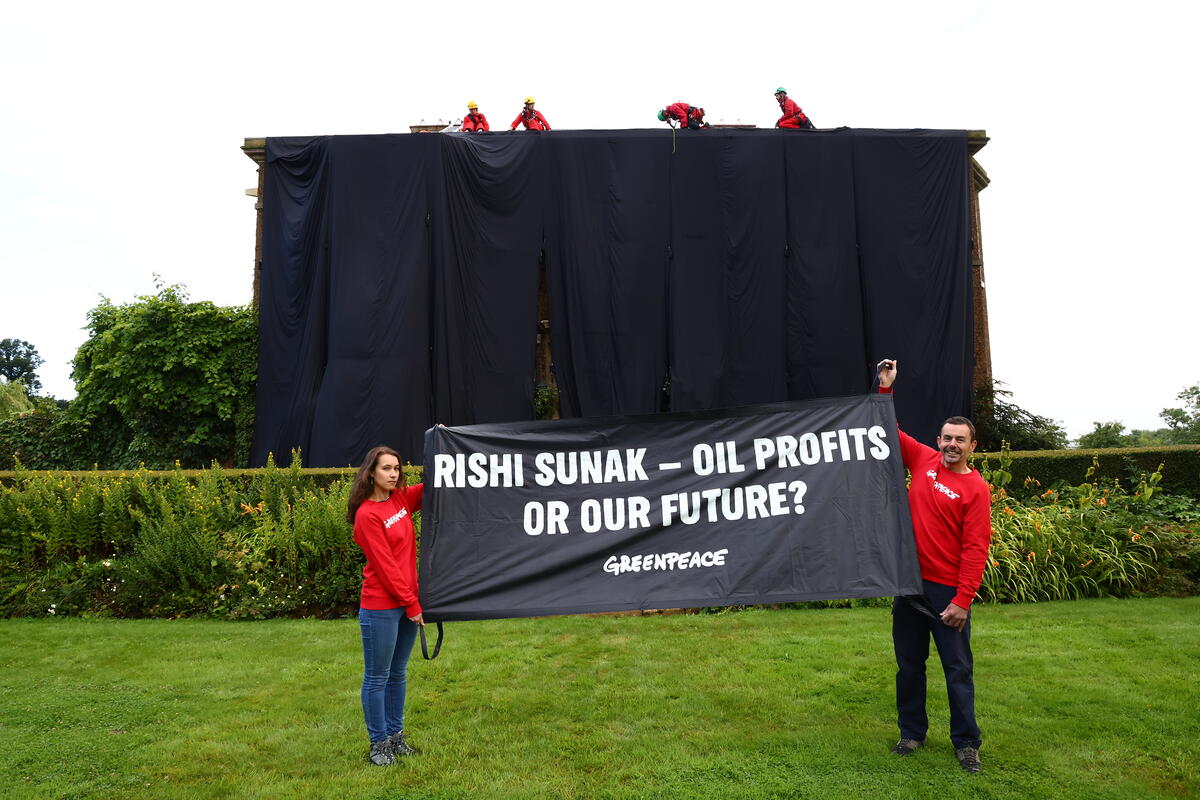
    Greenpeace activists have climbed onto the roof of Rishi Sunak’s £2m country mansion in protest at his backing for a major expansion of oil and gas drilling amid a climate crisis

    Four Greenpeace activists climbed onto the roof of the Prime Minister’s £2m manor house in Yorkshire earlier this morning in protest at his backing for a major expansion of North Sea oil and gas drilling amidst a summer of escalating climate impacts.

    After reaching the top of the building using ladders and climbing ropes, the activists unfolded 200 sq metres of oil-black fabric to cover a whole side of the luxury mansion. At the same time, two activists unfurled a banner emblazoned with the words “Rishi Sunak – Oil Profits or Our Future?” across the grass in front of the manor house. 

    Sunak’s government has come under heavy criticism for pushing ahead with plans to hand out around 100 new oil and gas licences in the North Sea, and even hinting at additional ones in future. He has also indicated that he will approve drilling at Rosebank – the UK’s largest undeveloped oil field. The controversial move flies in the face of multiple warnings from the government’s own climate advisers, the International Energy Agency and the UN Secretary General that any new fossil fuel projects risk tipping the world into the danger zone above 1.5C of warming. 

    The move, part of a series of climate policy row-backs following the Uxbridge by-election results, comes amidst a summer of devastating wildfires, floods and heatwaves. July has seen the hottest three-week period ever recorded, the three hottest days on record, and the warmest ocean temperatures ever for this season.

    Campaigners are warning that any new oil and gas from the North Sea will do nothing for our energy security or bills despite government rhetoric. The companies that own it will simply export it overseas, and any that is sold back to us will be done so at the international market price. 

    Commenting on the protest, Philip Evans, Greenpeace UK’s climate campaigner, said:

    “We desperately need our prime minister to be a climate leader, not a climate arsonist. Just as wildfires and floods wreck homes and lives around the world, Sunak is committing to a massive expansion of oil and gas drilling. He seems quite happy to hold a blowtorch to the planet if he can score a few political points by sowing division around climate in this country. This is cynical beyond belief.

    “Sunak is even willing to peddle the old myth about new oil and gas helping ordinary people struggling with energy bills when he knows full well it’s not true. More North Sea drilling will only benefit oil giants who stand to make even more billions from it, partly thanks to a giant loophole in Sunak’s own windfall tax.

    “The experts are clear – we can’t afford any new oil and gas, and the fossil fuel industry certainly doesn’t need another helping hand in destroying the climate. What we need is a clean, affordable energy system fit for the 21st century. It’s time for Sunak to choose between Big Oil’s profits or our future on a habitable planet.”

    The Sunak government is also expected to approve Rosebank, the largest undeveloped oil field in the North Sea. And thanks to a loophole in Sunak’s windfall tax, the UK public will foot the bill for 91% of the development costs as the Norwegian oil giant that owns it, Equinor, will be handed £3.75billion of public money to develop the field whilst being able to rake in tens of billions in profits.

    There is wide agreement that there should be no new oil and gas exploration or development. Former Tory Net Zero Tsar, Chris Skidmore, has called for Rosebank to be halted, and former COP President and Tory MP, Alok Sharma, has also spoken out against Rosebank, highlighting that it won’t help bring down energy bills. 

    Activists in swimwear queue up outside Sunak’s heated pool to highlight electricity grid scandal