Tag: fossil fuel industry

  • All the evidence against the UK’s plans to expand oil and gas drilling

    Spread the love

    StudioByTheSea/Shutterstock

    Jack Marley, The Conversation

    The UK will extract as much oil and gas from the North Sea as possible, Prime Minister Rishi Sunak said on Monday as he announced more than 100 new drilling licenses. Only a few days earlier, United Nations chief António Guterres declared that record heat and extreme weather signalled a new era of “global boiling” had arrived.

    How many new oil and gas fields can the climate sustain? None says David Waltham, a professor of geophysics at Royal Holloway University of London who has spent 36 years training young geologists to work in the fossil fuel industry.

    “We cannot safely set fire to all the fuel we’ve already found, so why look for more?” he asks.


    Imagine weekly climate newsletter

    This roundup of The Conversation’s coverage of how more oil and gas drilling will affect climate change comes from our weekly climate action newsletter. Every Wednesday, The Conversation’s environment editor writes Imagine, a short email that goes a little deeper into just one climate issue. Join the 20,000+ readers who’ve subscribed.


    This assessment is shared by the International Energy Agency (IEA), the UN and the Climate Change Committee (CCC) – the government’s own advisers on climate policy. Instead of expanding how much fossil fuel they extract, experts say countries must urgently reduce and even close down fossil fuel production.

    An analysis of the world’s reserves in 2021 revealed how stark this decline must be to prevent catastrophic warming. Daniel Welsby, James Price and Steve Pye, the UCL energy researchers behind the research, said 60% of known oil and gas must remain underground in 2050 to prevent global temperatures exceeding 1.5°C above the pre-industrial average – the point at which damage to the climate is expected to rapidly become irreversible.

    “Almost all of the world’s coal – 90% – will need to be spared from factory and power plant furnaces. Our analysis also showed that global oil and gas production must peak immediately and fall by 3% each year until mid-century,” they say.

    The prime minister argued that pumping oil and gas in UK waters is at least greener than importing it from dirtier producers abroad. After all, the UK did create a climate compatibility checkpoint in 2021: six tests to assess how new fossil fuel projects might contribute to the emissions driving climate change.

    “Only three tests remain,” say Tavis Potts and Daria Shapovalova, energy and development experts at the University of Aberdeen, “and each seems designed to wave through new rounds of oil and gas exploration and production.”

    Fortunately, Sunak also promised to share £20 billion (US$25.4 billion) in public funding for carbon capture and storage technology with the Acorn project near Peterhead in Aberdeenshire, north-east Scotland. Historical research by Marc Hudson, a visiting fellow in science policy at the University of Sussex, shows how the future potential of this technology has been used to justify prolonging coal power and building gas power plants several times over the last two decades.

    And evidence gathered by Nils Markusson indicates that hyping the promise of carbon capture and storage to offset rising emissions can actually delay necessary cuts to greenhouse gases. Markusson is a lecturer in environmental politics at Lancaster University.

    What about energy security? Oil and gas from the North Sea is sold on the international market, so the UK’s licensing bonanza is unlikely to ease household energy bills. And the UK isn’t obliged to keep using oil and gas until 2050 as Sunak suggests. The CCC’s plan shows how the UK could meet all of its energy needs with low-carbon sources by mid-century.

    The real cost of carbon

    Is Sunak at least right in arguing that drilling for more fuel and doing it closer to home will make the UK safer in an era of growing political instability? Not according to Adi Imsirovic, a fellow in energy economics at the University of Surrey.

    “The history of the oil and gas industry is a history of wars and geopolitical tensions,” he says. “Transitioning to cleaner fuels can only increase our energy security.”

    Research by Imsirovic and others gives some idea of the consequences of the oil and gas industry’s zeal to pump more fossil fuel.

    Economists estimate the cost to society of emitting an additional tonne of CO₂ between US$171 and US$310 (£133 to £241), he says.

    “If we go with, say, US$240 per tonne, the social cost of continued carbon equivalent emissions comes out at almost US$8.5 trillion every year.”

    But the effects of climate change aren’t so neat and self-contained. One problem caused by rising temperatures leads to others which ultimately accelerate the rate of warming, such as melting permafrost releasing heat-trapping methane gas. A study which attempted to include these feedback loops in calculations of economic damage put the social cost of releasing another tonne of CO₂ into the atmosphere at more than US$5,000.

    “That implies annual costs of more like US$170 trillion a year, which makes the US$4 trillion investment into clean energy that the IEA thinks necessary to meet the Paris climate goals look like a drop in the ocean,” he says.

    Would a new production boom in the North Sea at least benefit the UK’s public services through a flood of tax receipts? Because of loopholes in the government’s windfall tax on the North Sea industry, that’s not likely either says İrem Güçeri,
    associate professor of economics and public policy at the University of Oxford.

    “There is a lot of research to show how to design a strong windfall tax that will bring in solid revenues for a government and its citizens,” Güçeri says.

    The UK government doesn’t appear to have heeded it though, as it allows firms to reap a huge tax relief by investing profits into new extraction sites. “This is a massive subsidy,” she says.

    “This is how some oil majors have avoided paying very much tax on their UK profits in recent quarters, despite massive gains.”


    Imagine weekly climate newsletter

    Don’t have as much time to read all the news about climate change you’d like to?

    Get a weekly roundup in your inbox instead. Every Wednesday, The Conversation’s environment editor writes Imagine, a short email that goes a little deeper into just one climate issue. Join the 20,000+ readers who’ve subscribed.The Conversation


    Jack Marley, Environment + Energy Editor, The Conversation

    This article is republished from The Conversation under a Creative Commons license. Read the original article.

  • Science shows the severe climate consequences of new fossil fuel extraction

    Spread the love
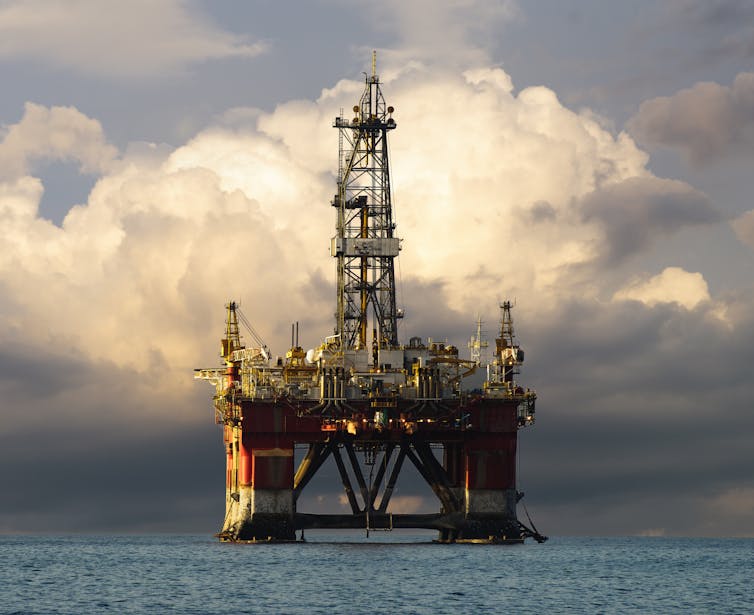
    An offshore drilling platform.
    Mike Mareen/Shutterstock

    Ed Hawkins, University of Reading

    The world has just suffered through its warmest month ever recorded. Heatwaves have swept across southern Europe, the US and China, breaking many temperature records in the process.

    Climate scientists have been sounding the alarm for decades that this type of event will become more frequent as the world continues to warm. The major culprit behind this is the burning of fossil fuels. So it’s extremely concerning that the UK government has announced its intention to grant hundreds of licences for new North Sea oil and gas extraction.

    Although burning fossil fuels to generate power and heat has enabled society to develop and flourish, we are now experiencing the unintended side effects. The carbon dioxide that has been added to the atmosphere is leading to a rise in global temperatures, causing heatwaves to become hotter and downpours more intense. The resulting large-scale disruption and suffering is becoming ever more visible.

    This warming will continue, with worsening climatic consequences, until we reduce global carbon dioxide emissions to “net zero”. After that, we will still have to live and suffer in a warmer climate for generations. The collective choices we make now will matter in the future.

    The small-scale, but high-profile, disruptions caused by Just Stop Oil protesters in the UK are extremely frustrating for many. But their single demand – for no licenses for new UK coal, oil and gas projects – is consistent with the science underpinning the international agreements that the UK has signed.

    Temperatures are rising

    Since the 1860s, the scientific community has understood that adding more carbon dioxide to the atmosphere would warm the climate. And as long ago as 1938, the burning of fossil fuels was linked to the observed rise in both carbon dioxide levels and global temperatures. Fast forward to now and global temperatures are warmer, and increasing faster, than at any point in human civilisation.

    In response to the overwhelming scientific evidence, the UK and 193 other nations came together in 2015 to ratify the Paris agreement on climate change. One of the agreed goals is to limit global warming to well below 2℃, and even aim for 1.5℃, compared to the pre-industrial era.

    However, the latest synthesis report from the Intergovernmental Panel on Climate Change, which all governments explicitly endorsed, paints a stark reality. If we burn all of the fossil fuels that we currently have access to, then global warming will exceed 1.5℃ and may reach 2℃.

    To avoid breaching the limits set out by the Paris agreement, some of the coal, oil and gas that we can already extract must remain unburnt. New fossil fuel extraction projects will make it even harder to stop further global warming.

    Build up renewable infrastructure

    There are other options. The UK government’s official advisers, the Climate Change Committee, have put forward a vision for UK power generation consistent with a net zero future. They say that the UK could provide all of its energy needs by 2050 through a combination of renewables, bioenergy, nuclear, hydrogen, storage and demand management, with some carbon capture and storage for fossil gas-based generation in the meantime.

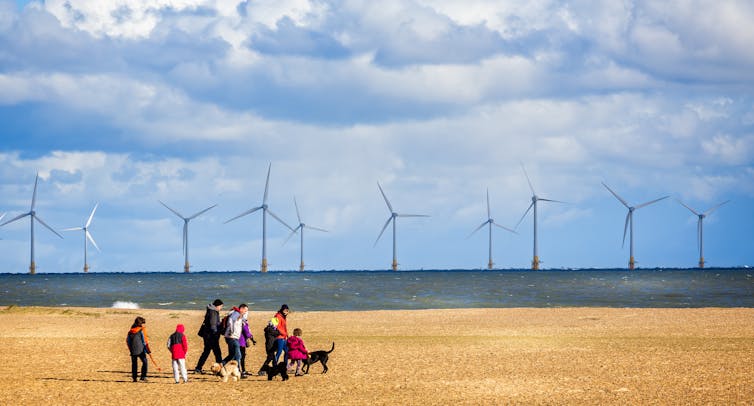
    A family walking dogs on a beach in front of an offshore wind farm.
    The UK can achieve energy security without causing additional global warming.
    Nigel Jarvis/Shutterstock

    If the UK followed the example of China and rapidly increased its investments in renewable energy, then it could achieve energy security without causing additional global warming. China emits the most carbon dioxide of any country in the world. But it is installing more renewable energy generation than the rest of the world combined.

    Rapidly reducing our reliance on fossil fuels, and not issuing new licenses to extract oil and gas, is the most effective way of minimising future climate-related disruptions. The sooner those with the power to shape our future recognise this, the better.


    Imagine weekly climate newsletter

    Don’t have time to read about climate change as much as you’d like?

    Get a weekly roundup in your inbox instead. Every Wednesday, The Conversation’s environment editor writes Imagine, a short email that goes a little deeper into just one climate issue. Join the 20,000+ readers who’ve subscribed so far.The Conversation


    Ed Hawkins, Professor of Climate Science, University of Reading

    This article is republished from The Conversation under a Creative Commons license. Read the original article.

  • Conservatives are the ‘political wing of the fossil fuel industry’ as Sunak invites BP and Shell to Downing Street

    Spread the love
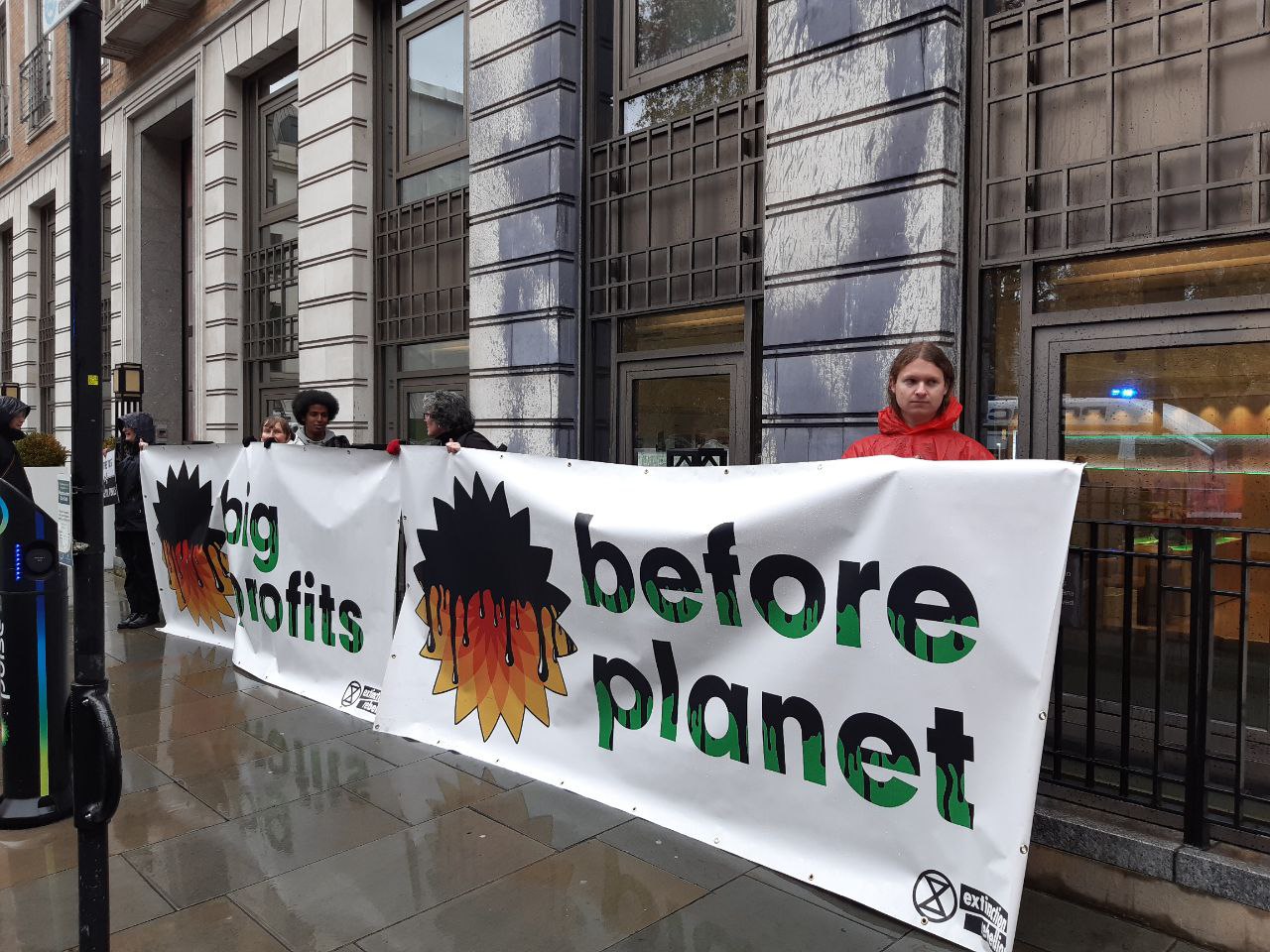
    Extinction Rebellion protests at BP
    Extinction Rebellion protests at BP. Banner reads big profits before planet

    https://www.globalwitness.org/en/press-releases/conservatives-are-the-political-wing-of-the-fossil-fuel-industry-as-sunak-invites-bp-and-shell-to-downing-street/

    New Global Witness analysis shows that government ministers met with fossil fuel companies 54 times between January and March.

    London, August 1st, 2023 – Between January and March of this year, Prime Minister Rishi Sunak and climate and energy ministers met with fossil fuel companies 54 times, on average more than once every two days, according to new Global Witness analysis of UK government data. This amounts to around 20 per cent of all lobbying meetings they held in that period. (1)

    This analysis comes as the Times reports that Sunak will meet with fossil fuel bosses on Wednesday, just two days after announcing that the Government would grant 100 new oil and gas licenses in the North Sea.

    Scientists and campaigners have denounced the Government’s plans to U-turn on its climate commitments and “max out” North Sea oil and gas. This would lock the country deeper into a fossil fuel dependency that has left the UK with the highest energy bills in Western Europe.  

    (1)    See Transparency International UK’s database on UK government lobbying, available at openaccess.transparency.org.uk.

    https://www.globalwitness.org/en/press-releases/conservatives-are-the-political-wing-of-the-fossil-fuel-industry-as-sunak-invites-bp-and-shell-to-downing-street/

  • Twenty one Just Stop Oil supporters arrested

    Spread the love

    Just Stop Oil are demanding that the UK government halt any new licensing or consents for oil, gas and coal extraction in the UK.

    In an escalation of resistance from previous weeks, 180 Just Stop Oil supporters, in fourteen groups, began marching on key roads in central London. They marched in groups of between 5 and 25 supporters, carrying placards reading “new oil = murder”, “ hottest June ever” and “can’t eat oil”.

    Police followed numerous groups before marches began and stopped and searched dozens of people. Police began issuing Public Order Act (Section 12) notices at 8:10am, just minutes after the first march set off. Three Just Stop Oil supporters were arrested after 15 minutes of marching on Liverpool Street. Around twenty Just Stop Oil supporters were arrested as they attempted to leave Lambeth bridge, however 11 of these were de-arrested. The team in Victoria was removed by 8:35. Police were seen following marchers on the tube at 9:00am. Another two were arrested on Liverpool Street at 9:45. At 10:30 two were arrested on Victoria Street.

    Frances Davis, 20, from Norwich spoke to the camera as she was held in handcuffs:

    “I’ve been marching for just under 15 minutes and I’m under arrest for demanding the same thing as the IPCC (Intergovernmental Panel on Climate Change), the United Nations and the government’s own scientific advisors have been demanding- and we’ve just been ignored. We’ve tried everything else and now I’m in handcuffs, just for going on a march.”

    This morning’s marches come as extreme heat continues to ravage Europe and now 110 million people have been issued extreme heat warnings in the US, as a heat dome over the US south-west has translated into coast to coast alerts. Temperature records could be broken in as many as 38 cities. In Las Vegas security guards can be seen guarding the fountains of upscale casinos and hotels to prevent people from jumping in, whilst mobile clinics are reporting treating homeless people suffering from third-degree burns.

    Since the Just Stop Oil campaign launched on 14th February 2022, there have been over 2,200 arrests and 138 people have spent time in prison, many without trial. Just Stop Oil supporters Morgan Trowland and Marcus Decker are serving three-year prison sentences for resisting new oil, gas and coal in the longest sentences for peaceful climate action in British history.

    Juststopoil.org.

  • UK should quit ‘climate-wrecking’ energy treaty, say official advisers

    Spread the love

    https://www.theguardian.com/environment/2023/jul/10/uk-should-quit-energy-charter-treaty-climate-change-committee

    The UK should quit a controversial energy treaty to stop it delaying vital climate action and triggering huge taxpayer payouts to fossil fuel companies, according to the government’s official advisers.

    The energy charter treaty (ECT) is a system of secret courts that enables companies to sue governments over policies that would cut their future profits. Companies have sued over phasing out coal-fired power stations, ending offshore oil drilling and banning fracking. The UK’s Climate Change Committee said Britain should withdraw from the ECT because recently proposed reforms did not go far enough.

    The UK and Japan are the only major economies not to have committed to exiting the ECT. France, Germany, Spain and others have already said they will leave and the EU is set to pull out en masse after saying that staying would “clearly undermine” climate targets.

    https://www.theguardian.com/environment/2023/jul/10/uk-should-quit-energy-charter-treaty-climate-change-committee