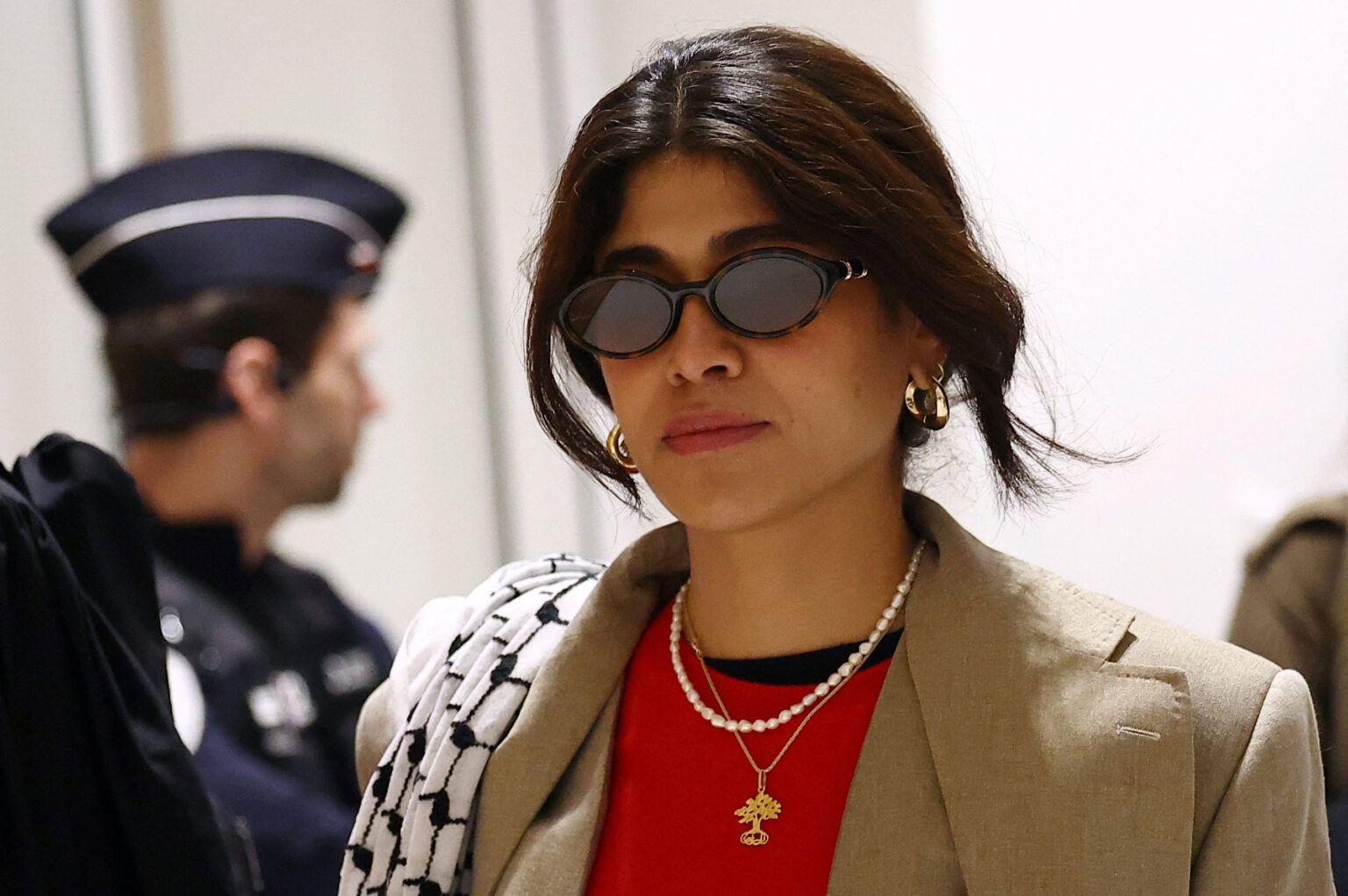
French MEP Rima Hassan appears at Paris criminal court on charges of glorifying terrorism online. Abdul Saboor/Reuters
‘The trial of the century for freedom of expression.’
For the last three years, Rima Hassan has watched in horror as thousands of people have been killed in her family’s homeland. The French jurist and La France Insoumise (LFI) MEP, who was born stateless in a Palestinian refugee camp in Syria, is one of France’s most outspoken critics of both Israel’s genocide in Gaza and the complicity of Europe’s governments.
Now, she could be sent to prison over a post on social media.
In March, Hassan posted a quotation on X/Twitter attributed to Kōzō Okamoto, a member of the Japanese Red Army who took part in a 1972 attack on an Israeli airport in which 26 people were killed.
“I gave my youth to the Palestinian cause,” Okamoto’s quotation read. “As long as there is oppression, resistance will not only be a right, but a duty.”
Far-right National Rally politician Matthias Renault, interior minister Laurent Nuñez and two French pro-Israel lobby groups reported Hassan to prosecutors for apologie du terrorisme (the glorification of terrorism) – a criminal offence. Hassan denied the charges and said her main goal had been to share a quotation about the “philosophy of resistance”, and that she couldn’t be accused of glorifying terrorism for doing so.
Hassan’s trial began on 19 October. If found guilty, she could be sentenced to up to seven years in prison and fined €100,000 under French law. Her situation, she said, is the latest in a series of legal and political battles in France over solidarity with Palestine.
“People who stand in solidarity with Palestine are labelled as terrorists because it [this label] is the only instrument that allows them to silence concrete opposition and activism,” Hassan told Novara Media ahead of her trial.
This isn’t the first time the French state has brought the full force of its institutional machinery against Hassan. 22 legal proceedings have been initiated against her in the last two years in connection with her political views (six have been closed by prosecutors without questioning, 13 after questioning and three remain open). In September, a separate trial in relation to two social media posts from 2025 was adjourned.
Keir Starmer objects to criticism of the IDF. He asks how could anyone object to them starving people to death, forced marches like the Nazis did, bombing Gaza’s hospitals and universities, mass-murdering journalists, healthworkers and starving people queuing for food, killing and raping prisoners and murdering children. He calls for people to stop obstructing his genocide for Israel. New Labour UK Prime Minister Andy Burnham continues Labour party policy of active support and complicity in Israel’s genocide.
This work by Middle East Monitor is licensed under a Creative Commons Attribution-NonCommercial-ShareAlike 4.0 International License.
French President Emmanuel Macron at the Elysee Palace in Paris, France on October 13, 2026. [Mustafa Yalçın – Anadolu Agency]
Emmanuel Macron’s phrase landed like a cracked whip in the stale air of Western politics. “As unacceptable as they are stupid.” The target was not immigration policy, but a lie — the claim, amplified by Donald Trump and a chorus of right-wing figures, that Muslim migrants had set France alight. The protests that swept Paris, Lyon and Marseille were not a civilisational invasion.
They were a cry about grocery bills, overcrowded classrooms and a state that had cut 4,000 teaching posts while fuel prices climbed. Macron’s fury was therefore more than a defence of immigrants. It was a rejection of the most durable political technology of the age: the conversion of economic failure into cultural panic.
The mechanics are almost elegant in their cynicism. When wages stagnate, and public services buckle, the scapegoat is not the tax code or the corporate margin. It is the most visible minority. Trump told Macron to “close your borders and take control before it is too late”. The facts said otherwise.
More than half a million people marched — students, trade unionists, farmers — against the cost of living and the decay of public provision. The violence was real, but the culprits were not a religious category. They were a political economy that has spent four decades redistributing risk downward while protecting wealth upward.
The digital architecture of 2026 has made this old manoeuvre infinitely more potent. AI-generated images of an elderly couple “stripped and robbed,” of a Palestinian flag atop the Eiffel Tower, of “hordes” storming French streets, accumulated millions of views in hours. Macron named the mechanism precisely: foreign leaders, some mid-election campaign, “naively repeat AI-generated content or spread narratives that certain circles are clearly trying to promote”.
The grammar of the “Muslim threat” is centuries old; the delivery system is new. What once required a pamphlet or a tabloid now requires a prompt and an algorithm optimised for outrage.
Against this manufactured panic sits an empirical reality that is almost impolite to state.
The OECD findsthat 77 per cent of immigrants across its member states are economically active, and that migration attenuates labour shortages in ageing societies.
Bruegel’s 2025 analysis is blunter still: with fertility rates unlikely to rebound, “continuingly high positive net-migration levels” are the only route to mitigate the economic effects of ageing, and inward migration can deliver a positive net contribution to public finances.
In Spain, the net annual fiscal contribution of the average immigrant has been estimated at some €1,600 more than the native-born, while costing the treasury 32 per cent less. The scapegoat, in other words, is subsidising the very state that is being told to fear him.
France’s security apparatus tells a more troubling story about how the panic is institutionalised. The FSPRT file — the register of suspected Islamist radicalisation — contained some 15,800 individuals as of late 2024. The database does not measure crime; it measures risk, and risk is a category that expands to fill the political demand for it. When a state can see a population through the lens of pre-emptive suspicion while remaining structurally blind to the socioeconomic composition of a protest, it has perfected a form of strategic unknowing.
The Muslim is legible as a suspect, illegible as a citizen with a grievance. That asymmetry is not a bug in the liberal state. It is a feature of how the liberal state has learned to govern insecurity.
This is where the global conversation must resist the imported script — and recognise that the script is no longer imported at all. It is written simultaneously in every major democracy.
In the United States, Gallup found in June 2026 that 73 per cent of Americans still see immigration as a good thing, and that the share wanting less immigration had fallen from a peak of 55 per cent in 2024 to 30 per cent — yet the political class continues to behave as if the opposite were true.
In Europe, the Transatlantic Trends survey records that 47 per cent of Europeans and 50 per cent of Americans see immigration as more of a problem than an opportunity, with the divide sharpest among those without a secondary education and those who have no personal contact with migrants. In Berlin, where 85 per cent of households rent, advertised rents have nearly doubled since 2014, and the far-right AfD has converted the housing crisis into an argument for restricting immigration, reaching around 17 per cent in city polling.
In Canada, Nanos Research found 52 per cent of respondents favour admitting fewer immigrants and temporary residents, with housing shortages, strained public services and the cost of living cited as the drivers — even as population growth slowed sharply. The proximate grievances are real and material: housing scarcity, wage stagnation, underfunded hospitals and schools.
But the moment those grievances are translated into a cultural threat narrative. These solutions might actually work — denser cities, a functioning care economy, a tax base that funds public infrastructure, sectoral bargaining that lifts wages — are displaced by a politics of exclusion that leaves the underlying failure untouched and the underlying distribution of power intact. The scapegoat is not a misunderstanding of the crisis. It is a substitute for solving it.
The far-right playbook now travels with a translation layer. The Guardian documented nationalist parties from the National Rally to Vox to Chega seizing on the same European unrest, each converting a housing or cost-of-living protest into evidence of “anarchic immigration” or an “uncontrolled influx”. The script is modular. Only the cast changes.
Macron’s own record is compromised. His governments have passed anti-separatism laws that Muslim civil society experienced as a targeted gaze, and his defence of French Muslims against foreign slander sits awkwardly beside domestic policies that have often treated Islamic practice as a problem to be administered. That contradiction matters, because it reveals the deeper trap.
The liberal centre condemns the crudest scapegoating while maintaining a softer, more respectable version of the same logic: integration as cultural erasure, security as a permanent suspicion. The choice is not between Trump’s panic and Macron’s laïcité. It is between a politics that names the real sources of anger and one that keeps looking for a minority to absorb it.
The lesson is not that immigration is costless or that every grievance is economic. It is that the political economy of scapegoating is now more profitable than the political economy of repair. A party that blames a migrant for a hospital queue need not explain why the hospital was starved of capital. A leader who warns of an Islamist takeover need not account for the energy shock, the fiscal squeeze or the algorithmic amplification that turned a local protest into a civilisational melodrama.
The costs of that evasion are not borne by the scapegoater. They are borne by the Muslim family in a Paris banlieue, the asylum seeker in a Mediterranean detention centre, the working-class neighbourhood in Ohio or Saxony told that its neighbours are the cause of its decline. They are borne by every community invited to trade solidarity for suspicion, and by every democracy that discovers, too late, that the anger it mobilised cannot be contained by the institutions it hollowed out.
Macron’s word — stupid — was undiplomatic and precise. It named an intelligence failure disguised as a political strategy. The task for policymakers is to make that strategy expensive. That means provenance and transparency in digital information, so that fabricated images carry a cost. It means fiscal and industrial policy that makes migration’s contribution visible in the public ledger, not merely in think-tank working papers. It means a security architecture capable of distinguishing suspicion from citizenship.
And it means a political language that treats the cost-of-living crisis as a crisis of distribution, not of demography. The scapegoat is a substitute for argument. The only antidote is the argument itself — conducted with the courage to name who actually benefits when the crowd is pointed at the wrong gate.
A protester holds a placard with a photo of French president Emmanuel Macron and a guillotine in front of a burning tourism office during a demonstration against rising living costs and in solidarity with students’ grievances in Lyon, France, October 17,
…
The escalating political and social crisis exposed by the young people, workers, unemployed, and retirees joining demonstrations in France last week, marks a new stage in a movement building for weeks and whose origins are decades old.
This crisis is rooted in the decision of French and EU political leaders and bankers to embark on a road to a Federal Europe enshrined in the 1992 Maastricht Treaty with a single currency and a single interest rate run by a European Central Bank in Frankfurt.
The current protest movement in France cannot be resolved by snap elections or a change of bourgeois government. The demands of the protests in France are for higher wages, increased social welfare benefits, and better pensions.
These are demands for a different kind of society, one that was ruled out by the Maastricht Treaty. The protesters are demanding a radical rupture with the politics of the EU and of so-called “centrism” exemplified in Emmanuel Macron.
As Europe approaches the fifth year of a war with Russia in Ukraine that its political and military leaders have stoked with money, guns and long-range missiles, frenzied discussions taking place in Paris, Brussels and Berlin, reveal the weakness and illegitimacy of the centrist project, which is predicated on denying the democratic right of citizens to choose an alternative path to that of neoliberalism and war.
…
This was the spark that lit the explosion in France’s streets. It is a result of a young generation being offered a future of poverty, low pay and war-readiness by their ruling political parties and emphatically rejecting it.
Police fire teargas in Paris and protesters storm town hall in Marseille – with officials blaming violence on ‘ultra-left’
More than 400 people were arrested in France on Saturday after protesters supporting high school student grievances clashed with police.
Police fired teargas in confrontations with protesters, as demonstrations across France were boosted by other groups angry over high prices and the fraying of a social welfare system.
Hundreds of thousands of people took to the streets across the country, and tensions erupted on the fringes of the nationwide demonstrations over absent teachers, decrepit school buildings and police violence.
Late on Saturday, the interior minister, Laurent Nuñez, said there had been 400 arrests and most were adults who were not part of the high school protests.
He said the official demonstration had been hijacked by casseurs – “opportunistic delinquents who had seen a chance to pillage and loot … we will find them and deal with them firmly”.
He said the state was not planning to declare a state of emergency but added: “I very strongly condemn the violence we have seen.”



 A protester holds a placard with a photo of French president Emmanuel Macron and a guillotine in front of a burning tourism office during a demonstration against rising living costs and in solidarity with students’ grievances in Lyon, France, October 17,