ISRAEL’S killing spree continued across Gaza today as a deadly air attack killed at least 28 people, mostly women and children, said the territory’s Health Ministry.
The attack came a day after a far-right Israeli minister claimed lawmakers in the United States supported Israel’s targeting of “food and aid depots” in Gaza.
In Thursday’s attacks at least nine people were killed in a strike on a police station in the northern Jabaliya area, the ministry said. The Israeli military claimed without evidence that it had targeted a command and control centre for Hamas and the smaller Islamic Jihad militant group.
At least seven people were killed, including a mother and her two children, and another two children, in three strikes on the southern city of Khan Younis. Strikes in central Gaza killed six people, including two women and two children. An air strike on a home in Gaza City reportedly killed four children and their parents.
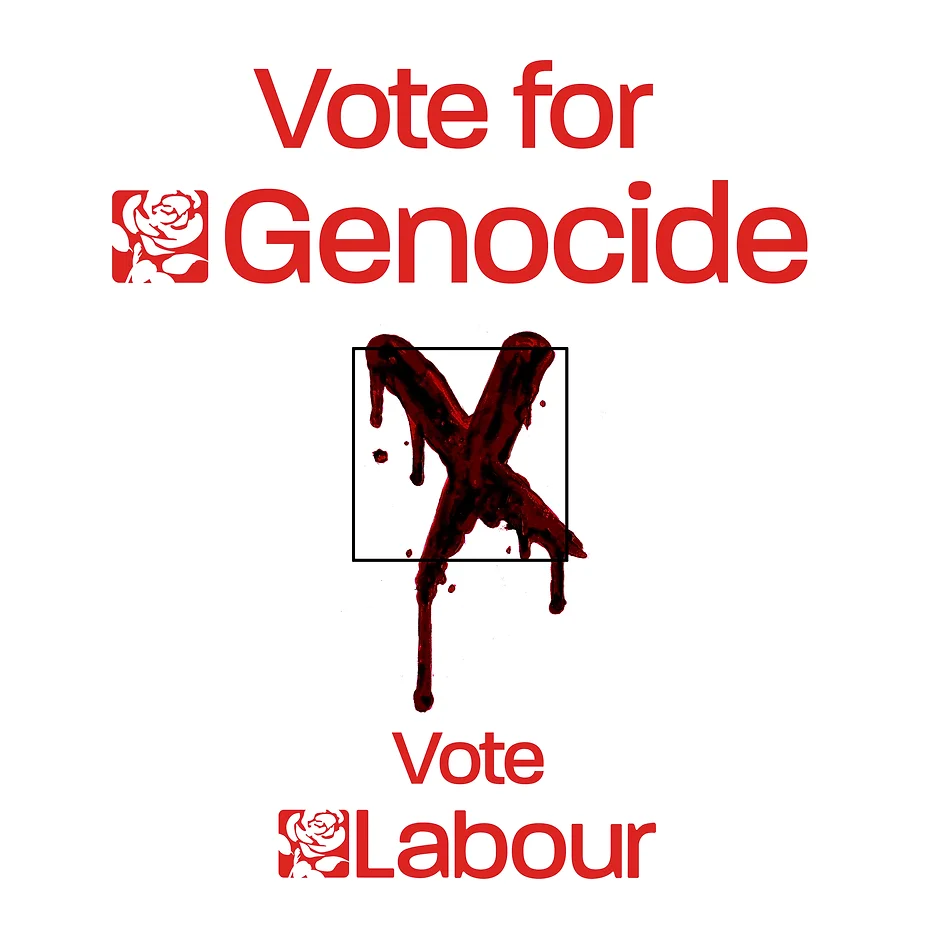
Genocide denier and Current UK Prime Minister Keir Starmer is quoted that he supports Zionism without qualification. He also confirms that UK air force support has been essential in Israel’s mass-murdering genocide. Includes URLs https://www.declassifieduk.org/keir-starmers-100-spy-flights-over-gaza-in-support-of-israel/ and https://youtu.be/O74hZCKKdpAUK Foreign Minister David Lammy confirms that UK government and military are active participants in Israel’s genocides and that the F-35 parts that they suspended from supplying to Israel are instead simply diverted via the United States. He says see https://youtu.be/QILgUHrdWREVote For Genocide Vote Labour.
Genocide denier and Current UK Prime Minister Keir Starmer is quoted that he supports Zionism without qualification. He also confirms that UK air force support has been essential in Israel’s mass-murdering genocide. Includes URLs https://www.declassifieduk.org/keir-starmers-100-spy-flights-over-gaza-in-support-of-israel/ and https://youtu.be/O74hZCKKdpAUK Foreign Minister David Lammy confirms that UK government and military are active participants in Israel’s genocides and that the F-35 parts that they suspended from supplying to Israel are instead simply diverted via the United States. He says see https://youtu.be/QILgUHrdWRE
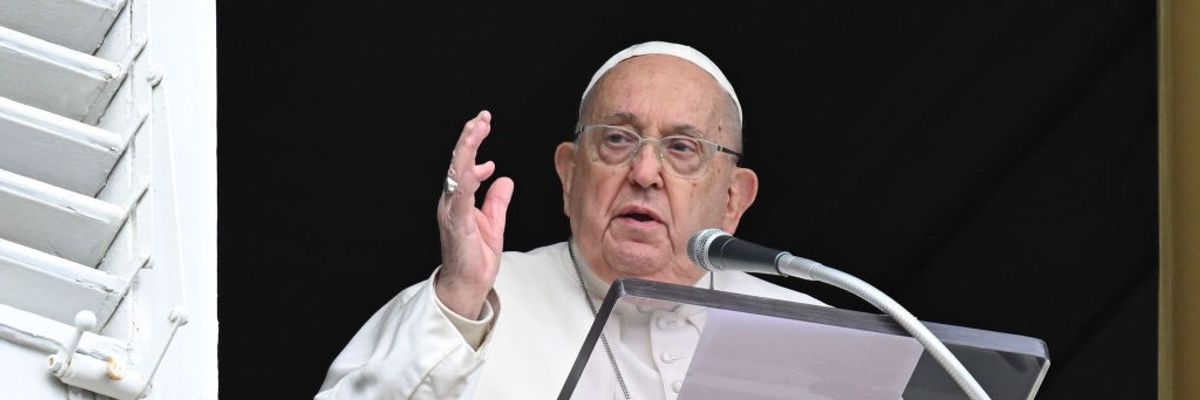
Pope Francis delivered a Sunday Angelus blessing from the window of his studio overlooking St. Peter’s Square on January 12, 2025 in Vatican City. (Photo: Vatican Media via Vatican Pool/Getty Images)
“Will the millions who will mourn his death these coming days respect this wish of his? Will they care for Gazans and Palestinians the way he did?”
The Vatican announced Monday that Pope Francis has died at the age of 88, hours after he appeared at an Easter mass and appealed for an end to Israel’s war on the Gaza Strip.
The pope’s Easter address, read aloud by Archbishop Diego Ravelli, decried the “terrible conflict” in Gaza that “continues to cause death and destruction and to create a dramatic and deplorable humanitarian situation.”
“I appeal to the warring parties: call a cease-fire, release the hostages, and come to the aid of a starving people that aspires to a future of peace!” said the message from the pope, an outspoken opponent of military conflict and war profiteers, climate destruction, and runaway economic inequality.
“In the face of the cruelty of conflicts that involve defenceless civilians and attack schools, hospitals, and humanitarian workers, we cannot allow ourselves to forget that it is not targets that are struck, but persons, each possessed of a soul and human dignity,” the pope’s address continued.
News of Pope Francis’ death came after a bout with double pneumonia left him hospitalized for more than a month. The Vatican did not specify a cause of death in its announcement.
The Nation‘s John Nichols wrote Sunday that Pope Francis’ calls for peace have made him “arguably the most consistent high-profile defender of the humanity of the Palestinian people during a period when the Israeli assault on Gaza has been pursued with relentless violence.”
Nichols continued:
With a boldness and specificity that has often sparked controversy, this pope has challenged economic injustice, racism, environmental neglect, militarism, and the abuses of new technologies that increase inequality. He has faced his share of criticism, not just from conservatives who disapprove of his views but also from reformers who sincerely wish that he would do more to modernize the church. Yet, in a time of too much indifference and impunity, this pope has remained uniquely engaged with the embattled regions that political and media elites neglect or abandon.
That’s been especially true when it comes to Gaza, where Pope Francis has long argued for cease-fires, arms blockades, aid convoys, and a diplomatic urgency that recognizes that Palestinians and Israelis are “fraternal peoples [who] have the right to live in peace.”
In a tribute to Pope Francis, Palestinian theologian Munther Isaac wrote Monday that “he conveyed true compassion to Palestinians, most notably to those in Gaza during this genocide.”
“The pope left our world today, and the occupation and the wall remained. Even worse, he left our world while a genocide continues to unfold,” Isaac wrote, pointing to the pontiff’s call for a thorough international investigation of Israel’s assault on Gaza.
“Today I wonder: Will the millions who will mourn his death these coming days respect this wish of his?” Isaac asked. “Will they care for Gazans and Palestinians the way he did?”
Pope Francis greeting people in St. Peter’s Square in Vatican City in 2014. (Photo: Alfredo Borba/Creative Commons)
Again and again, Pope Francis railed against our collective indifference to widespread suffering and urged humanity, especially world leaders, to do better. It’s not too late to heed his call.
Like millions of other people, I was deeply saddened to hear of the passing of Pope Francis, one of the most vocal and humble advocates for sharing the world’s resources.
But at the heart of his advocacy was a focus on ending inequality both globally and on a national basis, repeatedly calling upon governments to redistribute wealth and benefits to the poor in a new spirit of generosity.
I first recall being struck by Pope Francis’ headline-grabbing speech in 2014, when he urged the United Nations to promote a ‘worldwide ethical mobilization’ of solidarity with the poor to help curb an ‘economy of exclusion’ that is taking hold everywhere today.
A year later in 2015, the papal encyclical Laudato Si’—subtitled ‘On care for our common home’—made bigger headlines around the world with its powerful critique of laissez-faire ideology and its destructive effects on the environment. The trenchant letter expounded on the responsibility of rich countries to address their ‘ecological debt’ to less developed countries, with an acknowledgement of ‘differentiated responsibilities’ in addressing climate change. It was a radical entreaty for resource transfers between the Global North and South, and significant reductions in the consumption of non-renewable energy within developed countries.
The eloquent discourse of Laudato Si’ also reflected the core understanding of many environmental activists—that the climate and inequality crises are inextricably interconnected. Again and again, Pope Francis railed against our collective indifference to widespread human suffering. He persistently argued that the welfare of nations is interrelated, so the massive poverty and hunger experienced in the fragile economies of developing nations is, in turn, reflected in the destruction of the natural environment. Hence the urgency of remediating the enormous discrepancies in living standards throughout the world, which calls for a sense of global solidarity and interdependency that is tragically lacking in human affairs.
During the coronavirus pandemic, Francis also set out the challenge for rich nations to cooperate and distribute the vaccine freely to the world, rather than hoarding resources and treating one’s own nation first. The 2020 encyclical titled Fratelli tutti—‘Brother’s all’—made clear that Covid-19 was exposing existing inequalities, and fraternity on a state level requires richer countries to help poorer ones if we are to give meaning to the equality of human rights. Clearly, the world failed to heed Pope Francis’ plea to ensure recovery from the crisis tackled poverty, inequality and the climate emergency by ‘sharing resources in a just and respectable manner’.
Another theme that Francis constantly returned to was the need for cancelling the debts of countries unable to repay them. In his final papal bull for the Jubilee Year 2025, titled Spes non confundit—‘Hope does not disappoint’—he described debt forgiveness as a matter of justice more than generosity, and again decried the true ecological debt that exists between the Global North and South.
Francis was rightly known as the ‘Pope of the peripheries,’ standing up for the most vulnerable and marginalized peoples. He made clear his opposition to Western government policies of battening down the hatches and draconian responses to international migrants. Soon after taking office, Francis visited the Italian island of Lampedusa where he condemned European ‘indifference’ to the drowning of migrants crossing the Mediterranean in small boats. He later visited numerous camps for excluded migrants and refugees living ‘ghost lives in limbo,’ calling upon us to see Christ in the stranger and outsider. This was a sharp rebuke to reactionary politicians like Trump, Meloni, and Orbán, instead emphasizing the need for ‘universal fraternity’ as influenced by St. Francis of Assisi, after whom the Pope took his name.
It was a fitting testament to Francis’ advocacy for the poor and forgotten that he died hours after calling for a ceasefire in Gaza. In his annual Urbi et Orbi —‘To the City and World’—message on Easter Sunday, the day before he died, Francis repeated his appeal to the warring parties to “come to the aid of a starving people that aspires to a future of peace.” Few politicians, it seems, have followed the Pope’s counsel throughout his 12-year-long pontificate. Which now leaves it up to us, the ordinary people of goodwill, to uphold Francis’ tireless advocacy and hope for a better world.
This work by Middle East Monitor is licensed under a Creative Commons Attribution-NonCommercial-ShareAlike 4.0 International License.
Palestinians, including children gather around a water tanker to collect clean water amid ongoing Israeli attacks on Gaza and the continued closure of border crossings, which have severely limited access to basic necessities in Khan Yunis, Gaza on March 29, 2025. [Abed Rahim Khatib – Anadolu Agency]
Under the weight of war and a suffocating blockade, more than two million people in the Gaza Strip are facing an unprecedented water crisis that threatens their daily survival. What was already a dire situation before the escalation has now turned catastrophic due to the ongoing bombardment and the widespread destruction of water infrastructure. The UN report from 2022 unveils a grim reality: over 97 per cent of Gaza’s drinking water is unfit for drinking or human consumption as a result of contaminants infiltrating groundwater reserves, whether it was caused by the excessive pumping of polluted water by the Israeli Occupation into Wadi Gaza, leakage from deteriorating sewage networks into the aquifer or the intrusion of the polluted saltwater into the aquifer by 75 per cent to meet the water deficit of the increased demand caused by the increased population. Compared to that, natural rain that does not exceed 30 per cent of natural replenishment. The situation is further exacerbated by the leakage of residues from Israeli munitions into groundwater sources.
Gaza’s water crisis: Numbers dripping with pain
Gaza’s water reality reveals a prolonged and profound deficit. While the Israeli Occupation enjoys a near-universal coverage of clean water (more than 99 per cent), as well as a substantial control over the aquifer, Gaza languishes among the world’s lowest water access rates, with a coverage below 10 per cent, placing it in a state of constant water emergency.
Over the past years, Israel, through its national water company, Mekorot, supplied Gaza with around 18 million cubic meters of water annually through three pipelines, amounting to only 9 per cent of Gaza’s needs. Yet, the water sector in Gaza suffers from a severe deficit exceeding 120 million cubic meters per year (approximately 60 per cent of total demand). With the outbreak of the latest war, these limited supplies have been repeatedly disrupted and, today, they are completely cut off following the destruction of transmission networks. During the war, these pipelines provided up to 70 per cent of Gaza City’s water supply, after most local water sources were destroyed. More than 85 per cent of Gaza’s water and sewage networks have been bombarded, causing destruction and damage to 2,263 kilometres of pipelines and 47 pumping stations, as well as the cessation of all operations of wastewater treatment plants. Currently, only 30 per cent of Gaza’s wells remain operational. The capacity of desalination plants has plummeted to their lowest levels due to continuous bombardment and the shortages of electricity and fuel. Consequently, water supplies available to Gaza’s people have dropped by 95 per cent, with the average daily water consumption per capita reduced to just 3–5 litres, far below the 15-liter minimum emergency threshold set by the United Nations.
Gaza’s displaced: Long queues and arduous journeys for a few drops of water
Since the beginning of the escalation, thousands of Gaza’s residents have endured the tragedy of displacement, which has only deepened their daily suffering. Hundreds of families, forced to flee their homes under heavy bombardment, now face the exhausting challenge of searching for water in distant areas or in overcrowded shelters lacking even the most basic necessities of life. Long queues at water distribution points and wells have become a daily reality, fraught with the constant risks of air strikes, fear and loss of life.
“We wait for long hours just to access unsafe and contaminated water, and sometimes we only manage to get our share after complete exhaustion,” says Fatima, a 35-year-old mother of four, who was displaced with her children to a shelter in western Gaza. “The distance we have to walk every day just to collect water can stretch for several kilometres and, with each passing day, the journey becomes even more difficult.”
Contaminated water: An immediate and long-term health threatThe health situation in Gaza has become catastrophic due to the acute shortage of clean water and the forced reliance on contaminated sources for drinking and hygiene, if available, which has led tothe widespread outbreak of acute diseases such as diarrhoea, kidney infections, urinary tract infections and waterborne diseases, as well as skin infections due to poor hygiene conditions or the use of polluted water for personal care.
These health risks are even more severe for children under the age of five, who are particularly vulnerable to malnutrition, intestinal infections, and severe diarrhoea, which can lead to dehydration or death. Pregnant women also face higher risks of early miscarriage, premature delivery and reduced breast milk production due to dehydration and exposure to contaminated water. The elderly are not spared, either, as they face an increased risk of kidney diseases, kidney failure and challenges in managing chronic conditions in the absence of safe and sufficient water supplies.
Impact of the water crisis on food security and forced displacement
The water crisis in Gaza is not only a health emergency but also a growing threat to food security. The destruction of agricultural irrigation networks has further worsened the already fragile economic situation, increasing poverty and hunger across the Gaza Strip due to a sharp decline in agricultural and livestock production. Agricultural productivity in the limited available farmland has dropped by 60 per cent as a result of using contaminated water, not to mention that farmlands have become either unsuitable for cultivation or located in unsafe areas due to the ongoing conflict. Moreover, the scarcity of clean and safe water has intensified forced displacement, with many residents compelled to leave their homes in search of areas where drinking water is available.
A grave breach of International Law: Denying people their right to life
The targeting and destruction of water sources and infrastructure in Gaza constitute a grave breach of international humanitarian law.
According to the 1977 Additional Protocol I to the Geneva Conventions, it is prohibited to attack resources indispensable to the survival of civilians, such as water supplies. Denying water to civilians amounts to a war crime under the Fourth Geneva Convention and represents a blatant violation of Article 25 of the Universal Declaration of Human Rights.Such acts may also qualify as crimes against humanity under the Rome Statute of the International Criminal Court.
In the face of tragedy: An urgent call for action
In light of this tragic reality, there is an urgent need for immediate and coordinated action. Internationally, the United Nations must activate emergency protection mechanisms, while international organisations, including the Organisation of Islamic Cooperation and the Arab League, should play a key role in intensifying political pressure on the United States to compel Israel to stop the war, halt the supply of weapons to the Occupying forces and ensure the immediate entry of humanitarian aid into Gaza. The Human Rights Council is also expected to issue investigative reports on these violations, and the International Criminal Court should open immediate investigations into the crimes committed.
On the humanitarian level, aid organisations must intensify efforts to find emergency solutions for providing clean water to the population in Gaza by repairing damaged water networks, maintaining wells and desalination plants using locally available resources, operating mobile desalination units powered by solar energy, expanding water distribution through water trucks to shelters and displacement camps and providing households with simple tools for water purification and desalination.
On the relief level, it is essential to pre-position water-related equipment, including well supplies, fixed and mobile desalination units, generators, solar energy systems, spare parts for water networks and fuel in both Egypt and Jordan. These should be ready for immediate delivery as soon as border crossings are opened for humanitarian aid. It would be a grave mistake to wait until Crossings re-open before starting to procure these critical supplies, given the time required for sourcing and delivery.
For the recovery and development of Gaza’s water system, it is equally critical not to wait until the war ends to begin planning and preparation. Delaying the restoration and development of the water sector will only prolong the suffering of a population that has already endured unimaginable hardship for over 17 months. Efforts must begin now by developing a comprehensive recovery plan, securing supply chains, mobilising funding and preparing technical teams to respond without delay, ensuring the most vital resource for life, water, is restored for Gaza’s population.
Between a suffocating siege and relentless bombardment, the people of Gaza struggle for every drop of water, much like a drowning person gasping for their final breath. They call for water but receive none; they cry out for help but are left unheard. Has humanity truly turned its back on them? Is water not a right for every living soul, including those trapped and besieged in Gaza?