The Green Party has repeated its call for a full bilateral ceasefire, the release of all hostages, the suspension of arms exports to Israel, and for key players in the Netanyahu government to be held accountable for possible war crimes, six months on from the 7 October attacks by Hamas.
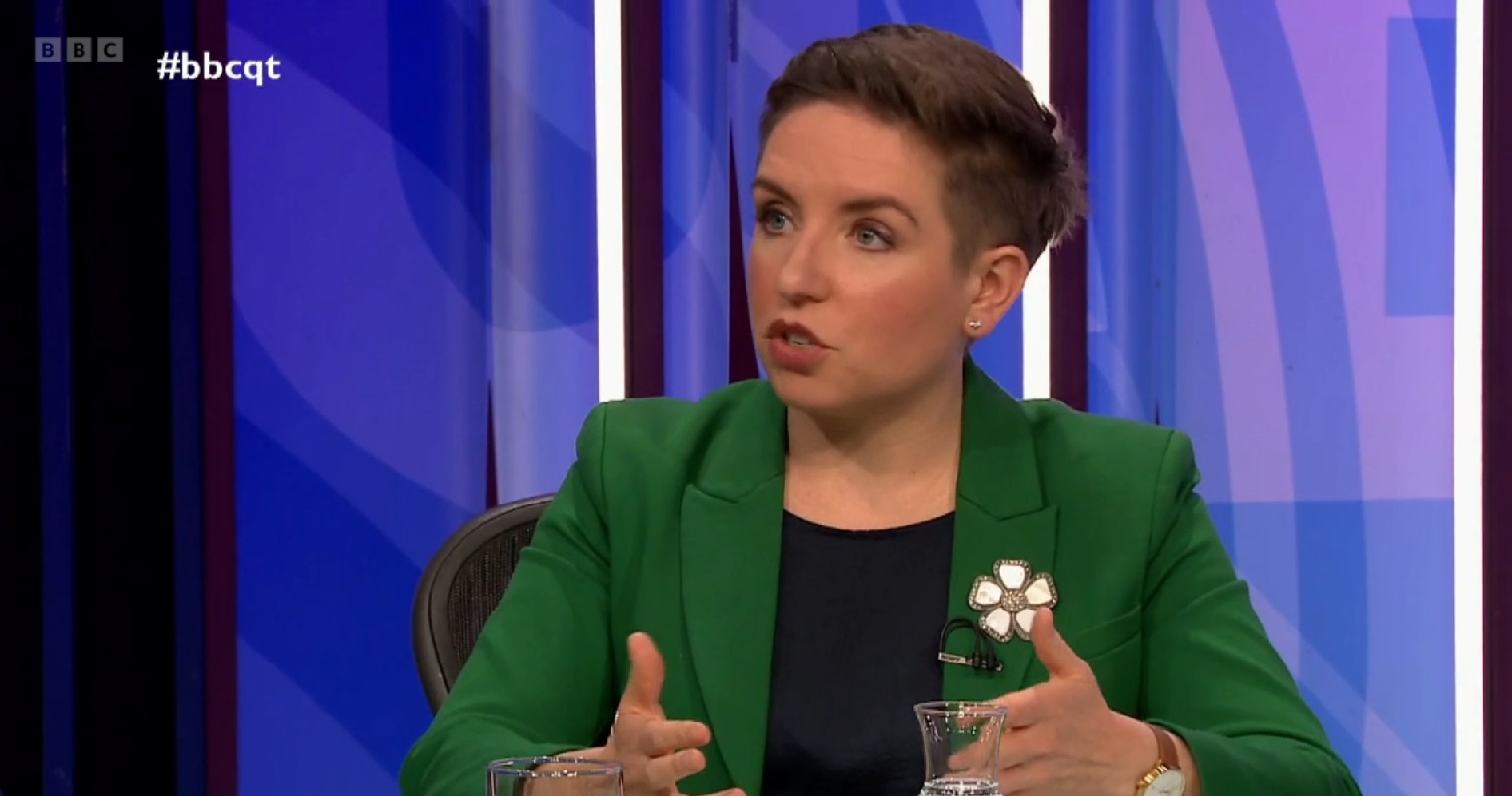
Image of the Green Party’s Carla Denyer on BBC Question Time.
Co-leader of the Green Party, Carla Denyer, said:
“This isn’t just a far away conflict that we have nothing to do with. By consistently refusing to call for a ceasefire and continuing to supply arms, the UK Government has been complicit in the deadly assault on Gaza by the Israel Defence Forces.
“Six months on from the horrific Hamas attacks on Israeli citizens, it is clear that the Netanyahu government’s response has been totally disproportionate. Over 33,000 innocent Palestinian civilians have now been killed, the majority of them women and children. This is not an act of self defence. As the UN’s Human Rights Council has resolved, the actions by the Israeli government are possible war crimes and crimes against humanity. Indeed, the UK Government itself has reportedly concluded secretly that Israel is breaking international humanitarian law.
“It is time for our Government to end their complicity and start leading efforts towards peace. They must finally call for a ceasefire, immediately suspend arms exports to Israel and back the UN Human Rights Council’s call for accountability for all violations of international humanitarian law and international human rights law.”
In the six months since October 7th, the Green Party of England and Wales has called for:
A full bilateral ceasefire
The release of all hostages
A suspension of all arms export licences to Israel until the violence stops
The cessation of all military collaboration with Israel, including use of British bases by Israeli forces, and intelligence sharing
Targeted Boycott, Divestment and Sanctions against individuals and institutions supporting or facilitating Israel’s occupation of Palestine
An investigation by the Metropolitan Police and Director of Public Prosecutions of war crimes committed against UK citizens, or where UK citizens are potential perpetrators
The UK government to use its position as a permanent member of the UN Security Council to vote for, rather than abstain on, ceasefire votes
Targeted sanctions against key individuals in the Israeli leadership, including travel bans and asset freezes on Israel’s government ministers
An end to occupation of the Palestinian territories
The UK government to return to international law being the benchmark for UK policy, and repair the UK’s international reputation as a defender of the international rules-based order.
The editorial boards of the nation’s major media organizations must have been frantic last week.
Used to reporting on US foreign policy, wars and arms exports so as to portray the United States as a benevolent, law-abiding and democracy-defending nation, they were confronted on March 25 with a real challenge dealing with Israel and Gaza. No sooner did the Biden administration, for the first time, abstain and thus allow passage of a United Nations Security Council resolution that was not just critical of Israel, but demanded a ceasefire in Gaza, than US officials began declaring that the resolution that they allowed to pass was really meaningless.
It was “nonbinding,” they said.
The New York Times (3/25/24) reported that US’s UN Ambassdor “Thomas-Greenfield called the resolution ‘nonbinding’”—and let no one contradict her.
That was enough for the New York Times (3/25/24), which produced the most one-sided report on the decision. That article focused initially on how Resolution 2728 (which followed three resolutions that the US had vetoed, and a fourth that was so watered down that China and Russia vetoed it instead) had led to a diplomatic dust-up with the Israeli government: Prime Minister Benjamin Netanyahu canceled a planned visit to Washington by a high-level Israeli delegation to discuss Israel’s planned invasion of Rafah and the future of Gaza and the West Bank.
The Times quoted Richard Gowan, a UN expert at the International Crisis Group: “The abstention is a not-too-coded hint to Netanyahu to rein in operations, above all over Rafah.”
Noting that “Security Council resolutions are considered to be international law,” Times reporters Farnaz Fassihi, Aaron Boxerman and Thomas Fuller wrote, “While the Council has no means of enforcing the resolution, it could impose punitive measures, such as sanctions, on Israel, so long as member states agreed.”
This was nevertheless followed by a quote from Washington’s UN Ambassador Linda Thomas-Greenfield, who abstained from the otherwise unanimous 14–0 vote of the rest of the Security Council, characterizing the resolution as “nonbinding.”
The Times offered no comment from any international law scholars, foreign or US, to rebut or even discuss that claim. Such an expert might have pointed to the unequivocal language of Article 25 of the UN Charter: “The members of the United Nations agree to accept and carry out the decisions of the Security Council in accordance with the present Charter.”
If the US offered its claim that this language only applies to resolutions explicitly referencing the UN Charter’s Chapter VII, dealing with “threats to the peace,” an international law expert (EJIL: Talk!, 1/9/17) might note that the International Court of Justice stated in 1971, “It is not possible to find in the Charter any support for this view.”
‘Creates obligations’
The Washington Post (3/26/24) quoted an international law expert to note that the resolution “creates obligations for Israel and Hamas.”
The Washington Post (3/26/24), though like the Times a firm defender of Washington’s foreign policy consensus, did marginally better. While the Times didn’t mention Britain or France, both major US NATO allies, in its piece on the Security Council vote, the Post noted that the four other veto powers—Britain and France, as well as China and Russia—had all voted in favor of the resolution, along with all 10 elected temporary members of the Council.
The Post also cited one international law legal expert, Donald Rothwell, of the Australian National University, who said the “even-handed” resolution “creates obligations for Israel and Hamas.”
While that quote sounds like the resolution is binding, the Post went on to cite Gowan as saying, “I think it’s pretty clear that if Israel does not comply with the resolution, the Biden administration is not going to allow the Security Council members to impose sanctions or other penalties on Israel.”
The Post (3/25/24) actually ran a stronger, more straightforward piece a day earlier, when it covered the initial vote using an AP story. AP did a fairer job discussing the fraught issue of whether or not the resolution was binding on the warring parties, Israel and Hamas (as well as the nations arming them).
That earlier AP piece, by journalist Edith M. Lederer, quoted US National Security spokesperson John Kirby as explaining that they decided not to veto the resolution because it “does fairly reflect our view that a ceasefire and the release of hostages come together.”
Because of the cutbacks to in-house reporting on national and international news in most of the nation’s major news organizations, most Americans who get their news from television and their local papers end up getting dispatches—often edited for space—from the New York Times, Washington Post or AP wire stories. (The Wall Street Journal, for example, ran the same AP report as the Post.)
‘A demand is a decision’
CNN (3/27/24) quoted US officials claiming the resolution was nonbinding—and noted that “international legal scholars” disagree.
In TV news, CNN (3/27/24) had some of the strongest reporting on the debate over whether the resolution was binding. The news channel said straight out, “While the UN says the latest resolution is nonbinding, experts differ on whether that is the case.”
It went on to say:
After the resolution passed, US officials went to great lengths to say that the resolution isn’t binding. State Department spokesperson Matthew Miller repeatedly said during a news conference that the resolution is nonbinding, before conceding that the technical details of are for international lawyers to determine. Similarly, White House National Security Council spokesman John Kirby and US ambassador to the UN Linda Thomas-Greenfield separately insisted that the resolution is nonbinding.
Those US positions were challenged by China’s UN Ambassador Zhang Jun, who “countered that such resolutions are indeed binding,” and by UN spokesperson Farhan Haq, who said Security Council resolutions are international law, and “so to that extent they are as binding as international law is.”
CNN quoted Maya Ungar, another International Crisis Group analyst:
The US—ascribing to a legal tradition that takes a narrower interpretation—argues that without the use of the word “decides” or evocation of Chapter VII within the text, the resolution is nonbinding…. Other member states and international legal scholars are arguing that there is legal precedence to the idea that a demand is implicitly a decision of the Council.
‘A rhetorical feint’
According to the Guardian (3/26/24), the US’s “nonbinding” interpretation “put the US at odds with other member states, international legal scholars and the UN itself.”
To get a sense of how one-sided or at best cautious the US domestic coverage of this critically urgent story is, consider how it was covered in Britain or Spain, two US allies in NATO.
The British Guardian (3/26/24), which also publishes a US edition, ran with the headline: “Biden Administration’s Gaza Strategy Panned as ‘Mess’ Amid Clashing Goals.” The story began:
The Biden administration’s policy on Gaza has been widely criticized as being in disarray as the defense secretary described the situation as a “humanitarian catastrophe” the day after the State Department declared Israel to be in compliance with international humanitarian law.
But the real contrast is with the Spanish newspaper El País (3/29/24), which bluntly headlined its story “US Sparks Controversy at the UN With Claim That Gaza Ceasefire Resolution Is ‘Nonbinding.’” Not mincing words, the reporters wrote:
By abstaining in the vote on the UN Security Council resolution demanding an immediate ceasefire in Gaza, the United States on Monday sparked not only the anger of Israel, which had asked it to veto the text, but also a sweeping legal and diplomatic controversy due to its claims that the resolution—the first to be passed since the start of the Gaza war—was “nonbinding.” For Washington, it was a rhetorical feint aimed at making the public blow to its great ally in the Middle East less obvious.
El País (3/29/24) quoted the relevant language from the UN Charter: “The members of the United Nations agree to accept and carry out the decisions of the Security Council in accordance with the present Charter.”
After quoting Thompson-Greenfield saying it was a “nonbinding resolution,” and Kirby saying dismissively, “There is no impact at all on Israel,” they wrote,
These claims hit the UN Security Council—the highest executive body of the UN in charge of ensuring world peace and security—like a torpedo. Were the Council’s resolutions binding or not? Our was it that some resolutions were binding and others were not?
The reporters answered their own rhetorical question:
Diplomatic representatives and legal experts came out in force to refute Washington’s claim. UN Secretary-General António Guterres made his opinion clear: the resolutions are binding. Indeed, this is stated in Article 25 of the UN Charter: “The members of the United Nations agree to accept and carry out the decisions of the Security Council in accordance with the present Charter.” Several representatives of the Security Council, led by Mozambique and Sierra Leone, pointed to case law to support this argument. The two African diplomats, both with legal training, said that the Gaza ceasefire resolution is binding, regardless of whether one of the five permanent members of the Council abstains from the vote, as was the case of the US. The diplomats highlighted that in 1971, the advisory opinion of the International Court of Justice (ICJ) established that all resolutions of the UN Security Council are legally binding. The Algerian ambassador to the UN summed it up even more categorically: “Security Council resolutions are binding. Not almost, not partly, not maybe.”
Unlike most most US news organizations, El País went to an expert, in this instance seeking out Adil Haque, a professor of international law at Rutgers University, where he is a professor, and also executive editor of the law journal Just Security. Haque, they wrote, “has no doubts that the resolution is binding.” He explains in the article:
According to the UN Charter, all decisions of the Security Council are binding on all member states. The International Court of Justice has ruled that a resolution need not mention Chapter VII of the Charter [action in case of threats to the peace, breaches of the peace or acts of aggression], refer to international peace and security, or use the word “decides” to make it binding. Any resolution that uses “mandatory language” creates obligations, and that includes the term “demands” used in the resolution on Gaza.” He adds, “For now, it does not seem that the US has a coherent legal argument.”
It should be noted that the New York Times, when there is a dispute regarding a document, typically runs a copy of the document in question—or, if it is too long, the relevant portion of it. In the case of Resolution 2728, which even counting its headline only runs 263 words, that would have not been a hard call. Despite the disagreement between the US and most of the Council over the wording of the ceasefire resolution, the Times chose not to run or even excerpt it.
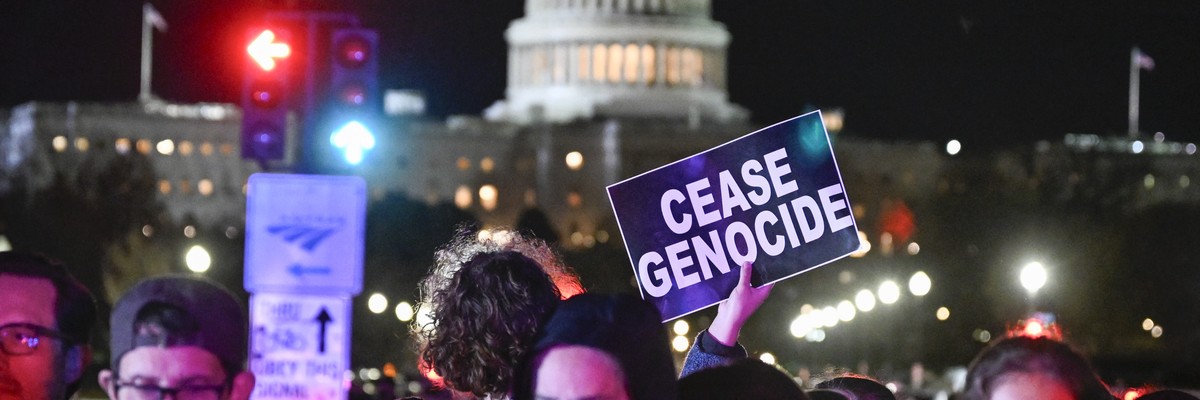
Hundreds of demonstrators demanding an immediate cease-fire in the Gaza Strip march in Washington D.C. on March 7, 2024. (Photo: Celal Gunes/Anadolu via Getty Images)
“Given these numbers,” said one progressive campaigner, “I don’t know how President Biden can reconcile his stalwart support for Israel with the clear preference that his core constituents have for an end to this war.”
A Gallup survey released Wednesday shows that U.S. public support for Israel’s military assault on Gaza has plummeted since November, with the decline particularly sharp among Democratic voters whom President Joe Biden will need to turn out to win reelection against presumptive GOP nominee Donald Trump.
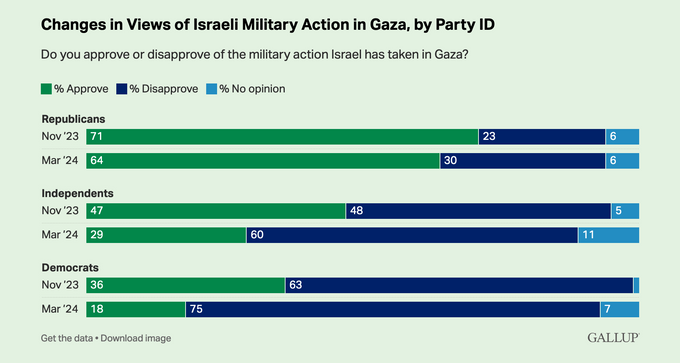
Just 18% of Democratic voters currently approve of “the military action Israel has taken in Gaza” and 75% disapprove, according to the new poll, which was conducted between March 1-20. In November, 36% of Democratic respondents expressed approval of Israel’s war and 63% disapproved.
“The crosstabs are even more striking—nearly two-thirds of people under 54, people of color, and women disapprove of the military action in Gaza,” Sam Rosenthal, political director of the progressive advocacy group RootsAction, told Common Dreams in response to the new poll. “That is effectively the Democratic Party’s base.”
“Given these numbers,” Rosenthal added, “I don’t know how President Biden can reconcile his stalwart support for Israel with the clear preference that his core constituents have for an end to this war.”
Overall, Gallup found that 55% of the American public—including 60% of Independents and 30% of Republicans—disapproves of Israel’s military campaign in the Gaza Strip, up from 45% in November. Just 36% of the U.S. public approves, down from 50% four months ago.
“Biden is risking his second term and our democracy by continuing to support the kind of violence and cruelty that is being perpetrated in Gaza right now.”
Observers noted that Gallup’s new poll was conducted after the Israeli military’s February 29 massacre of Palestinians seeking food aid. Since October, according to one human rights monitor, Israeli forces have killed more than 560 people waiting for humanitarian aid, the delivery of which Israel’s government has intentionally hindered—fueling the spread of famine across the territory.
The Biden administration has backed Israel’s assault from the beginning, providing the Netanyahu government with billions of dollars worth of weapons and diplomatic cover despite widespread and growing protests at home and abroad. Gallup’s survey found that 74% of U.S. adults say they are following developments in Gaza “closely.”
Political analyst Yousef Munayyer wrote on social media that “Biden’s policy of continued support for Israel’s war on Gaza is in line with the views of the right-wing Republicans,” noting that 64% of GOP voters still approve of the Israeli assault—down slightly from 71% in November.
“Just to emphasize how extreme his position is and out of line with his voters,” he added, “more Republicans disapprove of the war than Democrats who approve.”
Growing Democratic opposition to Israel’s military action in Gaza has fueled grassroots campaigns across the country urging voters to mark “uncommitted” on their Democratic primary ballots to pressure Biden to change course ahead of the general election against Trump, who has voiced support for Israel’s devastating assault on Gaza.
“Uncommitted” campaigns won 11 Democratic National Convention (DNC) delegates in Minnesota and two in both Michigan and Washington state.
“Biden is risking his second term and our democracy by continuing to support the kind of violence and cruelty that is being perpetrated in Gaza right now,” Faheem Khan, president of the American Muslim Advancement Council and a lead organizer of Uncommitted WA, said earlier this week.
Rosenthal of RootsAction told Common Dreams on Wednesday that the U.S. decision to abstain and allow the U.N. Security Council to pass a cease-fire resolution earlier this week was “a step in the right direction, and a clear indication that domestic pressure from campaigns like Listen to Michigan and other uncommitted voting efforts is working.”
“However, actual policy towards Israel has changed very little,” said Rosenthal. “Biden is still clamoring for more military aid to be sent, and the U.S. still largely supports Israel’s line, i.e., that military operations in Gaza are solely aimed at rooting out Hamas. What is manifestly obvious to the rest of the world, that Israel is committed to the wanton destruction of the Gaza Strip, is somehow escaping the administration’s notice.”
“President Biden should decide quickly whether he wants to continue to uphold policy that is increasingly associated with the opposition party,” Rosenthal added.
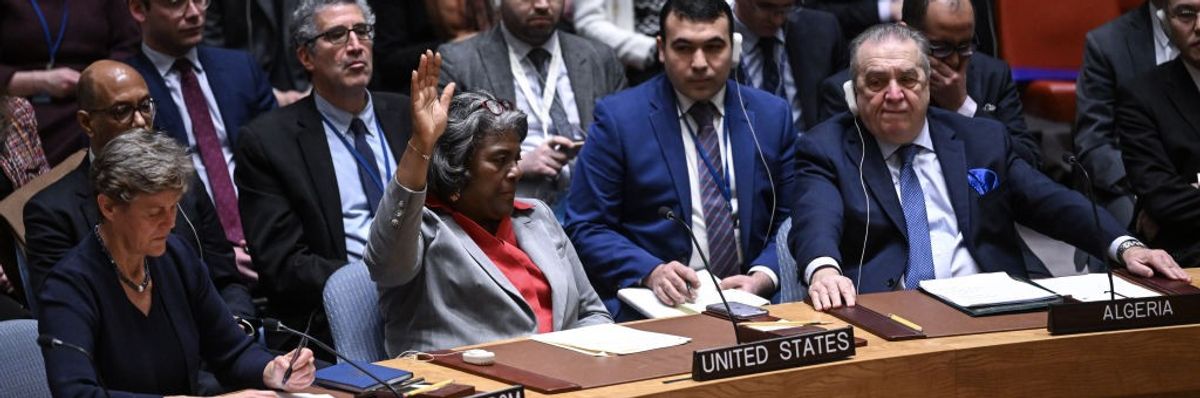
U.S. Ambassador to the United Nations Linda Thomas-Greenfield raises her hand to abstain during a U.N. Security Council vote on a Gaza cease-fire resolution on March 25, 2024 in New York City. (Photo: Fatih Aktas/Anadolu via Getty Images)
“This resolution must be implemented,” said U.N. Secretary-General António Guterres. “Failure would be unforgivable.”
The U.S. on Monday declined to veto but still abstained from a United Nations Security Council on Monday to adopt a resolution demanding an “immediate cease-fire for the month of Ramadan” in the embattled Gaza Strip, a move that came amid an ongoing Israeli genocide in which more than 114,000 Palestinians have been killed or wounded and hundreds of thousands of others are starving.
The Security Council voted 14-0, with the U.S. abstaining, to approve a resolution for the cessation of hostilities during the Muslim holy month after member states overcame a sticking point over the removal of the word “permanent” from an earlier draft version. Instead, the resolution calls for an “immediate” cease-fire.
The U.S. had vetoed three of the previous four cease-fire resolutions.
“This resolution must be implemented,” U.N. Secretary-General António Guterres said following Monday’s vote. “Failure would be unforgivable.”
NEW—The United Nations Security Council has voted 14-0 to demand: –immediate ceasefire for Ramadan leading to "lasting" sustainable ceasefire –immediate unconditional release of all hostages
US abstained, even after successfully pushing to replace word "permanent" with "lasting" pic.twitter.com/zAjvI5nqgE
The resolution is a bare-bones call for a cease-fire during the month of Ramadan, which began on March 11. It also demands the return of about 130 hostages seized in Israel and held in Gaza and emphasizes the urgent need to allow ample lifesaving aid to reach a starving population in the besieged enclave.
The demand to end hostilities has so far eluded the council following the Israeli forces’ invasion of Gaza in October after Hamas attacks left almost 1,200 dead and 240 taken hostage.
Since then, Israel’s daily bombardment alongside its near-total blockade of water, electricity, and lifesaving aid has killed more than 32,000 Palestinians in Gaza, according to the health ministry there, where a recent U.N.-backed report showed an imminent famine unfolding.
Palestinians—especially children—are starving to death in Gaza. Hospitals are under attack, with Israeli forces reportedly executing large numbers of people inside al-Shifa Hospital.
Meanwhile, the approximately 1.5 milllion Palestinians in the southern city of Rafah—most of them refugees forcibly displaced from other parts of Gaza—are bracing for an anticipated ground invasion, which Israeli leaders say will proceed despite a warning from U.S. Vice President Kamala Harris that such an operation would have “consequences.”
Monday’s vote followed intense negotiations over the measure introduced by 10 non-permanent Security Council members—Algeria, Ecuador, Guyana, Japan, Malta, Mozambique, Sierra Leone, Slovenia, South Korea, and Switzerland.
The United States—which, despite growing frustration over genocidal atrocities, still arms Israel—brushed off a threat from far-right Prime Minister Benjamin Netanyahu to cancel a planned visit to Washigton by a high-level Israeli delegation if the U.S. did not veto the resolution.
The Associated Press reported Netanyahu followed through with his threat and canceled the trip.
Human rights defenders welcomed Monday’s vote.
“Israel needs to immediately respond to the U.N. Security Council resolution adopted today by facilitating the delivery of humanitarian aid, ending its starvation of Gaza’s population, and halting unlawful attacks,” Louis Charbonneau, director of Human Rights Watch’s U.N. program, said in a statement.
“Palestinian armed groups should immediately release all civilians held hostage,” he added. “The U.S. and other countries should use their leverage to end atrocities by suspending arms transfers to Israel.”
With over 17 million subscribers, the Morning, the New York Times’ flagship newsletter, is by far the most popular newsletter in the English-speaking world. (It has almost three times as many subscribers as the next most popular newsletter.)
Since October 7, as Israel has waged an unprecedented war on Palestinian children, journalists, hospitals and schools, the New York Times’ highly influential newsletter has bent over backwards to blame everyone but Israel for the carnage.
Waging a legitimate war
According to the Morning—led by head writer David Leonhardt—Israel’s war on Gaza is a targeted operation designed to eliminate Hamas. The Morning propagates this narrative despite well-documented declarations of collective punishment and even genocidal intent by high-ranking Israeli officials—a tendency that South Africa has forcefully documented in their case before the ICJ (UN, 12/29/23). Israeli President Isaac Herzog’s comments on October 12, 2023, are typical: “It’s an entire nation out there that is responsible. It’s not true, this rhetoric about civilians not aware, not involved.”
This sentiment has been echoed by Prime Minister Benjamin Netanyahu, multiple cabinet-level ministers and senior military officials. Speaking from a devastated northern Gaza, one top Israeli army official said (UN, 12/29/23): “Whoever returns here, if they return here after, will find scorched earth. No houses, no agriculture, no nothing. They have no future.”
The Morning (10/13/23) expresses what it sees as the main problem with mass death in Gaza: “The widespread killing of Palestinian civilians would damage Israel’s global reputation.”
Despite these statements and the body of supporting evidence, the Morning has consistently portrayed the war on Gaza as a focused campaign targeting the military infrastructure of Hamas.
For instance, in one October edition (10/13/23), Leonhardt and co-writer Lauren Jackson explained, “Israel’s goals are to prevent Hamas from being able to conduct more attacks and to reestablish the country’s military credibility.”
In similar fashion, in a late January edition (1/28/24), the Morning argued that Israel’s 17-year-long blockade of Gaza is primarily designed to debilitate Hamas—rather than to collectively punish Gazan civilians, as many analysts and human rights groups have argued:
For years, Israel has limited the flow of goods into Gaza, largely to prevent Hamas from gaining access to military supplies.
The Morning did, in the same edition (1/28/24), quote Israeli Defense Minister Yoav Gallant’s comments in the immediate aftermath of October 7:
After the Hamas-led October 7 terrorist attacks, Israel ordered what its defense minister called a “complete siege” of Gaza. The goal was both to weaken Hamas fighters and to ensure that no military supplies could enter.
This is, however, a downright fictional interpretation of Gallant’s quote (Al Jazeera, 10/9/23), given that the Morning failed to quote the next words out of his mouth:
There will be no electricity, no food, no water, no fuel, everything will be closed. We are fighting against human animals, and we are acting accordingly.
Blame the terrorists
The Morning (10/30/23) insists that “Hamas is responsible for many of the civilian deaths” caused by Israel—a division of responsibility it would never apply to civilians killed by Hamas on October 7.
The Morning consistently has argued that Hamas makes densely populated civilian areas legitimate targets for Israeli attacks by conducting military operations nearby. This deflects blame from Israel and frames civilian casualties as a necessary evil, as in the October 30 edition of the newsletter:
Hamas has hidden many weapons under hospitals, schools and mosques so that Israel risks killing civilians, and facing an international backlash, when it fights. Hamas fighters also slip above and below ground, blending with civilians.
These practices mean that Hamas is responsible for many of the civilian deaths, according to international law.
Similar rhetoric was deployed in this December edition (12/20/23):
Hamas has long hidden its fighters and weapons in and under populated civilian areas, such as hospitals and mosques. It does so partly to force Israel to make a gruesome calculation: To fight Hamas, Israel often must also harm civilians.
The Morning has not yet found it pertinent to report on, for instance, the Israeli soldiers who dressed as doctors to gain access to the Ibn Sina Hospital in the West Bank, and proceeded to assassinate three Palestinian militants in their hospital beds.
To the Morning (11/14/23), Israel’s mass slaughter of civilians is unavoidable:
The battle over Al-Shifa Hospital in Gaza highlights a tension that often goes unmentioned in the debate over the war between Israel and Hamas: There may be no way for Israel both to minimize civilian casualties and to eliminate Hamas.
It repeats this line again in a late January edition (1/22/24), once again framing the mass murder of civilians as a “difficult decision”:
The Israeli military faces a difficult decision about how to proceed in southern Gaza…. Israel will not easily be able to eliminate the fighters without killing innocent civilians.
Longer term, there will be more difficult choices. Many steps that Israel could take to reduce civilian casualties in Gaza, such as advance warnings of attacks, would also weaken its attempts to destroy Hamas’s control.
These themes are repeated across all editions of the Morning, and echo throughout the New York Times’ reporting on Israel. Israel’s motivations in the war (beyond eliminating Hamas) go unquestioned, while the openly genocidal statements made by high-ranking politicians and military leaders go unacknowledged.
And when Israeli mass murder of Palestinian civilians is mentioned, it is constantly qualified by the line that Hamas is fully or partially to blame.
‘Civilian death toll in Gaza’
David Leonhardt assures readers of the Morning (12/7/23) that “military experts say that there is probably no way for Israel to topple Hamas without a substantial civilian toll.” The possibility that this means that Israel should therefore not try to “topple Hamas” is not addressed.
Let’s break down one emblematic newsletter (12/7/23) written by Leonhardt in December, in which he “puts the [civilian death] toll in context and explains the reason for it.”
Leonhardt began by qualifying the Palestinian death toll—around 17,000 at time of writing in early December. First, he delegitimized the Gaza Health Ministry, which, he wrote, “seems to have spread false information during the war.” Though he acknowledged that “many international observers believe that the overall death toll is accurate…as do some top Israeli officials,” he wrote that “there is more debate about the breakdown between civilian and combatant deaths.” Leonhardt went on:
A senior Israeli military official told my colleague Isabel Kershner this week that about a third of the dead were likely Hamas-allied fighters, rather than civilians. Gazan officials have suggested that the combatant toll is lower, and the civilian toll higher, based on their breakdown of deaths among men, women and children.
Leonhardt only informs readers that Hamas has spread false information, while neglecting to mention Israel’s documented history of lying to the press (IMEU, 10/17/23; Intercept, 2/27/24). He also declined to investigate the implausibility of his source’s figure: At this point in the war, about 30% of Palestinian fatalities were adult men, meaning the Israeli figure implies that essentially every adult man killed by Israel was a Hamas fighter—all civilian men being miraculously spared.
Next, Leonhardt attempted to explain “who is most responsible for the high civilian death toll”—concluding, even before describing them, that “different people obviously put different amounts of blame on each.”
First he named Israel, and contextualized and rationalized Israel’s war crimes:
After the October 7 attacks—in which Hamas fighters killed more than 1,200 people, while committing sexual assault and torture, sometimes on video—Israeli leaders promised to eliminate Hamas. Israel is seeking to kill Hamas fighters, destroy their weapons stockpiles and collapse their network of tunnels. To do so, Israel has dropped 2,000-pound bombs on Gaza’s densely populated neighborhoods.
Note that Leonhardt framed the war as a campaign only to “kill Hamas fighters, destroy their weapons stockpiles and collapse their network of tunnels,” despite the evidence that Israel has targeted civilian infrastructure, journalists, healthcare workers and aid workers—actions backed by the aforementioned statements of genocidal intent.
Though Leonhardt briefly mentioned that Israel’s war has drawn international criticism, he made no mention of international law and concluded with his refrain that Israel can hardly avoid causing the deaths of “substantial” numbers of civilians:
Nonetheless, military experts say that there is probably no way for Israel to topple Hamas without a substantial civilian toll. The question is whether the toll could be lower than it has been.
Next, Leonhardt turned to his condemnation of Hamas:
The second responsible party is Hamas. It hides weapons in schools, mosques and hospitals, and its fighters disguise themselves as civilians, all of which are violations of international law.
This approach both helps Hamas to survive against a more powerful enemy — the Israeli military—and contributes to Hamas’s efforts to delegitimize Israel. The group has vowed to repeat the October 7 attacks and ultimately destroy Israel. Hamas’s strategy involves forcing Israel to choose between allowing Hamas to exist and killing Palestinian civilians.
Hamas is simply not prioritizing Palestinian lives.
It is notable that—unlike with Israel—Leonhardt did not attempt to contextualize Hamas’ actions by noting the horrifying conditions that Israel has imposed on Gaza for years, or the over 900 Palestinian children killed by Israel in the decade preceding October 7. To Leonhardt, history is only relevant when it justifies Israeli aggression.
While Leonhardt states unequivocally that Hamas is violating international law, he does not find it worthwhile to investigate Israel’s flagrant and abundantlydocumented violations of international law. He also does not mention the Palestinian right to resist occupation, a right enshrined under international law.
This unequal treatment leads straight to the jarringly contrasting conclusions, in which he essentially excuses Israel’s genocidal war as unavoidable, while he condemns Hamas for “simply not prioritizing Palestinian lives.”
Leonhardt’s December 7 piece is not an aberration: It is emblematic of the language, selective contextualization and framing that the Times‘ Morning newsletter wields to provide ideological cover for Israel’s crimes.