Tag: hospitals

  • ‘Crime Against Humanity’: UN Inquiry Details Israeli ‘Extermination’ of Gaza Healthcare

    Spread the love

    Original article by Brett Wilkins republished from Common Dreams under Creative Commons (CC BY-NC-ND 3.0). 
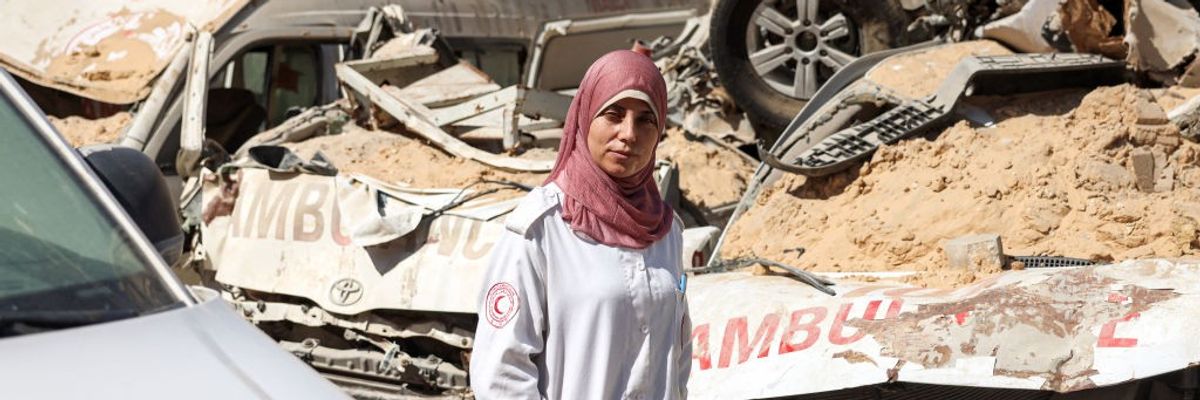
    Palestinian paramedic Maha Wafi, 43, walks past destroyed ambulances destroyed by Israeli attacks in Khan Yunis in the southern Gaza Strip on September 15, 2024. (Photo: Bashar Taleb/AFP via Getty Images)

    “Israel must immediately stop its unprecedented wanton destruction of healthcare facilities in Gaza,” the head of the inquiry stressed.

    For the second time this year, a United Nations commission tasked with investigating Israel’s conduct during its yearlong invasion and blockade of Gaza has found that the U.S.-armed Israeli military is committing crimes against humanity against Palestinians.

    The Independent International Commission of Inquiry on the Occupied Palestinian Territory released a report Thursday detailing how “Israel has perpetrated a concerted policy to destroy Gaza’s healthcare system as part of a broader assault on Gaza, committing war crimes and the crime against humanity of extermination with relentless and deliberate attacks on medical personnel and facilities.”

    “The commission also investigated the treatment of Palestinian detainees in Israel and of Israeli and foreign hostages in Gaza since October 7, 2023 and concluded that Israel and Palestinian armed groups are responsible for torture and sexual and gender-based violence,” the Office of the U.N. High Commissioner for Human Rights (OHCHR) said in a summary of the report.

    The report cites the U.N. World Health Organization’s findings that Israel carried out 498 attacks on healthcare facilities in the Gaza Strip between October 7, 2023—when Hamas launched the deadliest-ever attack on Israel—and July 30, 2024.

    “A total of 747 persons were killed directly in those attacks, and 969 others were injured, and 110 facilities were affected,” the publication states. The report calls the attacks “widespread and systematic.”

    The commission continued:

    Israeli security forces carried out air strikes against hospitals, causing considerable damage to buildings and surroundings, as well as multiple casualties; surrounded and besieged hospital premises; prevented the entry of goods and medical equipment and exit/entry of civilians; issued evacuation orders but prevented safe evacuations; and raided hospitals, arresting hospital staff and patients. Israeli security forces also obstructed access by humanitarian agencies.

    “Israel must immediately stop its unprecedented wanton destruction of healthcare facilities in Gaza,” said commission chair Navi Pillay. “By targeting healthcare facilities, Israel is targeting the right to health itself with significant long-term detrimental effects on the civilian population. Children in particular have borne the brunt of these attacks, suffering both directly and indirectly from the collapse of the health system.”

    OHCHR said that “attacks on medical facilities in Gaza, particularly those devoted to pediatric and neonatal care, have led to incalculable suffering of child patients, including newborns.”

    “In continuing these attacks, Israel has violated children’s right to life, denied children access to basic healthcare, and deliberately inflicted conditions of life resulting in the destruction of generations of Palestinian children and, potentially, the Palestinian people as a group,” the agency added.

    The commission’s inquiry found that as of July 15, “113 ambulances had been attacked and at least 61 had been damaged,” including vehicles used by the U.N., International Committee of the Red Cross (ICRC), the Palestine Red Crescent Society (PRCS), and other organizations.

    “Access was also reduced owing to closure of areas by Israeli security forces, [and] delays in coordination of safe routes, checkpoints, searches, or destruction of roads,” the report notes.

    The commission investigated the January 29 attack that killed 6-year-old Hind Rajab and six of her relatives, as well as two paramedics who had Israeli permission to attempt to rescue them.

    “They were attacked while trying to evacuate in their car,” the report said of the family. “The ambulance, carrying two paramedics, Yousef Zeino and Ahmed al-Madhoun, was dispatched after its route had been coordinated with Israeli security forces. It was hit by a tank shell at a distance of some 50 meters from the family’s car.”

    “Hind was still alive at the time that the ambulance was dispatched,” the publication noted. “The presence of Israeli security forces in the area prevented access. As a result, the family members’ bodies could not be retrieved from their bullet-ridden car until 12 days after the incident.”

    Israel Defense Forces officials have repeatedly claimed that no IDF troops were in the area at the time of the attack. Multiple journalistic investigations, including one published Tuesday by Sky News, showed that Israeli tank and machine gun fire killed the family and paramedics.

    The new report’s authors also noted that “hundreds of medical personnel, including three hospital directors and the head of an orthopedic department, as well as patients and journalists were arrested by Israeli security forces” during raids on Gaza medical facilities.

    “Reportedly, 128 health workers remain detained by Israeli authorities as of July 15, including four PRCS staff members,” the publication states.

    “The institutionalized mistreatment of Palestinian detainees, a longstanding characteristic of the occupation, took place under direct orders from the Israeli minister in charge of the prison system, Itamar Ben-Gvir, and was fueled by Israeli government statements inciting violence and retribution,” said OHCHR.

    The commission report also detailed crimes committed by Hamas and other Palestinian armed groups against Israelis on and after October 7, 2023, when more than 1,100 Israelis and others were killed—at least some by so-called “friendly fire” and under the fratricidal Hannibal Directive—and over 240 people abducted.

    Hostages “were mistreated to inflict physical pain and severe mental suffering, including physical violence, abuse, sexual violence, forced isolation, limited access to hygiene facilities, water and food, threats and humiliation,” OHCHR said. “Hamas and other Palestinian armed groups committed the war crimes of torture, inhuman or cruel treatment, and the crimes against humanity of enforced disappearance and other inhumane acts causing great suffering or serious injury.”

    In June, the same U.N. commission found Israel’s far-right government responsible for a range of war crimes and crimes against humanity in the Gaza Strip, including “extermination, torture, forcible transfer, and the use of starvation as a weapon of warfare.”

    Over the course of its 370-day assault on Gaza, Israeli forces have killed at least 42,010 Palestinians in the coastal enclave—most of them women and children—and wounded more than 97,700 others, according to the Gaza Ministry of Health and international agencies.

    At least 10,000 Palestinians are missing and believed to be dead and buried beneath the rubble of hundreds of thousands of bombed buildings. Israel’s “complete siege” of Gaza has forcibly displaced more than 90% of Gaza’s 2.3 million people, and has contributed to the starvation and sickening of hundreds of thousands of Gazans.

    Israel is on trial for genocide at the U.N. International Court of Justice. Meanwhile, International Criminal Court Prosecutor Karim Khan is seeking arrest warrants for Israeli Prime Minister Benjamin Netanyahu, Israeli Defense Minister Yoav Gallant, and three Hamas leaders—at least one of whom, political chief Ismail Haniyeh, has been assassinated—for alleged war crimes and crimes against humanity, including extermination.

    Original article by Brett Wilkins republished from Common Dreams under Creative Commons (CC BY-NC-ND 3.0). 
  • One year of Israel’s war on Gaza’s health system

    Spread the love

    Original article by Ana Vračar republished from peoples dispatch under a Creative Commons Attribution-ShareAlike 4.0 (CC BY-SA) license.

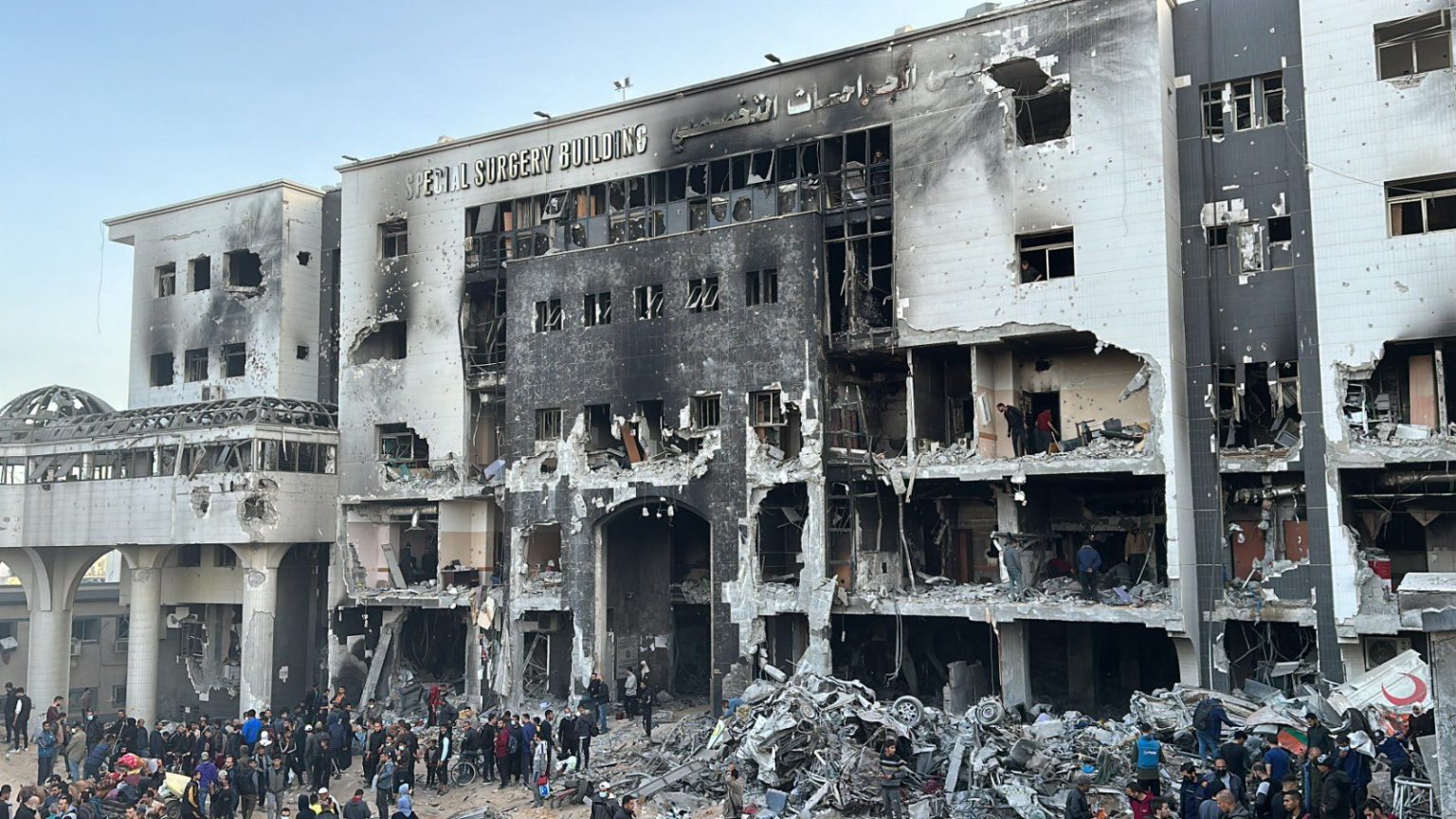
    Al Shifa Hospital after a two-week Israeli siege, April 2024.

    After a year of unrelenting Israeli attacks, Gaza’s healthcare system lies in ruins. Yet, health workers continue their steadfast efforts to provide care

    After a year of relentless bombardment, Gaza’s healthcare system lies in ruins, and the warnings Palestinians have issued for decades are being confirmed: hospitals, clinics, and health workers are deliberate targets of Israeli Occupation Forces (IOF). What was once a systematic campaign against healthcare has escalated into an all-out assault, resulting in the decimation of most of the infrastructure. As the one-year anniversary of this ongoing genocide approached, Israeli forces continued their siege on northern Gaza, intensifying their attacks on health facilities.

    Three hospitals still barely functioning in the area — including Al-Awda and Kamal Adwan — were just issued so-called “evacuation orders,” which, as pointed out by Medical Aid for Palestinians (MAP), are nothing short of forced removal orders. Kamal Adwan’s director, Hussam Abu Safiya, stressed the impossible position the hospital faced soon after the orders were issued. With critically injured children in their care, no means to safely evacuate them, and no other facility able to accept them, health staff are faced with the excruciating decision of either abandoning their patients or staying at the risk of their own lives.

    “In between the constant bombardment occurring on the hospital and the surrounding buildings, the healthcare staff have become terrorized to a point where they are struggling to do their jobs,” Abu Safiya stated. Their situation is similar to that faced in other health facilities. Around the same time Abu Safiya recorded his statement, medics in Al-Awda were also issued forced removal orders—for the third time in a year—says Matilde De Cooman from Viva Salud, a Belgian organization partnering with the hospital.

    The risks health workers face are all too real. Israeli forces have systematically besieged and destroyed healthcare infrastructure over the past 12 months, including Gaza’s largest hospitals, such as Al-Shifa. Under the pretext of searching for resistance fighters, the IOF raided operating rooms, destroyed medical equipment, and abducted patients and medical staff. In the aftermath of the attacks, civil defense teams discovered seven mass graves containing 520 bodies on hospital grounds.

    Read more: Remember the Palestinian doctors killed by Israel

    Over 1,000 health workers have been killed since the genocide began, with hundreds more kidnapped and held in Israeli concentration camps. Those who have been released share harrowing accounts of torture: shackles, electric shocks, broken limbs, and sexual violence. Families of those still missing, like Dr. Ahmed Muhanna, the director of Al-Awda Hospital in northern Gaza, are not granted any official information about prisoners’ conditions. Dr. Muhanna was abducted in December 2023. Since then, no official word has emerged about his mental or physical condition, says De Cooman.

    International campaigns to secure the release of Dr. Muhanna and other abducted health workers are ongoing, though disturbing reports of their treatment in Israeli camps have sparked both outrage and fear about what the future holds. Despite these developments, Gaza’s health workers remain resolute, refusing to abandon their patients. Their unwavering commitment, sumud (steadfastness), has been lauded by global health workers since the beginning of the genocide. Operating without pay or essential supplies due to the blockade, they have continued their work tirelessly since last October. “Even with Dr. Muhanna’s fate in mind, Al-Awda’s operating director, Mohammed Salha, never once considered abandoning the hospital,” says De Cooman. “As long as there is even one person left in the area, the hospital will remain open and stand by its people.”

    Read more: Fears of flooding add to Gaza’s health crisis

    The health suffering in Gaza extends far beyond the hospitals. With more than two million people pushed into poverty by the attacks and the aid blockade, food and clean water are scarce. Recent reports reveal that 35% of children and 40% of pregnant or breastfeeding women in Gaza are surviving on just one type of food. Malnutrition is rampant, and the World Health Organization (WHO) has documented cases of children starving to death as humanitarian aid convoys are blocked at Israeli-controlled checkpoints.

    Hunger and disease go hand-in-hand, as the WHO continues to repeat. Gaza is witnessing a hard-to-imagine surge in infectious diseases—respiratory infections, skin diseases, Hepatitis A, and even polio, a virus that had been eradicated decades ago but resurfaced, paralyzing a 10-month-old child. The shortage of basic hygiene products, such as soap and clean water, only adds to the crisis.

    The spread of diseases is anything but collateral damage: it is a calculated weapon in Israel’s strategy. As Jewish Voice for Peace remarked, in prisons, “skin diseases are a method of punishment. Prison authorities are allowing scabies to spread by restricting Palestinian inmates’ water supply and depriving them of clean clothes and medical care.”

    Read more: Palestinian health workers in Gaza describe torture and abuse in Israeli detention

    On top of it all, Gaza’s whole environment is contaminated with asbestos dust raised by the constant bombardment. An estimated 800,000 tonnes of debris in Gaza could contain asbestos particles, as reported by Al Jazeera, raising the prospect of soaring cancer rates in the coming years.

    “After a year, the occupying forces continue to practice an unprecedented genocide in modern history. What is particularly painful is the disgusting silence of the international community,” stated Hani Serag, Co-Chair of the People’s Health Movement. “We hope that activists across the world will continue expressing their solidarity to Palestinian people and refuse the barbaric practices of the occupying forces.”

    Israeli crimes against healthcare are not confined to Gaza. In less than a month, Israeli forces have killed over 100 health workers in Lebanon and forced the closure of dozens of health centers. The destruction unfolding in Gaza serves as a blueprint for the invasion of Lebanon, raising the question: how long will the West look away while Israel continues its rampage?

    People’s Health Dispatch is a fortnightly bulletin published by the People’s Health Movement and Peoples Dispatch. For more articles and subscription to People’s Health Dispatch, click here.

    Original article by Ana Vračar republished from peoples dispatch under a Creative Commons Attribution-ShareAlike 4.0 (CC BY-SA) license.

  • ‘No End to Hell’: Disaster Spirals as Israeli Assault Traps 400,000 in Northern Gaza

    Spread the love

    Original article by Jake Johnson republished from Common Dreams under Creative Commons (CC BY-NC-ND 3.0). 

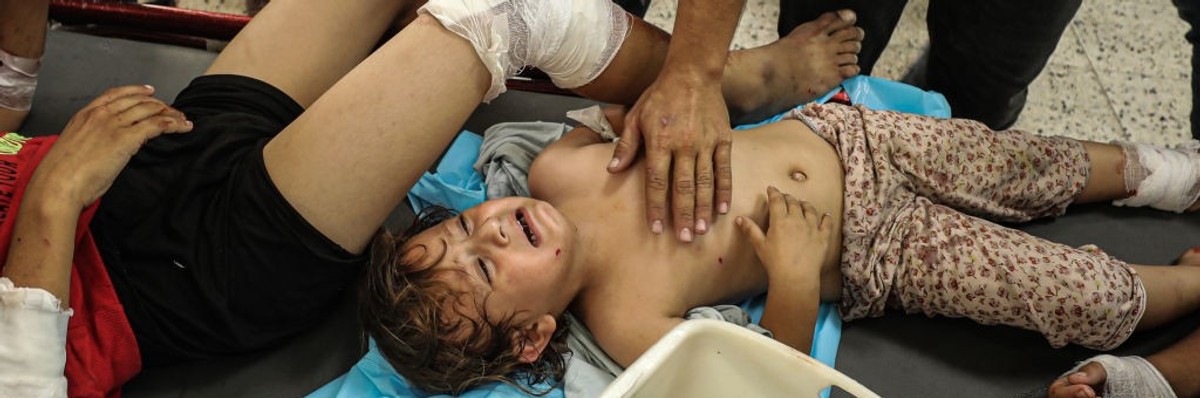
    A Palestinian child who was wounded in an Israeli attack on Jabalia, Gaza receives treatment on October 9, 2024. (Photo: Dawoud Abo Alkas/Anadolu via Getty Images)

    “The latest move to forcefully and violently push thousands of people from northern Gaza to the south is turning the north into a lifeless desert,” warned one aid worker.

    The head of the United Nations agency for Palestinian refugees said Wednesday that at least 400,000 people are trapped in northern Gaza as Israeli forces ramp up their bombardment of the area, killing dozens and intensifying an already nightmarish humanitarian emergency.

    “Northern Gaza: no end to hell,” Philippe Lazzarini, commissioner-general of the United Nations Relief and Works Agency for Palestine Refugees in the Near East (UNRWA), wrote on social media. “Recent evacuation orders from the Israeli authorities are forcing people to flee again and again, especially from Jabalia Camp. Many are refusing because they know too well that no place anywhere in Gaza is safe.”

    Lazzarini said some UNRWA shelters and services in northern Gaza have been forced to shut down amid the Israeli assault “for the first time since the war began” over a year ago.

    “With almost no basic supplies available, hunger is spreading and deepening again,” said Lazzarini. “This recent military operation also threatens the implementation of the second phase of the polio vaccination campaign for children. Children are as ever, the first and most to suffer. They deserve so much better, they deserve a cease-fire now, they deserve a future.”

    Zero humanitarian aid has entered besieged northern Gaza in over a week, according to aid groups and the U.N., and incessant Israeli attacks have rendered the area’s hospitals largely inaccessible. Israeli forces have ordered the area’s hospitals to evacuate, endangering patients and healthcare workers.

    https://twitter.com/francesleach_/status/1843728823298445676?ref_src=twsrc%5Etfw%7Ctwcamp%5Etweetembed%7Ctwterm%5E1843728823298445676%7Ctwgr%5Ecfd39eaab1069e7dd089e53b7ba55e9d7caf6d54%7Ctwcon%5Es1_c10&ref_url=https%3A%2F%2Fwww.commondreams.org%2Fnews%2Fisrael-northern-gaza-2669366558

    The director of northern Gaza’s Kamal Adwan Hospital told Drop Site on Wednesday that he is refusing to comply with Israel’s evacuation order.

    “As long as there are patients, I won’t leave,” said Dr. Hossam Abu Safia. “I’ve been here since the genocide started, and I am determined to continue helping my people.”

    At least dozens of people have reportedly been killed in the Israeli military’s latest assault on northern Gaza, but emergency workers on the ground have said it’s impossible to determine the true toll given Israel’s ongoing bombing campaign, which has targeted the Jabalia refugee camp and other areas in the region.

    Citing Gaza’s Civil Defense, The Associated Press reported Wednesday that an Israeli airstrike “hit a family home” in the Jabalia camp, “killing at least nine people”—including two women and two children.

    “Footage shared by the Civil Defense showed first responders recovering dead bodies and body parts from under the rubble,” the outlet noted.

    On Monday—the one-year anniversary of the Hamas-led October 7 attack and the beginning of Israel’s devastating response—Israeli forces ordered swaths of famine-stricken northern Gaza to evacuate, instructing residents to move south to Deir Al-Balah and Al-Mawasi, badly overcrowded so-called “humanitarian zones” that the Israeli military has repeatedly bombed.

    After ordering most of northern Gaza to evacuate, Israeli forces fired on Palestinians desperately trying to flee.

    https://twitter.com/mhdksafa/status/1843952667791642816?ref_src=twsrc%5Etfw%7Ctwcamp%5Etweetembed%7Ctwterm%5E1843952667791642816%7Ctwgr%5Ecfd39eaab1069e7dd089e53b7ba55e9d7caf6d54%7Ctwcon%5Es1_c10&ref_url=https%3A%2F%2Fwww.commondreams.org%2Fnews%2Fisrael-northern-gaza-2669366558

    Médecins Sans Frontières (MSF), also known as Doctors Without Borders, said Tuesday that Israel’s forced displacement of Palestinians is “turning the north of Gaza into an unlivable wasteland, effectively emptying out the whole north of the strip of Palestinian life.”

    “The latest move to forcefully and violently push thousands of people from northern Gaza to the south is turning the north into a lifeless desert, while aggravating the situation in the south, where more than one million people have already been squeezed into a small portion of the Gaza Strip and live in deplorable conditions,” said Sarah Vuylsteke, an MSF project coordinator in Gaza.

    “Access to water, healthcare, and safety is already almost nonexistent, and the thought of more people fitting into this space is impossible to imagine,” Vuylsteke added. “People have been subjected to endless displacement and relentless bombing for the past 12 months. Enough is enough, this must stop now.”

    In a joint statement on Wednesday, a coalition of 18 aid groups warned that the ongoing Israeli assault “will worsen the already dire humanitarian situation in the north” and has already “prevented international and national humanitarian organizations from carrying out already very limited lifesaving aid operations.”

    “The new orders have obstructed humanitarian actors from providing necessities such as health services, clean water, food, and nutrition services, taking away the remaining lifelines for the civilian population,” reads the statement signed by Oxfam, ActionAid, Islamic Relief, and more than a dozen other groups.

    “Nowhere in Gaza is safe for civilians,” the coalition said. “Given the severity of the needs, humanitarian actors must be able to distribute aid and continue their work, without threat of displacement or military operations. The undersigned aid organizations urge all parties to the conflict to uphold their obligations to protect civilians and facilitate unhindered humanitarian access at all times.”

    Original article by Jake Johnson republished from Common Dreams under Creative Commons (CC BY-NC-ND 3.0). 

  • Israel Killed 28 Lebanese Medical Workers in 24 Hours, 73 Since War’s Start: WHO

    Spread the love

    Original article by Brett Wilkins republished from Common Dreams under Creative Commons (CC BY-NC-ND 3.0). 
    A broken stethoscope and surgical glove are seen after Israeli warplanes bombed a building in the Bachoura area of Beirut, Lebanon on October 3, 2024. (Photo: Murat Sengul/Anadolu via Getty Images)

    “I’m afraid first about my safety and about my family’s safety because there’s no safe place in Lebanon now,” said one physician.

    The head of the United Nations World Health Organization said Thursday that Israeli forces killed 28 healthcare workers in Lebanon over the previous 24 hours, and that 73 medical personnel are among the nearly 2,000 Lebanese killed during Israel’s bombing and invasion of its northern neighbor.

    “In southern Lebanon, 37 health facilities have been closed, while in Beirut, three hospitals have been forced to fully evacuate staff and patients, and another two were partially evacuated,” WHO Director-General Tedros Adhanom Ghebreyesus said during a press conference in Geneva. “And yet healthcare continues to come under attack. In Lebanon alone, 28 health workers have been killed in the last 24 hours.”

    Tedros said the WHO “calls on urgent facilitation of flights to deliver health supplies to Lebanon,” adding, “Lives depend on it!”

    Lebanese Health Minister Firas Al-Abiad said separately Thursday that more than 40 paramedics and firefighters have been killed by Israeli forces over the previous three days.

    Dr. Abdinasir Abubakar, the acting WHO representative in Lebanon, said that “most of those healthcare workers killed in the last 24 hours, most of them—actually, all of them—were on duty.”

    “Some of them were in the ambulances, some of them were in the health facilities,” Abubakar added. “They were on duty trying to help civilians who have been wounded in the conflict.”

    Dr. Fathalla Fattouh, the head cardiovascular and thoracic surgeon at Rafik Hariri University Hospital (RHUH) in Jnah, just outside Beirut, described the chaos he witnessed firsthand, including “a surge of nearly identical injuries—amputations, eye trauma, and shattered hip and femur bones—straining the hospital’s capacity to a near-breaking point.”

    “We were forced to make difficult decisions,” he added. “I believe that we did our best relying on available capacities, but with the escalation of events we need to plan for the worst.”

    Sara, a surgeon at the hospital, said that “there are only two hospitals in Lebanon prepared to treat burn patients, and once they were at capacity, we were left with nowhere to send the patients we received.”

    “It was a feeling of helplessness that we had never experienced before,” she added.

    Some doctors admitted fearing for their lives.

    “It’s hard to work in fear,” Dr. Mohammad Taoube, who heads the emergency room at an undisclosed hospital in southern Lebanon, told Sky News on Wednesday. “I’m afraid first about my safety and about my family’s safety because there’s no safe place in Lebanon now.”

    According to figures provided by the WHO Regional Office for the Eastern Mediterranean, Israeli forces have killed 1,974 people in Lebanon—including at least 127 children—while wounding 9,384 others in recent weeks.

    At least one American has been killed by Israeli bombing of Lebanon this week. Hajj Kamel Ahmad Jawad, 56, of Dearborn, Michigan was killed Tuesday while in Nabatieth in southern Lebanon caring for his sick mother and volunteering to help elderly, disabled, and injured patients at a local hospital.

    The Nabatieth area has come under heavy Israeli bombardment. Local journalists said the city’s main hospital “came under direct Israeli fire” on Friday and that two nurses were killed.

    Lebanese officials said Friday that more than 1.2 million people have been forcibly displaced amid Israel’s recent bombing and invasion of their country. The Israeli campaign comes amid attacks by the political and paramilitary group Hezbollah, whose rockets and other projectiles have killed or wounded scores of Israelis and forced tens of thousands from their homes.

    Residents of southern Lebanon described the terror of coming under Israeli bombardment and having to flee for their lives. One woman, Fatima, and her 14-year-old daughter Zeinab said they were in their home preparing for a school exam when the shelling started.

    “My mother told us to pack our things quickly, and we left in a rush,” Zeinab told the U.N. Children’s Fund on Thursday. “My siblings were crying. The journey was terrifying.”

    “The shelling was all around us, and the sound of explosions echoed everywhere,” she said while crying. “We miss home dearly and yearn to return.”

    Tedros noted that since last October, when Hezbollah began launching rockets at Israel in solidarity with Gaza after Hamas-led militants attacked Israel, over 1 million Lebanese have been displaced, with many seeking refuge in neighboring Syria.

    He also said that “since the 7th of October last year, more than 1,500 people have been killed in Israel, almost 42,000 in Gaza, and more than 700 in the West Bank.”

    “In addition,” Tedros added, “more than 10,000 people are missing in Gaza, and 1.9 million people are displaced, while 101 hostages taken from Israel remain in Gaza.”

    Hundreds of Palestinians working in the health sector have been killed in Gaza by Israeli forces, who have deliberately targeted medical workers. Israeli troops have also allegedly tortured doctors and other medical workers after kidnapping them from the coastal enclave.

    Tedros on Thursday stressed the need for “deescalation of the conflict; for healthcare to be protected and not attacked; for access routes to be secured and supplies delivered; and for a cease-fire, a political solution, and peace.”

    “The best medicine,” he said, “is peace.”

    Original article by Brett Wilkins republished from Common Dreams under Creative Commons (CC BY-NC-ND 3.0). 

  • Analysis Details How Israel’s Gaza Siege ‘Is Driving a Humanitarian Disaster’

    Spread the love

    Original article by Brett Wilkins republished from Common Dreams under Creative Commons (CC BY-NC-ND 3.0). 
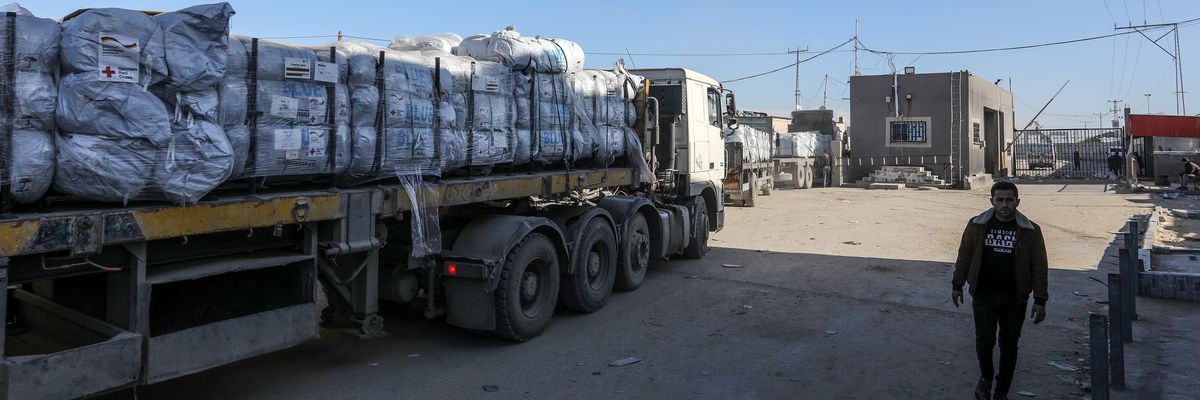
    Trucks carrying aid supplies to Gaza are seen at the Karem Abu Salem border crossing on February 17, 2024. (Photo: Abed Rahim Khatib/Anadolu via Getty Images)

    “Over 11 months, we have reached shocking levels of conflict, displacement, disease, and hunger,” said one campaigner.

    Israel’s “complete siege” of the Gaza Strip “is driving a humanitarian disaster,” with 83% of required food aid failing to enter the embattled enclave, where the entire population is facing hunger and disease and almost half a million Palestinians are at risk of starvation, an analysis published Monday revealed.starvation,

    The analysis by 15 international aid organizations noted that a record-low average of just 69 aid trucks are entering the Gaza Strip each day, compared with an already insufficient 500 daily truckloads a year ago. Additionally, the groups said that “only 17 out of Gaza’s 36 hospitals remain partially functional, and “critical infrastructure such as water networks, sanitation facilities, and bread mills” have been destroyed.

    “While Israeli military attacks on Gaza intensify, lifesaving food, medicine, medical supplies, fuel, and tents have been systematically blocked from entering for almost a year,” the aid groups—which include ActionAid, American Friends Service Committee, CARE International, Christian Aid, Islamic Aid, Oxfam International, and Save the Children—said in a statement.

    The publication highlights numerous ways that “lifesaving aid is systematically obstructed on a daily basis” in Gaza.

    “These include the denial of safety, with more than 40,000 Palestinians and nearly 300 aid workers killed since last October; the sharp tightening of a 17-year blockade to a full siege, which prevents aid from entering Gaza; delays and denials which restrict the movement of aid around Gaza; tightly restrictive and unpredictable control of imports; the destruction of public infrastructure such as schools and hospitals; and the displacement of civilians and humanitarian workers,” the analysis’ authors wrote.

    Zenab, a 33-year-old Palestinian woman pregnant with her second child, said that her pregnancy “has been the hardest time of my life.”

    “It was also hard to get the medication I needed,” she continued. Sometimes I had to walk for hours to different pharmacies, hospitals, and health centers to see if anyone had my medication available. For me as a pregnant woman, there has been hardly any healthcare support, no proper hygiene and sanitation, and no suitable mattress to sleep on.”

    “I was suffering from complications during my pregnancy,” Zenab added. “We didn’t have enough water to drink, and had hardly any food. The doctors again told me that my pregnancy was in danger.”

    Among the report’s key findings:

    • 83% of required food aid doesn’t make it into Gaza, up from 34% in 2023;
    • An estimated 50,000 children aged between 6-59 months urgently require treatment for malnutrition by the end of the year;
    • 65% of the insulin required and half of the required blood supply are not available in Gaza;
    • Availability of hygiene items has dropped to 15% of the amount available in September 2023, with 1 million women now going without the hygiene supplies they need;
    • Only around 1,500 hospital beds in Gaza remain operational, compared to around 3,500 beds in 2023 which was already well below sufficient to meet the needs of a population of more than 2 million people; and
    • 1.87 million people are in need of shelter with at least 60% of homes destroyed or damaged as of January, yet tents for around just 25,000 people have entered Gaza since May 2024.

    “There is a shortage of all humanitarian items. We are overwhelmed [with] these needs and [these] urgent requirements,” said Amjad Al Shawa, director of the Palestinian NGOs Network. “People [are] starving due to the shortage of aid. One hundred percent of the population depends on humanitarian aid.”

    The authors of the analysis—which was released ahead of this week’s United Nations General Assembly in New York—are demanding that Israel secure an immediate and lasting cease-fire. They are also calling for an arms embargo on Israel and Israeli compliance with the recent International Court of Justice (ICJ) advisory opinion, which found that the occupation of Palestine is an illegal form of apartheid that must end immediately. Israel is on trial for genocide in a separate ICJ case.

    “The situation was intolerable long before last October’s escalation and is beyond catastrophic now.”

    “The situation was intolerable long before last October’s escalation and is beyond catastrophic now,” CARE International West Bank and Gaza country director Jolien Veldwijik said in a statement. “Over 11 months, we have reached shocking levels of conflict, displacement, disease, and hunger.”

    That includes dozens of children who have died due to malnutrition, dehydration, and lack of adequate medical care.

    “Aid is still not getting in, and humanitarian workers are risking their lives to do their jobs while attacks and violations of international law intensify,” Veldwijik added. “Aid, which is urgently required for 2.2 million people at risk of dying in the coming weeks and months, should never be politicized. We demand an immediate and sustained cease-fire, and the free flow of humanitarian aid into and throughout Gaza.”

    Original article by Brett Wilkins republished from Common Dreams under Creative Commons (CC BY-NC-ND 3.0).