Equinix datacentre under construction (right) and an operational datacentre (left) in Slough. Photograph: Bloomberg/Getty Images
Government says Green leader’s proposed moratorium on ‘energy-guzzling’ AI projects would be disaster for economy
Labour has rejected calls to pause construction of major AI infrastructure in Britain after the Green party leader, Zack Polanski, said it was time to “slam the brakes on these energy-guzzling, water-guzzling datacentres”.
The government hit back at the opposition party’s proposal of a “moratorium other than [for] local-scale datacentres for the local community”, saying it “would be a disaster for jobs and national security”.
The Greens’ call for a pause comes amid one of the UK’s worst droughts in years and predictions that datacentres’ electricity use, now standing at about 2.5% of the UK’s supply, will rise fourfold by 2030.
Datacentres contain the processing chips that power billions of AI prompts every day and Labour has designated them as critical national infrastructure, a decision Polanski called “outrageous”. “To most people critical infrastructure means hospitals, water, electricity,” he said. “It doesn’t mean artificial intelligence.”
He added: “Right now the government is putting our communities, our water security and our climate ambitions second to the demands of tech giants.”
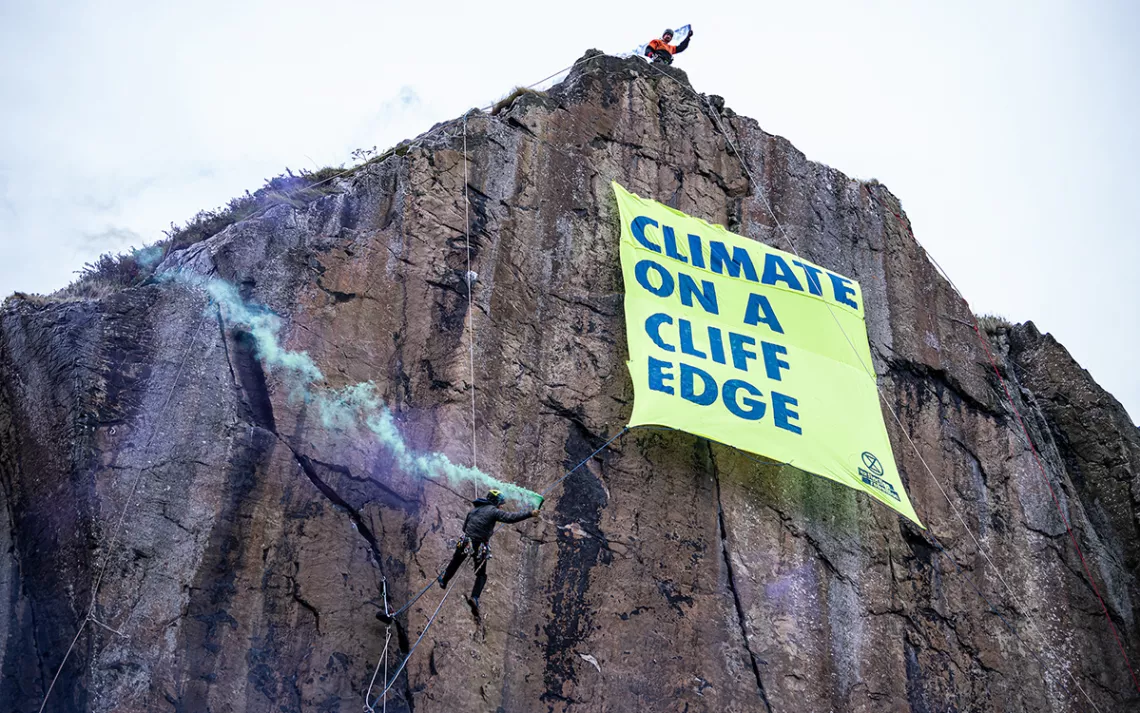
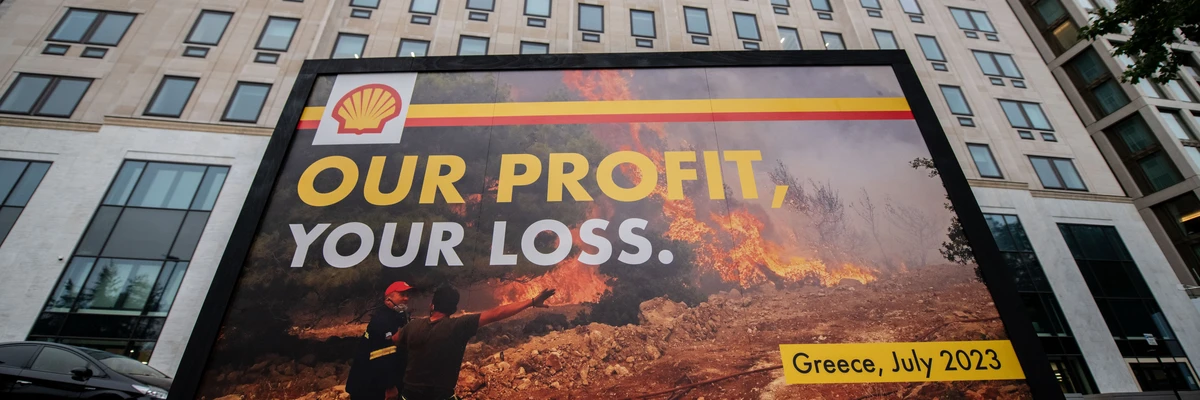
Experienced climbers scale a rock face near the historic Dumbarton castle in Glasgow, releasing a banner that reads “Climate on a Cliff Edge.” One activist, dressed as a globe, symbolically looms near the edge, while another plays the bagpipes on the shores below. | Photo courtesy of Extinction Rebellion and Mark RichardsGreenpeace activists display a billboard during a protest outside Shell headquarters on July 27, 2023 in London. (Photo: Handout/Chris J. Ratcliffe for Greenpeace via Getty Images)Donald Trump urges you to be a Climate Science denier like him. He says that he makes millions and millions for destroying the planet, Burn, Baby, Burn and Flood, Baby, Flood.
Daniele Rugo’s documentary turns the testimony of British and international medics who worked in Gaza into a searing record of what is described in the film as Israel’s “genocidal frenzy”.
Hospitals represent life. The killing of people inside them, the doctors in Life Support say, is a line that should never have been crossed. Daniele Rugo’s 93-minute documentary opens with British doctors talking about Gaza, their connection to it, the resilience of the people there and a love of life that even decades of siege has not extinguished, before showing what happened when that line was crossed, again and again, over two years.
The film had its world premiere at Sheffield DocFest on 13 June 2026, where it was nominated for the festival’s Tim Hetherington Award, followed by a Q&A with Rugo and contributors Dr Ana Jeelani and Prof Nick Maynard. A public premiere follows at Curzon Mayfair on 9 July. Most of what is on screen was shot by the doctors themselves, on their phones, in the middle of treating patients. MEMO was given an early preview of Life Support ahead of its public premiere at Curzon.
Rugo’s starting point, as he puts it, was simple: surgeons, physicians and nurses went to Gaza to support their Palestinian colleagues and ended up as “the sole international observers” of a genocide. Foreign media have been barred from entering Gaza throughout the war. The doctors who passed through Medical Aid for Palestinians (MAP), Healthcare Workers 4 Palestine and similar routes were, for long stretches, among the only outsiders able to see what was happening inside the enclave.
The names will be familiar to anyone who has followed British medics’ accounts since October 2023: Dr Victoria Rose, the London-based reconstructive surgeon who has worked in Gaza since 2016 and has been on four missions since the war began; Prof Nick Maynard, the Oxford gastrointestinal surgeon who helped set up Gaza’s cancer services; and Dr Tanya Haj Hassan, the paediatric intensive care doctor and one of the few international witnesses to reach the north of the Strip. Dr James Smith, Dr Deborah Harrington, Dr Khaled Dawas and Dr Ana Jeelani also appear.
Their testimonies, painfully delivered, are as heart-wrenching as they are inspirational. Rose recalls using her own initiative to take essential medical kit into Gaza in 23 suitcases. Jeelani describes operating without electricity or proper instruments, on wounded children who often needed repeated surgery. Maynard, who has worked in other war zones, says the scale of destruction in Gaza was on a different level.
Outside the hospitals hours of unseen footages filmed a dystopian landscape of buildings razed as far as the eye can see, alongside the daily life that somehow continues around it. This footage is vital because the film is not only about the wounded, the starving and the dead, but about the destruction of the institutions that make human life possible: hospitals, schools, religious buildings and the civic centres that sustain a people, a culture and a civilisation.
What the doctors describe is not only the bombing of buildings, but the destruction of the conditions that allow human existence to continue. This gives the film its wider charge: it is not only a record of war, but of what the doctors repeatedly understand as genocide.
“This is a war on civilians,” Haj Hassan says, describing wards filled with children and elderly women. The cases the doctors treat reflect Gaza’s population under siege: children, women, the elderly and the displaced. They speak of Palestinian medics operating after being told their own relatives had been killed, and of health workers fainting from hunger and exhaustion mid-shift. The footage from inside Al-Shifa hospital after Israel’s withdrawal, including the mass graves hospital staff were left to exhume themselves, is among the hardest material in the film to sit through.
The film also addresses one of the central justifications used by Israel for its attacks on Gaza’s hospitals: the claim that they were being used by Hamas. The doctors answer this directly. Despite hearing the allegation repeated by Israeli officials and echoed by Western governments, they say they saw no evidence to support it. For them, the destruction of Gaza’s hospitals cannot be explained away as a military necessity. It is part of a wider assault on everything that sustains life.
That is where the film’s argument about genocide becomes unavoidable. Maynard says he did not use the word lightly and initially resisted it. But after what he witnessed in Gaza, he reached a different conclusion. The film follows that moral and intellectual shift carefully, showing how doctors who entered Gaza to provide medical care came out asking how such devastation had been allowed to continue.
The documentary then widens the lens, turning to genocide scholars to explain the role of dehumanisation. They describe it as a common feature of genocides, from Rwanda onwards: a process by which a people are stripped of their humanity before violence against them is normalised. In Gaza, the film suggests, that process has been visible not only in language, but in the targeting of the very environment needed for human life to continue. As one contributor puts it, Palestinians have been dehumanised “in a way that we’ve not seen anywhere else in modern times.”
The doctors do not leave Gaza as they entered it. They arrive to treat the wounded and support Palestinian colleagues, but what they see makes it impossible for them simply to return home and move on. “You cannot witness what is happening in Gaza and not emerge enraged and determined to stop it,” one doctor says. That sense of responsibility runs through the film: having seen what they have seen, the doctors know that silence is no longer possible.
The film also shows how Israel’s policy of starvation became another weapon deployed against Palestinians. We see what that meant for Gaza’s children, and for the parents and doctors trying desperately to keep them alive with almost nothing. The documentary links this suffering to the Gaza Humanitarian Foundation, whose aid distribution system turned the search for food into a life-and-death situation for Palestinians.
Yet Life Support is not only a film about suffering. It also shows how Palestinians continue to hold on to their humanity, dignity and will to live amid conditions designed to break them. The doctors help carry Gaza’s story to the outside world, but they are not the centre of it. At the centre are the Palestinian doctors, nurses and medical teams who keep treating patients with almost nothing, relying on courage, skill and sheer determination to keep people alive.
Rugo brings the same concern with memory and violence that shaped his previous film, The Soil and The Sea, which documented mass graves from Lebanon’s civil war. In Life Support, he works with editor Masahiro Hirakubo to hold together material that is often extremely painful to watch without losing sight of the people at the heart of the film: the doctors, the patients and the Palestinian medical workers trying to keep Gaza alive.
The film’s sound is equally important. Palestinian composer Habib Shehada Hanna is joined by Robert Del Naja and Euan Dickinson of Massive Attack, giving the documentary a soundtrack that deepens its emotional force. The film’s executive producers include Hollywood star Susan Sarandon, Melissa Barrera, Farah Nabulsi and Asif Kapadia. Ken Loach has called the film “compulsory viewing.”
He is right. Life Support does not try to make its subject easier to watch, and it should not. What it leaves you with is a record of who kept Gaza’s hospitals running, what it cost them, and how much of it the world chose not to see.
Keir Starmer objects to criticism of the IDF. He asks how could anyone object to them starving people to death, forced marches like the Nazis did, bombing Gaza’s hospitals and universities, mass-murdering journalists, healthworkers and starving people queuing for food, killing and raping prisoners and murdering children. He calls for people to stop obstructing his genocide for Israel.Orcas discuss Donald Trump and the killer apes’ concept of democracy. Front Orca warns that Trump is crashing his country’s economy and that everything he does he does for the fantastically wealthy.
US Rep. Rashida Tlaib (D-Mich.) speaks during a press conference with families of Americans killed by Israeli forces on September 16, 2025, in Washington DC. (Photo by Celal Gunes/Anadolu via Getty Images)
“We are witnessing the same genocidal playbook used against Palestinians in Gaza, now in Lebanon,” Rep. Rashida Tlaib said.
As Israel ramps up its devastating invasion of Lebanon, Rep. Rashida Tlaib has introduced legislation in the US House of Representatives aimed at blocking US support.
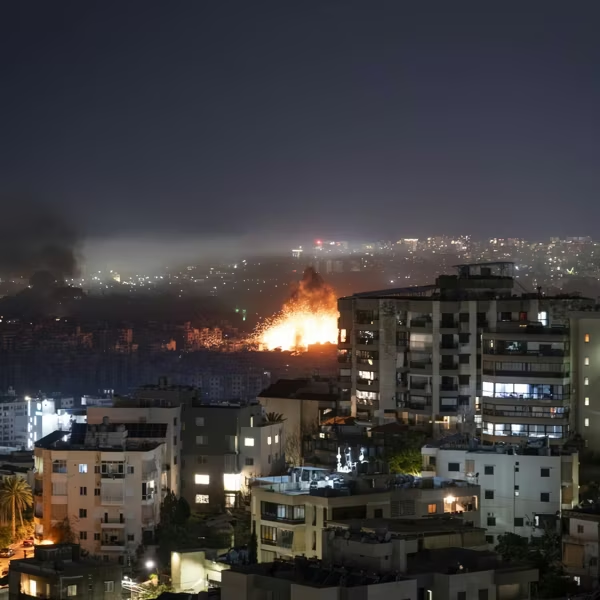
Israel’s latest onslaught against Lebanon, launched after the militant group Hezbollah retaliated against the joint US-Israeli attack against Iran at the end of February, has already killed more than 1,100 people, including at least 121 children, according to the Lebanese Health Ministry.
Many pieces of civilian infrastructure—including hospitals, schools, and residential buildings—have been attacked, and Israel has issued forced evacuation orders that have led more than 1 million people to be displaced from their homes.
“Thousands of families in our district with strong ties to Lebanon are living through immense pain,” said Tlaib, who represents a district that includes parts of Detroit and surrounding suburbs. “Many have lost loved ones, watched their grandparents’ towns and villages be completely destroyed, and seen relatives uprooted from their homes, not knowing if they will ever be able to return.”
Tlaib (D-Mich.), the only Palestinian-American member of Congress, introduced two resolutions on Friday. The first calls on the US to use its leverage to end Israel’s land and air assaults against Lebanese territory, denounce efforts at territorial expansion, and investigate alleged crimes against humanity.
The second, cosponsored by Reps. Delia Ramirez (D-Ill.) and Nydia Velázquez (D-NY), is a war powers resolution that would require President Donald Trump to remove US forces from participation in all military actions in Lebanon that have not been authorized by Congress.
I'm introducing two resolutions standing with the people of Lebanon against the U.S.-backed Israeli invasion. The first resolution calls on the United States to force an end to the Israeli military invasion, reject threats of the illegal occupation of Lebanese territory,… pic.twitter.com/qgrtNhOkxq
— Congresswoman Rashida Tlaib (@RepRashida) March 27, 2026
In recent days, Israel has expanded its ground operation, aiming to control the entire territory south of the Litani River indefinitely. Leaders of the military campaign, such as Defense Minister Israel Katz, have suggested using the genocidal war in Gaza as a “model” for Lebanon, including the full destruction of residential areas.
“We are witnessing the same genocidal playbook used against Palestinians in Gaza, now in Lebanon,” Tlaib said. “Israeli leaders are openly celebrating it. This ethnic cleansing campaign is only possible because of US support, funded by our tax dollars. We must act now to stop these crimes against humanity and illegal invasion of Lebanon.”
Nathan Thompson, a senior analyst at Just Foreign Policy, which advised Tlaib on the legislation, told Common Dreams that although the US military and Israel Defense Forces (IDF) are “deeply operationally integrated, and have only become more so since October 7, 2023,” the extent of direct US involvement in Lebanon has been kept secret from the public.
“Military officials wouldn’t say whether or not they provided targeting assistance for Israel’s airstrikes on Hezbollah in 2024, and that’s exactly the type of action Congress has considered to be unauthorized ‘hostilities’ under the War Powers Act in the past,” Thompson said.
However, he said, “We know that the IDF and the US military are linked at the hip—on weapons sales, missile defense, targeting assistance, everything.”
Tlaib’s resolutions come as another war powers resolution to limit Trump’s ability to launch more attacks against Iran appears to have gained enough support to pass the House, although Democratic leadership has chosen to delay the vote until mid-April despite warnings that Trump may soon dramatically escalate the war, including with US ground troops.
That bill remains viable due to limited Republican support, including from Reps. Thomas Massie (Ky.), Warren Davidson (Ohio), and Nancy Mace (SC). While Massie has been a consistent anti-war vote, it’s unclear whether other Republicans, as well as some pro-Israel Democrats, would similarly sign onto a resolution concerning Lebanon.
Thompson said the Lebanon-related legislation is an “urgently necessary tool to end US complicity” as Israeli officials are “talking about functionally annexing southern Lebanon and recreating Gaza-level destruction there.”
He said, “A war powers vote forces all of Congress to go on the record: Do you want the US to enable this genocide, or not?”
Keir Starmer objects to criticism of the IDF. He asks how could anyone object to them starving people to death, forced marches like the Nazis did, bombing Gaza’s hospitals and universities, mass-murdering journalists, healthworkers and starving people queuing for food, killing and raping prisoners and murdering children. He calls for people to stop obstructing his genocide for Israel.
This work by Middle East Monitor is licensed under a Creative Commons Attribution-NonCommercial-ShareAlike 4.0 International License.
Gustavo Petro, Colombia’s president, during the United Nations General Assembly (UNGA) in New York, US, on Tuesday, Sept. 23, 2025. [Photographer: Michael Nagle/Bloomberg via Getty Images]
In one of the most daring and controversial political interventions to echo through the halls of the United Nations in decades, Colombian President Gustavo Petro, in his address to the UN General Assembly on 23 September 2025, called for the creation of an international army that transcends the traditional balance of power and whose first mission would be the liberation of Palestine from Israeli occupation and the cessation of the ongoing genocide in Gaza.
The speech drew widespread global attention, opening the door to a complex debate on the future of the international order, the limits of international law, and the possibility of a fundamental transformation toward a new architecture of international relations that moves beyond bipolarity and the centrality of U.S. power.
Petro: The end of words and the beginning of action
In his speech, President Gustavo Petro sharply criticised the current international order, asserting that a world dominated by a single power and complicit in genocide cannot credibly claim to defend democracy or human rights. He emphasised that statements and declarations are no longer sufficient amid the mass killings in Gaza, calling for the creation of an international armed force composed of states that reject genocide, tasked with protecting threatened populations and enforcing international justice. Petro declared: “We need a strong army of nations that do not accept genocide… We must gather weapons and armies. We must liberate Palestine.”
Invoking Simón Bolívar, he added: “We are tired of words… It is time for the sword of liberty or death.”
In later remarks posted on X (formerly Twitter), Petro announced plans to submit a draft resolution to the UN General Assembly to establish a “global army for justice,” with its first mission focused on liberating Palestine,” marking a dramatic call for action over [sic]
Petro’s proposal marks a significant shift in international political discourse. Since the UN’s founding in 1945, international forces have primarily focused on post-conflict peacekeeping, operating under limited mandates and with Security Council approval. Petro, however, envisions a force designed not to maintain the status quo but to actively change it, intervening militarily to prevent genocide and end occupation. This transition from neutrality to action challenges core principles of international law, including state sovereignty and non-intervention, while contesting the Security Council’s monopoly, particularly its five permanent members, over the authorised use of force. Petro suggested that such a force could be established through the General Assembly, referencing the 1950 “Uniting for Peace” resolution, when the Assembly bypassed a deadlocked Security Council to authorize military intervention in Korea, setting a precedent for acting when conventional mechanisms fail.
Enormous political and legal obstacles
Despite Petro’s bold proposal, formidable obstacles make its near-term realization highly unlikely. The UN’s legal framework restricts the use of force to the Security Council, where the US holds veto power and would never allow the creation of a force that could act against Israel, its key Middle Eastern ally. Geopolitical realities also hinder the formation of a global coalition outside the Western security umbrella. Even countries critical of Israeli policies, including EU members and Global South states, may resist joining a force that risks direct confrontation with Israel or the U.S Additionally, there is a significant lack of collective political will: while smaller and medium-sized states often use strong rhetoric, turning such words into military action demands a consensus that is currently absent. Past struggles to reform the Security Council or establish war crimes tribunals underscore how difficult it is to translate ambitious ideas into action within today’s entrenched power structures.
The significance and timing of Petro’s speech
Despite significant practical obstacles, Petro’s speech carries profound symbolic and political weight in shaping global discourse on Palestine and the international order. He reframes the Palestinian issue from a mere “conflict” to an act of “genocide,” shifting the debate from political negotiation to one centered on liberation and international justice. His references to “Bolívar’s sword” and an “army of justice” seek to place Palestine at the core of a broader struggle against double standards and for global legitimacy.
Moreover, Petro’s call sparks renewed debate on reforming the United Nations. Beyond advocating for a force dedicated to Palestine, he highlights the failure of the current system to prevent genocides in Rwanda, Syria, Myanmar, and now Gaza. The proposed army thus symbolizes a deeper demand for rebuilding the international order on fairer, more pluralistic foundations.
Finally, the speech underscores a shift within the Global South. From Colombia to South Africa and Brazil, states on the geopolitical periphery are increasingly using the UN stage to challenge the Global North’s dominance and redefine concepts of legitimacy. Petro’s message aligns with this momentum, adding new strategic depth to the Palestinian cause within emerging international alliances.
President Petro’s speech comes at a critical moment, as Gaza endures one of the most brutal Israeli military campaigns since the Nakba. UN agencies and human rights organizations, including OCHA, Oxfam, and Human Rights Watch, report the killing of tens of thousands of civilians and the widespread destruction of vital infrastructure, including hospitals, schools, and relief centers. The UN has also documented the deaths of hundreds of humanitarian workers, in what international organizations describe as the largest targeting of the humanitarian sector in modern conflict.
In this context, Petro’s speech becomes more than a theoretical proposal, it is a cry against a world that remains silent in the face of genocide. His call to form an “army of justice” is, at its core, an expression of the failure of the international system to fulfill its most fundamental duty: protecting civilians and enforcing international law.
And while the idea may be unattainable at present, it exposes the glaring gap between the UN’s rhetoric and its reality, opening the door to rethinking the mechanisms of collective international action.
Conclusion
President Petro’s project to form an international army to liberate Palestine may seem, in the realpolitik balance, a utopian dream difficult to achieve amid current power dynamics. Yet, in the realm of symbolic and strategic politics, it reflects a profound shift in how international justice, Palestine, and the global order itself are conceived.
The speech will not change the world tomorrow, but it could mark a turning point in a longer trajectory toward reshaping international institutions so that they are capable of confronting genocide and injustice. And just as Simón Bolívar’s words once ignited the liberation of entire continents, President Petro’s speech may, even if only in the long run, be the spark that drives the world to contemplate a global army for justice, one whose first mission would begin in Gaza, if Gaza, as we know it, still exists.
The views expressed in this article belong to the author and do not necessarily reflect the editorial policy of Middle East Monitor.
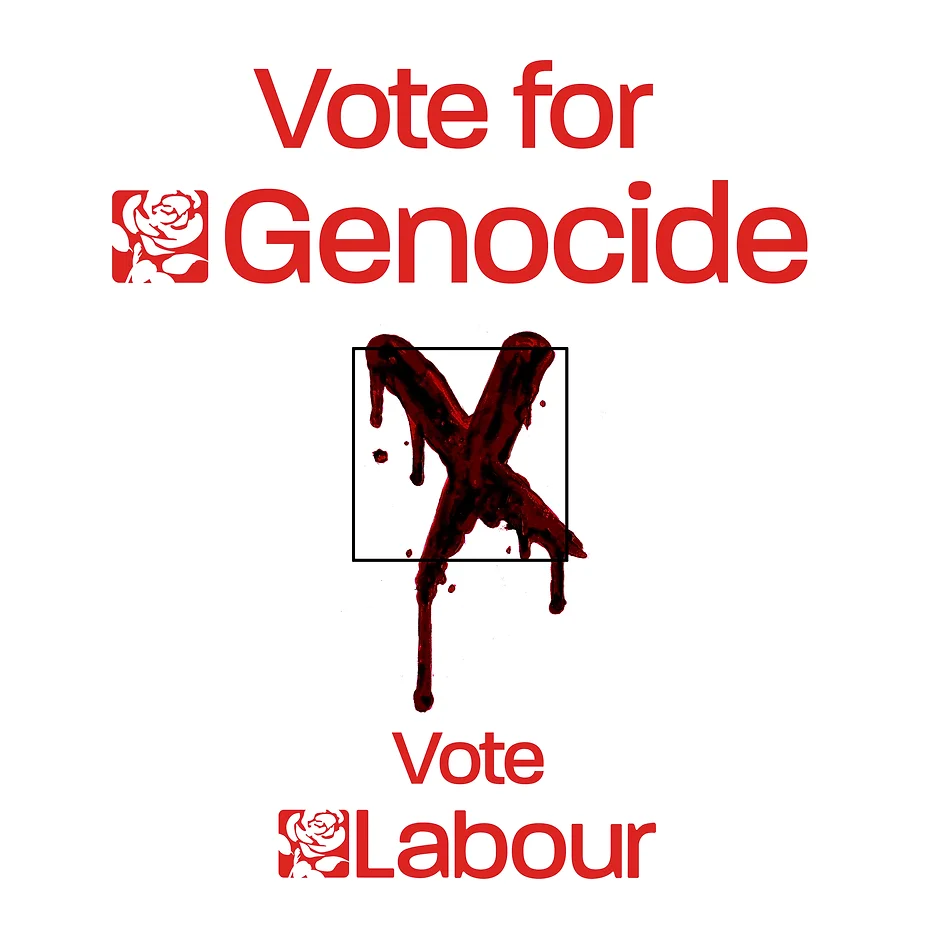
Genocide denier and Current UK Prime Minister Keir Starmer is quoted that he supports Zionism without qualification. He also confirms that UK air force support has been essential in Israel’s mass-murdering genocide. Includes URLs https://www.declassifieduk.org/keir-starmers-100-spy-flights-over-gaza-in-support-of-israel/ and https://youtu.be/O74hZCKKdpAKeir Starmer objects to criticism of the IDF. He asks how could anyone object to them starving people to death, forced marches like the Nazis did, bombing Gaza’s hospitals and universities, mass-murdering journalists, healthworkers and starving people queuing for food, killing and raping prisoners and murdering children. He calls for people to stop obstructing his genocide for Israel.Vote Labour for Genocide.
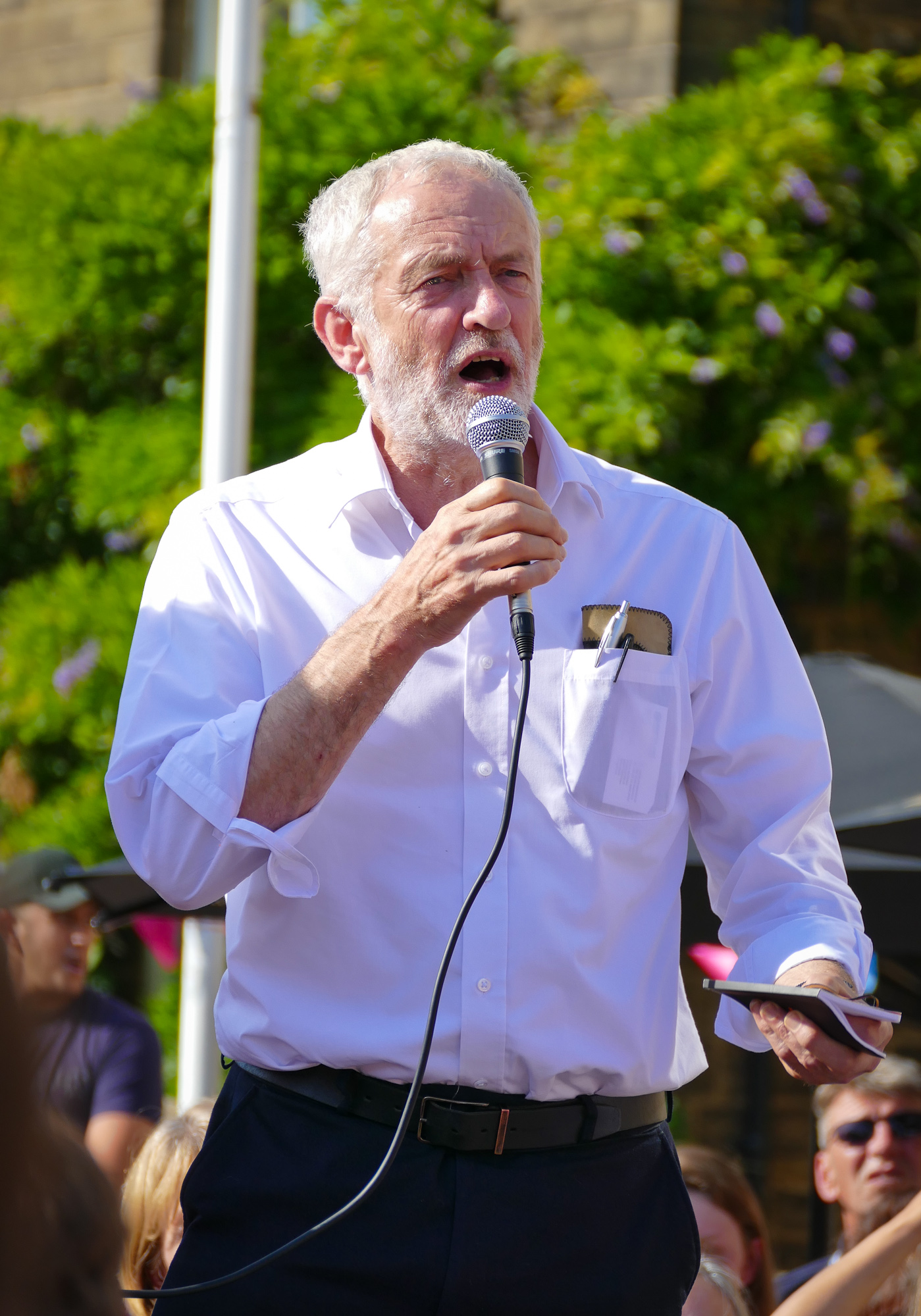
Instead of addressing child poverty, homelessness, poor working conditions or any of the real issues impacting this country, Labour has chosen to deflect the blame and pour billions into arms, says Jeremy Corbyn. Britain is tired of having no political choice – and we’re here to fix that
…
Over the past year, the government has continued a programme of austerity and privatisation. It has refused to lift the two-child benefit cap, the single biggest driver of child poverty. It has tried to take away the winter fuel allowance. It has increased the bus fare cap. And it has tried to take away £5bn from disabled people, curating a two-tiered benefit system that deprives thousands of people of a dignified life.
There is one area where the government has been very generous, though: arms spending. Government military spending is now at £31.7bn, which is a 6 per cent increase in real terms from last year. Imagine how much better ordinary people’s lives would be if we spent that money on schools, hospitals and green energy instead.
…
People have had enough of a political regime that serves the interests of billionaires and corporations. They have had enough of a government that inflicts suffering at home and enables genocide abroad. They have had enough of broken promises from political parties that fail to deliver real change.
Keir Starmer says that the Labour Party under his leadership all feel a small part of Scunthorpe.Keir Starmer explains the moral case for cutting disability benefits. He says work will set you free.Palestine Action joke that appeared in the UK satirical magazine ‘Private Eye’.