US activist shot by Israeli forces in West Bank

Spread the love

Original article republished from peoples dispatch under a Creative Commons Attribution-ShareAlike 4.0 (CC BY-SA) license.

Aysenur Ezgi Eygi was shot dead by Israeli forces (Photo via Wafa)

The shooting occurred while Israeli forces were violently suppressing a weekly protest against an Israeli settlement

26-year-old US activist Aysenur Ezgi Eygi succumbed to her wounds on Friday after being shot by Israeli forces at a protest in Beita, to the south of Nablus. Headlines from Western mainstream media sources have already attempted to obscure who killed the solidarity activist, with CNN stating “American activist shot dead during protest in West Bank, Palestinian officials say,” CBS News writing, “American woman Aysenur Eygi killed in Israeli-occupied West Bank, US confirms,” and BBC writing. “American activist shot dead in occupied West Bank.”

The shooting occurred while Israeli forces were violently suppressing a weekly protest against an Israeli settlement. Israeli forces employed live ammunition, stun grenades, and tear gas, and also resulted in the injury of an 18-year-old Palestinian man via shrapnel. Eygi was reportedly part of the Faz’a campaign, which aims to mobilize international solidarity activists on the ground in Palestine to protect Palestinian farmers from Israeli settlers and military forces. Eygi was also an activist with the International Solidarity Movement, a Palestinian-led organization committed to resisting the occupation. 

ISM released a statement condemning Eygi’s killing, quoting multiple ISM members. ISM volunteer Mariam Dag (a pseudonymn) witnessed the shooting, and said ““We were peacefully demonstrating alongside Palestinians against the colonization of their land, and the illegal settlement of Evyatar. The situation escalated when the Israeli army began to fire tear gas and live ammunition, forcing us to retreat. We were standing on the road, about 200 meters from the soldiers, with a sniper clearly visible on the roof. Our fellow volunteer was standing a bit further back, near an olive tree with some other activists. Despite this, the army intentionally shot her in the head.”

Dag continued, “This is just another example of the decades of impunity granted to the Israeli government and army, bolstered by the support of the US and European governments, who are complicit in enabling genocide in Gaza. Palestinians have suffered far too long under the weight of colonization. We will continue to stand in solidarity and honor the martyrs until Palestine is free.”

The Palestinian Ministry of Foreign Affairs condemned the “brutal execution committed today by Israeli occupation forces,” stating that “the ministry views this act as part of the ongoing crimes perpetrated by the Israeli occupation against the Palestinian people, including genocide, forced displacement, and the targeting of individuals who show solidarity with the Palestinian cause.”

The Ministry “calls on the international community, human rights organizations, and global institutions to take urgent action to provide international protection for Palestinians. The Ministry urges these entities to fulfill their legal and moral responsibilities by addressing violations, including genocide, forced displacement, illegal settlements, and extrajudicial killings, and to hold Israeli war criminals accountable.”

It is unclear how the United States will respond, beyond offering their “deepest condolences.” Israel has killed several US citizens, including two Palestinian-American teenagers earlier this year, Mohammad Khdour and Tawfic Abdel Jabbar, both 17 years old, also shot by Israeli forces. US Secretary of State Antony Blinken again offered condolences for the teenagers “who reportedly were killed,” but did nothing more than call for an investigation. 

“We’ve made clear that with regard to the incidents you’ve alluded to, there needs to be an investigation. We need to get the facts. And if appropriate, there needs to be accountability,” Blinken said at the time. 

The families were unsatisfied with the US’s response. “We don’t need talking, man,” said Adnan Khdour, uncle to Mohammad Khdour, killed by Israeli forces in the West Bank. “We need something. We want to see something.” The US has never conditioned aid to Israel based on the killing of a US citizen. 

Eygi’s killing recalls the high-profile case of Israel’s murder of US activist Rachel Corrie in 2003, who was run over by a bulldozer trying to demolish a Palestinian home in Rafah. The United States did nothing to punish Israel, despite US officials themselves claiming that the Israeli investigation into Corrie’s death was not “credible.” In fact, the US itself is complicit in the killing as the Caterpillar bulldozer which killed Corrie was supplied by the US as part of its aid to Israel.

The Party for Socialism and Liberation, a US-based socialist political party active in the Palestine solidarity movement, said of Eygi’s killing: “This killing, like so many others, was carried out thanks to weaponry provided by the United States. We demand the Biden administration end all aid to this genocidal regime. The killers of Aysenur should be brought to justice, alongside the killers of thousands of Palestinians.”

Original article republished from peoples dispatch under a Creative Commons Attribution-ShareAlike 4.0 (CC BY-SA) license.

Continue ReadingUS activist shot by Israeli forces in West Bank

Amnesty War Crimes Probe Exposes Israel’s ‘Wanton Destruction’ in Gaza

Spread the love

Original article by Brett Wilkins republished from Common Dreams under a CC licence.

A Palestinian woman surveys the destruction by Israeli forces of her home and neighborhood in Khuza’a, which is located near Gaza’s border with Israel, on November 25, 2023. (Photo: Mustafa Hassona/Anadolu via Getty Images)

“The creation of any ‘buffer zone’ must not amount to the collective punishment of the Palestinian civilians who lived in these neighborhoods,” warned one Amnesty campaigner.

Amnesty International said Thursday that the Israeli military should be investigated for the “war crimes of wanton destruction and of collective punishment” over its destruction of entire communities along Gaza’s border with Israel.

“Using bulldozers and manually laid explosives, the Israeli military has unlawfully destroyed agricultural land and civilian buildings, razing entire neighborhoods, including homes, schools, and mosques,” the London-based rights group said in a new investigation.

Amnesty analyzed satellite imagery, as well as photos and videos posted online by invading Israel Defense Forces troops between October and May, and found that the IDF has cleared wide swathes of land up to 1.2 miles (1.8 km) wide along Gaza’s eastern border.

“In some videos, Israeli soldiers are seen posing for pictures or toasting in celebration as buildings are demolished in the background,” the report states.

Israeli forces laid waste to much of Khuza’a in Khan Younis governate, under the pretext that Hamas-led militants attacked southern Israel from the town on October 7.

Salem Qudeih, a teacher who lived in Khuza’a about a mile from the border, told Amnesty that “around my family home we had a three dunam (0.7 acre) orchard full of fruit trees. They were all destroyed. Only an apple tree and a rose were left.”

“I had bees and produced honey. All of it is gone now,” he added. “Out of the 222 houses of my relatives in the area, only about a dozen remain. My home—where I lived with my wife, my five daughters, and one son—was completely destroyed.”

Erika Guevara-Rosas, Amnesty’s senior director for research, advocacy, policy, and campaigns, said in a statement: “The Israeli military’s relentless campaign of ruin in Gaza is one of wanton destruction. Our research has shown how Israeli forces have obliterated residential buildings, forced thousands of families from their homes, and rendered their land uninhabitable.”

“Our analysis reveals a pattern along the eastern perimeter of Gaza that is consistent with the systematic destruction of an entire area,” she continued. “These homes were not destroyed as the result of intense fighting. Rather, the Israeli military deliberately razed the land after they had taken control of the area.”

“The creation of any ‘buffer zone’ must not amount to the collective punishment of the Palestinian civilians who lived in these neighborhoods,” Guevara-Rosas added. “Israel’s measures to protect Israelis from attacks from Gaza must be carried out in conformity with its obligations under international law, including the prohibition of wanton destruction and of collective punishment.”

“The Israeli military deliberately razed the land after they had taken control of the area.”

Other experts—including United Nations officials and scholars—have previously highlighted what Robert Pape, a U.S. military historian and University of Chicago professor, described as “one of the most intense civilian punishment campaigns in history.”

In the 335 days since October 7, Israeli forces have killed or maimed more than 145,000 Palestinians in Gaza while forcibly displacing almost all of the embattled strip’s 2.3 million people and destroying hundreds of thousands of homes and other structures, according to Palestinian and international officials. Rebuilding after Israel’s obliteration of Gaza’s civilian infrastructure is expected to cost over $18.5 billion, or nearly Palestine’s entire annual gross domestic product.

Israel is currently on trial for genocide at the International Court of Justice in The Hague. Meanwhile, International Criminal Court (ICC) Prosecutor Karim Khan has applied for warrants to arrest Israeli Prime Minister Benjamin Netanyahu, Israeli Defense Minister Yoav Gallant, and Hamas leaders for alleged war crimes including extermination.

“International humanitarian law, which applies in situations of armed conflict, including during military occupation, is comprised of rules whose central purpose is to limit, to the maximum extent feasible, human suffering in times of armed conflict,” Amnesty explained Thursday.

The group noted that under the Fourth Geneva Convention, “extensive destruction and appropriation of property, not justified by military necessity and carried out unlawfully and wantonly,” is a war crime.

Additionally, the treaty bans collective punishment of civilians, stating that “no protected person may be punished for an offense he or she has not personally committed.”

Amnesty has repeatedly accused Israel of committing war crimes in Gaza and has urged the ICC to open investigations into multiple “indiscriminate” and “disproportionate” IDF massacres, as well as torture and other alleged human rights violations.

Original article by Brett Wilkins republished from Common Dreams under a CC licence.

Continue ReadingAmnesty War Crimes Probe Exposes Israel’s ‘Wanton Destruction’ in Gaza

Hostage Families in Tel Aviv: ‘Starting Tomorrow, the Country Will Tremble’

Spread the love

Original article by Common Dreams Staff republished from Common Dreams under a CC licence.

Israeli people, holding Israeli flags and banners, stage a demonstration demanding hostage swap deal and Israeli Prime Minister Benjamin Netanyahu’s government to sign a ceasefire in Gaza, on August 31, 2024, in Tel Aviv, Israel. (Photo by Mostafa Alkharouf/Anadolu via Getty Images.

‘Starting tomorrow, the country will tremble. We call on the public to prepare. The country will grind to a halt. The abandonment is over.’

Tens of thousands rallied across Israel on Saturday night, demanding a hostage deal and against the government of Israeli Prime Minister Benjamin Netanyahu.

In Tel Aviv, tens of thousands of demonstrators, including relatives of those held hostage in Gaza, gathered at the Hostages Square for a rally demanding their loved ones’ return and pled with the prime minister and negotiating team to reach an agreement before time runs out. Roving groups of right-wing activists cursed and spat on the demonstrators.

Along with the mass demonstration in Tel Aviv, large protests were held in cities nationwide, drawing thousands of demonstrators.

Later Saturday night, the Israeli Defense Force announced it had located several bodies in the Gaza Strip, which might be the remains of Israeli hostages. “At this stage, the forces are still operating in the area and carrying out a process to extract and identify the bodies, which will last several hours,” the military says.

After the IDF says it has found bodies in Gaza that possibly are of hostages, the Hostages and Missing Families Forum issued a statement calling on the public to prepare to hold sweeping protests tomorrow.

“Netanyahu abandoned the hostages. It is now a fact. Starting tomorrow, the country will tremble. We call on the public to prepare. The country will grind to a halt. The abandonment is over.”

The Forum says it will provide further details tomorrow morning.

Original article by Common Dreams Staff republished from Common Dreams under a CC licence.

Continue ReadingHostage Families in Tel Aviv: ‘Starting Tomorrow, the Country Will Tremble’

‘Israel’s Starvation Strategy’: IDF Fires on World Food Program Team

Spread the love

Original article by Jake Johnson republished from Common Dreams under a CC licence.

A photo shows a World Food Program vehicle damaged by Israeli gunfire. (Photo: World Food Program)

“This is totally unacceptable and the latest in a series of unnecessary security incidents that have endangered the lives of WFP’s team in Gaza.”

The World Food Program said Wednesday that it was forced to suspend the movement of its employees in Gaza after the Israeli military fired on one of the United Nations agency’s teams as its clearly marked vehicle advanced toward an Israeli checkpoint in the Palestinian enclave.

The agency said in a statement that the WFP team was returning from a mission with two armored vehicles “after escorting a convoy of trucks carrying humanitarian cargo routed to Gaza’s central area.”

“Despite being clearly marked and receiving multiple clearances by Israeli authorities to approach, the vehicle was directly struck by gunfire as it was moving towards an Israeli Defence Forces (IDF) checkpoint,” WFP said. “It sustained at least ten bullets: five on the driver’s side, two on the passenger side, and three on other parts of the vehicle. None of the employees onboard were physically harmed.”

While the WFP’s statement doesn’t explicitly attribute the gunfire to Israeli forces, U.N. spokesperson Stéphane Dujarric told reporters Wednesday that the food agency’s vehicle was “struck 10 times by IDF gunfire, including with bullets targeting front windows.”

Cindy McCain, WFP’s executive director, said the attack was “totally unacceptable and the latest in a series of unnecessary security incidents that have endangered the lives of WFP’s team in Gaza.”

“As last night’s events show, the current deconfliction system is failing and this cannot go on any longer,” said McCain. “I call on the Israeli authorities and all parties to the conflict to act immediately to ensure the safety and security of all aid workers in Gaza.”

The Israeli military’s latest attack on aid workers in Gaza came as famine continued to spread across the strip, which Israel has strangled with a blockade that has restricted the flow of food and other necessities.

Kenneth Roth, the former executive director of Human Rights Watch, characterized the WFP attack as part of “Israel’s starvation strategy.” Israeli forces have repeatedly targeted humanitarian workers in Gaza, making the enclave the most dangerous place in the world for aid agency employees.

Chef José Andrés, the founder of a nonprofit whose Gaza team came under deadly attack by Israeli forces earlier this year, expressed solidarity with the WFP in a social media post late Wednesday.


WFP did not say how long its pause on employee movement would stay in place, but any disruption to the agency’s humanitarian operations could be disastrous for starving Palestinians.

In its statement Wednesday, the U.N. food agency said that Israel’s “frequent and ongoing evacuation orders continue to uproot both families and food relief operations intended to support them.”

“Last week, WFP lost access to its third and last operational warehouse in Gaza’s middle area, while five of WFP’s operated community kitchens had to be evacuated,” the agency said. “This week, on Sunday 25 August, the evacuation orders impacted the main WFP operating hub in Deir al-Balah, forcing our team to relocate for the third time since the war started.”

Original article by Jake Johnson republished from Common Dreams under a CC licence.

Continue Reading‘Israel’s Starvation Strategy’: IDF Fires on World Food Program Team

‘Insane Torture’: Israeli Soldiers Confirm Horrific Abuse of Palestinians at Sde Teiman

Spread the love

Original article by BRETT WILKINS repulished from Common Dreams under Creative Commons (CC BY-NC-ND 3.0).
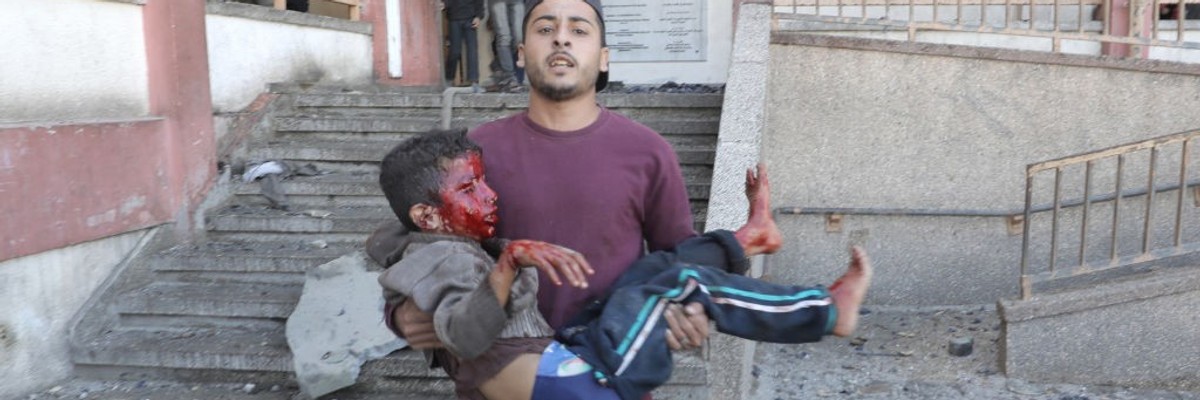
Palestinians imprisoned at Sde Teiman are shackled and blindfolded 24 hours a day and are forced to sit still and silent in painful positions for hours on end. (Photo: Whistleblower)

“Teeth were broken, bones were broken,” said one soldier. “You notice how easy it is to lose your humanity,” said another.

An Israeli newspaper on Friday published interviews with Israel Defense Forces reservists and medical staff who witnessed the “day-to-day torture” of Palestinian prisoners at the notorious Sde Teiman prison in the Negev Desert, where dozens of detainees have died and others were allegedly raped.

The Israelis described seeing torture and abuse of Palestinians detained in Sde Teiman, who included everyone from Hamas fighters to innocent civilians, and ranged in age from children to octogenarians.

“We said, ‘It’s torture.’ But you don’t get into it; you change the subject immediately.”

“What’s happening there is total dehumanization. You don’t really relate to them as if they’re real human beings,” said one public hospital physician who worked at Sde Teiman. “In the end it’s no less than torture. There are ways to administer even poor treatment, or even to torture a person, without crushing cigarettes on them.”

One female former medical staffer said that “the place was totally unimaginable, I had never considered anything like it.”

“My first thought was: What have I done?” she said, describing prisoners being forced to relieve themselves in diapers and take their meals through straws.

“The conditions there were described as torture,” she added. “Maybe. In many senses, yes, I agree with that. Maybe even insane torture.”

A 37-year-old male reservist said some of the worst abuse was committed by members of Force 100, the unit of the nine Israelis recently arrested for allegedly gang-raping a Sde Teiman prisoner.

“They took… guys aside and really laid into them,” he said. “I think that each time teeth were broken, bones were broken… And there was also a dog.”

Former Sde Teiman prisoners have described dogs attacking and performing “vile acts” on them.

Another IDF reservist said that “when you come to the camp, the first thing that hits you is the smell… of dozens of people who have been sitting in close quarters for more than a month in the same clothes and in insane heat.”

“They let them shower for a few minutes around twice a week, but I don’t remember ever seeing that they gave them a change of clothes, in any case not on my shifts,” he added.

The Haaretz interviewees said that much of the abuse occurred in the open.

“It wasn’t something that was done in the dark,” the 37-year-old reservist said. “Everyone saw what was going on… It’s not something that was done behind the back of the commander of the camp.”

“Most of the guys were just fine with what was happening,” he continued. “There were some who were a little bothered by it, and there were others who were bothered by it at the start and then they toed the line with the system.”

“There were people who in conversations suddenly mentioned the word ‘torture,'” he added. “And then we said, ‘It’s torture.’ But you don’t get into it; you change the subject immediately.”

Some of those interviewed by Haaretz expressed misgivings about what they did or saw at Sde Teiman.

“When I was there, I wrestled with myself about whether to stay on and try to do the right thing, the best I could as a moral person, or whether I should just get up and declare that I refused to take part in it,” said one male reservist and student. “I came out with a heavy feeling of guilt.”

Another reservist said, “The more distance I have from the place, the more my eyes have opened up.”

“What most disturbed me was to see how easily and how quickly ordinary people can disconnect themselves and not see the reality right in front of their eyes when they’re in the midst of a shocking human situation,” he added.

There were also rare moments of mercy.

“Sometimes the military police gave the minors candy, like in the evening, before sleep,” the 37-year-old reservist said. “One time a detainee started to cry. He was older, 60 years old. So the duty officer tried to speak to him and cheer him up a little.”

But more often, guards were “filled with rage,” said one reservist, who added that “there’s a desire for revenge.”

“What most disturbed me was to see how easily and how quickly ordinary people can disconnect themselves and not see the reality right in front of their eyes.”

One reservist said that “there was a female officer who gave us a briefing on the day we arrived. She said, ‘It will be hard for you. You’ll want to pity them, but it’s forbidden. Remember that they aren’t people.”

“You notice how easy it is to lose your humanity in a second, how easy it is to come up with justifications for treating people as if they’re not people,” he added.

One 27-year-old female reservist said that upon arriving at Sde Teiman—where she was welcomed with popcorn and cotton candy—she was alarmed to find that “good people whom I know talked about being cruel and abusive to people, like they were talking about something routine.”

“The dehumanization frightened me,” she said. “I couldn’t understand how a group of young people who were around me every day underwent such a dangerous process in such a short time.”

Another reservist said that some Sde Teiman staff—especially the volunteers—were “sadists” who “really enjoy beating up Arabs.”

The Haaretz interviews add to a growing body of evidence of torture and other war crimes perpetrated by Israelis against Palestinian prisoners at Sde Teiman and other lockups.

Former Palestinian detainees and Israeli personnel have described beatings, rape and sexual torture by male and female soldiers, routine amputations due to constant shackling, burnings, electrocutions, attacks by dogs, ice-water dousings, denial of food and water, sleep deprivation, constant loud music, and other abuse.

The Israeli military is investigating the deaths of at least 36 Sde Teiman detainees, including one who died after allegedly being sodomized with an electric baton.

On Friday, Alice Jill Edwards, the United Nations special rapporteur on torture, said that “there are no circumstances in which sexual torture or sexualized inhuman and degrading treatment can be justified.”

“I am troubled by recent attempts by Israeli citizens—including reportedly one member of Parliament—to intervene violently after the arrests of soldiers on these abuse charges,” she said of the recent storming of Sde Teiman and another base by a far-right mob in response to the arrests of the alleged rapists.

“Criminal proceedings into all allegations must proceed unhindered,” Edwards added. “No one is above the law. No one is immune from prosecution for torture.”

Original article by BRETT WILKINS repulished from Common Dreams under Creative Commons (CC BY-NC-ND 3.0).

Continue Reading‘Insane Torture’: Israeli Soldiers Confirm Horrific Abuse of Palestinians at Sde Teiman