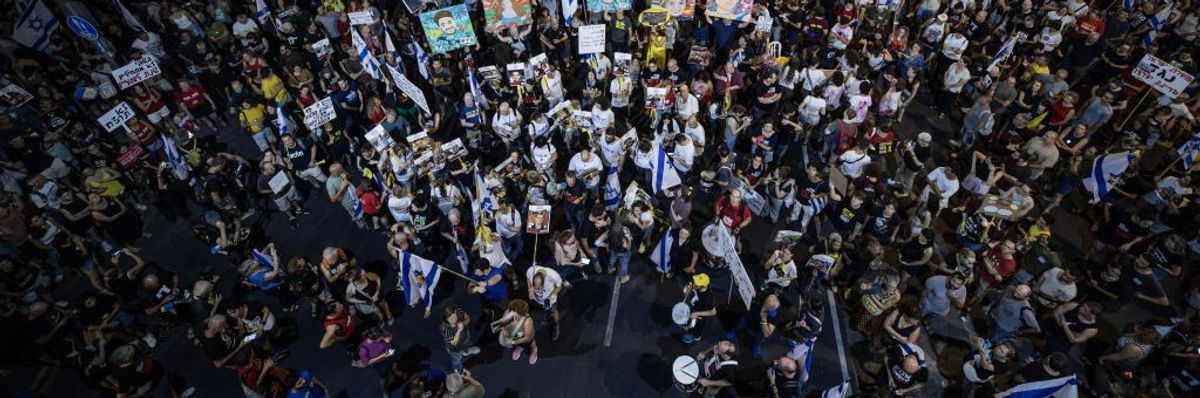
Israeli people, holding Israeli flags and banners, stage a demonstration demanding hostage swap deal and Israeli Prime Minister Benjamin Netanyahu’s government to sign a ceasefire in Gaza, on August 31, 2024, in Tel Aviv, Israel. (Photo by Mostafa Alkharouf/Anadolu via Getty Images.
‘Starting tomorrow, the country will tremble. We call on the public to prepare. The country will grind to a halt. The abandonment is over.’
Tens of thousands rallied across Israel on Saturday night, demanding a hostage deal and against the government of Israeli Prime Minister Benjamin Netanyahu.
In Tel Aviv, tens of thousands of demonstrators, including relatives of those held hostage in Gaza, gathered at the Hostages Square for a rally demanding their loved ones’ return and pled with the prime minister and negotiating team to reach an agreement before time runs out. Roving groups of right-wing activists cursed and spat on the demonstrators.
Along with the mass demonstration in Tel Aviv, large protests were held in cities nationwide, drawing thousands of demonstrators.
Later Saturday night, the Israeli Defense Force announced it had located several bodies in the Gaza Strip, which might be the remains of Israeli hostages. “At this stage, the forces are still operating in the area and carrying out a process to extract and identify the bodies, which will last several hours,” the military says.
After the IDF says it has found bodies in Gaza that possibly are of hostages, the Hostages and Missing Families Forum issued a statement calling on the public to prepare to hold sweeping protests tomorrow.
“Netanyahu abandoned the hostages. It is now a fact. Starting tomorrow, the country will tremble. We call on the public to prepare. The country will grind to a halt. The abandonment is over.”
The Forum says it will provide further details tomorrow morning.
via @NYTimes: Included was the body of Hersh Goldberg-Polin, an Israeli-American. “I am devastated & outraged”, said. Understandable comment. But in sharp contrast to the lack of anger & sympathy he’s shown re the Israeli killing of 1,000s of Palestinians. https://t.co/tMuUAw5dyo
IDF: The IDF located a number of bodies during combat in the Gaza Strip.
At this time, the troops are still operating in the area and are carrying out a process to extract and identify the bodies that will last several hours. We ask to refrain from spreading rumors.
A large crowd gathered at Hostage Square tonight in solidarity with the families of the hostages, chanting: “We will not allow Prime Minister Netanyahu to sacrifice the lives of the hostages.”
This evening, following the decision by the Prime Minister and the Political-Security… pic.twitter.com/Q0YArmtRt8
#TelAviv tonight: Tens of thousands 🇮🇱 calling for an immediate hostage/ceasefire deal in Gaza, the ousting of Netanyahu and new elections. pic.twitter.com/A1Z3sud6W6
A photo shows a World Food Program vehicle damaged by Israeli gunfire. (Photo: World Food Program)
“This is totally unacceptable and the latest in a series of unnecessary security incidents that have endangered the lives of WFP’s team in Gaza.”
The World Food Program said Wednesday that it was forced to suspend the movement of its employees in Gaza after the Israeli military fired on one of the United Nations agency’s teams as its clearly marked vehicle advanced toward an Israeli checkpoint in the Palestinian enclave.
The agency said in a statement that the WFP team was returning from a mission with two armored vehicles “after escorting a convoy of trucks carrying humanitarian cargo routed to Gaza’s central area.”
“Despite being clearly marked and receiving multiple clearances by Israeli authorities to approach, the vehicle was directly struck by gunfire as it was moving towards an Israeli Defence Forces (IDF) checkpoint,” WFP said. “It sustained at least ten bullets: five on the driver’s side, two on the passenger side, and three on other parts of the vehicle. None of the employees onboard were physically harmed.”
While the WFP’s statement doesn’t explicitly attribute the gunfire to Israeli forces, U.N. spokesperson Stéphane Dujarric told reporters Wednesday that the food agency’s vehicle was “struck 10 times by IDF gunfire, including with bullets targeting front windows.”
Cindy McCain, WFP’s executive director, said the attack was “totally unacceptable and the latest in a series of unnecessary security incidents that have endangered the lives of WFP’s team in Gaza.”
“As last night’s events show, the current deconfliction system is failing and this cannot go on any longer,” said McCain. “I call on the Israeli authorities and all parties to the conflict to act immediately to ensure the safety and security of all aid workers in Gaza.”
The Israeli military’s latest attack on aid workers in Gaza came as famine continued to spread across the strip, which Israel has strangled with a blockade that has restricted the flow of food and other necessities.
Kenneth Roth, the former executive director of Human Rights Watch, characterized the WFP attack as part of “Israel’s starvation strategy.” Israeli forces have repeatedly targeted humanitarian workers in Gaza, making the enclave the most dangerous place in the world for aid agency employees.
Chef José Andrés, the founder of a nonprofit whose Gaza team came under deadly attack by Israeli forces earlier this year, expressed solidarity with the WFP in a social media post late Wednesday.
No NGO employees or civilians or press corps can be never ever be targeted by anyone while delivering humanitarian aid! My support to @WFP @WFPChief @UN for their efforts and proud that we’ve work side by side in many countries! https://t.co/jl2hzplsyB
WFP did not say how long its pause on employee movement would stay in place, but any disruption to the agency’s humanitarian operations could be disastrous for starving Palestinians.
In its statement Wednesday, the U.N. food agency said that Israel’s “frequent and ongoing evacuation orders continue to uproot both families and food relief operations intended to support them.”
“Last week, WFP lost access to its third and last operational warehouse in Gaza’s middle area, while five of WFP’s operated community kitchens had to be evacuated,” the agency said. “This week, on Sunday 25 August, the evacuation orders impacted the main WFP operating hub in Deir al-Balah, forcing our team to relocate for the third time since the war started.”
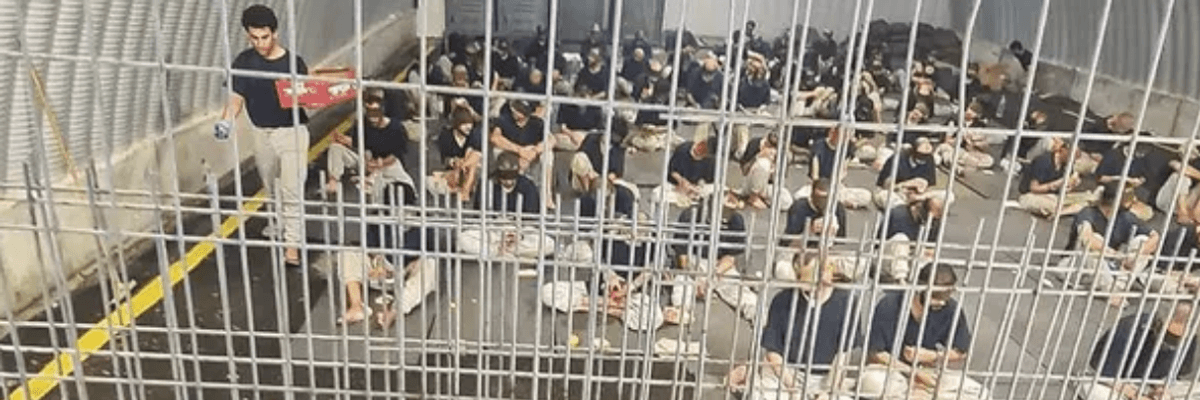
Palestinians imprisoned at Sde Teiman are shackled and blindfolded 24 hours a day and are forced to sit still and silent in painful positions for hours on end. (Photo: Whistleblower)
“Teeth were broken, bones were broken,” said one soldier. “You notice how easy it is to lose your humanity,” said another.
An Israeli newspaper on Friday published interviews with Israel Defense Forces reservists and medical staff who witnessed the “day-to-day torture” of Palestinian prisoners at the notorious Sde Teiman prison in the Negev Desert, where dozens of detainees have died and others were allegedly raped.
The Israelis described seeing torture and abuse of Palestinians detained in Sde Teiman, who included everyone from Hamas fighters to innocent civilians, and ranged in age from children to octogenarians.
“We said, ‘It’s torture.’ But you don’t get into it; you change the subject immediately.”
“What’s happening there is total dehumanization. You don’t really relate to them as if they’re real human beings,” said one public hospital physician who worked at Sde Teiman. “In the end it’s no less than torture. There are ways to administer even poor treatment, or even to torture a person, without crushing cigarettes on them.”
One female former medical staffer said that “the place was totally unimaginable, I had never considered anything like it.”
“My first thought was: What have I done?” she said, describing prisoners being forced to relieve themselves in diapers and take their meals through straws.
“The conditions there were described as torture,” she added. “Maybe. In many senses, yes, I agree with that. Maybe even insane torture.”
Israel cannot prosecute this war—ostensibly against Hamas but actually against all Palestinians in Gaza—without irreparably dehumanising itself and its soldiers, and causing far more harm than good.
This has been clear for months. Sde Teiman should wake up anyone still sleeping.
A 37-year-old male reservist said some of the worst abuse was committed by members of Force 100, the unit of the nine Israelis recently arrested for allegedly gang-raping a Sde Teiman prisoner.
“They took… guys aside and really laid into them,” he said. “I think that each time teeth were broken, bones were broken… And there was also a dog.”
Former Sde Teiman prisoners have described dogs attacking and performing “vile acts” on them.
Another IDF reservist said that “when you come to the camp, the first thing that hits you is the smell… of dozens of people who have been sitting in close quarters for more than a month in the same clothes and in insane heat.”
“They let them shower for a few minutes around twice a week, but I don’t remember ever seeing that they gave them a change of clothes, in any case not on my shifts,” he added.
The Haaretz interviewees said that much of the abuse occurred in the open.
“It wasn’t something that was done in the dark,” the 37-year-old reservist said. “Everyone saw what was going on… It’s not something that was done behind the back of the commander of the camp.”
“Most of the guys were just fine with what was happening,” he continued. “There were some who were a little bothered by it, and there were others who were bothered by it at the start and then they toed the line with the system.”
“There were people who in conversations suddenly mentioned the word ‘torture,’” he added. “And then we said, ‘It’s torture.’ But you don’t get into it; you change the subject immediately.”
Some of those interviewed by Haaretz expressed misgivings about what they did or saw at Sde Teiman.
“When I was there, I wrestled with myself about whether to stay on and try to do the right thing, the best I could as a moral person, or whether I should just get up and declare that I refused to take part in it,” said one male reservist and student. “I came out with a heavy feeling of guilt.”
Another reservist said, “The more distance I have from the place, the more my eyes have opened up.”
“What most disturbed me was to see how easily and how quickly ordinary people can disconnect themselves and not see the reality right in front of their eyes when they’re in the midst of a shocking human situation,” he added.
There were also rare moments of mercy.
“Sometimes the military police gave the minors candy, like in the evening, before sleep,” the 37-year-old reservist said. “One time a detainee started to cry. He was older, 60 years old. So the duty officer tried to speak to him and cheer him up a little.”
But more often, guards were “filled with rage,” said one reservist, who added that “there’s a desire for revenge.”
“What most disturbed me was to see how easily and how quickly ordinary people can disconnect themselves and not see the reality right in front of their eyes.”
One reservist said that “there was a female officer who gave us a briefing on the day we arrived. She said, ‘It will be hard for you. You’ll want to pity them, but it’s forbidden. Remember that they aren’t people.”
“You notice how easy it is to lose your humanity in a second, how easy it is to come up with justifications for treating people as if they’re not people,” he added.
One 27-year-old female reservist said that upon arriving at Sde Teiman—where she was welcomed with popcorn and cotton candy—she was alarmed to find that “good people whom I know talked about being cruel and abusive to people, like they were talking about something routine.”
“The dehumanization frightened me,” she said. “I couldn’t understand how a group of young people who were around me every day underwent such a dangerous process in such a short time.”
Another reservist said that some Sde Teiman staff—especially the volunteers—were “sadists” who “really enjoy beating up Arabs.”
The Haaretz interviews add to a growing body of evidence of torture and other war crimes perpetrated by Israelis against Palestinian prisoners at Sde Teiman and other lockups.
Former Palestinian detainees and Israeli personnel have described beatings, rape and sexual torture by male and female soldiers, routine amputations due to constant shackling, burnings, electrocutions, attacks by dogs, ice-water dousings, denial of food and water, sleep deprivation, constant loud music, and other abuse.
The Israeli military is investigating the deaths of at least 36 Sde Teiman detainees, including one who died after allegedly being sodomized with an electric baton.
On Friday, Alice Jill Edwards, the United Nations special rapporteur on torture, said that “there are no circumstances in which sexual torture or sexualized inhuman and degrading treatment can be justified.”
“I am troubled by recent attempts by Israeli citizens—including reportedly one member of Parliament—to intervene violently after the arrests of soldiers on these abuse charges,” she said of the recent storming of Sde Teiman and another base by a far-right mob in response to the arrests of the alleged rapists.
“Criminal proceedings into all allegations must proceed unhindered,” Edwards added. “No one is above the law. No one is immune from prosecution for torture.”
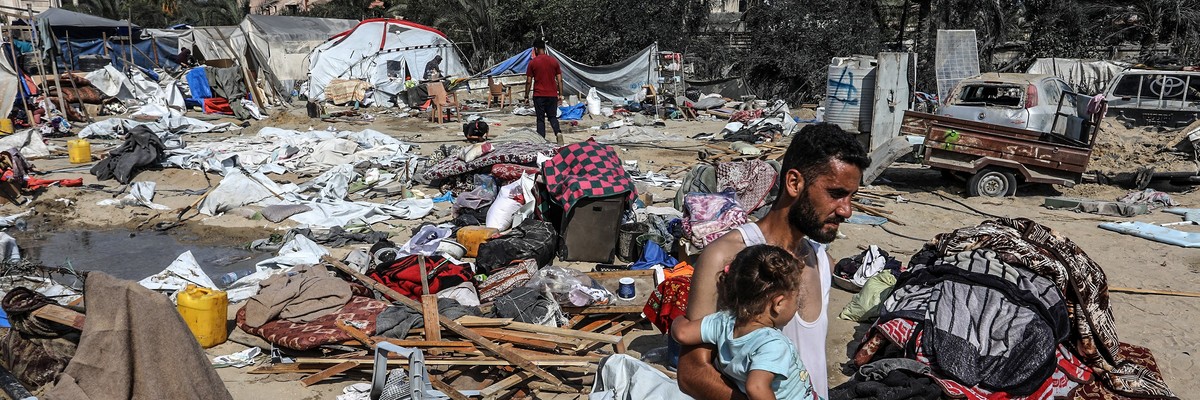
A view of destruction in the al-Mawasi area after an Israeli attack in Khan Younis in the southern Gaza Strip on July 14, 2024. (Photo: Abed Rahim Khatib/Anadolu via Getty Images
“We live in an area that is considered humanitarian and is supposed to be safe, but it is not,” one woman said. “There is no safe place for us or our children.”
Palestinians living in the so-called “humanitarian zone” designated by Israel described extreme and worsening overcrowding on Tuesday, saying that as the Israel Defense Forces has repeatedly struck the area in recent months, displaced people living there have been left feeling they “could die any minute.”
A 37-year-old mother of four, Nisreen Joudeh, told The New York Times that al-Mawasi, a stretch of coastal land to which hundreds of thousands of people from other parts of Gaza have evacuated under Israeli orders, “is no longer a safe area.”
With materials for tents now costing hundreds of dollars instead of an average of $50 as they did before Israel began bombarding Gaza and blocking humanitarian aid last October, families now commonly share the tents that have been erected along the sandy shore area.
“A tent that used to accommodate four to seven people now houses 15 to 17 people from two or more families,” a man named Karel Mohammed told the Times, and overcrowding has intensified in recent weeks as Israel forcibly displaced tens of thousands more Palestinians and ordered them to al-Mawasi.
People face “scorching heat” with very few trees to provide shade, and have access to only “primitive bathrooms,” according to Mohammed.
With Israel continuing to block large amounts of humanitarian aid—actions that United Nations experts last month said have pushed Gaza into famine—Mohammed said there is “no drinkable water, no healthy food” in al-Mawasi.
“The truth is that this area is anything but humanitarian,” said Mohammed. “Our life in these camps is like hell.”
The Times‘ dispatch from al-Mawasi came a day after the United Nations Children’s Fund (UNICEF) reported that the “lack of clean water” and the destruction of Gaza’s sanitation and sewage treatment systems” have caused a surge in diseases including diarrhea and skin disorders across Gaza.
The hygiene conditions in Gaza are appalling and threatening children’s lives and health.@UNICEF and partners are providing clean water. But more aid is urgently needed along with secure access to reach all those in need.
Mona al-Farra, another Palestinian who is sheltering in al-Mawasi in a tent crowded with nine other family members, said skin rashes among children have particularly become rampant due to a lack of clean water and medicine.
“We live in an area that is considered humanitarian and is supposed to be safe, but it is not,” she told the Times, adding that her family frequently hears airstrikes nearby. “There is no safe place for us or our children.”
Last month, at least 90 Palestinians were killed in a bombing within al-Mawasi, which the IDF said had targeted Hamas commander Muhammed Deif.
The so-called humanitarian zone covers 18 square miles, according to the U.N., or nearly 13% of the Gaza Strip. The IDF adjusted the area’s borders last month, shrinking it by about one-fifth.
Doctors Without Borders, also known as Medecins Sans Frontieres (MSF), shared on social media on Monday drawings that had been made by children in a mental health clinic in al-Mawasi, with the artwork exemplifying the “complete psychological destruction” among Gaza’s youngest residents that a report warned of earlier this year.
What a group of children in a mental health clinic in Al-Mawasi drew:
The first drawing on the wall is colorful. It shows Gaza before the war. The Gaza they miss.
“Even though the wounds are invisible, the drawings provide a glimpse into what these children have witnessed. It is beyond words,” said Samuel Johann, an emergency coordinator for MSF. “I cannot express what I feel, seeing what these children have experienced, through their eyes and the reality they are facing.”
“Today,” he said, “I heard a Palestinian colleague describe the human suffering of the war as such: ‘Only the dead have been spared this suffering.’”
Israeli Finance Minister Bezalel Smotrich speaks during a rally in Sderot, Israel on October 26, 2022. (Photo: Gil Cohen-Magen/AFP via Getty Images)
“This is what Israelis rioted to protect, what the Knesset debated—the right to rape Palestinians,” said one critic.
While human rights groups called for an investigation of a leaked recording apparently showing Israel Defense Forces reservists gang-raping a Palestinian detainee at the Sde Teiman military base and detention center, Israeli leaders including Finance Minister Bezalel Smotrich on Wednesday also furiously demanded a probe of the video—not to seek justice for the victim, but rather to find and punish whoever leaked it.
Smotrich took to social media Wednesday to call for “an immediate criminal investigation to locate the leakers of the trending video that was intended to harm the reservists and that caused tremendous damage to Israel in the world, and to exhaust the full severity of the law against them.”
Israeli media on Tuesday aired footage in which Israel Defense Forces (IDF) reservists are seen attacking a Palestinian man at Sde Teiman while trying to hide their actions with shields.
According to Israeli media reports, the victim was hospitalized with a severe anal injury, ruptured bowel, broken ribs, and lung damage.
My god – there is video of IDF soldiers raping the Palestinian man at the Sde Teiman torture camp.
This is what Israelis rioted to protect, what the Knesset debated – the right to rape Palestinians. https://t.co/Li868EXDBK
Nine alleged assailants—who include members of Force 100, the military unit tasked with guarding Sde Teiman prisoners—were arrested last week in connection with the attack. A mob of far-right Israelis including senior government officials subsequently stormed two military bases in an attempt to free the suspects.
While many Israelis condemned the alleged rape, others rallied around the accused reservists. Smotrich described them as “heroic warriors.” National Security Minister Itamar Ben-Gvir called them “our best heroes.”
Far-right Israeli lawmaker Zvi Sukkot—who took part in last week’s riot—joined Smotrich in demanding an investigation of the video leak.
“Leaking and disclosure of investigative materials is a criminal offense that harms the proper legal process, the rule of law, public trust, and the principle of justice,” he said Wednesday.
Israeli media reported Wednesday that two of the accused reservists lied on polygraph tests when asked if they had sodomized the prisoner.
Numerous Israelis continued to express support for the accused rapists. Israel Today political reporter Yehuda Schlesinger said Wednesday on a popular morning show that “I don’t give a rat’s ass what they do to Hamas man.”
"The only thing that is a problem for me here is that it's not a regulated policy of the state to abuse the detainees, because, first of all, they deserve it, and it's great revenge… maybe it will serve us a little more a a deterrent…"
“First of all, they deserve it,” Schlesinger said of the abuse at Sde Teiman and other Israeli military prisons. “It’s great revenge that we need to give them.”
“It’s just a shame that we don’t do it in an institutionalized way, as part of regulations for torture of prisoners,” he added, “because then the next guys who think about doing another October 7 will say, ‘Do you see what they’re doing to [us] in Israel?’”
Etan Nechin, the New York correspondent for the Israeli newspaper Haaretz, accused the media of being the “main culprit” that “has normalized the most extreme voices, letting genocidal brutes, racists, and messianic zealots into Israeli’s TV sets.”
Some American media critics drew attention to the scant coverage of abuse at Sde Teiman in the U.S. corporate media.
“U.S. taxpayers continue to support this military and its torture camps,” Palestinian American author and political analyst Yousef Munayyer wrote on social media. “How is this not front-page news?”
In the United States—which supports Israel’s war on Gaza with billions of dollars in military aid and diplomatic cover—State Department Spokesperson Matthew Miller said during a Wednesday press conference that “there ought to be zero tolerance for sexual abuse, rape of any detainee. Period.”
“It is appropriate that the IDF in this case, has announced an investigation, has arrested a number of people who are alleged to have been involved, and I won’t speak to the outcome of that investigation, but it ought to proceed swiftly,” Miller added.
Critics noted the IDF’s chronic failures to credibly investigate its alleged crimes. The Israeli rights group Yesh Din said in late 2022 that less than 1% of Israeli soldiers accused of harming Palestinians in the occupied West Bank and Gaza were indicted over the previous five years.
The Israeli Supreme Court on Wednesday took up a petition by rights groups seeking to close Sde Teiman, where widespread—and sometimes deadly—torture has been reported. Last month, Israel’s High Court issued a conditional order seeking to shut down the prison in response to the flood of reports of torture there.
Former prisoners including children and Israeli whistleblowers at Sde Teiman—often called “Israel’s Guantánamo Bay”—have described rampant torture and abuse at the facility, which is used to imprison Palestinians captured in the Gaza Strip. According to their testimonies, prisoners have been raped, electrocuted, mauled by dogs, burned with cigarettes, severely beaten, starved, and subjected to 24-hour shackling sometimes leading to amputations.
The Israeli human rights group B’Tselem said this week that at least 60 Palestinians have died in Israeli custody since October.
More than 1,100 Israelis and others died during the Hamas-led attack on October 7, during which more than 240 other people were kidnapped. Israel’s response—which is the subject of an International Court of Justice genocide case—has left more than 142,000 Palestinians dead, maimed, or missing, according to local and international officials.
Smotrich suggested earlier this week that it is “moral and justified” to starve 2 million Palestinians to death. So far, at least dozens, mostly children, have died from malnutrition, dehydration, and lack of medical care in Gaza amid Israel’s crippling assault and siege.