Tag: IDF

  • Israeli Bombings, Evacuation Order in Gaza City Forces Hospitals to Shut Down

    Spread the love

    Original article by JULIA CONLEY republished from Common Dreams under Creative Commons (CC BY-NC-ND 3.0). 
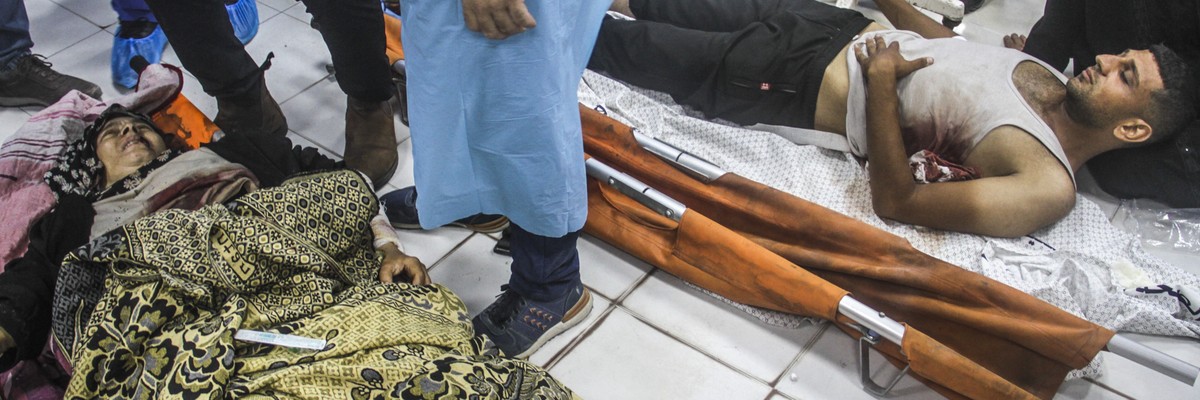
    Injured Palestinians lay on the floor at Indonesian Hospital in northern Gaza on July 8, 2024, following Israeli attacks on Gaza City.  (Photo: Mahmoud Issa/Anadolu via Getty Images)

    Patients were forced to move to other facilities in northern Gaza, where one hospital was at “triple capacity” and providers were struggling to provide care amid fuel and medical supply shortages.

    Healthcare officials were joined by human rights experts on Tuesday in condemning Israel’s latest evacuation orders for Gaza City, which the World Health Organization director said would “further impede delivery of very limited lifesaving care” as hospitals in the area struggled to treat sick and wounded Palestinians.

    The Israel Defense Forces claimed on Tuesday morning that there was “no need to evacuate the hospitals and medical facilities in the area,” after it had issued an evacuation order for 70% of Gaza City on Monday. The IDF has ordered civilians to evacuate parts of the city three times since June 27 as it has intensified its military operations, forcing tens of thousands of people to flee.

    Despite the IDF’s claims, the Episcopal Diocese of Jerusalem, which partially operates al-Ahli Arab Hospital in Gaza City, said it had closed and evacuated all patients and workers after a series of drone strikes in the facility’s “immediate vicinity.”

    “To our great dismay, our hospital is now out of operation at a time when its services are in very significant demand and where injured and sick people have few other options for places to receive urgent medical care,” said the diocese in a statement.

    “Key hospitals and medical facilities could quickly become nonfunctional due to hostilities in their vicinity or obstruction to access.”

    Healthcare authorities have been forced to transport patients to other hospitals that are also struggling to provide care, as Israel’s near-total blockade on humanitarian aid since October has caused dire shortages of fuel and medical supplies.

    Tedros Adhanom Ghebreyesus, director of the World Health Organization, said Patient’s Friends Benevolent Society Hospital in Gaza City was also out of service due to the evacuation order, putting more strain on other facilities in the northern city of Beit Lahia, including Kamal Adwan and Indonesian hospitals.

    Those medical centers are “suffering shortage of fuel, beds, and trauma medical supplies,” said Tedros on social media. “Indonesian Hospital is triple over its capacity. Al-Helou Hospital is within the blocks of the evacuation order but continues to be partially functional. As-Sahaba and al-Shifa hospitals are in close proximity to the areas under evacuation order but remain functional so far. Six medical points and two primary healthcare centers are also within the evacuation zones.”

    “These key hospitals and medical facilities could quickly become nonfunctional due to hostilities in their vicinity or obstruction to access,” he added before repeating a demand: “Cease-fire!”

    Israel’s claim that the hospitals in Gaza City remain safe despite the evacuation orders comes after several Israeli bombings of medical facilities and other so-called “humanitarian areas” since October.

    Hospitals including al-Shifa in Gaza City have become major targets of Israel’s assault on the enclave, prompting outcry from human rights advocates who have demanded that the IDF follow international humanitarian law.

    The United Nations Office of the High Commissioner for Human Rights (OHCHR) on Tuesday said it was “appalled” by the IDF’s latest evacuation order, noting that Palestinians have been killed after fleeing to supposedly “safe” zones since Israel’s bombardment began.

    Many of the people fleeing Gaza City this week “have been forcibly displaced multiple times, to evacuate to areas where IDF military operations are ongoing and where civilians continue to be killed and injured,” said the OHCHR.

    Deir al-Balah, where Gaza City residents have been told to move in the latest order, “is already seriously overcrowded with Palestinians displaced from other areas of the Gaza Strip,” the office added.

    The Gaza Health Ministry reports that 38,243 people have been killed in the enclave since Israel began its attacks in retaliation for a Hamas-led attack on October 7.

    As Israel forced hospitals in Gaza City out of operation and occupied the southern part of the city, including around the headquarters of the U.N. Relief and Works Agency for Palestine Refugees in the Near East, another Israeli attack on the Bureij refugee camp killed nine people on Tuesday, including five children.

    The IDF also said its warplanes had attacked “a school complex” in the Nuseirat refugee camp.

    “There’s really no safe corner in Gaza,” said Tedros.

    Original article by JULIA CONLEY republished from Common Dreams under Creative Commons (CC BY-NC-ND 3.0). 
  • ‘A Full-Fledged War Crime’: Israel Condemned Over New Human Shield Footage

    Spread the love

    Original article by JULIA CONLEY republished from Common Dreams under Creative Commons (CC BY-NC-ND 3.0). 
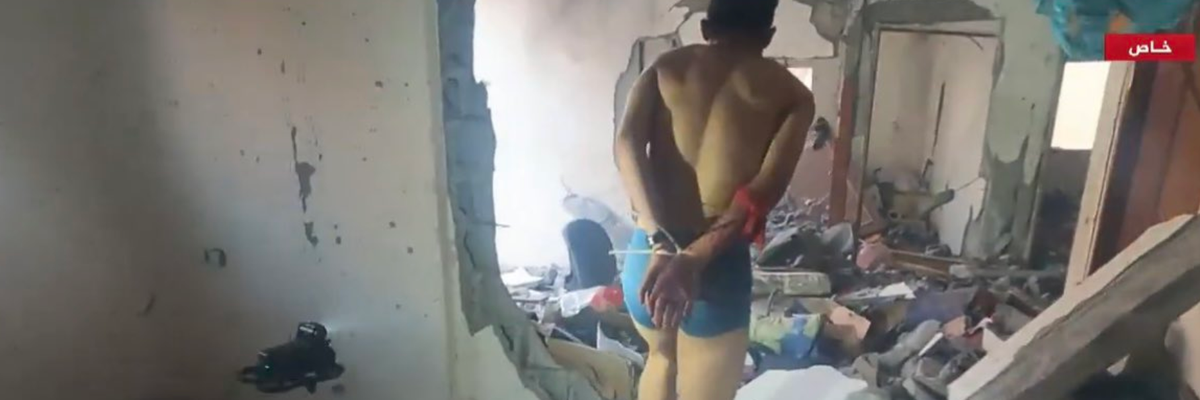
    Footage shows a Palestinian man being used by the Israel Defense Forces as a human shield. (Photo: Al Jazeera)

    “These crimes, and dozens of similar cases, require urgent intervention from the international justice system,” said one human rights group.

    The latest video evidence of Israel’s use of Palestinians as “human shields” during combat was condemned by one human rights advocate on Monday as “horrifying but not surprising,” as campaigners emphasized that the Israel Defense Forces has long used civilians in Palestine to shield their own soldiers from harm while bombarding Gaza and the West Bank.

    Footage released by Al Jazeera on Sunday night showed Israeli forces attaching body cameras to handcuffed Palestinians who they had detained, dressing them in IDF uniforms, and sending them into buildings and tunnels to ensure the locations weren’t rigged with explosives.

    The footage presented “evidence of a systematic tactic of the army,” said the Euro-Mediterranean Human Rights Monitor.

    “The leaked horrific scenes that were obtained and published by Al Jazeera reveal how the Israeli army uses civilians, including injured detainees, as human shields and forces them into hazardous combat zones after installing cameras on their bodies and binding them with rope,” said Euro-Med. “Each of the aforementioned acts of criminal, brutal, and inhumane behavior constitutes a grave violation of the rules of international humanitarian law, and is a full-fledged war crime. These crimes, and dozens of similar cases, require urgent intervention from the international justice system to ensure the protection of civilians, prevent their use as human shields, and hold the Israeli political and military perpetrators.”

    The Israeli government has long blamed Hamas’ use of “human shields” for deaths in Gaza, which now number at least 37,900, saying the group operates out of civilian infrastructure and places Palestinians in harm’s way.

    Journalist Dan Cohen pointed out that the IDF has used what it calls “the neighbor procedure” for decades, forcing Palestinian “messengers” to approach the homes of suspected fugitives alone and unarmed while Israeli soldiers announce over a loudspeaker that they are surrounding the building.

    The procedure “is so commonplace that the military tried to justify it as a lifesaving measure in use since the 1980s,” said Cohen. “The images… show the reality of this criminal practice.”

    In its statement on the new footage, Euro-Med detailed numerous instances in which Israel has appeared to use human shields as defined by the Geneva Conventions: “cases where persons were actually taken to military objectives in order to shield those objectives from attacks.”

    As Euro-Med reported:

    During the Shifa Medical Complex raid in March 2024, Israeli forces used civilians, including patients and displaced individuals sheltering inside the complex, as human shields. To protect their military operations within the hospital and its vicinity, Israeli forces exploited Palestinian civilians by making them form human barriers to surround Israeli soldiers and military vehicles, or sending them under threat to residential homes and buildings to either help arrest or forcibly evacuate other civilians before army raids and the subsequent destruction of many of these buildings.

    […]

    Furthermore, several families residing near the Shifa Medical Complex reported that Israeli forces arrested young men from inside the medical facility, then used them to enter the families’ homes and demand that they immediately evacuate to the central and southern Strip.

    The group also cited a recent example from June 22 in the Jenin refugee camp in the West Bank, where Israeli forces placed a wounded Palestinian man on the hood of a military vehicle and drove through the Jabariya neighborhood, and “a compound and comprehensive crime” against a civilian family in Gaza City on June 27.

    “A family comprising an elderly woman and her four children, including three young women and a one-and-a-half-year-old granddaughter, was attacked with gunfire and bombs by Israeli forces who stormed their house in the Gaza City neighborhood of Al-Shujaiya,” said the group. “They were later taken outside and detained for over three hours near Israeli tanks in a dangerous combat zone, despite the injuries they sustained in the initial attack on their home, and were used as human shields. The 65-year-old mother, identified as Safiya Hassan Musa Al-Jamal, was run over by an Israeli tank and killed in front of her son.”

    On Monday, the Council on American-Islamic Relations (CAIR) condemned the footage released Sunday from the incident in Gaza while noting that Israeli Minister of National Security Itamar Ben-Gvir was recorded over the weekend calling for Palestinian prisoners to be executed and fed reduced food rations as a “deterrence” tactic.

    Almost 10,000 Palestinians have been arrested by Israeli forces, including women and children, CAIR said, demanding that the U.S. end its military support for Israel.

    “Israeli war crimes, and calls for more war crimes, are occurring daily in Gaza and the West Bank, while the Biden administration rushes more American bombs to Israel to complete the genocide,” said CAIR communications director Ibrahim Hooper. “The U.S.-Israeli partnership in genocide, ethnic cleansing, and forced starvation will shape the international community’s image of America for generations to come. The Biden administration must change course to uphold universal human rights and recognize Palestinian humanity.”

    Original article by JULIA CONLEY republished from Common Dreams under Creative Commons (CC BY-NC-ND 3.0). 
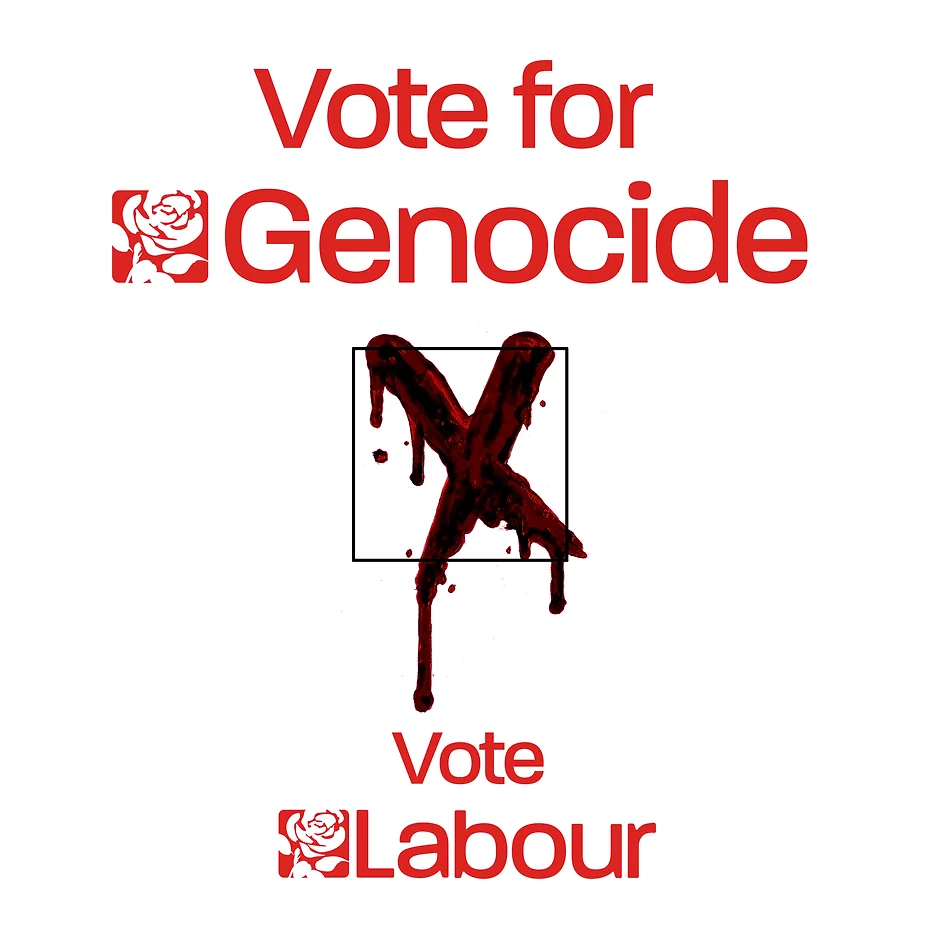
    Vote For Genocide Vote Labour.
    Vote For Genocide Vote Labour.
  • Conditions ‘Unspeakable’ as Israeli Onslaught Forces Over 1 Million to Flee Rafah

    Spread the love

    Original article by EDWARD CARVER republished from Common Dreams under Creative Commons (CC BY-NC-ND 3.0). 
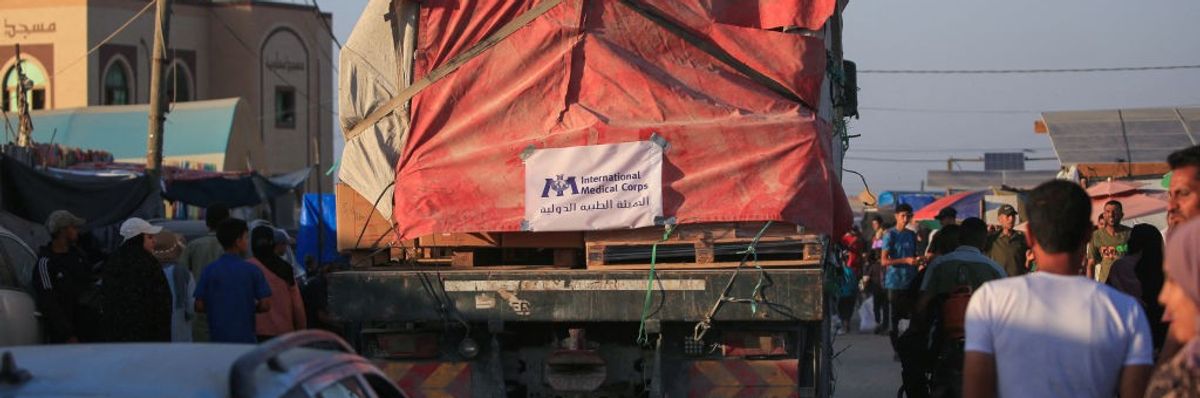
    A truck is used to evacuate the International Medical Corps American field hospital in Rafah in the southern Gaza Strip on June 2, 2024.
     (Photo: Eyad Baba/AFP via Getty Images)

    “Public health concerns are beyond crisis levels” in the areas where Palestinians have been forced to shelter, and “the sounds, the smells, the everyday life, are horrific and apocalyptic,” a U.N. official said.

    More than 1 million Palestinians have fled Rafah as the city comes under a continued Israeli assault, forcing many to shelter in badly damaged buildings in the nearby city of Khan Younis, according to the United Nations.

    The assault on Rafah, a city in the southern Gaza Strip, has left the displaced in “unspeakable” conditions, the United Nations Relief and Works Agency for Palestine Refugees in the Near East (UNRWA) said on social media. Approximately 1.7 million displaced people are now in Khan Younis and “Gaza Middle Areas,” according to UNRWA.

    Khan Younis, which saw sustained fighting earlier in the war, still does not appear to be a safe zone: Israeli military vehicles entered the city in recent hours after advancing to two towns just east of Khan Younis with “heavy gunfire and artillery shelling,” Al Jazeerareported.

    Since early May, the Israel Defense Forces (IDF) has issued evacuation orders for parts of Rafah, telling people to go to an “expanded humanitarian zone” in Al-Mawasi, located roughly 12 miles from the city.

    Israeli forces subsequently launched attacks on designated safe zones, including in Al-Mawasi. Two strikes killed 45 and 21 people last week, mostly women and children. The first of the attacks, known as the “tent massacre,” was carried out with U.S. weapons, later analysis showed.

    Many of the people fleeing Rafah are having to move for at least the second time during the war. Roughly 1 million Palestinians who’d been displaced elsewhere had gone to Rafah for refuge earlier in the war. They began to leave Rafah nearly four weeks ago as Israeli started its assault on the city. Before the war, Rafah’s population was about 275,000, but the governorate reached a population of 1.4 million by February as Israel ordered Palestianians to move there from northern Gaza. This meant squeezing more than half of Gaza’s prewar population of 2.3 million into one governorate, NPR reported.

    More than 18,500 pregnant women have been forced to leave Rafah, while about 10,000 pregnant women remain in the city in “desperate conditions,” the U.N. reported.

    “They’re exhausted, traumatized, dehydrated, and malnourished,” the U.N. Population Fund wrote on social media of pregnant women dealing with “Israel’s terrifying military operation in Rafah.”

    “Pregnant women in Gaza are living in an unrelenting nightmare,” the agency added.

    After successive operations last month, Israel now controls the entire Gaza-Egypt border. Humanitarian corridors have shut down, with many agencies and aid groups pausing operations in Rafah due to lack of supplies and security concerns.

    “We are living and working precariously in the south,” Matthew Hollingsworth said, World Food Program (WFP) country director in Palestine, said late last week, the U.N. reported. The areas where the displaced have been forced to shelter are nightmarish, he said.

    “Public health concerns are beyond crisis levels” and “the sounds, the smells, the everyday life, are horrific and apocalyptic,” Hollingsworth added.

    More than half of the structures in the Gaza Strip have been damaged, destroyed, or possibly destroyed during the eight-month Israeli assault, the United Nations Satellite Centre (UNOSAT) concluded, in findings released Monday.

    The mass displacement from Rafah continued as the Biden administration sought to arrange a cease-fire after after being pressured for months to end its military support for Israel’s onslaught. President Joe Biden called for an end to the war on Friday and backed a roadmap to a deal, which drew praise from Palestine defenders—the Council on American-Islamic Relations called it “long overdue” and a “positive step”—as well as criticism that it did not address the root causes of the conflict.

    Israeli Prime Minister Benjamin Netanyahu said Monday that the deal would not stop the war, which could not end until “total victory” had been achieved, according to Israeli National News.

    Original article by EDWARD CARVER republished from Common Dreams under Creative Commons (CC BY-NC-ND 3.0). 
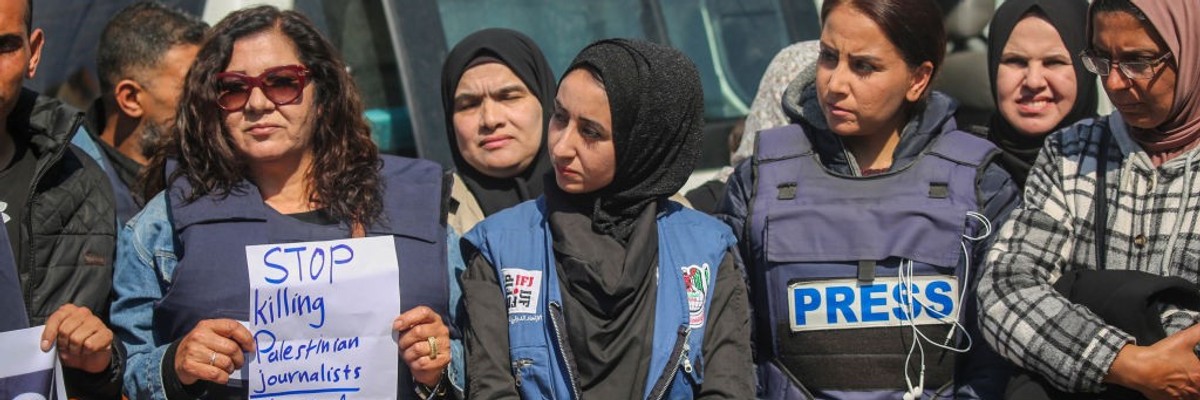
  • Group Files New ICC Complaint Over Journalists Killed by Israel in Gaza

    Spread the love

    Original article by BRETT WILKINS republished from Common Dreams under Creative Commons (CC BY-NC-ND 3.0). 

    Palestinian journalists stage a protest to draw attention to Palestinian press killed while covering the war in the Gaza Strip on February 26, 2024 in Rafah.
     (Photo: Ahmad Hasaballah/Getty Images)

    Reporters Without Borders says it has “reasonable grounds for thinking that some of these journalists were deliberately killed and that the others were the victims of deliberate IDF attacks against civilians.”

    The press freedom group Reporters Without Borders announced Monday that it has filed a third complaint at the International Criminal Court alleging “war crimes against journalists in Gaza,” where over 100 media professionals have been killed by Israeli forces since October 7.

    Paris-based Reporters Without Borders (RSF) is asking the ICC to investigate the Israel Defense Forces’ (IDF) killing of eight Palestinian journalists and wounding of another between December 15 and May 20 and, more broadly, the over 100 media workers slain during the course of Israel’s 234-day assault on Gaza.

    RSF said it “has reasonable grounds for thinking that some of these journalists were deliberately killed and that the others were the victims of deliberate IDF attacks against civilians” and accused Israel of “an eradication of the Palestinian media.”

    “Impunity endangers journalists not only in Palestine but also throughout the world,” RSF advocacy and assistance director Antoine Bernard said in a statement. “Those who kill journalists are attacking the public’s right to information, which is even more essential in times of conflict. They must be held accountable, and RSF will continue to work to this end, in solidarity with Gaza’s reporters.”

    Journalists in RSF’s latest complaint include Mustapha Thuraya and Hamza al-Dahdouh, freelancers working for Al Jazeera in Rafah when they were killed by a targeted Israeli drone strike on their vehicle on January 7, and Hazem Rajab, who was injured in the strike.

    According to RSF:

    The complaint also cites the cases of Hadaf News website reporter Ahmed Badir, who was killed by an airstrike at the entrance to Shuhada al-Aqsa Hospital in Deir al-Balah on 10 January; Kan’an News Agency correspondent Yasser Mamdouh, who was killed near Al-Nasser Hospital in Khan Yunis on 11 February; Ayat Khadoura, an independent video blogger killed by an Israeli strike on his home on 20 November shortly after posting a video; Yazan Emad Al-Zwaidi, a cameraman with the Egyptian satellite TV news channel Al Ghad, who was killed on 14 January when an Israeli strike hit the group of civilians he was with in Beit Hanoun; Ahmed Fatima, a journalist with the Al Qahera News TV channel, who was killed during a bombardment in Khan Yunis on 13 November; and Rami Bdeir, a reporter for the Palestinian New Press media outlet, who was killed during an Israeli bombardment in Khan Yunis on 15 December.

    Another advocacy group, the Committee to Protect Journalists, previously condemned what it called an “apparent pattern of targeting journalists and their families,” noting cases in which media workers were killed while wearing press insignia and after being threatened by Israeli officials.

    Monday marked the ninth anniversary of United Nations Security Council Resolution 2222, which concerns the protection of journalists in conflict zones and “emphasizes the responsibility of states to comply with the relevant obligations under international law to end impunity and to prosecute those responsible for serious violations of international humanitarian law.”

    Last month, Francesca Albanese, the U.N. special rapporteur on the occupied Palestinian territories, said: “Killing journalists is a war crime that undermines the most basic human rights. Justice starts with the cessation of injustice.”

    Original article by BRETT WILKINS republished from Common Dreams under Creative Commons (CC BY-NC-ND 3.0). 

  • ‘War Criminals’: IDF Strikes Rafah After Hamas Agrees to Cease-Fire

    Spread the love

    [This article remains relevant despite having been published 2 days ago]

    Original article by JESSICA CORBETT republished from Common Dreams under Creative Commons (CC BY-NC-ND 3.0).

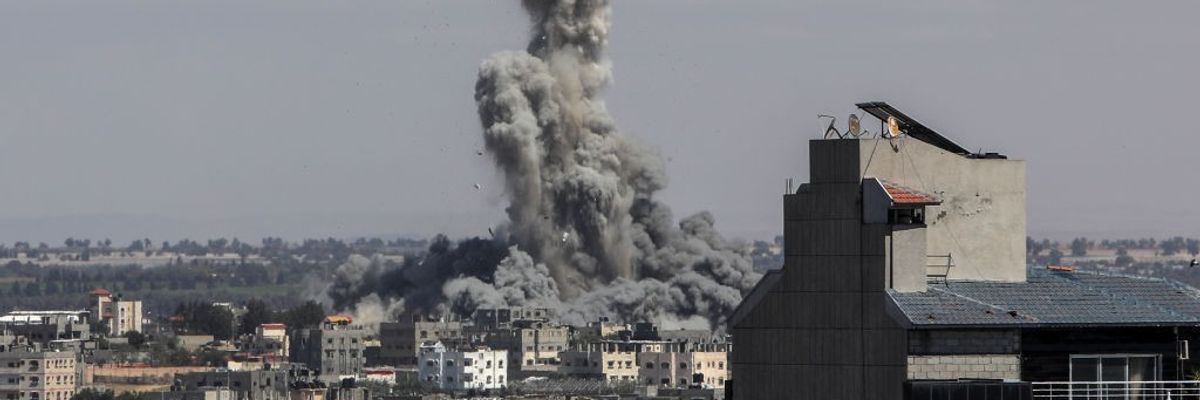
    Smoke rises from buildings after Israeli strikes on Rafah, Gaza on May 6, 2024.  (Photo: Abed Rahim Khatib/Anadolu via Getty Images)

    “Why?” asked Israeli lawmaker Ofer Cassif. “Because killing Palestinians is more important for the Israeli government than saving Israelis.”

    Israel on Monday launched long-awaited strikes on Rafah in the southern Gaza Strip despite Hamas publicly confirming it agreed to a cease-fire and hostage release proposal from Egyptian and Qatari mediators.

    The Israel Defense Forces said on social media that “the IDF is currently conducting targeted strikes against Hamas terror targets in eastern Rafah,” the city to which over a million Palestinians have fled since October 7, when Israel launched a retaliatory war that has already killed at least 34,735 people in Gaza and wounded another 78,108.

    Earlier Monday, the IDF had dropped leaflets directing residents and refugees in that part of Rafah to relocate to a strip along Gaza’s coast, ignoring warnings from the international community and humanitarian groups that a full-scale Israeli attack on the crowded city would further endanger civilians and relief efforts.

    “It is obvious Netanyahu wants this genocidal war to continue indefinitely so that he can remain in power.”

    In addition to sparking outrage around the world, the Israeli government’s Rafah attack and rejection of the Hamas-backed proposal was met with criticism from people across Israel. The Associated Press reported that “thousands of Israelis rallied around the country Monday night calling for an immediate deal to release the hostages still held in the Gaza Strip.”

    Ofer Cassif, a member of the Knesset who was almost expelled by fellow Israeli lawmakers earlier this year for backing South Africa’s ongoing genocide case against Israel at the International Court of Justice (ICJ), again called out his own government.

    “Israeli tanks and infantry enter east Rafah while planes bomb from above, just hours after Hamas’ decision to accept the hostages/prisoners exchange deal,” Cassif said Monday. “Why? Because killing Palestinians is more important for the Israeli government than saving Israelis. War criminals!”

    The office of Israeli Prime Minister Benjamin Netanyahu said Monday that “the War Cabinet unanimously decided this evening Israel will continue its operation in Rafah, in order to apply military pressure on Hamas so as to advance the release of our hostages and achieve the other objectives of the war.”

    Along with the prime minister, Israel’s War Cabinet includes Defense Minister Yoav Gallant and Benny Gantz, former IDF chief of the general staff, along with three observers.

    Netanyahu added that “while the Hamas proposal is far from meeting Israel’s core demands, Israel will dispatch a ranking delegation to Egypt in an effort to maximize the possibility of reaching an agreement on terms acceptable to Israel.”

    Reuters reported that “an Israeli official said the deal was not acceptable to Israel because terms had been ‘softened.’”

    According to the news outlet, the first part of a three-phase plan that Hamas—which has controlled Gaza for nearly two decades—agreed to includes a 42-day pause in fighting, the release of 33 hostages held by the group and some Palestinians in Israeli jails, a partial IDF withdrawal, and free movement in the besieged enclave.

    Phase two would be “another 42-day period that features an agreement to restore a ‘sustainable calm’ to Gaza, language that an official briefed on the talks said Hamas and Israel had agreed in order to take discussion of a ‘permanent cease-fire’ off the table,” Reuters detailed. This phase also includes withdrawing most Israeli troops and Hamas releasing some soldiers and reservists.

    The third phase would involve the exchange of bodies; reconstruction of Gaza overseen by Egypt, Qatar, and the United Nations; and ending the complete blockade on the strip, the outlet added.

    Shortly before Israel’s Monday night strikes on Rafah began, Stéphane Dujarric, a spokesperson for United Nations Secretary-General António Guterres, said that the U.N. chief “reiterates his pressing call to both the government of Israel and the leadership of Hamas to go the extra mile needed to make an agreement come true and stop the present suffering.”

    Expressing concern about the then-imminent Israeli operation in Rafah, the spokesperson said that “we are already seeing movements of people—many of these people are in desperate humanitarian condition and have been repeatedly displaced. They search safety that has been so many times denied. The secretary-general reminds the parties that the protection of civilians is paramount in international humanitarian law.”

    Other U.N. officials have been warning of what an assault on Rafah will mean for the over 1.4 million Palestinians there, among them 600,000 children. So have humanitarian and political leaders, including U.S. Sen. Bernie Sanders (I-Vt.)—who on Monday urged President Joe Biden to stand by his earlier position that attacking the city was a “red line” and “end all offensive military aid to Israel.”

    Council on American-Islamic Relations national executive director Nihad Awad issued a similar call Monday evening, warning that “the Israeli government is hellbent on using American financial, military, and diplomatic support to ethnically cleanse what remains of Gaza and commit another massacre.”

    “President Biden must stand up to Benjamin Netanyahu and take concrete action to end the genocide now,” Awad continued, nodding to the Israeli leader’s legal trouble. The prime minister faces not only potential consequences on a global scale for what the ICJ has deemed a “plausibly” genocidal war on Gaza but also a corruption trial in his own country.

    “It is obvious Netanyahu wants this genocidal war to continue indefinitely so that he can remain in power, avoid jail, and fulfill his racist, far-right Cabinet’s demands for the complete destruction of Gaza and the massacre of its people,” Awad said. “It is long past time for President Biden to end our nation’s complicity in this 21st-century genocide.”

    Biden spoke with Netanyahu by phone ahead of the IDF strikes on Monday and “reiterated his clear position on Rafah,” according to a White House readout. They also discussed the hostage negotiations, humanitarian aid, the Holocaust, and antisemitism.

    Trita Parsi, executive vice president of the Quincy Institute for Responsible Statecraft, also suggested that the Israeli prime minister wants the bloodshed in Gaza to continue for personal reasons.

    “Netanyahu does not want an end to the war because the moment the war ends, his political career ends as well. And his prison sentence will commence,” said Parsi. “Yet, Biden has for seven months deferred to Netanyahu.”

    Original article by JESSICA CORBETT republished from Common Dreams under Creative Commons (CC BY-NC-ND 3.0).