This work by Middle East Monitor is licensed under a Creative Commons Attribution-NonCommercial-ShareAlike 4.0 International License.
A view of the vessels passing through Strait of Hormuz following the two-week temporary ceasefire reached between the United States and Iran on the condition that the strait be reopened, seen in Oman on April 08, 2026. [Shadi J. H. Alassar – Anadolu Agency]
Tehran says Washington has accepted some of its 7 conditions but must clarify unresolved issues
Iran considers Washington’s response to its seven conditions for reopening the Strait of Hormuz “insufficient,” a senior Iranian official said, according to the semi-official Tasnim News Agency.
Mohsen Rezaei, secretary of Iran’s Supreme National Security Council, said the US had accepted some of Tehran’s conditions, while others remained unclear.
Rezaei said Washington had approached Tehran over the past two months through three channels — Pakistan, Qatar and Iraq — asking Iran to submit its proposals.
About two weeks ago, Iran conveyed seven conditions to the US, explicitly stating that the Strait of Hormuz would not reopen to Washington and no negotiations would take place until those conditions were met, he said.
Rezaei said Tehran was no longer in the process of responding to Washington because the US had already submitted its response, which Iran considered “insufficient.”
“They must clarify the issues that remain ambiguous to us,” he said.
The report did not detail all seven conditions or specify which ones Washington had accepted.
Rezaei also said the Gulf could not be secure without Iran’s management of the Strait of Hormuz, describing control over the waterway as an “immense source of national wealth and a major national asset.”
He said Iran’s interests extended beyond closing the passage and collecting transit fees.
Iranian Foreign Minister Abbas Araghchi said in late September that Tehran could reopen the strategic waterway within seven days if Washington accepted a proposal conveyed through Qatari mediation.
Under the plan, the US would be expected to take agreed steps during the first four or five days, allowing normal navigation through the strait to resume on the sixth day and negotiations on a final agreement to begin on the seventh.
Tehran’s demands include an end to hostilities, the release of frozen Iranian assets, the lifting of restrictions on Iranian oil exports and an end to the US naval blockade on Iranian ports.
Iran has kept the Strait of Hormuz restricted while demanding that Washington fulfill commitments under a June memorandum of understanding.
Tehran has said the waterway will not fully reopen until its conditions are met and US commitments are implemented.
The US and Israel launched a war against Iran on Feb. 28. Tehran responded with missile and drone attacks across the region and effectively closed the Strait of Hormuz, while Washington later imposed a naval blockade on Iranian ports.
Washington and Tehran subsequently signed a memorandum of understanding in June concerning freedom of navigation in the Strait of Hormuz, but implementation stalled over disagreements related to security in the strategic waterway.
Climate science denier Donald Trump confirms that he knows nothing about democracy and that more liquid gold is being secured according to his policy of global privateering.Orcas discuss rotting brain, front Orca says Sundown Syndrome is a dead givaway and he wishes someone would Lock Him Up
This work by Middle East Monitor is licensed under a Creative Commons Attribution-NonCommercial-ShareAlike 4.0 International License.
Civilians receive training on the use of long-barreled firearms, multiple rocket launchers and air defense systems during drills held in Tehran, Iran, on October 04, 2026. [Fatemeh Bahrami – Anadolu Agency]
Iran is reviewing the US response to a proposal submitted by Tehran and is preparing for various possible scenarios, an Iranian deputy foreign minister said on Sunday.
The official said Iran was closely monitoring developments surrounding its proposal and Washington’s response, according to Iran’s Tasnim News Agency.
He added that Tehran remained prepared to deal with different potential scenarios as diplomatic efforts continued with the aim of reaching understandings between Iran and the United States.
The remarks come as attention remains focused on the outcome of negotiations between Washington and Tehran and their potential implications for relations between the two countries and developments in the region.
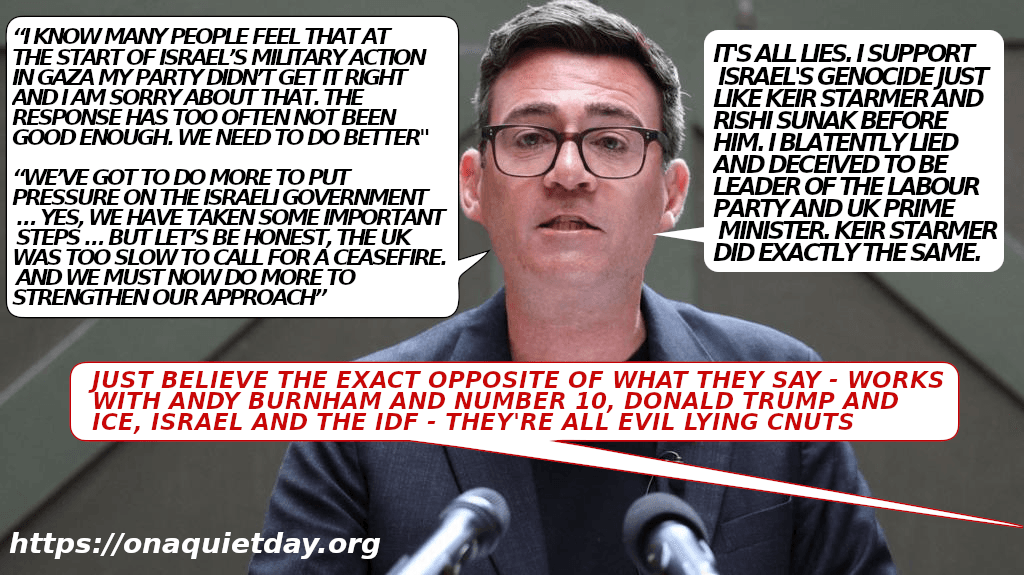
Ed Miliband says that he and the Labour Party are full of shit criminalising people holding signs as terrorists despite anything he says.UK Prime Minister Andy Burnham admits to blatently lying and engaging in deception to become leader of the UK Labour Party and Prime Minister.
This work by Middle East Monitor is licensed under a Creative Commons Attribution-NonCommercial-ShareAlike 4.0 International License.
The United States Capitol building is seen in Washington DC, United States on April 22, 2026, [Celal Güneş – Anadolu Agency]
Foreign policy is rarely the principal factor shaping how Americans vote in congressional primaries or midterm elections. The 2026 cycle, however, appears to be different, as crises abroad increasingly spill over into concerns at home. The issues emphasised by Republican and Democratic candidates, the results of the primaries and shifts in public opinion suggest that Iran and the Palestinian question have emerged as additional factors in the domestic political contest. Iran has entered the electoral calculus through the economic costs of the war and majority opposition to military action, while the Palestinian issue has gained salience amid a discernible shift in American attitudes towards Israel and the Palestinians. These developments could influence the outcome of November’s midterms, against a backdrop of falling approval of the administration’s foreign policy and a growing Democratic lead in congressional polling.
The war with Iran shows this most clearly. Its repercussions have spread beyond foreign policy into the economy and the cost of living, the issues that weigh most heavily on American voters. The effects of the US-Israeli war on Iran have fed through into energy prices, inflation and interest rates in the United States, while consumer confidence has fallen to its lowest level. Public opposition is also substantial: 60 per cent of voters opposed US military action against Iran in a Quinnipiac poll conducted in July, and only 29 per cent approved of Trump’s handling of Iran in a Reuters/Ipsos poll in June.
Attitudes towards Israelis and Palestinians point to a notable shift in American public opinion, one that is increasingly reflected in the positions of the candidates of both parties and in the electoral mood. For nearly two decades, Gallup polling showed a wide and persistent sympathy gap in favour of the Israelis, exceeding 40 percentage points in many years and averaging 43 points between 2001 and 2018.
That gap had begun to narrow even before 7 October 2023, particularly among Democrats and younger Americans. In February 2023, Gallup found that, for the first time, Democrats sympathised more with the Palestinians than with the Israelis. The war in Gaza, however, accelerated and deepened that trend. The change has not been confined to Democrats. Movement within the Republican electorate, historically the constituency most sympathetic to Israel, has also contributed to the broader evolution of American opinion. Republicans still sympathise overwhelmingly with the Israelis, but that advantage has begun to erode. Gallup found that Republican sympathy for the Israelis had fallen by 10 percentage points since 2024, to its lowest level. More striking still is the emerging generational divide: among Republicans under 30, Pew found favourable views of the Israeli and Palestinian peoples almost evenly matched, at 42 and 40 per cent respectively. The most consequential movement, however, has come among independents. In 2025, they sympathised more with the Israelis than with the Palestinians by 42 to 34 per cent; a year later, that balance had reversed to 41 per cent for the Palestinians and 30 for the Israelis, a swing Gallup identifies as the principal driver of the latest change in public opinion. The trajectory across the three political groups underscores how far this realignment broadened during the war.
Between 2023 and 2026, Gallup recorded an increase in sympathy for the Palestinians from 49 to 65 per cent among Democrats, from 32 to 41 per cent among independents and, more modestly, from 11 to 13 per cent among Republicans.
The scale of the movement varied considerably across the partisan spectrum, but its consistent direction suggests that the war marked an important inflection point in a process already under way. Taken together, these trends indicate that the latest change is neither sudden nor transitory, but part of a deeper and more gradual realignment in American public opinion attitudes. Against this backdrop, Gallup’s finding in February this year that 41 per cent of Americans sympathised more with the Palestinians, compared with 36 per cent who sympathised more with the Israelis, appears less an isolated polling result than the culmination of a longer-term trend cutting across the country’s partisan divide.
The change is not confined to sympathy. It is increasingly extending to the terms of the US relationship with Israel itself, and particularly to whether American military and financial support should remain as extensive and as largely unconditional as it has traditionally been. A Quinnipiac University poll conducted between 18 and 22 June found that 48 per cent of registered voters considered the United States too supportive of Israel, the highest proportion since the question was first asked in 2017. That sentiment has begun to find expression in Congress. In April, 40 of the 47 members of the Senate Democratic caucus voted to block a $295 million sale of bulldozers to Israel, while 36 opposed a $151.8 million sale of 1,000-pound bombs. The votes marked a significant expansion of Democratic support for placing limits on arms transfers to Israel and reflected a widening gap between the two parties over the terms of US support. Within the Republican coalition, the change is more limited, but potentially significant. Support for Israel remains dominant within the party, yet an increasingly visible America First current on the right has begun to question whether extensive US military commitments to Israel serve American interests.
Tucker Carlson has become one of the most prominent voices articulating that argument, accusing the Republican establishment of placing Israel’s security ahead of America’s. Such arguments remain far from commanding the Republican mainstream, but their growing visibility, particularly alongside weakening support for Israel among younger Republicans, suggests that a debate once concentrated largely within the Democratic Party is beginning to reach parts of the American right as well.
The 2026 congressional primaries offer an early indication of how these shifts may play out in November, both in the issues candidates chose to emphasise and in the results themselves. According to Ballotpedia, 2,497 candidates ran in congressional primaries covering 468 seats: all 435 in the House of Representatives and 33 in the Senate. With two special Senate elections in Ohio and Florida, 470 congressional seats are being contested this year. Of those running, 2,232 sought House seats, the highest number since 2014, while 265 competed for the Senate, the third-highest figure over the same period. The cycle also featured 547 competitive primaries: 272 Democratic, 209 Republican and 66 conducted under the “top-two” system, in which parties do not hold separate primaries. Instead, all candidates appear on a single ballot, and the two who receive the highest votes advance to the general election regardless of party affiliation.
In the 2024 congressional primaries, the MAGA wing accounted for 43 per cent of Republican winners, compared with 40 per cent for traditional conservatives and 11 per cent for moderates, according to Brookings. On the Democratic side, the mainstream wing, the party’s dominant force, accounted for 67 per cent of winners, while progressives made up 30 per cent and democratic socialists remained marginal.
With no comprehensive breakdown of the balance of forces within either party yet available following the primaries, concluded in mid-September 2026, Brookings offers partial results that allow for a comparison between the two cycles. Its analysis is confined to the most competitive contests in 33 House districts and 10 Senate races, covering a total of 300 candidates.
Among Republicans, MAGA candidates won only around 26.7 per cent of the competitive races, while more than 92 per cent of Trump-endorsed candidates prevailed. Around half of those endorsed by Trump, however, were incumbents, giving them an inherent advantage in seeking re-election. Even with that qualification, Trump-backed candidates recorded a markedly higher success rate than MAGA candidates across these swing races.
Among Democrats, progressives won only 17.8 per cent of competitive races, while democratic socialists remained marginal, broadly in line with their showing in 2024. Yet other analyses suggest that progressives’ success rates were close to those of previous cycles, and that more progressive candidates won. The wing also registered notable victories, among them those of candidates endorsed by Zohran Mamdani in New York. An important caveat is that the 2026 figures measure each faction’s success rate in competitive races, rather than its share of all winners, as the 2024 figures do. They therefore offer an indication of the broader direction of travel, not a definitive numerical comparison between the two cycles.
These results point to a pattern among Democratic winners whose campaigns centred on issues of particular concern to their constituencies, rather than necessarily signalling an ideological shift to the left. More broadly, across the most competitive districts and states in 2026, the outcomes in both parties show an advantage for their mainstream, less ideological wings, reflecting the premium placed on general-election viability and the ability to reach voters beyond each party’s ideological core.
The issues on which the winners of the latest primaries campaigned offer an important measure of each party’s voter priorities, as well as a guide to what may matter most in the coming midterms. Republican candidates were more supportive of Israel than their Democratic counterparts, and less so of military and economic assistance to Ukraine.
Among Republicans, immigration, security and the border featured more prominently. Only 23.5 per cent of those running in swing or contested states defended the administration’s record on the economy and the cost of living, while none acknowledged shortcomings in its handling of these issues. Healthcare went unaddressed by roughly half of the party’s candidates, and most of those who did discuss it focused on containing spending. In competitive races in swing states, success was associated with a combination of Trump’s endorsement, electability and the avoidance of ideological positions that might narrow a candidate’s broader electoral appeal.
Among Democrats, the economy and the cost of living came to the fore, with affordability emerging as the overriding economic concern. Around 56 per cent of Democratic candidates addressed inflation, most using it to criticise the Trump administration’s record, while 94 per cent made healthcare an issue in their campaigns. In competitive districts, no candidate embraced an “open borders” policy or called for defunding the police, and many steered clear of more divisive positions, including on transgender issues. On immigration, the small number who took more conservative stances performed well. In safe Democratic seats with competitive primaries, progressive candidates backed by Zohran Mamdani defeated their rivals with a more left-wing message centred on economic inequality, immigration, the Palestinian question and higher taxes on the wealthy. The results underscored how the issues that decide a party primary can vary with the electoral character of the district.
Trump’s endorsement emerged as a powerful factor in Republican candidates’ performance, while the economy, the cost of living and healthcare featured prominently in Democratic messaging. Across both parties, candidates in competitive races sought to balance the issues that mobilise their party base with the need to appeal to swing voters.
Pew polling in 2026 shows a clear divide between Republican and Democratic priorities on illegal immigration, security and crime. In a Reuters/Ipsos poll conducted this month, 79 per cent of Republicans approved of Trump’s handling of immigration, revealing a marked gap between the Republican base and the public at large. Among Americans overall, only 36 per cent approved of his immigration policy and 55 per cent disapproved. Democratic priorities, according to Pew, are more heavily concentrated on the cost of living, healthcare, gun violence and climate, while only 17 per cent of Democrats regarded illegal immigration as a very big problem. Yet the economy, the cost of living and healthcare are concerns that extend well beyond Democratic voters. On healthcare policy, Democrats held a clear advantage over Republicans, 42 per cent to 28 per cent, and also led on climate, abortion and education, positions that broadly align with public opinion. Republicans, by contrast, led clearly on crime and more narrowly on immigration.
This alignment may help explain the broader electoral mood, which in recent months has tilted towards the Democratic Party ahead of the midterms. A Reuters/Ipsos poll in the middle of this month put Democrats at 44 per cent, against 37 per cent for Republicans. In 37 swing House districts, a Cook Political Report poll conducted in September found Democrats ahead by 49 per cent to 47 per cent. Trump had carried these districts collectively in 2024. In a separate poll, his approval rating fell to 32 per cent.
The seven Senate races rated Toss Up by the Cook Political Report are in Alaska, Iowa, Maine, Michigan, New Hampshire, Ohio and Texas, with Republicans currently holding five of those seats. The balance of the Senate stands at 53 Republicans and 45 Democrats, alongside two independents who caucus with the Democrats. This leaves Republicans defending more of the most competitive seats at a time when late-September polling shows Democrats ahead in several swing races. The battle for the Senate has therefore become more competitive, although current polling is not sufficient to determine which party will hold the chamber after the elections.
Domestic concerns nevertheless continue to carry greater electoral weight. Seventy per cent of voters said the cost of living was important to their vote in House elections, compared with 59 per cent for healthcare, 57 per cent for immigration and 41 per cent for the Israeli-Palestinian conflict, according to a national Quinnipiac University poll released on 24 June 2026.
The polling therefore does not suggest that foreign policy has displaced the economy as a principal determinant of electoral outcomes. It does, however, show that Iran and the Palestinian question have become factors whose impact on these elections can no longer be overlooked.
The views expressed in this article belong to the author and do not necessarily reflect the editorial policy of Middle East Monitor.
This work by Middle East Monitor is licensed under a Creative Commons Attribution-NonCommercial-ShareAlike 4.0 International License.
Orcas discuss rotting brain, front Orca says he wishes someone would lock him up, small Orca speaks bluntly.
Donald Trump sings and dances, says that it’s fun to kill everyone … unless he gets distracted or falls asleep.Climate science denier Donald Trump confirms that he knows nothing about democracy and that more liquid gold is being secured according to his policy of global privateering.
This work by Middle East Monitor is licensed under a Creative Commons Attribution-NonCommercial-ShareAlike 4.0 International License.
The displaced families who fled their homes in the Kadha area of western Yemen’s Taiz province due to clashes between forces affiliated with the Yemeni government and Iranian-backed Houthi forces are struggling to survive in temporary camps where basic necessities are scarce, in Al-Maafer, Taiz, Yemen on September 16, 2026. [Marwan Abdullah Yahya Saeed Al-shabi – Anadolu Agency]
Around 79,000 children have been displaced in western Yemen in less than a month amid escalating fighting between government forces and the Houthis, UNICEF said late Thursday, Anadolu reports.
“Across western Yemen, renewed hostilities and shifting frontlines have deepened an already devastating humanitarian crisis,” the UN children’s agency said in a report.
It said fighting in Taiz and Al Hudaydah provinces, the western coast and surrounding areas have forced families to flee once again, leaving behind their homes, belongings and livelihoods.
“Between 3 September – 30 September, more than 145,000 people have been displaced, including an estimated 79,000 children,” UNICEF said.
The agency warned that the latest escalation comes amid an already severe humanitarian situation in a country where needs are among the highest in the world.
“More than 12 million children in Yemen require humanitarian assistance,” it said.
UNICEF said some displaced families are staying in overcrowded camps with limited access to clean water, healthcare and other essential services, while many arrived with little more than the clothes they were wearing.
The agency said it continues to support affected communities while calling for safe humanitarian access to children most in need.
On Thursday, UN Special Envoy for Yemen Hans Grundberg called for an end to fighting in Taiz province and for civilians and civilian infrastructure to be protected.
Yemen has witnessed its broadest military escalation in three weeks between government forces and the Houthis in recent hours.
The developments are part of an escalation that began in July, the most intense since the relative calm that followed an April 2022 truce.
Fighting accelerated in September, leading to Houthi control of several key locations in Al Hudaydah and Taiz provinces, including the strategic city of Mokha, and extending to Mayun Island overlooking the Bab el-Mandeb Strait.
Yemen has been at war since the Houthis seized the capital Sanaa and several provinces in September 2014, before a Saudi-led Arab coalition intervened in March 2015 in support of the Yemeni government.
This work by Middle East Monitor is licensed under a Creative Commons Attribution-NonCommercial-ShareAlike 4.0 International License.
Japanese national flag flutters in the wind in Tokyo, Japan on February 23, 2023 [David Mareuil – Anadolu Agency]
Japan on Thursday urged Iran to show “maximum flexibility” and called for building “momentum for diplomacy” to end the US-Iran war, according to the Japanese Foreign Ministry, Anadolu reports.
This came in a phone call between Japanese Foreign Minister Toshimitsu Motegi and his Iranian counterpart Abbas Araghchi, a ministry statement said.
Motegi said that indirect talks between Washington and Tehran had been “underway since last week,” according to the statement.
The US and Iran held indirect talks through Qatar in New York last week on the sidelines of the 81st session of the UN General Assembly.
Japan has “made consistent efforts toward an early de-escalation and stabilization of the situation and a diplomatic resolution,” Motegi said.
He added that Japan would like to “build momentum for diplomacy together with the countries concerned.”
Motegi also “strongly requested Iran to continue to show maximum flexibility,” the statement said.
Referring to a meeting on maritime cooperation co-hosted by Japan at the UN last week, Motegi stressed the importance of restoring navigation through key regional waterways.
He said it “is important to restore free and safe navigation through the Strait of Hormuz and the Bab el-Mandeb Strait, and to discuss the future of the Strait of Hormuz with the entire international community.”
Motegi “strongly requested Iran to respond to the matter constructively,” the statement said.
The ministry said Araghchi explained the current status of talks with the US and Iran’s position.
The US and Israel launched a war against Iran on Feb. 28. Tehran responded with missile and drone attacks across the region and effectively closed the Strait of Hormuz, a strategic route for energy supplies. The Pentagon imposed its own military blockade of Iranian ports.
Efforts to end the war have continued since the June 18 Islamabad memorandum of understanding, which seeks to pave the way for a final peace deal covering navigation in the strategic waterway and Iran’s nuclear program.
This work by Middle East Monitor is licensed under a Creative Commons Attribution-NonCommercial-ShareAlike 4.0 International License.
Orcas discuss Donald Trump and the killer apes’ concept of democracy. Front Orca warns that Trump is crashing his country’s economy and that everything he does he does for the fantastically wealthy.
Ed Miliband says that he and the Labour Party are full of shit criminalising people holding signs as terrorists despite anything he says.UK Prime Minister Andy Burnham admits to blatently lying and engaging in deception to become leader of the UK Labour Party and Prime Minister.