This work by Middle East Monitor is licensed under a Creative Commons Attribution-NonCommercial-ShareAlike 4.0 International License.
The head of the Iranian parliament’s National Security and Foreign Policy Committee Ebrahim Azizi [X]
The head of the Iranian parliament’s National Security and Foreign Policy Committee warned Saturday that a “single miscalculation” could render Israel uninhabitable in less than an hour, posting a map marking infrastructure sites across the country, Anadolu reports. “A single miscalculation is all it takes: the occupied lands rendered uninhabitable in under an hour,” Ebrahim Azizi wrote on US social media company X.
The map identified desalination plants, power stations, oil facilities, bridges, and transport routes, as well as the Dimona nuclear research center in the Negev desert in southern Israel.
In the north, it marked the Haifa oil refineries, Carmel Tunnels in Haifa, and Yokne’am viaducts on Highway 6.
Along the Mediterranean coast, it identified the Hadera desalination plant and Orot Rabin power plant, the Sorek desalination plant, and desalination facilities in Ashdod and Ashkelon. It also marked the Eshkol power plant in Ashdod and a site labeled “Ashdod Oil Refineries & Fuel Storage.”
Transport infrastructure included the Ayalon interchange bridges on Highway 20 in Tel Aviv, the Anava interchange linking Highways 1 and 6, the Motza Valley road and rail bridges near Jerusalem, and Jerusalem’s Chords Bridge.
The map also traced an oil pipeline running between Eilat in the south and Ashkelon on the Mediterranean coast.
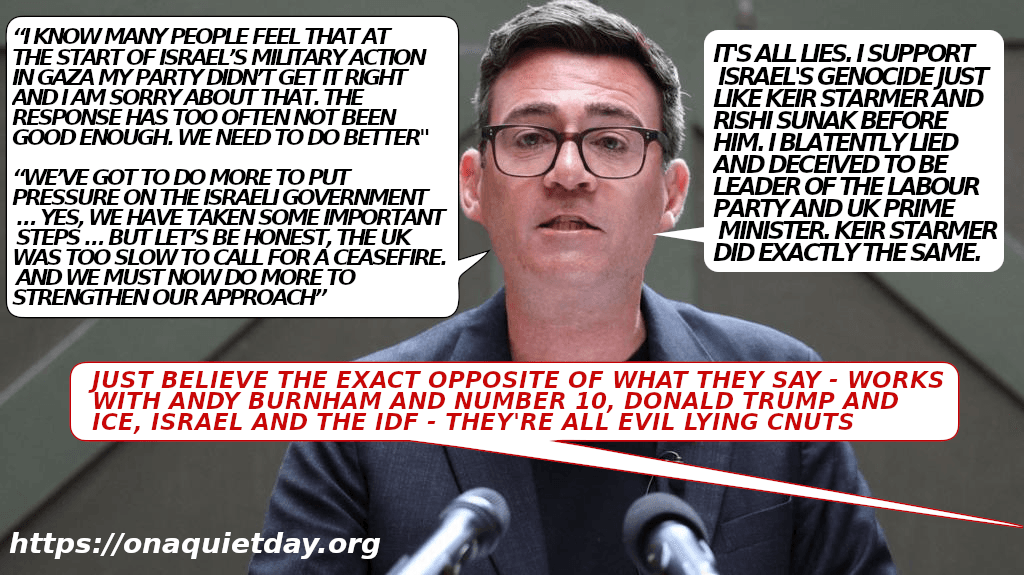
Keir Starmer objects to criticism of the IDF. He asks how could anyone object to them starving people to death, forced marches like the Nazis did, bombing Gaza’s hospitals and universities, mass-murdering journalists, healthworkers and starving people queuing for food, killing and raping prisoners and murdering children. He calls for people to stop obstructing his genocide for Israel. New Labour UK Prime Minister Andy Burnham continues Labour party policy of active support and complicity in Israel’s genocide.UK Prime Minister Andy Burnham admits to blatently lying and engaging in deception to become leader of the UK Labour Party and Prime Minister.Ed Miliband says that he and the Labour Party are full of shit criminalising people holding signs as terrorists despite anything he says.
An actor impersonating U.S. President Donald Trump stands behind symbolic prison bars set up inside an interactive billboard frame at Tajrish Square in Tehran, Iran. [Fatemeh Bahrami – Anadolu Agency]
There appears to be little prospect of lasting peace between Iran and the United States while Donald Trump remains in the White House. This is a view that an increasing number of serious actors across the region now seem to share. Eight months into Iran war, Washington has neither broken Tehran’s resolve nor found a clear path out. The president’s own remarks point to a narrowing set of options. Trump told TIME he does not believe peace with Iran is ever possible, a striking admission from the leader still expected to negotiate one.
Tehran, for its part, has set conditions it knows this administration cannot meet, insisting that sanctions and threats be lifted before talks resume and that not a single gram of enriched uranium leaves the country. Neither side is bargaining towards a settlement. Each is waiting for the political ground beneath the other to shift.
Trump’s problem is that the ground is shifting under him first, as the 3rd November midterms approach with his approval rating near 39 per cent and crude trading above 110 dollars a barrel. The House has voted three times to restrict his war powers in Iran, with Republican candidates in competitive seats now campaigning openly on ending the war to lower petrol prices. Facing a likely defeat, the president has promised no strikes before polling day while Central Command has reportedly been told to prepare for resuming major combat operations. Therefore, it is quite likely that Trump may order striking Iran even before the mid-term day.
Analysts have noted that a Republican defeat could strengthen this incentive, as a president with little left to lose at the ballot box faces fewer costs for escalation. Yet such strikes would do little damage control, since a Politico survey found 46 per cent of voters said ending the war before the election would not change their vote at all. Iran has meanwhile fortified its nuclear sites and warned that regional energy infrastructure would be targeted, so any parting blow risks sending oil prices even higher.
The president’s own inner circle appears to have read the same numbers and is quietly positioning itself for the aftermath. Vice President JD Vance, reportedly sceptical from the outset, has kept his distance and this week declined to endorse Benjamin Netanyahu ahead of Israel’s election.
Secretary of State Marco Rubio, his chief rival for 2028, spent the same week in India on a trip devoted largely to trade rather than Iran.
Defence Secretary Pete Hegseth, by contrast, made an unannounced visit to Israel a day after Trump endorsed Netanyahu, keeping himself firmly in the frame. Commentators suggested as early as April that Hegseth was being set up as the fall guy should the war end badly. His visibility since has only reinforced that impression.
The Gulf states have reached the same conclusion. They are hedging accordingly against an American policy they no longer trust to last. The UAE joined the campaign against Iran in February, yet they opened a backchannel with Iranians lately after the realization that it is better to deal directly instead of relying on the US. Moreover, the UAE, by the virtue of being in support of the Saudis vis-à-vis Yemen, is trying to find a diplomatic way to lower tensions. It signals a striking reversal in barely eight months. Having absorbed thousands of Iranian missiles and drones, Abu Dhabi appears to be securing its own understandings before Washington’s next round begins.
Yemen shows how the burden is being shifted, since the United States has twice rebuffed Saudi requests for airstrikes against the Houthis and says it will not take kinetic action for now. Instead, the UAE has reportedly agreed to resume funding anti-Houthi forces in southern Yemen. This is an arrangement that lets Washington stay out while a partner carries the fight on its behalf.
Iran’s strategy rests on patience and its leaders appear confident they can absorb another year or so of American pressure before the political weather in Washington changes. Its posture towards Saudi Arabia fits this reading more closely than the images of burning airports suggest. Houthi strikes have killed at least 19 people at Saudi airports, and the Wall Street Journal has reported Revolutionary Guard officers helping to direct them. Yet within days of the deadliest attack, Foreign Minister Abbas Araghchi called Riyadh to offer mediation with the Houthis and insist the crisis had no military solution.
The aim is not to destroy Saudi infrastructure but to convince the kingdom that American protection is unreliable and that any opening to Israel will carry a heavy price. Riyadh has begun to absorb that lesson, but the pressure is unlikely to ease while Trump remains in office and Tehran sees no reason to settle.
The real question is how Israel reacts to all this, both during the remainder of Netanyahu’s tenure and after it. Trump has endorsed Netanyahu so he can help “finish the job” against Iran, and Israel has reportedly asked that any renewed strikes wait until after its 27 October vote. Polls give Netanyahu’s coalition fewer than 50 of the 61 seats needed to govern, raising the prospect of a weakened caretaker with every reason to keep the Iran file burning.
A successor led by Gadi Eisenkot would hardly soften Israel’s line on the Iranian nuclear programme, but it might be less willing to tie national strategy to American president’s fortunes. Should Israel strike alone after an American exit, Gulf hedging would only accelerate and normalisation with Riyadh would recede further from view.
Tehran and the Gulf have made their calculations. Both now wait for a different figure in the Oval Office.
The views expressed in this article belong to the author and do not necessarily reflect the editorial policy of Middle East Monitor.
Donald Trump sings and dances, says that it’s fun to kill everyone … unless he gets distracted or falls asleep.
Keir Starmer objects to criticism of the IDF. He asks how could anyone object to them starving people to death, forced marches like the Nazis did, bombing Gaza’s hospitals and universities, mass-murdering journalists, healthworkers and starving people queuing for food, killing and raping prisoners and murdering children. He calls for people to stop obstructing his genocide for Israel. New Labour UK Prime Minister Andy Burnham continues Labour party policy of active support and complicity in Israel’s genocide.UK Prime Minister Andy Burnham admits to blatently lying and engaging in deception to become leader of the UK Labour Party and Prime Minister.Ed Miliband says that he and the Labour Party are full of shit criminalising people holding signs as terrorists despite anything he says.
This work by Middle East Monitor is licensed under a Creative Commons Attribution-NonCommercial-ShareAlike 4.0 International License.
United States Secretary of War Pete Hegseth speaks during the press conference held by The United States President Donald Trump in the James S. Brady Press Briefing Room at the White House on April 6, 2026, in Washington DC, United States. [Celal Güneş – Anadolu Agency]
US Defense Secretary Pete Hegseth said Saturday that Iran faces a choice between abandoning its “nuclear ambitions” and reaching a deal or facing devastating military action, Anadolu reports.
“Iran’s going to have a choice to make real quick about whether they’re going to give those up at the table or face the kind of devastation that America can bring and will bring swiftly if necessary,” Hegseth told Reserve Officers’ Training Corps cadets and military recruits at the University of Tennessee.
He accused Tehran of building a large conventional missile arsenal to deter military action while pursuing “nuclear ambitions,” arguing that US military strength was essential to forcing adversaries to negotiate.
Hegseth also said that Iran “funds the proxies in Hezbollah, funds the proxies in the Houthis in Yemen,” adding that Washington had sought to deter attacks on US forces and shipping.
The defense chief framed the policy on Iran as part of US President Donald Trump’s wider effort to reassert American power, including confronting drug cartels and limiting the influence of Iran, China and Russia in Latin America.
Referring to Venezuela, Hegseth said the US operation there would have “generational implications,” describing the country as a strategic partner and highlighting its oil resources.
He said Washington was seeking to push its rivals out of the Western Hemisphere while strengthening its military presence and partnerships across the Americas.
Keir Starmer objects to criticism of the IDF. He asks how could anyone object to them starving people to death, forced marches like the Nazis did, bombing Gaza’s hospitals and universities, mass-murdering journalists, healthworkers and starving people queuing for food, killing and raping prisoners and murdering children. He calls for people to stop obstructing his genocide for Israel. New Labour UK Prime Minister Andy Burnham continues Labour party policy of active support and complicity in Israel’s genocide.UK Prime Minister Andy Burnham admits to blatently lying and engaging in deception to become leader of the UK Labour Party and Prime Minister.Ed Miliband says that he and the Labour Party are full of shit criminalising people holding signs as terrorists despite anything he says.
This work by Middle East Monitor is licensed under a Creative Commons Attribution-NonCommercial-ShareAlike 4.0 International License.
Iranian Foreign Minister Abbas Araghchi at the Ministry of Foreign Affairs in Baghdad, Iraq, on June 28, 2026. [Murtadha Al-Sudani – Anadolu Agency]
Iran remains open to negotiations but requires “credible guarantees” before resuming talks, Foreign Minister Abbas Araghchi said on Saturday, state news agency IRNA reported.
“Iran does not accept coercion, threats and intimidation and will not relinquish its sovereign rights under pressure. But it remains ready for dialogue based on mutual respect and credible guarantees,” Araghchi told the 52nd session of the Organization of Islamic Cooperation (OIC) Council of Foreign Ministers in Baghdad.
He said Iran negotiated “in good faith” over the past two years, but claimed diplomatic efforts were repeatedly followed by military attacks, creating “deep mistrust” over restarting negotiations without guarantees against a recurrence.
Nevertheless, Araghchi said, Tehran has kept the door to diplomacy open.
He referred to a previously conveyed seven-day proposal through Qatar under which, he said, the Strait of Hormuz could be reopened and normal maritime traffic restored if the necessary conditions were met.
Araghchi also referred to the June 17 Islamabad understanding between Iran and the US, reached through Pakistan’s mediation and with Qatar’s support.
He said maritime traffic recovered to around 60% of its pre-war level within two weeks before implementation of the understanding stalled.
On Yemen, Araghchi said the conflict has no military solution and should be resolved through an inclusive political process and negotiations, adding that Iran is ready to help facilitate dialogue between the parties based on a previously agreed peace roadmap.
He reiterated Tehran’s position on Palestine, and called for coordinated action by OIC members to support Palestinian rights.
The two-day OIC foreign ministers’ meeting opened in Baghdad on Saturday, bringing together representatives of member states to discuss regional crises, Palestine, peace, development and cooperation.
Iraq assumed the organization’s rotating presidency from Türkiye at the meeting, held under the theme “Dialogue and Solidarity: Two Essential Pillars for Promoting Peace and Sustainable Development.”
This work by Middle East Monitor is licensed under a Creative Commons Attribution-NonCommercial-ShareAlike 4.0 International License.
The GBU-43/B Massive Ordnance Air Blast (MOAB) bomb. [Photo/AA]
The US military has developed new strike plans that include the potential use of the “mother of all bombs” against Iranian energy infrastructure and nuclear sites if President Donald Trump orders a resumption of combat operations, CNN reported Wednesday, citing multiple US officials familiar with the plans.
The proposed use of the GBU-43/B Massive Ordnance Air Blast Bomb (MOAB), the largest non-nuclear bomb in the US arsenal, would mark a significant escalation in the conflict with Iran, although officials have questioned whether the weapon could achieve Washington’s military objectives.
According to CNN, Trump has directed the military to prepare additional strike options against Iranian targets, including energy infrastructure and facilities associated with the country’s nuclear program. The plans could be activated before or after the upcoming US midterm elections if the president decides to resume major combat operations.
One source familiar with the military planning told CNN that the proposed strikes could take place before a US military withdrawal from the US Central Command area of responsibility, potentially allowing the administration to launch further attacks before declaring victory and withdrawing its forces.
A second source said plans for strikes against Iranian nuclear sites, including a suspected underground facility at Pickaxe Mountain, explicitly included the potential deployment of the MOAB.
Trump has repeatedly threatened to target Pickaxe Mountain, where Washington and Israel believe Iran has stored components of its nuclear program. The president has maintained that preventing Tehran from obtaining a nuclear weapon remains a central objective of the US campaign.
A US official told CNN that military planners routinely prepare a range of options for policymakers, from lower-intensity operations to more powerful strikes against heavily fortified targets.
However, the MOAB’s effectiveness against deeply buried nuclear facilities remains uncertain.
The GPS-guided bomb can devastate a large surface area equivalent to approximately nine city blocks, but it is not designed to penetrate deeply underground. Sources cited by CNN said the weapon would likely struggle to destroy facilities protected by thick layers of granite and other fortifications.
“The MOAB is a massive information operation type weapon that is great for huge area clearance but not much else,” a source familiar with the military planning discussions told CNN, describing it as unsuitable for deep penetration.
If deployed, the bomb could cause extensive destruction at the point of impact, while its large blast radius could raise serious concerns about civilian casualties, particularly if strikes targeted energy infrastructure near populated areas or other civilian facilities.
Despite these limitations, US officials have reportedly considered the weapon’s potential psychological impact as part of the administration’s broader military options.
One source told CNN that the president could face pressure to take further action against Iran despite uncertainty over whether additional strikes would force Tehran to accept Washington’s demands.
The source suggested the MOAB could serve as a means of exerting psychological pressure, particularly given the limitations of available munitions against deeply buried targets.