Tag: lies

  • Big Oil Clouded the Science on Extreme Weather. Now It Faces a Reckoning.

    Spread the love

    Original article by Emily Sanders, ExxonKnews republished from DeSmog.

    As more communities sue oil majors following climate disasters, a collection of evidence reveals the industry’s efforts to deny the link between extreme weather and climate change.
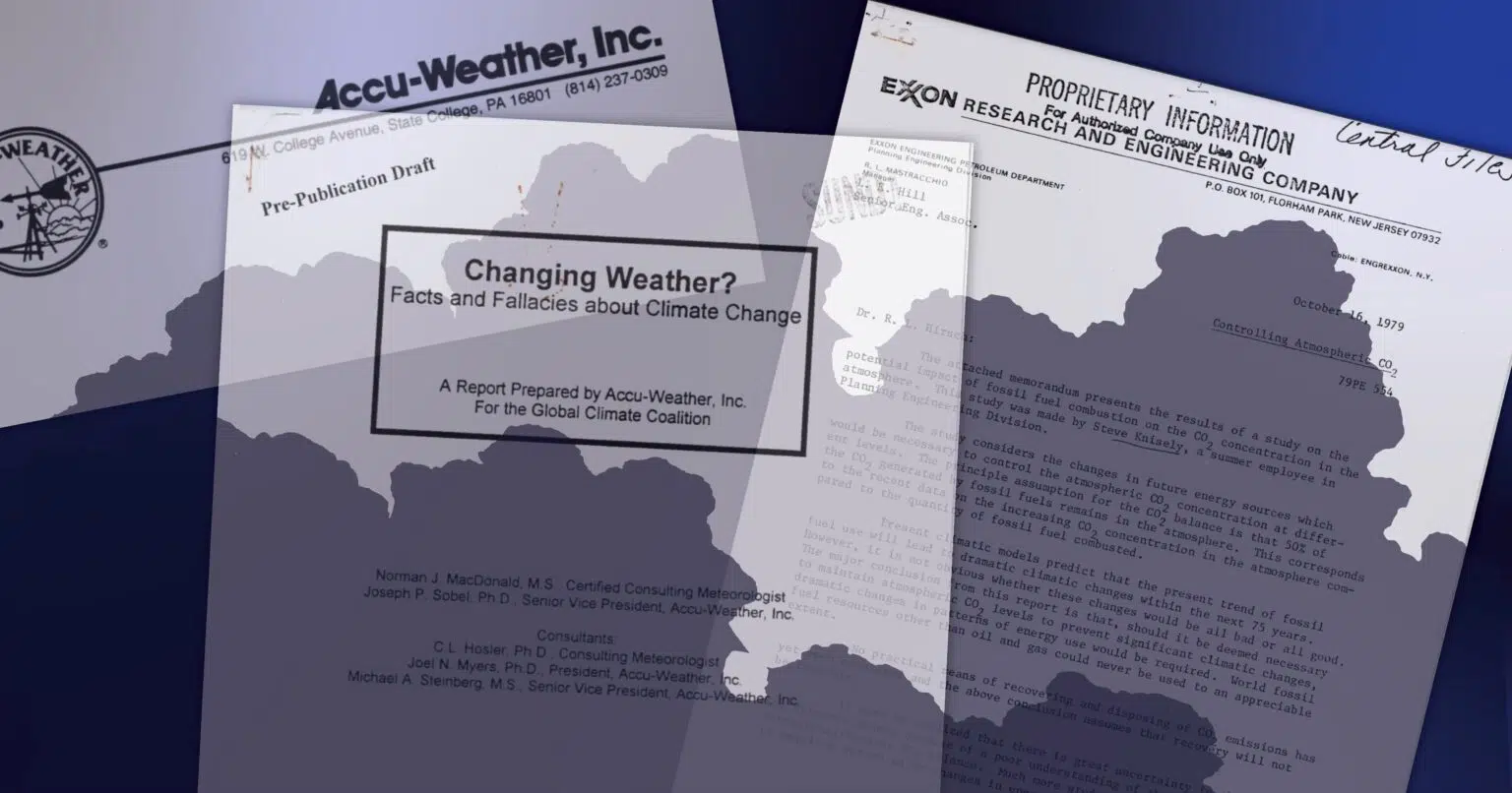
    Illustration by Tess Abbot

    This story was originally published by ExxonKnews.

    When Bucks County, Pennsylvania, filed a lawsuit last week against major oil and gas companies for climate damages, Commissioner Chair Diane Ellis-Marseglia pointed to “unprecedented weather events here in Bucks County that have repeatedly put residents and first responders in harm’s way, damaged public and private property and placed undue strain on our infrastructure.” The county argues oil companies’ “campaigns to deceive and mislead the public about the damaging nature of their fossil fuel products” delayed climate action for decades, robbing communities of precious time to mitigate the climate-driven disasters they now face.

    One of those disasters occurred last year, when a rainstorm in Bucks County caused deadly flash flooding that swallowed vehicles and killed 7 people, including two children. Scientists said the deluge and its aftermath — not the county’s first “100-year flood” in recent years — are a harbinger of the intense and dangerous rainstorms that a warming climate is making more likely.

    As the science connecting climate change to more frequent and severe weather events becomes clearer, there is mounting evidence that members of the fossil fuel industry coordinated to downplay that link — evidence that could be valuable to lawsuits seeking accountability. 

    Bucks County is just one in a growing list of communities taking legal action against fossil fuel companies in the wake of deadly extreme weather events. Multnomah County, Oregon sued oil, gas, and coal majors after a 2021 heat dome that killed nearly 70 people. On the 10 year anniversary of Superstorm Sandy, New Jersey’s attorney general took Exxon, Chevron, and other oil giants to court, citing the billions of dollars in damage and deaths the hurricane caused in the state. In the first-ever racketeering lawsuit against Big Oil companies, Puerto Rico municipalities are seeking to recover costs incurred by Hurricane Maria. 

    Fossil fuel majors, these cases argue, should help communities pay for the costs of adapting to and recovering from climate disasters given the industry’s early research into — and subsequent denial of — their products’ harm. “We’re already seeing the human and financial tolls of climate change beginning to mount,” said Commissioner Ellis Marseglia. “If the oil companies’ own data is to be believed, the trend will continue.”

    It’s a trend that the fossil fuel industry worked to obscure for decades. collection of evidence just published to ClimateFiles.com reveals the extent to which oil companies and their trade associations sought to deny and downplay the relationship between climate change and extreme weather. 

    Nicky Sundt, a climate expert and former communications director for the U.S. Global Change Research Program during the George W. Bush administration, said she tried to publicly communicate the science behind that link, but was “stymied over and over again” by industry interests inside and outside the White House — an experience she has discussed with The Guardian and PBS Frontline.

    “By interfering with the communications of climate science to the public, [the fossil fuel industry] knew that the public was less likely to become agitated and do something about it,” Sundt said. “The consequence was to slow efforts to reduce our emissions, and to leave us more unprepared for the impacts of climate change. The longer you wait, the more expensive it is to deal with all of these issues, and they’ve eaten up incredibly important time we needed.”

    “A new norm”

    In 1997, fossil fuel interests successfully convinced prominent United States officials to oppose U.S. ratification of the Kyoto Protocol — an international climate agreement that would have limited greenhouse gas emissions decades ago. 

    A year later, the American Petroleum Institute (API) — the largest oil and gas trade association in the U.S. — bluntly outlined a plan to keep drumming up opposition to the Kyoto Protocol as negotiations continued. According to a newly uncovered February 1998 internal strategy proposal reviewed by ExxonKnews, API would “develop and implement a campaign-style ‘rapid response’ team… to respond to op-eds that make exaggerated claims about climate science… and to media events staged by government officials and/or environmental organizations seeking to tie extreme weather events to possible human impacts on global climate.” 

    Long before that campaign began, internal industry memos and promotional materials show, major oil companies knew about the role that climate change would play in intensifying hurricanes, floods, droughts, heatwaves, precipitation patterns, and other extreme weather events.

    One 1979 memo distributed to Exxon management, about a report conducted by Steve Knisley of Exxon’s Research and Engineering Department, accurately predicted the growth of atmospheric carbon dioxide concentrations by 2010 and referenced the “ecological consequences of increased CO2 levels.” Those consequences were listed in detail, including global temperature increases, water shortages in the U.S. southwest, increased rainfall, and “violent storms.”

    In a 1991 film production by Shell, called “Climate of Concern,” a narrator warns that “if the weather machine were to be wound up to such new levels of energy, no country would remain unaffected,” and that “what is now considered abnormal weather could become a new norm.”

    Another film produced that year by BP, called “This Earth – What Makes Weather?”, alludes to the ways climate change would increase the frequency and damage caused by extreme weather events like storms, flooding, and drought. “From warmer seas, more water would evaporate — making storms and the havoc they cause more frequent,” the narrator predicts. “Catastrophic floods could become commonplace and low-lying countries like Bangladesh would be defenseless against them.”

    But around the same time, the industry began to worry about how public understanding of those phenomena could affect their core business. A 1989 presentation by Duane LeVine, a senior executive at Exxon, expressed concern that an extreme heat and drought event the year before had “drawn much attention to the potential problems and we’re starting to hear the inevitable call for action. Exactly what happens now is not clear… but this critical event has energized the greenhouse effort and raised public concern over PEG [potential enhanced greenhouse].”

    Under the cover of trade associations and front groups, through PR campaigns and funded academic research, the industry developed a strategy to undermine the link between climate change and weather-related disasters — and discredit those who sought to communicate that science to the public.

    A Campaign to Turn the Tide
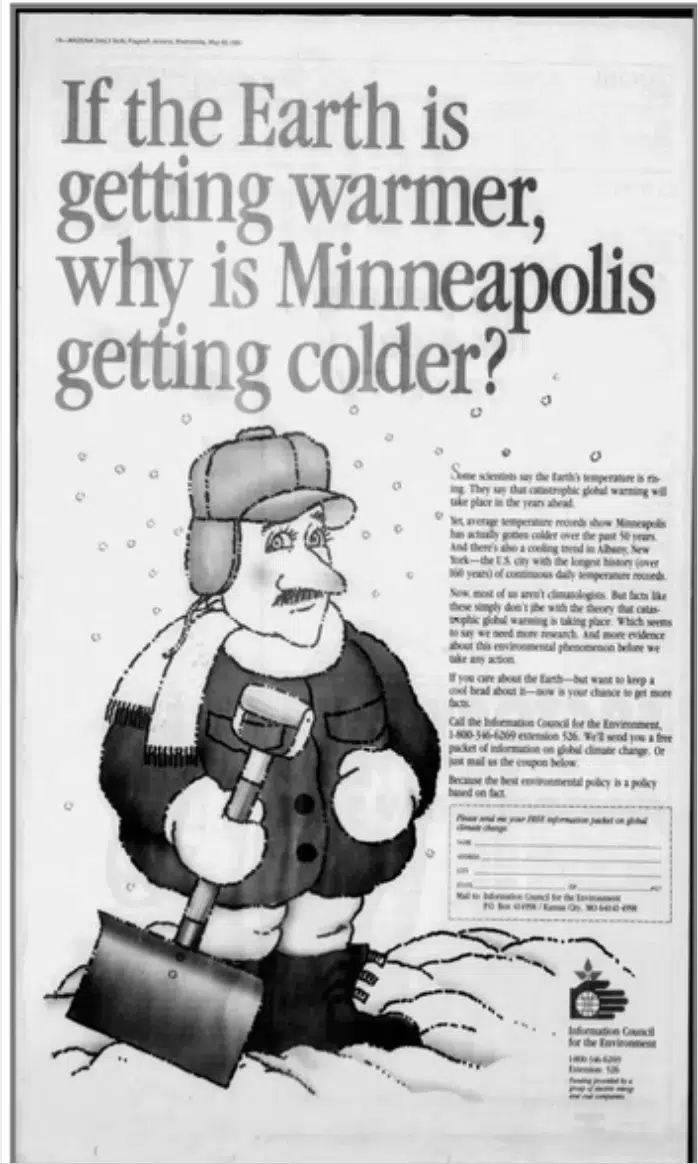
    One ad from a PR campaign by the “Information Council on the Environment,” funded by fossil fuel and electric utility interests. Minnesota is now suing ExxonMobil, Koch Industries, and the American Petroleum Institute for climate fraud.

    One key player was the Global Climate Coalition (GCC) — an international industry lobbying group that was instrumental in early efforts to deny climate change and generate opposition to policy action to reduce emissions. In 1994, the GCC hired weather forecasting service AccuWeather Inc. to produce a report minimizing the impact of global warming on extreme weather, which the GCC would cite in a pamphlet distributed at the United Nations climate convention the following year. 

    “No convincing, observational evidence exists that hurricanes, tornadoes and other extreme temperature and precipitation events are on the rise because of the recent slight increase in the Earth’s surface temperature,” the report states. 
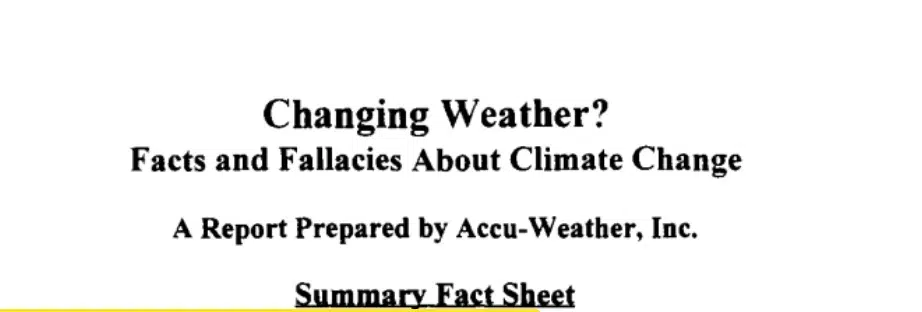
    A report that AccuWeather produced minimizing the impact of global warming on extreme weather in 1994.

    In response to ExxonKnews’ requests for comment on the report, a spokesperson for AccuWeather said that “AccuWeather and the other leading consulting meteorologists involved had been engaged to produce an analysis based upon the available data at that time. There was much debate and uncertainty in the scientific community over the causes and effects of global warming during that time period, and a new generation of computer modeling studies was just beginning to emerge that would create an important shift in scientific judgment.” 

    “As an organization rooted in science, AccuWeather’s view on global warming and extreme weather has evolved over the past three decades, as has the view of many other scientific organizations,” they said, noting that data now shows a “marked increase in billion-dollar disasters due to extreme weather events.” Today, the spokesperson added, AccuWeather has signed the “Global Climate Science-Media Action Pledge”, and is committed to communicating the impacts of climate change on extreme weather to the public.

    The GCC also hired academics to further their cause. Internal meeting notes from July 1997 show that the GCC commissioned a research paper from Robert E. Davis, a University of Virginia climatologist, explicitly denying the climate and extreme weather connection. 

    Excerpt from Global Climate Coalition meeting notes in 1997.

    “A belief commonly held is that global warming will produce more extreme weather,” the published paper read. “While this thinking serves as convenient fuel for sensationalist headlines linking what only a decade ago would have been viewed as the normal vagaries of weather to some approaching climatic apocalypse, it is not based on sound science.”
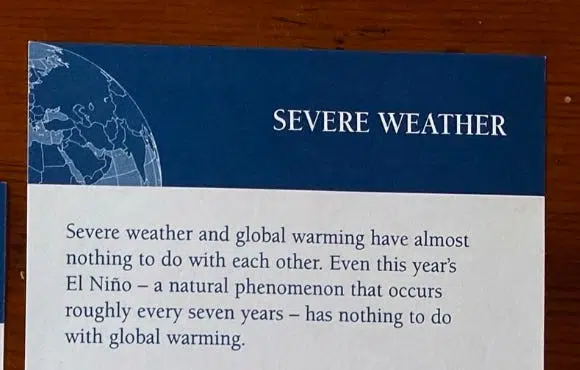
    From a folder handed out by the GCC at the UN climate negotiations in 1999.

    In 1999, in the wake of Hurricane Floyd, Frank Maisano, then a spokesman for the GCC, faxed a memo to “Communicators Interested in Global Climate Issues.” “As millions of people flee Hurricane Floyd, many climate activists have again suggested — despite the facts — that hurricanes and global warming are connected,” the memo stated.

    In response to questions about the memo and the GCC’s positions, Maisano told ExxonKnews that “Any fair review of the debate over any link between climate and severe weather has always been the subject of significant discussion between the experts themselves, especially with regard to hurricanes.”

    “Importantly,” Maisano said, “GCC’s main focus at the time was on the economic impacts, sovereignty and effectiveness of any policy proposed to address climate change.”

    Maisano now runs a strategic communications practice for Bracewell LLP, whose separate law practice provides services for oil and gas companies including Eni (currently being sued for climate deception in Italy) and Phillips 66 (which is a defendant in many U.S. climate lawsuits, including those filed by Bucks County and the state of New Jersey). Since 2005, the group has also advocated for renewables, Maisano said.

    The industry’s campaign stretched on for years. In 2006, shortly after Hurricane Katrina, the DCI Group — a lobbying and campaign contractor with ties to Exxon — produced and sent VHS tapes of videos designed to look like a national news broadcast to Gulf of Mexico area news stations. The tape featured Dr. William Gray, a (now deceased) hurricane scientist at Colorado State University and climate change denier, stating that in the past 20 years, scientists had seen “no significant change in the frequency and intensity of major hurricanes around the globe…. This is the way nature sometimes works.” (Scientists have since concluded that climate-driven warming contributed to the increased rainfall and severity of storm surge during Hurricane Katrina, which killed nearly 2,000 people.) 

    According to Sundt, after Hurricane Katrina hit, the communications arm of the U.S. Global Change Research department proposed hosting a session on the implications for preparing for climate change on the Gulf Coast. “We had a well developed proposal, and it was just killed [by the White House] without explanation,” she said.

    “A more resilient world”

    Today, the steady growth of attribution science — or research investigating the role of climate change in altering or intensifying extreme weather events — has put a dent in Big Oil’s designs. The field of study has developed to even be able to tie the emissions of specific corporate actors to climate-worsened disasters — opening up more possibilities for those companies to be held liable for climate damages in court.

    One such study, from researchers from the Union of Concerned Scientists and the University of California, Merced, found that nearly 40% of all forests burned in the Western U.S. and Canada since 1986 can be tied to emissions from just 88 of the world’s largest fossil fuel and cement manufacturers. That research was cited in Multnomah County’s lawsuit against oil and gas majors for climate damages last year.

    Delta Merner, lead scientist for the Union of Concerned Scientists’ climate litigation hub and a co-author of the study, pointed out that many of the same companies that fought regulation of climate-warming emissions adapted their own fossil fuel infrastructure to account for rising seas, warming temperatures, and worsening storms decades ago. 

    “As you look through the oil industry’s own reactions to their knowledge about climate change, they were able to build better infrastructure to be resilient,” Merner said. “We would have a more resilient world, we would not be facing the realities of climate change that we’re seeing today if it wasn’t for the lies the industry propped up for so long.”

    At least one oil major anticipated legal action decades ago. In a planning scenario from 1998, Shell made an eerie prediction: “In 2010, a series of violent storms causes extensive damage to the eastern coast of the U.S. … Following the storms, a coalition of environmental NGOs brings a class-action suit against the US government and fossil-fuel companies on the grounds of neglecting what scientists (including their own) have been saying for years: that something must be done.”

    Shell was ahead of its time. Between the increased frequency, severity, and costs of extreme weather events, the advancing science connecting them to polluters, and mounting legal theories, Merner said she expects more communities to file suit. Even as she sees the industry’s deception evolving in content and sophistication — like companies trying to shift the blame for emissions onto consumers to avoid responsibility — Merner believes attribution research is evolving faster.

    “It’s a testament to the power of science that climate litigation has been able to withstand an additional onslaught of disinformation from the fossil fuel industry and is now a key part in the fight for climate justice,” she said. 


    Note: Additional individuals mentioned here were asked to provide comment. The piece will be updated if they respond.

    CLARIFICATION 4/3/24: This story has been updated to clarify the difference between Bracewell LLP’s strategic communication practice and its law practice.

    Original article by Emily Sanders, ExxonKnews republished from DeSmog.
  • Morning Star: The real extremists are those trying to silence solidarity with Palestine

    Spread the love

    https://morningstaronline.co.uk/article/editorial-real-extremists-are-those-trying-silence-solidarity-palestine

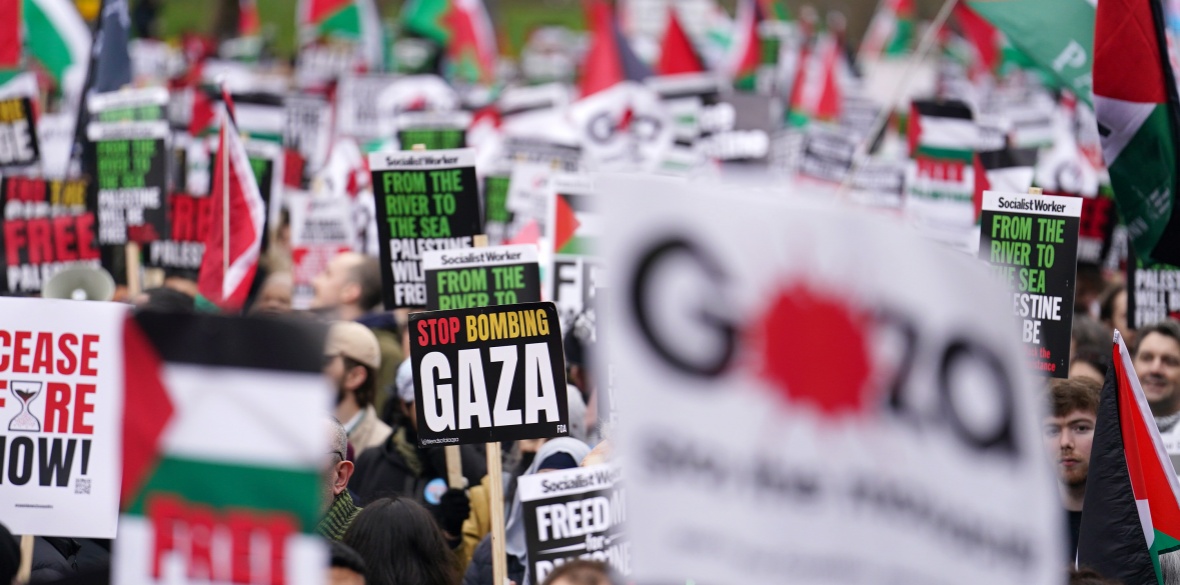
    People take part in a pro-Palestine march in central London, organised by the Palestine Solidarity Campaign, February 17, 2024

    BRITAIN’S rulers are coming for our democratic rights. And their way is being prepared with a barrage of propaganda and lies.

    The “counter-extremism commissioner” Robin Simcox peddles an outrageous smear against the peace movement when he claims Palestine solidarity demonstrations make London a “no-go zone for Jews.”

    Tell that to the large and growing Jewish bloc that has marched for a Gaza ceasefire at every national demo.

    But, as Stop the War Coalition officer John Rees warns, the ruling-class’s cynical strategy of interpreting empathy with Palestinians as hostility to Jews has sown confusion and fear.

    https://morningstaronline.co.uk/article/editorial-real-extremists-are-those-trying-silence-solidarity-palestine

  • When the Big Oil CEO Blames You for the Climate Crisis His Industry Created

    Spread the love

    https://www.commondreams.org/opinion/exxonmobil-ceo-blames-public-for-climate Despite being published on Common Dreams it’s not under a CC licence so it’s only an excerpt.

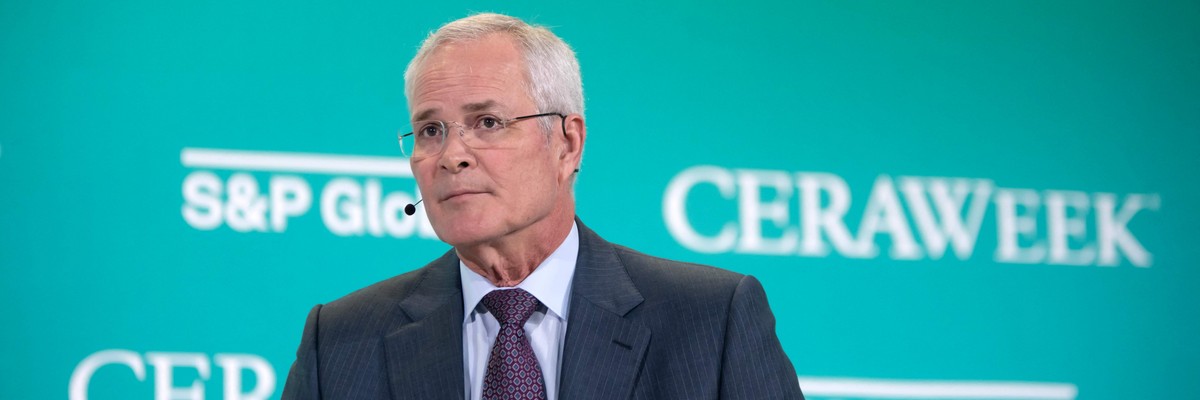
    Exxon CEO Darren Woods speaks at an international energy conference on March 7, 2023. (Photo: Mark Felix/AFP via Getty Images)

    We simply “waited too long,” said ExxonMobil’s top executive last week. But never mind, the important thing is that we made “above-average returns.”

    [L]ast week the CEO of Exxon gave an interview that amounts to an attempt to pawn off the climate crisis on everyone else, and also to map out the road he sees ahead—a road that involves wasting huge amounts of money subsidizing the fossil fuel industry. Darren Woods was talking to Fortune magazine reporter Michal Lev-Ram and editor Alan Murray, who began by explaining that Exxon was a group of charming “Texas tough boys” before teeing up one of the classic softball questions of all time. Some people, he said, were thinking that perhaps Exxon wasn’t entirely “serious about addressing climate change. Tell me why they’re wrong.”

    Well, Woods explains, Exxon is a molecule company, by which he means it’s interested in transforming molecules—’and they happen to be hydrogen and carbon molecules’—to ‘address the needs of our society.’ What he’s saying, quite explicitly, is that Exxon is not an electron company, i.e. a company interested in building out wind or solar power. And when Fortune asks him why not, he lets slip the basic truth of our moment: “we don’t see the ability to generate above-average returns for our shareholders.”

    For everyone who’s ever asked themselves, why isn’t Exxon (and Chevron and the rest) leading the charge to renewable energy, there’s the answer: you can make money doing it, but not as much as they’ve made traditionally. That’s because the sun and the wind deliver the energy for free, and all you need is some equipment to turn it into electrons. But Exxon controls the molecules—that’s what oil and gas reserves are. And that control means they can make outsize profits—as long as they can persuade the world to keep burning stuff.

    And it’s the story of that persuasion where Woods’ words go from galling to really really gross. Because he explains to his nodding interlocutors that the world “waited too long” to start developing renewables. Or, in his particular brand of corporate speak: “we’ve waited too long to open the aperture on the solution sets terms of what we need as a society.”

    https://www.commondreams.org/opinion/exxonmobil-ceo-blames-public-for-climate

  • [Morally bankrupt] UK Conservatives: Edited video attack ad on London Mayor was not misinformation

    Spread the love

    https://www.reuters.com/world/uk/uk-conservatives-edited-video-attack-ad-london-mayor-was-not-misinformation-2024-02-16/

    London Mayor Sadiq Khan walks on the day he gives evidence at the COVID-19 Inquiry, in London, Britain, November 27, 2023. REUTERS/Belinda Jiao Purchase Licensing Rights

    LONDON, Feb 16 (Reuters) – Britain’s governing Conservative Party on Friday brushed off criticism of an attack video it posted on social media that misrepresented comments by a senior opposition politician to make it look like he was proud to be antisemitic.

    In a television interview on Thursday, London Mayor Sadiq Khan said Labour was “proud to be both anti-racist but also antisemitic – I beg your pardon, tackling antisemitism.”

    Later, the Conservative Party posted the clip on X without including the part where he clarified the comment. The caption said “Sadiq Khan says the quiet part out loud.”

    https://www.reuters.com/world/uk/uk-conservatives-edited-video-attack-ad-london-mayor-was-not-misinformation-2024-02-16/

  • Israel is assassinating journalists in Gaza

    Spread the love

    Original article by Amanda Yee republished from peoples dispatch under a Creative Commons Attribution-ShareAlike 4.0 (CC BY-SA) license.

    As part of its genocidal onslaught on Gaza, Israel is killing media workers at an unprecedented rate, seemingly to prevent the world from seeing the unspeakable atrocities it carries out.

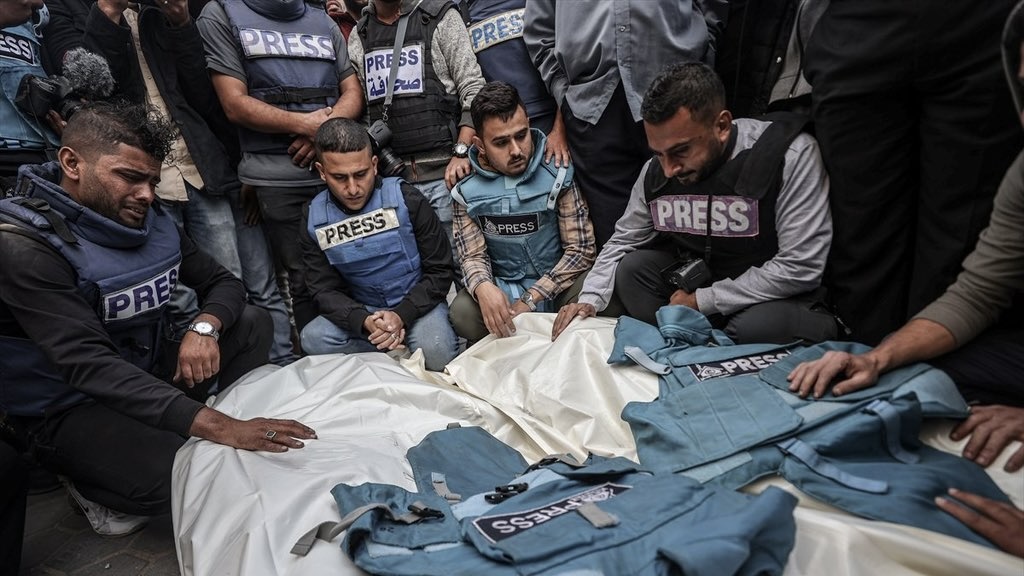
    Relatives, colleagues and loved ones of Palestinian journalists Sari Mansour and Hasona Saliem, who were killed while working, mourn during funeral ceremony in Deir al-Balah, Gaza on November 19, 2023. Photo: Anadolu Ajansı / Ali Jadallah

    Israel is intentionally assassinating journalists in Gaza. As it wages its genocidal onslaught on the enclave, having murdered at least 13,000 Palestinians so far, Israel is simultaneously killing media workers in order to prevent the world from seeing the unspeakable atrocities it carries out.

    The situation at hand is as dire as it is unprecedented. Since October 7, the Israeli military has killed 60 media workers, according to the Gaza Government Media Office. The Committee to Protect Journalists has stated this is the deadliest month for attacks on journalists since it started keeping record in 1992. Additionally, many other Palestinian reporters outside of Gaza face intimidation and harassment by Israeli forces.

    “We have never experienced anything like this and we are overwhelmed,” admitted Nasser Abu Bakr, head of the Palestinian Journalists’ Syndicate, a Ramallah-based trade union representing Palestinian media workers. “We are losing colleagues and friends every day as a result of the ongoing Israeli genocide against the Palestinian people and the policy of targeted killing against journalists.”

    “We can’t keep up with the number of attacks against our journalists,” Abu Bakr continued. “We are receiving more calls and information about … incidents than we can process. Our journalists have always been a target for the Israeli military, but Israel moved from killing [an average of] one Palestinian journalist a year before October 7 to killing [over] one a day.”

    And it’s not just Palestinian reporters the Israel Defense Forces (IDF)  is attacking—any journalist who may potentially disseminate information critical of Israel is a potential target.

    Among the long list of reporter casualties is Reuters photojournalist Issam Abdallah, who was killed by an October 13 Israeli strike on the Lebanese border while covering clashes between Hezbollah and the IDF. According to an independent investigation by Reporters Without Borders (RWB), Abdallah was explicitly targeted by Israeli forces—he was clearly identified as a journalist through his press helmet and vest, and he was standing next to a vehicle marked “press” on its roof. Immediately before the attack, other journalists in the area had witnessed an Israeli helicopter flying overhead, so the military was able to clearly see that Abdallah was a non-combatant. According to ballistic analysis done by RWB, the missiles were launched from the side of the Israeli border and “two strikes in the same place in such a short space of time (just over 30 seconds), from the same direction, clearly indicate precise targeting.”

    Not even the families of journalists are safe from Israeli retaliation. After learning on air that an Israeli air raid had killed his wife, son, daughter, and grandson, Gaza Al Jazeera bureau chief Wael Al-Dahdouh rushed to the hospital, followed by press cameras. Upon finding his son there, he knelt over his lifeless body and lamented, “They take revenge on us with our children.”

    On November 7, Mohammad Abu Hasira, a correspondent for Palestinian news agency Wafa, was killed by an Israeli air raid, along with 42 members of his family. And just days before that, an Israeli strike killed Palestine TV reporter Mohammad Abu Hattab and 11 members of his family in south Gaza, including his wife, son, and brother.

    Israel invents lies to justify war crimes

    Just as it has claimed that Hamas was hiding in Gaza hospitals, near schools, and in ambulance convoys in order to justify its bombing and killing of civilians, Israel has peddled the same predictable excuses for these targeted assassinations of journalists. In a chilling November 2 article that effectively doubles as a hit list, the Jerusalem Post spotlighted several independent Palestinian journalists who had been reporting from Gaza and smeared them as part of “Hamas’s propaganda team.”

    Then, pro-Israel media watchdog group HonestReporting released a report on November 8 claiming—with little evidence—that the Associated Press, CNN, The New York Times, and Reuters freelance photographers in Gaza knew in advance of the October 7 Palestinian Resistance counter-offensive and even collaborated with Hamas in order be on location to get their shots during the operation.

    Israeli officials quickly jumped on the story to vindicate their assassination campaign against Palestinian reporters.

    In response to the report, former Minister of Defense and current member of Israel’s war cabinet Benny Gantz said, “Journalists found to have known about the massacre, and [who] still chose to stand as idle bystanders while children were slaughtered, are no different than terrorists and should be treated as such.”

    Danny Danon, Israel’s representative to the United Nations, went so far as to declare that these reporters would be put on a hit list, stating on X, “Israel’s internal security agency announced that they will eliminate all participants of the October 7 massacre. The ‘photojournalists’ who took part in recording the assault will be added to that list.”

    Gil Hoffman, executive director of HonestReporting, later admitted that he had no evidence to substantiate the claims made, but was just “raising questions.” According to Hoffman, he and HonestReporting “don’t claim to be a news organization.”

    Accusations that Palestinian reporters are embedded within and acting in coordination with Hamas lay the propaganda groundwork to depict journalists as legitimate military targets.

    Israel restricting information coming out of Gaza

    Not only is the IDF killing Palestinian journalists on the ground, but the Israeli government is actively denying access to foreign press into Gaza. The only reporters allowed into the strip are those embedded within the IDF, and media outlets such as NBC and CNN have confirmed that in exchange for access, they must submit all materials to the Israeli military prior to broadcast for review and approval.

    Additionally, the Palestinian Journalists’ Syndicate reported that as many as 50 media outlets in Gaza have been partially or entirely destroyed by Israeli air strikes since October 7. If Israel is not outright bombing news outlets, then they are actively trying to repress the flow of information coming out. In late October, the Israeli government approved regulations that would allow it to shut down any foreign news channel if it believed the outlet posed a threat to national security. This regulation was then used to block the programming and website of Lebanese outlet Al Mayadeen, because of its “wartime efforts to harm [Israel’s] security interests and to serve the enemy’s goals,” according to a statement released by the Israeli security cabinet.

    In the absence of foreign press bearing witness to Israel’s atrocities in Gaza, Palestinian civilians have taken to documenting the horrors themselves and sharing them on social media sites such as X and TikTok for the outside world to see.

    The Israeli government has responded by repeatedly shutting down internet and communications systems across Gaza, even further restricting the flow of information coming out.

    History of Israel targeting journalists

    Even before its current war on Gaza began on October 7, Israel had a long history of targeting reporters and news networks. During its 2021 military incursion on Gaza, Israel was accused of “silencing” journalists by press freedom advocates after it bombed the offices of Al Jazeera and the Associated Press. This occurred just days after it had bombed another building that housed a number of other news outlets, including Al Araby TV, Al Kofiya TV, and Watania News Agency, among others.

    According to the Palestinian Journalists’ Syndicate, Israel killed 55 journalists from 2000 to 2022, either by live fire or bombardment. This figure includes Shireen Abu Akleh, the beloved Palestinian-American journalist and longtime Al Jazeera correspondent who was shot by Israeli forces while reporting on IDF raids in Jenin, as well as Yaser Murtaja, a cameraman for Palestinian network Ain Media, who was shot and killed by the IDF while covering the 2018 Great March of Return.

    Like so many other Palestinian journalists Israel murdered on the job, Abu Akleh and Murtaja were both wearing their press vests at the time of their killings. Immediately after his death, Israel predictably—with no evidence—rushed to accuse Murtaja of being a Hamas fighter in order to cover its tracks.

    The day after Murtaja’s killing, Israel’s then-Defense Minister Avigdor Lieberman bluntly stated, “In the march of terror, there were no innocent civilians. They were all Hamas.”

    Israel is losing the information war

    Israel relies on its advanced military weaponry and billions of dollars in funding from the US to carry out its genocidal violence against the Palestinian people across Gaza, Jerusalem, and the West Bank. Its Hasbara and “Brand Israel” campaigns work around the clock to justify its war crimes through outright lies and disinformation.

    However, Israel has suffered significant losses in the information war as reports and images of the atrocities have reached millions across the world, many of whom have joined the mass mobilizations in support of the Palestinian cause. On the international stage, Israel is further politically isolated, with more and more countries cutting ties or recalling their diplomatic staff.

    This battle of ideas cannot be won through sheer force and US-backed military superiority. Israel cannot prevent information about its atrocities from leaking out, especially in an age of social media in which ordinary Palestinians are emboldened to act as citizen journalists, documenting what they are living through in Gaza for the world to see. As Israel escalates its assassination campaign against media workers, support for the Palestinian Resistance continues to grow.

    Grim as the current situation may seem, it speaks to the reality at hand: The people of the world are waking up to the atrocities carried out by the Zionist state and refusing to allow it to continue.

    And that speaks to another reality: Israel is living on borrowed time, and that time is running out.

    Amanda Yee is a journalist and organizer based out of Brooklyn. She is the managing editor of Liberation News, and her writing has appeared in Monthly Review Online, The Real News Network, CounterPunch, and Peoples Dispatch. Follow her on X @catcontentonly.

    This article was produced by Globetrotter.

    Original article by Amanda Yee republished from peoples dispatch under a Creative Commons Attribution-ShareAlike 4.0 (CC BY-SA) license.