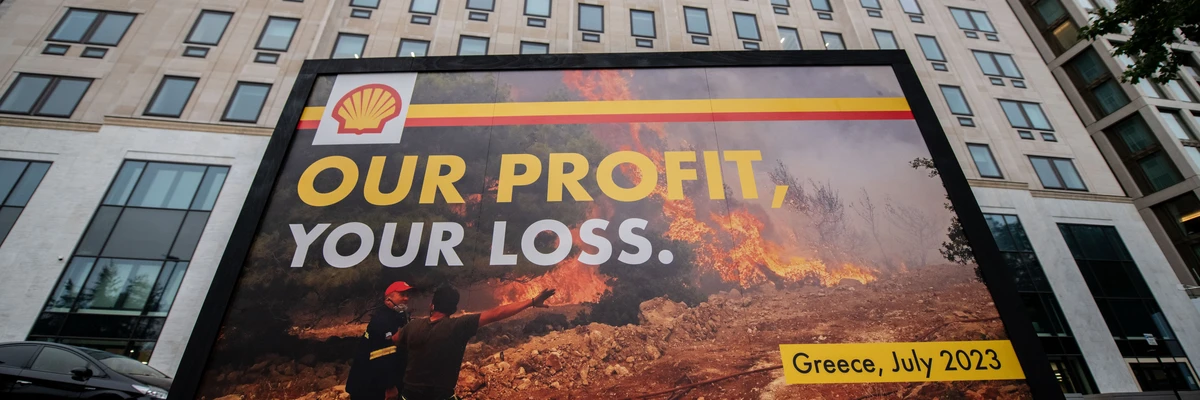
Greenpeace activists display a billboard during a protest outside Shell headquarters on July 27, 2023 in London. (Photo: Handout/Chris J. Ratcliffe for Greenpeace via Getty Images)
In February this year, the UK’s Climate Change Committee (CCC) wrote a letter to government in which it claimed that more domestic oil and gas extraction would have “at most, a marginal effect on prices”, recommending instead that the best way of reducing exposure to volatile energy markets is “cut[ting] fossil fuel consumption, improving energy efficiency, [and] shifting to a renewables-based power system”.
Meanwhile, research from campaign group Uplift reveals that gas from undeveloped UK oil and gas fields in the North Sea, including Rosebank, will deliver at most three weeks of energy to the UK per year, while oil would provide up to five years of oil demand, even if none of it were exported. In reality, most production from North Sea fields, along with Rosebank, which is joint-owned by Norwegian state oil major Equinor (40%), Canadian Suncor Energy (20%) and Israeli-owned Ithaca Energy (20%), is likely to be exported abroad, as is currently the case with 60% and 80% of North Sea gas and oil, respectively.
Further analysis of data from GlobalData reveals just how far burning oil and gas from Rosebank would threaten the UK’s climate targets. According to GlobalData, Rosebank contains the largest untapped oil and gas reserves of all proposed North Sea fields, with 370 million barrels of oil equivalent.
Using US Environmental Protection Agency (EPA) conversion figures – according to which one barrel of oil emits 0.43 tonnes (t) of CO₂ when burnt and 1,000 cubic feet of gas emit 0.0551t of CO₂ when burnt – Rosebank is likely to release 155 million tonnes of carbon dioxide (mtCO₂) into the atmosphere over its lifetime.
However, in a “balanced” net-zero pathway, as per the CCC’s sixth carbon budget, emissions from fossil fuels fall 75% by 2035 from 2018 levels. In total, emissions from “fuel supply” – predominantly made up of fossil fuels – amount to 298mtCO₂-equivalent (mtCO₂e) between 2023 and 2050, meaning lifetime emissions from Rosebank are equivalent to more than half of the UK’s remaining carbon budget for total fuel supply.
…
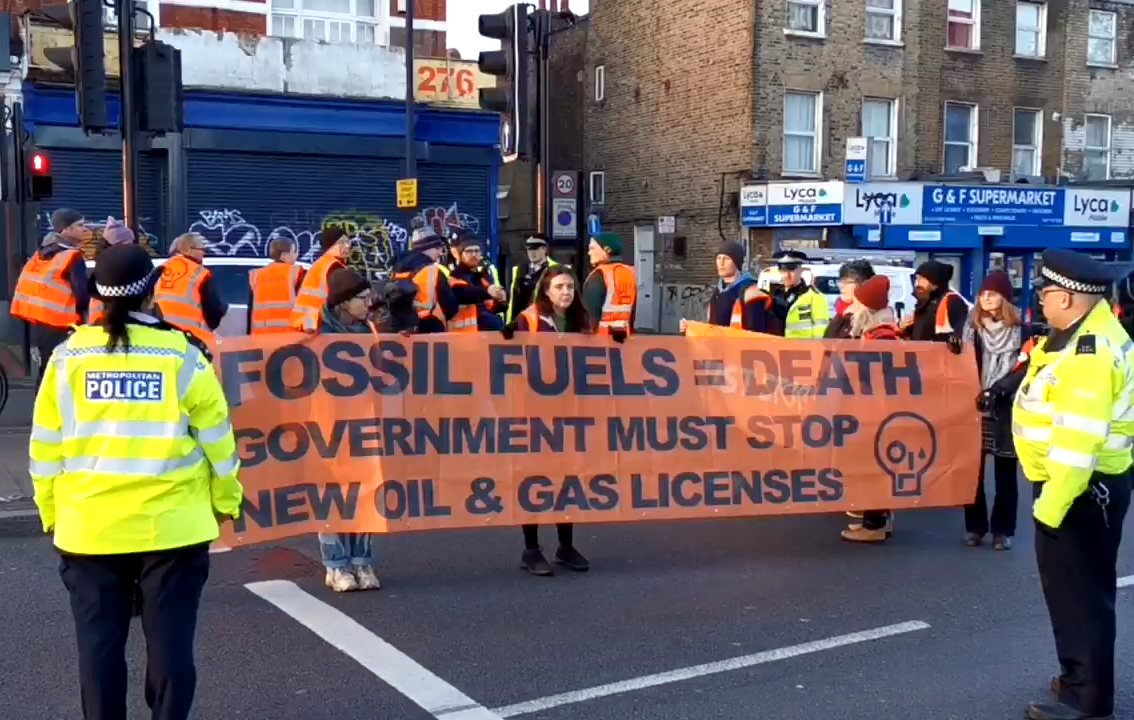
Just Stop Oil protesting in London 6 December 2022.
The UK government has approved the Rosebank oil field in the North Sea. I’ll have a lot to say on this but for a start while it blows any remaining pretence that UK is committed to net zero, the UK government will be massively subsidising a foreign company to extract and take the oil abroad …
… [N]ew estimates by the campaign group Uplift show that Rosebank, expected to cost £4.1bn to develop, could receive an effective taxpayer subsidy worth £3.75bn through tax breaks and the loophole in the government’s windfall tax that spares oil and gas investment.
This would mean that Equinor, the Norwegian state-owned company behind the potential field, would pay only £350m to develop Rosebank, which is three times the size of the Cambo oilfield. Equinor made £62bn last year, and about 80% of the oil from Rosebank is likely to be exported, rather than bolstering the UK’s energy security.
The acclaimed 1990 film Awakenings tells the story of a neurologist who discovers a drug which rouses catatonic patients from decades of “sleep”. It’s a true story, based on Oliver Sacks’ 1973 memoir of the same name.
Sadly, the awakening doesn’t last. The drug wears off. The mirage fades. After a brief window of hope, the patients return to their catatonic state.
Listening to UK prime minister Rishi Sunak’s recent speech, in which he announced the rolling back of policies to achieve net zero, I had a nagging sense that I had seen this movie before.
I had been there when the UK miraculously built a cross-party consensus around climate change. As early as 1989, I’d attended a high-level seminar convened by Sir James Goldsmith (father of Tory peer Zac Goldsmith) to advise Margaret Thatcher on climate policy.
I’d applauded John Prescott’s tireless leadership in negotiating the Kyoto Protocol in 1997. I’d given evidence to the Royal Commission on Environmental Pollution, whose influential 2000 report on Energy – the Changing Climate set the UK on the path to a world-leading Climate Change Act. When it came to a vote only five MPs stood against it.
I’d had what you might call a front row seat as a political consensus on climate change emerged in the UK. But during the long and uncomfortable 25 minutes of Sunak’s speech, I felt I was witnessing a homage to catatonia.
There was so much patently wrong in the speech that it’s difficult to know where to start. Most obviously, the prime minister’s insistence that the UK can still meet its climate commitments, despite putting a brake on policy, bucks his own advisors’ assessment of the country’s progress towards net zero emissions. It also reveals a deep misunderstanding of the science.
Delay is costly
Remaining within the 1.5° or even 2°C thresholds set out in the Paris agreement to avoid catastrophic climate change requires substantial emission reductions now. The climate is indifferent to the date on our targets. Its concern is the volume of carbon in the atmosphere.
As my own analysis has shown, the UK’s fair share of the global carbon budget, taking into account the development needs of the poorest parts of the world, will be exhausted before 2030. Forget 2050. The science is clear. Delay is tantamount to capitulation.
A key economic principle follows from this: the sooner you act, the lower the final bill. The 2006 Stern Review on the economics of climate change showed why. There may be some upfront costs in reaching net zero, and it is clearly the job of government to ensure that these do not fall on the poor. But the long-term costs of refusing to pay are catastrophic.
Those costs are already being counted: fires in Europe and Canada, droughts in North America and Africa, floods in Libya. All this will keep getting worse. Homes in some parts of the US are already “essentially uninsurable” because of climate risk.
The same lesson applies to the transition itself. Research I led has established the principles on which (to use the prime minister’s words) “a fair and proportionate” response to climate change should be based.
Early signals on the direction of regulation; financial and technical support for business and households to make the transition; transparent guidance for those who stand to benefit; and appropriate compensation for those who stand to lose: these are the foundations for clear and consistent policy.
As the chair of Ford UK put it on the same day Sunak tore up Boris Johnson’s 2030 target for the phase-out of diesel and petrol cars: “Our business needs three things from the UK government: ambition, commitment and consistency. A relaxation of 2030 would undermine all three.”
Sunak wasn’t listening. A target set by a predecessor, even from his own party, carries no truck with this prime minister.
He also ditched a ban on new domestic oil boilers in off-grid locations (which could have reduced costs and improved air quality for rural households) and minimum energy efficiency standards for privately rented homes (which could have saved poorer families thousands in energy bills).
Just to emphasise the point, he scrapped a host of made-up policies such as taxes on meat and regulations on carsharing which had never actually existed.
It’s no surprise to find an embattled political party trying to draw clear blue water between itself and the opposition. Buoyed by Labour’s narrow defeat in the Uxbridge and South Ruislip byelection (widely attributed to a backlash against London’s Ulez policy) Tory strategy is now turning net zero into election fodder.
Sunak was swift to deny this charge when it was posed to him by a sympathetic Sun journalist in what seemed like a carefully rehearsed question. Casually couched within a cricket joke, Rishi-the-cricket-fan was able to laugh it off. “No, this is not actually about politics,” he said. “It’s about doing what’s right for the country in the long term.”
It was a stunning revelation. From Aristotle to Hannah Arendt, genuine politics was always about doing what’s right for the long term. Only today is it reduced to shallow electioneering. Not content with betraying the interests of the future, Sunak’s speech has helped turn climate change into a sordid culture war.
After 13 years, single-party rule has become a dangerous thing. Not so much because it stifles dissent, but rather because it has destroyed a vital consensus.
Perhaps consensus is a commodity yet more fragile than consciousness. But its disappearance still carries a sense of political and social loss more tragic even than the final scenes of Awakenings.
Don’t have time to read about climate change as much as you’d like?
Tim Jackson, Professor of Sustainable Development and Director of the Centre for the Understanding of Sustainable Prosperity (CUSP), University of Surrey
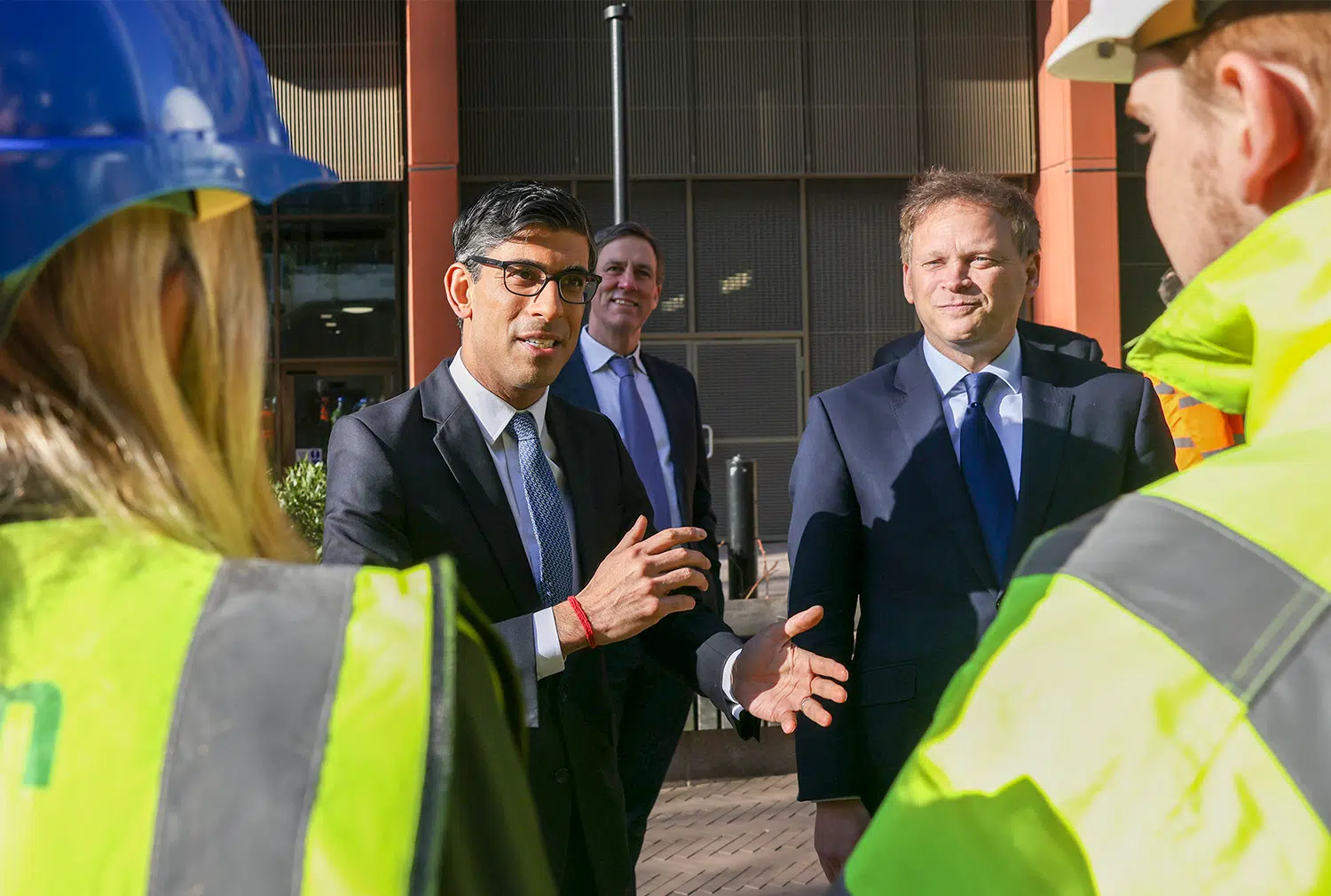
Prime Minister Rishi Sunak and former Energy Security and Net Zero Secretary Grant Shapps. Credit: Simon Dawson / 10 Downing Street, CC BY-NC-ND 2.0
The prime minister’s attempts to turn the climate emergency into a US-style wedge issue have dismayed veteran MPs who champion green policies
Rishi Sunak’s decision to drive a “green wedge” between the Conservatives and Labour will take the UK into dangerous new political territory and “the worst kind of culture wars”, not seen for more than 30 years, senior Tory figures and political observers have warned.
Reversals and delays to net zero policy announced last week will be just the start of a general election campaign in which the UK’s longstanding cross-party political consensus on climate will be increasingly at stake. Emails sent to journalists from the Conservative campaign headquarters revealed lines of attack on targets including the independent Climate Change Committee and Labour’s proposed £28bn investment in a low-carbon economy.
…
Lord Goldsmith, a former Tory minister, told the Observer: “It’s not so much the individual measures he’s announced. It’s more about the language and politics. This is a clear attempt to turn the environment into a wedge issue, as it is in the US. We have managed to avoid that until now, with disagreements mostly being about means, not ends. Sacrificing the environment to culture wars is cynical, devastating and wildly irresponsible.”
Sunak repeated many times that he was still committed to the UK’s legally binding target of reaching net zero by 2050, though experts said the policy changes were more likely to hamper than help. But Chris Skidmore, the Conservative ex-minister and author of the government’s net zero review, accused the prime minister of misleading voters. “It’s especially worrying that false claims and disinformation are being made about meat taxes that have never existed, or compulsory car sharing, or having seven bins. This is completely untrue, and is the worst kind of culture war politics, attempting to deliberately mislead,” he told the Observer.
Decision by UK prime minister to water down key climate policies ‘really shocking to me’, says former US vice-president
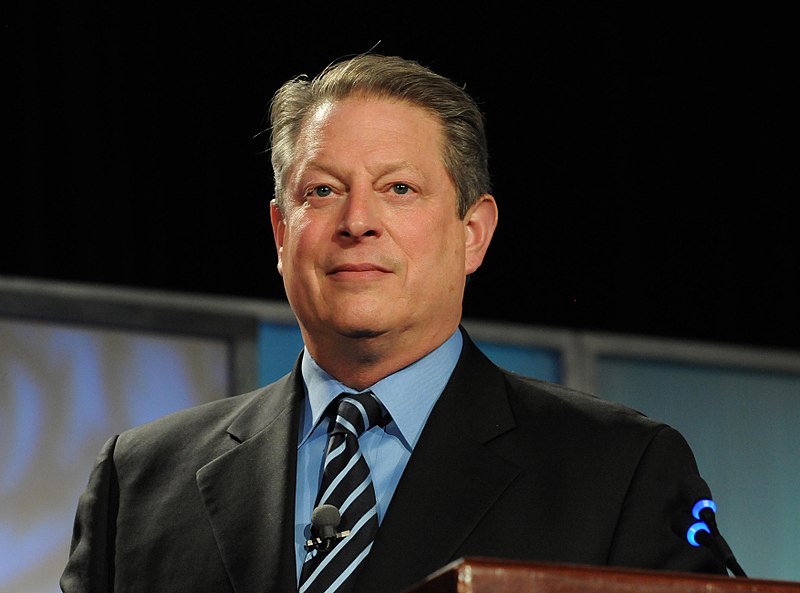
Image of Al Gore by JD Lasica Creative Commons Attribution 2.0 Generic license.
Al Gore, the former US vice-president, has described the decision by the UK prime minister, Rishi Sunak, to water down key climate policies as “shocking and disappointing” and “not what the world needs from the United Kingdom”.
Gore, now one of the world’s foremost advocates for swift action to avert the climate crisis, told CNN: “I find it shocking and really disappointing … I think he’s done the wrong thing. I’ve heard from many of my friends in the UK including a lot of Conservative party members who have used the phrase, ‘utter disgust’.
“And some of the young people there feel as if their generation has been stabbed in the back. It’s really shocking to me.”
UK not a serious player in global race for green growth, says Greenpeace, while Oxfam says move is ‘betrayal’
Just Stop Oil protesting in London 6 December 2022.
Jim Watson, professor of energy policy and director of UCL’s Institute for Sustainable Resources
“Rishi Sunak’s net zero speech is full of contradictions, and will make it harder to meet our medium- and long-term climate change targets. It also risks increasing the costs by delaying the shift away from fossil fuels and reducing the economic benefits to the UK.”
ProfSir Brian Hoskins, chair of the Grantham Institute at Imperial College London
“Our PM wants to have his cake and eat it when he says that the government wants to keep to the UK climate change targets but to weaken the policies to achieve them. These policies were already too weak according to the June report of its advisers, the Climate Change Committee.”
…
Rebecca Newsom, head of politics at Greenpeace UK
“The grim reality is that Britain is no longer seen as a serious player in the global race for green growth. Under the Conservative government, Britain has gone from leader to laggard on climate change and further planned U-turns leaked last night will only hasten our waning influence on the world stage.”
“Any further weakening of the government’s climate policies is a complete betrayal of people living in poverty – both in the UK and abroad – who are most vulnerable to climate change. The government needs to put long-term interests ahead of short-term politics and that means a fast and fair move towards renewable energy.”