Article by Josh Gabbatiss, Daisy Dunne republished from Carbon Brief under a CC license.

More than 1,000 operations at NHS hospitals were cancelled due to heat during the UK’s record May and June heatwaves, Carbon Brief can reveal.
This includes 167 orthopaedic surgeries, such as knee and hip replacements, as well as heart, eye and skin cancer operations.
At least 10 emergency surgeries – those for “life-threatening” conditions – had to be cancelled because of the record-breaking heat, according to the investigation.
Carbon Brief sent freedom-of-information (FOI) requests to 140 NHS trusts to investigate the impact of heatwaves on operations being cancelled in England and Wales.
Areas with the most operations cancelled due to heat include Surrey and Sussex, south Essex and parts of London – all regions experiencing among the highest temperatures.
High temperatures can threaten patient safety by stopping the ventilation systems used in theatres from working, increasing the risk of infection, experts tell Carbon Brief.
Less than half of the NHS trusts provided details of heat-related surgery cancellations – and Carbon Brief understands that many hospitals do not routinely record this information.
Carbon Brief’s figure is therefore likely to be a significant underestimate, but still provides an unprecedented insight into a surgical system “poorly prepared” for heatwaves and the impact on patients.
Overheating operations
The record-breaking heatwaves that have repeatedly struck the UK in 2026 – amplified by climate change – have already been linked to thousands of deaths.
High temperatures can lead to all sorts of health complications and worsen respiratory, cardiovascular and kidney diseases.
Extreme heat also threatens healthcare systems. News outlets have reported on the NHS “struggling”, as it faces record A&E demand, hospital wards reaching “unsafe” temperatures and equipment failing due to heat.
Among these reports was coverage of hospitals being forced to cancel operations, or even abandon them midway through, as surgical theatres became intolerably hot.
To investigate this problem, Carbon Brief sent FOI requests to the 140 NHS trusts and health boards in England and Wales responsible for hospitals with surgical theatres.
They were asked about all the operations that were cancelled due to extreme heat during the May and June heatwaves, when “amber” and “red” heat warnings were in place.
In total, 59 trusts and health boards responded with details of 1,110 heat-related cancellations across the 17-day period covering 22-28 May and 18-27 June.
(Of the 63 trusts that responded but did not provide details of heat-related disruption, many said that they simply did not record this data, rather than stating that heat was not a problem. See Methodology for more details.)
The map below shows the location of these cancelled surgeries, which cover everything from routine hernia operations to heart surgeries.

Surrey and Sussex Healthcare NHS Trust reported the most cancellations – 140 in total – all in the surgery unit at Crawley Hospital. This hospital was in one of the hottest parts of the country in June, with temperatures approaching 36C.
Other hotspots for cancellations include south Essex, Dudley in the West Midlands, south Wales and parts of London. Many of the hardest-hit hospitals were in southern England, where temperatures were highest.
Of the trusts that provided full datasets of all surgery cancellations in the period, around 7% were heat-related. This data illustrates how heat is placing more strain on an already stretched NHS, adding to existing issues such as staff shortages and lack of beds.
Nearly all of the cancelled surgeries were “elective”, meaning they were scheduled in advance and not immediately life-saving. Nevertheless, the list of cancellations includes at least eight heart operations and seven skin-cancer removals.
There were also 10 “emergency” operations cancelled due to heat in surgical theatres. Another 18 surgeries had to be abandoned mid-way through.
Dr Dmitri Nepogodiev, a public health researcher focusing on surgery at the University of Birmingham, says hospitals will always prioritise “time-sensitive, life-threatening” surgeries.
Nevertheless, he tells Carbon Brief that every cancellation can cause significant “distress” and harm to patients’ quality of life, adding:
“Behind all of these statistics…are real people who have probably already been waiting a long time.”
Each dot in the graphic below indicates a cancelled surgery. Of the 596 for which trusts provided details, 167 are orthopaedic surgeries, such as knee and hip replacements.
Eye surgeries, gynaecological and urological surgeries are also among the most frequently cancelled, broadly reflecting how common such procedures are.

Richard Egan, an endocrine surgeon and a national clinical director within NHS Wales, notes the knock-on effects of cancelling surgeries for several days during heatwaves. He tells Carbon Brief:
“That’s a significant impact on waiting lists…For every week that patients are waiting on a waiting list, their condition could get worse and deteriorate.”
‘Increased risks’
When providing specific reasons for cancellations, most NHS trusts simply indicated that surgical theatres were “too hot and humid”.
Sometimes, this was accompanied by comments about “risk of infection” or “overheating for both patients and staff”.
There are several reasons why it can get “too hot” for operations to take place, but the main one is that the complex ventilation systems installed in theatres can stop working above a certain temperature, explains Dr Ed Robinson, an NHS anaesthetist. He tells Carbon Brief:
“An operating theatre is a very tightly engineered clinical environment. There are quite complicated ventilation systems, which dilute airborne contaminants, remove fumes from different [medications] and anaesthetic gases.
“We have generalised airflow systems that make the air in theatre flow outwards to adjacent areas, so pathogens and fumes get carried away from the patient into non-clinical areas. When it gets to a certain heat, those systems can fail.”
These systems are also responsible for controlling heat and humidity levels inside theatres, says Robinson.
When the systems fail, it is not possible to guarantee patient safety, he continues, meaning surgeries may need to be cancelled.
Although most hospitals simply stated that it was “too hot” for operations to take place during the heatwaves, there were 48 cases where staff specified that this was due to air conditioning or ventilation units that were either broken or unable to sustain appropriate temperatures.
Tim Lane, a urological surgeon and president of the Royal College of Surgeons of England (RCS England), tells Carbon Brief that heat places “extra physical strain” on patients:
“Extreme heat can increase risks and make it harder to deliver care under the conditions clinicians would consider ideal.”
If air in operating theatres is too humid, excess moisture can condense on surgical implements and transmit infections, he says.
Extreme heat and humidity inside theatres can also pose a risk to staff having to wear heavy protective clothing. Robinson explains:
“Staff are usually wearing PPE [personal protective equipment]. If it’s orthopaedics, they will be wearing ‘leads’ a lot of the time. This is because they will be doing lots of X-rays, and there’s no time to descrub and rescrub every time.
“So if the ventilation system is not working, you’re going to overheat [and] that’s going to affect your ability to concentrate and perform a safe operation. You just wouldn’t start under those conditions.”
There are also “certain pieces of equipment and medications” that are not “validated to be used outside of certain ranges of temperature”, he says.
This includes specialised “cement” used to secure hip and knee replacements, which can set too quickly at higher temperatures, according to Lane.
‘Poorly prepared’
Following the record-breaking heat of 2022, one study found that surgical services in the UK were “poorly prepared for heatwaves”.
Based on staff surveys, the study concluded that ambient temperatures “could not be controlled” in two-fifths of NHS operating theatres.
With hospitals once again under significant pressure this summer, health secretary Yvette Cooper told the Guardian that the NHS “has to make sure we are preparing for summer pressures now in the same way we prepare for winter”.
Nepogodiev notes that the problem of extreme heat extends from increased patient numbers to staff shortages, which can be the result of a range of wider factors such as heat-related train cancellations. He tells Carbon Brief.
“There isn’t a single magic solution because it’s a kind of complex, multifactorial challenge – so it also underlines the importance of broader preparedness.”
Egan, who is investigating ways to prepare surgical theatres for extreme heat, says the response so far has been “ad hoc”. He suggests it may be possible to continue with less risky operations, even at higher humidity levels.
As it stands, many NHS hospitals are old and not designed for increasingly extreme temperatures.
Government advisers at the Climate Change Committee (CCC) have recommended that all healthcare buildings should work to “maintain safe and appropriate temperatures” by 2035.
The UK’s national adaptation programme already says NHS England will work to “adapt NHS infrastructure to extreme weather events and overheating risks”, by incorporating adaptation measures into plans for new buildings.
However, years of underinvestment have left many sites with what the King’s Fund thinktank calls “deteriorating buildings” and “outdated technology”.
Following the extreme heat this summer, the government has announced £32m from a £1.5bn spending programme for projects that strengthen hospitals’ “resilience to extreme heat, including improved “cooling and ventilation systems”.
RCS England president Lane tells Carbon Brief that heat-related surgical cancellations underline the need for investment in hospitals, ventilation systems and modern equipment:
“NHS staff work incredibly hard to adapt, often reorganising services and finding practical solutions to keep care running, but resilience alone cannot compensate indefinitely for outdated infrastructure or sustainability.”
Methodology
Carbon Brief contacted 140 NHS trusts and health boards in England and Wales, only including those that perform surgical procedures. Mental health trusts, community trusts and other specialist trusts were therefore excluded.
These requests covered the periods 22-28 May 2026 and 18-27 June 2026, when heatwaves affected much of England and Wales.
At the time of filing the FOIs, these were the two periods when the UK Health Security Agency (UKHSA) had issued “amber” or “red” heat-health alerts across much or all of England. There were also comparable weather warnings in place across Wales for some of this time.
(Scotland and Northern Ireland were excluded from the analysis, on the basis that they did not experience such extreme heat.)
The FOI requests asked for details of all surgical procedures – both elective and emergency – that were cancelled during this period. Specifically, the requests also asked trusts to state which cancellations were related to extreme heat. Of these, 59 provided details of surgeries that were cancelled due to heat.
Of the remaining 63 that responded to the FOI requests, only a few stated explicitly that there were no surgeries cancelled due to heat. Most either said that they did not record this information, or provided lists with standard cancellation reasons that may – or may not – indicate heat as a factor, such as “failure of equipment”. The remaining 19 did not respond to the request by the time of publication.
NHS trusts and health boards responded to Carbon Brief’s FOI requests in a large variety of ways, reflecting the inconsistent way in which heat-related cancellations are recorded.
Among those that disclosed data, some provided all the information requested while others only provided parts. Some would not provide exact numbers when the number of cancellations was five or less. In those cases, Carbon Brief assumed that two surgeries had been cancelled. (This assumption accounts for fewer than 50 of the 1,110 cancellations.)
The full dataset is available here, with details of all the surgeries cancelled and the reasons given for their cancellations.
Article by Josh Gabbatiss, Daisy Dunne republished from Carbon Brief under a CC license.


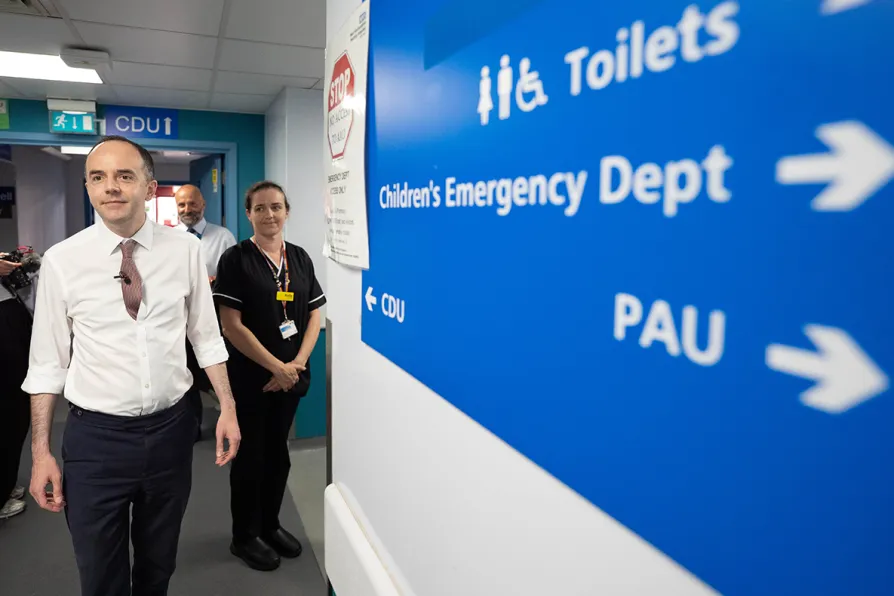
 Health Secretary James Murray during a visit to Watford General Hospital in Hertfordshire, July 9, 2026