Protesters gather outside Number 10 North in Manchester demanding the government puts an end to spy tech firm Palantir’s role in the NHS, October 1, 2026
Patients and health workers unite at demos across England demanding the government cut ties with the spy tech firm
PATIENTS, health workers, and members of the public gathered in more than 40 protests across England today to demand an end to spy tech firm Palantir’s role in the NHS.
In London, protesters converged on Palantir’s headquarters to hand in a giant “contract terminated” poster as part of a global week of action against the company’s involvement in public services.
The protests in Manchester, Exeter, Liverpool, Bristol, Norwich, Newcastle, Birmingham and Brighton were organised by campaign groups, including Medact, Global Justice Now, Keep Our NHS Public, Palestine Solidarity Campaign, and We Own It.
Campaigners condemned Palantir’s role in managing the country’s health data, citing its track record of surveillance, human rights abuses and complicity in the genocide in Gaza.
Speaking at the London rally, Dr Omar Abdel-Mannan, a paediatric neurologist in the NHS who has volunteered in Gaza, said: “Everything that I stand for as a doctor, every principle of the NHS committed to providing equitable healthcare for all, is directly contradicted by the core values and repeated actions of Palantir.
Ellie Chowns, Green Party MP for North Herefordshire. CC image Wikipedia.
Responding to a pledge made by Andy Burnham that there will be access to free social care services for everyone in England, and that the plans will be put before voters at the next general election, Green Party leader in parliament, Dr Ellie Chowns MP, said:
“For too long successive governments have kicked social care down the road and treated it as a political football – so it is certainly welcome to hear the Prime Minister both recognising the scale of the challenge and signalling a willingness to work across party lines to tackle it.
“The Green Party is clear that social care should be available to everyone who needs it and free at the point of use, just like the NHS is for healthcare – it makes no sense that help is available for those facing cancer, but not for those struggling with dementia, disability, or old age.
“Despite the Prime Minister’s stated commitment to working cross-party on this issue, so far no invitation has been extended to the Greens to take part in discussions. We would therefore like to reiterate to the Prime Minister that the Green Party stands ready to work constructively with the government and other parties to build a social care system that commands broad support and truly works for families across Britain.
“And for those struggling with the cost of care now, promises of transformative action following the next general election are simply not good enough. After years of delay, we simply cannot kick this crucial work down the road again. Work needs to begin now to fix the system that is failing too many people and putting unsustainable pressure on families and the NHS.”
All the ambulance services in England experienced some of their busiest-ever days during this summer’s record-breaking June heatwave, according to data obtained by Carbon Brief.
In June, temperatures climbed past 37C in parts of the country as authorities declared only the second ever “red” extreme heat warning.
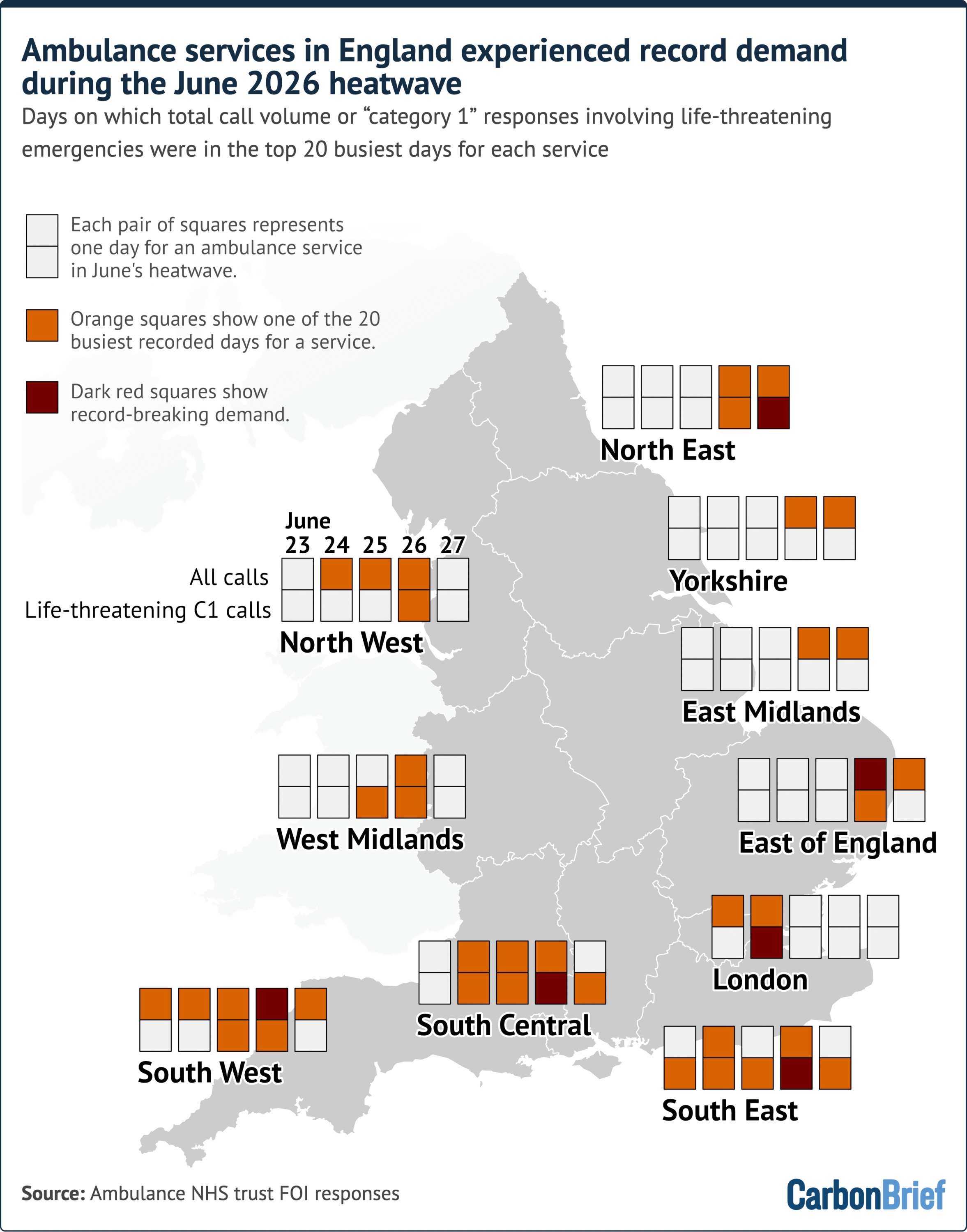
Four out of 10 NHS ambulance services, including London’s, responded to unprecedented numbers of life-threatening emergencies on at least one day from 23-27 June.
Another two services – in the south-west and east of the country – received their highest volume of 999 calls on record.
Ambulance services provided data on their busiest days since records began, in response to freedom-of-information (FOI) requests from Carbon Brief.
The results show how demand during the June heatwave exceeded levels seen during the traditionally busy winter season in other years – and even the height of the Covid-19 pandemic – for many services.
Heat demand
Extreme heat ramps up the risk of numerous life-threatening conditions, including heart disease and respiratory problems.
England experienced record-breaking temperatures at the end of June, with the whole country covered by amber or red “heat health alerts” from the government.
A red alert, which was issued for the entire Midlands and south of England, indicates “significant risk to life for even the healthy population”. This was only the second time such an alert has been triggered.
Researchers calculated that there were nearly 3,000 heat-related deaths in the UK this summer. There has also been unprecedented demand for A&E departments and some ambulance services.
To investigate the strain facing ambulances, Carbon Brief sent FOI requests to the 10 NHS ambulance trusts in England, asking for lists of their busiest days.
This covered both the total volume of 999 calls and “category 1” responses – referring to incidents involving “life-threatening injuries and illnesses”, such as heart attacks.
The chart below shows the busiest days on record for England’s ambulances, including both total calls and category 1 responses. Most services were able to provide records back to the 2010s. (See: Methodology.)
The five-day period from 23-27 June is overrepresented in these results, with at least two heatwave days ranking in the top 20 for every service in the country.
The top 20 rankings for services across England cover different periods of time. See Methodology for more details.
This trend is especially pronounced in the south and east of England, where June temperatures exceeded 36C and even approached 38C in some regions.
London, South East Coast, South Central and North East ambulance services all reported daily records for responding to life-threatening emergencies during the heatwave.
For the South East Coast and South Central services – which cover a region stretching from Oxfordshire to Kent – 25, 26 and 27 June all saw unprecedented numbers of category 1 callouts.
South Western and East of England services both saw record numbers of 999 calls on 26 June, the same day the highest-ever June UK temperature was reported in Norfolk.
It is worth noting that demand for ambulance services – including category 1 calls – has been growing for many years, driven by factors such as an ageing population, more complex health conditions and growing mental-health pressures.
This helps to explain why dates from before the 2020s are rare in the top rankings provided to Carbon Brief.
Beyond the heatwave, 2026 as a whole is on track to be a record year for ambulance demand.
‘Stifling heat’
On 26 June, the busiest day of the heatwave, ambulances across England responded to 4,084life-threatening emergencies.
The average daily volume of such incidents is normally around 2,500 during the summer months.
Stu Holliday, head of emergency preparedness, resilience and response at North East Ambulance Service, tells Carbon Brief:
“During periods of hot weather, we typically see an increase in calls from people affected by dehydration, heat exhaustion and heatstroke, as well as those whose existing health conditions, particularly heart and respiratory illnesses, can be made worse by prolonged high temperatures.
“Older people, young children and pregnant people can be especially vulnerable.”
Ambulance teams are generallybusier in the winter because cold weather and seasonal illnesses drive up the number of severe medical emergencies.
However, the data from June shows that extremely hot days are starting to match or even edge out cold ones as the busiest days. This is a trend seen across the healthcare system.
While not every service provided records back to 2019, the data broadly shows that ambulances were busier during the heatwave than at the height of the Covid-19 pandemic.
As well as patients, heatwaves put pressure on ambulance workers. The UNISON union has warned of crews facing “stifling heat with faulty or no air conditioning” and “back-to-back callouts” due to increased demand.
Methodology
Carbon Brief requested data on the top 50 busiest days for England’s 10 main ambulance services.
These are: London; South East Coast; South Central; South Western; West Midlands; East Midlands; East of England; North East; Yorkshire; and North West.
Data was requested for as far back as service records go. Most were able to provide records going back to some point in the 2010s, with the exception of North East and South Central, which only had records from 2021 and 2022 onwards, respectively.
Rising annual demand for ambulance services means that most of the busiest days for ambulances have been in the 2020s. For example, all but four of the busiest days for category 1 emergencies reported to Carbon Brief were in the 2020s.
Carbon Brief requested data on ambulance demand for all the UK nations. In Scotland and Northern Ireland – where temperatures are cooler – services did not see call volumes reach the top 50 rankings during the June heatwave. The Welsh Ambulance Service did not respond to Carbon Brief’s request.
Nigel Farage urges you to ignore facts and reality and be a climate science denier like him and his Deputy Richard Tice. He says that Reform UK has received £Millions and £Millions from the fossil fuel industry to promote climate denial and destroy the planet.Power-mad orange gasbag Donald Trump says Burn, Baby, Burn.Elon Musk urges you to be a Fascist like him, says that you can ignore facts and reality then.
Operation theatre illustration by Kerry Cleaver for Carbon Brief.
More than 1,000 operations at NHS hospitals were cancelled due to heat during the UK’s record May and June heatwaves, Carbon Brief can reveal.
This includes 167 orthopaedic surgeries, such as knee and hip replacements, as well as heart, eye and skin cancer operations.
At least 10 emergency surgeries – those for “life-threatening” conditions – had to be cancelled because of the record-breaking heat, according to the investigation.
Carbon Brief sent freedom-of-information (FOI) requests to 140 NHS trusts to investigate the impact of heatwaves on operations being cancelled in England and Wales.
Areas with the most operations cancelled due to heat include Surrey and Sussex, south Essex and parts of London – all regions experiencing among the highest temperatures.
High temperatures can threaten patient safety by stopping the ventilation systems used in theatres from working, increasing the risk of infection, experts tell Carbon Brief.
Less than half of the NHS trusts provided details of heat-related surgery cancellations – and Carbon Brief understands that many hospitals do not routinely record this information.
Carbon Brief’s figure is therefore likely to be a significant underestimate, but still provides an unprecedented insight into a surgical system “poorly prepared” for heatwaves and the impact on patients.
Overheating operations
The record-breaking heatwaves that have repeatedly struck the UK in 2026 – amplified by climate change – have already been linked to thousands of deaths.
Extreme heat also threatens healthcare systems. News outlets have reported on the NHS “struggling”, as it faces record A&E demand, hospital wards reaching “unsafe” temperatures and equipment failing due to heat.
Among these reports was coverage of hospitals being forced to cancel operations, or even abandon them midway through, as surgical theatres became intolerably hot.
To investigate this problem, Carbon Brief sent FOI requests to the 140NHS trusts and health boards in England and Wales responsible for hospitals with surgical theatres.
They were asked about all the operations that were cancelled due to extreme heat during the May and June heatwaves, when “amber” and “red” heat warnings were in place.
In total, 59trusts and health boards responded with details of 1,110 heat-related cancellations across the 17-day period covering 22-28 May and 18-27 June.
(Of the 63 trusts that responded but did not provide details of heat-related disruption, many said that they simply did not record this data, rather than stating that heat was not a problem. See Methodology for more details.)
The map below shows the location of these cancelled surgeries, which cover everything from routine hernia operations to heart surgeries.
Surrey and Sussex Healthcare NHS Trust reported the most cancellations – 140 in total – all in the surgery unit at Crawley Hospital. This hospital was in one of the hottest parts of the country in June, with temperatures approaching 36C.
Other hotspots for cancellations include south Essex, Dudley in the West Midlands, south Wales and parts of London. Many of the hardest-hit hospitals were in southern England, where temperatures were highest.
Of the trusts that provided full datasets of all surgery cancellations in the period, around 7% were heat-related. This data illustrates how heat is placing more strain on an already stretched NHS, adding to existing issues such as staff shortages and lack of beds.
Nearly all of the cancelled surgeries were “elective”, meaning they were scheduled in advance and not immediately life-saving. Nevertheless, the list of cancellations includes at least eight heart operations and seven skin-cancer removals.
There were also 10 “emergency” operations cancelled due to heat in surgical theatres. Another 18 surgeries had to be abandoned mid-way through.
Dr Dmitri Nepogodiev, a public health researcher focusing on surgery at the University of Birmingham, says hospitals will always prioritise “time-sensitive, life-threatening” surgeries.
Nevertheless, he tells Carbon Brief that every cancellation can cause significant “distress” and harm to patients’ quality of life, adding:
“Behind all of these statistics…are real people who have probably already been waiting a long time.”
Each dot in the graphic below indicates a cancelled surgery. Of the 596 for which trusts provided details, 167are orthopaedic surgeries, such as knee and hip replacements.
Eye surgeries, gynaecological and urological surgeries are also among the most frequently cancelled, broadly reflecting how common such procedures are.
Richard Egan, an endocrine surgeon and a national clinical director within NHS Wales,notes the knock-on effects of cancelling surgeries for several days during heatwaves. He tells Carbon Brief:
“That’s a significant impact on waiting lists…For every week that patients are waiting on a waiting list, their condition could get worse and deteriorate.”
‘Increased risks’
When providing specific reasons for cancellations, most NHS trusts simply indicated that surgical theatres were “too hot and humid”.
Sometimes, this was accompanied by comments about “risk of infection” or “overheating for both patients and staff”.
There are several reasons why it can get “too hot” for operations to take place, but the main one is that the complex ventilation systems installed in theatres can stop working above a certain temperature, explains Dr Ed Robinson, an NHS anaesthetist. He tells Carbon Brief:
“An operating theatre is a very tightly engineered clinical environment. There are quite complicated ventilation systems, which dilute airborne contaminants, remove fumes from different [medications] and anaesthetic gases.
“We have generalised airflow systems that make the air in theatre flow outwards to adjacent areas, so pathogens and fumes get carried away from the patient into non-clinical areas. When it gets to a certain heat, those systems can fail.”
These systems are also responsible for controlling heat and humidity levels inside theatres, says Robinson.
When the systems fail, it is not possible to guarantee patient safety, he continues, meaning surgeries may need to be cancelled.
Although most hospitals simply stated that it was “too hot” for operations to take place during the heatwaves, there were 48 cases where staff specified that this was due to air conditioning or ventilation units that were either broken or unable to sustain appropriate temperatures.
“Extreme heat can increase risks and make it harder to deliver care under the conditions clinicians would consider ideal.”
If air in operating theatres is too humid, excess moisture can condense on surgical implements and transmit infections, he says.
Extreme heat and humidity inside theatres can also pose a risk to staff having to wear heavy protective clothing. Robinson explains:
“Staff are usually wearing PPE [personal protective equipment]. If it’s orthopaedics, they will be wearing ‘leads’ a lot of the time. This is because they will be doing lots of X-rays, and there’s no time to descrub and rescrub every time.
“So if the ventilation system is not working, you’re going to overheat [and] that’s going to affect your ability to concentrate and perform a safe operation. You just wouldn’t start under those conditions.”
There are also “certain pieces of equipment and medications” that are not “validated to be used outside of certain ranges of temperature”, he says.
This includes specialised “cement” used to secure hip and knee replacements, which can set too quickly at higher temperatures, according to Lane.
‘Poorly prepared’
Following the record-breaking heat of 2022, one study found that surgical services in the UK were “poorly prepared for heatwaves”.
Based on staff surveys, the study concluded that ambient temperatures “could not be controlled” in two-fifths of NHS operating theatres.
With hospitals once again under significant pressure this summer, health secretary Yvette Cooper told the Guardian that the NHS “has to make sure we are preparing for summer pressures now in the same way we prepare for winter”.
Nepogodiev notes that the problem of extreme heat extends from increased patient numbers to staff shortages, which can be the result of a range of wider factors such as heat-related train cancellations. He tells Carbon Brief.
“There isn’t a single magic solution because it’s a kind of complex, multifactorial challenge – so it also underlines the importance of broader preparedness.”
Egan, who is investigating ways to prepare surgical theatres for extreme heat, says the response so far has been “ad hoc”. He suggests it may be possible to continue with less risky operations, even at higher humidity levels.
As it stands, many NHS hospitals are old and not designed for increasingly extreme temperatures.
Government advisers at the Climate Change Committee (CCC) have recommended that all healthcare buildings should work to “maintain safe and appropriate temperatures” by 2035.
The UK’s national adaptation programme already says NHS England will work to “adapt NHS infrastructure to extreme weather events and overheating risks”, by incorporating adaptation measures into plans for new buildings.
However, years of underinvestment have left many sites with what the King’s Fund thinktank calls “deteriorating buildings” and “outdated technology”.
Following the extreme heat this summer, the government has announced £32m from a £1.5bn spending programme for projects that strengthen hospitals’ “resilience to extreme heat, including improved “cooling and ventilation systems”.
RCS England president Lane tells Carbon Brief that heat-related surgical cancellations underline the need for investment in hospitals, ventilation systems and modern equipment:
“NHS staff work incredibly hard to adapt, often reorganising services and finding practical solutions to keep care running, but resilience alone cannot compensate indefinitely for outdated infrastructure or sustainability.”
Methodology
Carbon Brief contacted 140 NHS trusts and health boards in England and Wales, only including those that perform surgical procedures. Mental health trusts, community trusts and other specialist trusts were therefore excluded.
These requests covered the periods 22-28 May 2026 and 18-27 June 2026, when heatwaves affected much of England and Wales.
At the time of filing the FOIs, these were the two periods when the UK Health Security Agency (UKHSA) had issued “amber” or “red” heat-health alerts across much or all of England. There were also comparable weather warnings in place across Wales for some of this time.
(Scotland and Northern Ireland were excluded from the analysis, on the basis that they did not experience such extreme heat.)
The FOI requests asked for details of all surgical procedures – both elective and emergency – that were cancelled during this period. Specifically, the requests also asked trusts to state which cancellations were related to extreme heat. Of these, 59provided details of surgeries that were cancelled due to heat.
Of the remaining 63 that responded to the FOI requests, only a fewstated explicitly that there were no surgeries cancelled due to heat. Most either said that they did not record this information, or provided lists with standard cancellation reasons that may – or may not – indicate heat as a factor, such as “failure of equipment”. The remaining 19did not respond to the request by the time of publication.
NHS trusts and health boards responded to Carbon Brief’s FOI requests in a large variety of ways, reflecting the inconsistent way in which heat-related cancellations are recorded.
Among those that disclosed data, some provided all the information requested while others only provided parts. Some would not provide exact numbers when the number of cancellations was five or less. In those cases, Carbon Brief assumed that two surgeries had been cancelled. (This assumption accounts for fewer than 50 of the 1,110 cancellations.)
The full dataset is available here, with details of all the surgeries cancelled and the reasons given for their cancellations.
Donald Trump urges you to ignore facts and reality and be a Climate Science denier like him. He says that he makes millions and millions for destroying the planet, Burn, Baby, Burn and Flood, Baby, Flood.Nigel Farage urges you to ignore facts and reality and be a climate science denier like him and his Deputy Richard Tice. He says that Reform UK has received £Millions and £Millions from the fossil fuel industry to promote climate denial and destroy the planet.Orcas discuss Donald Trump and the killer apes’ concept of democracy. Front Orca warns that Trump is crashing his country’s economy and that everything he does he does for the fantastically wealthy.
Go to any hospital and there are signs and posters everywhere “NHS staff will not tolerate abuse”. They can’t half give it out though. NHS staff won’t tolerate abuse … but they’ll abuse you as much as you like and expect you to be grateful for it.
The NHS is not wonderful in everything they do despite expecting you to sing their praises at every opportunity. Sometimes they’re totally carp just like the rest of us really I suppose. They expect you to take their abuse and be grateful for it. Cnuts, maybe on a different scale but cnuts the same.
ed: Very recently I’ve learned that you can’t say Can you do this dressing again because it’s carp, not doing what it’s supposed to and I’ve got to keep it on for 3 weeks not the 1 week the guy who did it said? you can’t say that because that’s criticising a collegue of theirs – that he did a crap dressing.
You can’t say I object to the guy lying to me. He told me it was a bone in my thumb not a bone in my wrist. I’ve got a Masters Degree FFS, brain the size of a planet. Why are you treating me like a child? Hiding the truth from me? I didn’t get to say that actually.
So what happens is they just sit you down waiting for absolutely as long as they can. I decided at 90 minutes that I’d had enough. I’ve had it before, they waste as much of your time as they possibly can. Can’t see how this abuse sits with their Safeguarding Duty actually, perhaps they just conveniently ignore that.
Looks like I’ve done it now. NHS cnuts, I withdraw consent. I refuse to be abused by you.

 Protesters gather outside Number 10 North in Manchester demanding the government puts an end to spy tech firm Palantir’s role in the NHS, October 1, 2026