Tag: Nicolás Maduro

  • Common Dreams: Israel human rights abuses, Venezuela coup attempts, Trump & Sen. J.D. Vance

    Spread the love

    Far-Right Israelis Mob Bases After Soldiers Arrested for Allegedly Raping Palestinian
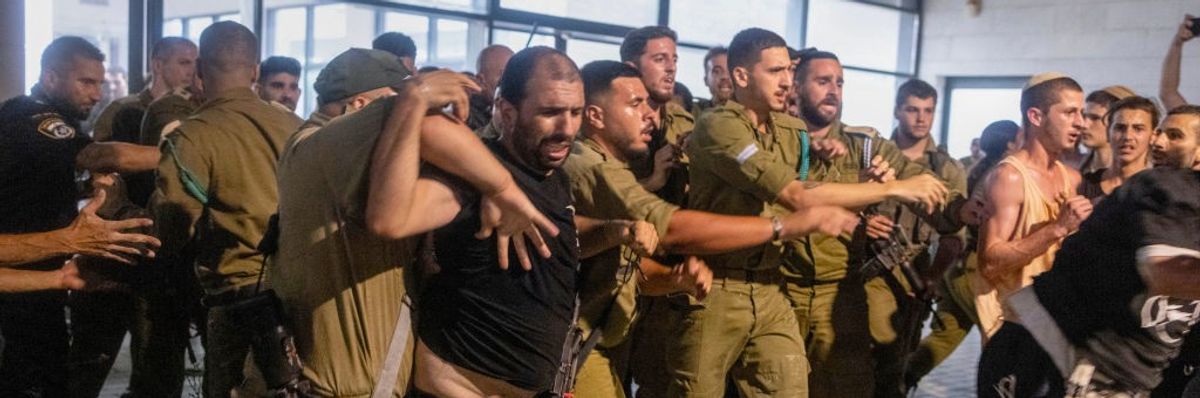
    Israeli soldiers and police clash with a far-right mob that invaded the Beit Lid army base in Kfar Yona on July 29, 2024.  (Photo: Oren Ziv/AFP via Getty Images)

    Several Israeli lawmakers and one minister took part in the attempt to free the nine reservists, who were hailed as heroes by multiple Cabinet members.

    Far-right Israelis including government officials stormed two military bases late on Monday, sparking clashes with troops and police over the arrest of Israel Defense Forces reservists who allegedly gang-raped a Palestinian prisoner.

    Hundreds of protesters broke into the notorious Sde Teiman base in the Negev Desert in an attempt to stop the detention of nine reserve troops accused of sodomizing a Palestinian jailed there. According to the Israeli newspaper Haaretz, the victim is hospitalized with severe injuries and is unable to walk.

    The nine suspects were then taken to the Beit Lid army base, which was also mobbed by at least dozens of demonstrators.

    UN Experts Say Israel ‘Must Stop Acting as If Uniquely Above the Law’

    Maduro Victory Shows Democratic Bolivarian Socialism Continues in Venezuela
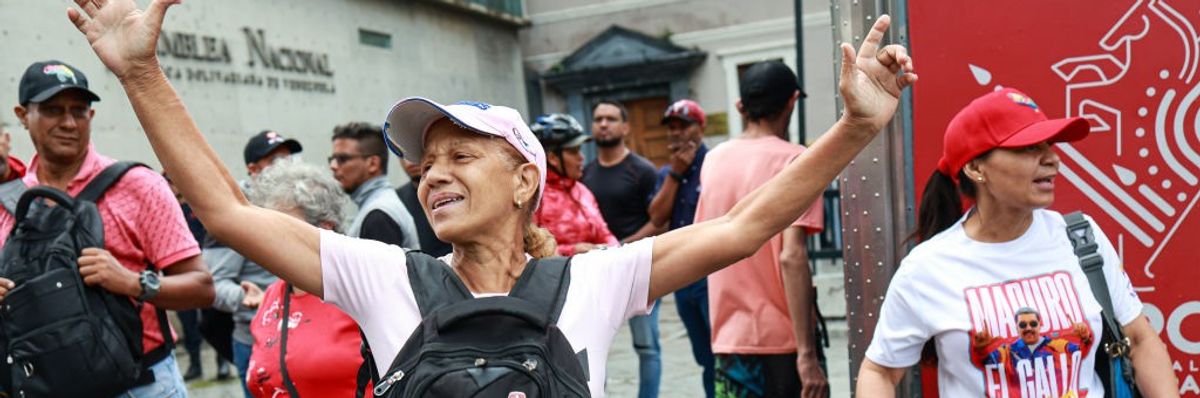
    Supporters of president-elect Nicolas Maduro celebrate his proclamation as president-elect in the vicinity of the CNE headquarters during the ceremony to deliver the majority of the vote Certificate at CNE Headquarters on July 29, 2024 in Caracas, Venezuela. (Photo by Jesus Vargas/Getty Images)

    Shortly before midnight on 28 July, Venezuela’s National Electoral Council (CNE) announced that — with 80 percent of the over 20 million votes counted — the trend was irreversible: Nicolás Maduro had been re-elected president of Venezuela.

    According to the CNE, Maduro received 51.2 percent of the vote, while his primary opponent, the little-known Edmundo Gonzales, received 44.02 percent. With that result, it was clear that the Venezuelan majority chose to continue the project of Bolivarian socialism introduced by Hugo Chavez at the end of the nineties. Recognizing the economic turn-around of the last two years and proud of their achievements in building 5.1 million housing units, securing food sovereignty, and deepening communal democracy, Venezuelans re-elected Maduro for a third six-year term.

    A former ambassador to Argentina, the opposition candidate Gonzales replaced far-right leader Maria Corina Machado as the candidate of the Unity Platform after Machado was disqualified from running. Machado has long been an outspoken critic of Chavismo, supporting US sanctions and advocating foreign intervention in the country. In 2018, she asked Benjamin Netanyahu for military assistance in dismantling the Maduro government. Machado has close ties in the United States. In 2009, she was a Yale World Fellow. On June 23, 2024 she spoke at a National Endowment for Democracy awards ceremony in Washington, DC. She has been nicknamed the new “iron lady” after her idol Margaret Thatcher. In contrast, Maduro supports the Palestinian liberation struggle, linking it to the struggle of the indigenous peoples of Venezuela against colonial genocide.

    Maduro Slams Attempted ‘Coup Against Venezuela’ as Far-Right Cries Fraud

    Venezuela’s far-right opposition is doubling down on its refusal to accept defeat in the country’s presidential election amid simmering unrest and violence in the streets of Caracas, sparking warnings of another coup attempt in a nation that has long faced interference from the United States and other Western powers.

    Led by María Corina Machado, who was disqualified from running in Sunday’s election, Venezuela’s opposition claimed that its candidate—ex-diplomat Edmundo González—defeated President Nicolás Maduro with over 70% of the vote, contradicting the official results announced by the Consejo Nacional Electoral (CNE).

    Machado, who once urged Israeli Prime Minister Benjamin Netanyahu to back an effort to topple Maduro’s elected government, pointed Venezuelans to a website the opposition is using to assemble its own vote counts.

    “So far, she hasn’t presented any evidence [of fraud],” Caracas-based reporter Andreína Chávez Alava said in an appearance on Democracy Now! Tuesday morning. “In past elections they have also said they have evidence that they won and they never actually showed any proof.”

    Trump and Vance Are the Enemy of Working People
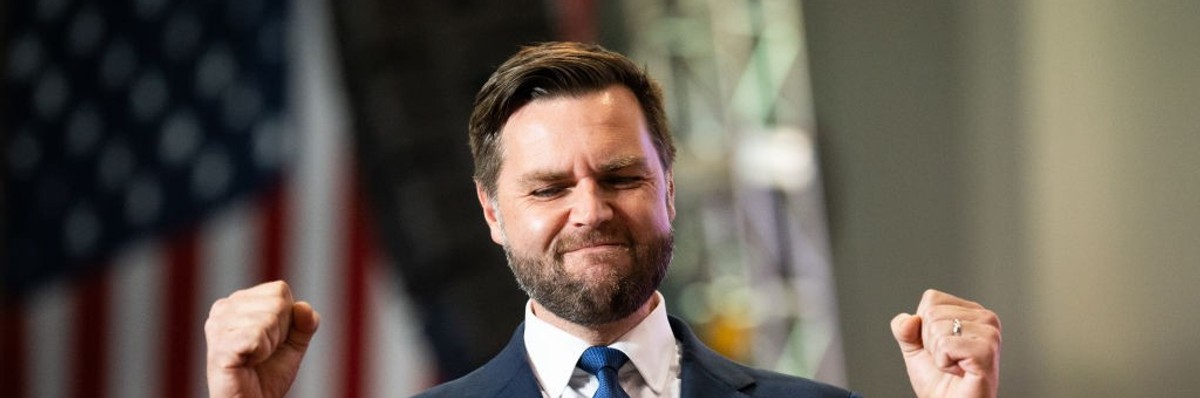
    Republican vice presidential nominee U.S. Sen. J.D. Vance (R-OH) arrives to speak during a rally with running mate U.S. Republican Presidential nominee former President Donald Trump at Herb Brooks National Hockey Center on July 27, 2024 in St Cloud, Minnesota. (Photo by Stephen Maturen/Getty Images)

    The former Republican president, despite all his allegedly populist rhetoric, has a deeply anti-worker record from his first term. Vance’s record is no different and he’s no better.

    Trump’s Repeated Efforts to Disavow Project 2025 ‘Not Fooling Anyone’

    “These attempts to create the appearance of distance between Trump and Project 2025 are happening because Americans are starting to learn about this extreme takeover plan,” said one Democratic congressman.

    The 2025 Presidential Transition Project, as it is formally called, is a policy agendapersonnel recruitmenttraining, and a 180-day playbook for the next right-wing president, spearheaded by the Heritage Foundation and backed by over 100 other organizations. Critics have described it as a “far-right playbook for American authoritarianism.”

    At least 140 people who worked in the Trump administration—including six former Cabinet secretaries—have been involved with Project 2025, according to a CNN analysis published earlier this month. Among them is the outgoing director, Paul Dans.

    “Dans served in the Trump administration as chief of staff at the U.S. Office of Personnel Management where he managed the federal agency in charge of human resources policy for the more than 2 million federal workers,” according to his profile on the Heritage website.


  • Mainstream media scales up attacks against Maduro ahead of Sunday’s elections

    Spread the love

    Original article republished from peoples dispatch under a Creative Commons Attribution-ShareAlike 4.0 (CC BY-SA) license.

    Closing campaign rally of Nicolás Maduro in Caracas. Photo: Zoe Alexandra

    Numerous international media outlets have stepped up attacks against Nicolás Maduro in a seemingly scripted manner with key messages that they seek to establish as the truth

    On Sunday, the people of Venezuela will head to the polls to elect their next president. The 21 million eligible voters in Venezuela have the opportunity to pick between 10 candidates from a broad range of political parties and currents. The two projected front runners however, are from completely opposite ends of the spectrum: incumbent President Nicolás Maduro and candidate for the right-wing Unitary Democratic Platform, Edmundo González.

    As election day comes closer, and international mainstream media pays more attention to what is happening in the Caribbean country, several dominant patterns have emerged in the discourse and messages of these outlets.

    First of all, several media outlets have carried profiles of the leading candidates, and presented a very stark dichotomy. Maduro is authoritarian, González is democratic. Maduro is oppressive, González is free. In these profiles, when talking about Maduro, they will talk about the alleged amount of money and properties that he owns, but when profiling González, no such questions are asked.

    When speaking of González, another type of framing is used, namely, that of the chosen one who was able to bring about the unity of an opposition that has historically had enormous difficulties in reaching minimum agreements. In this way, they want to present a worn out, questioned and “possibly” corrupt candidate (Maduro), while on the other hand, they want to show a peaceful, conciliatory, and ethically pristine candidate (Gónzález). This framing also erases the other eight opposition candidates who are running in these elections who also represent important political sectors. This has a very clear political intention, although not explicitly stated.

    It goes without saying that there is almost no mention of the ferocious hybrid war which Venezuela has been subjected to for the last decade and how the Maduro government has endured coup attempts, assassination attempts, a near complete blockade on the country’s economy and oil production, and attempted invasions by paramilitary groups. In this situation of an almost constant political and economic siege, Maduro and his party United Socialist Party of Venezuela (PSUV) have not only been able to initiate remarkable economic recovery, but also have forged unity amongst the diverse political progressive tendencies which are under the broad umbrella of Chavismo. During the last several months, the socialist candidate has traveled to dozens of cities and towns across the country to meet with the people, listen to them, and hear their demands of the government and the Bolivarian process. These multitudinous rallies and meetings have received almost no media attention.

    Another type of premise that hegemonic media outlets have tried to establish is that of an almost certain electoral fraud if the candidate of the PSUV wins. At the same time they state that if the opposition wins, Maduro will not recognize the results (even though the government has repeatedly publicly stated that it will respect the results, whatever they may be).

    That is to say, the media perspective acquires the structure of an informal fallacy called “false dilemma”, in which, according to the hegemonic narrative, either the opposition wins and Maduro ignores the results, or Maduro wins but only through electoral fraud.

    For almost a month, these media outlets have also sought to express that the so-called opinion polls (carried out by corporate, right-wing pollsters) give such a wide advantage to González that Maduro will be unable to subtract such difference, implicitly stating that, for almost a month, the election has already been decided. This fatalism also relies on the false premise that election results are absolute and defined several weeks before voting day – completely undermining the people’s will and sovereignty to decide their future.

    Furthermore, it is intentionally not said that other polls have put Maduro ahead in terms of voting intentions, thus reinforcing their message that either González wins overwhelmingly or that Maduro carries out electoral fraud. Hence, it is justified, in a somewhat bizarre way, when far-right opposition leaders like María Corina Machado that are backing the candidacy of González, say that the only result they will accept is the victory of their candidate. These figures continue to denounce that Chavismo would only accept a victory of its own. Ironically, only the PSUV has affirmed that it would accept the result, whatever it may be.

    This type of Manichean media attitude provokes an evident polarization and increases the tension in a country that already suffered right-wing political violence and tensions after electoral processes.

    With all eyes on Venezuela this Sunday, these predetermined media narratives are important to identify and debunk. It will not be the mainstream media outlets like the New York Times, CNN, InfoBae, Voz de América and others that will determine Venezuela’s future, it will be the Venezuelan people.


    Original article republished from peoples dispatch under a Creative Commons Attribution-ShareAlike 4.0 (CC BY-SA) license.