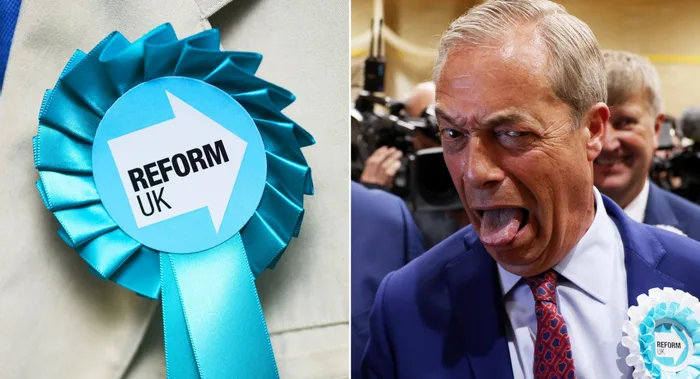
A few months ago, Reform figures couldn’t stop banging on about how many members were joining the party, prompting them to start a live ticker of membership numbers.
…
But the problem with having a live tracker of your membership numbers is that everyone can see when things aren’t going so well.
And in the last month or so it seems that the ticker has started going in the other direction – significantly.
At the start of June, Reform appeared to have around 237,000 members. Now, their membership ticker is roughly 10,000 down on this, at 227,592 at the time of writing.
…
Nigel Farage urges you to ignore facts and reality and be a climate science denier like him. He says that Reform UK has received millions and millions from the fossil fuel industry to promote climate denial and destroy the planet.Donald Trump urges you to be a Climate Science denier like him. He says that he makes millions and millions for destroying the planet, Burn, Baby, Burn and Flood, Baby, Flood.Nigel Farage explains the politics of Reform UK: Racism, Fake anti-establishmentism, Deregulation, Corporatism, Climate Change Denial, Mysogyny and Transphobia.
Ed Miliband said the Conservatives had ‘abandoned 20 years of bipartisanship when to comes to climate’. Photograph: UK Parliament
Energy and net zero secretary lays out stark picture of how climate crisis and nature depletion is affecting UK
Ed Miliband has accused the Conservatives of being “anti-science” by abandoning a political consensus on net zero as he gave MPs a stark outline of how the climate crisis and nature depletion are already affecting the UK.
In the first of what is promised to be an annual “state of the climate” report, the energy and net zero secretary set out the findings of a Met Office-led study that detailed how the UK was already hotter and wetter, and faced a greater number of extreme weather events.
Miliband, who told the Guardian before the statement that politicians who rejected net zero policies needed to be accountable for their decisions, called for opposition parties to unite around the need for urgent action.
But speaking after Miliband, Andrew Bowie, a shadow energy minister, criticised what he called the government’s “shrill” language, saying the party was sticking by Kemi Badenoch’s decision to ditch the 2050 target for the UK to reach net zero.
…
Miliband quoted the former prime minister Theresa May, who put net zero targets into law in 2019 and had argued that the real climate zealots were “populists who offer only easy answers to complex questions”. He added: “I couldn’t put it better myself.”
…
“The lesson is clear. The choices we make as a country have influenced the cause of global action, and in doing so, reduced the impact of the climate and nature crisis on future generations in Britain. To those who say Britain cannot make a difference. I say: you are wrong. Stop talking our country down. British leadership matters.”
UK Conservative Party leader Kemi ‘not a genocide’ Badenoch explains her reality that the Earth is flat, the Moon is made of cheese and that she was born from Unicorn horn dustNigel Farage urges you to ignore facts and reality and be a climate science denier like him. He says that Reform UK has received millions and millions from the fossil fuel industry to promote climate denial and destroy the planet.
Starmer and Macron agree on ‘one in, one out’ deal during the first French state visit to the UK since Brexit | Ludovic Marin/POOL/AFP/Getty Images. All rights reserved
Don’t be fooled by Labour’s show of providing safe migration routes. It’s justifying a cruel trade in people
Yesterday afternoon, British Prime Minister Kier Starmer and French President Emmanuel Macron announced a new migration deal to respond to Channel crossings.
After three days of discussions between the two leaders, Starmer promised “hard-headed, aggressive action on all fronts” to “smash the gangs” who he says are responsible for people crossing the Channel on dinghies.
The deal? A “one in, one out” system, which will return to France some of the people who cross the Channel irregularly. In exchange, France will send people to the UK who, for example, are seeking to reunite with family members here.
Since then, however, Labour has done what they said they wouldn’t – introduce performative gimmicks to convince voters they’re in ‘control’ of migration. They announced plans to invest £75m in a new ‘Border Security Command’, which was quickly criticised as a simple rebranding of what came before. And in a move straight out of Trump’s playbook, they also began televising deportation flights.
Starmer and Macron say the scheme will help deter people from making the crossing by reducing their chances of settling in the UK. But there is no evidence to support this. Time and time again, successive British governments have increased their cruelty towards people arriving on ‘small boats’. Yet people have continued to make the journey.
“New deterrents” are not the solution. This new deal will cause considerable further harm, resulting in the forcible transfer of people back to France. Labour are falling into the same trap that contributed to the Conservatives’ last general election defeat.
‘Safe routes’ used to justify hostility
While details are not yet available, the new deal proposes a ‘safe route’ for some people trying to reach the UK from France. It’s been reported that the ‘one in’ element would target those with family in the UK, enabling them to reach the country without having to risk their lives.
The problem is, for nearly everybody else waiting to cross the Channel, no other route exists for them to seek safety in the UK. This agreement will not, in any meaningful way, solve this issue. People will continue to cross in dinghies in the absence of other, safer routes. If anything, it may fuel demand for crossing the Channel, as those forcibly returned by the ‘one out’ element could try again to reach the UK.
Piecemeal ‘safe and legal routes’ like this should not replace people’s ability to claim asylum if they arrive on UK soil. Yet this is exactly what is happening. The UK is replacing its legal and moral obligations to people seeking asylum with a discretionary ‘pick-your-own’ approach based on national self-interest. Then, they use these ‘safe routes’ to justify hostility towards asylum seekers who do arrive irregularly.
This agreement will result in the punitive trade in human beings across Europe
We don’t yet know what will happen to people after they’ve been returned to France. It’s possible that those returned would then be transferred onwards across Europe. An EU law called the Dublin Regulation means that France could return them back to the first country in Europe they entered. Five of those states – Cyprus, Greece, Italy, Malta and Spain – have written to the European Commission warning that the deal could increase pressure on them. They argue it sets a dangerous precedent for migration governance across the bloc.
Above all else, this agreement will result in the punitive trade in human beings across Europe.
The deterrence delusion
The proposed ‘one-for-one’ pilot scheme continues a 30-year pattern of UK-France agreements to ‘deter’ irregular crossings by increasingly hostility. Deterrence is the convenient, common-sense logic used to justify increasingly cruel policies. It possesses a dangerous self-reinforcing quality: when harsh policies fail to reduce arrivals, this is always attributed to the insufficient severity of the deterrent. Rather than questioning the logic itself, the much easier conclusion to reach is that even more severe measures are necessary.
Yet, even according to the Home Office’s own analysts, there is no evidence that harsh measures deter people from trying to reach the UK to seek asylum. And while some don’t know about the UK’s ever-changing policies, many are aware and still judge the journey to be worth the risk, because there is no other option available.
The government refuses to acknowledge this, so we find ourselves caught in a cycle with no end in sight.
‘Deterrence’ has been used to justify a series of rights-eroding legislation in recent years. The Nationality and Borders Act changed the meaning of ‘refugee’ in British law, making it a harder definition to qualify for. It also introduced powers which enabled the home secretary to deem the asylum claims of irregular arrivals to the UK inadmissible.
The 2022 law also introduced the new crime of ‘illegal arrival’, which criminalised seeking asylum for the first time in the UK. The move was criticised by the UN refugee agency (UNHCR), who said it breached the UK’s obligations under the Refugee Convention: refugees should not be penalised for the way they arrive in a country to seek asylum. In spite of this, at least 500 people have been convicted for ‘illegal arrival’ since June 2022, including refugees, victims of trafficking and torture, and children wrongly assessed to be adults.
‘Deterrence’ does not work. This is not because the policies are not ‘tough enough’, but because people will continue to move when it is not safe for them to stay still
Then in 2023, the Illegal Migration Act rolled back refugee rights even further. It legislated that people whose asylum claims are rejected could never have a future claim assessed in the UK and could not be granted any form of leave. It also created a mandatory duty for the home secretary to remove people deemed inadmissible for asylum – either to their own country, or to a ‘safe third country’. However, post-Brexit, the UK had very few agreements regarding removals. In desperation, the previous government hatched its ill-fated Rwanda plan – which ultimately proved to be a costly, unlawful disaster.
Despite these punitive efforts, people have continued to make the difficult journey across the Channel. Almost 20,000 people crossed in the first half of 2025, a significant increase from the same period in both 2024 and 2023. It’s clear that ‘deterrence’ does not work. This is not because the policies are not tough enough, but because people will continue to move when it is not safe for them to stay still.
Following the money: what happens in France?
While often justified as necessary to prevent the loss of life at sea, evidence strongly suggests that British spending in northern France has in fact increased the risks for people crossing.
Restrictions to the supply of dinghies has forced more people onto fewer crafts, resulting in deadly overcrowding. Footage released by the Guardian and the BBC has shown French police using violent tactics both on land and in the water, including creating waves to flood dinghies, threatening people with pepper spray, and using knives to slash boats in the water. Men, women and children have died in northern France, on land and in the shallows, as a direct result of these tactics.
Alongside the “one in, one out” deal, Macron argued that new tactics were needed on French beaches to respond to people smugglers. It has been rumoured that new powers are being considered which would enable French officers to intervene with dinghies up to 300m from the coastline. However, police unions are resisting, with concerns that this might breach laws regulating the treatment of boats in distress at sea. These are the same concerns which ultimately ended the previous UK government’s plans to ‘push-back’ dinghies at sea.
If passed, this measure will clearly endanger people further. British-funded policing efforts have resulted in record numbers of people drowning in the French shallows – 82 people died last year, including at least 14 children. While the government scapegoats young asylum seekers for these deaths, we must continue to call the UK and France to account for how money is being spent on the beaches.
No more gimmicks?
Starmer’s promise to end the “gimmicks and gestures” has proven hollow. Despite the promise of something new, his plans represent a direct continuation of the Conservative’s cruel approach.
In a dangerous escalation in rhetoric, Labour have argued that Channel crossings must be treated using “counter-terror style powers”. Its new Border Security, Asylum and Immigration Bill – currently in the parliamentary committee stage – proposes several new immigration offences, modelled on terrorism offences. These include the possession of information or objects that could be used for “immigration crime”.
Performative measures will not bring an end to death and despair in the Channel. These are policies not based on evidence or concerns for human life, but rather on a desire to appear “tough” on migration.
As people have continued to cross the Channel, both Labour and Conservative governments have resorted to increasingly cruel, often violent policies in their attempts to “stop the boats”. As continued cycles of policies have shown, they will not work. Instead, they will bring further harm to people seeking a better life in the UK. We must resist the state-supported trade in human beings and break the cruel cycle of deterrence.
Keir Starmer chases Nigel Farage’s racist bigot vote.Nigel Farage explains the politics of Reform UK: Racism, Fake anti-establishmentism, Deregulation, Corporatism, Climate Change Denial, Mysogyny and Transphobia.Nigel Farage urges you to ignore facts and reality and be a climate science denier like him. He says that Reform UK has received millions and millions from the fossil fuel industry to promote climate denial and destroy the planet.
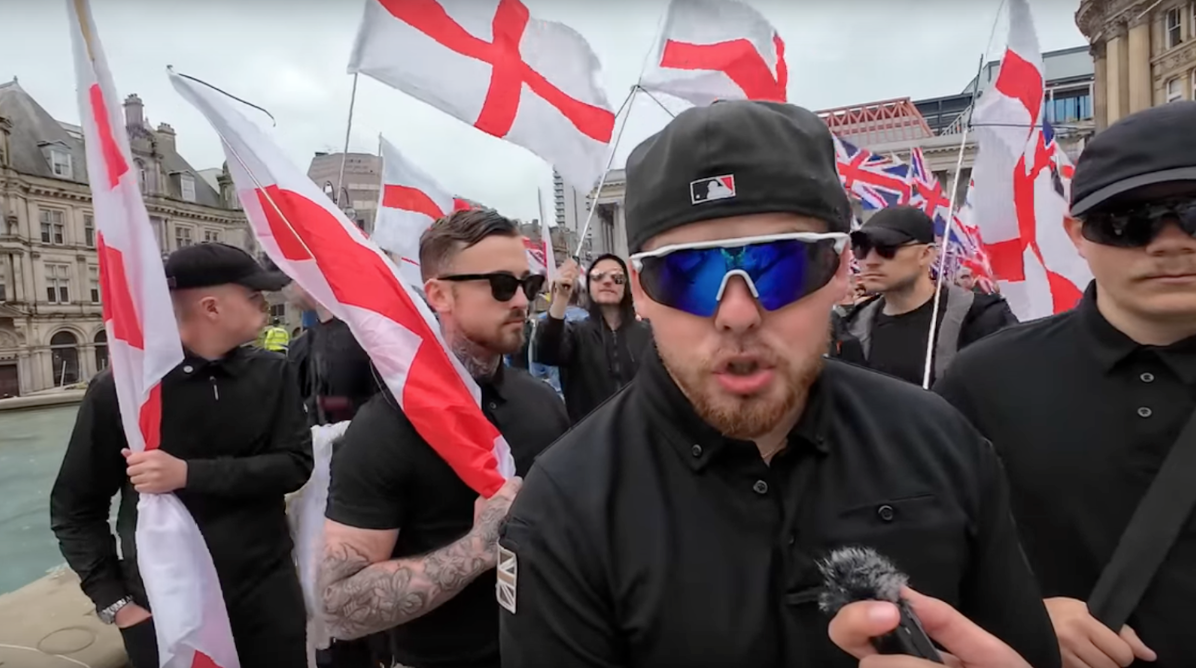
Kai Cunningham speaking to YouTuber Wesley Winter. Credit: Wesley Winter/YouTube
This ‘may come across as racist’.
A far-right activist who said Britain needs a “national socialist government” has been suspended from Reform UK following a Novara Media investigation.
In April, a reporter from Unherd, a news and commentary website owned by GB News owner Paul Marshall, went to Dagenham, Essex to report on the insurgent rise of Reform UK.
According to Unherd’s dispatch, in a tense meeting in Rainham working men’s club where a party seeking to professionalise met with a “lagered-up, pissed-off crowd”, one voice cut through the atmosphere. “There’s no point squabbling,” Kai Cunningham is reported to have said, to the loudest cheer of the night. “Reform is our only chance. The country is broken. Barking and Dagenham is broken, and all the lefties need to hear us say it’s broken, and realise we’re still here advocating for our country.”
Cunningham was described by Unherd as “representative of the new Reform”, but he also appears to be representative of something else.
In May, Cunningham was filmed among the small number of attendees at a “remigration” rally in Birmingham organised by far-right party Britain First.
In comments to a YouTuber who was filming the event, Cunningham said: “What Britain needs is a national socialist government.”
He then promoted the political group White Vanguard. “White Vanguard are the only British national socialist activist group. That’s what’s going to bring change – the only change.”
“National socialism is on the rise. It’s the only thing that’s going to save Britain,” he said.
…
When approached by Novara Media, a Reform UK spokesman said: “Kai Cunningham’s membership has been suspended with immediate effect pending the outcome of an internal investigation. We will never tolerate those with extreme views in our party.”
Nigel Farage explains the politics of Reform UK: Racism, Fake anti-establishmentism, Deregulation, Corporatism, Climate Change Denial, Mysogyny and Transphobia.Nigel Farage urges you to ignore facts and reality and be a climate science denier like him. He says that Reform UK has received millions and millions from the fossil fuel industry to promote climate denial and destroy the planet.
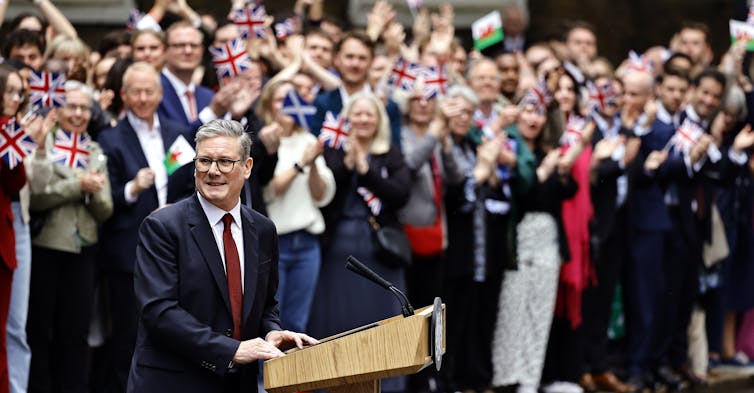
Exhausted from a long campaign but buoyed by an extraordinary victory, Keir Starmer stood on the steps of Downing Street just over one year ago to deliver his victory speech. “Your government,” the new prime minister said, “should treat every single person in this country with respect.”
This message of respect resonated strongly in the year leading up to the campaign, coming as close as anything to providing a central argument to Labour’s case for government. And, according to polling and focus groups that my team at UCL Policy Lab designed along with polling company More in Common, it seemed to work.
As our research at the time showed, voters felt that “respecting ordinary people” was the most important attribute that any politician could have, more important than having ideas for the future, managing effectively or having real experience. And they thought Starmer was the leader who displayed that respect most.
A year later, the picture looks quite different. In new polling, we asked a representative sample of over 7,000 people to evaluate the government one year on. On respect, the judgement has not been good.
Want more politics coverage from academic experts? Every week, we bring you informed analysis of developments in government and fact check the claims being made.
During the general election campaign, 41% of the electorate said that they believed that Starmer “respected people like them”. One year on, that stands at only 24%. At the same time, the number who say that he does not respect them has risen from 32% to 63%. Starmer is now outstripped on that question by Nigel Farage – 33% say the Reform UK leader respects people like them.
Losing support
This view has had crucial political consequences. Of those who voted for Labour in the general election, only 60% of our respondents say they would vote for the party in an election held tomorrow.
And that is not because some other political party is suddenly swooping in for their supporters. Labour’s voters are defecting in a host of different directions: 11% say they would vote Reform; 8% would vote Liberal Democrat; 4% would vote Green and 4% would vote Conservative. A further one in ten say they simply don’t know how they would vote.
Labour’s losses have been most dramatic among their first-time voters. Of those who voted for Labour in 2024 but not in any other general election since 2010, barely a third still support the party, while a fifth would vote for Reform UK.
These political failures, our report contends, are directly related to the declining sense of respect. The top reason voters gave for turning away from Labour are the broken promises and U-turns made by Labour in government, followed by the party’s failure to reduce the cost of living and changes to the winter fuel payment.
The idea of “respect” being key to the public’s sense of whether a government is on their side or not has been growing for many years now, both in academia and in politics itself. Since at least the 2007/8 financial crisis there has been a sense that large swathes of the public feel neglected, overlooked and even disdained by those who govern them.
When people talk about wanting to see “change” in Britain, this is often what they mean. It was a theme I touched on recently in two books, Out of the Ordinary and, with my co-author Tom Baldwin, England.
Just over a year ago, a happier Starmer delivers his victory speech. Shutterstock
But respect is not just an abstract idea. People appear to judge whether they are respected by those who govern them or not primarily on the basis of whether the government stands up for them against powerful vested interests.
Our earlier research demonstrated that there is a widespread sense among the British public that certain groups have had it too easy for too long. This is either because they have been able to intimidate the government, or because government ministers and advisers have themselves been recruited from among these groups.
In our new report, therefore, we see that the new government’s most popular act was their willingness to raise the minimum wage by £1,400 in April, against the objections of some in business who suggested that such a move was too burdensome on them.
Changes to the winter fuel allowance and proposed changes to the disability benefits system, on the other hand, registered poorly. They suggest that the interests of ordinary and vulnerable people count for too little in decision-making.
These judgements currently shape the mood of the country and probably top the list of issues that the government now needs to address. There is still time for the government to rebuild its appeal, of course. Indeed, our respondents who said they would vote for Labour said they would do so because the party needs more time to fix the problems they inherited.
But as it seeks to do so, voters will want to know who this government stands for. Whose interests does it put first? What kind of people does it respect?
Much of the electorate thought they knew the answer to these questions one year ago. Now they’re not so sure.
Marc Stears, Director of UCL Policy Lab and Professor of Political Science, UCL
Keir Starmer says that the Labour Party under his leadership all feel a small part of Scunthorpe.Keir Starmer objects to criticism of the IDF. He asks how could anyone obect to them starving people to death, forced marches like the Nazis did, bombing Gaza’s hospitals and universities,mass-murdering journalists, healthworkers and starving people queuing for food, killing and raping prisoners and murdering children. He calls for people to stop obstructing his genocide for Israel.Keir Starmer chases Nigel Farage’s racist bigot vote.