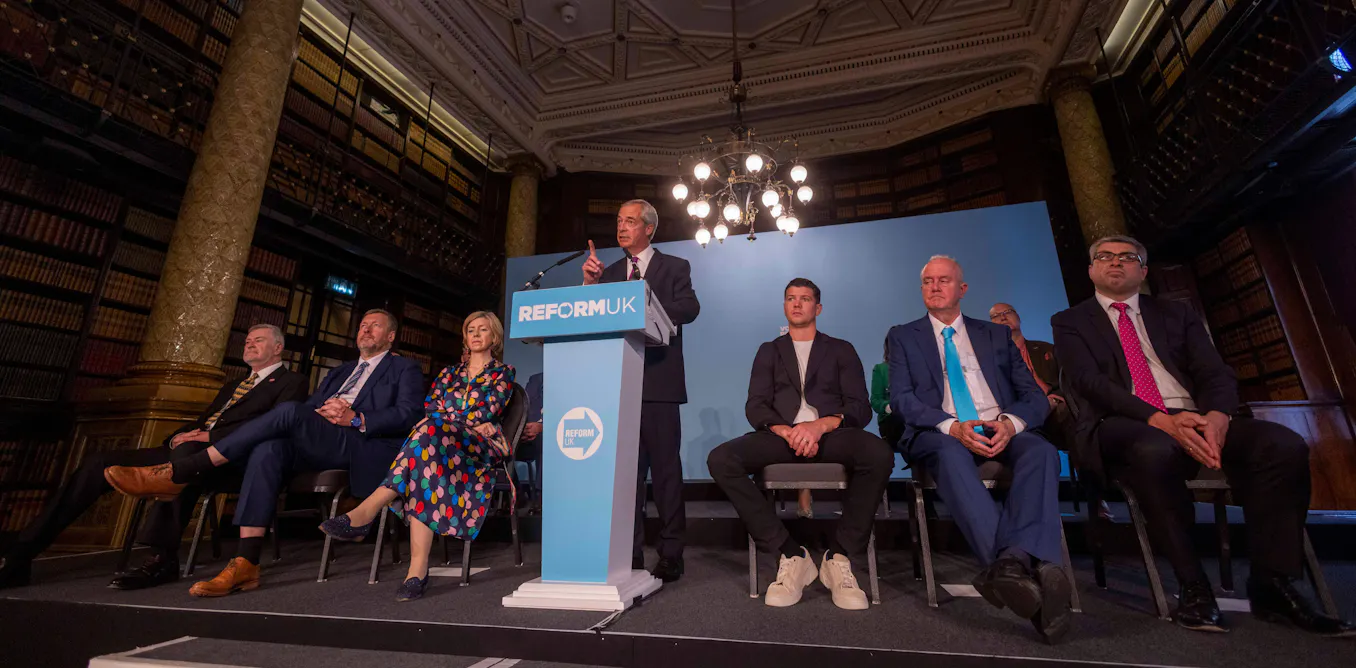
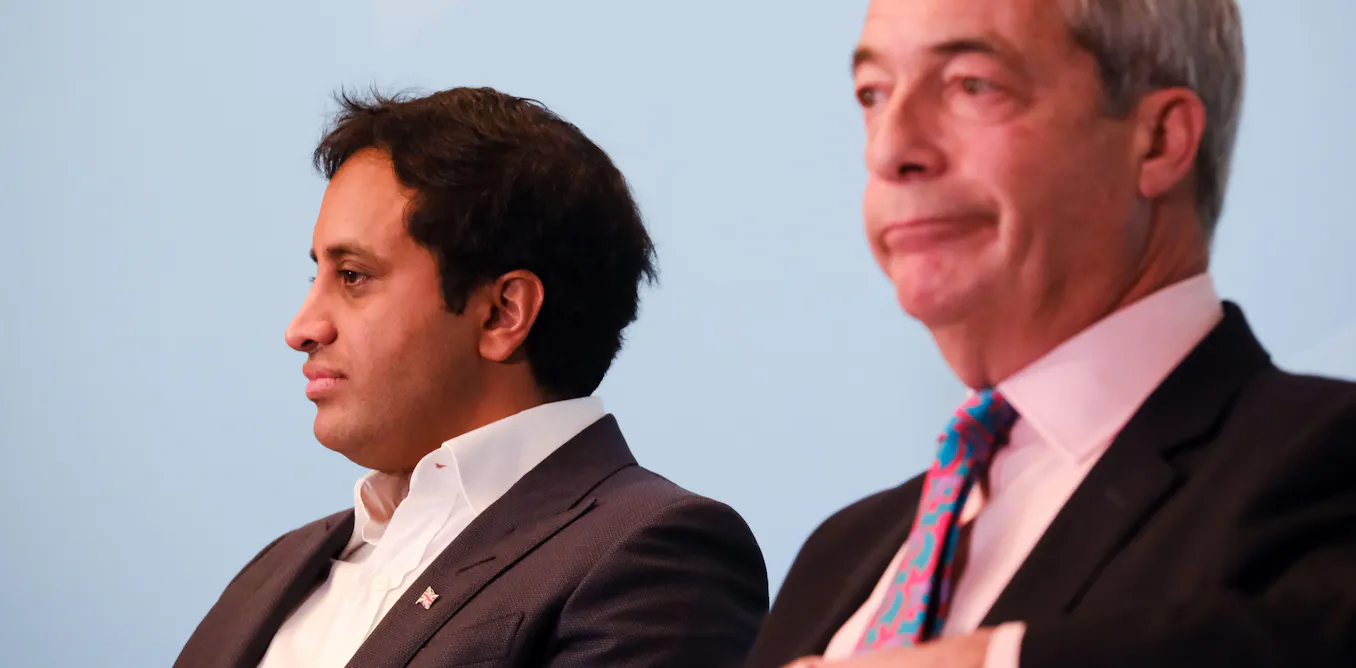
Reform UK leader Nigel Farage (right) and Zia Yusuf during a press conference in Westminster, London, June 23, 2025 Reform UK leader Nigel Farage (right) and Zia Yusuf during a press conference in Westminster, London, June 23, 2025
REFORM UK’s proposed change to non-dom tax rules were branded today a “bonanza for billionaires” that would cost the public purse £34 billion a year.
Party leader Nigel Farage insisted the change would be “very attractive” despite admitting he’s “not clever enough” to answer questions about the suggested hit to Britain’s economy.
Image added by dizzy ;). Nigel Farage says he’s too stupid to answer questions about the hit to the UK economy of his plans to suck up to the uber-rich.
He said that he believed “tens of thousands of people” would come to Britain “on this ticket” if Reform was successful.
The far-right party said that it would reinstate non-dom status for wealthy individuals in exchange for a £250,000 one-off fee which would be given to Britain’s poorest workers.
Under the “Britannia Card,” non-doms would be offered a 10-year renewable residence permit and a return to the controversial arrangement whereby overseas income can be shielded from British tax.
They would also avoid inheritance tax, with the one-off payment then being distributed to Britain’s bottom 10 per cent of earners.
The Labour government abolished the non-dom tax status in April, which is where British residents whose permanent home or domicile for tax purposes is outside the country.
Today Dan Neidle, founder of Tax Policy Associates, said that the policy would cost Britain £34 billion
Reform UK is proposing a “Britannia card” that would let wealthy foreigners pay a £250k fee to move to the UK and live here exempt from all tax on their foreign assets. All fees received would be distributed, “Robin Hood”-style, to the 2.5 million lowest-paid workers in the UK.
Reform UK don’t include any analysis of the cost of their proposal. Our analysis of OBR data suggests the cost would likely be around £34bn over five years.
…
[T]he card would provide a very large and expensive tax windfall to a small number of very wealthy people who are already here. Office for Budget Responsibility data shows that this would amount to £34bn of lost Government revenue over five years. That would have to be funded by either tax increases or spending cuts.
The leader of Reform UK, Nigel Farage, recently announced that if in government, his party would abolish the two-child limit on benefits. This social security policy restricts the payment of means-tested benefits to the first two children of a family.
Farage explained the announcement as being pro-natalist – intended to encourage a higher birth rate – as well as being “pro-worker”. Farage said that the abolition of the two-child limit “makes having children just a little bit easier” for “lower paid workers”.
He noted that Reform wanted “to encourage people to have children”. Such arguments are familiar in the European political right, although the UK’s Conservative opposition criticised Reform’s proposal.
To be in government, Reform has two possible routes: to build a coalition of voters for it, or to split left-leaning voters. Its proposal to abolish the two-child limit may be aimed at both.
On the one hand, it might be supported by left-leaning voters who are able to accept Reform’s broader policy agenda. On the other hand, it might be aimed at encouraging left-leaning voters who find Reform’s agenda problematic to move to parties (such as the Greens and Liberal Democrats) who are less equivocal in their commitment to abolishing the two-child limit than the Labour government.
Social security policies winning votes
Social security policies have long been used as part of political strategising. The situation with the two-child limit is complicated, though, because both anti- and pro-natalist views of social security (and it predecessors) have been popular at particular moments.
Political and popular arguments have long been made that supporting the poorest families leads to them having too many children. This, so the argument goes, reproduces, rather than addresses, the poverty they face. Examples can be found, for instance, in the 1834 poor law commission report in relation to “bastardy” and large families, Sir Keith Joseph’s 1970s focus upon the “cycle of deprivation”, as well as “underclass” arguments in the 1980s and 1990s.
The two-child limit was announced in the 2015 budget and introduced in 2017 with the reasoning that “those in receipt of tax credits should face the same financial choices about having children as those supporting themselves solely through work.”
The two-child limit on benefits restricts welfare payments for children to the first two children in a family. Len44ik/Shutterstock
In contrast, the architect of the British welfare state, William Beveridge, noted in 1942 that children’s allowances (now child benefit) would help “housewives as mothers” in their “vital work in ensuring the adequate continuance of the British race and of British ideals in the world.” The 1945 Labour election victory in support of the welfare state suggests pro-natalist policies can contribute to electoral success.
The expansion of tax credits in the 1990s and 2000s were partly explained in pro-natalist terms. Tony Blair, for instance, noted: “The working tax credit enables half a million mothers to choose to stay at home.” That, in other words, tax credits enabled women to choose having and raising children over paid work.
Recent polling, however, suggests that the anti-natalist two-child limit polls well among voters, especially Reform voters. In 2024, for example, YouGov found 60% of Britons thought the two-child limit should be kept. The figure was 84% for Reform voters.
Targeting voters
The abolition of the two-child limit may have been adopted to increase Reform’s appeal to left-leaning voters. Providing additional support for families through social security may be attractive to voters concerned with social injustice. The two-child limit increases child poverty. Affected families are unable to provide even the most basic needs, such as food, clothing and heating.
Nevertheless, Reform’s proposal is also embedded in caveats and would be paid for through means appealing to its existing voters. So, for example, Farage emphasised that the abolition of the two-child limit would be restricted to only British families. It would not be extended to families “who come into the country and suddenly decide to have a lot of children”.
By keeping the two-child limit for migrant families, Reform’s proposals are consistent with existing immigration and asylum policies. It has been observed in an inquiry by All Party Parliamentary Groups on poverty and on migration that policies like this are, at least in part, “designed to push people into poverty in the hope that it will deter others from moving to the UK.” And, therefore, the abolition of the two-child limit can be seen as part of Reform’s pledge to severely curtail immigration.
Farage also argued that the abolition of the two-child limit would be paid for by other policies that are central to Reform’s electoral agenda. These include stopping asylum seekers being housed in hotels and the abolition of net zero policies. It is also consistent with Reform’s view that jobs in Britain should be filled by British people. This, it believes, will help reduce reliance on migrant labour from overseas.
There is little evidence that the introduction of the two-child limit had the desired impact on lowering poorer households’ birth rates. And it is unclear whether the proposed abolition of the two-child limit rooted in a British-only, pro-natalist agenda is enough to attract left-leaning voters.
These voters might, for example, be more concerned with Reform’s position on immigration and asylum seeking, as well as the social injustice of the undoubted poverty in which families subjected to the two child limit on benefits live.
Reform’s strategy then may be to further encourage those voters to turn from its closest rival – the Labour party – to other political parties. Whichever is the case, the situation will undoubtedly shift if the Labour government does take the step of abolishing the two-child limit.
Former chairman Zia Yusuf has rejoined Reform after quitting days previously. Yusuf had said he no longer wanted to work to get the party into government when new MP Sarah Pochin called for a ban on burqas in the UK. However, he seems to have had a change of heart and will return, ostensibly to lead the party’s “department of government efficiency”.
Donald Trump and Elon Musk’s bromance, however, is on much rockier ground. There’s no sign of the world’s richest man reconciling with the US president, his former employer.
These spats, at first glance, might seem like little more than, put politely, teething problems in (relatively) new political operations. Or, a little less politely, the unedifying spectacle of people in or seeking power being completely unable to act like adults.
However, it also points to something more akin to a canary in the coalmine for radical right parties around the world. Their increasing reliance on an ultra-wealthy donor class presents an ideological puzzle that may not be solvable.
Want more politics coverage from academic experts? Every week, we bring you informed analysis of developments in government and fact check the claims being made.
Reform currently operates on what has been described as vibes alone. That is to say, there’s very little meaningful common ground between the people who vote for Reform and the party elite. The only continuity is their sense of anger at the current political system.
This, as we are seeing in election after election, is an incredibly powerful (and compelling) force. The problem is, of course, that you can’t oppose forever. You often end up having to actually do something. All boxers, Mike Tyson will be glad to tell you, have a plan – until they get punched in the face.
And what makes them such a powerful force at the moment, is precisely that which may cause challenges further down the line. At least for me, given it’s my bread and butter research-wise, I see this when I follow the money.
And I’m increasingly asked a lot of questions about the kind of people who are either giving money to Reform – or who Reform are courting (and at the moment it is decidedly the latter which is the case).
Then you have a Silicon Valley-reared tech-bro libertarian. This group already runs on a “move fast and break things” philosophy so the idea of an insurgent party which proclaims, on entering parliament, that “the fox is in the henhouse” naturally appeals.
There are some places where the interests of these groups align – most notably a distaste for government interference and red tape (though not necessarily a smaller state in terms spending on public services). They also share a sense that progressive politics, broadly defined, ought to be pegged back a bit (but with an emphasis on a bit).
They differ on a great deal else, to the extent that you can only really please two out of the three, but never everybody. And, unfortunately, without all three the project starts collapsing. This is what we have been seeing in the fractious relationships between Trump and Musk and Farage and Yusuf.
Two out of three ain’t bad – but it’s not enough
Yusuf (and Musk) are very much representative of the new tech-bro class. And, when Yusuf called questions about banning the burqa “dumb” he was speaking at both an ideological and organisational level.
At the ideological level it is, frankly, a bit rich for his blood, because “philosophically I am always a bit uneasy about banning things which, for example, would be unconstitutional in the United States”.
Organisationally, it pushes Reform much closer to what journalist Fraser Nelson calls “a tactic more akin to the old BNP”. Indeed, Reform started “just asking questions” about burqas at the same time as it started twisting footage to claim that Anas Sarwar, leader of Scottish Labour, wants to prioritise the needs of Pakistanis.
This kind of dog-whistle politics appeals to some, but puts off a lot more, including, I think, some of the (saner) tech-bro right.
Indeed, Ian Ward at Politico perceptively notes that if we want to explain the current Musk-Trump meltdown we should look back to Christmas 2024, when cracks first started appearing over immigration policy.
The tech-bro right are, generally speaking, much less hardline on the flow of people than the Maga-populist right (think Steve Bannon and Tommy Robinson). In fact, they are pro-high skilled immigration as it tends to benefit them and their business interests.
Tech-bros also like the idea of moving fast and breaking things in theory. But when things start moving fast and actually breaking in practice (or Tesla stocks start to plummet), they tend to get a bit freaked out.
In other words, it’s not just that they don’t like government, they don’t like governing and the inevitable compromise that comes with it. When they say move fast and break things, I get the sense what they really mean is “leave me alone so I can make billions in peace”.
This, of course, is quite appealing to traditional hedge-fund conservatives, but is also the politics that literally built the economic grievances that much of the white-working class support for the populist radical right is, in turn, built on.
Two out of three ain’t bad, but you do need all three. So, don’t be surprised if despite Farage’s seemingly genuine affection for Yusuf, it all falls apart again before long.
Ultimately, Reform will need to decide how they are going to spin these plates. The good news is that it might well be that they can, indeed, get by on vibes alone until the next general election. The bad news, unfortunately, is that winning an election is the easy bit. Just ask Boris Johnson and Keir Starmer. After all, everyone has a plan.
He is calling for the scrapping of the two-child benefit cap and restoring the winter fuel payment to all pensioner
Nigel Farage’s tax and spend plans were slammed as “fantasy economics” as Reform UK claimed it could save a massive £225 billion over five years by scrapping net zero projects.
Mr Farage’s party also wants the threshold for paying the basic rate of income tax to be dramatically increased from £12,570 to £20,000.
…
Reform sources said the £225 billion figure of savings from ditching net zero projects was based on a report by the Institute for Government.
But the IfG stressed that the bulk of this green investment, highlighted in the paper called “Paying for Net Zero” was due to come from the private sector, not public funds.
Jill Rutter, senior fellow at the IfG, told The Standard: “Cancelling private investment does not save the Government money.”
…
Nigel Farage reminds you that he’s the man that brought you Brexit and asks what could possibly go wrong.Elon Musk urges you to be a Fascist like him, says that you can ignore facts and reality then.
As British prime minister Keir Starmer vowed to “finally take back control of our borders” in a landmark speech on immigration on May 12, it felt a little like déjà vu.
Some nine years earlier, we had heard those exact words repeated over and over in the build-up to the Brexit referendum from former prime minister Boris Johnson and the Leave campaign. It was a refrain also used by Nigel Farage and UKIP.
Of course, this direct reference was the point. Starmer used it to claim that the Labour government’s white paper on immigration was finally going to deliver on what had been promised and desired for many years.
In these opening lines, the tone was set. And as the speech went on, there were echoes of far-right language and ideas reverberating throughout. Starmer lamented the “squalid” state of contemporary politics, the “forces” pulling the country apart, and the previous government’s so-called “experiment in open borders”.
This speech and the white paper that it unveiled are but the latest indication of the rightward direction of travel within UK politics, led by mainstream and far-right parties alike – as exemplified in recent months by the footage released of immigration raids and deportations.
Some will argue this is Labour’s response to the rising threat of Reform UK, with results in the recent local elections seen as evidence of the far right’s growing popularity. So the story goes, Labour is proving that they can be tough on immigration, showing would-be Reform defectors that they can be trusted after all.
This familiar narrative seems to follow a prevailing wisdom which is parroted in political, media and public debates – that appeasing the far right is the way to defeat it. Rather than beating the far right at their own game, however, research shows that these techniques simply legitimise their key talking points and further normalise exclusionary politics.
Starmer’s speech is a case in point. In using “take back control” from the outset, there was no hiding the intended audience or message. Starmer claimed that this project would “close the book on a squalid chapter for our politics, our economy, and our country”, implying that excessive immigration has directly caused these problems and that stopping it solves them. This chimes with classic far-right narratives where migration is framed as the root of all societal ills.
When these kinds of ideas are pushed by those in government, with great authority and influence, they are given greater credence and weight. A strikingly clear example of this came in the summer of 2024 when participants in racist riots waved posters containing the slogan “stop the boats” (a phrase popularised by the previous Tory government).
Another component of the speech that was reminiscent of far-right tropes was the idea that increased immigration was a deliberate tactic by the previous government. Starmer suggested that the Conservatives were actively pursuing a “one-nation experiment in open borders” while deceiving the British public of their intentions.
Far-right conspiracies are often premised on the idea that elites are deliberately encouraging mass immigration. It’s not hard to see how Starmer’s words could act as a dog whistle in this scenario.
These claims are especially damaging when we think about the draconian measures introduced under former Conservative governments, such as the Rwanda policy. Labour is now indicating that these proposals didn’t go far enough.
To justify bringing far stricter immigration rules, Starmer stated that “for the vast majority of people in this country, that is what they have long wanted to see”. As far-right parties so often do, Labour suggests that they are delivering on “people’s priorities”. Yet are they really a priority for people, or are we told that they are a priority which then makes them more of a priority?
Research by Aurelien Mondon, senior lecturer in politics at the University of Bath, illustrates how people’s personal and national priorities differ dramatically. When people in the UK were asked to name the two most important issues facing them personally, immigration didn’t even make it into the top ten.
However, when asked the same question about the issues facing their country, immigration topped the list. How can something that doesn’t affect you in your day-to-day life suddenly become a top priority for your country? We need to challenge the narrative that the government is simply acting on people’s wishes and acknowledge its own capacity to set the agenda.
Other priorities
Some will say that harsher anti-immigration policies are a necessary evil to defeat the far right. However, if people’s personal priorities are really the cost of living, housing and education, why is the government not focusing more of its energy on these things rather than scapegoating migrants?
What’s more, research shows that even based on these terms, these strategies are ineffective and can actually boost the success of the far right electorally. After all, its ideas are being repeatedly normalised.
In all this tactical talk, we lose sight of the fact that people are living the consequences of this rhetoric and policies right now. Rather than focus on Reform’s potential performance in a general election that is probably years away, we should recognise the immediate consequences of the rhetoric that has accompanied this white paper. Even if this did put a dent in Reform’s prospects, what is the meaning of defeating them if the policies they promote become part of the mainstream in the process?
The bottom line is that you do not beat the far right by becoming them. It doesn’t work electorally or ideologically, and even if it did, minoritised communities suffer the consequences regardless. The far right is not some threat lying waiting in the future – its normalisation is happening now.
Elon Musk urges you to be a Fascist like him, says that you can ignore facts and reality then.Keir Starmer says that the Labour Party under his leadership all feel a small part of Scunthorpe.

 Reform UK leader Nigel Farage (right) and Zia Yusuf during a press conference in Westminster, London, June 23, 2025 Reform UK leader Nigel Farage (right) and Zia Yusuf during a press conference in Westminster, London, June 23, 2025