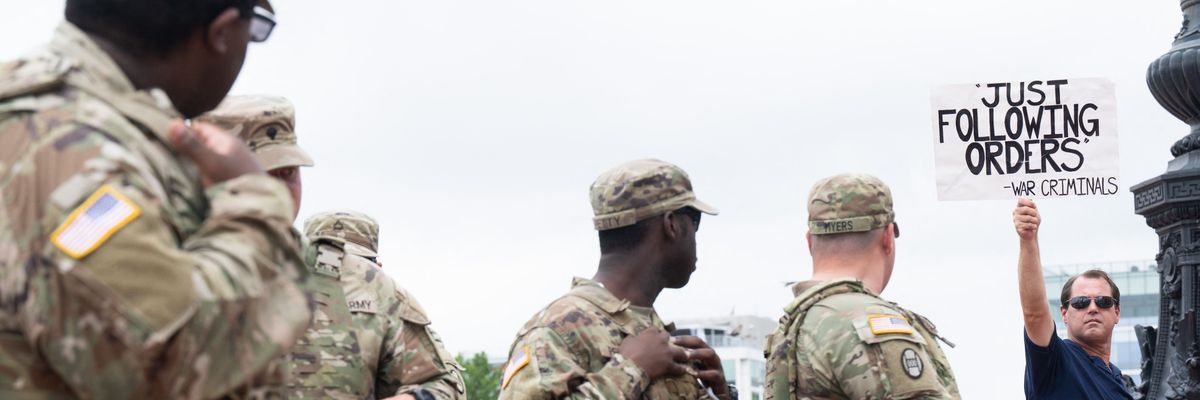
Protesters demonstrate near members of the National Guard as they stand watch outside Union Station in Washington, DC, on August 20, 2025. (Photo by Saul Loeb/AFP)
A federal judge ruled Thursday that President Donald Trump’s deployment of more than 2,000 National Guard troops to police Washington, DC, is illegal and must come to an end.
Over objections from city officials, Trump ordered the troops to flood the nation’s capital in August to deter what he claimed was an unstoppable crime wave, even though crime was falling precipitously and was at a 30-year low.
Federal District Judge Jia Cobb, an appointee of former President Joe Biden, wrote that the Trump administration “exceeded the bounds of their authority” and “acted contrary to law” by deploying the National Guard “for nonmilitary, crime-deterrence missions in the absence of a request from the city’s civil authorities.”
She wrote that while Trump is the commander-in-chief of the armed forces, Trump’s legal authority to deploy troops around the country is subject to limits by Congress, especially in DC, where it has the ultimate authority under the Constitution.
She wrote that the court “rejects defendants’ fly-by assertion of constitutional power, finding that such a broad reading of the president’s Article II authority would erase Congress’ role in governing the district and its National Guard.”
Cobb also said that the Pentagon lacked statutory authority to deploy more than 1,000 out-of-state National Guard members to DC. She wrote that “the district’s exercise of sovereign powers within its jurisdiction is irreparably harmed by defendants’ actions in deploying the guards.”
While finding the administration’s actions illegal, Cobb said it will not be required to pull back troops immediately. She gave the administration until December 11 to file an appeal.
“There is generally no public interest in the perpetuation of unlawful agency action,” Cobb concluded. “There is a substantial public interest in having governmental agencies abide by the federal laws that govern their existence and operations.”
The ruling follows a lawsuit in early September from the office of DC Attorney General Brian Schwalb.
“The court has ruled that the National Guard deployment to DC is illegal and granted a preliminary injunction,” Schwalb said after the ruling was handed down. “As we made clear from the start: The US military should not police American citizens on American soil. This is a victory for DC, home rule, and American democracy.”
The ruling comes amid legal battles over Trump’s moves to deploy the National Guard in other US cities. The US Supreme Court is expected to soon weigh in on his deployment in Chicago, even as some troops sent to Illinois are headed home.
“Normalizing the use of military troops for domestic law enforcement sets a dangerous precedent,” Schwalb continued. “No president should be empowered to disregard states’ independence and deploy troops anywhere—with no check on their military power. This federal overreach is not normal or legal.”
Orcas discuss how Trump was re-elected and him being an obviously insane, xenophobic Fascist.Donald Fuhrump says that Amerikkka doesn’t bother with crimes or charges anymore, not being 100% Amerikkkan and opposing his real estate intentions is enough.
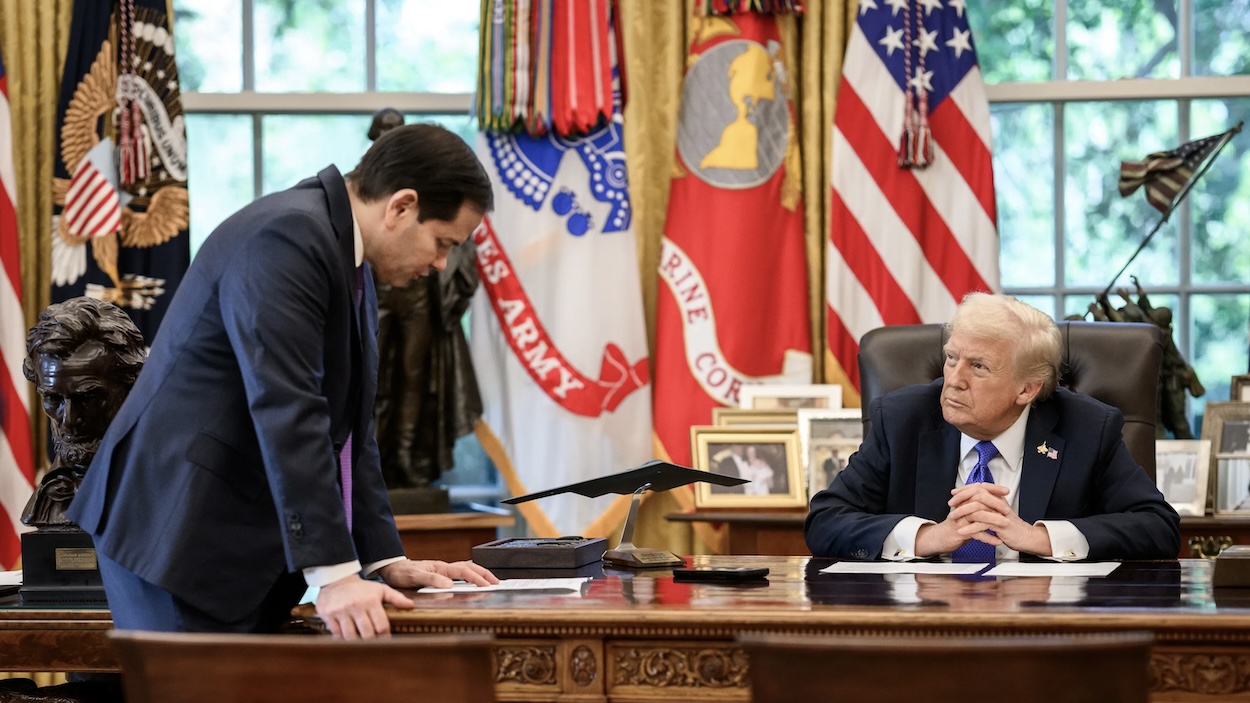
US President Donald Trump and US Secretary of State Marco Rubio in the Oval Office. Photo: The White House
While Trump increases military pressure in the Caribbean Sea, he hasn’t ruled out the possibility of resuming talks with Caracas. Meanwhile, Maduro supports the diplomatic route and rejects the possibility of war
The Trump administration claims that a large amount of the drugs entering the United States comes from Venezuela, whose government is allegedly part of a criminal structure called the “Cartel of the Suns”.
Caracas has flatly denied these accusations and claimed that they are part of a justification to overthrow the Venezuelan government (which controls the world’s largest oil reserves) and thus force a change of direction in the country that is aligned with Washington’s economic and geopolitical interests.
Washington insists on its accusations
On November 16, the US State Department announced that it will designate the Cartel of the Suns (Cartel de los Soles) a foreign terrorist organization. Defense Secretary Marco Rubio stated: “The Cartel of the Suns, along with other designated foreign terrorist organizations, including the Aragua Train and the Sinaloa Cartel, are responsible for terrorist violence throughout the hemisphere, as well as drug trafficking to the United States and Europe.”
Despite these warnings, the Trump administration has already launched attacks on small boats in the Caribbean Sea that, according to Washington, were carrying drugs to the United States, although no reliable evidence has yet been presented to prove this. Dozens of deaths have been reported so far.
The big question arising from the recent military and administrative maneuvers by the United States is whether Washington will dare to attack Venezuelan territory on the grounds that it is an attack to destroy a terrorist organization. For the moment, Trump has moved forward with these measures, although he has been cautious in stating that the attack will take place.
Trump says he will speak with Maduro soon
While the Trump administration increases pressure on Venezuela, even authorizing covert actions in the Caribbean country according to the New York Times, it also claims that there may be an open channel of communication with Caracas.
This was seemingly confirmed at the November 17 press conference, when, in response to questions from reporters about possible communication with Maduro, Trump said, “At some point, I will talk to him.”
Maduro’s response
In response to these statements, the Venezuelan president reacted by saying that the conversation should take place: “Only through diplomacy can differences be resolved … Anyone who wants to talk to Venezuela will talk face to face, but the Venezuelan people cannot be allowed to be massacred.”
Maduro warned that one of the consequences of a possible military invasion of Venezuela would be the loss of legitimacy of the Trump administration: “A war against Venezuela would be the political end of his leadership and his name. [Some people are trying to push Trump to] make the most serious mistake of his entire life.” He also said that public opinion in the United States is increasingly rejecting a possible military intervention in South America.
For now, Washington wants to maintain all options available when negotiating with Maduro’s government, whether through military or diplomatic means. Thus, Trump is deploying his military and intelligence assets in South America while keeping the lines of communication open with Maduro. For its part, the Venezuelan government is betting on diplomacy while preparing for a possible military invasion that would seek to end more than 25 years of Chavista rule, although such an operation could have unforeseen effects in the region, even for Washington.
Donald Fuhrump says that Amerikkka doesn’t bother with crimes or charges anymore, not being 100% Amerikkkan and opposing his real estate intentions is enough.Orcas discuss how Trump was re-elected and him being an obviously insane, xenophobic Fascist.
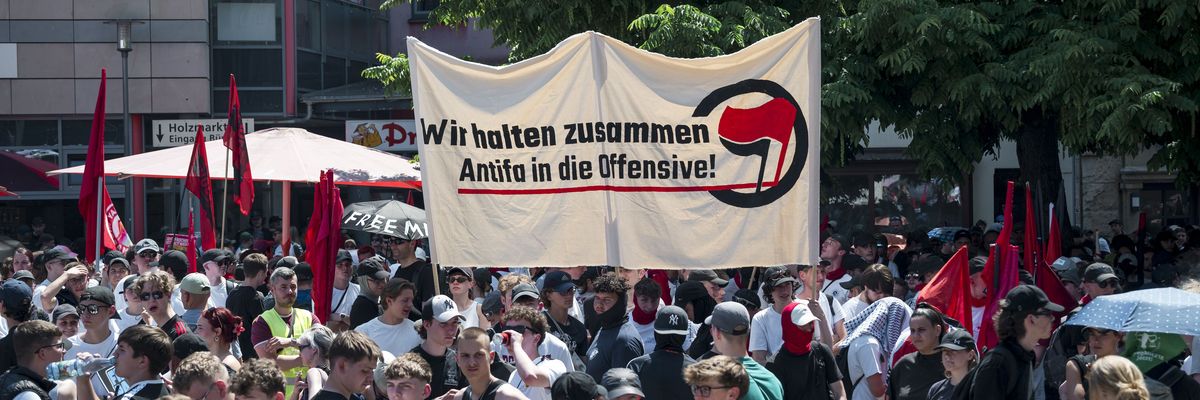
“We stick together – Antifa on the offensive!” reads a banner at a demonstration on June 14, 2025, in Jena, Thuringia, Germany, called by a broad alliance of anti-fascist groups under the slogan “Now more than ever! Anti-fascism is necessary!”. (Photo by Daniel Vogl/Picture Alliance via Getty Images)
Investigative journalist Ken Klippenstein warns that the designation opens up US citizens to government surveillance, asset seizure, and material support charges.
President Donald Trump’s State Department on Thursday broadened his efforts to use “terrorism” to crush his enemies on the left, designating four European groups as “foreign terrorist organizations” based on their alleged connections to the vaguely defined network of leftist agitators known as “antifa,” short for “anti-fascist.”
Following the assassination of right-wing activist Charlie Kirk in September, Trump turned his attention toward waging a war on left-wing protest groups and liberal nonprofits, describing them as part of a vast, interconnected web that was fomenting “terrorism,” primarily through First Amendment-protected speech.
As part of that effort, Trump formally designated “antifa” as a “domestic terrorist organization,” even though it is not a formal group with any structure, but rather, a loose confederation of individuals all expressing an amorphous political belief. Civil rights advocates warned that the vague nature of the designation could be extended to bring terrorism charges against anyone who describes the Trump administration’s actions as fascist or authoritarian.
Shortly after, Trump also signed a little-reported national security order, known as National Security Presidential Memorandum 7 (NSPM-7), which mandated a “national strategy to investigate and disrupt networks, entities, and organizations that foment political violence so that law enforcement can intervene in criminal conspiracies before they result in violent political acts.”
Some of the indicators of potential violence, the memo said, were “anti-Americanism, anti-capitalism, and anti-Christianity,” “extremism on migration, race, and gender,” and “hostility towards those who hold traditional American views on family, religion, and morality.”
Referencing NSPM-7 explicitly, the State Department on Thursday spread that crusade against the left overseas, slapping four German, Greek, and Italian anarchist groups with the label of “foreign terrorist organization” (FTO). The same designation has been given to groups like al-Qaeda, ISIS, and al-Shabaab.
Trump slaps Antifa with its first-ever foreign terror label, in move that explicitly cites NSPM-7. https://t.co/NIeWFNv1PZ
The groups targeted were Antifa Ost in Germany; the Informal Anarchist Federation/International Revolutionary Front (FAI/FRI) in Italy; Armed Proletarian Justice in Greece; and Revolutionary Class Self-Defense, also in Greece.
The designation of Antifa Ost and other violent Antifa groups supports President Trump’s National Security Presidential Memorandum-7, an initiative to disrupt self-described ‘anti-fascism’ networks, entities, and organizations that use political violence and terroristic acts to undermine democratic institutions, constitutional rights, and fundamental liberties.
Groups affiliated with this movement ascribe to revolutionary anarchist or Marxist ideologies, including anti-Americanism, ‘anti-capitalism,’ and anti-Christianity, using these to incite and justify violent assaults domestically and overseas.
Each of the accused groups has had members charged with or convicted of violence, often against Neo-Nazis or adjacent far-right causes. But while they are more organized than America’s anti-fascist movement, they are still broad-based and diffuse.
Mirroring what studies have shown in the US, the far-right is responsible for the overwhelming bulk of political violence in the European Union. A 2024 study by Armed Conflict Location and Event Data (ACLED) found that across Europe, the far-right was responsible for 85% of the violent targeted incidents they tracked.
Though Greece was one exception, where far-left violence was more prevalent than far-right violence, Mary Bossis, an emeritus professor of international security at Piraeus University in Athens, told The Guardianthat Greece’s anti-fascist movement has little to do with it.
“It is highly exaggerated to say that the antifa movement in Greece employs terror tactics,” she said. “They even run in elections and have never shown any sign of violence.”
While most social movements have some violent adherents, Bossis said, “that does not mean, as in the case of antifa, that the whole movement is either violent or supportive of terrorism. In fact, it is very much not the case… Standing against fascism does not make someone a terrorist.”
As Mark Bray, a Rutgers University professor who teaches a course on the history of antifascism, pointed out in The Guardian, Antifa Ost is the only one of the four groups designated by Trump that self-identifies as anti-fascist.
“The others are revolutionary groups,” he said. “This shows how the Trump administration is trying to lump all revolutionary and radical groups together under the label ‘antifa’. By establishing the (alleged) existence of foreign antifa groups, the Trump administration seems to be setting the stage for declaring American antifa groups (and all that they deem to be ‘antifa’) to be affiliated with these supposed foreign terrorist groups.”
Ken Klippenstein, an independent investigative journalist who has warned about NSPM-7 since its release, noted that this marks the first time that an entity in any of these three European countries has ever been slapped with the label of an FTO.
“The move seems an attempt to make people accustomed to white Westerners being treated as terrorists,” he wrote Thursday. “That, after all, is the goal of Trump’s national security directive NSPM-7.”
While there is no law on the books to back Trump’s designation of antifa as a domestic terrorist organization, there is such a designation for foreign terrorist groups.
Being designated as a member of a foreign terrorist organization can subject one to significant sanctions, including having assets in American banks frozen, being unable to enter the country, or being prosecuted for “material support.”
The government has used accusations of terrorism to go much farther, including carrying out extrajudicial assassinations of targets. Over the past two months, the Trump administration has bombed over a dozen boats in the Caribbean using the unsubstantiated justification that their passengers are “narco-terrorists” shipping drugs for cartels, which the administration has also designated as FTOs. The attacks have killed at least 76 people.
Attorney General Pam Bondi suggested last month that the Trump administration planned to use the “same approach” to antifa as it has with cartels, leading many to fear that might include assassinations.
Mehdi Hasan, the founder of the media outlet Zeteo, said the designation of these groups as terrorist organizations was “super bad for US citizens, especially on the left of the spectrum,” because it “gives this authoritarian administration potentially the power to surveil and go after US citizens on spurious ‘funding of FTO’ grounds.”
The State Department noted in a fact sheet on the designations that it is also seeking to target those in the US accused of supporting these groups.
“US persons are generally prohibited from conducting business with sanctioned persons. It is also a crime to knowingly provide material support or resources to those designated, or to attempt or conspire to do so,” the memo said. “Persons that engage in certain transactions or activities with those designated today may expose themselves to sanctions risk. Notably, engaging in certain transactions with them entails risk of secondary sanctions pursuant to counterterrorism authorities.”
Klippenstein said that while Trump’s “domestic terrorist” designation was limited, “with an FTO designation, the gloves come off,” opening Americans up to “FISA surveillance, seizure of financial assets, [and] material support charges.”
Donald Fuhrump says that Amerikkka doesn’t bother with crimes or charges anymore, not being 100% Amerikkkan and opposing his real estate intentions is enough.Donald Trump warns against following the Onaquietday.org blog, says that he’s heard that she’s a witch with a black cat and a dangerous kitchen.Orcas discuss how Trump was re-elected and him being an obviously insane, xenophobic Fascist.
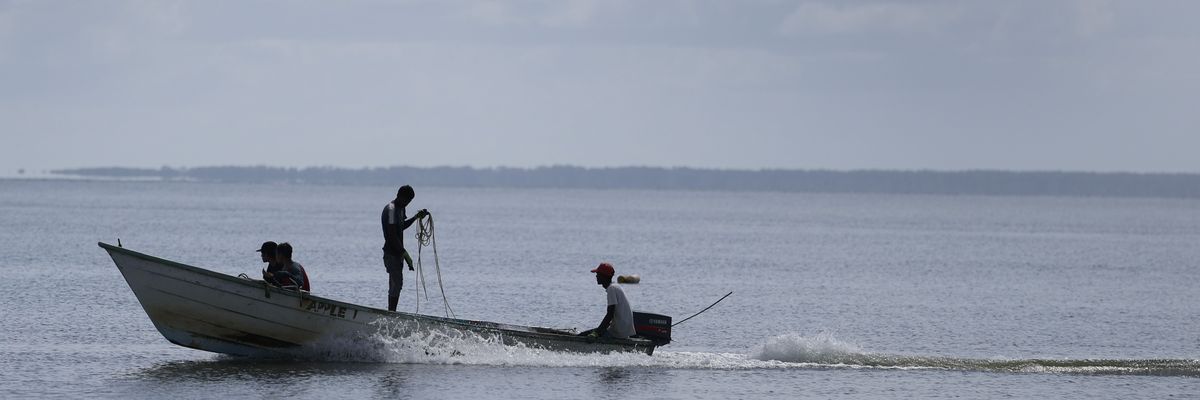
Fishermen work in the Gulf of Paria, an inlet of the Caribbean Sea, on November 06, 2025, in Icacos Point, Trinidad and Tobago. (Photo by Joe Raedle/Getty Images)
“We want this case to help stop these killings from taking place again,” said the American lawyer representing the family.
Family members of a Colombian fisherman killed in one of the Trump administration’s illegal strikes on boats in the Caribbean is preparing to take legal action over what they describe as the murder of their loved one.
The New York Timesreported Thursday that the family of Alejandro Carranza “has hired an American lawyer, who said he was preparing a legal claim.”
The lawyer, Dan Kovalik, told the Times that the impending case is important both because “the family deserves compensation for the loss” of Alejandro and, more broadly to stop the Trump administration from killing people with impunity.
“We want this case to help stop these killings from taking place again,” Kovalik said. “This is murder, and it is destroying rule of law.”
The description of Carranza’s killing as murder aligns with the views of United Nations experts and human rights advocates who have characterized the Trump administration’s bombings in international waters as extrajudicial killings. To date, the administration has carried out at least 19 strikes on vessels in international waters, killing an estimated 75-80 people in total.
“I never thought I would lose my father in this way,” said Cheila Carranza, Alejandro’s 14-year-old daughter.
Trump has claimed, without providing any evidence, that the targeted vessels were smuggling drugs to the US. Though his body has yet to be found, Carranza is believed to have been killed in an attack in the Caribbean on September 15, part of the Trump administration’s broader military campaign and buildup in the region that has sparked fears of a direct US war with Venezuela and other nations.
The attack infuriated Colombia President Gustavo Petro, who suspended intelligence cooperation with the US in response and accused the Trump administration of trampling international law.
“If intelligence communications only serve to kill fishermen with missiles, it is not only irrational, but a crime against humanity, insofar as the murder of civilians is systematic,” Petro wrote in a lengthy social media post earlier this week.
“Colombia respects international law and defends it because it is the only wall we have as a human civilization against the barbarism that threatens to take over all of humanity,” he added.
Donald Fuhrump says that Amerikkka doesn’t bother with crimes or charges anymore, not being 100% Amerikkkan and opposing his real estate intentions is enough.Orcas discuss how Trump was re-elected and him being an obviously insane, xenophobic Fascist.Orcas discuss Donald Trump and the killer apes’ concept of democracy. Front Orca warns that Trump is crashing his country’s economy and that everything he does he does for the fantastically wealthy.
People take part in a pro-government youth rally in Caracas, Venezuela, November 13, 2025
FEARS grew today of an imminent US attack on Venezuela as the superpower’s biggest warship, the USS Gerald R Ford aircraft carrier, arrived off the South American country’s coast.
Countries rarely in agreement all called for restraint, with Germany and Switzerland saying today they hoped the US and Venezuela could engage in talks, as Russia urged Washington not to take actions that risked destabilising the region.
“I believe it is in everyone’s interest to prevent another war from breaking out,” Swiss Foreign Minister Ignazio Cassis said.
The United States has built up its biggest military force in the Caribbean in decades, and killed at least 70 people in recent weeks in illegal strikes on boats it accuses of smuggling drugs.
On Thursday US Secretary for War Pete Hegseth declared the commencement of “Operation Southern Spear,” which he claimed was aimed at crushing the illegal drug trade. The US accuses Venezuela, without evidence, of masterminding the trafficking of drugs across US borders — a claim many believe is intended to justify a regime change operation against its socialist government. Venezuela has the world’s largest proven oil reserves.
Donald Fuhrump says that Amerikkka doesn’t bother with crimes or charges anymore, not being 100% Amerikkkan and opposing his real estate intentions is enough.Orcas discuss how Trump was re-elected and him being an obviously insane, xenophobic Fascist.Orcas discuss Donald Trump and the killer apes’ concept of democracy. Front Orca warns that Trump is crashing his country’s economy and that everything he does he does for the fantastically wealthy.





 People take part in a pro-government youth rally in Caracas, Venezuela, November 13, 2025