More on bees and Neonicotinoid pesticides

Read more about the article More on bees and Neonicotinoid pesticides
Black bees
Spread the love

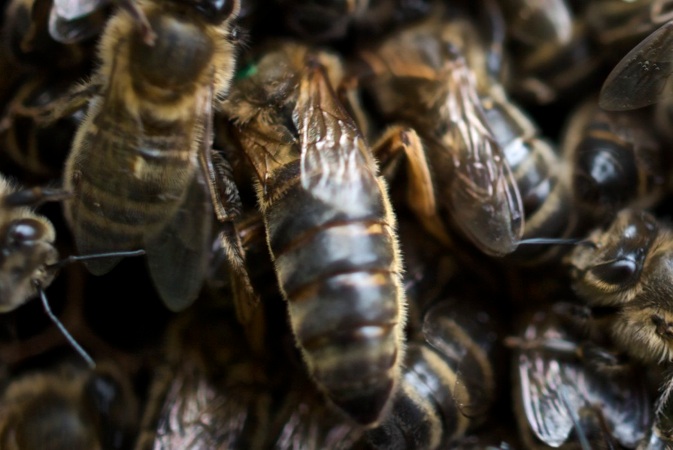
image of black bees

The Independent has a further article on bees and Neonicatinoid pesticides. I’ve looked for those “two independent studies carried out in the past two years” showing that “bees treated with imidacloprid … are far more susceptible to disease, even at microscopic doses.”Perhaps Mike or Phil could point them out?

In yesterday’s bee post I wrote “These pesticides are systemic meaning that the whole plant is affected. If bees are dying through contaminated nectar, us humans eat the whole fruit or vegetable and are at the very end of the food chain.” I’ve since realised that the normal precautions of washing or peeling fruit and vegetables would be ineffective.

Government asked to investigate new pesticide link to bee decline – Nature, Environment – The Independent

By Michael McCarthy, Environment Editor

The Government is being asked to investigate a possible link between a new generation of pesticides and the decline of honey bees. It is suspected that the chemicals may be impairing the insects’ ability to defend themselves against harmful parasites through grooming.

The Environment Secretary, Caroline Spelman, will have to answer a question in the Commons from the former Home Office minister David Hanson about whether the Government will investigate if the effect of neonicotinoids on the grooming behaviour of bees is similar to its effect on termites.

The pesticides, neonicotinoids, made by the German agribusiness giant Bayer and rapidly spreading in use, are known to be fatal to termites by damaging their ability to groom themselves and thus remove the spores of harmful fungi.

In a leaflet promoting an anti-termite insecticide, Premise 200SC, sold in Asia, the company says it is the direct effect on the insects’ grooming abilities of the neonicotinoid active ingredient, imidacloprid, which eventually kills them. Now bee campaigners in Britain want to know if this mechanism could also be at work on European honey bees and other pollinating insects which are rapidly declining in numbers.

“Grooming protects insects from all kinds of pests and viruses, while helping to maintain general health and functioning,” Ms Williams said yesterday. “A defence for honey bees against the varroa mite [a parasite causing colonies to decline] is to groom the mites away from the body. Do we know for sure that neonicotinoids do not hamper the ability of honey bees to deal with varroa?”

Matt Shardlow, chief executive of Buglife, the invertebrate conservation charity, said: “Scientific studies have shown that neonicotinoids significantly reduce the activity of honey bees, and it is highly likely that this would include a reduction in the amount of grooming that they do.

“Hence there is a clear potential mechanism for these pesticides to damage the first line of defence that insects have against disease. Again it seems clear that insecticides are linked to sickness in bees and impairment to pollination services.”

The possibility fits in with what has already been discovered about the harmful effects of neonicotinoids – in that bees treated with imidacloprid, which is Bayer’s biggest-selling insecticide worth £500m a year in sales to the company – are far more susceptible to disease, even at microscopic doses. This has been shown by two independent studies carried out in the past two years.

In its publicity material for Premise 200SC, Bayer says: “The termites are susceptible to disease caused by micro-organisms or fungi found in soil.

“A principal part of their defence system is their grooming habits, which allow the termites to get rid of the fungal spores before these spores germinate and cause disease or death. Premise 200SC interferes with this natural process by lowering defences to nature’s own weaponry.”

Dr Julian Little, Bayer’s UK spokesman, said: “We do a lot of tests of the effects of insecticides on bees, and impairment of grooming has never shown up.”

Specific tests to see whether or not bees’ grooming ability was impaired by neonicotinoids had not been carried out, he added.

Exclusive: Bees facing a poisoned spring – Nature, Environment – The Independent

Ban Neonicotinoid Pesticides to Save the Honeybee

Leaked document shows EPA allowed bee-toxic pesticide despite own scientists’ red flags | Grist

Top USDA bee researcher also found Bayer pesticide harmful to honeybees | Grist


27/11/13 Having received a takedown notice from the Independent newspaper for a different posting, I have reviewed this article which links to an article at the Independent’s website in order to attempt to ensure conformance with copyright laws.

I consider this posting to comply with copyright laws since
a. Only a small portion of the original article has been quoted satisfying the fair use criteria, and / or
b. This posting satisfies the requirements of a derivative work.

Please be assured that this blog is a non-commercial blog (weblog) which does not feature advertising and has not ever produced any income.

dizzy

Continue ReadingMore on bees and Neonicotinoid pesticides

Neonicotinoids and dying bees

Spread the love

image of black bees


The Independent has an article today about concern that Neonicatinoid pesticides are damaging the bee population. It says that Prof. Robert Watson, chief scientific advisor at the Department for Environment, Food and Rural Affairs (Defra) has initiated an inquiry.

Growing concern about the new generation of pesticides used on 2.5 million acres of UK farmland has led one of the Government’s most senior scientific advisers to order a review of the evidence used to justify their safety.

There are mounting fears around the world that the growing use of “neonicotinoid” pesticides, which work by poisoning the nervous system of insects, could explain why bees and other pollinating insects are in such dramatic decline in Britain, Europe and the United States, where the insecticide is widely used.

The official British government position has been that the insecticide is safe when used correctly – but Professor Robert Watson, the chief scientific adviser at the Department for Environment, Food and Rural Affairs (Defra), has now initiated his own inquiry, The Independent can reveal, because of concerns about the alleged effects on bees.

I would suggest that there is little doubt that Neonicotinoids are seriously killing honey bee populations. There is also the overlooked issue to human health. These pesticides are systemic meaning that the whole plant is affected. If bees are dying through contaminated nectar, us humans eat the whole fruit or vegetable and are at the very end of the food chain.


Pesticides linked to bee decline, say green groups | Environment | guardian.co.uk

New evidence that pesticide could be killing bees – Rob Edwards


27/11/13 Having received a takedown notice from the Independent newspaper for a different posting, I have reviewed this article which links to an article at the Independent’s website in order to attempt to ensure conformance with copyright laws.

I consider this posting to comply with copyright laws since
a. Only a small portion of the original article has been quoted satisfying the fair use criteria, and / or
b. This posting satisfies the requirements of a derivative work.

Please be assured that this blog is a non-commercial blog (weblog) which does not feature advertising and has not ever produced any income.

dizzy

Continue ReadingNeonicotinoids and dying bees

Spread the love

image of black honeybees

Exclusive: Bees facing a poisoned spring

New kind of pesticide, widely used in UK, may be helping to kill off the world’s honeybees

By Michael McCarthy, Environment Editor

A new generation of pesticides is making honeybees far more susceptible to disease, even at tiny doses, and may be a clue to the mysterious colony collapse disorder that has devastated bees across the world, the US government’s leading bee researcher has found. Yet the discovery has remained unpublished for nearly two years since it was made by the US Department of Agriculture’s Bee Research Laboratory.

The release of such a finding from the American government’s own bee lab would put a major question mark over the use of neonicotinoid insecticides – relatively new compounds which mimic the insect-killing properties of nicotine, and which are increasingly used on crops in the US, Britain and around the world.

Bayer, the German chemicals giant which developed the insecticides and makes most of them, insists that they are safe for bees if used properly, but they have already been widely linked to bee mortality. The US findings raise questions about the substance used in the bee lab’s experiment, imidacloprid, which was Bayer’s top-selling insecticide in 2009, earning the company £510m. The worry is that neonicotinoids, which are neurotoxins – that is, they attack the central nervous system – are also “systemic”, meaning they are taken up into every part of the plant which is treated with them, including the pollen and nectar. This means that bees and other pollinating insects can absorb them and carry them back to their hives or nests – even if they are not the insecticide’s target species.

Independent article continues

The Independent has a further good article on honeybees. Having discussed neonicotinoids with my Scientific Advisor we were wondering whether these neurotoxins – since they are systemic – remain in plant produce to affect humans. Logically, that would have to be the case…


27/11/13 Having received a takedown notice from the Independent newspaper for a different posting, I have reviewed this article which links to an article at the Independent’s website in order to attempt to ensure conformance with copyright laws.

I consider this posting to comply with copyright laws since
a. Only a small portion of the original article has been quoted satisfying the fair use criteria, and / or
b. This posting satisfies the requirements of a derivative work.

Please be assured that this blog is a non-commercial blog (weblog) which does not feature advertising and has not ever produced any income.

dizzy

Continue Reading

BBKA pesticide endorsement

Spread the love

image of black bees

A couple of articles in today’s Independent discuss the British Beekeepers Association’s shameless endorsement of bee-killing pesticides. It’s due to be debated this weekend at their conference at Stoneleigh.

Beekeepers fume at association’s endorsement of fatal insecticides

Britain’s beekeepers are at war over their association’s endorsement for money of four insecticides, all of them fatal to bees, made by major chemical companies.

The British Beekeepers’ Association has been selling its logo to four European pesticide producers and is believed to have received about £175,000 in return.

The active ingredient chemicals in the four pesticides the beekeepers endorsed are synthetic pyrethroids, which are among the most powerful of modern insect-killers.

Michael McCarthy: BBKA oligarchy has buried the truth in its cosy relationship with the pesticide lobby

The saga of the British Beekeepers’ Association (BBKA) and its long-term pesticide endorsements is quite extraordinary. For 10 years, the BBKA has been giving its official blessing to four insecticides as “bee-friendly” or “bee-safe” – for example, the May 2001 newsletter BBKA News referred to “the BBKA’s endorsement of Fury as a bee-safe product”, while another piece in August 2005 said “the products we endorse are bee-friendly when used properly”.

Yet the active ingredients of these products, as shown above, are among the most deadly substances for bees existing on the planet.


27/11/13 Having received a takedown notice from the Independent newspaper for a different posting, I have reviewed this article which links to an article at the Independent’s website in order to attempt to ensure conformance with copyright laws.

I consider this posting to comply with copyright laws since
a. Only a small portion of the original article has been quoted satisfying the fair use criteria, and / or
b. This posting satisfies the requirements of a derivative work.

Please be assured that this blog is a non-commercial blog (weblog) which does not feature advertising and has not ever produced any income.

dizzy

Continue ReadingBBKA pesticide endorsement