‘A National Outrage’: Days After Monsanto Ruling, Trump EPA Approves More Forever Chemical Pesticides

Spread the love

Article by Jessica Corbett republished from Common Dreams under Creative Commons (CC BY-NC-ND 3.0).

Supporters of the Make America Healthy Again movement are seen at a news conference at the Department of Health and Human Services headquarters in Washington, DC on April 22, 2025. (Photo by Nathan Posner/Anadolu via Getty Images)

Ripping “Trump’s reckless push to ignore science and embrace these extremely harmful, long-lasting pesticides,” one critic said his legacy will be the millions “his shortsighted policies will sicken and prematurely kill.”

The US Environmental Protection Agency on Tuesday continued its betrayal of President Donald Trump’s campaign promise to “Make America Healthy Again,” approving the use of multiple “forever chemical” pesticides on crops despite public health concerns.

Per- and polyfluoroalkyl substances (PFAS) are called forever chemicals because they don’t naturally break down—instead accumulating in human and animal bodies as well as the environment. They have been used in everything from fabrics for clothing and furniture to firefighting foam to nonstick cookware, and are tied to various health problems, including increased risk of some cancers.

RECOMMENDED…
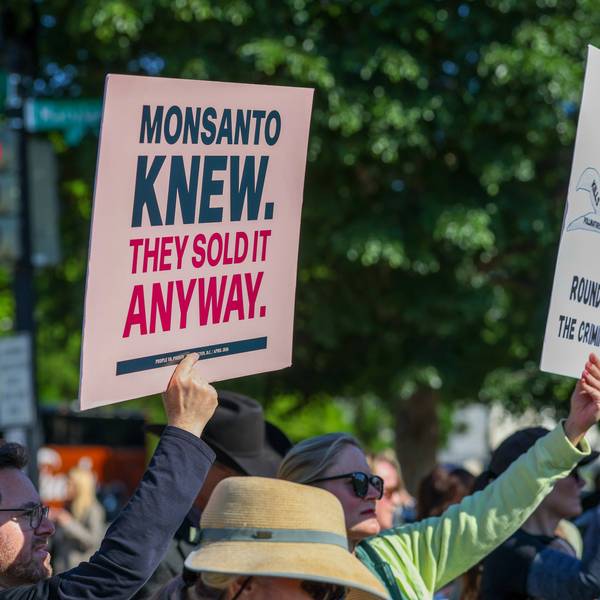
Rally Held As Supreme Court Hears Arguments For Monsanto v. Durnell

‘Trump’s Name Written All Over It’: Supreme Court Sides With Monsanto Over Roundup Cancer Victims

Zohran Mamdani jumps into a public pool

As Trump’s Reflecting Pool Disaster Turns ‘Dystopian,’ Fully-Dressed Mamdani Jumps Into NYC Public Pool With a Joyful Smile

The Trump EPA on Tuesday finalized its approval of using two PFAS pesticides, diflufenican and epyrifenacil, on corn and soybeans, the two most widely grown crops in the United States.

The agency also expanded its allowances for another previously approved forever chemical pesticide, bifenthrin, and greenlighted the first food use of chlormequat, a non-PFAS pesticide tied to reproductive issues.

“While the Biden administration had approved one PFAS pesticide in the prior four years, this is the third and fourth approval of a PFAS pesticide under Trump in just his second year in office,” the Center for Biological Diversity (CBD) noted in a Tuesday statement. “The previous two PFAS pesticide approvals were cyclobutrifluram and isocycloseram.”

As the center detailed:

The EPA has stated in press materials that these new fluorinated pesticides are not PFAS. That assertion is based on the fact that they do not meet the chemicals office’s unilateral regulatory PFAS definition. But the new pesticides do meet the much more widely accepted PFAS definition that was developed transparently by dozens of scientists around the world. That definition has subsequently been endorsed by more than 150 leading PFAS researchers, is used by nearly every US state for regulating PFAS, and specifically was written into past versions of the National Defense Authorization Act.

Using the scientific definition of a PFAS that is widely accepted in this country and around the world, these pesticides are PFAS.

The EPA had even initially acknowledged that these pesticides met the more broadly accepted PFAS definition on its fluorinated pesticides webpage. Yet three weeks after creating the webpage, it removed any mention of the conflicting definition, instead portraying the agency’s unilateral definition as the only PFAS definition.

Under the Freedom of Information Act, CBD obtained documents showing that those website revisions were overseen by EPA Office of Chemical Safety and Pollution Prevention’s assistant administrator, Douglas Troutman, and Kyle Kunkler—a former American Soybean Association (ASA) lobbyist controversially installed as the office’s deputy assistant administrator for pesticides—and reviewed by agency Administrator Lee Zeldin.

While ASA president and Ohio soybean farmer Scott Metzger welcomed the Tuesday approvals, saying that “we appreciate EPA Administrator Lee Zeldin and the agency” for advancing the registrations, Nathan Donley, CBD’s environmental health science director, was deeply critical and tied the developments to the Trump administration’s other actions serving the pesticide industry.

“It’s a national outrage that Trump’s EPA is expanding use of dangerous, cancer-linked PFAS pesticides just days after the Supreme Court limited the American people’s right to sue pesticide companies,” said Donley, referring to last week’s ruling in favor of Monsanto and against thousands of people who argue that its glyphosate-based weedkiller Roundup caused their cancer.

In addition to the Trump administration backing Bayer—which bought Monsanto in 2018—in the case before the high court, the president in February issued an executive order mandating the production of glyphosate. Since returning to office last year, Trump has also faced criticism for EPA approvals of other pesticides, from atrazine to dicamba, and for his administration’s MAHA report that echoes industry talking points.

Donley declared Tuesday that “Trump’s reckless push to ignore science and embrace these extremely harmful, long-lasting pesticides ensures his legacy won’t be the many monuments he’s built to himself, but the many millions of people his shortsighted policies will sicken and prematurely kill.”

Article by Jessica Corbett republished from Common Dreams under Creative Commons (CC BY-NC-ND 3.0).

Orcas discuss rotting brain, front Orca says disinhibition and swearing are typical and common symptoms
Continue Reading‘A National Outrage’: Days After Monsanto Ruling, Trump EPA Approves More Forever Chemical Pesticides

DDT2 George Monbiot on Neonicatinoid poisons

Spread the love

image of black bees
Black bees

George Monbiot has a very good article on Neonicatinoid poisoning being the nu DDT, our environment, government support support for such poisoning using discredited, flawed studies, etc. Strange that I missed it first time.

It’s the new DDT: a class of poisons licensed for widespread use before they had been properly tested, which are now ripping the natural world apart. And it’s another demonstration of the old truth that those who do not learn from history are destined to repeat it.

It is only now, when neonicotinoids are already the world’s most widely deployed insecticides, that we are beginning to understand how extensive their impacts are. Just as the manufacturers did for DDT, the corporations which make these toxins claimed that they were harmless to species other than the pests they targeted. Just as they did for DDT, they have threatened people who have raised concerns, published misleading claims and done all they can to bamboozle the public. And, as if to ensure that the story sticks to the old script, some governments have collaborated in this effort. Among the most culpable is the government of the United Kingdom.

As Professor Dave Goulson shows in his review of the impacts of these pesticides, we still know almost nothing about how most lifeforms are affected. But as the evidence has begun to accumulate, scientists have started discovering impacts across a vast range of wildlife.

Slightly later edit: The article is well worth reading and I should have quoted this section. (and it should be Neonicotinoid in the title.)

Most people who read this newspaper will be aware by now of the evidence fingering neonicotinoids as a major cause of the decline of bees and other pollinators. These pesticides can be applied to the seeds of crops, and they remain in the plant as it grows, killing the insects which eat it. The quantities required to destroy insect life are astonishingly small: by volume these poisons are 10,000 times as powerful as DDT. When honeybees are exposed to just 5 nanogrammes of neonicotinoids, half of them will die. As bees, hoverflies, butterflies, moths, beetles and other pollinators feed from the flowers of treated crops, they are, it seems, able to absorb enough of the pesticide to compromise their survival.

Continue ReadingDDT2 George Monbiot on Neonicatinoid poisons

UK & bee-killing pesticides

Spread the love

image of black bees
Black bees

My assessment of the current state of UK bees follows

MPs call for precautionary ban on pesticides linked to bee decline

Pressure on the government to impose a “precautionary moratorium” on three controversial pesticides linked to the decline of bee populations will crank up a notch today, with the publication of a new report from the Environmental Audit Committee (EAC) criticising ministers for their “extraordinarily complacent approach to protecting bees”.

The report calls on the government to impose a ban on imidacloprid, clothianidin and TMX, suspending their use on flowering crops attractive to pollinators. It also argues that with several of the UK’s largest garden retailers, including B&Q and Homebase, having voluntarily withdrawn neonicotinoids their shelves the government should impose a full ban on the sale of neonicotinoids for public domestic use, in order to create an “urban safe haven for pollinators”.

The report notes that France, Germany, Italy and Slovenia have already imposed partial bans on some neonicotinoids and criticises the government for opposing European Commission proposals for a full moratorium on imidacloprid, clothianidin and TMX on all crops attractive to bees.

“Defra seems to be taking an extraordinarily complacent approach to protecting bees given the vital free service that pollinators provide to our economy,” said EAC chair Joan Walley in a statement. “If farmers had to pollinate fruit and vegetables without the help of insects it would cost hundreds of millions of pounds and we would all be stung by rising food prices. Defra Ministers have refused to back EU efforts to protect pollinators and can’t even come up with a convincing plan to encourage bee-friendly farming in the UK.”

Environment Secretary Owen Paterson has argued that the benefits of any ban would outweigh the costs, [a mistake in editing?] insisting there is not yet sufficient evidence to impose restrictions on pesticides that are widely used across the agricultural industry.

But Walley confirmed that the EAC had reached an entirely different conclusion. “We believe that the weight of scientific evidence now warrants precautionary action, so we are calling for a moratorium on pesticides linked to bee decline to be introduced by 1 January next year,” she said. “This allows farmers to use treated seeds that have already been purchased for this growing season and gives Defra time to implement EU legislation on the sustainable use of pesticides.”

The report also criticises the behaviour of some chemicals companies, which have argued that there is not sufficient evidence of a link between the pesticides and declines in bee populations to justify a ban, but have failed to disclose full results from their research into the impact of the chemicals.

“Pesticide companies often try to pick holes in studies linking their products to bee decline, but when pushed to publish their own research and safety studies they hide behind claims of commercial sensitivity,” said Walley. “The industry must open itself to greater academic scrutiny if it wants to justify its continued opposition to the precautionary protection of pollinators.”

‘Flawed research’ leads to bee call

SCOTTISH ministers could today call on the UK government to consider a ban on pesticides linked to the deaths of billions of bees worldwide after a key environment watchdog branded official research into the issue “fundamentally flawed”.

The Scottish Government, which up until now has backed Westminster in opposing a ban on neonicotinoids, said it was now “urgently” reviewing the evidence in the light of the criticism from the UK parliament’s cross-party environmental audit committee.

Committee chair MP Joan Walley said members supported calls from the European Commission for a moratorium on using the controversial insecticides.

The UK government had commissioned a field study on bumblebees which failed to provide conclusive proof there was a major impact on the insects from the pesticides.

But the committee report concludes research was “fundamentally flawed” and should not be used as a reason for not taking action.

Environment Secretary Richard Lochhead last night said: “We will be reviewing this as a matter of urgency.

“If in light of this new advice the case for the EU’s precautionary measures is strong, then I would want the UK government to consider supporting this 
position.”

Current State of UK bees

So much rain last year prevented UK bees from building good stores of honey in preparation for winter.

The mild winter was hard on bees keeping them active and consuming their honey stores. A harder winter would have made less demands on stores.

The extended very cold spell this year is the third serious blow to bees. Even with sufficient stores, there was no pollen necessary to rear bees available.

Beekeepers are only starting to realise the damage sustained by bees over the winter as it now becomes warm enough for bees to start flying and to inspect hives. I expect bee colonies to have been decimated with survival over this winter in the region of 25 – 50%.

Continue ReadingUK & bee-killing pesticides

Pesticides kill bees

Spread the love

Neonicotinoid pesticides are shown to poison bees. While this study was concerned with bumblebees it is likely that the findings are also relevant to honeybees and similar insects.

The point about pesticides is that they are poisons. Neonicotinoid pesticides are systemic pesticides that affect the whole plant including nectar and pollen.

image of black bees
Black bees


Insecticide blamed for bee deaths by Stirling University study

Use of a specific group of insecticides is having a serious impact on bumblebee populations, according to a team of Scottish scientists.

The Stirling University researchers found exposure even to low levels of neonicotinoid pesticides had a serious impact on the health of bumblebees.

Bee populations have fallen sharply, and scientists say urgent action is needed to reverse the decline.

Of particular concern is an 85% drop in the number of queens.

That means 85% fewer nests in the following year.

The research found bumblebee colony growth slowed after exposure to the chemicals.

This may partly be to blame for colony collapse disorder, a mysterious phenomenon which has hit large numbers of hives in Europe and North America in recent years.

Professor Dave Goulson, who led the Stirling research, said: “Some bumblebee species have declined hugely. For example in North America, several bumblebee species which used to be common have more or less disappeared from the entire continent. In the UK, three species have gone extinct.

“Bumblebees pollinate many of our crops and wild flowers. The use of neonicotinoid pesticides on flowering crops clearly poses a threat to their health, and urgently needs to be re-evaluated.”

Continue ReadingPesticides kill bees

Sub-lethal effects of pesticides on honeybees

Spread the love

image of black bees
Black bees

I am uncertain about the claim to be the first research “to demonstrate the sub-lethal effects of pesticide residue exposure on honey bees” – I believe that there may be a growing body of research that demonstrates this.

Research expands understanding of bee health

Recently published research is the first to demonstrate the sub-lethal effects of pesticide residue exposure on honey bees, which play a critical role in the production of one third of the food that human’s consume.

The pesticides involved in Wu’s study include those used by beekeepers, growers and homeowners. They include miticides, insecticides, fungicides and herbicides. The accumulation occurs because beekeepers reuse combs to save on the expense of replacement.

Some of the consequences to honey bees that Wu found were delayed larval development and a shortened adult lifespan, which can result indirectly in premature shifts in hive roles and foraging activity.

Shortened bee lifespans dramatically change the dynamic of a hive. According to Sheppard, foragers are the bees that provide pollination and bring food back to a hive.

“A bee’s life span as a forager is on average only the last eight days of its life,” he said. “This research shows that, if raised with pesticide residues in the brood comb, an individual’s foraging life span is shortened by four days, a 50 percent cut.”

If there are not sufficient foragers, the colony makes up the deficit by using younger bees that are not physiologically ready. The result is a negative cascade through the hive all the way down to the larval bees because individual nurse bees must prematurely move toward foraging behavior and stop feeding larvae, Sheppard said.

Continue ReadingSub-lethal effects of pesticides on honeybees