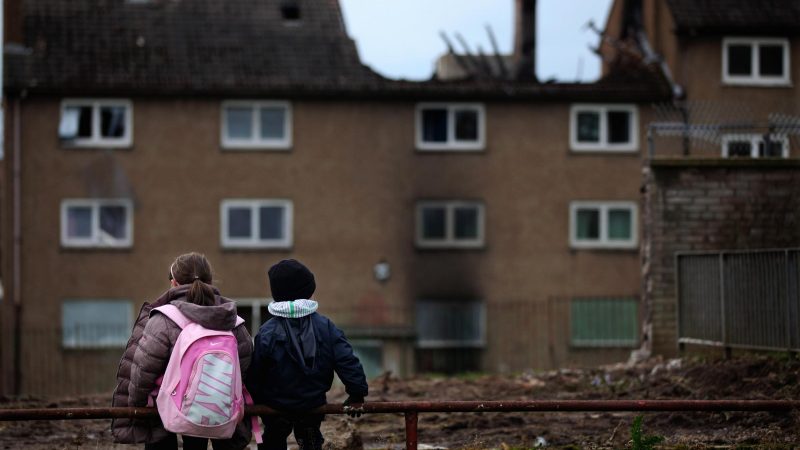
Shameful number of children getting to class too hungry to learn makes the case for universal free school meals
The ‘heartbreaking‘ rise of child poverty in the UK has been highlighted in a recent poll that revealed a shameful number of children going to school hungry in England.
Four in ten teachers said their students were showing up to class too hungry to learn, which rose to 63% in the poorest areas, a new poll by Teacher Tapp reported by the Mirror, found. For more than a fifth of teachers, the issue had become worse since September.
This has led to schools stepping in to address hunger where pupils don’t qualify for free school meals, with four in ten teachers saying their school is offering free school dinners to hungry children who don’t qualify. This rose to over half in the most deprived areas.
The poll has emphasised the argument made by campaigners that free school meals should be extended to all primary school pupils, as strict eligibility criteria means many children living in poverty miss out.
‘It is not right that anyone should need to use a food bank because they can’t afford to eat and pay bills. However, food bank need is at an historic high.’
On May 15, the Trussell Trust, the UK’s largest food bank charity and a leading voice on poverty and hunger, released its annual figures. In the last year, 3.1 million food parcels were distributed by their network, the most parcels the network has ever distributed in a single year. It is also a 94 percent increase in the total number of parcels distributed compared to five years ago.
Facing historic food bank need in 2024, the charity says this long-term pattern needs to change and is urging for urgent reform to Britain’s social security system.
In its General Election Manifesto, the Trussell Trust is calling on all political parties to commit to building a future where no one needs a food bank to survive. The charity asks for an Essential Guarantee into Universal credit to be introduced, that would protect people from going without essentials, such as food and bills. They urge for debt deductions from social security payments to be more affordable, and for there to be a long-term strategy and funding for local crisis support.
A record 145,800 children are now homeless in England, the government’s latest quarterly homelessness stats have shown, highlighting once more the sheer scale of the housing crisis in the country.
The number of children living in temporary accommodation is now at the highest ever level recorded and up 15% on last year.
Almost 320,000 households were assessed as homeless or at risk of homelessness – also a record high, while the number of households threatened with homelessness and owed a prevention duty because of a section 21 notice is the highest on record, at 25,910 over the last year. It was only last week that the government failed to set a date for banning section 21 no-fault eviction notices, which continue to have devastating impacts for low-income and vulnerable households up and down the country.
Reacting to the record figures, Matt Downie, chief executive at Crisis, said: “Today’s statistics need to be a wake-up call. We are failing to stop people being forced into homelessness and we are failing to help them back out. These are the appalling consequences of our failure to get a grip on this crisis.
We need to build a firewall between politicians and the oil and gas firms driving the climate crisis.
Richard Burgon is the Labour MP for Leeds East
The same oil and gas giants behind the record energy bills that have forced so many into poverty have also brought us to the cliff edge of climate catastrophe.
If we are to have a fighting chance of preventing the worst of the climate crisis, then we need to rapidly cut fossil fuel use. Key to that is breaking the vast power that oil and gas companies have over our politics.
That’s why this week I will present a Bill in the House of Commons to ban MPs from receiving funding or any other benefit from oil and gas companies.
My Private Members Bill would stop MPs from taking any second jobs with, or receiving any donations, gifts, hospitality or benefits-in-kind from, any company that makes more than 50% of its annual revenue from oil or gas.
It would also force the Government to end investments by the Parliamentary Contributory Pension Fund in any oil and gas companies.
The aim of my Bill is simple: to build a firewall between our political decision-makers and the oil and gas corporations that have knowingly caused the climate crisis.
For decades, oil and gas giants used their vast financial power to confuse and undermine the science about the role of fossil fuels in driving climate change. More recently, their focus has moved on throwing huge sums at delaying, blocking and weakening global climate action.
Fossil fuel money also pollutes British politics. The Tory Party received £3.5m from donors with fossil fuel, polluter and climate denial links in 2022 according to an analysis of Electoral Commission records by DeSmog, an investigative website focused on global warming misinformation campaigns.
dizzy: Despite this article having been written by a Labour MP it should not be assumed that the UK Labour Party will be any different from the Conservatives on the climate crisis or fossil fuel industry.
EIGHT million people are at risk of ill-health caused by substandard housing that is putting “enormous strain” on an overstretched NHS, a coalition of charities warned today.
Nine charities are backing a national Safe Homes Now campaign, demanding an end to the “scandal” of 3.7 million “dangerous” homes “that pose significant risk to inhabitants’ health” in both the private rented and owner-occupied sectors.
The charities said the “hidden housing crisis” included shocking conditions such as rat infestation, damp, leaks and mould on children’s bedding.
They said that grant support for home repairs has been slashed by more than £2 billion over the past decade, preventing the repair of 600,000 homes.
And they highlighted that 2.2 million owner-occupied homes were now defined as “unsafe” — double the number in the private rented sector.
A survey by campaign founder the Centre for Better Ageing revealed increasing problems with heating costs and home maintenance bills.
The nine charities, including St John Ambulance, Race Equality Foundation and children’s charity Barnardo’s, are calling for a “national strategy to tackle the poor quality of the country’s homes” that includes halving the number of unsafe homes within the next decade to improve the nation’s health.