Tag: Reform 2025 Ltd (Reform UK)

  • Racism never went away – it simply changed shape

    Spread the love
    ‘We are winning’, claims politician Enoch Powell to students at York University in 1969 following his notorious ‘rivers of blood’ speech. Alamy/PA Images

    Lars Cornelissen, Manchester Metropolitan University; Independent Social Research Foundation

    Prime Minister Keir Starmer thinks that racism is returning to British society. He has accused Nigel Farage’s Reform UK of sowing “toxic division” with its “racist rhetoric”.

    Starmer’s comments follow a trend that has seen senior Labour party officials portray their political opponents on the far-right as sowing division with racist rhetoric.

    Recently, Wes Streeting, the Labour health secretary, warned that an “ugly” racism is on the rise again, pointing to worrying figures showing an increase of race-based abuse of NHS staff.

    And in October, senior Labour officials attacked Farage’s plans to strip millions of legal migrants of their Indefinite Leave to Remain status as a racist policy. Home Secretary Shabana Mahmood said that Farage’s plans sounded like a “very loud dog whistle to every racist in the country”.

    Labour officials portray the rise in racist incidents and rhetoric as the return of attitudes that had all but disappeared from British society. Streeting expressed his worry that “1970s, 1980s-style racism has apparently become permissible again in this country”. Starmer similarly stated that “frankly I thought we had dealt with” the problem of racist abuse “decades ago”.

    This is an appealing story because it conveys a neat and simple message: racism was defeated decades ago and it is now being revived by racist agitators. But in truth, the history of post-war racism is much more complex.

    In my new book, I investigate how ideas of race and racism have changed since the second world war. History shows that racism never disappeared from public life. Rather, it assumed different shapes, some of which are harder to discern than others.

    The experience of fascism

    The defeat of Nazism in 1945 marked a key moment in the history of racism. Prior to the second world war, ideas of racial difference and even racial hierarchy were firmly entrenched in elite society.

    In Victorian Britain, for example, a belief in the racial superiority of Europeans was decisive to maintaining colonial rule across large parts of central and east Asia, Africa, and the Caribbean. This sentiment was famously captured in Rudyard Kipling’s 1899 poem, The White Man’s Burden, which depicted colonial rule as the moral duty of white nations.


    The Insights section is committed to high-quality longform journalism. Our editors work with academics from many different backgrounds who are tackling a wide range of societal and scientific challenges.


    Likewise, pseudosciences like eugenics and physical anthropology enjoyed significant prestige among British elites well into the 20th century. The British Eugenics Society, dedicated to improving the genetic stock of the British population, flourished in the interwar period. At this time the eugenics movement was an ideological broad church, appealing to progressive as much as conservative elites.

    But the second world war irrevocably changed this landscape. The experience of fascism made it clear for all to see just how dangerous the concept of racial superiority was. Ideas of racial purity, racial hierarchy, and eugenics had driven the Nazis to commit genocide. It had led to a world war that many experienced as a straightforward conflict between good and evil.

    At the same time, anti-colonial movements were gaining momentum all over the world. In south-east Asia, Africa, and the Caribbean, there emerged powerful critiques of European colonialism and the racist views that supported it. Some of these critiques linked fascism to colonialism, arguing that Nazism represented the “boomerang effect” of colonial violence curving back onto the people of Europe.

    The great sociologist W.E.B. Du Bois worded this view powerfully in 1947:

    There was no Nazi atrocity – concentration camps, wholesale maiming and murder, defilement of women or ghastly blasphemy of childhood – which Christian civilization or Europe had not long been practicing against colored folk in all parts of the world in the name of and for the defense of a Superior Race born to rule the world [sic].
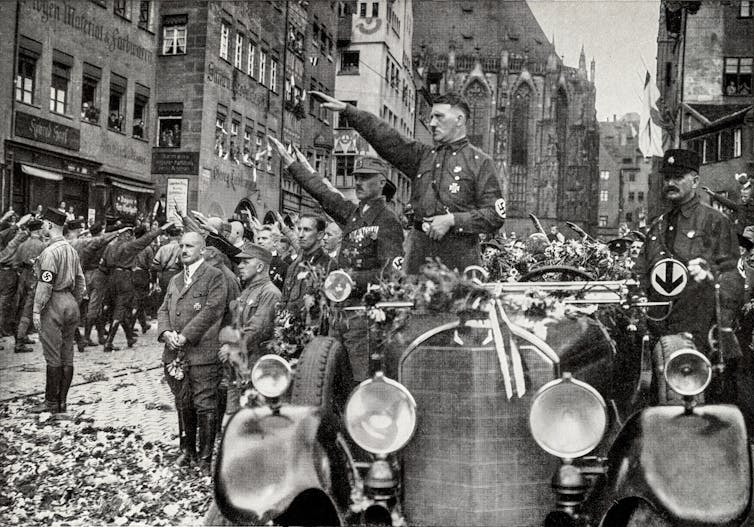
    Adolf Hitler gives the Nazi salute from his car.
    Adolf Hitler on the third day of the Nazi party conference Nuremberg, Germany, in 1929. Shutterstock/Andreas Wolochow

    The cumulative effect of these experiences was that ideas of racial superiority came to be seen an unscientific relic of the past.

    Squashing ‘scientific racism’

    This was exemplified by the United Nations, which in November of 1945 established Unesco (United Nations Educational, Scientific and Cultural Organisation) with the explicit aim of battling racism. Unesco’s constitution, adopted on November 16 of that year, drew a direct connection between racism and the second world war:

    The great and terrible war which has now ended was a war made possible by the denial of the democratic principles of the dignity, equality and mutual respect of men, and by the propagation, in their place, through ignorance and prejudice, of the doctrine of the inequality of men and races.

    In 1949, Unesco appointed a panel of prominent scientists to formulate a critique of scientific racism. Reporting in 1950, the panel concluded that there is no scientific basis for any claims of racial superiority of one group over another. As the panel wrote, “the likenesses among men are far greater than their differences”.

    While a small number of academics remained committed to race science and eugenics, they were forced into the margins of the academic world. The Eugenics Society, though it continued to exist, lost much of its prestige.

    Going forward, race science or political appeals to racial superiority were no longer deemed acceptable, even among ruling elites. The language of race lost the scientific legitimacy and political purchase it once had.

    This did not mean that racism disappeared, however. Rather, it changed shape.

    Immigration and culture

    Explicit appeals to race remained politically unacceptable for many decades after the war. This forced intellectuals and politicians on the right, especially those with divisive views about racial and ethnic differences, to develop an alternative language in which to express their ideas.

    In Britain, one such language crystallised in the 1960s. During this period, tensions grew over the number of migrants coming to Britain from Commonwealth countries. Migration from former colonial areas had been on the rise in preceding years, made possible by the 1948 British Nationality Act, which conferred citizenship on all former imperial subjects.

    The backlash against these migration trends was exemplified by Enoch Powell, a Conservative MP and former Minister of Health. In the late 1960s, Powell developed a vocal critique of immigration numbers.

    Powell’s rhetoric was inflammatory and racially charged. In his infamous ‘Rivers of Blood’ speech, delivered in 1968 in Birmingham, Powell claimed that unless immigration was restricted, people of colour would soon have “the whip hand over the white man”. In another speech, from 1970, Powell complained that it was no longer politically acceptable to say that “the English are a white nation”.

    Powell made no appeal to the idea of biological difference. Instead, his emphasis was on cultural difference. He claimed that migrants and white British people were culturally too dissimilar for assimilation to be possible in large numbers.

    Powell’s speeches on immigration cost him his political career. He was dismissed from the Shadow Cabinet following his “Rivers of Blood” comments. Yet his views were soon echoed by other political figures.

    In 1976, Ivor Stanbrook, a Conservative MP, said in the House of Commons: “Let there be no beating about the bush. The average coloured immigrant has a different culture, a different religion and a different language. That is what creates the problem.”

    And in 1978, Margaret Thatcher said in a TV interview that British “people are really rather afraid that this country might be rather swamped by people with a different culture”. Migration was a threat to Britain’s national identity.

    Thatcher added: “We are a British nation with British characteristics. Every country can take some small minorities and in many ways they add to the richness and variety of this country. The moment the minority threatens to become a big one, people get frightened.”

    In the 1979 general election, which Thatcher won with a landslide, the Conservative party manifesto pledged to tighten immigration controls and restrict citizenship. This pledge was enacted in 1981.

    The denial of racism

    The rhetoric of people like Powell, Stanbrook, and Thatcher represented a new kind of racial vocabulary. What is striking about this rhetoric is that it pretended not to concern race at all. Each of them explicitly denied that their rhetoric appealed to racist sentiment.

    Powell often distanced his critique of immigration from concerns over race. In a 1970 interview, Powell said:

    I’m not talking about race at all. I am talking about those differences, some of which are related to race, between the members of different nations which make the assimilation of the members of one nation into another nation more difficult or less difficult.

    Stanbrook also denied that his comments about “coloured immigrants” were racist. In a parliamentary debate, he insisted that to highlight problems with cultural integration “is not racialism, if by that one means, as I do, an active hostility to another race”. This was because, in his view, “a preference for one’s own race is as natural as a preference for one’s own family”. A dislike of immigration, therefore, is not based on racist animosity. “It is simply human nature,” Stanbrook added.

    Even Thatcher complained that whenever she tried to address concerns about immigration she was “falsely accused of racial prejudice” by her political opponents. She claimed that because mainstream political parties were not willing to talk about immigration, voters were instead turning to the far-right National Front. “If we do not want people to go to extremes, and I do not, we ourselves must talk about this problem and we must show that we are prepared to deal with it,” she said.

    These denials of racism indicate that during this period, the language of race itself remained socially unacceptable. Powell, Stanbrook and Thatcher all felt the need to distance themselves from it.

    This helps to explain why they preferred to focus on ideas of cultural difference and national identity. These ideas did not carry the same negative connotations as race, yet could be used to convey a similar message – namely that some groups did not belong in Britain.

    Researchers have called these ideas “cultural racism”. This is a form of racism that discriminates between groups on the basis of cultural or religious traditions rather than biological traits.

    Though it can be harder to pin down, cultural racism can be just as harmful to marginalised groups.

    Normalisation of racist rhetoric

    The rise of inflammatory rhetoric surrounding immigration in the 1960s and 70s had an immediate impact on policy. During this period, successive governments responded to the growing clamour over immigration by selectively tightening migration controls and nationality legislation.

    However, this rhetoric has also had a more gradual, long-term effect on racism’s place in society. Powell’s and Thatcher’s views on immigration have been echoed again and again, often framed in the same vocabulary. This continues to this day.

    Last month, Katie Lam, the shadow home office minister, appeared to argue that Ukrainian and Gazan refugees should be treated differently because the former are better able to assimilate to British culture, as well as being more likely to go back to rebuild their country of origin.

    And earlier this month, nationalist writer and academic Matthew Goodwin, who is formally linked to Reform, wrote in his personal newsletter that the “cultures that our hapless politicians are now importing into our country at speed are not just radically different and incompatible to our own; they are inferior, primitive, stuck in cultural codes and practices we moved on from centuries ago”.

    Over time, public debate on immigration has soured, and dehumanising language has become more commonplace. In 2015, The Sun columnist Katie Hopkins compared migrants to “cockroaches”, while Farage refers to migration as a “flood”.

    In 2022, the then home secretary Suella Braverman spoke of an “invasion” of Channel migrants, directly echoing Thatcher’s rhetoric 50 years earlier. Strikingly, again echoing Thatcher, Braverman also denies that her anti-immigration rhetoric is racist. Instead, she describes the word “racist” as a “slur” used by the left “to silence debate”.

    The gradual normalisation of this kind of rhetoric has allowed it to re-enter mainstream public discourse. This has caused the erosion of the anti-racist norms established in the wake of the second world war. For many years after the war, these social norms meant that public figures who expressed views that were considered racist paid a high social or professional cost. Powell’s dismissal from the shadow cabinet following his Rivers of Blood speech is a forceful example of this.

    Today, these anti-racist norms are under increasing pressure. To be sure, they have not fully disappeared. In recent years, anti-racist movements like the Black Lives Matter have enjoyed broad popular support in Britain and elsewhere.

    Likewise, officials who express inflammatory rhetoric can still expect to be challenged. Politicians including Starmer, Robert Jenrick and Katie Lam have recently been met with criticism for divisive comments or policies on race, migration, and culture.

    Starmer, for instance, was criticised for saying that migration numbers are turning Britain into an “island of strangers”. This comment was likened to Powell’s rhetoric on immigration, who also said that immigration left Britons feeling like “strangers in their own country”. When confronted with criticism, Starmer said he deeply regretted using that phrase.

    Meanwhile, Farage has faced pressure to distance himself from racist comments he is alleged to have made in the past – allegations which he has strongly denied.

    Yet, the prospect of a politician being dismissed from a cabinet role for racially inflammatory comments is very remote today. Neither Jenrick nor Lam has been dismissed from the shadow cabinet for their comments, with Conservative Party leader Kemi Badenoch expressly defending Jenrick.

    More worryingly, on the fringes of public debate, the erosion of anti-racist norms has created conditions in which racist rhetoric can flourish. Researchers have shown that on online platforms like X (formerly Twitter) and Parler, racist abuse has sharply increased in recent years. Under the ownership of Elon Musk, himself notorious for his right-wing views, X has systematically amplified right-wing messaging.

    In some circles, racist rhetoric not only receives little to no challenge but is actively incentivised. Far-right groups constitute a lucrative market for racist ideas. Authors expressing right-wing ideas, for example English nationalist Tommy Robinson, have access to large speaker circuits, podcasts, digital publishers, and many other markets.

    Even in academia, recent years have seen a resurgence in race theory and eugenics. While mostly restricted to fringe groups, some authors have been able to publish work with prestigious university presses admiring the ideas of Francis Galton – the man who has been called the “father of eugenics”.

    Hiding in plain sight

    Various forms of racism persist. Today, cultural racism is the most widespread and politically consequential kind. Derogatory and stereotyped views on cultural differences and national identity are now an everyday feature of public discourse, especially in debates over immigration.

    Yet cultural racism remains poorly understood. In most media reporting and political discourse, the term “racism” continues to refer primarily to individual prejudice based on outward appearance or group belonging. When Streeting talks about “1970s, 1980s-style racism” he specifically means “abuse based on people’s skin colour”.

    While it is undeniably a good thing that racist abuse is being vocally challenged by politicians, this narrow definition of racism obscures as much as it reveals. It fails to challenge forms of racism that do not appeal to physical traits but to cultural traditions. And it gives political agitators intent on sowing division on themes like immigration the opportunity to deflect criticism by denying that their ideas are racist.

    Similarly, the notion that racism was already dealt with “decades ago”, in Starmer’s words, ignores the fact that racism never went away. It also downplays the extent to which the harm of past racism lives on in the present in structural issues like wealth and income gaps, uneven access to work or housing, unequal health outcomes, and police profiling.

    To tackle racism, a widening of focus is needed. Our conception of racism cannot be restricted to instances of individual prejudice but must also include these structural effects.

    At the structural level, racism causes certain individuals or communities to be more vulnerable to violence, exclusion, marginalisation, poverty, and other harmful outcomes on the basis of their membership of a particular racial, cultural, or religious group. Rhetoric that intensifies this vulnerability feeds racism, even when it is not expressed in the language of “race” or when there is no prejudicial intent.

    So long as these structural factors are not taken into consideration, more subtle forms of racism will continue to hide in plain sight and exert a corrosive influence on the health and wellbeing of those it targets.


    For you: more from our Insights series:

    To hear about new Insights articles, join the hundreds of thousands of people who value The Conversation’s evidence-based news. Subscribe to our newsletter.

    Lars Cornelissen, Lecturer in Politics, Manchester Metropolitan University; Independent Social Research Foundation

    This article is republished from The Conversation under a Creative Commons license. Read the original article.

    Elon Musk urges you to be a Fascist like him, says that you can ignore facts and reality then.
    Elon Musk urges you to be a Fascist like him, says that you can ignore facts and reality then.
    A parody ‘Tesla – The Swasticar’ advert posted at a London bus stop. Photograph: People vs Elon
    A parody ‘Tesla – The Swasticar’ advert posted at a London bus stop. Photograph: People vs Elon
    Keir Starmer refuses to be outcnuted by Nigel Farage's chasing the racist bigot vote.
    Keir Starmer refuses to be outcnuted by Nigel Farage’s chasing the racist bigot vote.

    dizzy: I tend to regard racism and misogyny as inherent and necessary to Capitalism, part of the divide and rule strategy providing an implied differentiation and continuum of perceived statuses. “No dogs, blacks or Irish”. It’s so ridiculously stupid and obviously transparent really.

    I sometimes experience racism as a Welshman in England and as a perceived Englishman in Wales. It must be strange when I say the odd Welsh phrase “Diolch yn fawr” (most Welsh people will recognise and understand that). FM,(*1) an Englishman who’s learned Welsh, what’s the World coming to?

    Strange hypocrisy that these Labour politicians can so readily condemn racism while supporting the explicitly racist and genocidal Israel apartheid regime …

    *1

    Orcas discuss the formation of UK's new Socialist party and ask if the killer apes have finally come to their senses.
    Orcas discuss the formation of UK’s new Socialist party and ask if the killer apes have finally come to their senses.

  • Zarah Sultana: ‘We must fight, we must unite, we must win’

    Spread the love

    Original article republished from Socialist Worker

    Zarah Sultana spoke to Socialist Worker ahead of the Your Party conference

    ‘Your Party must be explicitly socialist, anti-imperialist and anti-Zionist—and also as maximally democratic,’ she told Socialist Worker

    Zarah Sultana issued a rallying call for the left to unite and fight ahead of the Your Party founding conference in Liverpool this weekend.

    She told Socialist Worker, “Labour is plummeting in the polls because this government has failed the working class.

    “It has failed to help people here at home—and it has alienated thousands if not millions by materially participating in the genocide in Gaza.

    “Reform UK is exploiting that anger, but it’s just the establishment in disguise.

    “Farage scapegoats migrants to distract from his neoliberal economic agenda.

    “We have a duty to offer a real alternative. Your Party must be explicitly socialist, anti-imperialist and anti-Zionist—and also as maximally democratic.

    “We must build a party robust enough to take on entrenched power and win.

    “No more tinkering at the edges—we need to reconstruct our society from first principles. We need socialism.

    “History will not forgive us if we fail to capitalise on this moment. The options are socialism or barbarism.

    “We must fight, we must unite and we must win.”

    Orcas discuss the formation of UK's new Socialist party and ask if the killer apes have finally come to their senses.
    Orcas discuss the formation of UK’s new Socialist party and ask if the killer apes have finally come to their senses.
  • Climate activists slam lack of a meaningful deal at Cop30

    Spread the love

    https://morningstaronline.co.uk/article/climate-activists-slam-lack-meaningful-deal-cop30

     Indigenous activists participate in a climate protest during the COP30 U.N. Climate Summit, November 17, 2025, in Belem, Brazil

    CLIMATE activists slammed the lack of a meaningful deal as the United Nations Cop30 climate talks in Belem, Brazil, came to a close on Saturday.

    The negotiators pledged more funding for countries to adapt to extreme weather. But the catch-all agreement doesn’t include explicit details to phase out fossil fuels or strengthen countries’ inadequate emissions-cutting plans, which dozens of nations demanded.

    After the deal was approved, Cop30 president Andre Correa do Lago said that the tough discussions will continue under Brazil’s leadership until the next annual conference “even if they are not reflected in this text we just approved.”

    UN secretary-general Antonio Guterres said the deal shows “that nations can still come together to confront the defining challenges no country can solve alone.”

    He said: “I cannot pretend that Cop30 has delivered everything that is needed. The gap between where we are and what science demands remains dangerously wide.”

    Amnesty International slammed the deal, accusing the leaders of placing “profit over people” and saying it lacked “accountability and transparency.”

    Amnesty said that “the final document avoided any mention of fossil fuels, the primary driver of climate change, failing to build on or even to reaffirm the commitment to ‘transition away’ from fossil fuels agreed upon in Cop28.

    “A record number of fossil fuel lobbyists at Cop30 showed who had the real access, leaving humanity, especially those already the most marginalised, to suffer the deadly consequences of their plans to continue fossil fuel expansion and to be the ones to pump the last barrel of oil,” said Amnesty climate justice adviser Ann Harrison.  

    The Elders group of former world leaders said: “Cop30 didn’t deliver the results needed. Major emitters have blocked a roadmap to phase out fossil fuels.”

    …

    Continues at https://morningstaronline.co.uk/article/climate-activists-slam-lack-meaningful-deal-cop30

    Orcas discuss Donald Trump and the killer apes' concept of democracy. Front Orca warns that Trump is crashing his country's economy and that everything he does he does for the fantastically wealthy.
    Orcas discuss Donald Trump and the killer apes’ concept of democracy. Front Orca warns that Trump is crashing his country’s economy and that everything he does he does for the fantastically wealthy.
    Donald Trump urges you to be a Climate Science denier like him. He says that he makes millions and millions for destroying the planet, Burn, Baby, Burn and Flood, Baby, Flood.
    Donald Trump urges you to be a Climate Science denier like him. He says that he makes millions and millions for destroying the planet, Burn, Baby, Burn and Flood, Baby, Flood.
    Nigel Farage urges you to ignore facts and reality and be a climate science denier like him and his Deputy Richard Tice. He says that Reform UK has received £Millions and £Millions from the fossil fuel industry to promote climate denial and destroy the planet.
    Nigel Farage urges you to ignore facts and reality and be a climate science denier like him and his Deputy Richard Tice. He says that Reform UK has received £Millions and £Millions from the fossil fuel industry to promote climate denial and destroy the planet.
  • UK Labour to Let Authorities Take Jewelry From Asylum-Seekers as Part of Sweeping New Immigration Crackdown

    Spread the love

    Original article by Stephen Prager republished from Common Dreams under Creative Commons (CC BY-NC-ND 3.0). 

    Protesters hold their banners, placards, and flags while they block the road during an anti-fascist counterprotest against a far-right anti-immigration protest on October 5, 2025, outside the Acacia Court in Faversham, UK. (Photo by Krisztian Elek/SOPA Images/LightRocket via Getty Images)

    “Labour won’t redistribute wealth from billionaires,” said former party Leader Jeremy Corbyn. “But they will seize belongings from those fleeing war and persecution.”

    A new asylum policy announced Monday by the UK Labour Party will allow authorities to confiscate the jewelry and other belongings of asylum-seekers in order to pay for their claims to be processed.

    The policy, which some critics said was “reminiscent of the Nazi era,” was just one part of the Labour Party’s total overhaul of the nation’s asylum system, which it says must be made much more restrictive in order to fend off rising support for the far-right.

    In a policy paper released Monday, the government announced that it would seek to make the status of many refugees temporary and gave the government new powers to deport refugees if it determines it to be safe. It also revoked policies requiring the government to provide housing and legal support to those fleeing persecution, while extending the amount of time they need to wait for permanent residency to 20 years, up from just five, for those who arrive illegally.

    The UK government also said it will attempt to change the way judges interpret human rights law to more seamlessly carry out deportations, including stopping immigrants from using their rights to family life under the European Convention on Human Rights (ECHR) to avoid deportation.

    In an article for the Guardian published Sunday, UK Home Secretary Shabana Mahmood called the reforms “the most significant and comprehensive changes to our asylum system in a generation.” She said they were necessary because the increase in migration to the UK had stirred up “dark forces” in the country that are “seeking to turn that anger into hate.”

    Nigel Farage, the leader of the far-right Reform UK Party, is leading national polls on the back of a viciously anti-immigrant campaign that has included calls to abolish the UK’s main pathway for immigrants to become permanent residents, known as “leave to remain.”

    Meanwhile, in September, over 100,000 people gathered in London for an anti-immigrant rally led by Tommy Robinson, a notorious far-right figure who founded the anti-Muslim English Defence League (EDL). The event saw at least 26 police officers injured by protesters.

    Last summer, riots swept the UK after false claims—spread by Robinson, Farage, and other far-right figures—that the perpetrator of the fatal stabbing of two young girls and their caretaker had been a Muslim asylum-seeker. A hotel housing asylum-seekers was set on fire, mosques were vandalised and destroyed, and several immigrants and other racial minorities were brutally beaten.

    Mahmood said that if changes are not made to the asylum system, “we risk losing popular consent for having an asylum system at all.”

    But as critics were quick to point out, the far-right merely took Labour’s crackdown as a sign that it is winning the war for hearts and minds.

    Robinson gloated to his followers that “the Overton window has been obliterated, well done patriots!” while Farage chortled that Mahmood “sounds like a Reform supporter.”

    Many members of the Labour coalition expressed outrage at their ostensibly Liberal Party’s bending to the far-right.

    “The government should be ashamed that its migration policies are being cheered on by Tommy Robinson and Reform,” said Nadia Whittome, the Labour MP for Nottingham East. “Instead of standing up to anti-migrant hate, this is laying the foundations for the far-right.”

    In a speech in Parliament, she chided the home secretary’s policy overhaul, calling it “dystopian.”

    “It’s shameful that a Labour government is ripping up the rights and protections of people who have endured unimaginable trauma,” she said. “Is this how we’d want to be treated if we were fleeing for our lives? Of course not.”

    The UK has signed treaties, including the ECHR, obligating it to process the claims of those who claim asylum because they face persecution in their home countries based on race, religion, nationality, group membership, or political opinion. According to data from the Home Office, over 111,000 people claimed asylum in the year from June 2024-25, more than double the number who did in 2019.

    The spike came as the number of people displaced worldwide reached an all-time high of over 123.2 million at the end of 2024, according to the Norwegian Refugee Council, with desperate people seeking safety from escalating conflicts in Sudan, Ukraine, Myanmar, the Democratic Republic of Congo, and across the Middle East.

    In her op-ed, Mahmood lamented that “the burden borne by taxpayers has been unfair.” However, as progressive commentator Owen Jones pointed out, the UK takes in far fewer asylum-seekers than its peers: “Last year, Germany took over twice as many asylum-seekers as the UK. France, Italy, and Spain took 1.5 times as many. Per capita, we take fewer than most EU countries. Poorer countries such as Greece take proportionately more than we do.”

    The Labour government, led by Prime Minister Keir Starmer, already boasts that it has deported more than 50,000 people in the UK illegally since it came to power in 2024, but it has predictably done little to satiate the far-right, which has only continued to gain momentum in polls despite the crackdown.

    Under the new rules, it is expected that the government will be able to fast-track many more deportations, particularly of families with children.

    The jewelry rule, meanwhile, has become a potent symbol of how the Labour Party has shifted away from its promises of economic egalitarianism toward austerity and punishment of the most vulnerable.

    “Labour won’t redistribute wealth from billionaires,” said former party leader Jeremy Corbyn, who is now an independent MP. “But they will seize belongings from those fleeing war and persecution.”

    Original article by Stephen Prager republished from Common Dreams under Creative Commons (CC BY-NC-ND 3.0). 

    Keir Starmer refuses to be outcnuted by Nigel Farage's chasing the racist bigot vote.
    Keir Starmer refuses to be outcnuted by Nigel Farage’s chasing the racist bigot vote.
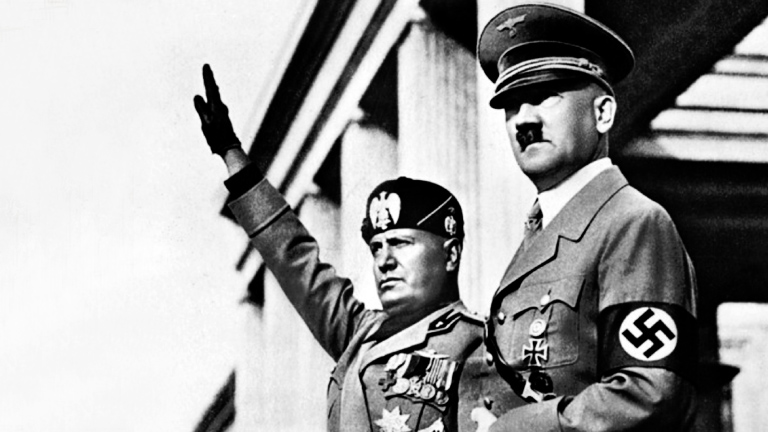
    Image of the original Fascists Mussolini and Hitler.
    The original Fascists Mussolini and Hitler
    Climate science denier Nigel Farage explains that it's simple to blame asylum-seekers or Muslims for everything.
    Climate science denier Nigel Farage explains that it’s simple to blame asylum-seekers or Muslims for everything.
  • ‘Little to No Measurable Progress’ on Climate as World on Track for 2.6°C: Report

    Spread the love

    Original article by Olivia Rosane republished from Common Dreams under Creative Commons (CC BY-NC-ND 3.0). 

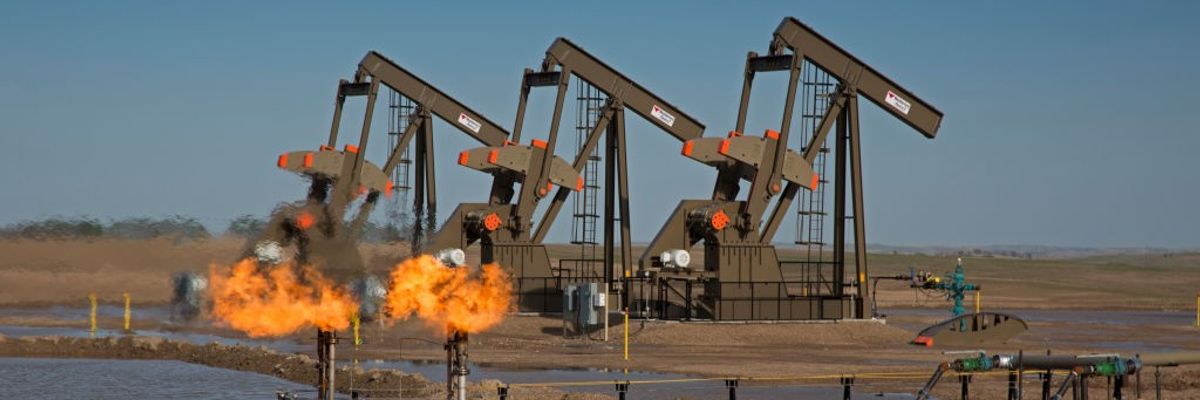
    Natural gas is flared off as oil is pumped in the Bakken shale formation in Watford City, North Dakota. (Photo by Jim West/UCG/Universal Images Group via Getty Images)

    “Without rapid, deep emissions cuts—over 50% by 2030—overshooting 1.5°C becomes ever more likely, with severe consequences for people and ecosystems,” one expert said.

    Despite new national policies submitted ahead of the United Nations COP30 climate conference in Belém, Brazil, the world remains on track for a disastrous 2.6°C of fossil fuel-driven warming, according to an annual analysis released on Thursday.

    Climate Action Tracker (CAT) said the 2025 report marked the fourth year in a row in which there had been “little to no measurable progress” in its warming predictions for 2100 based on the current policies and commitments of 40 countries.

    “The world is running out of time to avoid a dangerous overshoot of the 1.5°C limit,” Climate Analytics CEO Bill Hare said in a statement. “Delayed action has already led to higher cumulative emissions, and new evidence suggests the climate system may be more sensitive than previously thought. Without rapid, deep emissions cuts—over 50% by 2030—overshooting 1.5°C becomes ever more likely, with severe consequences for people and ecosystems.”

    Under the Paris Agreement, countries are required to submit nationally determined contributions (NDCs) every five years outlining their plans to slash greenhouse gas emissions and adapt to the impacts of the climate crisis. However, CAT found that nearly none of the 40 countries it analyzed had updated their 2030 NDCs or announced sufficiently ambitious 2035 NDCs ahead of COP30, which began on Monday. This means that the projected warming based on 2030 and 2035 targets remained at 2.6°C above preindustrial levels.

    “We have said it before, and we will keep saying it: We are running out of time.”

    “A world at 2.6°C means global disaster,” Hare told The Guardian, adding that it would likely trigger key tipping points such as the death of coral reefs, the transformation of the Amazon rainforest into grassland, the destabilizing of ice sheets, and the collapse of the Atlantic Meridional Overturning Circulation.

    “That all means the end of agriculture in the UK and across Europe, drought and monsoon failure in Asia and Africa, lethal heat and humidity,” Hare explained. “This is not a good place to be. You want to stay away from that.”

    CAT also made temperature projections based on existing policies and actions; pledges and targets, including binding long-term targets; and an optimistic scenario including net-zero targets. In 2025, the temperature projection for existing policies dropped from 2.7°C to 2.6°C, mostly due to a change in methodology, and the “optimistic scenario” remained the same at 1.9°C. However, the “pledges and targets” projection increased from 2.1°C to 2.2°C, predominately due to President Donald Trump’s decision to withdraw the US from the Paris Agreement.

    Other major carbon polluters China and the European Union did not update their plans with the ambition required to meet the Paris goals.

    The analysis comes a week after the UN Environment Programme released its Emissions Gap Report, which found that NDCs put the world on track for 2.3-2.5°C of warming, while current policies put it on track for 2.8°C.

    Overall, CAT blamed the lack of progress on the continued growth of fossil fuel production and use. It noted that several major countries had continued to expand fossil fuels, from India, China, and Indonesia building more coal plants to Japan and Saudi Arabia championing gas as a “bridge fuel.”

    “Worst of all,” the report authors wrote, “the United States is actively shutting down offshore wind projects, rolling back renewable energy incentives, cutting curbs on carbon pollution, and actively expanding oil and gas production.”

    However, despite their grim projections, CAT did see hope in the massive rollout of renewable energy, which generated more power than coal for the first time in 2025.

    “While not at the pace needed, our analysis shows that the Paris Agreement works,” said Niklas Höhne, of CAT partner the NewClimate Institute, in a statement.

    Höhne continued:

    Back in 2015, our current policies scenario led to 3.6°C of warming by 2100. Today, 10 years later, our latest projections show that this has been reduced by roughly 1°C to around 2.6°C. The Paris Agreement has rewritten the rules of global climate action—sparking investment, innovation, and reforms that would simply not have happened without it.

    But governments need to speed up the pace now. Although emissions have risen, the exponential pace of the renewable energy expansion allows us to now reduce emissions much faster than previously thought. Governments can strengthen or overachieve 2030 targets, implement robust policies, and ensure transparency and accountability to deliver on the Paris Agreement promise and safeguard a sustainable future.

    The faster governments act, the faster they can close the “targets gap” between current emissions and how far they have to fall to keep the 1.5°C goal within reach. This gap is expected to grown by as many as 2 billion metric tons between 2030 and 2035 alone.

    CAT said that current research indicates that implementing the most ambitious policies could limit peak warming to 1.7°C. This could be achieved by reaching net-zero carbon dioxide emissions before 2050, reaching net-zero greenhouse gas emissions in the 2060s, and removing carbon dioxide from the atmosphere. Under this scenario, global temperatures would return to below 1.5°C by the end of the century.

    “We have said it before, and we will keep saying it: We are running out of time,” said report lead author Sofia Gonzales-Zuñiga.

    “Every new fossil gas deal the EU makes, every new coal plant built in China, every fossil gas expansion project in Australia, every exported barrel from Norway, every tonne of LNG Japan pushes into neighboring Asian countries, costs billions to people elsewhere in the world as they deal with increasingly extreme weather events,” Gonzales-Zuñiga continued. “These are not abstract policy choices—they are physical realities with human consequences. The atmosphere does not negotiate, and it does not wait.”

    Original article by Olivia Rosane republished from Common Dreams under Creative Commons (CC BY-NC-ND 3.0). 

    Orcas comment on killer apes destroying the planet by continuing to burn fossil fuels.
    Orcas comment on killer apes destroying the planet by continuing to burn fossil fuels.
    Donald Trump urges you to be a Climate Science denier like him. He says that he makes millions and millions for destroying the planet, Burn, Baby, Burn and Flood, Baby, Flood.
    Donald Trump urges you to be a Climate Science denier like him. He says that he makes millions and millions for destroying the planet, Burn, Baby, Burn and Flood, Baby, Flood.
    Nigel Farage urges you to ignore facts and reality and be a climate science denier like him and his Deputy Richard Tice. He says that Reform UK has received £Millions and £Millions from the fossil fuel industry to promote climate denial and destroy the planet.
    Nigel Farage urges you to ignore facts and reality and be a climate science denier like him and his Deputy Richard Tice. He says that Reform UK has received £Millions and £Millions from the fossil fuel industry to promote climate denial and destroy the planet.