Reform UK has suspended one of its councillors while the party investigates him over alleged online comments about wanting to kill Keir Starmer.
The suspension came after the party was presented with details indicating that John Allen, a Reform UK Northumberland county councillor, had posted comments online about wanting to shoot the prime minister.
Nigel Farage, the party’s leader, last week challenged police to arrest social media users who he said had been using TikTok to call for him to be shot.
Reform was presented with details of the alleged comments after an investigation by the antifascist group Hope Not Hate.
A Reform UK spokesperson said on Friday: “Cllr Allen has been suspended pending investigation.”
Allen, who is also an appointee to the Northumbria police and crime panel and sits on a number of committees, neither confirmed nor denied that he was behind the YouTube account @johnallen7807 when he was asked by the Guardian.
That account has made repeated calls for Starmer to be killed. In recent years, it has posted comments indicating it is likely to be Allen’s account, such as an announcement last month that the handle user had been elected to Northumberland county council for Reform.
…
Nigel Farage explains the politics of Reform UK: Racism, Fake anti-establishmentism, Deregulation, Corporatism, Climate Change Denial, Mysogyny and Transphobia.Nigel Farage urges you to ignore facts and reality and be a climate science denier like him. He says that Reform UK has received millions and millions from the fossil fuel industry to promote climate denial and destroy the planet.
People taking part in a Tommy Robinson-led Unite the Kingdom march and rally in Trafalgar Square, central London, September 13, 2025
WELL over 100,000 people gathered in London last weekend under the banner of “Tommy Robinson” — actually Stephen Yaxley-Lennon — a notorious and violent fascist and grifter, with several criminal convictions.
…
The racist core of Robinson’s support is a small minority in most communities, and its attempt to stir up violence generally falls flat.
Saturday’s rally was actually called not to protest about the arrival of asylum-seekers on our shores, the issue which Reform’s Nigel Farage had been majoring on all summer. Its main theme was, ostensibly, “free speech.”
And underlying it was certainly an expression of popular powerlessness and national decline, sentiments which powered the Brexit vote in 2016 but which have only been exacerbated since, since the assertion of sovereignty does not in itself guarantee that it will be wielded to any good effect.
…
In reality, the left has always focused on winning arguments rather than banning contrary views, but it needs to double down on that approach today as part of the general defence of democracy.
The particular argument it urgently needs to prevail in today is the responsibility for the national malaise affecting so many areas of ordinary people’s lives. It is not down to the impoverished refugees arriving by boat.
It is down to the ruling class and the global super-rich, seen fawning on the leader of the far right internationally, Donald Trump, in Windsor Castle this week.
It is they who have spent 15 years slashing living standards to protect profits, who squeeze public services dry to promote private interests, and who slash support for the neediest the better to fund their imperialist aggression abroad.
What Farage and Robinson are doing is, in large part, a manoeuvre of deflection. Farage is himself a very wealthy Thatcherite, while Robinson is the well-funded plaything of the multibillionaire manchild Elon Musk. Their populist demagogy is just a mask.
Climate science denier Nigel Farage explains that it’s simple to blame asylum-seekers or Muslims for everything.Keir Starmer refuses to be outcnuted by Nigel Farage’s chasing the racist bigot vote.Elon Musk urges you to be a Fascist like him, says that you can ignore facts and reality then.
People take part in a Stand Up to Racism protest in Epping, Essex, entitled Defend Refugees – Stop the Far Right – No to Fascist Tommy Robinson, following protests outside the former Bell Hotel in Epping, July 27, 2025
…
The far right will not be beaten unless its racism is challenged: Labour echoes it.
It will not be beaten either unless we offer different answers to people’s accurate perception that Britain is becoming a run-down, ramshackle country of enfeebled services, collapsing infrastructure and falling living standards. Labour clings to Thatcherite orthodoxies on privatisation, unfettered banks and all-powerful markets long after the public have seen through the rip-off.
The right have the wind in their sails because their narrative, that immigration is the main cause of this country’s ills, has been allowed to crowd out others. We need public campaigning on the real issues: the cost of living, the council cuts. The NHS: where a Trump trade deal forcing up medicine prices is ideal ground to battle a far right that idolises him.
As these arguments are not being made by Labour, they need to be made by others.
Climate science denier Nigel Farage explains that it’s simple to blame asylum-seekers or Muslims for everything.Elon Musk urges you to be a Fascist like him, says that you can ignore facts and reality then.
People take part in a Stand Up to Racism protest in Epping, Essex, July 27, 2025
LEFT MPs Zarah Sultana and Diane Abbott and senior trade unionists will lead thousands of counterprotesters’s “far-right festival of hate” in London on Saturday.
A thousand people attended an online event to launch the Women Against the Far Right campaign on Thursday night, in the run-up to the march organised by Stand Up To Racism, with hundreds from the campaign set to join the march.
Ms Abbott, who is currently suspended from the Labour Party, said: “The far right are a menace to the whole of society.
“Their first targets, asylum-seekers and Muslims, are broadening to all migrants, black people and on to trade unionists, all religious minorities and anti-racists. They must be stopped.”
Ms Sultana said: “The far right are not welcome on our streets. We see through their lies.
“Their politics of hate and division make our communities weaker and women less safe.
“That’s why thousands of us are marching on Saturday — to show that fascists will be met with resistance wherever they spread their poison.”
Climate science denier Nigel Farage explains that it’s simple to blame asylum-seekers or Muslims for everything.Elon Musk urges you to be a Fascist like him, says that you can ignore facts and reality then.
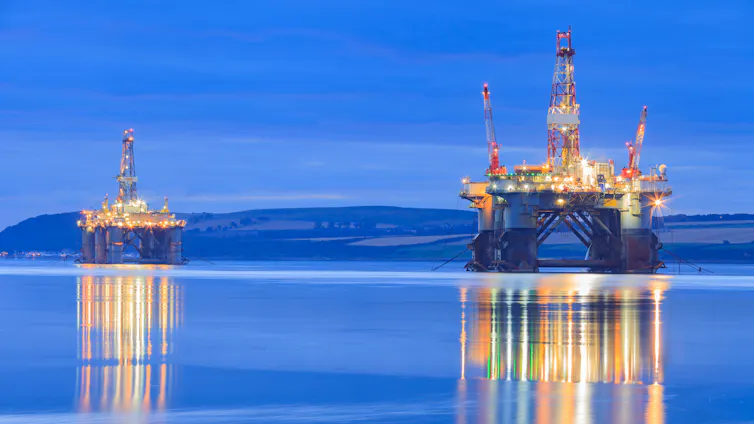
“We are going to get all our oil and gas out of the North Sea”, Conservative Party leader Kemi Badenoch said recently. Her promise to “maximise extraction” sets up a clash between political ambitions, economic reality and geological limits.
Reform UK has also said drilling for more oil and gas in the North Sea would be a “day one” priority. But even if the Conservatives or Reform were to be elected and lifted the current moratorium on new exploration licenses, there might not be the promised prizes of oil and gas under the seabed – or enough appetite from investors – to deliver on that promise.
BP, in those days British Petroleum, first extracted gas from under the North Sea in 1967. It marked the start of what was to become, for decades, one of the most valuable sectors of the UK economy, with more than 400 separate oil and gas fields developed to date.
But production peaked in 1999 and the North Sea now produces less than half as much as in its heyday.
It is now a “mature” basin: most of the biggest and easiest-to-develop fields have already been discovered and depleted. What remains are smaller, sometimes more remote, and often more technically challenging or expensive resources and reserves.
This is typical of ageing oil and gas provinces, where production declines even as operating costs rise. New projects must compete with oil and gas extracted from other parts of the world where it is easier and cheaper and more appealing to investors.
Finding oil and gas
Historically, only one in eight exploration wells in the North Sea led to a field producing oil and gas. That ratio has improved: between 2008 and 2017, a bit more than one in four wells led to a commercial success.
But far fewer wells are being drilled today. Even with the advances in technology, such as improved geophysical imaging which allows us to better define opportunities ahead of drilling, the big discoveries were probably made decades ago.
UK exploration wells vs offshore fields by year:
The number of exploration wells is down hugely from its peak in the 1980s and early 90s. Mark Ireland / NSTA
The UK government’s North Sea Transition Authority estimates there could still be around 3.5 billion barrels of oil equivalent in more than 400 undeveloped prospects. But most of these potential fields are small, isolated or technically complex. Developing them will require high oil and gas prices, fiscal stability, and a lot of investor confidence.
Politics vs geology
Even if a future government relaxes exploration licensing rules, geology will remain the bigger constraint. The North Sea is simply not as cheap as it was, and global fossil fuel giants have many other options. It is currently far cheaper to produce oil and gas in other regions, the Middle East or North Africa for example. Projects in these countries are all competing for the same capital.
Volatility in the energy sector will continue to make investors cautious. The 2015 oil price crash cut activity in the UK sector to its lowest level in decades, and it has never fully recovered. As fossil fuels are sold on the global market, political volatility, international and national, can lead to rapid shifts in investor confidence.
In the UK the introduction of a windfall tax in 2023 and changing requirements for environmental impact assessments are all making decision making on long-term projects riskier. And while the UK still needs considerable volumes of gas in future (and more modest amounts of oil) both are declining as our energy system evolves and renewable energy expand.
The UK’s mix of economic uncertainty, mature geology and smaller discoveries will make it harder to attract major international energy firms.
The future of the North Sea
That doesn’t mean the North Sea has finished as a source of oil and gas. For instance, undeveloped discoveries – where oil or gas has been confirmed but not yet produced – represent a lower-risk opportunity. But returns may be modest as many are relatively small and isolated from existing infrastructure.
New exploration licenses, if issued, might extend production modestly, but they are unlikely to deliver another game-changing discovery.
Some analysts argue that future licensing should be highly strategic, limited to projects with clear economic importance or climate compatibility. That approach could reduce reliance on imported gas, which tends to be more carbon-intensive than gas produced domestically. This would certainly make more sense than restarting fracking. But it would still not recreate the industry’s heyday.
Easy oil is over
The North Sea will still produce oil and gas for years to come, but its role will shrink. Even with friendlier policies, the era of big discoveries and rapid growth isn’t coming back.
Maximising extraction may sound appealing to politicians, but geology, economics and climate commitments all point to the North Sea’s best oil and gas days being behind it. The real challenge now is managing the investment during decline while investing in the cleaner solutions that will replace it.
UK Conservative Party leader Kemi ‘not a genocide’ Badenoch explains her reality that the Earth is flat, the Moon is made of cheese and that she was born from
Unicorn horn dust


 People taking part in a Tommy Robinson-led Unite the Kingdom march and rally in Trafalgar Square, central London, September 13, 2025