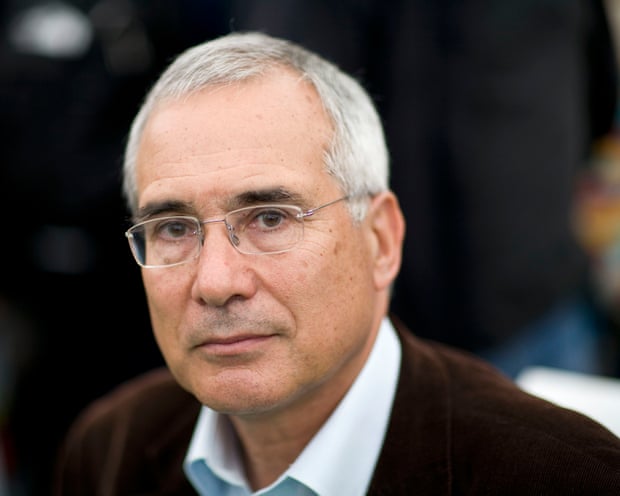
Nicholas Stern, pictured, led a review that concluded climate action would cost less than the damage caused by inaction. Photograph: David Levenson/Getty Images
Lord Stern says fossil-fuelled growth is futile as the damage it causes ends in economic self-destruction
Investment in climate action is the economic growth story of the 21st century, while growth fuelled by fossil fuels is futile because the damage it causes ends in self-destruction, the economist Nicholas Stern has said.
The plummeting costs of clean technologies, from renewable energy to electric cars, plus the healthier and more productive societies they enable, meant investments could simultaneously tackle the climate crisis and faltering economic growth, and bring millions of people out of poverty, he said.
This requires big changes in policies and levels of investment and Stern, at the London School of Economics, acknowledged that the geopolitical environment was currently difficult but he said making the rational argument was vital. The US president, Donald Trump, recently called climate change a “con job” and is backing fossil fuel companies to “drill, baby, drill”.
“I’d say to Trump: ‘You’ve got children and grandchildren – think about the science, think about the risks,’ and I’d give examples about the wildfires in California,” said Stern. “I’d point out to him that his place in Florida is going to be extremely vulnerable to more intense hurricanes, sea level rise and storm surges. The people and places he loves are under severe risk.
Neo-Fascist Climate Science Denier Donald Trump says Burn, Baby, Burn.Orcas comment on killer apes destroying the planet by continuing to burn fossil fuels.Nigel Farage urges you to ignore facts and reality and be a climate science denier like him and his Deputy Richard Tice. He says that Reform UK has received £Millions and £Millions from the fossil fuel industry to promote climate denial and destroy the planet.
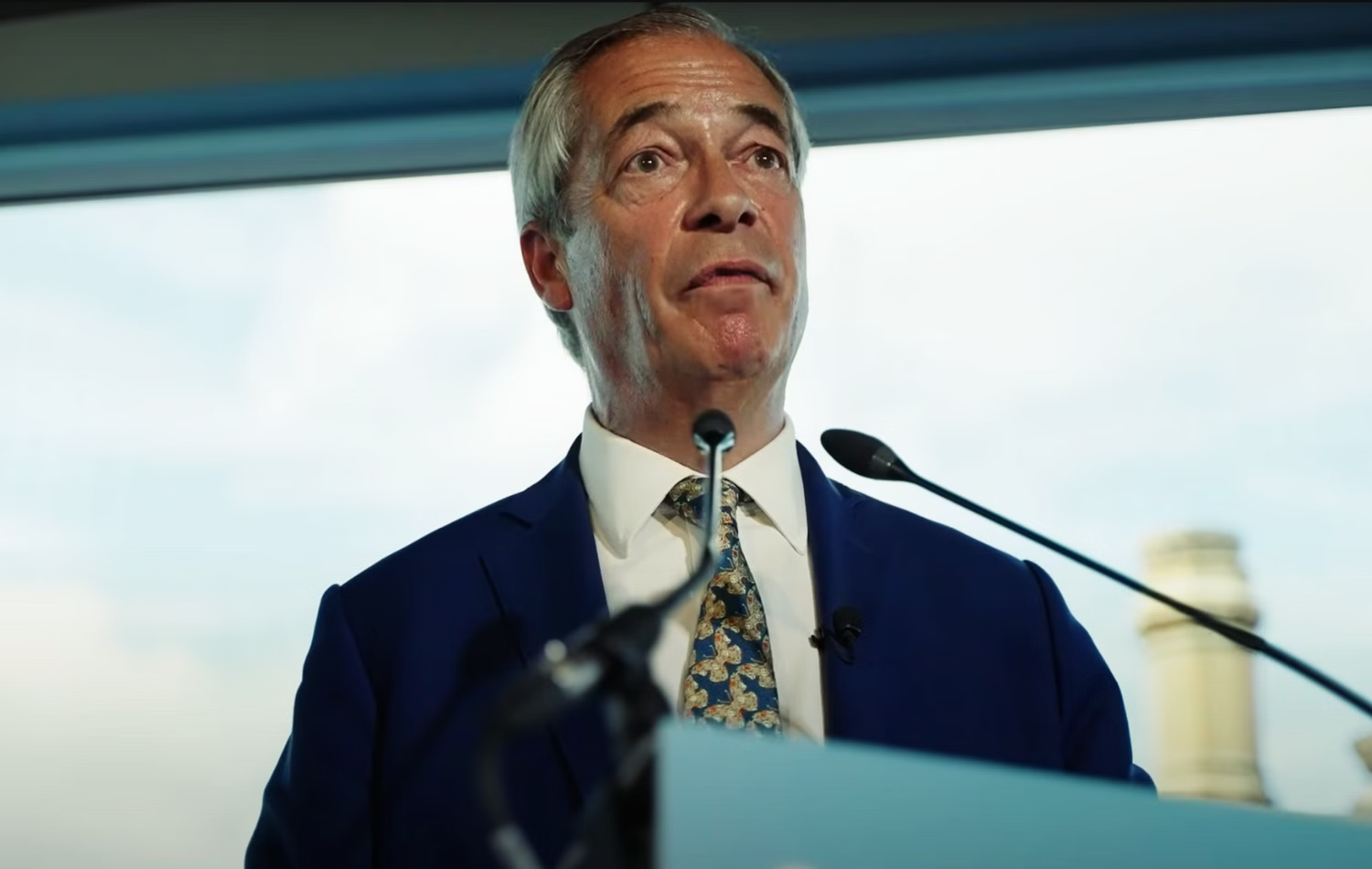
Reform UK leader Nigel Farage speaking in Aberdeen. Credit: Reform UK / YouTube
Nigel Farage’s party was told by Offshore Energies UK to rethink its plan to thwart clean energy.
LIVERPOOL – The UK’s largest oil and gas trade body has criticised Reform UK’s plans to “turn off the tap” on renewable energy.
Nigel Farage’s party has tried to present itself as the oil and gas industry’s closest ally, vowing to “drill, baby, drill” in the North Sea and scrap the windfall tax on excess profits, while meeting with oil executives, and courting donations from the sector.
However, on a panel at the Labour Party’s annual conference in Liverpool on Monday (29 September), a spokesperson for Offshore Energies UK (OEUK) criticised Reform’s plans to end state support for clean energy.
Natalie Coupar, communications and marketing director at OEUK – members of which include fossil fuel giants BP, Shell, ExxonMobil, TotalEnergies, and Equinor – said the group is “apolitical” but gives “hard truths to all parties”.
She said: “One of the things we’ve been saying to Reform very much is, you know, if you’re going to turn on the taps for oil and gas, there’s almost really no point if you’re just going to turn off the taps to renewables.
“That doesn’t help. We need to keep both those streams open.”
According to the Confederation of British Industry (CBI), the UK’s net zero economy grew by 10 percent in 2024, employing almost a million people in full-time jobs.
Coupar also said it was essential to “hold the consensus on tackling climate change and growing our energy future”.
A panel at 2025 Labour Party conference sponsored by Offshore Energies UK (OEUK). Credit: DeSmog
Reform’s Oil Campaign
Reform has vowed to stop all government subsidies for renewable energy, and has pledged to block solar and onshore wind farms in the local authorities it controls.
In May, the party’s deputy leader Richard Ticesaid: “Whether it’s planning blockages, whether it’s judicial reviews, whether it’s lawsuits, whether it’s health and safety notices, we will use every available legal measure to an extreme way in order to frustrate these people.”
Tice – who has said “there’s no evidence that man-made CO2 is going to change the climate” – met with senior oil executives in May and promised to approve new drilling licences “on day one” of a Reform government.
Last month, he pledged to overturn the UK’s ban on fracking for shale gas, which he calls “treasure beneath our feet”, and told the industry to “get ready”.
In April, Reform party treasurer and a billionaire property developer Nick Candy said he was trying to secure donations from oil and gas executives, claiming to have raised £100,000 from one, though this has yet to appear on Reform’s donations register.
As DeSmog has reported, 92 percent of Reform’s funding between the 2019 and 2024 general elections came from climate science deniers or those with highly polluting interests – a total of £2.3 million.
Since his election as an MP last year, Farage has spoken at a string of events in the U.S. organised by radical groups backing U.S. President Donald Trump’s pro-fossil fuel agenda. Last December, Farage launched the UK-EU branch of the Heartland Institute, a U.S. climate denial think tank.
Speaking at the Alliance for Responsible Citizenship conference in London in February, Farage claimed it was “absolutely nuts” for CO2 to be considered to a pollutant. However, he added: “I’m not a scientist. I can’t tell you whether CO2 is leading to warming or not, but there are so many other massive factors.”
Climate scientists at the UN’s Intergovernmental Panel on Climate Change (IPCC), the world’s leading climate science body, have stressed that “it is a statement of fact, we cannot be any more certain; it is unequivocal and indisputable that humans are warming the planet”.
Nigel Farage urges you to ignore facts and reality and be a climate science denier like him and his Deputy Richard Tice. He says that Reform UK has received £Millions and £Millions from the fossil fuel industry to promote climate denial and destroy the planet.Elon Musk urges you to be a Fascist like him, says that you can ignore facts and reality then.Nigel Farage reminds you that he’s the man that brought you Brexit and asks what could possibly go wrong.
Nigel Farage meets members of the public during campaigning in Caerphilly, south Wales. Photograph: Ben Birchall/PA
Farage said he was shocked by Nathan Gill’s admissions relating to pro-Russia statements
Nigel Farage has insisted his party’s former leader in Wales who was convicted of taking pro-Russian bribes was a “bad apple” who betrayed him.
The Reform UK leader was in Caerphilly campaigning for his candidate in a forthcoming Senedd byelection when he was asked about his links to Nathan Gill.
Gill, who led Reform UK in Wales in 2021, last month admitted taking bribes to make statements in favour of Vladimir Putin’s Russia while he was a member of the European parliament.
His activities were said to include making pro-Russian statements about events in Ukraine in the European parliament and in opinion pieces to news outlets.
Questioned by reporters before walking through Caerphilly town centre, Farage said he was shocked by Gill’s admissions. He said: “Any political party can find in their midst all sorts of terrible people.
…
Gill, 52, pleaded guilty last month to eight counts of bribery between 6 December 2018 and 18 July 2019.
He was leader of Reform UK Wales from March to May 2021.
Nigel Farage urges you to ignore facts and reality and be a climate science denier like him. He says that Reform UK has received £Millions and £Millions from the fossil fuel industry to promote climate denial and destroy the planet.Orcas discuss how Trump was re-elected and him being an obviously insane, xenophobic Fascist.Nigel Farage reminds you that he’s the man that brought you Brexit and asks what could possibly go wrong.
The BBC’s decision to scrap a planned Zack Polanski interview on the channel’s flagship Laura Kuenssberg show has caused fury within the Green Party
The BBC’s decision to cancel a planned conference interview with new Green leader Zack Polanski on the Laura Kuenssberg show on Sunday has caused fury within the party.
As I report today for Byline Times, the decision to scrap the interview came after the show also refused to have him on last month, following his election as party leader, choosing to instead invite Nigel Farage.
Green party sources are particularly furious with the reason they were given for this week’s cancellation, which is that the show needed more time to cover the Manchester synagogue terror attack.
This is particularly galling for Polanski, who is both Jewish and from Manchester, and yet was denied his chance to have his voice heard.
Polanski suggested on social media that the decision to cancel may have been due to his position on Gaza. The BBC declined to comment on their reason, saying only that he had been interviewed elsewhere on the BBC during the Green party conference and would be invited on the show in “the coming weeks”.
However, it is not the first time that the BBC has been accused of ignoring the Greens and others on the left of British politics.
Nigel Farage urges you to ignore facts and reality and be a climate science denier like him. He says that Reform UK has received £Millions and £Millions from the fossil fuel industry to promote climate denial and destroy the planet.
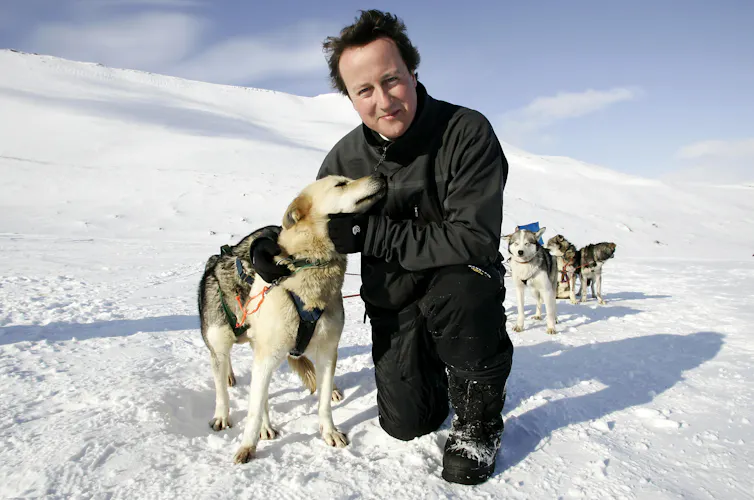
In the mid-2000s, soon after becoming Conservative leader, David Cameron hugged a husky on a trip to the Arctic, in what was widely described as an attempt to “detoxify” the Tory brand. Eighteen years later, Kemi Badenoch has promised to scrap the law that once made that rebranding credible.
Her announcement that the Conservatives will repeal the 2008 Climate Change Act if they win the next general election has the potential to be a major own goal – politically, environmentally and economically.
To understand why, we need to remember how the Climate Change Act came about. The bill was put forward by the Labour government of Gordon Brown, but it had enthusiastic support from the Conservative opposition, which tabled several amendments to strengthen it. Cameron had concluded that green policies were a good way to modernise his party and lead it back into power.
It worked, both for Cameron, who became prime minister in 2010, and for UK climate policy, which has enjoyed a unique period of consensus and stability. Over seven governments, multiple economic crises, Brexit, COVID-19 and the war in Ukraine, there has been clarity about Britain’s climate change objectives. Policies were chopped and changed, often to the frustration of investors, but the institutional framework was stable and widely appreciated.
The Climate Change Act gives the UK a statutory long-term emissions target – initially an 80% cut from 1990 levels by 2050, strengthened to net zero by 2050 by Theresa May, another Tory prime minister.
Progress is managed through a series of five-year carbon budgets, legislated 12 years in advance and monitored by a powerful independent body, the Climate Change Committee (CCC). For much of its existence, the CCC has been chaired by yet another environmentally-minded Tory, Lord Deben (John Gummer). It is this framework the Conservatives now say they want to dismantle.
Husky hugger David Cameron visits Svalbard, Norway, in 2008. Andrew Parsons / PA
Yet the Climate Change Act has delivered, both in terms of process and substance. Indeed, the UK model has been emulated around the world. Nearly 60 countries have UK-style climate change laws and over 20 countries have CCC-style advisory bodies, cementing the UK’s position as a climate leader.
The act gives the UK a steady institutional rhythm. Relevant businesses and other organisations know the formal set pieces, such as the CCC’s annual report to parliament, and can time their interventions accordingly.
When colleagues and I interviewed people from business and civil society about the act a few years ago, they emphasised the predictable process, the clear rules on accountability and the evidence-based discourse it has enabled. This all reduces uncertainty and enables long-term planning.
Importantly, the Climate Change Act has delivered environmentally too. Compared to 1990, UK greenhouse gas emissions are down by 50%. The UK economy now uses three times less carbon per unit of economic output than in 1990. Emissions are at their lowest level since 1872.
This trend started before the act, but it was helped and accelerated by it. This is perhaps most noticeable in the radical transformation of the electricity sector: coal has been completely phased out, while offshore wind and other renewables have flourished.
Most people want climate action
Voters value this progress more than politicians appreciate. A University of Oxford survey found that internationally public support for climate action is almost twice as high as policymakers assume. In the UK, three out of four people are fairly or very concerned about climate change.
Badenoch’s announcement comes just as households are starting to reap the financial benefits of clean technology. Colleagues and I have estimated that four out of five UK households, particularly those owning a car, would be better off if net zero was achieved. The typical savings are £100-£380 per household and year.
It is true that households do not yet see the benefits of renewables on their energy bills. We are still paying for the high costs of early investments in clean power, before technology and sheer scale brought the price down.
Successive governments have chosen to recoup these learning costs through electricity bills, rather than general taxation, which would have been easier on most households. But recent analysis suggests renewables are now cutting electricity prices by up to a quarter.
The policy uncertainty generated by the Tory announcement and similar pronouncements by Reform UK will eventually find its way into the risk premiums for investors, though for the time being this effect is still small.
But the reputational damage is immediate. Undoing the act would signal that the UK no longer values the long-term stability that has driven clean investment and made its climate policy admired around the world.
Climate policy requires debate. Deeply political choices need to be made about different decarbonisation strategies, how to pay for necessary investments or the role of controversial technologies like nuclear energy. The past 17 years have shown that these debates are best had within an agreed framework, with support from all major parties. That is what the Climate Change Act provides.
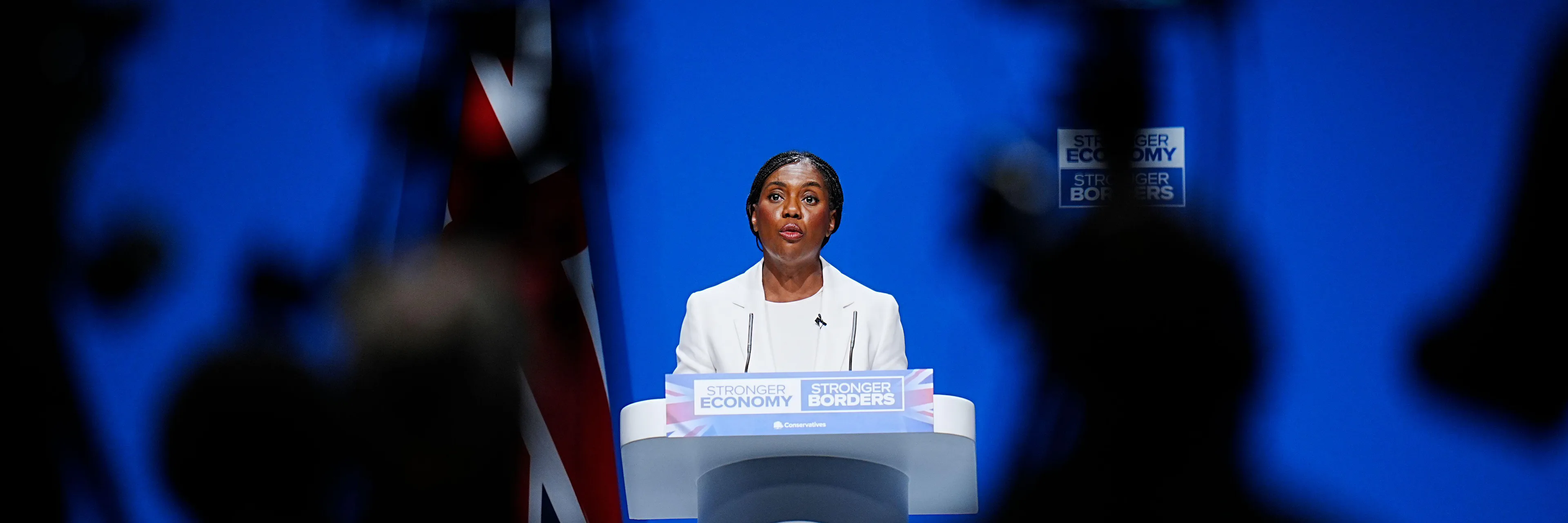
UK Conservative Party leader Kemi ‘not a genocide’ Badenoch explains her reality that the Earth is flat, the Moon is made of cheese and that she was born from
Unicorn horn dustNigel Farage urges you to ignore facts and reality and be a climate science denier like him. He says that Reform UK has received £Millions and £Millions from the fossil fuel industry to promote climate denial and destroy the planet.Orcas discuss how Trump was re-elected and him being an obviously insane, xenophobic Fascist.