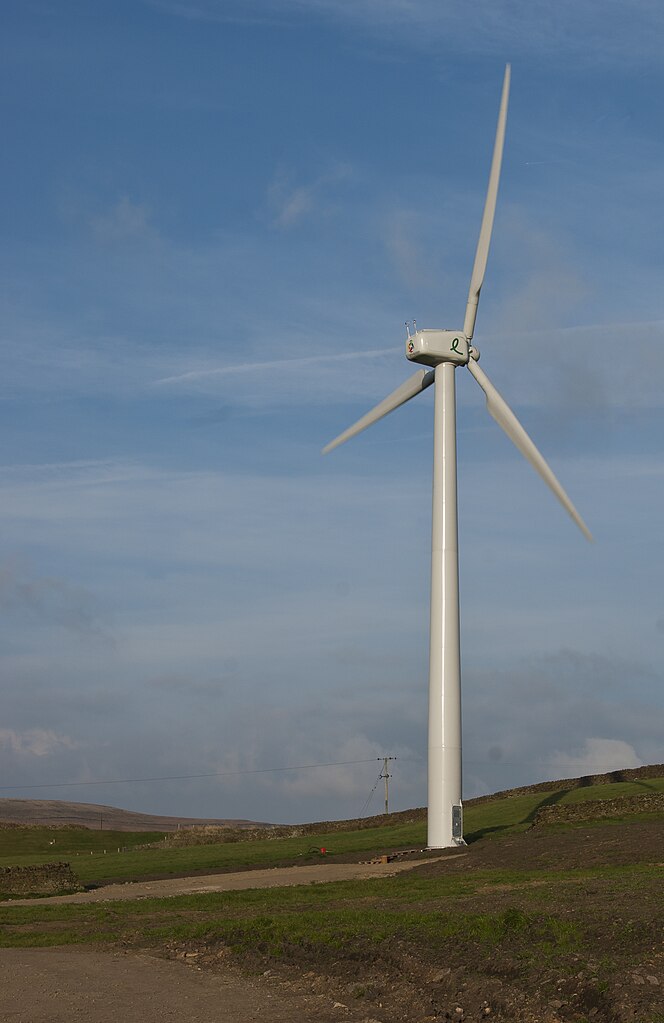
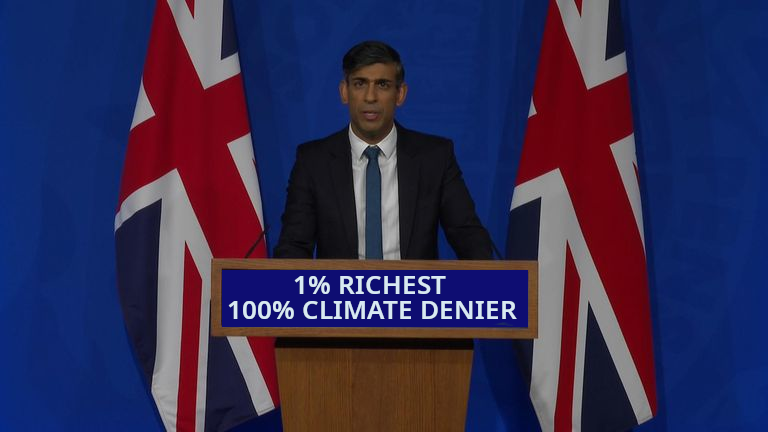
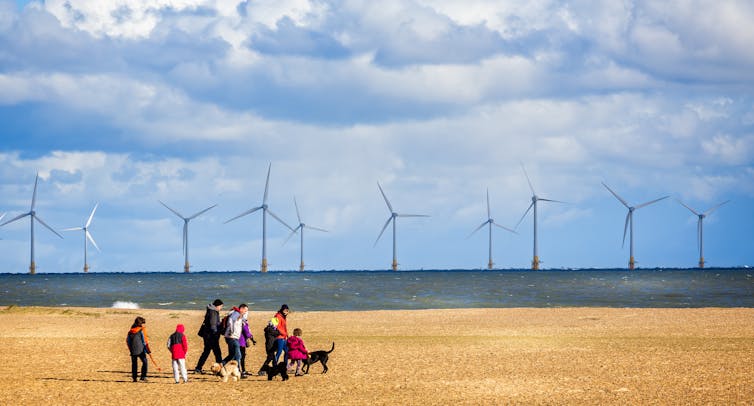
Analysis of the government’s renewable energy planning database shows that no applications for new onshore wind projects have been submitted since the prime minister, Rishi Sunak, claimed that the government would overturn the onshore wind ban in September 2023.
At the time, the National Infrastructure Commission advised the government to go further and restore onshore wind to the government’s Nationally Significant Infrastructure Projects process, which would encourage more applications.
The government rejected this recommendation and said the measures announced in September were enough.
Analysis by Carbon Brief estimates that if onshore wind had continued to be built at the same rate it was in 2017 – before the ban started to come into effect – 7GW of onshore wind would have been built. This would have knocked £5.1bn off energy bills, or £182 for each UK household, in the year from July 2022 to June 2023.
Romain Ioualalen, Global Policy Manager at Oil Change International said:
“It is positive to see this COP28 presidency and the IEA reflect the growing consensus that we need urgent action to rein in fossil fuel production and use. As COP28 negotiations start, countries must agree to end fossil fuel expansion, the only way to see fossil fuels decline significantly this decade, and for a full phase out of fossil fuels production and use. Distant promises and voluntary pledges are not enough, we need to see immediate action.
“The phase out will not happen on its own, even with growth in renewable energy. Without a strong agreement at COP28 that gets reflected in national policies, fossil fuels will not decline at the speed and scale necessary to limit temperature rise to 1.5°C.
“We deeply regret the inclusion of the fossil fuel industry’s favorite distractions, CCS and hydrogen, in this document and we urge parties to oppose any attempts to legitimize these failed technologies in a COP decision”.
David Tong, Global Industry Manager at Oil Change International said:
“Fatih Birol and the IEA reconfirmed this year that to limit global warming to 1.5ºC, there is no room for any new oil and gas expansion beyond existing fields and mines. To confront the climate crisis we need a full, fast, fair, and funded phase out of oil, gas, and coal.
“Oil Change International data show no big oil and gas company comes even close to aligning its business model with the Paris Agreement. Fossil fuel producers will not phase themselves out. The Big Oil and Gas business model cannot be reformed. Its foundation is destruction – of communities, of ecosystems, and all our futures. Cutting oil and gas companies’ operational emissions will achieve a maximum of 20% reduction in their total emissions. Governments must act to phase out the destructive fossil fuel industry and unlock the transition to nature-positive, community-owned, renewable energy.”
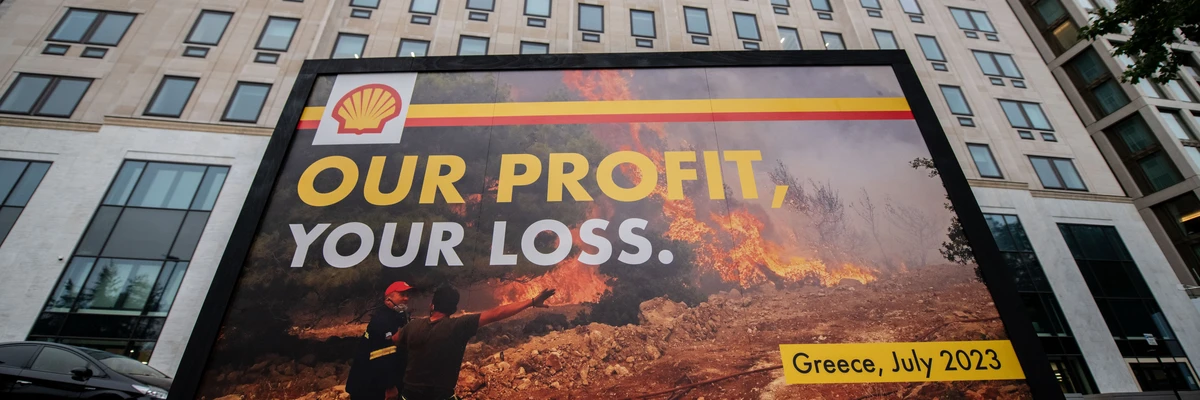
Greenpeace activists display a billboard during a protest outside Shell headquarters on July 27, 2023 in London. (Photo: Handout/Chris J. Ratcliffe for Greenpeace via Getty Images)
In reaction to today’s announcement about the historic establishment of the United Nation’s loss and damage fund, David Tong, Global Industry Campaign Manager, Oil Change International, said:
“Unprecedented, countries finalized the creation of a fund to compensate countries for loss and damage caused by the climate crisis on the first day of the UN Climate Change Conference.
“So far, governments’ contributions to the loss and damage fund are dwarfed by their approximately USD 200 billion in planned subsidies for carbon capture and storage (CCS). Subsidies for CCS are subsidies for fossil fuels, because most captured carbon is used to produce more oil and gas. Instead of paying their fair share to clean up their mess, rich polluting countries are offering a lifeline to the fossil fuel industry in the form of billions in handouts for CCS, fueling more loss and damage.
“For this COP to be a success, the negotiators must focus on securing an agreement to massively scale up renewable energy, end all new fossil fuel expansion, and commit to a fast, fair, full, and funded phase out of all fossil fuels”
Governments have spent over $20 billion – and are planning up to $200 billion more – of public money on Carbon Capture and Storage (CCS), providing a lifeline for the fossil fuel industry.
The majority of CCS is used to expand fossil fuel extraction. 79% of the world’s CCS operating capacity sends captured CO2 to produce more oil (via Enhanced Oil Recovery)
Many of the largest projects in the world operate far below their stated capacity. They are designed only to capture a fraction of the emissions of the plant they serve.
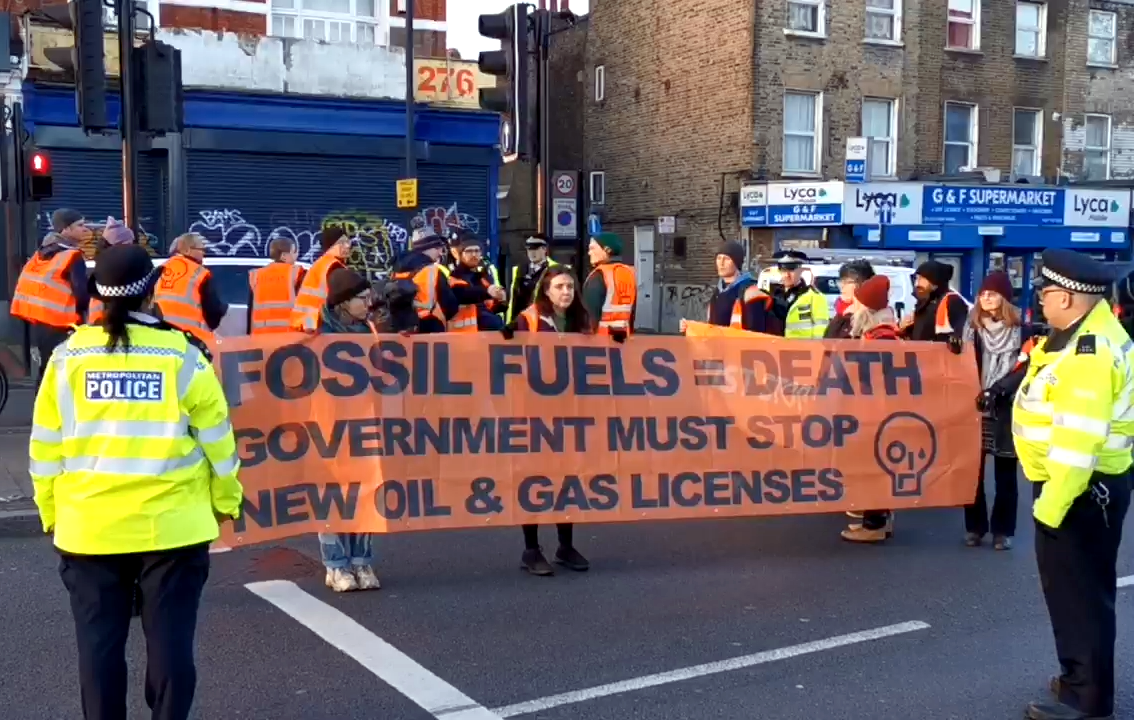
Just Stop Oil protesting in London 6 December 2022.
As the COP28 climate talks begin today in Dubai, the Green Party has set out three key demands. They are to ‘keep 1.5 alive’; an agreement on the fair and managed phase-out of all fossil fuels; and measures to address ‘climate inequality.’ Greens are challenging the UK government to lead by example and put into practice policies that will help meet these demands.
Image of the Green Party’s Carla Denyer on BBC Question Time.
Co-leader of the Green Party, Carla Denyer, said:
“We need to hear a clear unambiguous commitment from the UK government to the 1.5C Paris Agreement target which was signed up to by 196 countries eight years ago at COP21. The government must agree to whatever it takes to get this target back on track. It’s going to require a hugely ambitious strategy, but the massive scaling up of climate action that is now necessary is because of dither and delay by countries like the UK in taking the bold action needed.
“Another vital outcome of COP28 must be the fair and managed phase-out of all fossil fuels. As one of the rich countries most responsible for the climate crisis, the UK must stand on the side of future generations and those on the front line of climate breakdown and agree to urgently move away from fossil fuels. The UK government must resist pressure from the petrostates and others at COP who wish to continue with business as usual and keep the world hooked on fossil fuels. At home this means leading by example with an immediate end to all new oil and gas licences and a rapid acceleration towards renewable energy.
“Thirdly, these climate talks must recognise that it is a super-rich elite who are super-heating the planet. The UK government must be willing to challenge the grotesque inequality driving climate breakdown and reform our tax system to make the polluter pay. This means taxing the wealth of the super-rich and introducing a carbon tax on the most polluting corporations and individuals. Such taxes, introduced globally, could generate the funds needed for a generous new Loss and Damage Fund to finance climate action in the poorest countries – those suffering the most from the impacts of climate breakdown but contributing the least to the crisis.”
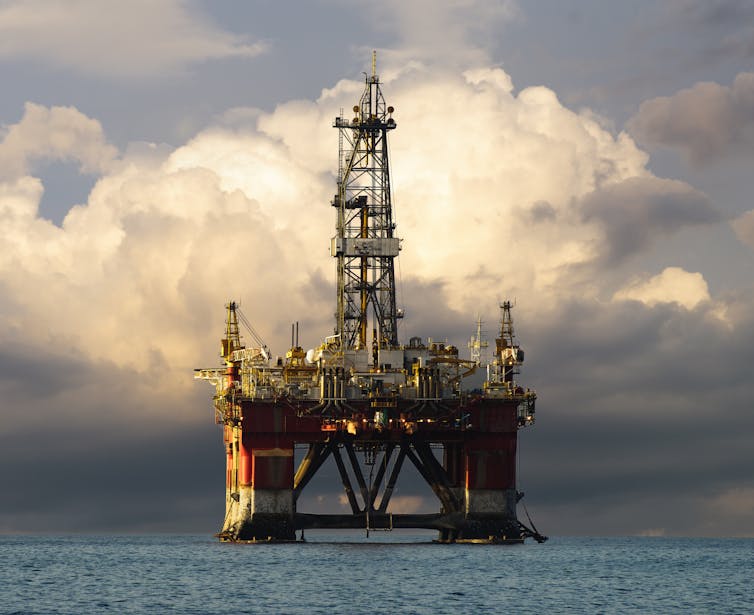
Climate scientists have been sounding the alarm for decades that this type of event will become more frequent as the world continues to warm. The major culprit behind this is the burning of fossil fuels. So it’s extremely concerning that the UK government has announced its intention to grant hundreds of licences for new North Sea oil and gas extraction.
Although burning fossil fuels to generate power and heat has enabled society to develop and flourish, we are now experiencing the unintended side effects. The carbon dioxide that has been added to the atmosphere is leading to a rise in global temperatures, causing heatwaves to become hotter and downpours more intense. The resulting large-scale disruption and suffering is becoming ever more visible.
This warming will continue, with worsening climatic consequences, until we reduce global carbon dioxide emissions to “net zero”. After that, we will still have to live and suffer in a warmer climate for generations. The collective choices we make now will matter in the future.
The small-scale, but high-profile, disruptions caused by Just Stop Oil protesters in the UK are extremely frustrating for many. But their single demand – for no licenses for new UK coal, oil and gas projects – is consistent with the science underpinning the international agreements that the UK has signed.
Temperatures are rising
Since the 1860s, the scientific community has understood that adding more carbon dioxide to the atmosphere would warm the climate. And as long ago as 1938, the burning of fossil fuels was linked to the observed rise in both carbon dioxide levels and global temperatures. Fast forward to now and global temperatures are warmer, and increasing faster, than at any point in human civilisation.
In response to the overwhelming scientific evidence, the UK and 193 other nations came together in 2015 to ratify the Paris agreement on climate change. One of the agreed goals is to limit global warming to well below 2°C, and even aim for 1.5°C, compared to the pre-industrial era.
However, the latest synthesis report from the Intergovernmental Panel on Climate Change, which all governments explicitly endorsed, paints a stark reality. If we burn all of the fossil fuels that we currently have access to, then global warming will exceed 1.5°C and may reach 2°C.
To avoid breaching the limits set out by the Paris agreement, some of the coal, oil and gas that we can already extract must remain unburnt. New fossil fuel extraction projects will make it even harder to stop further global warming.
Build up renewable infrastructure
There are other options. The UK government’s official advisers, the Climate Change Committee, have put forward a vision for UK power generation consistent with a net zero future. They say that the UK could provide all of its energy needs by 2050 through a combination of renewables, bioenergy, nuclear, hydrogen, storage and demand management, with some carbon capture and storage for fossil gas-based generation in the meantime.
The UK can achieve energy security without causing additional global warming. Nigel Jarvis/Shutterstock
If the UK followed the example of China and rapidly increased its investments in renewable energy, then it could achieve energy security without causing additional global warming. China emits the most carbon dioxide of any country in the world. But it is installing more renewable energy generation than the rest of the world combined.
Rapidly reducing our reliance on fossil fuels, and not issuing new licenses to extract oil and gas, is the most effective way of minimising future climate-related disruptions. The sooner those with the power to shape our future recognise this, the better.
Don’t have time to read about climate change as much as you’d like?