Tag: report

  • Carbon capture: a decarbonisation pipe dream

    Spread the love

    Relearning lessons of the past

    1 September 2022 (IEEFA): Underperforming carbon capture projects considerably outnumber successful projects globally, and by large margins, with both the technology and regulatory framework found wanting, finds a new report by the Institute for Energy Economics and Financial Analysis (IEEFA).

    The report, The Carbon Capture Crux – Lessons Learned, studies 13 flagship large-scale carbon capture and storage (CCS)/carbon capture utilisation and storage (CCUS) projects in the natural gas, industrial and power sectors in terms of their history, economics and performance. These projects account for around 55% of the total current operational capacity worldwide.

    Author Bruce Robertson says seven of the thirteen projects underperformed, two failed, and one was mothballed

    “CCS technology has been going for 50 years and many projects have failed and continued to fail, with only a handful working.

    “Many international bodies and national governments are relying on carbon capture in the fossil fuel sector to get to Net Zero, and it simply won’t work.

    “Although some indication it might have a role to play in hard-to-abate sectors such as cement, fertilisers and steel, overall results indicate a financial, technical and emissions-reduction framework that continues to overstate and underperform.”

    IEEFA’s study found that Shute Creek in the U.S. underperformed its carbon capture capacity by around 36% over its lifetime, Boundary Dam in Canada by about 50%, and the Gorgon project off the coast of Western Australia by about 50% over its first five-year period.

    “The two most successful projects are in the gas processing sector – Sleipner and Snøhvit in Norway. This is mostly due to the country’s unique regulatory environment for oil and gas companies,” says co-author Milad Mousavian.

    “Governments globally are looking for quick solutions to the current energy and ongoing climate crisis, but unwittingly latching onto CCS as a fix is problematic.”

    Last week the Australian government approved two new massive offshore greenhouse gas storage areas, saying CCS “has a vital role to play to help Australia meet its net zero targets. Australia is ideally placed to become a world leader in this emerging industry”.

    However, Robertson says, carbon capture technology is not new and is not a climate solution.

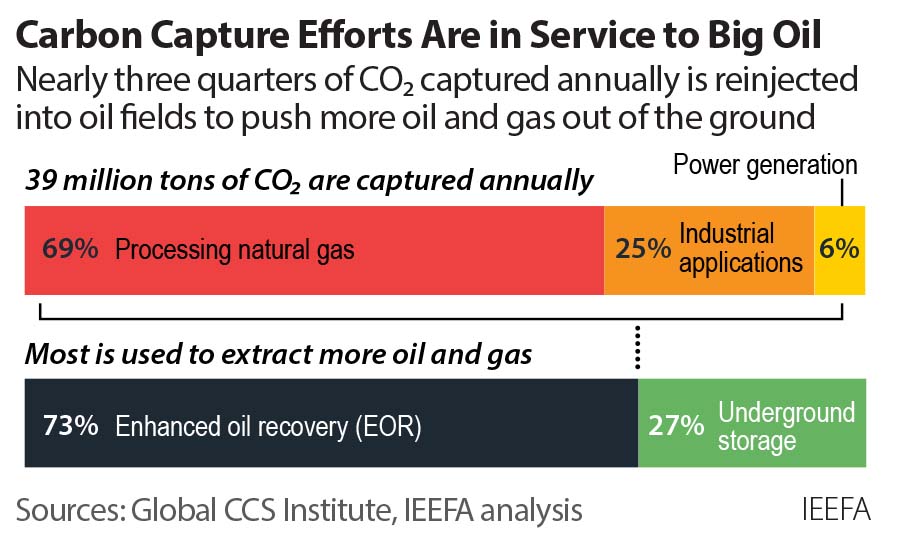
    “As our report shows, CCS has been around for decades, mostly serving the oil industry through enhanced oil recovery (EOR). Around 80–90% of all captured carbon in the gas sector is used for EOR, which itself leads to more CO2 emissions.”

    About three-quarters of the CO2 captured annually by multi-billion-dollar CCUS facilities, roughly 28 million tonnes (MT) out of 39MT total capture capacity globally, is reinjected and sequestered in oil fields to push more oil out of the ground.

    The International Energy Agency says annual carbon capture capacity needs to increase to 1.6 billion tonnes of CO2 by 2030 to align with a net zero by 2050 pathway.

    “In addition to being wildly unrealistic as a climate solution, based on historical trajectories, much of this captured carbon will be used for enhanced oil recovery,” says Robertson.

    History shows CCS projects have major financial and technological risks. Close to 90% of proposed CCS capacity in the power sector has failed at implementation stage or was suspended early — including Petra Nova and the Kemper coal gasification power plant in the U.S. Further, most projects have failed to operate at their theoretically designed capturing rates. As a result, the 90% emission reduction target generally claimed by the industry has been unreachable in practice.

    Finding suitable storage sites and keeping it there is also a major challenge—the trapped CO2 underground needs monitoring for centuries to ensure it does not come back to the atmosphere.

    The report identifies interim considerations for CCS projects if no alternative solutions to emissions reduction are found.

    • Safe storage locations must be identified, and a long-term monitoring plan and compensation mechanism in case of failure developed.
    • The CCS project must not promote enhanced oil recovery.
    • To avoid project liability being handed over to taxpayers, as is currently the situation with Gorgon, large oil and gas companies mainly benefiting from CCS at their gas developments must be liable for any failure/leakage and monitoring costs of CCS projects, specifically if they get subsidies, grants and tax credits for capturing the carbon.
    • It must not be used by governments to greenlight or extend the life of any type of fossil fuel asset as a climate solution.

    Robertson says more research could be done on CCS applications in industries where emissions are hard to abate such as, cement, as an interim partial solution to meeting net zero targets.

    “As a solution to tackling catastrophic rising emissions in its current framework however, CCS is not a climate solution.”

    The report: The Carbon Capture Crux – Lessons Learned
  • Over 20,000 Children Missing in Gaza, With ‘Unknown Number’ in Mass Graves: Report

    Spread the love

    Original article by JAKE JOHNSON republished from Common Dreams under Creative Commons (CC BY-NC-ND 3.0).

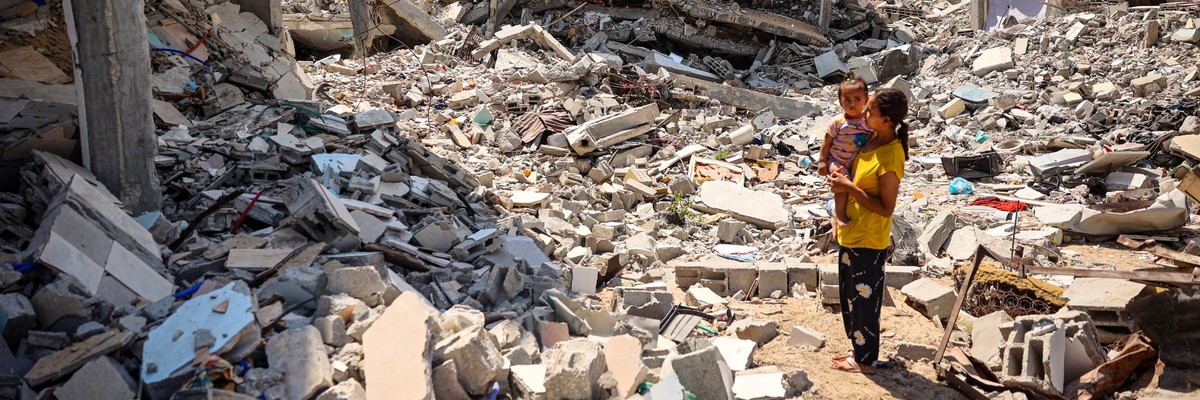
    A woman stands holding a child surrounded by the rubble of buildings destroyed by Israeli airstrikes in Khan Younis, Gaza on June 23, 2024.
     (Photo: Eyad Baba/AFP via Getty Images)

    “No parent should have to dig through rubble or mass graves to try and find their child’s body,” said the Save the Children’s regional director for the Middle East.

    The humanitarian group Save the Children estimated Monday that around 21,000 kids are missing in the Gaza Strip as Israel’s military continues its assault on the enclave, reducing much of the Palestinian territory to rubble.

    Roughly 4,000 kids are likely buried under that debris, according to Save the Children, while at least 17,000 are unaccompanied, an “unknown number” are in mass graves, and others have been “detained and forcibly transferred out of Gaza, their whereabouts unknown to their families amidst reports of ill-treatment and torture.”

    A child protection specialist with Save the Children said that the group finds more unaccompanied children every day in Gaza, where parents and entire families have been wiped out by Israel’s relentless bombing campaign and ground invasion.

    “We work through partners to identify separated and unaccompanied children and trace their families, but there are no safe facilities for them—there is no safe place in Gaza,” said the Save the Children specialist. “Besides, reuniting them with family members is difficult when ongoing hostilities restrict our access to communities, and constantly force families to move.”

    “Neighbors and extended family members who have taken in lone children are struggling to meet their basic needs, such as shelter, food, and water,” they added. “Many are with strangers—or completely alone—increasing the risk of violence, abuse exploitation, and neglect.”

    “We desperately need a cease-fire to find and support the missing children who have survived, and to prevent more families from being destroyed.”

    More than 14,000 children have been killed by Israeli forces in the Gaza Strip since October 7, and many others have experienced devastating psychological and physical trauma, including the loss of limbs. Dozens of children have also been starved to death in recent months as Israel’s blockade hinders the flow of lifesaving humanitarian assistance.

    Conditions for children have further deteriorated since Israel’s invasion of Rafah, which has forced roughly a million people to flee the city. Last month, Israeli forces used U.S.-made bombs in an attack on a Rafah camp sheltering displaced people, killing dozens—including women and children. The United Nations Human Rights Office said that infants were “torn apart” in the attack and people were “trapped inside burning plastic tents, leading to a horrific casualty toll.”

    Save the Children stressed Monday that its count of Gaza’s missing kids is far from conclusive, given the difficulty of collecting accurate information in areas under near-constant attack. The group noted that “confirming identification of a body by the next of kin is almost impossible when whole families have been wiped out and entry restrictions mean the equipment and experts needed cannot get in.”

    Jeremy Stoner, Save the Children’s regional director for the Middle East, said that “families are tortured by the uncertainty of the whereabouts of their loved ones.”

    “No parent should have to dig through rubble or mass graves to try and find their child’s body. No child should be alone, unprotected in a war zone. No child should be detained or held hostage,” said Stoner. “Children who are missing but living are vulnerable, face grave protection risks, and must be found. They must be protected and reunited with their families. For the children who have been killed, their deaths must be formally marked, their families informed, burial rites respected, and accountability sought.”

    “As many have pointed out, Gaza has become a graveyard for children, with thousands of others missing, their fates unknown,” he added. “There must be an independent investigation and those responsible must be held accountable. We desperately need a cease-fire to find and support the missing children who have survived, and to prevent more families from being destroyed.”

    Original article by JAKE JOHNSON republished from Common Dreams under Creative Commons (CC BY-NC-ND 3.0).

    Zionist Keir Starmes is quoted "I support Zionism without qualification." He's asked whether that means that he supports Zionism under all circumstances, whatever Zionists do.
    Zionist Keir Starmes is quoted “I support Zionism without qualification.” He’s asked whether that means that he supports Zionism under all circumstances, whatever Zionists do.
  • BP Was Warned Gas-Driven Climate Change Could Cause ‘Unprecedented Famine’

    Spread the love

    Original article by Geoff Dembicki republished from DeSmog.

    Yet the oil and gas major led a campaign to present gas as a climate solution, new ‘confidential’ documents released by a U.S. Congressional investigation reveal.

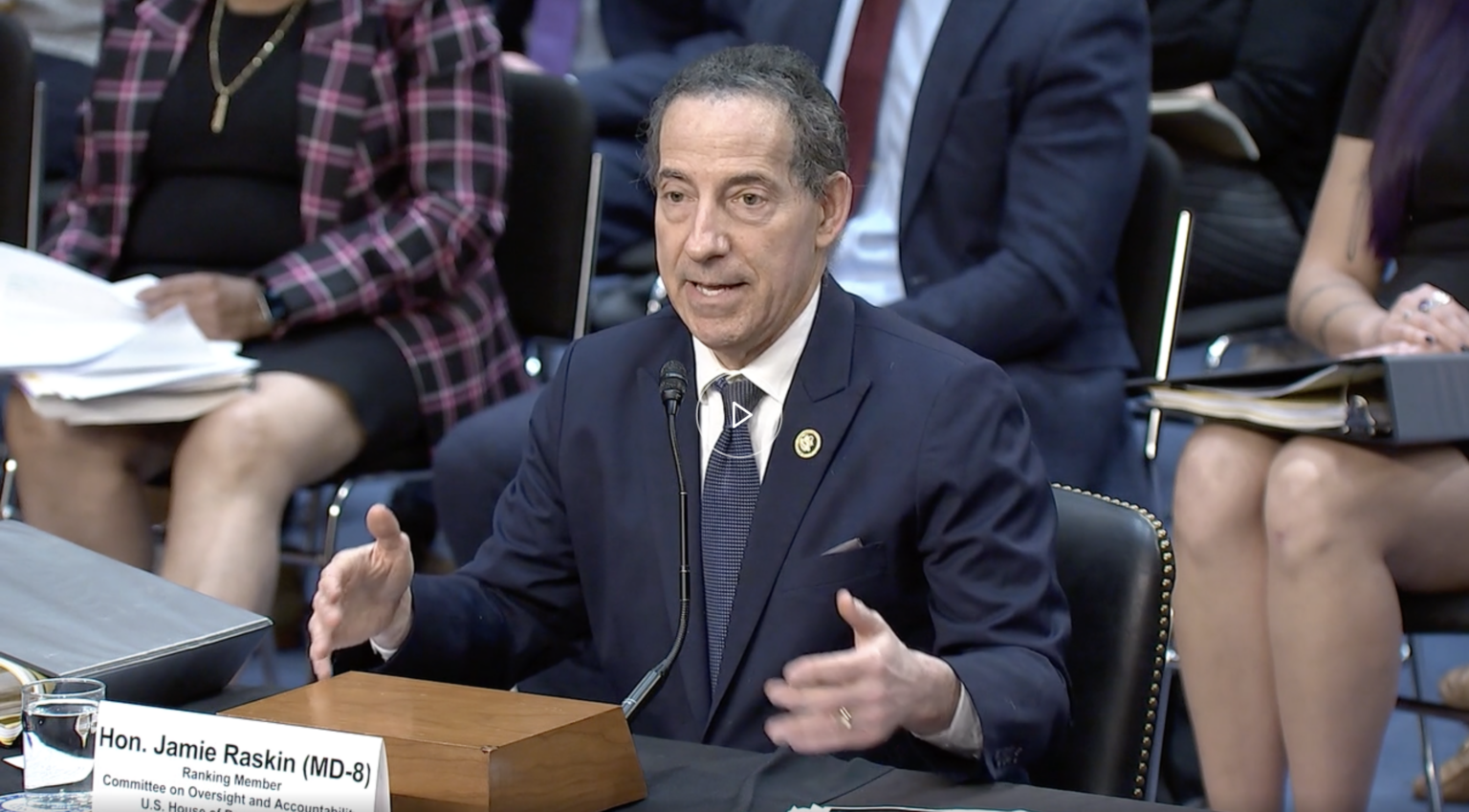
    Democrat Jamie Raskin appeared before a Senate hearing examining Big Oil’s efforts to avoid climate accountability. Credit: US Senate

    BP was warned by Princeton University researchers in 2016 that climate change accelerated in part by new global supplies of shale gas could lead to catastrophic events such as “mass extinctions and unprecedented famine.” 

    Yet despite acknowledging internally the concern that “gas doesn’t support climate goals,” the UK-headquartered oil and gas major embarked on a marketing campaign to “advance and protect the role of gas—and BP—in the energy transition.” 

    That’s been accompanied by large new investments in gas, including a recent agreement to take nearly two million tonnes per year of liquefied natural gas shipments from a $5.1 billion export facility called Woodfibre LNG proposed for the west coast of British Columbia. 

    Revelations concerning BP’s private knowledge about the dangers of gas expansion were contained in a trove of documents—some labelled “confidential”—released by Democrats in early May as part of a joint House and Senate investigation into the oil and gas industry’s climate obstruction. 

    “The fossil fuel industry evolved from denying climate science to spreading disinformation and perpetuating doublespeak about the safety of natural gas and its commitment to reducing greenhouse gas emissions,” the Joint Staff Report argues.  

    BP didn’t respond to questions from DeSmog related to the report. 

    Documents contained in the report, which were obtained via federal subpoenas, suggest that the highest levels of BP leadership have been privately made aware of potential climate disruption caused by natural gas. Comments on a draft outline for a 2017 speech by BP’s then-CEO Robert Dudley articulate that fear explicitly.

    “You don’t say anything about concerns about so-called lock-in, the idea that, once built, gas locks in future emissions above a level consistent with 2 degrees, at least without CCUS,” the comments read, referring to expensive and frequently underperforming carbon capture utilization and storage technologies. 

    A confidential 2018 presentation from BP notes that while gas may release less emissions when burned than coal, those climate gains can be erased by leakages of the “potent” greenhouse gas methane. “Methane (CH₄) accounts for 20% of GHGs [greenhouse gas emissions],” a slide from the presentation notes. “Oil and gas accounts for nearly a quarter of this 20%.”

    The presentation acknowledges the concern, widely reported in the media by that point, that “gas doesn’t support climate goals when you take methane emissions into account.” BP appears to have seen such worries as an “opportunity” for the company, however. 

    The company intended to launch a communications campaign that could “position BP as [a] strong gas player” in part by “demonstrating leadership on methane challenge,” the slide reads.

    Yet the oil and gas producer had been warned that a failure to limit global temperature rise to below 2 degrees could be catastrophic for humankind and the planet. During a 2016 town hall event for BP in Houston, Princeton researchers noted “innovation in the energy sector has been dramatically affected by the arrival of shale gas and oil and low energy prices.” 

    One result, they noted, is that “fossil fuels are so abundant that, for even a weak climate target, attractive fossil fuel will be left in the ground.” But if the world fails to limit warming below 2 degrees, “the climate monsters begin to come into the room,” they noted. 

    As warming approaches 3 degrees, their presentation explained, “we expect a rogue’s gallery, from the loss of all of our coastal cities because of >10 m of sea level rise, to cessation of the ocean’s circulation.”

    Yet the company continues to publicly portray the fossil fuel as a climate solution. “As the world seeks secure, affordable and lower carbon energy, global demand for LNG is expected to continue to grow,” a BP executive said last year upon the company signing its latest off-take agreement with Woodfibre LNG in Canada. 

    This is part of a years-long global campaign to spread “disinformation” about the role of gas “as a bridge fuel to a fossil-free future,” the Congressional report argues. “It is long past time to hold Big Oil accountable for its deception campaign and to take action to undo the harms it has perpetrated.”

    Original article by Geoff Dembicki republished from DeSmog.

  • World’s largest oil companies ‘way off track’ on emissions goals, report finds

    Spread the love

    https://www.theguardian.com/us-news/2024/mar/22/oil-companies-emissions-goals-report

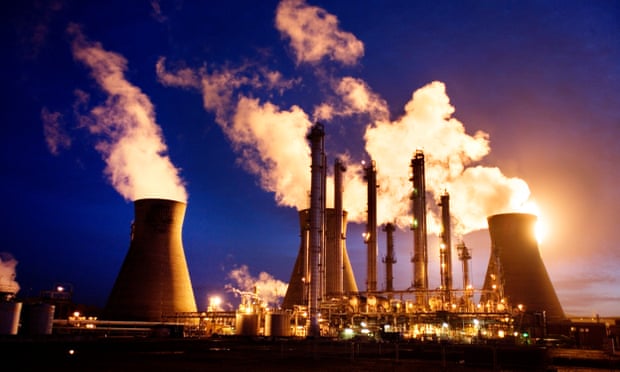
    Gas flares at BP’s Grangemouth oil refinery at dusk in Scotland. Photograph: Murdo Macleod/The Guardian

    Despite splashy climate pledges, firms including BP and Saudi Aramco have plans to expand fossil fuel production, says analysis

    In recent years, virtually all of the world’s largest oil companies have made splashy climate pledges. But when it comes to actually slashing emissions, those firms are “way off track”, a new report has found.

    The analysis from the thinktank Carbon Tracker assessed the production and transition plans of 25 of the world’s largest oil and gas companies. None align with the central goal of the 2015 Paris climate agreement to keep global warming “well under” 2 degrees above pre-industrial levels, the report found.

    “Companies worldwide are publicly stating they are supportive of the goals of the Paris-Agreement, and claim to be part of the solution in accelerating the energy transition,” said Maeve O’Connor, analyst at Carbon Tracker and co-author of the report. “Unfortunately, however, we see that none are currently aligned with the goals of the Paris agreement.”

    …

    The analysis comes as oil and gas companies are publicly reneging on their climate commitments. Shell last week watered down earlier emissions targets, following BP, which made a similar announcement last year. In October, ExxonMobil also made a deal to buy the shale group Pioneer Natural Resources, while Chevron announced plans to acquire the Texas oil company Hess – marking two of the country’s largest oil and gas deals in decades.

    https://www.theguardian.com/us-news/2024/mar/22/oil-companies-emissions-goals-report

  • United in Science: We are heading in the wrong direction

    Spread the love

    United in Science: We are heading in the wrong direction Link contains a summary of the report’s findings

    Geneva, 13 September 2022 (WMO) – Climate science is clear: we are heading in the wrong direction, according to a new multi-agency report coordinated by the World Meteorological Organization (WMO), which highlights the huge gap between aspirations and reality. Without much more ambitious action, the physical and socioeconomic impacts of climate change will be increasingly devastating, it warns.

    The report, United in Science, shows that greenhouse gas concentrations continue to rise to record highs. Fossil fuel emission rates are now above pre-pandemic levels after a temporary drop due to lockdowns. The ambition of emissions reduction pledges for 2030 needs to be seven times higher to be in line with the 1.5 °C goal of the Paris Agreement

    United_in_Science_2022_-_Antonio_Guterres_Quote_Card.png

    The past seven years were the warmest on record. There is a 48% chance that, during at least one year in the next 5 years, the annual mean temperature will temporarily be 1.5°C higher than 1850-1900 average. As global warming increases, “tipping points” in the climate system can not be ruled out.

    … Go to article