This work by Middle East Monitor is licensed under a Creative Commons Attribution-NonCommercial-ShareAlike 4.0 International License.
A view of the site as Israeli forces take measures in front of the Ofer Prison in West Bank, in Jerusalem on January 19, 2025. [Mostafa Alkharouf – Anadolu Agency]
At least 98 Palestinians have died in Israeli prisons since the start of Gaza war in October 2023, an Israeli human rights group said Monday, Anadolu reports.
The findings were published in a report issued by Physicians for Human Rights–Israel, which said the report is based on official responses, medical documents, autopsy reports, testimonies from medical staff and released detainees, and other human rights sources.
The organization said Israel has concealed the causes of death among Palestinian detainees in its prisons and continues to hide the true number of victims, warning that the real figure is likely much higher.
It accused Israel of carrying out a policy of systematic killing, ill-treatment, and medical neglect against Palestinian prisoners.
“The unprecedented toll, together with extensive findings and evidence of deaths caused by torture and medical neglect, points to a deliberate Israeli policy of killing Palestinians in custody,” said Oneg Ben Dror, a project coordinator in the organization’s Prisoners and Detainees Department.
The rights group said 98 Palestinians lost their lives in Israeli custody, including 94 documented deaths between October 2023, and August 2025. It added that four other fatalities were recorded during October and November of this year alone.
The report includes only deaths that occurred inside Israeli prisons and detention centers and does not include seven additional documented cases of Palestinians executed by gunfire shortly after their arrest.
The rights group said that the fatalities included 52 detainees from Gaza.
There was no comment from the Israel Prison Service nor the army on the report.
The Israeli group said the report revealed a repeated pattern of severe violence by prison guards alongside serious medical neglect of Palestinian detainees.
It said that an examination of ten autopsy reports showed signs of physical violence in nearly half the cases, including head injuries, internal bleeding, and rib fractures.
Other medical reports documented cases of extreme malnutrition, denial of insulin for diabetic patients, failure to treat cancer, and the presence of life-threatening infections.
The organization noted that these findings correspond with extensive documentation over the past two years of hunger, dehydration, and prolonged exposure to extreme cold and heat in Israeli detention centers.
The report dedicated significant space to describing the methods used by Israeli authorities for “concealing the causes of death and obstructing families from uncovering the truth about the circumstances in which their relatives died.”
The Israeli army launched a brutal offensive on Gaza in October 2023, killing more than 69,000 people, mostly women and children, injuring over 170,000 others, and arresting thousands. The assault came to a halt under a ceasefire agreement that took effect on Oct. 10.
This work by Middle East Monitor is licensed under a Creative Commons Attribution-NonCommercial-ShareAlike 4.0 International License.
Keir Starmer objects to criticism of the IDF. He asks how could anyone object to them starving people to death, forced marches like the Nazis did, bombing Gaza’s hospitals and universities, mass-murdering journalists, healthworkers and starving people queuing for food, killing and raping prisoners and murdering children. He calls for people to stop obstructing his genocide for Israel.Vote Labour for Genocide.Orcas discuss Genocide-supporting and complicit Zionists. Donald Trump, Keith Starmer, David Lammy, Rachel Reeves, Angela Rayner and Wes Streeting are acknowledged as evil genocide-complicit and supporting cnuts.
An aerial view of a 33 megawatt data center with closed-loop cooling system, amid warehouses on October 20, 2025 in Vernon, California. (Photo by Mario Tama/Getty Images)
“It’s hard to see utility bills coming down in this decade,” said one industry analyst.
Although the rising cost of groceries has gotten a lot of attention in recent weeks, US consumers are also increasingly under pressure from the rising cost of electricity.
A new report from researchers at The Century Foundation and financial abuse watchdog Protect Borrowers has found that the average overdue balance on utility bills has surged by 32% over the last three years, going from $597 in 2022 to $789 in 2025. What’s more, the report estimates that roughly 1 out of every 20 US households has utility debt that is “so severe it was sent to collections or in arrears.”
The increase in overdue utility bill debt has come at a time when electricity costs have been growing significantly faster than the overall rate of inflation, the organizations found.
“Comparing twelve-month moving averages from March 2022 to June 2025 (to adjust for seasonality), monthly energy costs… nationwide rose from $196 to $265—a 35% jump, or nearly three times overall inflation during that period,” noted the report.
The organizations said that the reasons for these price increases are complicated, although factors include “poorly regulated monopolies overcharging customers to the tune of $5 billion a year,” as well as the explosion in the construction of energy-devouring artificial intelligence data centers and the Trump administration’s attacks on renewable energy projects that began under former President Joe Biden’s administration.
AI data center construction has become a major controversy in communities across the US, and a CNBC analysis published late last week found that “in at least three states with high concentrations of data centers,” electric bills have grown “much faster than the national average” over the last year.
Virginia, which has the highest concentration of AI data centers in the country, saw electricity prices surge by 13% over the last year, while data center-heavy states such as Illinois and Ohio saw electricity costs go up by 16% and 12%, respectively.
Rob Gramlich, president of power sector consulting firm Grid Strategies, told CNBC that the massive growth in data centers means that “it’s hard to see utility bills coming down in this decade.”
The Century Foundation and Protect Borrowers conclude that their report paints “a grim picture” of “increasing energy prices, rising overdue balances, and squeezed household budgets that together are pushing families deeper and deeper into debt.”
Orcas discuss how Trump was re-elected and him being an obviously insane, xenophobic Fascist.Elon Musk urges you to be a Fascist like him, says that you can ignore facts and reality then.Donald Trump urges you to be a Climate Science denier like him. He says that he makes millions and millions for destroying the planet, Burn, Baby, Burn and Flood, Baby, Flood.
Memorials for some of the more than 100 people killed in July 2025’s catastrophic flash flooding in central Texas, which was intensified by climate change. Credit: source/credit info: World Central Kitchen (CC BY 4.0)
A 435-page review found the authors used standard climate denier tropes to produce a report riddled with errors.
A group of more than 85 climate experts today released a scathing review of the Trump administration’s “Climate Working Group” report on climate change science, condemning it as “biased, full of errors, and not fit to inform policymaking.”
The reviewers include MacArthur “Genius” Fellows, a half-dozen members of the National Academy of Sciences, Royal Society fellows, and fellows from other prominent scientific organizations including the American Meteorological Society, which issued its own separate statement criticizing the Climate Working Group report.
They found that the federal report “exhibits pervasive problems with misrepresentation and selective citation of the scientific literature, cherry-picking of data, and faulty or absent statistics” in order “to downplay the risks of record-breaking heat, intense rainfall, worsening wildfires, rising sea levels, and widespread health harms – all well-established by decades of peer-reviewed science.”
The Trump administration’s report was authored by five longtime climate deniers — Steve Koonin, John Christy, Ross McKitrick, Judith Curry, and Roy Spencer —as part of its effort to gut federal powers to regulate climate-heating pollution from cars, power plants, and other major sources. The Department of Energy (DOE) released it on July 29.
On the same day the Trump report was released, Environmental Protection Agency Administrator Lee Zeldin announced the agency’s proposal to rescind the foundation of those regulations: its scientific “endangerment finding” affirming that carbon pollution threatens human health and welfare by creating dangerous planetary warming.
Texas A&M climate scientist Andrew Dessler organized the volunteer effort to review the report, which is being submitted to the Department of Energy during the public comment period that closes on September 2. The public comment period on the EPA’s proposal is open through September 22.
Announcing the release of the review this morning on his personal blog, Dessler termed the Trump report “a show trial for climate science.
“Like any good Soviet trial, the outcome of this exercise by the Dept. of Energy is already known: climate science will be judged too uncertain to justify the endangerment finding,” Dessler said. “Once you understand that, everything about the DOE report makes total sense. You understand why the five contrarian authors were selected: The only way to get this report was to pick these authors. If any other writing team had been chosen, the report would have been 180° different.”
The Trump report’s authors have previously defended their work, telling the journal Nature that they are “committed to a transparent and fact-based dialogue on climate science and know from long experience that scientific criticism and rebuttal are essential to that process.”
In response to a request for comment, Curry referred reporters to her blog, where she described the Dessler review as “comprehensive” and a “laudable effort,” noting that it “was prepared in 30 days (sort of weakens the argument that the DOE report was written too quickly, ha ha).”
The Energy Department’s public comment period on the report was set for 30 days, rather than a more typical 60 days. The agency has not announced an extension.
After “skimming” the review, Curry said, she “didn’t spot anything in this report that would lead to changing any of the conclusions in the DOE Report.”
The four other members of the Climate Working Group, as well as the Energy Department, did not immediately respond to a request for comment.
“A Wonderful Example of Junk Science”
The Trump report “is a travesty for U.S. scientific integrity,” said Ryan Katz-Rosene of the University of Ottawa, an expert on climate and sustainability policies and politics, in a statement. “It reads like a list of common climate skeptic tropes — long ago rebutted by the scientific community — being rehashed by a group of disgruntled scientists.”
The 435-page expert review found that the Trump climate report exhibited a pattern of questionable reasoning, as well as dozens of factual and structural flaws — such as relying on “verifiably flawed and unrepresentative [scientific] literature.”
It was also riddled with typos, scrambled citations, unsupported claims about climate science, and references to research or data that the reviewers could not find, along with at least one manufactured quote.
These sorts of errors have become associated with AI slop, though the reviewers didn’t speculate whether the report’s five authors — who the expert reviewers described in a statement as a “tiny team of hand-picked contrarians” — used AI to write their report.
“I always like to find a silver lining,” climate scientist Andy Miller, a 33-year EPA veteran, said in a statement. “In this case the silver lining is that this document is a wonderful example of junk science that can be used as an example for years to come.”
Koonin, Curry, and their co-authors used several climate disinformation tactics in their report. Here are just a few.
Omitting Evidence
The review found many instances where the Trump report left out vital details — sometimes entire fields of study — that would undercut the administration’s case for deregulation.
“The only mention of the oceans throughout the entire report is in the context of ocean acidification, coral reefs, and sea level rise,” the review noted. “The glaring omission of the myriad impacts of climate change on the ocean — marine heat waves, changing species distributions, changes in ocean circulation, increased harmful algal blooms, coastal erosion, and economic impacts on commercially valuable fisheries to name a few — is a significant problem with the report.”
The report also has a bad case of “selection bias,” by elevating minor issues or weak science over well-established and strong science, or issues vital to climate action.
In one instance, the Trump team heavily downplayed the scientific research at the heart of the Paris Agreement’s nitty-gritty methodologies for measuring carbon emissions, and put a more marginal approach at the center instead.
“For a report claiming to be a ‘Critical Review’ of greenhouse gas impacts to entirely ignore the primary scientific framework for international and national climate policy is an inexplicable and scientifically unjustifiable omission,” the review concluded.
In sections where Trump’s climate team claimed that there were no long-term extreme weather trends associated with climate change — such as more frequent and destructive floods and hurricanes — the review found that they left out key findings that contradicted their conclusion, cherry-picked studies, quoted research out of context, and used outdated materials instead of the best available science.
The five authors used similar tactics to slant sections on tornadoes and wildfires.
Zombie Arguments
The Trump administration report raises questions about climate change that have been asked and answered — repeatedly. Rehashing these long-settled scientific debates created an opportunity for the report’s authors to deny the fundamental cause of the climate crisis: burning fossil fuels.
“Those sorts of back-from-the-dead arguments [create] a ‘zombie argument’ that is inconsistent with the state of the best available science,” the expert review concluded.
One such resurrected claim pointed to record-breaking high temperatures in the 1930s to dismiss climate change as a factor in recent heat waves. However, many of these records have fallen since 2000. “[I]n our calculation, the most recent few years have had as many record-breaking high temperatures as the 1930s,” the review notes. “In fact, the year with the most record-breaking hot days is 2023.”
The federal report sometimes griped about the absence of their claims from recent Intergovernmental Panel on Climate Change surveys of the best-available science, without acknowledging that climate scientists have moved on from those questions for good reasons.
“So much literature has been produced to refute the claims of the [Climate Working Group] report authors, and over so long a time period,” the review pointed out, “that these claims are no longer part of the active scientific debate.”
Echo Chambers
The Trump administration’s five authors relied heavily on citations to their own climate-related research and analyses, the review found.
Overall, 11 percent of the report’s citations were self-citations, according to the review — roughly two to four times more than the self-citations in the climate science overview released by the Intergovernmental Panel on Climate Change in 2021.
In a couple of chapters, the self-citations numbered more than one out of every four.
This echo chamber of self-citations pushes out other, peer-reviewed and published science on the same topics, “of which there is plenty,” according to the expert review.
Word Games
The expert review found that conclusions reached by the Trump team sometimes relied on incorrect uses of scientific terms in ways that favored climate denial.
In one example, reviewers explained that the term ocean acidification “is not used in a way to indicate that the ocean is becoming an acid,” but “the more commonly used term for the phenomena of ocean carbonate chemistry changes because it provides a straightforward terminology to describing the declining pH of the ocean.”
Elsewhere, the Trump team uses the term “greening” in a misleading way that “implies ‘greening’ is an expansion of vegetation into areas that were previously non-vegetated,“ the review found. This is a key mistake because the report “thus incorrectly interprets the literature on ‘greening’ throughout this section.”
The Endangerment Finding, Endangered
Opponents of greenhouse gas cuts have worked for decades to block or overturn the federal government’s power to regulate them.
The legal basis for this authority is the EPA endangerment finding that — despite being credited to the Obama-Biden administration by Trump officials — dates back to George W. Bush’s second term as president.
In 2007, the U.S. Supreme Court ruled, in lawsuit brought by Massachusetts and several other states, that CO2, methane, and four other greenhouse gases are pollutants under the Clean Air Act. In the ruling the court also found that under the Clean Air Act, the EPA had a duty under to analyze whether they endanger public health or welfare and — if so — to regulate sources of carbon pollution.
In response to this decision, the EPA produced its endangerment finding. Rather than regulate carbon pollution, however, the Bush White House suppressed the document.
In 2009 the Obama White House released the finding, and began establishing rules under the Clean Air Act to cap and cut carbon pollution from motor vehicles as well as power plants and other industrial sources.
Since then, as DeSmog has previously reported, a powerful anti-climate coalition of politicians, oil companies, trade groups, and right-wing networks has been trying to overturn the endangerment finding, culminating in Project 2025 — the extreme-right blueprint for transforming the federal government.
Project 2025’s chapter on the EPA, which mentions “updating” the 2009 endangerment finding, was written in part by Aaron Szabo, now a high-level Trump appointee to the agency.
The director of the White House Office of Management and Budget, Russ Vought, was one of the main architects of Project 2025, and has publicly supported rescinding the endangerment finding.
Some members of the Trump climate working group were also part of his first administration. Steve Koonin, a physicist, advised the government on climate change during Trump’s first term, and atmospheric scientist John Christy was on the EPA’s Science Advisory Board.
Another Trump report co-author, climatologist Judith Curry, was a paid witness for the state of Montana during a 2023 trial on whether the state’s promotion of fossil fuels violated its constitution. The 16 young Montana residents who sued the state won that case.
UPDATE Sept. 2, 2025: This story has been updated to include a statement from Judith Curry, and to correct the end date of the public comment period for the EPA’s proposal to rescind the endangerment finding.
Donald Trump urges you to be a Climate Science denier like him. He says that he makes millions and millions for destroying the planet, Burn, Baby, Burn and Flood, Baby, Flood.Elon Musk urges you to be a Fascist like him, says that you can ignore facts and reality then.Orcas discuss Donald Trump and the killer apes’ concept of democracy. Front Orca warns that Trump is crashing his country’s economy and that everything he does he does for the fantastically wealthy.
Reaching net-zero will be much cheaper for the UK government than previously expected – and the economic damages of unmitigated climate change far more severe.
These are two key conclusions from the latest report on risks to the government finances from the independent Office for Budget Responsibility (OBR), which includes a chapter on climate change.
The new OBR report shows very clearly that the cost of cutting emissions to net-zero is significantly smaller than the economic damages of failing to act.
Here are four key charts from the OBR report.
Climate damages could reach 8% of GDP by 2070s
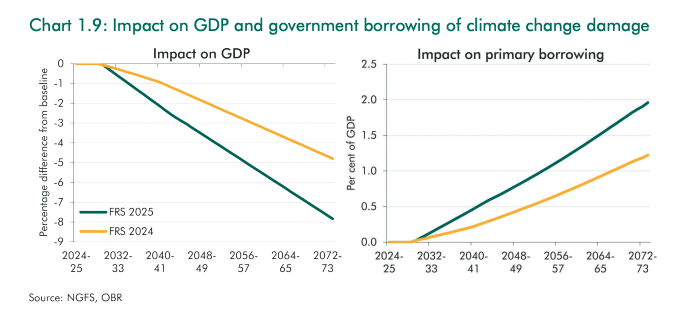
The UK could take an 8% hit to its economy by the early 2070s, if the world warms by 3C this century, according to the new OBR report.
(This aspect of the OBR report has been picked up in a Reuters headline: “Global 3C warming would hurt UK economy much more than previously predicted, OBR says.”)
Its latest estimate (blue line) of the impact of “climate-related damages” by the 2070s is three percentage points (60%) higher than thought just last year (yellow), as shown in the figure below.
Left: Impact of climate damages on UK GDP, if global warming reaches 3C by the end of the century. Right: Impact on government borrowing. Blue lines show the latest estimates whereas yellow lines are from last year’s report. Credit: OBR
The OBR says that the increase in its estimate of climate damages is due to using a “more comprehensive and up-to-date analysis”.
(The world is currently on track to warm by only slightly less than 3C this century.)
Unchecked damages could double hit to borrowing
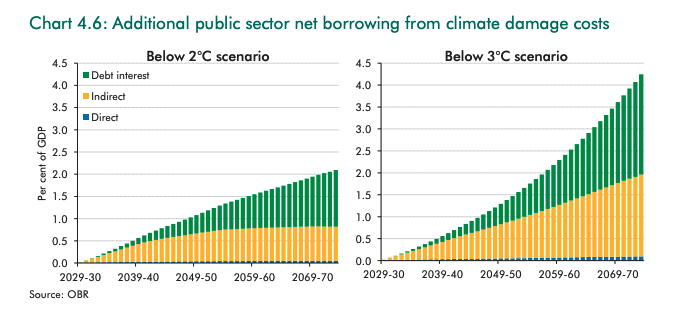
The impact of climate damages on government borrowing would be nearly twice as high by the 2070s, if global warming goes unchecked and reaches 3C, according to the OBR report.
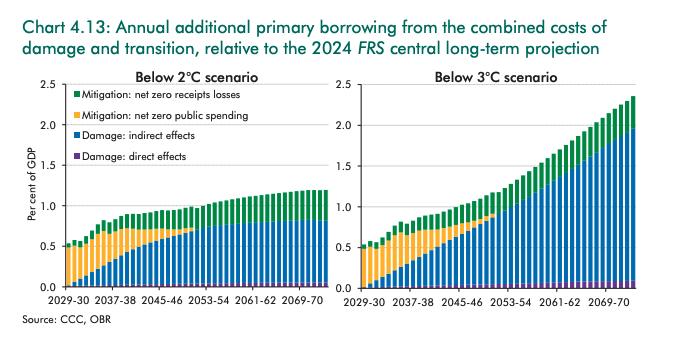
This is shown in the figure below, which compares additional government borrowing each year, as a share of GDP, if warming is limited to less than 2C this century (left) or if it climbs to 3C (right).
Additional government borrowing each year due to climate damages, as a share of GDP, %, if warming is limited to less than 2C this century (left) or 3C (right). Credit: OBR.
The OBR explains that the largest impact of climate damages on government borrowing is “lower productivity and employment and, therefore, lower tax receipts”.
Cost of net-zero halved
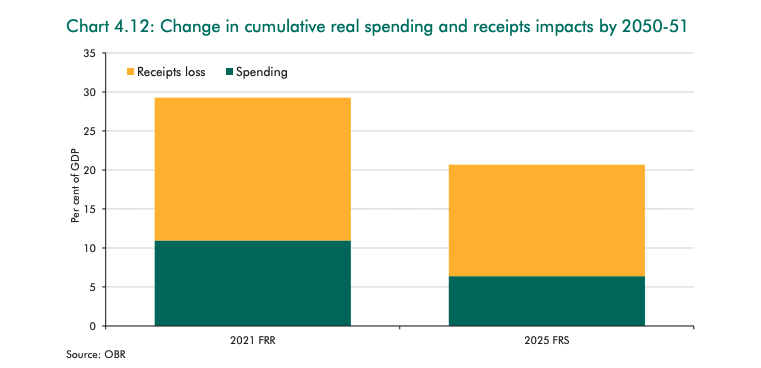
When it comes to cutting UK emissions, the OBR says the government will only need to invest just over half as much on reaching net-zero, compared with what it expected four years earlier.
This is shown in the figure below, with the latest 2025 estimate (right) showing a cumulative government investment of 6% of GDP across the 25 years to 2050, down from 11% (left).
(Note that the large majority of “lost government receipts”, shown in yellow in the figure below, are due to fuel duty evaporating as drivers shift to electric vehicles. As the OBR notes, the government could choose to recoup these losses via other types of motoring taxes.)
Cumulative change in government lost receipts (yellow) and extra investment (green), as a share of GDP, %. Left: OBR’s 2021 report. Right: Latest 2025 report. Credit: OBR.
The OBR takes its estimates of the costs and benefits of cutting emissions to net-zero from the government’s Climate Change Committee (CCC). The CCC recently issued significantly lower estimates for net-zero investment costs, due to more rapidly falling clean-technology costs.
Acknowledging this shift, the OBR says the latest CCC estimates on the cost of reaching net-zero are “significantly lower” than earlier figures.
It notes that the net cost to the economy of reaching net-zero emissions by 2050 is now put at £116bn over 25 years, some £204bn lower than previously expected.
In very rough terms, this figure – which excludes health co-benefits due to cutting emissions and avoided climate damages – is equivalent to less than £70 per person per year.
Cost of action far lower than cost of inaction
Taken together, the OBR findings show more clearly than ever before that the cost of taking action to tackle climate change would be far lower than the cost of unchecked warming.
For the first time, its latest report combines the estimated cost of cutting emissions with the expected damages due to rising temperatures in a single figure, shown below.
The comparison illustrates that climate damages (blue bars in the chart) are set to impose severe costs on the UK public finances, even if warming is limited to less than 2C this century (left).
The OBR also shows how the cost of government investment in cutting emissions (yellow) is both temporary and relatively small in comparison to climate damages.
Moreover, it highlights how unchecked warming of 3C this century (right) would impose far higher climate damages on the UK government’s finances than if global temperatures are kept in check.
Specifically, global action to limit warming to 2C instead of 3C could prevent more than 1 percentage point of climate damages being added to annual government borrowing by the 2070s.
In contrast, the combined estimated cost to government of action to cut emissions never exceeds 0.6 percentage points – even if lost receipts due to fuel duty are not replaced (green).
Annual additional government borrowing as a result of action to cut emissions (yellow, green) and from climate damages (blue, purple). Left: 2C of warming this century. Right: 3C. Credit: OBR.
Beyond these new numbers, the OBR acknowledges that it still does not include the cost of adapting to climate change, or the impact this could have on reducing damages.
Nor does it consider the potential for accelerated transitions towards clean energy, technological advances that make this shift cheaper or the risk of tipping points, which could cause “large and irreversible changes” to the global climate.
Donald Trump urges you to be a Climate Science denier like him. He says that he makes millions and millions for destroying the planet, Burn, Baby, Burn and Flood, Baby, Flood.Nigel Farage urges you to ignore facts and reality and be a climate science denier like him. He says that Reform UK has received millions and millions from the fossil fuel industry to promote climate denial and destroy the planet.Neo-Fascist Climate Science Denier Donald Trump says Burn, Baby, Burn.
Chris Sidoti, Member of the Commission, speaks during a press conference about the launch of the latest report of the Independent International Commission of Inquiry on the Occupied Palestinian Territory, including East Jerusalem, and Israel, at the European headquarters of the United Nations, in Geneva, Switzerland, March 13, 2025
UN-BACKED human rights experts accused Israel today of a “systematic use of sexual, reproductive and other gender-based violence” during its latest bombardment of the Gaza Strip.
Israeli Prime Minister Benjamin Netanyahu lashed out at the Human Rights Council, a UN-backed body that commissioned the team of independent experts, as an “anti-Israel circus” that “has long been exposed as an anti-semitic, rotten, terrorist-supporting, and irrelevant body.”
His statement did not address the findings themselves.
The Commission of Inquiry on the Occupied Palestinian Territory report – which seeks to document in minute detail allegations and evidence of crimes to bolster accountability for perpetrators – could be used by prosecutors at the International Criminal Court or in other jurisdictions to try to bring justice for victims and their relatives.
The commission’s research examines the widespread destruction of Gaza, use of heavy explosives in civilian areas and Israeli attacks on hospitals and health facilities.
It said all three led to “disproportionate violence against women and children.”
The commission documented a range of violations perpetrated against Palestinian women, men, girls and boys and accused Israeli security forces of rape and sexual violence against Palestinian detainees.
Genocide denier and Current UK Prime Minister Keir Starmer is quoted that he supports Zionism without qualification. He also confirms that UK air force support has been essential in Israel’s mass-murdering genocide. Includes URLs https://www.declassifieduk.org/keir-starmers-100-spy-flights-over-gaza-in-support-of-israel/ and https://youtu.be/O74hZCKKdpAUK Foreign Minister David Lammy confirms that UK government and military are active participants in Israel’s genocides and that the F-35 parts that they suspended from supplying to Israel are instead simply diverted via the United States. He says see https://youtu.be/QILgUHrdWRE