Media freedom faces unprecedented threats globally, reports say on World Press Freedom Day

Spread the love

Original article by Abdul Rahman republished from peoples dispatch under a Creative Commons Attribution-ShareAlike 4.0 (CC BY-SA) license.
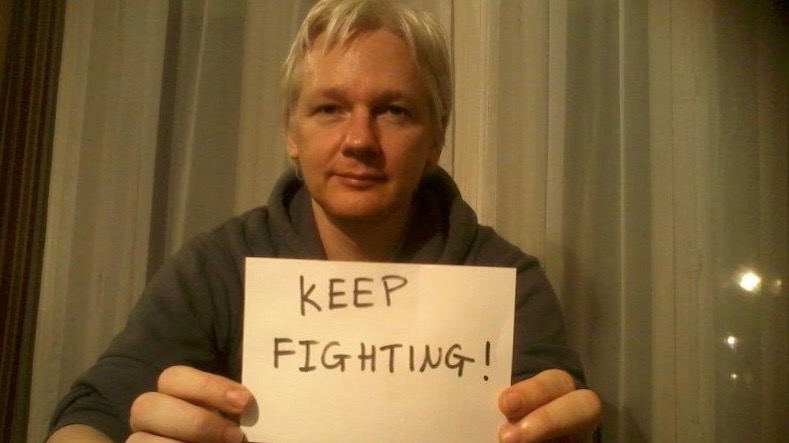
Israel has killed over 100 Palestinian journalists in seven months of its war on Gaza while Julian Assange has spent over 1850 days in prison for merely doing his duty


Journalists and independent media outlets are facing an unprecedented decline in press freedom and a rise of state repression all across the world, according to the annual report published by Reporters without Borders (RSF) on the occasion of World Press Freedom Day on May 3.

RSF claims that the physical security of journalists continues to be the main threat to press freedom, noting that over 100 Palestinian journalists have been killed by Israel in Palestine in the last seven months of war in Gaza. RSF’s World Press Freedom Index of 2024 notes with worry that in most of the countries, political authorities supposed to protect press freedom, have emerged as the primary threat and the world has seen a “worrying decline in respect for media autonomy.”

RSF’s findings draw attention to the long incarceration of Julian Assange with a threat to his life. Assange’s example presents the significant indictment of the governments in the West who otherwise claim to cherish media freedom.

World Press Freedom Day was first proclaimed by the UN General Assembly in December 1993 on the recommendations of the UNESCO general conference as a reminder to governments across the world of their commitment to free press. The day also underlines the need to take steps to defend the media from attacks on its independence and to commemorate all the journalists and media workers who have lost their lives in the line of duty.

Several reports confirm RSF’s figure of the killing of over 100 Palestinian journalists by Israel in its war against the people of Gaza in the last seven months. Meanwhile, local Palestinian sources claim the figure is above 140. Due to Israel’s genocide, Palestinian territories, with a population of less than seven million, have emerged as the deadliest place on earth for journalists in the last year.

Free Julian Assange!

Julian Assange, the co-founder of Wikileakes, will be spending his 1850th day in prison for his work exposing the deliberate killing of civilians by the US forces during the Iraq and Afghanistan wars more than a decade ago.

Assange has been kept in the British jail with repeated threats of extradition to the US, where he would face charges under the Espionage Act that could total a sentence of 175 yearsAssange’s continued incarceration despite his severe mental and physical health issues by some of the most “celebrated governments” on the RSF’s Index, is the best example of intolerance of the governments in the West to the truth.

Activists and friends of Assange have used the occasion of the World Press Freedom Day, reminding that it “was established to celebrate the value of truth and to protect the people who work courageously to uncover it” reiterated their demand of dropping all the charges and his immediate release from prison.

In the same countries that try to cover up Assange’s unjust imprisonment while championing press freedom, journalists and media groups also face challenges. Some journalists have lost their jobs altogether, especially with regards to opposition to outlets’ position on Israel’s genocide in Gaza. In recent years, several media organizations have faced forced closures and censorship under the guise of “foreign state influence”. Some of these countries are among the highest ranked in the RSF’s index as well, with Germany, one such offender, apparently improving its rankings.

The threat of losing their jobs has historically forced many journalists in the West to fall in line and manipulate truth. For example, in the case of Israeli genocide in Gaza many journalists fall in line with their outlets role to support the unshakeable US support to Israel and deliberately misrepresent the horrific truth of what is happening.

The fight for press freedom continues but as the threats to the well being of Julian Assange and the journalists in Gaza show us, there can be no free press as long as imperialists continue to vie for global domination.

Original article by Abdul Rahman republished from peoples dispatch under a Creative Commons Attribution-ShareAlike 4.0 (CC BY-SA) license.
Continue ReadingMedia freedom faces unprecedented threats globally, reports say on World Press Freedom Day

Amnesty Details ‘Shocking’ Allegations of India Targeting Reporters With Pegasus Spyware

Spread the love

Original article by JULIA CONLEY republished from Common Dreams under Creative Commons (CC BY-NC-ND 3.0). 

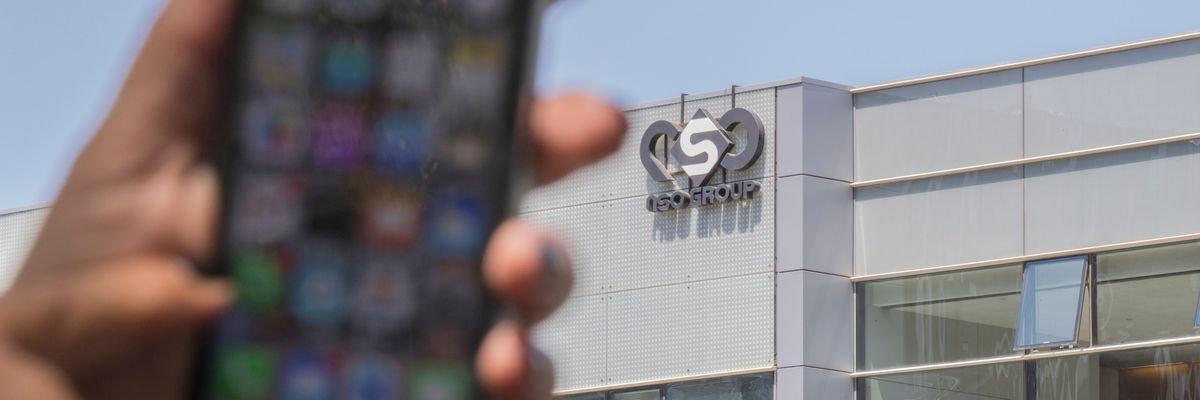
A woman uses an iPhone in front of the building of the NSO Group, developer of the spyware Pegasus, on August 28, 2016, in Herzliya, Israel. (Photo: Jack Guez/AFP via Getty Images)

“Increasingly, journalists in India face the threat of unlawful surveillance simply for doing their jobs,” said one advocate.

Amnesty International on Thursday demanded transparency from the Indian government regarding its contracts with surveillance companies, including the Israeli firm NSO Group, after the rights organization joined The Washington Post in publishing what it called “shocking new details” about the use of spyware to target journalists in India.

Amnesty’s Security Lab revealed that a round of “state-sponsored attacker” notifications that were sent to Apple customers in October by the tech company went to more than 20 Indian journalists including Siddharth Varadarajan, founding editor of The Wire, and Anand Mangnale, South Asia editor at the Organized Crime and Corruption Report Project (OCCRP).

The Security Lab ran a forensic analysis of the two reporters’ devices and found evidence that the NSO Group’s highly invasive Pegasus spyware, which is capable of eavesdropping on phone calls and harvesting data, had been installed on phones owned by Varadarajan and Mangnale.

In Mangnale’s case, the journalist appeared to have received a “zero-click exploit” via iMessage on August 23, allowing the individual or group who sent it to covertly install Pegasus spyware on his phone without requiring Mangnale to take any action, such as clicking a link.

At the time of the attempted attack, said Amnesty, Mangnale was working on a story about alleged stock manipulation by a major Indian multinational firm with ties to Indian Prime Minister Narendra Modi. The journalist told Agence France Presse that his phone was targeted “within hours” of his sending interview questions to the company.

The timing of the attack—and the fact that NSO Group has said it only licenses Pegasus to governments and security agencies—was “a hell of a coincidence,” Mangnale said.

“Targeting journalists solely for doing their work amounts to an unlawful attack on their privacy and violates their right to freedom of expression,” said Donncha Ó Cearbhaill, head of Amnesty’s Security Lab. “All states, including India, have an obligation to protect human rights by protecting people from unlawful surveillance.”

The Indian government was previously accused of targeting journalists, opposition politicians, and activists with Pegasus in 2021, when leaked documents showed the spyware had attacked more than 1,000 phone numbers.

India has fallen 21 spots to 161 out of 180 countries in Reporters Without Borders’ World Press Freedom Index since Modi took office in 2014. In addition to the alleged use of spyware by the government, journalists have been arrested and detained while covering anti-government protests, and reporters have been targeted by coordinated social media campaigns inciting hatred and violence.

Varadarajan was the subject of an earlier report by Amnesty, which documented how he had previously been targeted by Pegasus spyware in 2018.

This past October the same email address used in the Pegasus attack on Mangnale was identified on Varadarajan’s phone, confirming he was targeted again.

Varadarajan toldThe Washington Post that at the time of the most recent covert spyware installation, he had been leading public opposition to the detention of a news publisher in New Delhi.

“Our latest findings show that increasingly, journalists in India face the threat of unlawful surveillance simply for doing their jobs, alongside other tools of repression including imprisonment under draconian laws, smear campaigns, harassment, and intimidation,” said Ó Cearbhaill.

The group called for the Indian Supreme Court to immediately release the findings of a technical committee report on Pegasus, which was completed in 2022 but has still not been made public.

“Despite repeated revelations,” said Ó Cearbhaill, “there has been a shameful lack of accountability about the use of Pegasus spyware in India which only intensifies the sense of impunity over these human rights violations.”

Original article by JULIA CONLEY republished from Common Dreams under Creative Commons (CC BY-NC-ND 3.0). 

Continue ReadingAmnesty Details ‘Shocking’ Allegations of India Targeting Reporters With Pegasus Spyware

Reporters Without Borders denied access to visit Julian Assange in Belmarsh prison

Spread the love

Earlier today Reporters Without Borders’ (RSF’s) Secretary-General Christophe Deloire and Director of Operations and Campaigns Rebecca Vincent arrived to visit Julian Assange inside Belmarsh prison but were denied access at the last minute.

RSF’s representatives had been granted permission to visit Assange before the four-year anniversary of his imprisonment in Belmarsh, where he has been held since 11 April 2019.

Christophe Deloire, RSF Secretary-General, said: “We are deeply disappointed by the arbitrary decision of the Belmarsh Prison Governor to prevent us from visiting Julian Assange, despite following all relevant prison procedures and rules. Julian Assange has the right to receive visitors in prison, and we are legitimate to visit him as a press freedom NGO. We call for an urgent reversal of this decision and to be allowed visitation access without further delay.”

Rebecca Vincent, RSF Director of Operations, said: “This is the latest in a long series of ludicrous obstacles that we have faced over the past three years in campaigning for the release of Julian Assange. At every level, British authorities have defaulted to secrecy and exclusion rather than allowing normal engagement around this case – from refusing to accept RSF petitions, to making it nearly impossible to access court, and now this. What do they have to hide? Regardless, we continue our campaign to #FreeAssange.

WikiLeaks editor-in-chief Kristinn Hrafnsson commented on the news: “A press freedom NGO barred from visiting a political prisoner and a journalist (after visit had previously been confirmed). This is not Russia, China or North Korea but the United Kingdom. Remember this next time the UK Government tries to lecture you on lack of press freedom elsewhere.”

Continue ReadingReporters Without Borders denied access to visit Julian Assange in Belmarsh prison