US Rights Group Urges Media to Condemn Israel’s Killing of Journalists in Gaza

Spread the love

Original article by BRETT WILKINS republished from Common Dreams under Creative Commons (CC BY-NC-ND 3.0).
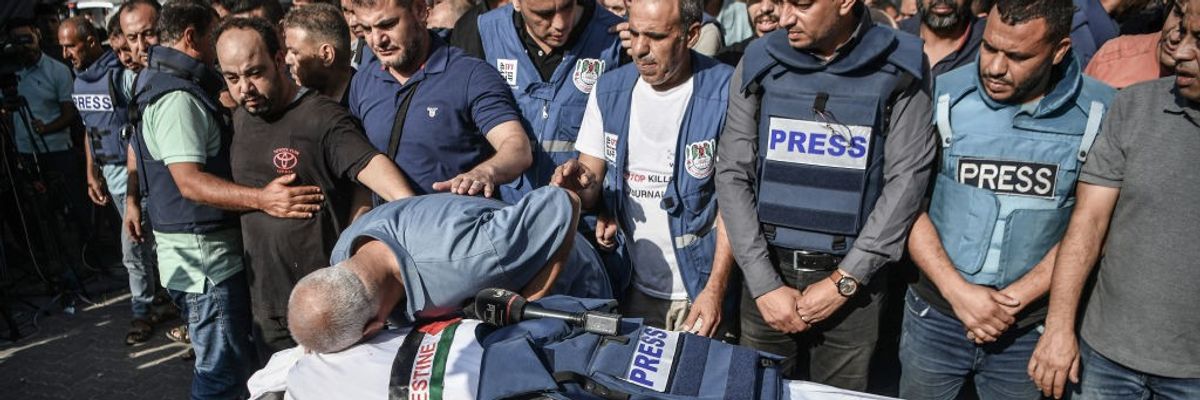
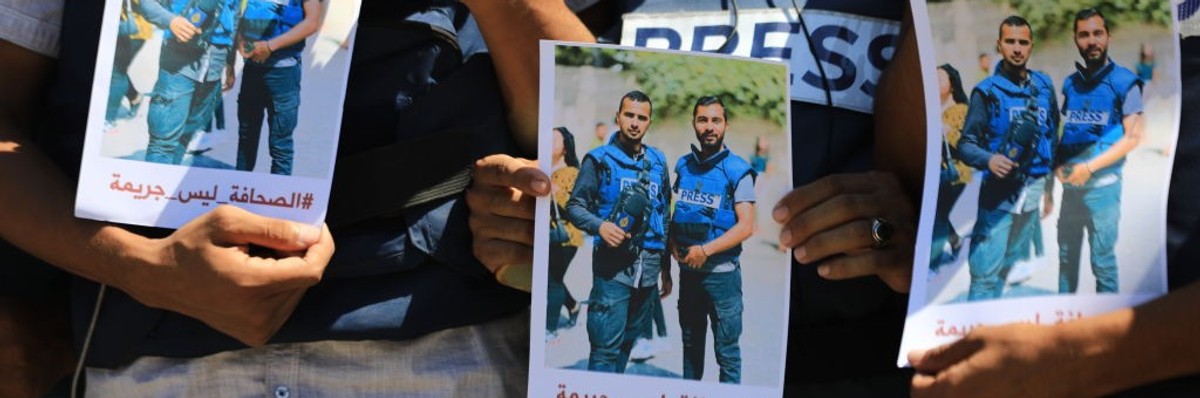
A funeral ceremony is held for Palestine TV correspondent Mohammed Abu Hatab, who was killed, along with his family members, in an airstrike on his home in Khan Yunis, Gaza on November 3, 2023. (Photo: Abed Zagout/Anadolu via Getty Images)

“The only thing that can explain the shocking silence of American and international media professionals about the mass killing of their Palestinian colleagues is the decadeslong and systematic dehumanization of the Palestinian people.”

The largest U.S. Muslim advocacy group on Friday implored American and international media outlets to speak out against Israel’s killing of more than 100 journalists, almost all of them Palestinians, during the ongoing assault on Gaza.

The Council on American-Islamic Relations (CAIR) renewed its plea following Israeli airstrikes on the homes of Palestine TV journalist Tamim Ma’mmar and Al-Aqsa TV‘s Abdullah Al-Sousi. Ma’mmar was killed along with his wife and two of their children, while the other attack killed Al-Sousi and two of his nephews, according to Quds News Network.

“The only thing that can explain the shocking silence of American and international media professionals about the mass killing of their Palestinian colleagues is the decadeslong and systematic dehumanization of the Palestinian people, in which the lives of Palestinians have lesser or no value,” CAIR national communications director Ibrahim Cooper said in a statement.

“Journalists worldwide must begin to speak out about these killings and about the Israeli genocide in Gaza,” he added.

https://twitter.com/QudsNen/status/1821932693400981588?ref_src=twsrc%5Etfw%7Ctwcamp%5Etweetembed%7Ctwterm%5E1821932693400981588%7Ctwgr%5Eb50525bcbd64fb1a441b5d53fd2d2b071768fd5b%7Ctwcon%5Es1_c10&ref_url=https%3A%2F%2Fwww.commondreams.org%2Fnews%2Fisrael-killing-journalists

Israel is on trial for genocide at the International Court of Justice in The Hague. Its 308-day assault on Gaza has left more than 142,000 Palestinians dead, wounded, or missing, according to local and international officials.

Preliminary investigations by the New York-based Committee to Protect Journalists found that at least 113 media professionals—including 108 Palestinians, three Lebanese, and two Israelis—have been killed during the war, “making it the deadliest period for journalists since CPJ began gathering data in 1992.”

CPJ has condemned what it called an “apparent pattern of targeting journalists and their families,” noting cases in which media workers were killed while wearing press insignia and after being threatened by Israeli officials.

Gaza’s Government Media Office said this week that Israeli forces have killed 166 journalists since October.

In May, the Paris-based press freedom group Reporters Without Borders (RSF) filed a third complaint at the International Criminal Court alleging “war crimes against journalists in Gaza.”

RSF said it had “reasonable grounds for thinking that some of these journalists were deliberately killed and that the others were the victims of deliberate IDF attacks against civilians” and accused Israel of “an eradication of the Palestinian media.”

The following month, the Gaza Project—led by the Paris-based nonprofit Forbidden Storiespublished a report detailing a “chilling pattern” of Israeli forces apparently targeting journalists during the war.

Human Rights Watch and Amnesty International have called for official investigations into Israeli killing of journalists including an October 13 attack that killed 37-year-old Lebanese Reuters videographer Issam Abdallah and wounded half a dozen other journalists who were covering cross-border clashes between Israeli troops and Hezbollah fighters in southern Lebanon.

Dylan Collins, an American deputy editor at Al Jazeera English, was wounded while administering first aid to Christina Assi, an Agence-France Presse journalist who was seriously wounded in the attack. Assi-one of whose legs was amputated—recently carried the Olympic torch in Paris.

CPJ president Jodie Ginsburg recently told Al Jazeera that the killing of journalists by Israeli forces “appears to be part of a broader strategy that aims to stifle the information coming out of Gaza.”

Original article by BRETT WILKINS republished from Common Dreams under Creative Commons (CC BY-NC-ND 3.0).

Continue ReadingUS Rights Group Urges Media to Condemn Israel’s Killing of Journalists in Gaza

US Urged to Condemn Israel’s ‘Summary Execution’ of Two Journalists

Spread the love

Original article by EDWARD CARVER republished from Common Dreams under Creative Commons (CC BY-NC-ND 3.0). 

Palestinian Al Jazeera journalist Ismail al-Ghoul and cameraman Rami al-Rifee were killed by Israeli forces on July 31, 2024. (Photo: Dawoud Abo Alkas/Anadolu via Getty Images)

International outcry and a reporter’s pointed questions weren’t enough to get the State Department to denounce the killings of Al Jazeera journalists.

A Palestinian journalist on Thursday pressed a U.S. State Department spokesperson to characterize the killings of two Al Jazeera journalists by Israeli forces as summary execution.

The heated press briefing followed an airstrike on Wednesday that killed Al Jazeera reporter Ismail al-Ghoul and cameraman Rami al-Rifee, and sparked global outrage. Israel’s military acknowledged targeting al-Ghoul, saying he was “eliminated” because he was a Hamas “terrorist,” an allegation the Qatar-based network said was “baseless.”

The death toll of Palestinian journalists and media workers now stands at least 108, including several intentionally targeted by Israel forces, according to the Committee to Protect Journalists (CPJ).

Said Arikat, the Washington bureau chief of Al-Quds, an Arabic-language newspaper based in Jerusalem, called the strike a “premeditated crime to kill a journalist for doing their job” and a “summary execution” in the press briefing, but State Department spokesperson Vedant Patel declined to affirm the characterizations or condemn the airstrike.

Al-Ghoul and al-Rifee were killed in northern Gaza after reporting from near the home of Ismail Haniyeh, the Hamas political leader who was assassinated in Tehran earlier on Wednesday. They wore press vests and had signs on their vehicle identifying them as journalists; they had last contacted their news desk just 15 minutes before the strike, Al Jazeera reported.

The Israel Defense Forces (IDF) presented no evidence in a social media post claiming that al-Ghoul was a terrorist and Hamas operative. In March, al-Ghoul reported being stripped, handcuffed, and blindfolded during the course of a 12-hour detainment by Israeli forces; he had been covering an Israeli attack on al-Shifa hospital in Gaza City. Witnesses said Israeli forces severely beat al-Ghoul at the hospital before arresting him.

Anas al-Sharif, another Al Jazeera reporter in Gaza, was on site at a different hospital on Wednesday when his colleagues’ bodies were brought in, and he spoke about the role al-Ghoul had played in the outlet’s war coverage.

“Ismail was conveying the suffering of the displaced Palestinians and the suffering of the wounded and the massacres committed by the [Israeli] occupation against the innocent people in Gaza,” he told his own news outlet.

“The feeling—no words can describe what happened,” he added.

In protest of the killings, Palestinian journalists gathered to throw off their press vests and vowed to continue showing the suffering of Gazans through their work, despite the dangers they faced.

Condemnation of the killings of the two Al Jazeera journalists came not just from Gaza but all over the world.

CPJ CEO Jodie Ginsberg said in a statement that she was “dismayed” by the killings and that journalists are civilians who should never be targeted.

Defending Rights & Dissent, a U.S.-based civil liberties nonprofit, also condemned the killing of al-Ghoul and said the reasons for it were clear.

“When you ‘eliminate’ journalists, it’s much easier to hide war crimes, it’s easier to spread lies, it’s easier to commit genocide,” Sue Udry, the group’s executive director, said in a statement.

In response to the killing, the International Committee of the Red Cross (ICRC) said that journalists “must be protected, and we decry attacks against them.”

William Schomburg, head of the ICRC’s sub-delegation in Gaza, said in a statement that his team had just met with al-Ghoul the previous week to get an update on the humanitarian situation in Gaza. “Journalists in all wars play a central role in highlighting the plight of civilians and in speaking for the voiceless,” Schomburg said.

Reporters Without Borders (RSF, in French), a Paris-based nonprofit, wrote in unequivocal terms about the need for Israel to stop killing journalists.

“RSF is deeply disturbed to see the Israel Defense Forces using social media to justify their targeted killing of Al Jazeera journalist Ismail al-Ghoul,” the organization wrote on social media. “Journalists are not terrorists. This campaign of violence against media in Gaza must stop now.”

The Freedom of the Press Foundation also responded forcefully to the IDF’s claim about al-Ghoul.

“Documenting a war isn’t terrorism, it’s journalism,” the group wrote on social media. “If the IDF can prove al-Ghoul was working for Hamas’ military, it should do so immediately. If not, this looks like a flimsy excuse for intentionally murdering a journalist from an outlet Israel dislikes.”

Israeli forces have killed at seven journalists or media workers affiliated with Al Jazeera during the war, and Israel shut down the network’s local operations in May, citing a security threat, though critics said it was a case of censorship—an attempt to hide the brutality of the assault on Gaza.

In total, 113 journalists and media workers have died since the war began, including two Israelis and three Lebanese, according to CPJ, which says this has been the deadliest period for journalists anywhere in the world since it began collecting data in 1992.

The international outcry over all of the killings has ramped up pressure on the U.S.—which has backed the Israeli assault with weapons and diplomatic support— to condemn them, and Wednesday’s strike on al-Ghoul and al-Rifee has only increased that pressure. Still, Patel, the spokesperson, wouldn’t issue any such condemnation on Thursday.

Arikat also pressed Patel to call for the release of Palestinian journalists being held in Israeli detention centers without charges, but Patel didn’t do so.

Original article by EDWARD CARVER republished from Common Dreams under Creative Commons (CC BY-NC-ND 3.0). 

Continue ReadingUS Urged to Condemn Israel’s ‘Summary Execution’ of Two Journalists

The Gaza Project Exposes Israel’s ‘Chilling Pattern’ of Killing Journalists

Spread the love

Original article by BRETT WILKINS republished from Common Dreams under a CC licence.

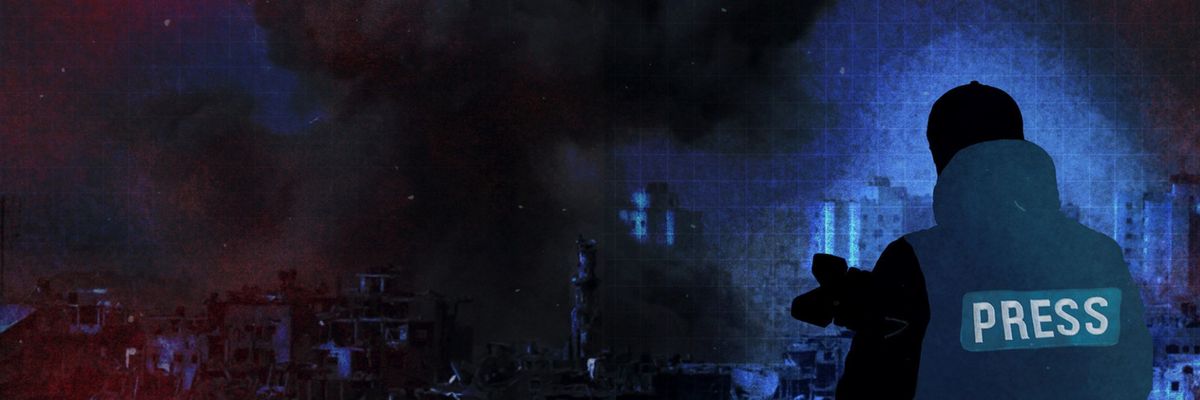
Forbidden Stories and its Gaza Project partners investigated Israel’s killing of journalists in Gaza and elsewhere.
 (Illustration: Forbidden Stories/The Gaza Project)

“This is one of the most flagrant attacks on press freedom that I can remember,” said one campaigner. “The impact on press freedom in Gaza, in the region, and the rest of the world is something we cannot accept.”

With more than 100 media professionals—nearly all of them Palestinian—killed in Gaza since October, a group of 50 reporters from 13 international organizations this week shared the results of a new investigative journalism initiative aimed at exposing the deadly toll Israel’s onslaught has taken on those reporting it to the world.

The Gaza Project—led by the Paris-based nonprofit Forbidden Stories—”analyzed nearly 100 cases of journalists and media workers killed in Gaza, as well as other cases in which members of the press have been allegedly targeted, threatened, or injured since October 7,” when Hamas-led attacks on Israel left more than 1,100 people dead and over 240 others kidnapped.

“Faced with what is being reported as the record number of journalists killed, Forbidden Stories, whose mission is to pursue the work of journalists who are killed because of their work, set out to investigate the targeting of journalists,” the group said

“For four months, Forbidden Stories and its partners investigated the circumstances of their killings, as well as those who have been targeted, threatened, and injured in the West Bank and Gaza,” it added. “These investigations point to a chilling pattern and suggest some journalists may have been targeted even though they were identifiable as press.”

Gaza Project member Committee to Protect Journalists (CPJ) has condemned what it called an “apparent pattern of targeting journalists and their families,” noting cases in which media workers were killed while wearing press insignia and after being threatened by Israeli officials.

“This is one of the most flagrant attacks on press freedom that I can remember,” CPJ program director Carlos Martínez de la Serna said of the ongoing war. “The impact on press freedom in Gaza, in the region, and the rest of the world is something we cannot accept.”

Basel Khair Al-Din, a Palestinian journalist in Gaza who believes he was targeted by a drone strike while wearing a press vest, said, “Whereas this press vest was supposed to identify and protect us, according to international laws, international conventions, and the Geneva Conventions, it is now a threat to us.”

“It’s this vest that almost got us killed, as has happened to so many of our fellow journalists and media workers,” he added.

Groups like Human Rights Watch (HRW) and Amnesty International have called for official investigations into Israeli killing of journalists including an October 13 attack that killed 37-year-old Lebanese Reuters videographer Issam Abdallah and wounded half a dozen other journalists who were covering cross-border clashes between Israeli troops and Hezbollah fighters in southern Lebanon.

Dylan Collins, an American deputy editor at Al Jazeera English, was wounded while administering first aid to Christina Assi, an Italian Agence-France Presse journalist whose legs were blown off in the attack.

Reuters determined that an Israeli tank crew “fired two shells in quick succession” at the journalists, who HRW said were “clearly identifiable as members of the media, and had been stationary for at least 75 minutes.” HRW “found no evidence of a military target near the journalists’ location.”

Amnesty International, meanwhile, asserted that the Israel Defense Forces (IDF) strike was “likely a direct attack on civilians that must be investigated as a war crime.”

Asa Kasher, the lead author of the IDF’s Code of Ethics, told Forbidden Stories that “no member of the press should have been killed under normal circumstances of hostilities in Gaza.”

“It shouldn’t happen, even a single one,” he added. “It’s illegal. It’s unethical. The person who does it should be brought to court.”

Israel’s alleged deliberate targeting of journalists is part of the evidence presented in a South Africa-led genocide case against Israel being reviewed by the International Court of Justice in The Hague.

Separately, the chief prosecutor at the International Criminal Court (ICC), also located in the Dutch city, is seeking arrest warrants for Israeli Prime Minister Benjamin Netanyahu, Israeli Defense Minister Yoav Gallant, and three Hamas leaders for alleged war crimes and crimes against humanity including extermination and forced starvation in the case of the Israelis and extermination, rape, and torture in the case of Hamas.

The international press freedom group Reporters Without Borders last month filed a third ICC complaint alleging “war crimes against journalists in Gaza.”

According to Palestinian and international officials, at least 37,718 Palestinians—mostly women and children—have been killed during Israel’s 264-day assault on Gaza, which has also left more than 86,300 people wounded and 11,000 others missing and feared dead and buried beneath the rubble of hundreds of thousands of homes and other bombed-out buildings.

Around 90% of Gaza’s 2.3 million people have also been forcibly displaced, and the Israeli siege on Gaza has caused widespread—and deadly—starvation and what the head of the United Nations food agency called a “full-blown famine” in northern parts of the strip.

Original article by BRETT WILKINS republished from Common Dreams under a CC licence.

Zionist Keir Starmes is quoted "I support Zionism without qualification." He's asked whether that means that he supports Zionism under all circumstances, whatever Zionists do.
Zionist Keir Starmes is quoted “I support Zionism without qualification.” He’s asked whether that means that he supports Zionism under all circumstances, whatever Zionists do.

Continue ReadingThe Gaza Project Exposes Israel’s ‘Chilling Pattern’ of Killing Journalists

Group Files New ICC Complaint Over Journalists Killed by Israel in Gaza

Spread the love

Original article by BRETT WILKINS republished from Common Dreams under Creative Commons (CC BY-NC-ND 3.0). 

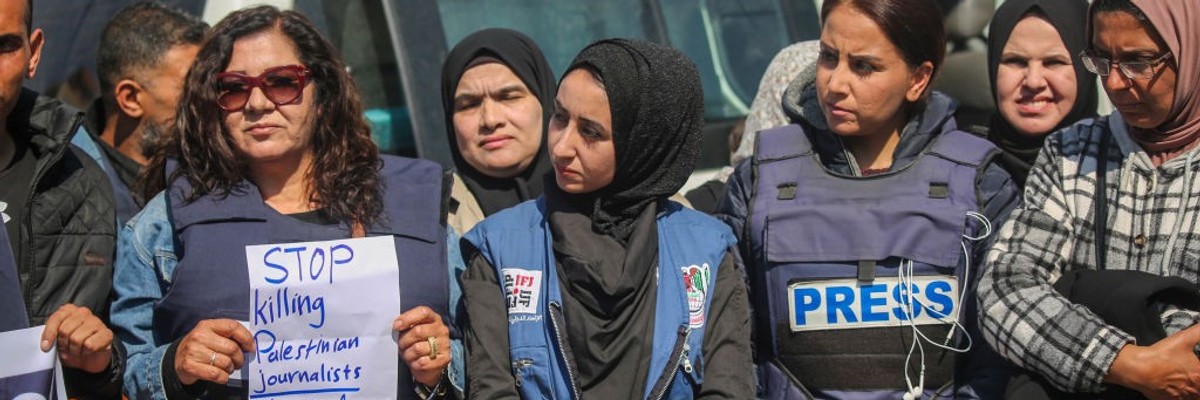
Palestinian journalists stage a protest to draw attention to Palestinian press killed while covering the war in the Gaza Strip on February 26, 2024 in Rafah.
 (Photo: Ahmad Hasaballah/Getty Images)

Reporters Without Borders says it has “reasonable grounds for thinking that some of these journalists were deliberately killed and that the others were the victims of deliberate IDF attacks against civilians.”

The press freedom group Reporters Without Borders announced Monday that it has filed a third complaint at the International Criminal Court alleging “war crimes against journalists in Gaza,” where over 100 media professionals have been killed by Israeli forces since October 7.

Paris-based Reporters Without Borders (RSF) is asking the ICC to investigate the Israel Defense Forces’ (IDF) killing of eight Palestinian journalists and wounding of another between December 15 and May 20 and, more broadly, the over 100 media workers slain during the course of Israel’s 234-day assault on Gaza.

RSF said it “has reasonable grounds for thinking that some of these journalists were deliberately killed and that the others were the victims of deliberate IDF attacks against civilians” and accused Israel of “an eradication of the Palestinian media.”

“Impunity endangers journalists not only in Palestine but also throughout the world,” RSF advocacy and assistance director Antoine Bernard said in a statement. “Those who kill journalists are attacking the public’s right to information, which is even more essential in times of conflict. They must be held accountable, and RSF will continue to work to this end, in solidarity with Gaza’s reporters.”

Journalists in RSF’s latest complaint include Mustapha Thuraya and Hamza al-Dahdouh, freelancers working for Al Jazeera in Rafah when they were killed by a targeted Israeli drone strike on their vehicle on January 7, and Hazem Rajab, who was injured in the strike.

According to RSF:

The complaint also cites the cases of Hadaf News website reporter Ahmed Badir, who was killed by an airstrike at the entrance to Shuhada al-Aqsa Hospital in Deir al-Balah on 10 January; Kan’an News Agency correspondent Yasser Mamdouh, who was killed near Al-Nasser Hospital in Khan Yunis on 11 February; Ayat Khadoura, an independent video blogger killed by an Israeli strike on his home on 20 November shortly after posting a video; Yazan Emad Al-Zwaidi, a cameraman with the Egyptian satellite TV news channel Al Ghad, who was killed on 14 January when an Israeli strike hit the group of civilians he was with in Beit Hanoun; Ahmed Fatima, a journalist with the Al Qahera News TV channel, who was killed during a bombardment in Khan Yunis on 13 November; and Rami Bdeir, a reporter for the Palestinian New Press media outlet, who was killed during an Israeli bombardment in Khan Yunis on 15 December.

Another advocacy group, the Committee to Protect Journalists, previously condemned what it called an “apparent pattern of targeting journalists and their families,” noting cases in which media workers were killed while wearing press insignia and after being threatened by Israeli officials.

Monday marked the ninth anniversary of United Nations Security Council Resolution 2222, which concerns the protection of journalists in conflict zones and “emphasizes the responsibility of states to comply with the relevant obligations under international law to end impunity and to prosecute those responsible for serious violations of international humanitarian law.”

Last month, Francesca Albanese, the U.N. special rapporteur on the occupied Palestinian territories, said: “Killing journalists is a war crime that undermines the most basic human rights. Justice starts with the cessation of injustice.”

Original article by BRETT WILKINS republished from Common Dreams under Creative Commons (CC BY-NC-ND 3.0). 

Continue ReadingGroup Files New ICC Complaint Over Journalists Killed by Israel in Gaza

AP and Free Press Defenders Blast Israeli Shutdown of Gaza Live Feed

Spread the love

Original article by BRETT WILKINS republished from Common Dreams under Creative Commons (CC BY-NC-ND 3.0).

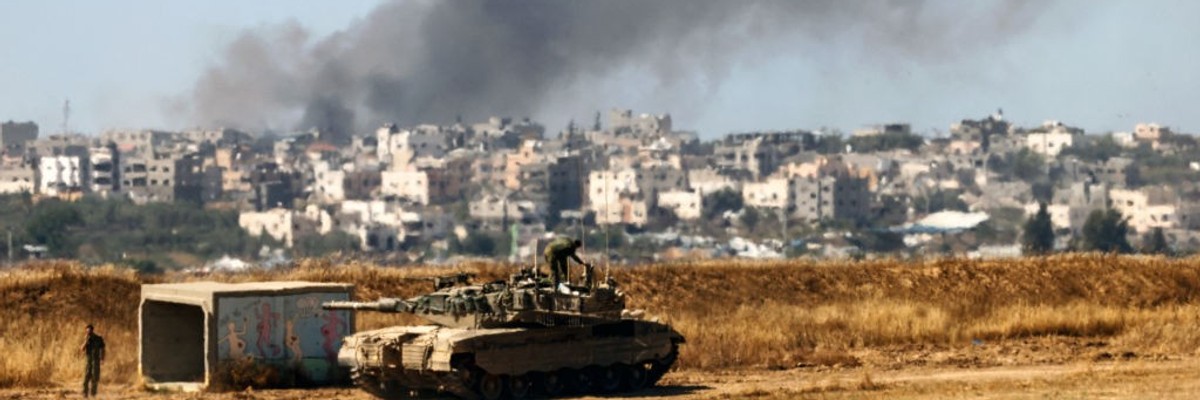
An Israel Defense Forces tank and soldiers are seen in this view of Gaza from southern Israel on May 15, 2024. (Photo: Jack Guez/AFP via Getty Images)

One NGO called the move “yet another attempt by Israel to hide its war crimes against Palestinians.”

The White House and press freedom advocates were among those who on Tuesday criticized the Israeli government’s shutdown of The Associated Press‘ live video shot of northern Gaza for violating a new media law by providing access to the banned Al Jazeera network.

The AP said Israeli authorities confiscated its camera and broadcasting equipment from a home in the southern Israeli city of Sderot. The live shot was broadcast from a balcony on the home.

The Associated Press decries in the strongest terms the actions of the Israeli government to shut down our long-standing live feed showing a view into Gaza and seize AP equipment,” said Lauren Easton, vice president of corporate communications at the New York-based news organization.

“The shutdown was not based on the content of the feed but rather an abusive use by the Israeli government of the country’s new foreign broadcaster law,” Easton added. “We urge the Israeli authorities to return our equipment and enable us to reinstate our live feed immediately so we can continue to provide this important visual journalism to thousands of media outlets around the world.”

The law to which Easton referred empowers the Israeli government to shut down the operations of foreign media outlets if they are deemed national security threats. Israeli Prime Minister Benjamin Netanyahu’s far-right Cabinet used the law to ban Qatar-based Al Jazeera—the sole international media outlet providing 24/7 live coverage from Gaza—from operating in Israel.

Israeli Communications Minister Shlomo Karhi said the AP broke the foreign broadcaster law by providing the live feed to Al Jazeera, one of thousands of AP clients. Karhi accused the AP of “causing real harm to the security of the state.”

“It should be noted that a warning was given to the AP agency already last week that according to the law and the government’s decision they are prohibited from providing broadcasts to Al Jazeera, however they decided to continue broadcasting on the channel,” Karhi said.

Speaking to reporters aboard Air Force One en route to New Hampshire on Tuesday, White House Press Secretary Karine Jean-Pierre said that U.S. President Joe Biden believes journalists should be free to do their jobs. Addressing Israel’s shutdown of the AP live feed, Jean-Pierre said, “Obviously this is concerning and we want to look into it.”

Paris-based Reporters Without Borders (RSF) was one of several press freedom groups that condemned Israel’s shutdown of the AP live feed.

“After having banned Al Jazeera, Israel is lashing out at the AP,” RSF said in a statement. “RSF denounces the seizure of the news outlet’s camera and the interruption of the continuous feed that films Gaza under the pretext that these images are supplying, among others, Al Jazeera.”

The U.S. advocacy group Freedom of the Press Foundation said on social media that “Israel is now using its Al Jazeera ban as a pretext to seize equipment belonging to one of the world’s largest news agencies, stripping millions of people of a view into Gaza at a time of war and mass atrocities.”

Kenneth Roth, a visiting professor at Princeton University in New Jersey and former head of Human Rights Watch, said that “rather than stop the war crimes charged yesterday by the International Criminal Court, Israel tries to cover them up.”

Roth was referring to Monday’s decision by ICC Prosecutor Karim Khan to seek arrest warrants for Netanyahu and Israeli Defense Minister Yoav Gallant and Hamas leaders Yahya Sinwar, Ismail Haniyeh, and Mohammed Deif for alleged war crimes and crimes against humanity in connection with the October 7 attacks on Israel and that country’s genocidal retaliation—which has killed, wounded, or left missing more than 126,000 Palestinians, according to Gazan and international officials.

More than 100 journalists, the vast majority of them Palestinians, have been killed by Israeli forces since October 7 in what the Committee to Protect Journalists and others say are often intentional targetings of not only media workers but also their families. Previous investigations—including the probe of Israeli troops’ 2022 killing of Palestinian American Al Jazeera reporter Shireen Abu Akleh—have confirmed that Israel has deliberately targeted journalists.

Israeli forces have also attacked newsrooms during every major Gaza war, including in May 2021 when the 11-story al-Jalaa Tower—which housed offices of Al JazeeraAP, and other media outlets—was leveled in an airstrike.

Even Yair Lapid, who leads Israel’s political opposition and is a former journalist, called the AP shutdown “an act of madness.”

“This is an American media outlet that has won 53 Pulitzer Prizes,” Lapid said in a statement. “This government behaves as if it has decided to make sure at any cost that Israel will be outcast all over the world. They went mad.”

Original article by BRETT WILKINS republished from Common Dreams under Creative Commons (CC BY-NC-ND 3.0).

Continue ReadingAP and Free Press Defenders Blast Israeli Shutdown of Gaza Live Feed