People attending the People’s Assembly Against Austerity protest in central London, June 7, 2025
BRITAIN’S Communists meet tomorrow in Yorkshire for their 58th Congress. They will debate the urgent challenges faced by the left across the nations of Britain and more widely across the world.
Reactionary nationalism and racism, accelerated militarism and the abandonment of commitments on global warming all demand a new level of unity, a united front, not just as a slogan, but as a unifying solidarity across our communities and the organised labour movement.
How to secure that unity is a question that both unites but also sometimes divides the wider left. It is certainly not one that will be currently resolved by thinking purely in terms of political parties.
Keir Starmer says that the Labour Party under his leadership is intensely relaxed about assaulting those least able to defend themselves – the very poorest and most vulnerable.Nigel Farage urges you to ignore facts and reality and be a climate science denier like him and his Deputy Richard Tice. He says that Reform UK has received £Millions and £Millions from the fossil fuel industry to promote climate denial and destroy the planet.Nigel Farage explains the politics of Reform UK: Racism, Fake anti-establishmentism, Deregulation, Corporatism, Climate Change Denial, Mysogyny and Transphobia.
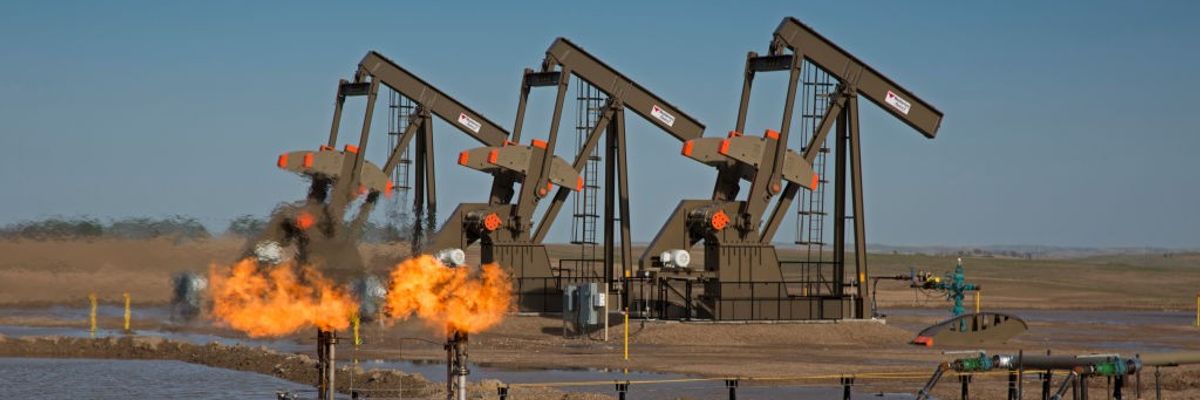
Natural gas is flared off as oil is pumped in the Bakken shale formation in Watford City, North Dakota. (Photo by Jim West/UCG/Universal Images Group via Getty Images)
“Without rapid, deep emissions cuts—over 50% by 2030—overshooting 1.5°C becomes ever more likely, with severe consequences for people and ecosystems,” one expert said.
Despite new national policies submitted ahead of the United Nations COP30 climate conference in Belém, Brazil, the world remains on track for a disastrous 2.6°C of fossil fuel-driven warming, according to an annual analysis released on Thursday.
Climate Action Tracker (CAT) said the 2025 report marked the fourth year in a row in which there had been “little to no measurable progress” in its warming predictions for 2100 based on the current policies and commitments of 40 countries.
“The world is running out of time to avoid a dangerous overshoot of the 1.5°C limit,” Climate Analytics CEO Bill Hare said in a statement. “Delayed action has already led to higher cumulative emissions, and new evidence suggests the climate system may be more sensitive than previously thought. Without rapid, deep emissions cuts—over 50% by 2030—overshooting 1.5°C becomes ever more likely, with severe consequences for people and ecosystems.”
Under the Paris Agreement, countries are required to submit nationally determined contributions (NDCs) every five years outlining their plans to slash greenhouse gas emissions and adapt to the impacts of the climate crisis. However, CAT found that nearly none of the 40 countries it analyzed had updated their 2030 NDCs or announced sufficiently ambitious 2035 NDCs ahead of COP30, which began on Monday. This means that the projected warming based on 2030 and 2035 targets remained at 2.6°C above preindustrial levels.
“We have said it before, and we will keep saying it: We are running out of time.”
“A world at 2.6°C means global disaster,” Hare toldThe Guardian, adding that it would likely trigger key tipping points such as the death of coral reefs, the transformation of the Amazon rainforest into grassland, the destabilizing of ice sheets, and the collapse of the Atlantic Meridional Overturning Circulation.
“That all means the end of agriculture in the UK and across Europe, drought and monsoon failure in Asia and Africa, lethal heat and humidity,” Hare explained. “This is not a good place to be. You want to stay away from that.”
CAT also made temperature projections based on existing policies and actions; pledges and targets, including binding long-term targets; and an optimistic scenario including net-zero targets. In 2025, the temperature projection for existing policies dropped from 2.7°C to 2.6°C, mostly due to a change in methodology, and the “optimistic scenario” remained the same at 1.9°C. However, the “pledges and targets” projection increased from 2.1°C to 2.2°C, predominately due to President Donald Trump’s decision to withdraw the US from the Paris Agreement.
Other major carbon polluters China and the European Union did not update their plans with the ambition required to meet the Paris goals.
— ClimateActionTracker @catclimate.bsky.social (@climateactiontr) November 13, 2025
The analysis comes a week after the UN Environment Programme released its Emissions Gap Report, which found that NDCs put the world on track for 2.3-2.5°C of warming, while current policies put it on track for 2.8°C.
Overall, CAT blamed the lack of progress on the continued growth of fossil fuel production and use. It noted that several major countries had continued to expand fossil fuels, from India, China, and Indonesia building more coal plants to Japan and Saudi Arabia championing gas as a “bridge fuel.”
“Worst of all,” the report authors wrote, “the United States is actively shutting down offshore wind projects, rolling back renewable energy incentives, cutting curbs on carbon pollution, and actively expanding oil and gas production.”
However, despite their grim projections, CAT did see hope in the massive rollout of renewable energy, which generated more power than coal for the first time in 2025.
“While not at the pace needed, our analysis shows that the Paris Agreement works,” said Niklas Höhne, of CAT partner the NewClimate Institute, in a statement.
Höhne continued:
Back in 2015, our current policies scenario led to 3.6°C of warming by 2100. Today, 10 years later, our latest projections show that this has been reduced by roughly 1°C to around 2.6°C. The Paris Agreement has rewritten the rules of global climate action—sparking investment, innovation, and reforms that would simply not have happened without it.
But governments need to speed up the pace now. Although emissions have risen, the exponential pace of the renewable energy expansion allows us to now reduce emissions much faster than previously thought. Governments can strengthen or overachieve 2030 targets, implement robust policies, and ensure transparency and accountability to deliver on the Paris Agreement promise and safeguard a sustainable future.
The faster governments act, the faster they can close the “targets gap” between current emissions and how far they have to fall to keep the 1.5°C goal within reach. This gap is expected to grown by as many as 2 billion metric tons between 2030 and 2035 alone.
The longer we wait, the larger the "targets gap": from 2030 to 2035, the gap between climate targets and the pathways to 1.5°C is projected to grow up to two billion tonnes, up from 26-29 GtCO2e in 2030, to 26-31 GtCO2e by 2035. pic.twitter.com/ityn6p9wOC
— ClimateActionTracker @catclimate.bsky.social (@climateactiontr) November 13, 2025
CAT said that current research indicates that implementing the most ambitious policies could limit peak warming to 1.7°C. This could be achieved by reaching net-zero carbon dioxide emissions before 2050, reaching net-zero greenhouse gas emissions in the 2060s, and removing carbon dioxide from the atmosphere. Under this scenario, global temperatures would return to below 1.5°C by the end of the century.
“We have said it before, and we will keep saying it: We are running out of time,” said report lead author Sofia Gonzales-Zuñiga.
“Every new fossil gas deal the EU makes, every new coal plant built in China, every fossil gas expansion project in Australia, every exported barrel from Norway, every tonne of LNG Japan pushes into neighboring Asian countries, costs billions to people elsewhere in the world as they deal with increasingly extreme weather events,” Gonzales-Zuñiga continued. “These are not abstract policy choices—they are physical realities with human consequences. The atmosphere does not negotiate, and it does not wait.”
Orcas comment on killer apes destroying the planet by continuing to burn fossil fuels.Donald Trump urges you to be a Climate Science denier like him. He says that he makes millions and millions for destroying the planet, Burn, Baby, Burn and Flood, Baby, Flood.Nigel Farage urges you to ignore facts and reality and be a climate science denier like him and his Deputy Richard Tice. He says that Reform UK has received £Millions and £Millions from the fossil fuel industry to promote climate denial and destroy the planet.
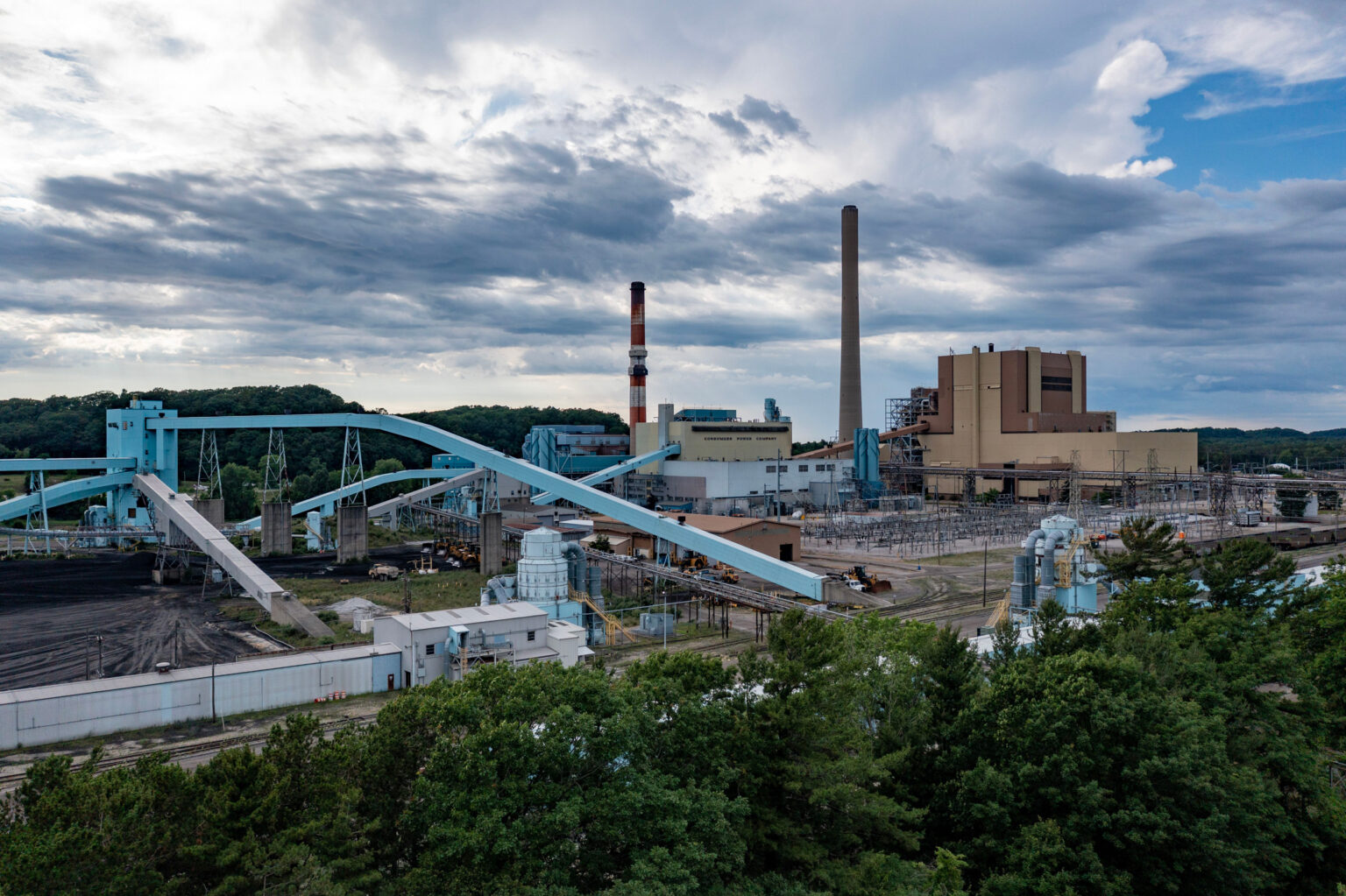
A view of Consumers Energy’s J.H. Campbell coal-fired power plant in West Olive, Mich. Credit: Jim West/UCG/Universal Images Group via Getty Images
Midwestern electricity ratepayers will pay the still-mounting tab under a plan Consumers Energy reported to regulators and investors.
The Trump administration’s emergency order to keep the huge J.H. Campbell coal plant on Lake Michigan operating past its planned retirement date has cost at least $80 million since May, its operator, Consumers Energy, told regulators and investors this week.
The company said in its third-quarter earnings report Thursday that it would pursue the process laid out in the U.S. Department of Energy’s order for collecting those costs: It will seek payment from ratepayers across the Midwest.
Even though the peak summer electricity demand season has passed, executives at Consumers, Michigan’s largest energy provider, said that they see no sign of let-up in the emergency orders.
“We expect those to continue for the long-term,” said CEO Garrick Rochow in a conference call for investors. “And we’re prepared to continue to operate the plant and comply with those orders.”
He said the costs—$615,385 per day—should be shared beyond the 1.9 million electricity customers of Consumers Energy. The company plans to propose the tab be split among ratepayers (an estimated 42 million to 45 million electricity customers) in the nine states served by the regional electric grid operator, the Midcontinent Independent System Operator (MISO).
“The benefits go to MISO,” Rochow said. “Not just to our customers, they go to MISO.”
Rochow said the Trump administration envisioned this approach. “That order from the Department of Energy has laid out a clear path to cost recovery,” he said. Consumers Energy will have to apply to the Federal Energy Regulatory Commission in order to pass the costs to the ratepayers, and states that oppose such a cost allocation could move to intervene in those proceedings.
U.S. Energy Secretary Chris Wright issued two consecutive 90-day orders—on May 23 and on Aug. 20—to keep the Campbell plant open under the emergency provisions of the Federal Power Act. In the past, such orders have been used to ensure energy delivery at times of natural disasters. But Wright used the act to execute Trump’s agenda to ramp up energy production, saying Campbell needed to stay open to minimize the risk of power outages and address critical grid security issues in the Midwest.
The Department of Energy did not immediately respond to a request for comment on the Campbell cost figures, nor did MISO. When he extended the Campbell order in August, Wright said that he was directing MISO “to take every step to minimize cost to the American people.”
“This order will help ensure millions of Americans can continue to access affordable, reliable, and secure baseload power,” he said in that statement.
But critics say the operation of the 63-year-old plant is generating unnecessary costs as well as pollution. In a September regulatory filing challenging the DOE’s order, a coalition of environmental groups pointed out that even on the day of highest peak demand this summer, MISO had an unused surplus of resources greater than 10 times the power provided by the Campbell plant.
And indeed, according to recent Environmental Protection Agency data, two of the three units at the Campbell plant were not operating at all for about 30 days of the 131 days from the start of the DOE order through Sept. 30. The third unit at the plant only ran for 18 days. Such stoppages could occur for maintenance or simply because the grid operator did not call on the plant to deliver energy to the grid.
“Forcing this unnecessary coal plant to keep operating is bilking consumers for the benefit of the coal industry,” said Michael Lenoff, senior attorney for Earthjustice, which is representing the environmental groups.
Because DOE did not respond to their petition for reconsideration of the Campbell order within 30 days, the environmental groups and the states of Michigan, Minnesota and Illinois have asked the D.C. Circuit Court of Appeals to review the case. The purpose of the litigation, Lenoff said, is “to stop the administration from harming consumers, trampling markets and unlawfully usurping the authority of states and regulators to make decisions in the public interest.”
Campbell is by far the largest of three fossil fuel electricity plants that are staying open beyond their planned retirements under Trump administration emergency orders. Campbell released 6.6 million metric tons of carbon in 2023, the most recent year for which data is available. Talen Energy’s Wagner plant near Baltimore and Constellation Energy’s Eddystone plant just south of Philadelphia, both run on oil and natural gas. Some detail on their costs for keeping open may emerge next week, when Talen and Constellation report their third-quarter earnings.
Consumers Energy, which is continuing to work toward its previously stated goal of achieving net-zero carbon emissions by 2040, had projected that the retirement of the Campbell plant would save its customers $600 million over the next 20 years, or $30 million per year. Instead, running the plant for the past five months has cost close to three times that annual amount.
Elon Musk urges you to be a Fascist like him, says that you can ignore facts and reality then.Donald Trump urges you to be a Climate Science denier like him. He says that he makes millions and millions for destroying the planet, Burn, Baby, Burn and Flood, Baby, Flood.Nigel Farage urges you to ignore facts and reality and be a climate science denier like him and his Deputy Richard Tice. He says that Reform UK has received £Millions and £Millions from the fossil fuel industry to promote climate denial and destroy the planet.
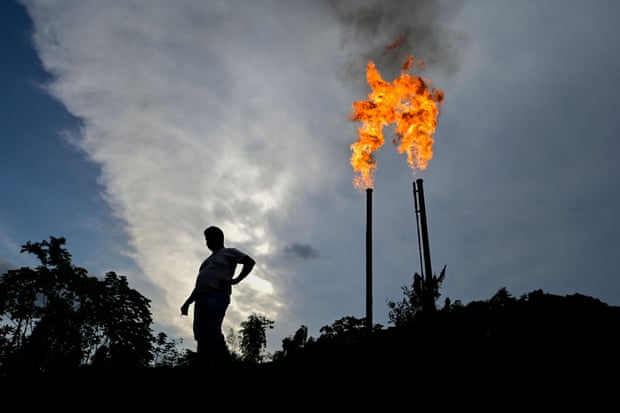
Ecuadorian activist Donald Moncayo Jiménez stands next to a gas flare from a refinery in the Sucumbíos province of Ecuador, on 14 January 2023. Photograph: Pedro Pardo/AFP/Getty Images
Exclusive: ‘Deep-rooted injustices’ affect billions of people due to location of wells, pipelines and other infrastructure
A quarter of the world’s population lives within three miles (5km) of operational fossil fuel projects, potentially threatening the health of more than 2 billion people as well as critical ecosystems, according to first-of-its-kind research.
A damning new report by Amnesty International, shared exclusively with the Guardian, found that more than 18,300 oil, gas and coal sites are currently distributed across 170 countries worldwide, occupying a vast area of the Earth’s surface.
Proximity to drilling wells, processing plants, pipelines and other fossil fuel facilities elevates the risk of cancer, respiratory conditions, heart disease, premature birth and death, as well as posing grave threats to water supplies and air quality, and degrades land.
Almost half a billion (463 million) people, including 124 million children, now live within 0.6 miles (1km) of fossil fuels sites, while another 3,500 or so new sites are currently proposed or under development that could force 135 million more people to endure fumes, flares and spills, according to Extraction Extinction: Why the Lifecycle of Fossil Fuels Threatens Life, Nature, and Human Rights.
Most active projects have created pollution hotspots, turning nearby communities and critical ecosystems into so-called sacrifice zones – heavily contaminated areas where low-income and marginalized groups bear the disproportionate burden of exposure to pollution and toxins.
Elon Musk urges you to be a Fascist like him, says that you can ignore facts and reality then.Donald Trump urges you to be a Climate Science denier like him. He says that he makes millions and millions for destroying the planet, Burn, Baby, Burn and Flood, Baby, Flood.Nigel Farage urges you to ignore facts and reality and be a climate science denier like him and his Deputy Richard Tice. He says that Reform UK has received £Millions and £Millions from the fossil fuel industry to promote climate denial and destroy the planet.
Research based on a poll of 11,000 Reform UK supporters, the biggest survey of its kind, tells us more about who is intending to vote for the party than has been previously known.
The in-depth polling analysis from Hope Not Hate reveals a voter coalition that stretches from struggling workers and frustrated graduates to wealthy retirees, in places from Hitchin to Runcorn.
While immigration is often viewed as the defining issue for Reform supporters, the data shows a far more complex picture. This diverse coalition is deeply divided on big issues such as the economy, the climate crisis and the role of government.
…
Who are the Reform supporters?
The research divides them into five groups, based on their attitudes towards different issues. These groups are the “working right”, “hardline conservatives”, “squeezed stewards”, “contrarian youth” and “reluctant reformers”. They differ in some key ways.
…
Anki Deo, who leads the policy and insights team at Hope Not Hate, says that in “an era of hyper-marginal politics where election results are decided by just a few percentage points”, identifying these groups and where they live is crucial.
She adds: “For those of us desperate to prevent a Farage-led government in 2029, this research shows us that not all is lost. Reform UK voters do not fit a single profile or ideology. Far from a homogenous group, it is a broad coalition, with many voters having quite different and contradictory views from each other.
Nigel Farage explains the politics of Reform UK: Racism, Fake anti-establishmentism, Deregulation, Corporatism, Climate Change Denial, Mysogyny and Transphobia.Nigel Farage urges you to ignore facts and reality and be a climate science denier like him and his Deputy Richard Tice. He says that Reform UK has received £Millions and £Millions from the fossil fuel industry to promote climate denial and destroy the planet.Nigel Farage reminds you that he’s the man that brought you Brexit and asks what could possibly go wrong.

 People attending the People’s Assembly Against Austerity protest in central London, June 7, 2025