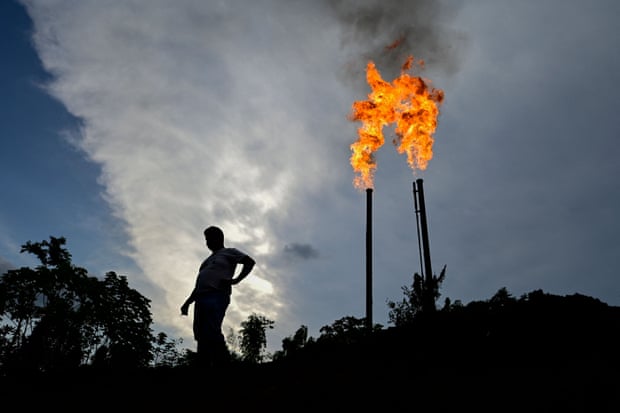
Ecuadorian activist Donald Moncayo Jiménez stands next to a gas flare from a refinery in the Sucumbíos province of Ecuador, on 14 January 2023. Photograph: Pedro Pardo/AFP/Getty Images
Exclusive: ‘Deep-rooted injustices’ affect billions of people due to location of wells, pipelines and other infrastructure
A quarter of the world’s population lives within three miles (5km) of operational fossil fuel projects, potentially threatening the health of more than 2 billion people as well as critical ecosystems, according to first-of-its-kind research.
A damning new report by Amnesty International, shared exclusively with the Guardian, found that more than 18,300 oil, gas and coal sites are currently distributed across 170 countries worldwide, occupying a vast area of the Earth’s surface.
Proximity to drilling wells, processing plants, pipelines and other fossil fuel facilities elevates the risk of cancer, respiratory conditions, heart disease, premature birth and death, as well as posing grave threats to water supplies and air quality, and degrades land.
Almost half a billion (463 million) people, including 124 million children, now live within 0.6 miles (1km) of fossil fuels sites, while another 3,500 or so new sites are currently proposed or under development that could force 135 million more people to endure fumes, flares and spills, according to Extraction Extinction: Why the Lifecycle of Fossil Fuels Threatens Life, Nature, and Human Rights.
Most active projects have created pollution hotspots, turning nearby communities and critical ecosystems into so-called sacrifice zones – heavily contaminated areas where low-income and marginalized groups bear the disproportionate burden of exposure to pollution and toxins.
Elon Musk urges you to be a Fascist like him, says that you can ignore facts and reality then.Donald Trump urges you to be a Climate Science denier like him. He says that he makes millions and millions for destroying the planet, Burn, Baby, Burn and Flood, Baby, Flood.Nigel Farage urges you to ignore facts and reality and be a climate science denier like him and his Deputy Richard Tice. He says that Reform UK has received £Millions and £Millions from the fossil fuel industry to promote climate denial and destroy the planet.
Research based on a poll of 11,000 Reform UK supporters, the biggest survey of its kind, tells us more about who is intending to vote for the party than has been previously known.
The in-depth polling analysis from Hope Not Hate reveals a voter coalition that stretches from struggling workers and frustrated graduates to wealthy retirees, in places from Hitchin to Runcorn.
While immigration is often viewed as the defining issue for Reform supporters, the data shows a far more complex picture. This diverse coalition is deeply divided on big issues such as the economy, the climate crisis and the role of government.
…
Who are the Reform supporters?
The research divides them into five groups, based on their attitudes towards different issues. These groups are the “working right”, “hardline conservatives”, “squeezed stewards”, “contrarian youth” and “reluctant reformers”. They differ in some key ways.
…
Anki Deo, who leads the policy and insights team at Hope Not Hate, says that in “an era of hyper-marginal politics where election results are decided by just a few percentage points”, identifying these groups and where they live is crucial.
She adds: “For those of us desperate to prevent a Farage-led government in 2029, this research shows us that not all is lost. Reform UK voters do not fit a single profile or ideology. Far from a homogenous group, it is a broad coalition, with many voters having quite different and contradictory views from each other.
Nigel Farage explains the politics of Reform UK: Racism, Fake anti-establishmentism, Deregulation, Corporatism, Climate Change Denial, Mysogyny and Transphobia.Nigel Farage urges you to ignore facts and reality and be a climate science denier like him and his Deputy Richard Tice. He says that Reform UK has received £Millions and £Millions from the fossil fuel industry to promote climate denial and destroy the planet.Nigel Farage reminds you that he’s the man that brought you Brexit and asks what could possibly go wrong.
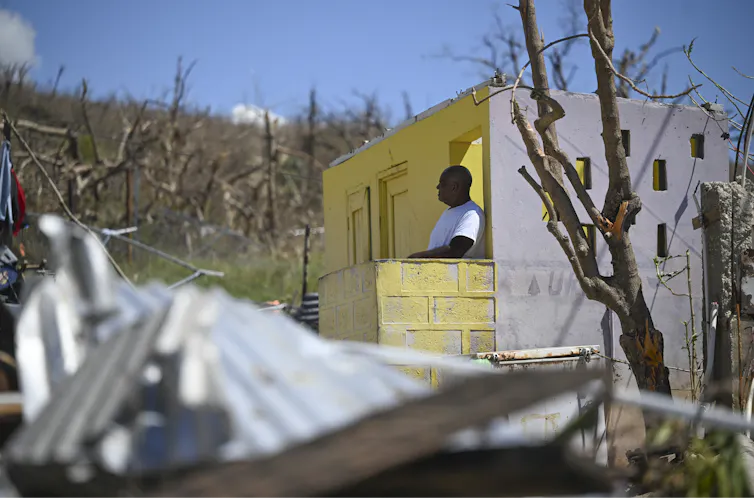
Hurricane Melissa tore off roofs and stripped trees of their leaves, including in many parts of Jamaica hit by Hurricane Beryl a year earlier. Ricardo Makyn/AFP via Getty Images
Headlines have been filled with talk of the catastrophic power of Hurricane Melissa after the Category 5 storm devastated communities across Jamaica, Cuba and Haiti in October 2025. But to see this as a singular disaster misses the bigger picture: Melissa didn’t hit stable, resilient islands. It hit islands still rebuilding from the last hurricane.
St. Elizabeth Parish, Jamaica, suffered intense damage from both Hurricane Melissa in October 2025 and Hurricane Beryl a year earlier. Ivan Shaw/AFP via Getty Images
In Cuba, the power grid collapsed during Hurricane Oscar in October 2024, leaving 10 million people in darkness. When Melissa arrived, it struck the same fragile infrastructure that Cubans had barely begun to rebuild.
This is the new reality of the climate crisis: Disasters hitting the Caribbean are compounding and can trigger infrastructure collapse, social erosion and economic debt spirals.
The compounding disaster trap
I study disasters, with a focus on how Caribbean island systems absorb, adapt to and recover from recurring shocks, like the nations hit by Melissa are now experiencing.
It’s not just that hurricanes are more frequent; it’s that the time between major storms is now shorter than the time required for a full recovery. This pulls islands into a trap that works through three self-reinforcing loops:
Infrastructure collapse: When a major hurricane hits an already weakened system, it causes simultaneous infrastructure collapses. The failure of one system – such as power – cascades, taking down water pumps, communications and hospitals all at once. We saw this in Grenada after Hurricane Beryl and in Dominica after Hurricane Maria. This kind of cascading damage is now the baseline expectation for the Caribbean.
When schools are heavily damaged by storms, like this one in Jamaica that lost its roof during Hurricane Melissa, it’s harder for families to remain. Ricardo Makyn/AFP via Getty Images
The trap is that all three of these loops reinforce each other. A country can’t rebuild infrastructure without money. It can’t generate economic activity without infrastructure. And it can’t retain the skilled workforce needed for either when people are fleeing to safer places.
Rebuilding a system of overlapping recoveries
The Caribbean is not merely recovering from disasters – it is living within a system of overlapping recoveries, meaning that its communities must begin rebuilding again before fully recovering from the last crisis.
Each new attempt at rebuilding happens on the unstable physical, social and institutional foundations left by the last disaster.
The question isn’t whether Jamaica will attempt to rebuild following Melissa. It will, somehow. The question is, what happens when the next major storm arrives before that recovery is complete? And the one after that?
Without fundamentally restructuring how we think about recovery – moving from crisis response to continuous adaptation – island nations will remain trapped in this loop.
The way forward
The compounding disaster trap persists because recovery models are broken. They apply one-size-fits-all solutions to crises unfolding across multiple layers of society.
Breaking free requires adaptive recovery at all levels, from household to global.
Residents formed a human chain among the hurricane debris to pass food supplies from a truck to a distribution center in the Whitehouse community in Westmoreland, an area of Jamaica hit hard by Hurricane Melissa in October 2025. Ricardo Makyn/AFP via Getty Images
Local networks are often the only ones capable of rebuilding trust and participation.
At the infrastructure level: Breaking the cycle
The pattern of rebuilding the same vulnerable roads or power lines only to see them wash away in the next storm fails the community and the nation. There are better, proven solutions that prepare communities to weather the next storm:
Decentralized power grids with renewable energy sources can operate independently when the main grid fails.
Natural infrastructure such as restored mangroves and wetlands provide natural storm barriers.
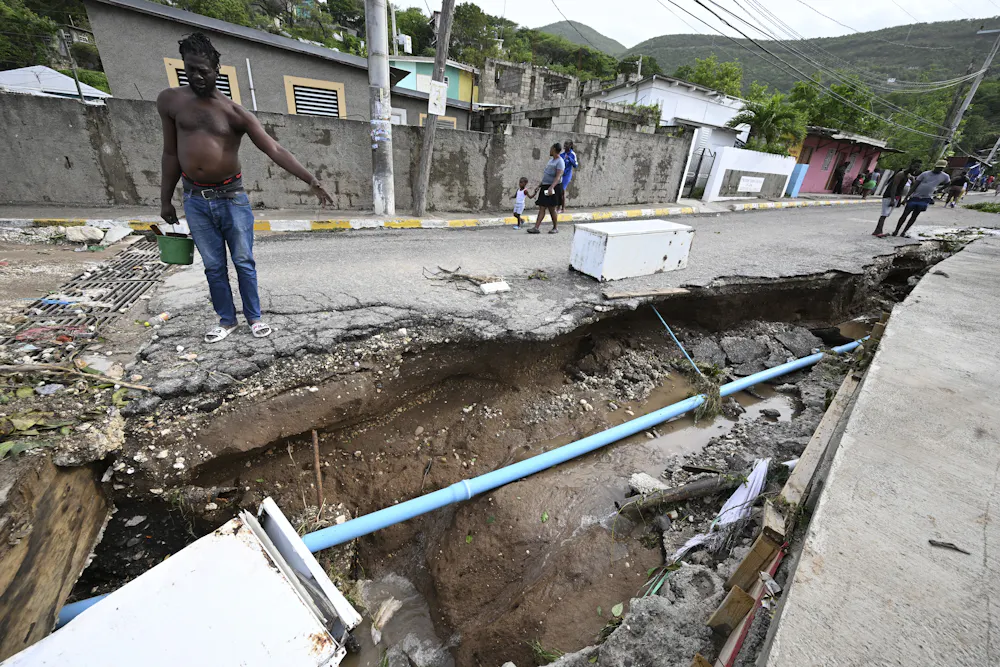
Hurricanes can damage infrastructure, including water and drainage systems. Hurricane Beryl left Jamaican communities rebuilding not just homes but also streets, power lines and basic infrastructure. Ricardo Makyn/AFP via Getty Images
At the global level: Fixing the debt trap
None of this is possible if recovery remains tied to high-interest loans. There are ways for internal financial institutions and global development lenders to allow for breathing room between disasters:
Hurricane clauses in bond agreements can automatically pause all debt payments when disasters strike. These clauses allow governments to automatically suspend debt service payments to bondholders for up to two years when a qualifying disaster strikes. After Beryl, Grenada became the first government to activate a hurricane clause with private creditors.
Comprehensive debt-for-climate swaps involve reducing existing debt – owed to private banks, institutional investors, countries or multilateral banks – in exchange for the debtor country committing funds to climate adaptation or resilience projects.
The Caribbean needs a system that provides support before disasters strike, with agreed-upon funding commitments and regional risk-pooling mechanisms that can avoid the delays and bureaucratic burden that slow recovery.
What’s happening in Jamaica, Cuba and Haiti today is a glimpse of what’s coming for coastal and island communities worldwide as climate change accelerates. In my view, we can either learn from the Caribbean’s experiences and redesign disaster recovery now or wait until the trap closes around everyone.
Elon Musk urges you to be a Fascist like him, says that you can ignore facts and reality then.Donald Trump urges you to be a Climate Science denier like him. He says that he makes millions and millions for destroying the planet, Burn, Baby, Burn and Flood, Baby, Flood.Nigel Farage urges you to ignore facts and reality and be a climate science denier like him and his Deputy Richard Tice. He says that Reform UK has received £Millions and £Millions from the fossil fuel industry to promote climate denial and destroy the planet.
The Daily Telegraph front page. Credit: Steven May / Alamy
The newspaper has been scolding the BBC for its editorial failings, while issuing a string of climate corrections.
The Telegraph, which has accused the BBC of bias and a lack of editorial rigour, has been forced to amend a swathe of climate inaccuracies.
The BBC’s director-general and CEO resigned this weekend after a critical review of the broadcaster’s coverage was leaked to The Telegraph.
The Telegraph has used this opportunity to slam the BBC – saying that the “BBC has just signed its own death warrant” and that its future is “now in doubt”. The paper is also reporting that the BBC is now reviewing its climate and energy coverage over accusations of bias.
However, The Telegraph has repeatedly made basic errors in relation to its climate coverage in recent times.
According to its corrections and clarifications page, The Telegraph published four articles in December and January that included the false claim that Energy and Net Zero Secretary Ed Miliband plans to build 1 billion solar panels to meet his net zero emissions targets.
In reality, reaching net zero by 2050 will require a tenth of that figure – 100 million solar panels.
The Telegraph has repeatedly castigated the BBC in recent days for its apparent lack of fairness, yet the newspaper frequently attacks its opponents using hyperbolic, incendiary language – even when its facts are wrong.
One of the reports that used the false solar panels statistic was entitled, “Miliband’s eco lunacy will wreck Britain and enrich the Chinese dictatorship”.
In an article from Reform UK deputy leader Richard Tice entitled, “Ed Miliband’s solar farm building spree will ruin our countryside for ever”, the newspaper also claimed that the solar panels set to be installed over the next decade will cover an area of farmland the size of Greater London – a falsehood that had to be corrected.
Tice is a notorious climate science denier who has suggested that CO2 is “plant food”.
Other Telegraph falsehoods have included the amount of undersea cables and overland power lines needed to reach net zero, the amount that would be saved by manufacturers if “net zero costs” were scrapped from bills, and that Britain has been “paying the highest electricity prices in the world for second year running”.
The BBC has made 33 corrections to its coverage overall this year, compared with 114 corrections from The Telegraph.
“The paper’s attacks on the BBC are not remotely done in good faith and are the result of the publisher’s ideological and commercial interests. There is no world in which The Telegraph’s output would survive the level of scrutiny applied to the BBC’s journalism.”
The leaked review of BBC editorial decisions was produced by Michael Prescott, a former external adviser to the broadcaster’s editorial standards committee. He claimed that a speech by Donald Trump during the 6 January 2021 riots on Capitol Hill in Washington DC had been selectively edited by Panorama to suggest that Trump was encouraging the riot.
Trump is now threatening to sue the BBC for $1 billion (£760,000).
While Trump’s speech was edited to distort his words, he did tell his supporters to “walk down to the Capitol”, after which rioters smashed through barricades, ransacked the U.S. Capitol, and injured 174 police officers. When he re-entered office in January 2025, Trump retrospectively pardoned all 1,600 individuals who were charged or convicted in relation to the attempted coup.
“It’s easy to see why Trump wants to destroy the world’s number one news source,” said Liberal Democrat leader Ed Davey. “We can’t let him.
“The BBC belongs to all of us here in the UK. The prime minister and leaders from across the political spectrum should be united in telling Trump to keep his hands off it.”
The Telegraph was approached for comment.
The Telegraph’s Climate Deniers
As DeSmog has shown, The Telegraph has ramped up its aggressive, inaccurate, anti-climate attacks over recent years.
DeSmog’s analysis of opinion and editorial articles about the environment published on The Telegraph’s website in the first 100 days of the current Labour government found that 94 percent were anti-green – attacking or undermining climate science, policy and technological solutions, or environmental activists.
The Telegraph focused on Ed Miliband, with its columnists regularly deploying ad hominem attacks, labelling him “red Ed” and “mad Ed”. In one article, columnist Allison Pearson called Miliband “thoroughly mental Mili”.
In an article last week about the BBC, Pearson said: “We have become accustomed to BBC journalists lying by omission and the prioritisation of pet subjects – I swear there isn’t a spark caused by two sticks rubbed together in southern Europe that hasn’t been seized on by climate editor Justin Rowlatt as evidence of man-made global warming.”
Pearson has formal ties to climate science denial groups – a common feature of The Telegraph’s climate commentators.
She is a director of the Global Warming Policy Foundation (GWPF), which has claimed that carbon dioxide has been “mercilessly demonised” when in fact it is a “benefit to the planet” and should be “two or three times” higher than current levels.
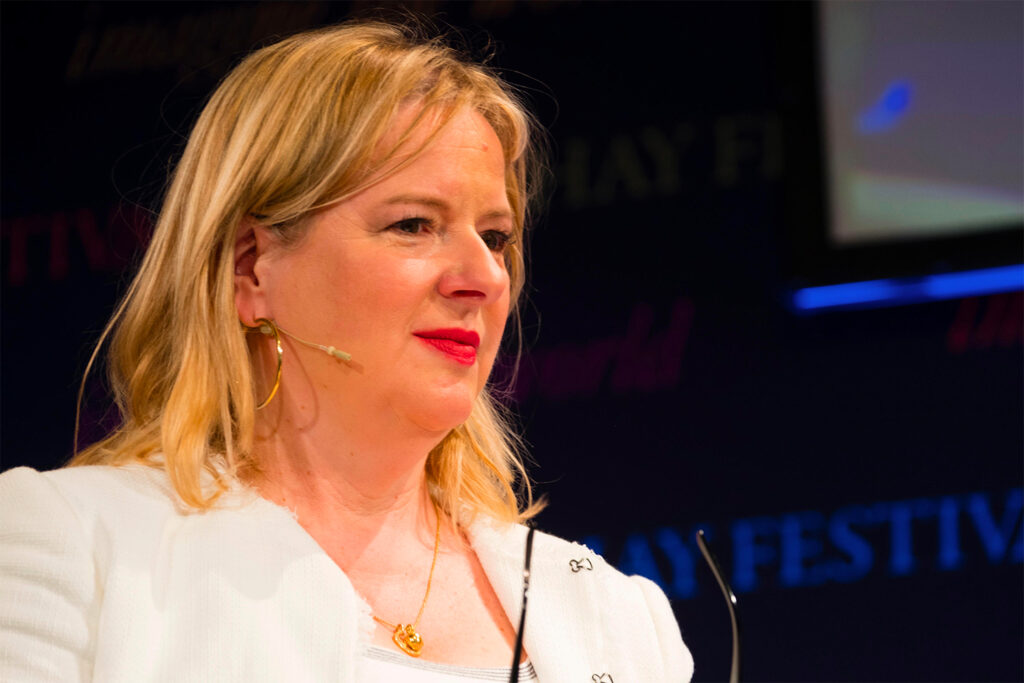
Telegraph journalist and GWPF director Allison Pearson. Credit: Keith Morris / Hay Ffotos / Alamy
Fellow Telegraph columnist Lord David Frost is a director of Net Zero Watch, the GWPF’s campaign arm. Frost – who has no scientific training – has claimed that “rising temperatures are likely to be beneficial” to Britain. He was recently appointed director-general of the Institute of Economic Affairs, an anti-climate lobby group that received funding from oil major BP for decades.
Individuals associated with the GWPF wrote at least 48 articles in The Telegraph during Labour’s first 100 days, yet their ties to the climate denial group were not mentioned once by the newspaper.
“When disinformation is allowed to run rampant, this can have devastating consequences for democracy – as is already being seen in the United States,” said Richard Wilson, director of the campaign group Stop Funding Heat. “Clearly we all therefore have an interest in ensuring that every UK media outlet – including the BBC – maintains the highest possible standards of accuracy.
“Equally, anyone familiar with The Telegraph’s long track record of misleading climate coverage may have questions about their new-found enthusiasm for rigorous and accurate reporting.”
The UN’s Intergovernmental Panel on Climate Change (IPCC), the world’s leading climate science body, has said “it is a statement of fact, we cannot be any more certain; it is unequivocal and indisputable that humans are warming the planet.”
The IPCC has also stated that carbon dioxide pollution “is responsible for most of global warming” since the late 19th century, which has increased the “severity and frequency of weather and climate extremes, like heat waves, heavy rains, and drought” – all of which “put a disproportionate burden on low-income households and thus increase poverty levels.”
A previous DeSmog analysis found that, during the six-month period to 16 October 2023, 85 percent of The Telegraph’s editorials and opinion pieces on environmental issues were anti-green.
Bob Ward, policy and communications director at the Grantham Research Institute on Climate Change and the Environment at the London School of Economics, previously said the editors of The Telegraph had “lost their minds when it comes to climate change”.
“Both newspapers [The Telegraph and Sunday Telegraph] are campaigning against climate policies,” Ward told DeSmog. “They are bombarding their poor readers with laughable propaganda, particularly in their comment columns.”
Nigel Farage urges you to ignore facts and reality and be a climate science denier like him. He says that Reform UK has received millions and millions from the fossil fuel industry to promote climate denial and destroy the planet.Orcas comment on killer apes destroying the planet by continuing to burn fossil fuels.Donald Trump urges you to be a Climate Science denier like him. He says that he makes millions and millions for destroying the planet, Burn, Baby, Burn and Flood, Baby, Flood.
The Rio Guajará (Guajará River), part of the vast Amazon River delta
As COP30 kicks off in Belém, Brazil, we look at the significance of hosting this year’s UN climate conference in the heart of the Amazon rainforest.
The world’s largest rainforest – home to more species of plants and animals than anywhere else on Earth – is opening its doors, giving humanity a chance to do right by the planet that hosts it. As we walk through the rainforest, we are humbled, as it reminds us that it is the heartbeat and the lungs of our planet.
Here in Belém, “the gateway to the Amazon”, life moves in time with nature. The air is thick with humidity, sudden tropical showers fall, followed by the hum of insects and the call of birds. Vultures circle above, herons perch on the riverbanks, and capybaras wander through the green patches that break the city’s skyline. Coconut water stalls line the streets, purple açaí leaves a natural liner around the lips of the men, women and children who eat it – with their fish or in their milkshakes. Even amongst the hustle and bustle, as the streets fill up, Belém is very clearly inseparable from the forest that cradles it.
…
Representing the Holy See just prior to the opening of COP30, at the leaders’ summit on 7 November, Vatican Secretary of State, Cardinal Pietro Parolin, reminded delegates of Pope Leo XIV’s message: “If you want to cultivate peace, care for creation.” Cardinal Parolin reminded world leaders that the climate crisis is not only a question of technology or finance, but of justice and solidarity – pointing out that ‘those in the most vulnerable situations are the first to suffer,’ and he called for COP30 to become ‘a sign of hope’ in a world already ‘in flames’ from both environmental and human conflict.
His words echoed those of Pope Francis in Laudato si’, who wrote that “we have no such right” to destroy creation, reminding us that humanity’s vocation is not to dominate the earth but to till and keep it – to care for the world and for every creature that shares it with us.
The message is clear: caring for the planet is inseparable from caring for one another.
As delegates gather in Belém over the next two weeks, the world will watch for commitments that can bring together words and action, pray for funding that reaches the communities protecting the world’s organs, and hope for agreements that honour both people and planet.
Orcas comment on killer apes destroying the planet by continuing to burn fossil fuels.Donald Trump urges you to be a Climate Science denier like him. He says that he makes millions and millions for destroying the planet, Burn, Baby, Burn and Flood, Baby, Flood.Nigel Farage urges you to ignore facts and reality and be a climate science denier like him. He says that Reform UK has received millions and millions from the fossil fuel industry to promote climate denial and destroy the planet.