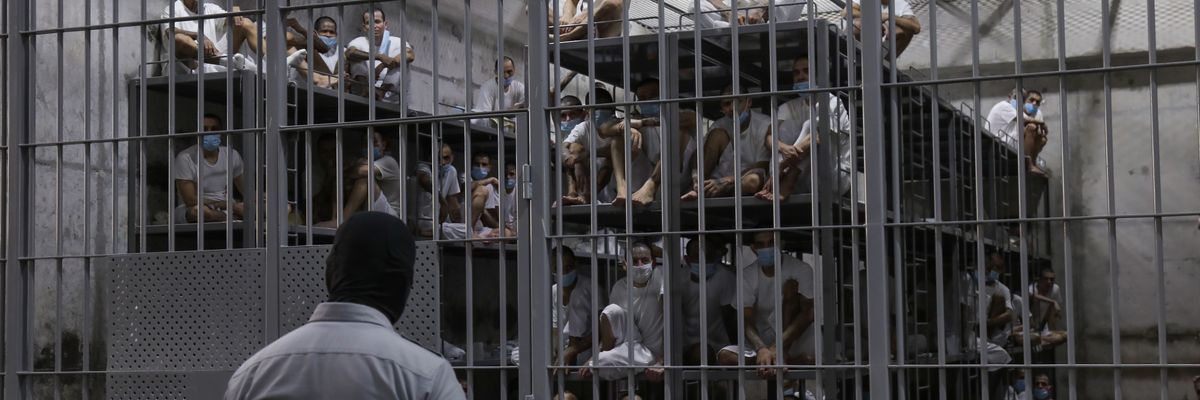
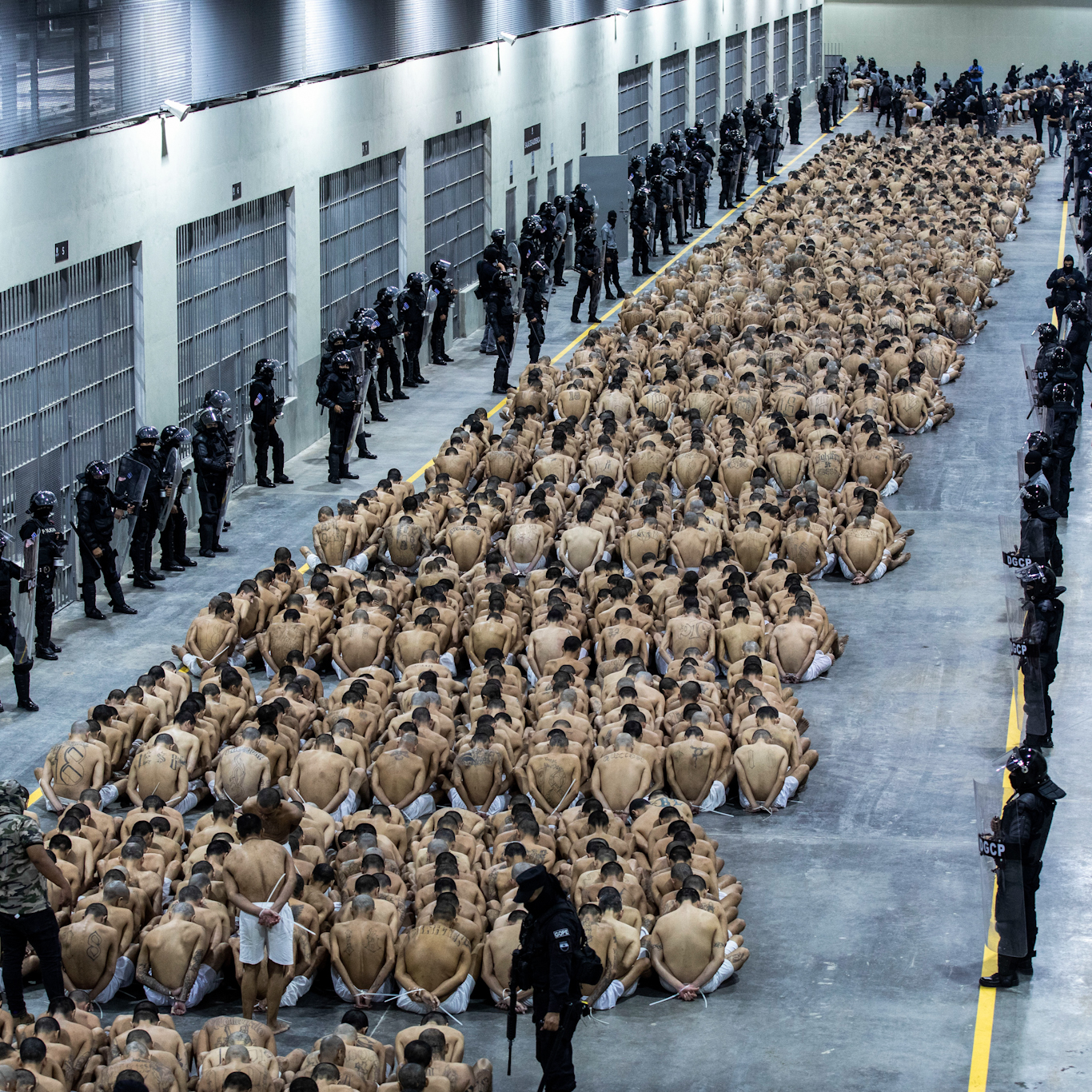
A guard stands outside a cell of prisoners at the Terrorism Confinement Center (CECOT) in Tecoluca, in San Vicente, El Salvador on April 4, 2025. (Photo by Alex Pena/Anadolu via Getty Images)
“The US government has not been linked to acts of systematic torture on this scale since Abu Ghraib.”
“You have arrived in hell.”
That’s what the director of El Salvador’s Terrorism Confinement Center (CECOT) told 26-year-old Gonzalo Y., one of the 252 Venezuelans deported by US President Donald Trump to the infamous prison in March and April, according to a report released Wednesday.
The report was compiled by US-based Human Rights Watch (HRW) and Cristosal, a regional group that fledEl Salvador in July, citing harassment and legal threats from President Nayib Bukele’s government. They used the CECOT director’s comment to Gonzalo as a title.
“When we arrived at the entrance of CECOT, guards made us kneel so they could shave our heads… One of the officers hit me on the legs with a baton, and I fell to the ground on my knees,” Gonzalo said. “The guards beat me many times, in the hallways of the prison module and in the punishment cell… They beat us almost every day.”
NEW: The Venezuelan nationals the US government sent to El Salvador in March and April were tortured and subjected to other abuses, including sexual violence.In a new report, HRW and @cristosal.bsky.social provide a comprehensive account of the treatment of these people in El Salvador.
Gonzalo is among 40 detainees interviewed for the report. The groups also spoke with 150 individuals with credible knowledge of the conditions, such as lawyers and relatives; consulted international forensic experts; and reviewed “a wide range” of materials, including criminal records, judicial documents in El Salvador and the United States, and photographs of injuries.
While the US and Salvadoran governments claimed that most of the migrants sent to CECOT were part of the Venezuelan gang Tren de Aragua, HRW and Cristosal found that “many of them had not been convicted of any crimes by federal or state authorities in the United States, nor in Venezuela or other Latin America countries where they had lived.”
Up until they were sent to Venezuela as part of a prisoner exchange on July 18, the report states, “the people held in CECOT were subjected to inhumane prison conditions, including prolonged incommunicado detention, inadequate food, denial of basic hygiene and sanitation, limited access to healthcare and medicine, and lack of recreational or educational activities, in violation of several provisions of the United Nations Standard Minimum Rules for the Treatment of Prisoners, also known as the ‘Mandela Rules.’”
“We also documented that detainees were subjected to constant beatings and other forms of ill-treatment, including some cases of sexual violence,” the publication continues. “Many of these abuses constitute torture under international human rights law.”
According to the 81-page report:
Daniel B., for instance, described how officers beat him after he spoke with [ International Committee of the Red Cross] staff members during their visit to CECOT in May. He said guards took him to “the Island,” where they beat him with a baton. He said a blow made his nose bleed. “They kept hitting me, in the stomach, and when I tried to breathe, I started to choke on the blood. My cellmates shouted for help, saying they were killing us, but the officers said they just wanted to make us suffer,” he said.
Three people held in CECOT told Human Rights Watch and Cristosal that they were subjected to sexual violence. One of them said that guards took him to “the Island,” where they beat him. He said four guards sexually abused him and forced him to perform oral sex on one of them. “They played with their batons on my body.” People held in CECOT said sexual abuse affected more people, but victims were unlikely to speak about what they had suffered due to stigma.
In a Wednesday statement, Cristosal executive director Noah Bullock drew a comparison to the early stages of the George W. Bush administration’s invasion of Iraq.
“The US government has not been linked to acts of systematic torture on this scale since Abu Ghraib and the network of clandestine prisons during the War on Terror,” he said. “Disappearing people into the hands of a government that tortures them runs against the very principles that historically made the United States a nation of laws.”
Although many migrants have been freed from El Salvador’s CECOT, “they continue to suffer lasting physical injuries and psychological trauma,” the report notes. They also face risks in Venezuela, which “suffers a humanitarian crisis and systematic human rights violations carried out by the administration of Nicolás Maduro.”
“Their repatriation to Venezuela violates the principle of nonrefoulement,” the document explains. “Additionally, in some cases, members of the Venezuelan intelligence services have appeared at the homes of people who were held in CECOT and forced them to record videos regarding their treatment in the United States.”
The CECOT renditions were crimes under both domestic and international law. and some people remain disappeared. www.hrw.org/report/2025/…
The report notably comes as Trump has spent recent months blowing up small boats from Venezuela under the guise of combating drug trafficking—which experts across the globe have condemned as blatantly illegal—and as the White Housestokes fears of strikes within the country aimed at forcing regime change.
Stressing that “officials cannot summarily kill people they accuse of smuggling drugs,” HRW Washington director Sarah Yager has called on the US military to “immediately halt any plans for future unlawful strikes” on boats in the Caribbean and Congress to “open a prompt and transparent investigation.”
With the release of the new report, HRW and Cristosal also issued fresh demands, including an end to the United States’ transfer of third-country nationals to El Salvador and for other nations and international bodies, including the United Nations Human Rights Council, to increase scrutiny of the Trump and Bukele governments’ human rights violations.
“The Trump administration paid El Salvador millions of dollars to arbitrarily detain Venezuelans who were then abused by Salvadoran security forces on a near-daily basis,” said HRW Americas director Juanita Goebertus. “The Trump administration is complicit in torture, enforced disappearance, and other grave violations, and should stop sending people to El Salvador or any other country where they face a risk of torture.”
Donald Fuhrump says that Amerikkka doesn’t bother with crimes or charges anymore, not being 100% Amerikkkan and opposing his real estate intentions is enough.
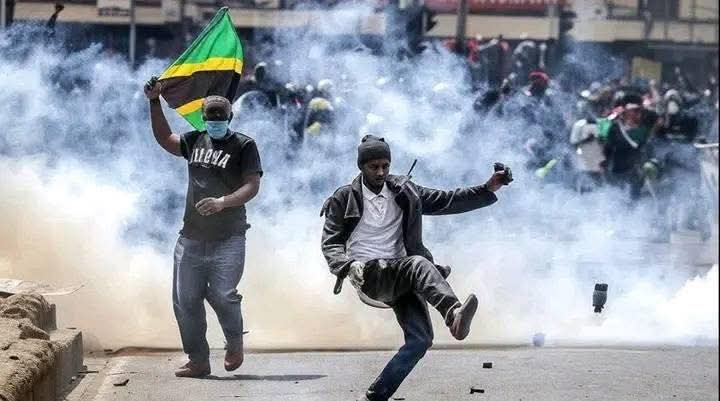
The Tanzanian Government has shut down internet services in the country and denied access to foreign reporters during elections The people are out in the streets protesting the “ceremonial” elections. Photo: X
Protests erupted as Tanzania went to the polls on October 29, 2025. With opposition leaders jailed, Internet access cut, the election has been criticized as ceremonial for President Samia Suluhu Hassan to get back to power.
Some of the regions in Tanzania descended into chaos following the country’s general elections on Wednesday, October 29, which many observers described as “ceremonial” rather than a contest. President Samia Suluhu Hassan, who became Tanzania’s first female head of state in 2021, was already the overwhelming favorite to win in an election devoid of meaningful opposition.
According to reports, the vote was marred by a nationwide internet shutdown, curfews, and unrest after protests broke out in parts of Dar es Salaam, reflecting widespread discontent over what citizens and regional observers have called a sham election.
Internet shutdown and curfew
Live network data from the internet observatory NetBlocks confirmed that Tanzania imposed nationwide internet restrictions early Wednesday morning, severely disrupting mobile data services and blocking access to social media platforms. The blackout coincided with the start of voting, signaling a deliberate move to suppress the flow of information.
By evening, the government imposed a nationwide curfew, urging students and civil servants to remain indoors for the following day. The restrictions came as images and reports of protests spread, despite the blackout, with demonstrators denouncing the exclusion of opposition parties and the continued detention of opposition leader Tundu Lissu, who is currently on trial for treason.
Opposition barred, democracy in decline
Both CHADEMA, the main opposition party, and ACT Wazalendo were barred from participating in the elections. Lissu, who had called for electoral reforms, was arrested earlier this year on what human rights groups have called trumped-up charges. His arrest, coupled with the systematic oppression and media censorship, has deepened fears of an authoritarian turn in Tanzania’s politics.
Reports from human rights organizations, including Amnesty International, describe the political climate as one of “repression, intimidation, and fear.” Amnesty’s recent publication titled “Wave of Terror Sweeps Across Tanzania” documents cases of enforced disappearances, torture, and unfair trials, primarily targeting critics of the regime. Opposition leaders and activists have also faced severe restrictions on their freedom of movement that have effectively prevented them from conducting normal political activities.
Targeting of religious leaders and civil society
The crackdown has extended to religious leaders who have spoken against government abuses. In June, the regime deregistered the Ufufuo na Uzima Church, led by Bishop Dr. Josephat Gwajima, citing alleged violations of the Societies Act. The move came just days after the bishop publicly condemned abductions and enforced disappearances.
Other clergy, including Bishop Benson Bagonza of the Evangelical Lutheran Church and Bishop Dickson Kabigumila, have reported threats or fled the country. Several religious figures, journalists, and political activists remain missing, with families demanding justice.
“We stand here as East African citizens, mandated by the fact that Jumuiya ni yetu (the community is ours). The tragic occurrences we are witnessing in Tanzania go against the very principles that underpin the East African Community,” the statement read.
“Borders will not limit our brotherhood and sisterhood. Injustice anywhere is a threat to justice everywhere.”
The group also noted that no credible international observation missions were allowed into Tanzania. Countries, including Belgium, Sweden, Germany, and Ireland withdrew their participation, while the United Nations Development Program (UNDP) is also not engaging in the electoral process. The African Union (AU) and East African Community (EAC) sent only symbolic delegations, drawing criticism for “legitimizing repression”.
Earlier this year, a delegation from Kenya that included Boniface Mwangi of Kenya and Agather Atuhaire of Uganda, were detained and later deported from Tanzania after attempting to go to Tundu Lissu’s trial. Mwangi and Atuhaire were later assaulted and subjected to torture during their detention.
A regional warning
There are concerns across East Africa that the Tanzanian crisis reflects a broader pattern of shrinking democratic space across the region.
The KHRC statement concluded – “Africans are rightfully outraged that the African Union, an institution meant to defend human rights, democracy, and the rule of law, has chosen silence over principle. It increasingly resembles a club of presidents shielding each other rather than protecting the people they claim to serve. The same betrayal is evident in SADC and the EAC. We are coming to the defense of Tanzanians and hereby give notice to Tanzania and all authoritarian regimes in the rest of East Africa and Africa. As despots regroup to oppress citizens, we, as the citizens, are similarly regrouping to reclaim our countries and our inherent freedoms.”
As of Thursday evening, Dar es Salaam remained tense under heavy police presence, with sporadic protests continuing despite the curfew. The official election results are expected to be announced in the coming days.
David Lammy met Benjamin Netanyahu in July 2024 soon after Labour won power. (Photo: Ben Dance / FCDO)
Book review: Peter Oborne spares neither Labour nor the Conservatives in his searing history of Gaza’s destruction.
As British people have turned against Israel’s destruction of Gaza, leading figures in its present and former governing parties still deny that Israel has committed even war crimes, let alone genocide.
Some of these denialists are hardened Zionists, others are opportunists, but the bottom line is summed up in the one-word title of Peter Oborne’s timely book. They have made themselves “complicit” (at the very least) in Israel’s monstrous crimes.
Oborne traces British complicity through Rishi Sunak’s unconditional backing for Israel after 7 October 2023, and Keir Starmer’s outrageous statement that Israel had the right to cut off power and water, to their joint opposition to a ceasefire.
Through a “cross-party cartel”, they “established the political foundation that would make Britain complicit” in massacres, indiscriminate bombing, torture and displacement.
This led to specific contributions to Israel’s genocide. Britain sold parts for the F-35 fighter jets that it used to kill civilians, and withdrew funding for UNRWA, the agency that provided Gaza’s humanitarian lifeline.
The RAF flew hundreds of reconnaissance flights, as Declassified exposed. The pretext of helping to find Israel’s hostages was quickly undermined as it became clear that Netanyahu was sacrificing them in his pursuit of endless destruction.
Genocide denier and Current UK Prime Minister Keir Starmer is quoted that he supports Zionism without qualification. He also confirms that UK air force support has been essential in Israel’s mass-murdering genocide. Includes URLs https://www.declassifieduk.org/keir-starmers-100-spy-flights-over-gaza-in-support-of-israel/ and https://youtu.be/O74hZCKKdpAKeir Starmer objects to criticism of the IDF. He asks how could anyone object to them starving people to death, forced marches like the Nazis did, bombing Gaza’s hospitals and universities, mass-murdering journalists, healthworkers and starving people queuing for food, killing and raping prisoners and murdering children. He calls for people to stop obstructing his genocide for Israel.Orcas discuss Genocide-supporting and complicit Zionists. Donald Trump, Keith Starmer, David Lammy, Rachel Reeves, Angela Rayner and Wes Streeting are acknowledged as evil genocide-complicit and supporting cnuts.
This work by Middle East Monitor is licensed under a Creative Commons Attribution-NonCommercial-ShareAlike 4.0 International License.
Egyptian President Abdel Fattah El-Sisi in El Alamein, Egypt on August 05, 2024 [Murat Gök/Anadolu Agency]
Egyptian President Abdel Fattah el-Sisi on Friday reiterated his country’s strong opposition to any attempts to forcibly displace Palestinians from their land during his talks with Dutch Prime Minister Dick Schoof, Anadolu reports.
The two leaders spoke by phone about bilateral relations and the deteriorating situation in the Gaza Strip, according to the Egyptian presidency.
Sisi emphasized the importance of strengthening cooperation between Egypt and the Netherlands.
Sisi also highlighted Egypt’s ongoing efforts to broker a ceasefire in Gaza and ensure the urgent and sufficient delivery of humanitarian aid to the besieged enclave, according to the presidency’s statement. He stressed the need for progress in negotiations to release prisoners on both sides.
Israel currently claims that 50 of its hostages remain in Gaza, including 20 who are still alive. Meanwhile, over 10,800 Palestinians are imprisoned in Israeli jails under conditions widely condemned by rights groups as involving torture, starvation, and medical neglect, practices that have led to numerous deaths.
Negotiations between Israel and Hamas mediated by Qatar and Egypt and backed by the US recently collapsed in Doha after Israel hardened its position on issues including full military withdrawal from Gaza, ending the war, prisoner exchange terms, and aid distribution mechanisms.
While Hamas has signaled readiness to release all Israeli hostages in a single exchange, conditional on a permanent ceasefire and Israel’s withdrawal from Gaza, Israeli Prime Minister Benjamin Netanyahu has continued to impose new demands.
In his call with Schoof, Sisi also reaffirmed Egypt’s commitment to restarting the political process based on a two-state solution.
He further stressed the urgency of launching Gaza’s reconstruction as soon as a ceasefire is achieved.
“Egypt remains firmly opposed to any plans to forcibly displace Palestinians,” the presidency said, reaffirming Cairo’s longstanding position.
In March, Egypt proposed a five-year, $53 billion reconstruction plan for Gaza, adopted at an emergency Arab League summit.
The plan explicitly ruled out any displacement of Palestinians. However, both Israel and the US have rejected the initiative and instead backed an alternative plan promoted by US President Donald Trump that would relocate Palestinians to neighboring countries like Egypt and Jordan.
Both nations have rejected such proposals, alongside other Arab states and international organizations.
Rejecting international calls for a ceasefire, the Israeli army has pursued a brutal offensive on Gaza since Oct. 7, 2023, killing more than 60,300 Palestinians, most of them women and children. The relentless bombardment has destroyed the enclave and led to food shortages.
Last November, the International Criminal Court issued arrest warrants for Israeli Prime Minister Benjamin Netanyahu and his former Defense Minister Yoav Gallant for war crimes and crimes against humanity in Gaza.
Israel also faces a genocide case at the International Court of Justice for its war on the enclave.
This work by Middle East Monitor is licensed under a Creative Commons Attribution-NonCommercial-ShareAlike 4.0 International License.
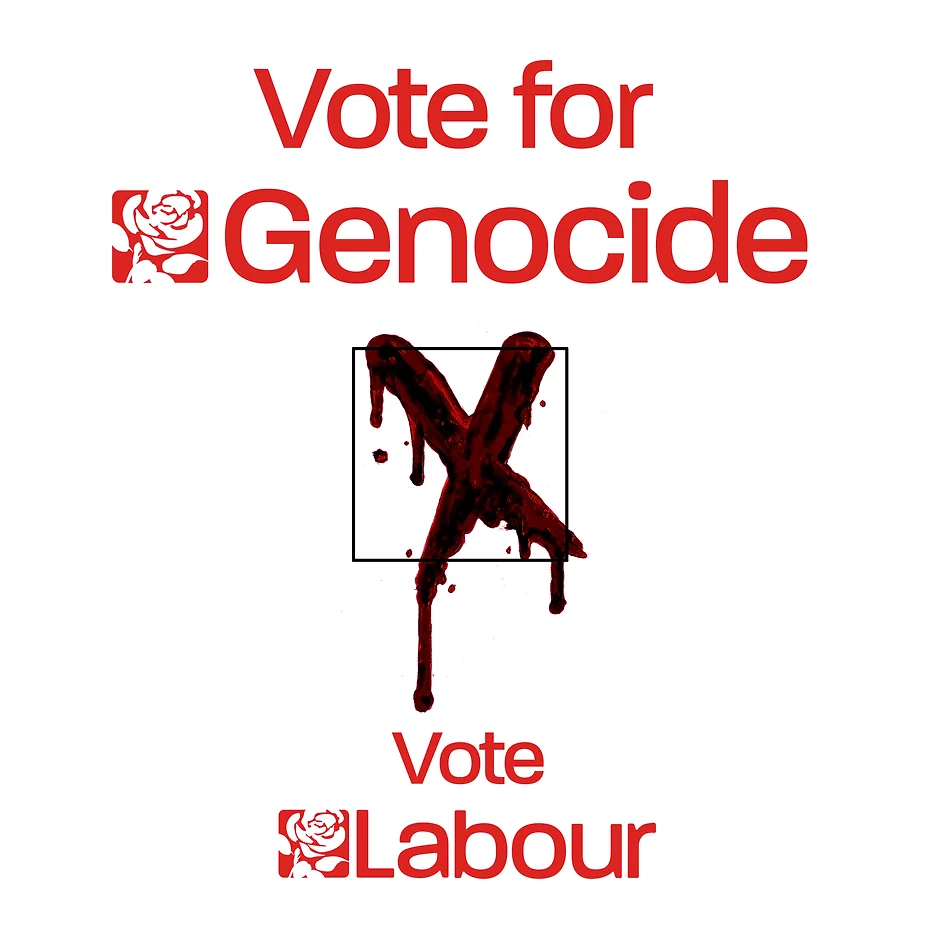
UK Labour Party government ministers Keir Starmer, Angela Rayner and Rachel Reeves explain that they are partners complicit in Israel’s Gaza genocide. The UK has provided Israel with arms, military and air force support. They explain that they don’t do gas chambers but do do forced marches, starvation, destroy hospitals, mass-murders of journalists and healthcare workers.Vote Labour for Genocide.
Original article by Alan Macleod republished from MPN under a Creative Commons Attribution-NonCommercial-ShareAlike 3.0 International License.
The Trump administration’s deal to send large numbers of people to prisons in El Salvador has thrust its president, Nayib Bukele, into the international spotlight. Bukele has been praised, especially in conservative media, as a dynamic and popular leader who has saved his country from the grips of gang violence. But beneath this polished image, he has cemented his rule based on assigning himself autocratic powers, jailing and persecuting his political opponents, and overseeing the creation and expansion of the world’s first prison state. MintPress News explores the dark side of the man who calls himself “the world’s coolest dictator.”
Cruelty is the Point
The hundreds of migrant detainees the U.S. sent to Central America should be kept in Salvadoran jails “for the rest of their lives,” according to Homeland Security Secretary Kristi Noem in an April interview. This is despite the fact that a Bloomberg investigation found that around 90% of those deported have no criminal records or charges against them.
Noem’s words reflect an administration eager to find a partner willing to help them outsource America’s prison-industrial complex. In February, Salvadoran President Nayib Bukele offered to use El Salvador’s sprawling and rapidly growing network of jails to receive thousands of “dangerous American criminals” for a fraction of the cost of detaining them in the United States. “No country has ever made an offer of friendship such as this,” said a delighted Secretary of State Marco Rubio, a strong Bukele supporter.
The migrants have been sent to the Terrorism Confinement Center (Centro de Confinamiento del Terrorismo, or CECOT), a $115 million facility widely criticized by human rights groups that opened its doors in October 2023. The 23-hectare site is situated in a rural area of the country, around 70 km (45 miles) from the capital, San Salvador, and is set to house 40,000 people, making it, by quite some margin, the largest prison in world history.
Conditions inside the jail have been widely condemned. Those incarcerated are packed into cells of up to 100 people. Sleeping on metal or concrete bunks, inmates must defecate in front of their cellmates. A 2024 report from the Inter-American Commission on Human Rights found an average of just 0.6 square meters (6.45 square feet) per inmate. Lights are kept on 24 hours a day.
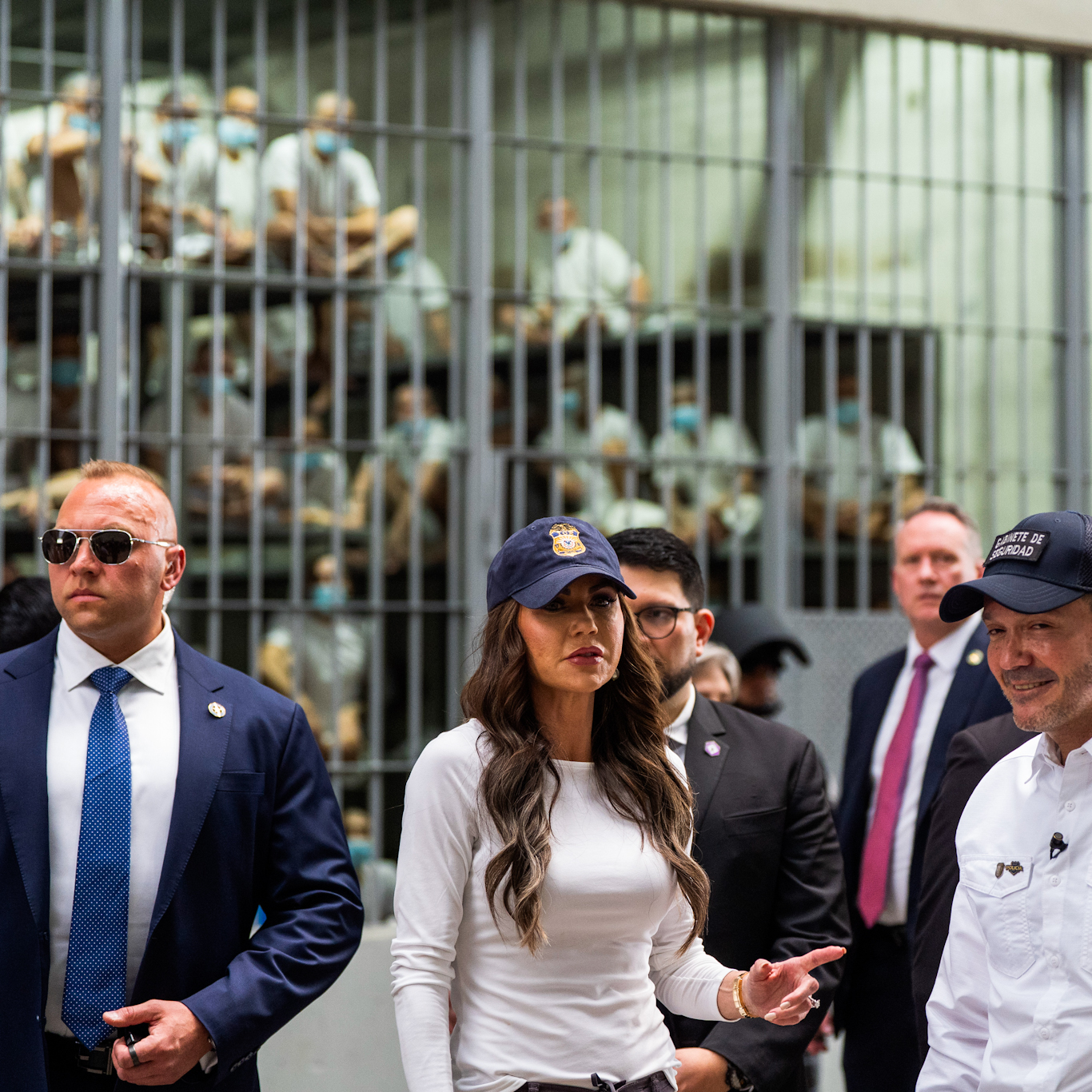
Kristi Noem tours El Salvador’s mega-prison with Minister Héctor Villatoro, March 26, 2025. Alex Brandon | AP
The food is as sparse as the personal space. Detainees are fed just 450 grams of the same meal every day, consisting of beans, pasta and tortillas, along with coffee or another drink. Provided no utensils, they must eat with their hands only.
CECOT offers no outside recreation space, and those inside are allowed only 30 minutes per day out of their cells. Upon arrival, prisoners have their heads shaved, and are often forced to sit close together in formations resembling the conditions on trans-Atlantic slave ships. They are not allowed any contact with their friends, family, or lawyers. Often, the first news a family receives of the whereabouts of their disappeared relative is a note explaining that they have died in prison. The Bukele administration has made clear that they intend to make sure those inside CECOT’s walls “will never leave.”
The Trump administration had shown little concern for the reported condition at CECOT. In March, Noem herself traveled to the complex to pose in front of dozens of incarcerated people, warning others that they could be next. The Trump administration has justified its move as legal under an obscure law from 1798, and claimed that those deported were members of Tren de Aragua, a Venezuelan criminal group.
Prison Nation
Yet the conditions at CECOT are actually considerably better than at many other Salvadoran jails, as it is one of the few facilities not (yet) overflowing with inmates. In 2022, under the rubric of fighting gang violence, Bukele declared a state of exception, suspending civil liberties and overseeing the arrest and imprisonment of 85,000 people. The prison population has tripled in just a few years, to the point where around 2% of the country’s adult population is behind bars—equivalent to roughly seven million Americans.
“El Salvador, under the dictatorship of Nayib Bukele, has overtaken the U.S. as the global leader in incarcerating its own people,” Wanda Bertram, a spokesperson for the Prison Policy Initiative, told MintPress News. Today, the country imprisons more than twice as many people per capita as the next highest nation. “As horrific as El Salvador’s mass incarceration program is, we shouldn’t overlook that it had a clear role model in the United States,” she added, pointing out that nearly half of all U.S. adults have an immediate family member who has been incarcerated.
Few of those caught up in Bukele’s massive dragnet have had due process. Unable to prove their guilt or connections to MS-13 or other gangs, prosecutors continue to extend their pretrial detentions. Torture is widespread. “It’s a system that by design is mistreating and torturing people,” said Ana Piquer, Amnesty International’s Americas Director. Hundreds have died in custody.
Since he declared the state of exception, Bukele’s forces have arrested at least 3,000 children. Far from releasing them, in February, the president signed a bill into law transferring child detainees into adult prisons.
The U.S. government is intimately aware of the nature of Bukele’s rule. A 2023 State Department report detailed widespread abuses, including:
[U]nlawful or arbitrary killings; enforced disappearance; torture or cruel, inhuman, or degrading treatment or punishment by security forces; harsh and life-threatening prison conditions; arbitrary arrest or detention; [and] serious problems with the independence of the judiciary.”
It also noted that, even before the massive surge in prisoner numbers, conditions inside Bukele’s jails were “harsh and life-threatening,” and recounted how prison guards beat victims to death and used electric stun guns on the prison’s wet floors to deliver shocks to prisoners en masse.
Osiris Luna, the director of El Salvador’s prison system, had been sanctioned by the U.S. government for his role in “gross human rights abuses.”
Despite the long list of documented abuses, the Trump administration has chosen El Salvador as the location to dump migrants and has promised that this is the beginning of a long partnership between the two nations.
“Salvadoran prisons are the product of the U.S. justice department, Drug Enforcement Agency, and other officials’ work in Latin America over the course of the decades. The United States has aided and abetted the construction of these gulags of the Americas. And so, in a lot of ways, Bukele is a monster made in the U.S.,” Roberto Lovato, a Salvadoran-American writer and professor at the University of Nevada, Las Vegas, told MintPress News.
Accused gang members sit on the floor of El Salvador’s Terrorism Confinement Center, March 15, 2023. Via AP
“The combination of importing U.S. prison and gang culture with U.S. government-funded digital technology applied to politics is how we get Bukele now,” he added. Lovato’s 2020 memoir, “Unforgetting: A Memoir of Family, Migration, Gangs, and Revolution in the Americas,” explores the relationship of violence between the U.S. and El Salvador.
President Bukele has justified the crackdown as a necessary response to the country’s overwhelming organized crime problem, with groups such as MS-13 and Barrio 18 terrorizing the nation. His uncompromising approach has produced results: El Salvador’s official murder rate has fallen dramatically, and many say the country’s streets are safe again. His policies have certainly gained him significant public backing and praise in the West.
“Nayib Bukele’s iron fist has transformed El Salvador,” wrote Time magazine, noting he is “arguably the most popular head of state in the world.” He also has a fan in billionaire turned government official Elon Musk, who met with him in September, describing him as an “amazing leader.” Bukele’s achievements, including the drop in homicides, Musk later stated that such policies, “need to happen and will happen in America.”
One major issue with this narrative, however, is that as soon as the state of exception was declared, the government began radically undercounting homicides by changing the way deaths were recorded. As Foreign Policy noted, unidentified bodies, or those discovered in mass graves, were no longer classified as homicides, nor were prison homicides, or individuals killed by Bukele’s police or security forces, a number known to total in the hundreds.
Persecuting Opponents
El Salvador’s youngest president has used these same security forces to attack those who oppose him, such as union leaders and human rights campaigners.
In January, the spokesperson for the Human Rights and Community Defense Union, along with 20 local leaders fighting the eviction of hundreds of families from their land, were arrested and absorbed into the country’s sprawling prison network. Public union leaders who organized a protest against the government’s failure to pay its workers were also jailed. Likewise, officials and activists from the country’s main left-wing political party, the FMLN (in power between 2009 and 2019), are prime targets.
Journalists unwilling to toe the official line have faced scrutiny and persecution. A 2022 report from Citizen Lab and Amnesty International found Pegasus spyware on the devices of dozens of Salvadoran reporters and civil society leaders.
Outlets critical of Bukele have been subjected to costly audits and other legal measures to financially cripple them. In 2023, El Faro, one of the nation’s leading outlets, moved its operations to neighboring Costa Rica, citing ongoing threats against its staff. “The dismantling of democracy, the lack of checks and balances on the exercise of power of a small group of people, the attacks against press freedom, and the shuttering of all transparency and accountability mechanisms gravely threaten Salvadorans’ right to be informed,” its editorial board lamented.
Another potential check on Bukele’s power is the judiciary, and the president has taken steps to dismantle it, replacing older judges with loyalists and packing the courts. In 2021, in what was widely described as a “self-coup,” he swiftly removed the Attorney General and five judges from the Supreme Court.
With few impediments to his power, Bukele could then concentrate on implementing his agenda of economic shock therapy, which largely consisted of firing tens of thousands of public workers and reducing taxes on the rich and the international business community.
More than 22,000 public sector employees have been laid off in a country of only 6.3 million people. Most of them have not received their legally mandated compensation, and some of those who protested have been arrested.
Bukele has been careful to enrich his backers in El Salvador’s business community. Indeed, he has gone so far as to announce his intent to charge municipal governments who do not lower business taxes with “extortion”—a crime usually associated with organized criminal groups. In a country supposedly fighting an all-out war against gangs, the consequences of being labeled as such could be severe.
Another of Bukele’s projects is to try to turn El Salvador into a tech hub, building data centers and science parks across the country. To much international fanfare, in 2021, he made Bitcoin legal tender, although it failed to gather significant domestic traction. He has also used social media to carefully craft his image as a maverick risk-taker. Lovato was unimpressed by Bukele’s branding, telling MintPress:
El Salvador is a digital dictatorship. It is innovating fascism for the digital age. The country has always been a laboratory for U.S. repression tactics. Both Democrat and Republican administrations would study and experiment with everything from death squads, torture, surveillance technology, and now imprisonment in El Salvador, and then they would bring it back to the U.S.”
Made in the USA
Internationally, Bukele has aligned himself with the Trump administration and the global right-wing movement. This has included Israel.
Despite being a member of El Salvador’s large Palestinian diaspora, Bukele has made pains to associate himself with Tel Aviv. In 2019, he traveled to Jerusalem to meet with local officials and to be photographed at the Western Wall. And in the wake of the October 7 attack, he described Hamas as “savage beasts” and said that the “best thing that could happen to the Palestinian people is for Hamas to completely disappear.”
The conditions that led to El Salvador’s poverty and Bukele’s rise were intimately shaped by the United States. Throughout the late twentieth century, successive administrations provided the cash, weapons, and training for far-right death squads to rampage throughout Central America, in an attempt to suppress the then-armed FMLN guerrillas.
Trade policies, crafted in Washington, locked El Salvador into a dependent relationship with the U.S., turning the country into a source of cheap labor, where American corporations could outsource poorly-paid jobs, like those in textiles. Predictably, millions of Salvadorans attempted to escape this fate. Two and a half million have moved to the United States. Aroundhalf of those living there now are undocumented, meaning that they could be swept up by the very system Bukele is enabling Trump to roll out. Remittances continue to sustain the economy. Furthermore, the insatiable appetite for drugs in the U.S. has left deep scars on the Central American nation, as rival cartels vie for supremacy and control over the lucrative drug trade.
Rather than stop the harm that is triggering it in the first place, Washington’s solution to the predictable migrant wave is to militarize the border, using many of the tactics honed by the same death squads it funded in the 1980s.
Perhaps most ominously, the Trump administration is looking to drastically expand the outsourcing of the carceral state to El Salvador, including sending American citizens to the country.
In a meeting between the two presidents in the Oval Office in April, Trump stated that “Home-growns are next. The home-growns. You have got to build about five more places. It [CECOT] is not big enough.” Bukele appeared delighted by the proposal. “Yeah, we’ve got space,” he replied.
This development has shocked onlookers. “The U.S. system of mass incarceration is already draconian, oppressive, and racist. Sending U.S. citizens to El Salvador would be an extremely dark turn for an already misguided system,” Bertram told MintPress.
“El Salvador serves the U.S. as a laboratory of repression,” Lovato said:
Just as the U.S. provided El Salvador with schools of oppression, like the School of the Americas. And now we see what I call the Salvadorization of the United States. The wealth gap between rich and poor has reached Latin American proportions, and even surpassed them. The dismantling of the welfare state, coup attempts, mass imprisonment, counterinsurgency theory and practice, the militarization of the police. The U.S. is becoming a Latin American country in many ways, and therefore, it is having to learn repression techniques from places like El Salvador.”
It is, therefore, crucial for those wishing to understand American politics to study the Salvadoran model. “If you want to look to the future of the U.S., you can look at the history of El Salvador, and you can see some of the things that are coming our way now. And we should be signaling red alert,” Lovato said.
Follow Alan on Twitter for more of his work and commentary: @AlanRMacLeod.
Original article by Alan Macleod republished from MPN under a Creative Commons Attribution-NonCommercial-ShareAlike 3.0 International License.
Neo-Fascist Climate Science Denier Donald Trump says Burn, Baby, Burn.Elon Musk urges you to be a Fascist like him, says that you can ignore facts and reality then.