Tag: torture

  • Amnesty Condemns Israel’s ‘Mass Incommunicado Detention and Torture’ of Palestinians

    Spread the love

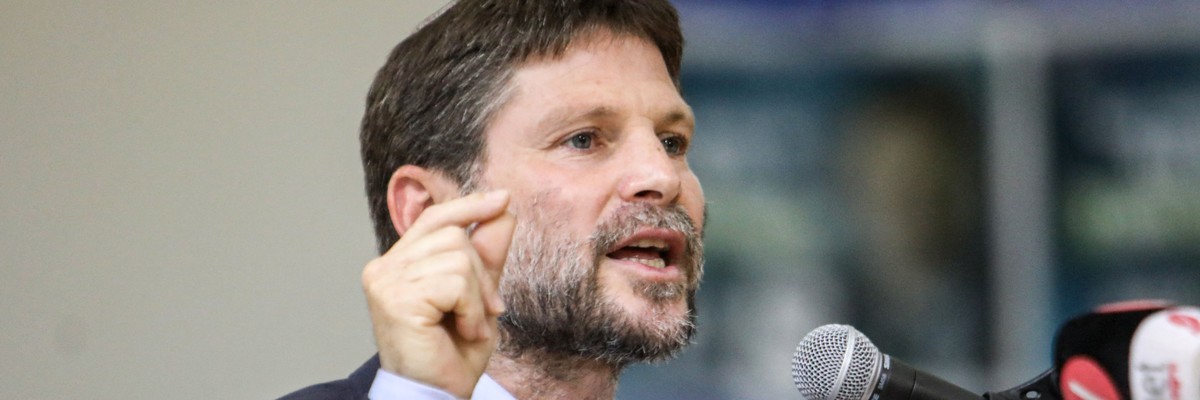
    Original article by BRETT WILKINS republished from Common Dreams under Creative Commons (CC BY-NC-ND 3.0). 
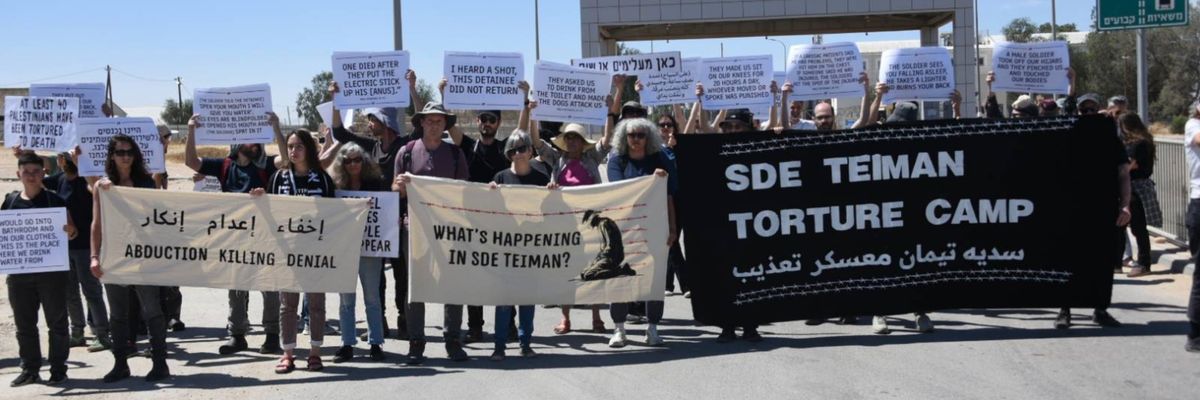
    Israeli activists protest outside the notorious Sde Teiman prison in the Negev Desert on April 20, 2024. (Photo: Ofer Neiman/X)

    The head of the human rights group said Israel’s Unlawful Combatants Law is enabling “rampant torture” of Palestinian detainees and “institutionalizes enforced disappearance.”

    Israel is using its dubious Unlawful Combatants Law to arbitrarily detain Palestinians from the Gaza Strip—including women and children—indefinitely without charge and trial, according to an Amnesty International report published Thursday.

    All 27 former detainees interviewed by the rights group described being tortured by Israeli forces.

    Amnesty documented the cases of 21 men, five women, and one 14-year-old boy taken from Gaza and held in indefinite incommunicado detention in facilities including the notorious Sde Teiman camp in Israel’s Negev Desert for periods of up to four-and-a-half months, without access to lawyers or contact with their families.

    “All those interviewed by Amnesty International said that during their incommunicado detention, which in some cases amounted to enforced disappearance, Israeli military, intelligence, and police forces subjected them to torture and other cruel, inhuman, or degrading treatment,” the report states.

    “Israeli authorities are using the Unlawful Combatants Law to arbitrarily round up Palestinian civilians from Gaza and toss them into a virtual black hole.”

    Israel’s Unlawful Combatants Law allows the Israel Defense Forces (IDF) to detain anyone from Gaza that they suspect of being engaged in the fight against Israel or posing a threat to its national security indefinitely without charge, trial, or evidence. Last December, the law was amended to allow the IDF to hold suspects for up to 96 hours without a detention order, up to 75 days without being brought before a judge, and up to three months without seeing a lawyer.

    “While international humanitarian law allows for the detention of individuals on imperative security grounds in situations of occupation, there must be safeguards to prevent indefinite or arbitrary detention and torture and other ill-treatment,” Amnesty International secretary general AgnèsCallamard said in a statement. “This law blatantly fails to provide these safeguards. It enables rampant torture and, in some circumstances, institutionalizes enforced disappearance.”

    “Our documentation illustrates how the Israeli authorities are using the Unlawful Combatants Law to arbitrarily round up Palestinian civilians from Gaza and toss them into a virtual black hole for prolonged periods without producing any evidence that they pose a security threat and without minimum due process,” Callamard added. “Israeli authorities must immediately repeal this law and release those arbitrarily detained under it.”

    According to the report, “those detained included doctors taken into custody at hospitals for refusing to abandon their patients; mothers separated from their infants while trying to cross the so-called ‘safe corridor’ from northern Gaza to the south; human rights defenders, [United Nations] workers, journalists, and other civilians.”

    Former detainees at Sde Teiman said they were blindfolded and handcuffed for their entire imprisonment, forced to remain in painful stress positions for hours on end, and prevented from speaking to other prisoners or even raising their heads.

    Said Maarouf, a 57-year-old pediatrician kidnapped by Israeli troops during an attack on al-Ahli Baptist Hospital in Gaza City in December 2023, was detained for 45 days at Sde Teiman. He described being constantly blindfolded and handcuffed, beaten, starved, and forced to sit on his knees for long periods.

    A 14-year-old boy taken from his home in Jabalia in January was held for 24 days at Sde Teiman. He told Amnesty that he was jailed with more than 100 adults in a single barrack and was kicked, punched in the head, and repeatedly burned with cigarettes. Amnesty observed bruises and burns on the child’s body when it examined him in February. Like other detainees interviewed by the rights group, the boy said he was always blindfolded and handcuffed and was not permitted to see a lawyer or his relatives.

    Earlier this year, Israeli medics working at Sde Teiman said amputations of hands and feet due to injuries from constant handcuffing were “a routine event.”

    The five women interviewed by Amnesty were initially jailed at a military detention center in an illegal Israeli settler colony in the occupied West Bank, then at Dimon women’s prison in northern Israel. All five said they were beaten during transport.

    One woman taken on December 6 said she was separated from her two children—ages 4 and 9 months—and initially held alongside hundreds of male prisoners. She was beaten, forced to remove her veil and photographed without it, and subjected to the mock execution of her husband.

    “On the third day of detention, they put us in a ditch and started throwing sand,” she said. “A soldier fired two shots in the air and said they executed my husband and I broke down and begged him to kill me too, to relieve me from the nightmare.”

    Another woman said guards threatened: “We will do to you what Hamas did to us. We will kidnap and rape you.”

    These and other accounts are consistent with the testimonies of Israeli whistleblowers and former prisoners at Sde Teiman and other Israeli detention facilities.

    Former detainees and human rights defenders have described Sde Teiman as “Israel’s Guantánamo” and “more horrific than Abu Ghraib“—the notorious U.S. military prison in Iraq where prisoners were tortured and dozens died. Palestinians held at Sde Teiman and at other detention sites described being electrocuted, mauled and even raped by dogs, constantly beaten, starved, and subjected to other torture and abuse. Other former Sde Teiman detainees said they witnessed a prisoner raped to death, possible executions, and other atrocities.

    IDF officials told the Israeli newspaper Haaretz last month that the IDF is investigating the in-custody deaths of dozens of detainees, including 36 who died or were killed at Sde Teiman since October, when Israel began its retaliatory war following the attack by Hamas-led militants that left more than 1,100 Israelis and foreign nationals dead—some of whom were killed by Israeli troops.

    Over 240 other people, mostly Israelis, were kidnapped and taken to Gaza. A Human Rights Watch report published Wednesday details war crimes and crimes against humanity including murder and rape perpetrated by members of five Palestinian armed groups that took part in the October 7 attacks.

    Since October, Israel’s siege, bombardment, and invasion of Gaza has left at least 139,000 Palestinians dead, maimed, or missing, around 90% of Gaza’s 2.3 million people forcibly displaced, and starvation—sometimes deadly—running rampant.

    Israel is on trial for genocide at the International Court of Justice in The Hague. International Criminal Court Prosecutor Karim Khan has also applied for warrants to arrest Israeli Prime Minister Benjamin Netanyahu, Defense Minister Yoav Gallant, and three Hamas leaders for war crimes and crimes against humanity, including “extermination.”

    Original article by BRETT WILKINS republished from Common Dreams under Creative Commons (CC BY-NC-ND 3.0). 
  • Newly Released Gaza Hospital Director Alleges ‘Almost Daily Torture’ in Israeli Detention

    Spread the love

    Original article by EDWARD CARVER republished from Common Dreams under Creative Commons (CC BY-NC-ND 3.0).
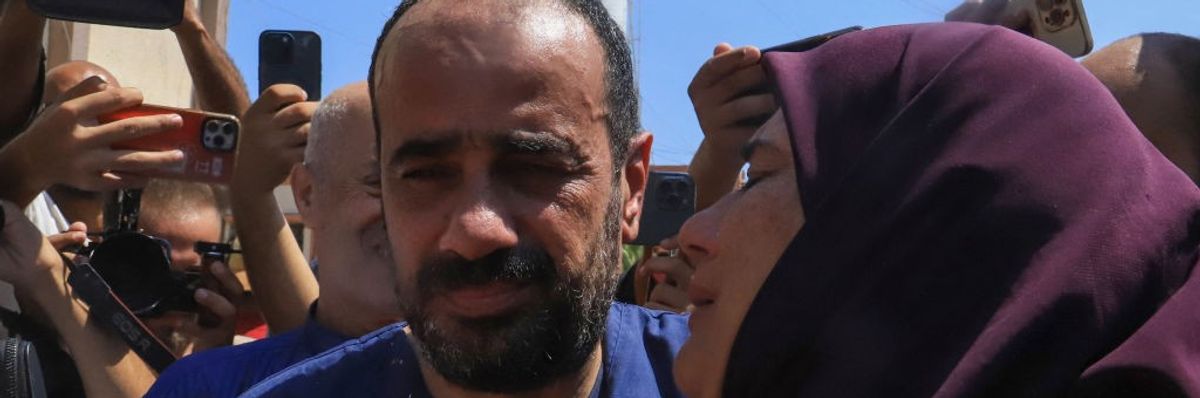
    Al-Shifa hospital director Muhammad Abu Salmiya is welcomed by relatives as he arrives in the Gaza Strip on July 1, 2024, after being detained by Israel for more than seven months. Abu Salmiya said that he and his fellow detainees were subjected to torture and terrible conditions.  (Photo: Bashar Taleb/AFP via Getty Images)

    The hospital director, who’d been held without trial since Israeli forces detained him in November, said that he and others were subjected to torture, psychological humiliation, and severe undernourishment.

    The director of Gaza’s main hospital said at a press conference on Monday that he was tortured while being held without charges for the last seven months at an Israeli detention center.

    Muhammad Abu Salmiya, director of the Al-Shifa hospital, once Gaza’s main medical center, made the claims after he and 54 other Palestinian detainees were released and arrived back to the Gaza Strip.

    Israeli forces had raided the hospital in November and alleged that Abu Salmiya was involved in making it a Hamas command center. They later destroyed the hospital.

    Abu Salmiya said detention guards broke his finger and beat him to the point that his head bled—and that he wasn’t the only one.

    “Our detainees have been subjected to all kinds of torture behind bars,” Abu Salmiya said. “There was almost daily torture.”

    There was “daily physical and psychological humiliation,” he added.

    He also said that they were severely underfed, surviving on nothing more than a loaf of bread per day. He said that all of the detainees had lost at least 30 kilograms (66 pounds).

    “Our detainees have been subjected to all kinds of torture behind bars. There was almost daily torture.”

    Israeli forces seized Abu Salmiya from a United Nations convoy on November 22. They took him to court three times while in detainment but brought no charges and allowed him no lawyer, Abu Salmiya said.

    His detention in November followed an Israeli siege of Al-Shifa hospital, which Israeli officials said had become a Hamas control center. Though weapons were found at the hospital, an investigation by The Washington Post in December showed that the evidence fell short of revealing a command center, and that key claims the Israelis had made to justify the siege turned out to be incorrect.

    Israeli forces attacked the hospital again in late March, killing hundreds and leaving the facility mostly destroyed. Several mass graves were discovered near the hospital site in the weeks that followed.

    Israel has detained thousands of Palestinians since the war started, leading to “intolerable overcrowding” of its facilities, as Haaretz reported in February. Many detainees are held without charges in what is called “administrative detention.”

    At least 40 Palestinians have died in Israeli detention during the war, according to Addameer, a Palestinian watchdog group. Salmiya said Monday that some had been killed in interrogation cells, Al Jazeera reported.

    At least one other doctor was among those released on Monday: Bassam Miqdad, head of the orthopedic unit at Gaza European hospital in Khan Younis.

    In April, Adnan Ahmad Albursh, a 50-year-old Palestinian surgeon, died in Israeli detention, according to Palestinian officials and rights groups. He had been the head of orthopedics at Al-Shifa hospital. Overall, hundreds of healthcare workers have been killed during the war.

    Israeli officials and political figures from various parties denounced the release of the 55 detainees, which was reportedly done to make space in the overcrowded detention centers.

    Itamar Ben-Gvir, a far-right minister in charge of Israel’s police and prison service, called the release of the detainees a case of “security negligence” and blamed another ministry. Benny Gantz, an opposition figure who recently resigned from the war cabinet, said whoever released the detainees should be fired and that government offices should be made available to “free up space and budget for prisoners,” according to Al Jazeera.

    Original article by EDWARD CARVER republished from Common Dreams under Creative Commons (CC BY-NC-ND 3.0).
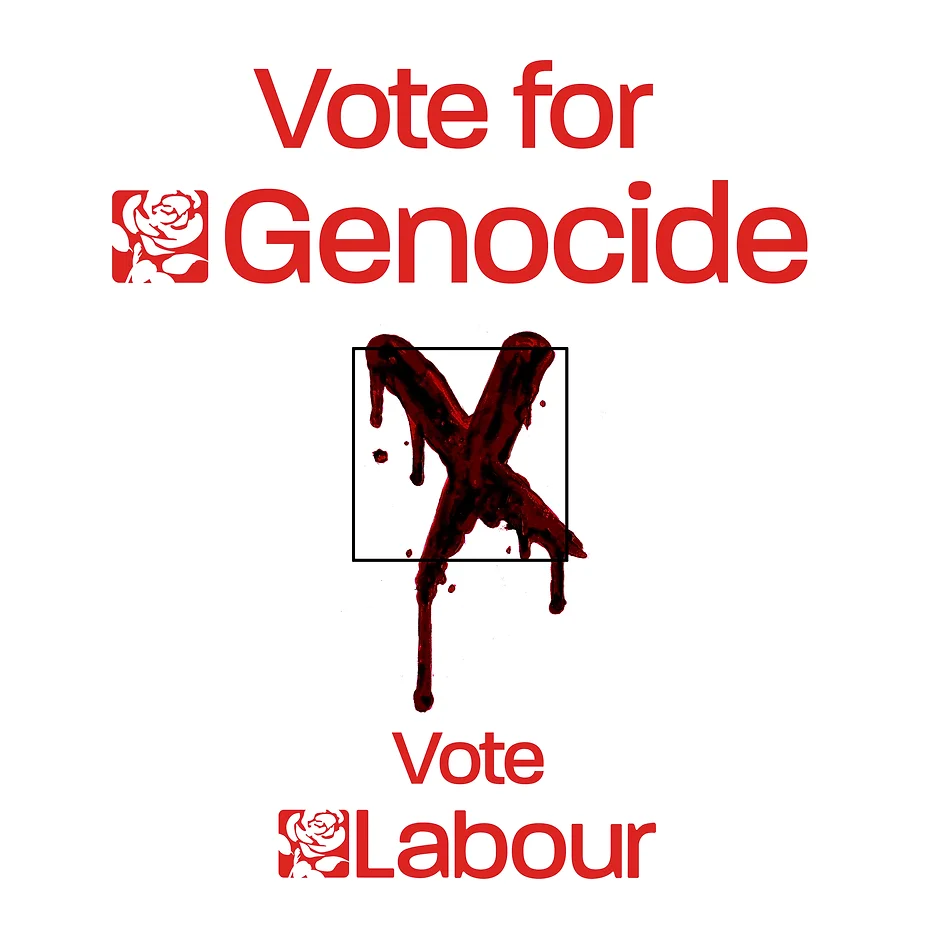
    Vote For Genocide Vote Labour.
    Vote For Genocide Vote Labour.
  • Argentine organizations reject attempts by Milei to silence dissent with fear

    Spread the love

    Original article by Pablo Meriguet republished from peoples dispatch under a Creative Commons Attribution-ShareAlike 4.0 (CC BY-SA) license.

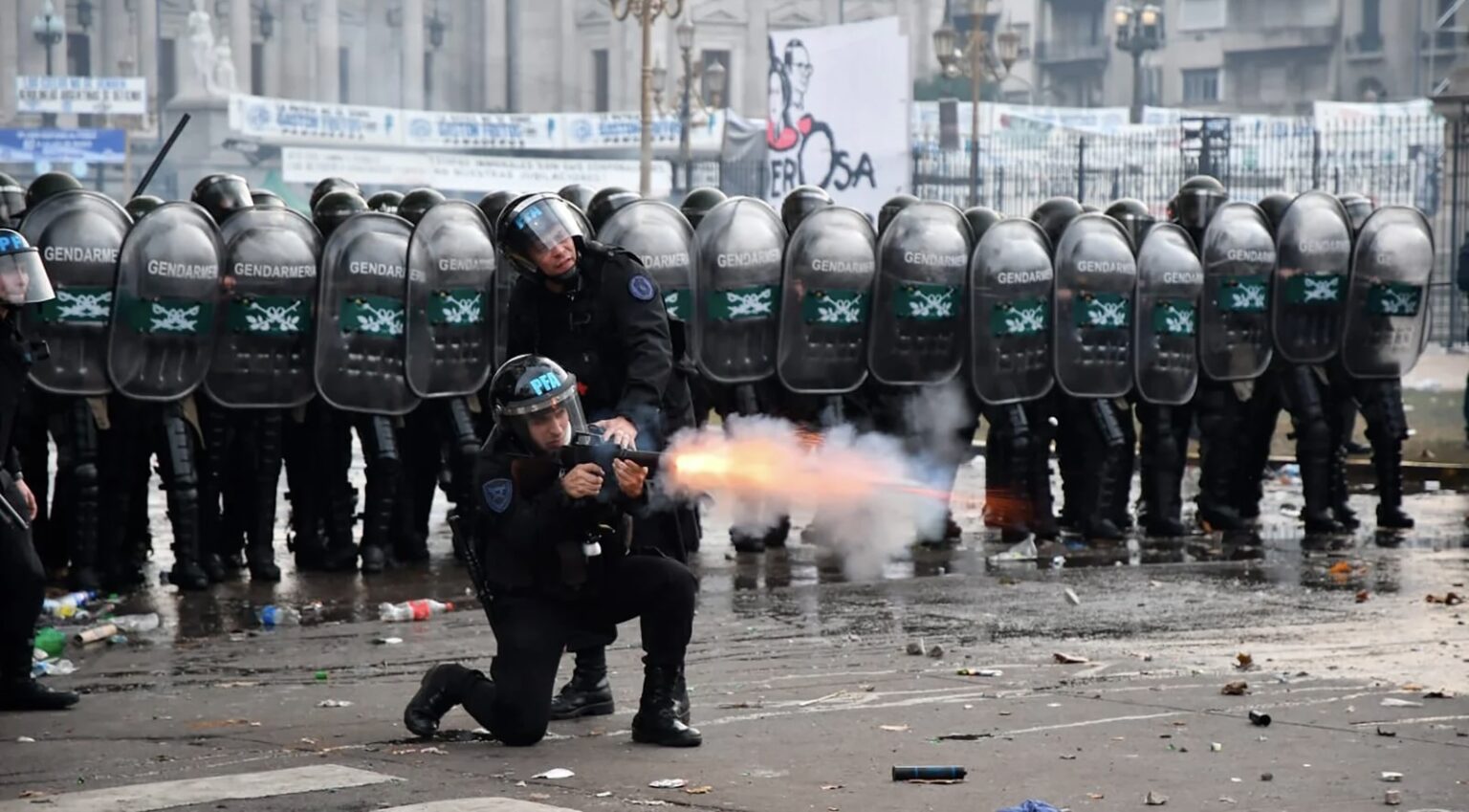
    Police in Argentina brutally repressed a mobilization against Milei’s controversial economic reforms. Photo: UP Diputados

    Over 30 people were detained in Buenos Aires during the brutal repression of the protests against Milei’s economic reform law

    Last week, the Argentine Senate debated the bill called “Law for Bases and Starting Points for the Freedom of Argentines” (Ley Bases), a set of economic and political reforms proposed by the far-right government of Javier Milei. While the Executive sought the necessary votes in the Senate to pass the law, thousands of demonstrators gathered around the legislature to demand that the law be shelved.

    The protests were called by several social organizations and trade unions, including the country’s largest trade union confederations, the General Confederation of Labor (CGT), the Argentine Workers’ Central Union, and the Argentine Workers’ Central Union (Autonomous).

    The action of the police, under the orders of the Minister of Security, Patricia Bullrich, was excessive and brutal. Even lawmakers were not spared the violent repression. Peronist legislators, Eduardo Valdés, Carlos Castagnetto, Leopoldo Moreau, Juan Manuel Pedrini, Carolina Yutrovic and Luis Basterra, denounced that they were beaten by the security forces. In addition, several detainees told press that “they were stripped naked and that pepper spray was thrown at them”.

    Martin Dirroco, a worker detained during the protests, recounted: “We were in Congress and we began to feel the tear gas, our throats began to burn and we began to leave. We heard more and more shots fired; we could see the repression. […] Suddenly a lot of people started to come, we tried to leave and seven motorcycles appeared. The one on the back of the motorcycle was pointing a gun at us. They got off the motorcycle and told us to stay still. They shooted and shouted ‘everybody against the wall’. They started pushing and shoving, holding me and throwing me to the ground. […] We had to sleep in a courtyard with handcuffs on”.

    On Wednesday, June 12, 33 people were arrested, with many held for several days. Carlos Lopez, a left Argentine political leader, told Peoples Dispatch that as of today there are still five people detained on alleged charges of “public intimidation” and “arson”. Lopez comments that some people were even arrested 15 blocks from the Senate, far away from the events for which they are accused. “They are trying to sow terror from the government, the State, so that the population feels fear and shuts its mouth”. In addition, López continues, the detainees did not have adequate access to water and food; some spent more than 15 hours in a police patrol car and many could not speak to their lawyers: “There was intimidation, torture and threats […] We ask for everyone’s solidarity so that this type of action does not happen again,” said López.

    Police launching tear gas canisters at protesters on Wednesday June 12 in Buenos Aires. Photo: Somos Telam

    The President’s Office celebrated the approval of the law and called the demonstrators “terrorists”: “Starting from 38 deputies and 7 senators, with terrorist groups attacking the Congress, having to deploy the Security Forces in defense of democracy, with the political caste resisting and operating until the last moment, and having to resort to the tie-breaker of the Vice President of the Nation, Victoria Villarruel, tonight’s is a triumph of the Argentine people and the first step towards the recovery of our greatness, having approved the most ambitious legislative reform of the last forty years.”

    Several human rights organizations, such as the Grandmothers and Mothers of the Plaza de Mayo, the Permanent Assembly for Human Rights, the Relatives of the Disappeared and Detained for Political Reasons, among others, called for a demonstration on Tuesday June 18 to demand the release of the 16 people that were still detained (including several students and professors) accused of “terrorism”. During a press conference, various relatives of the detainees denounced the injustice of the accusations against the prisoners and affirmed that they are not terrorists and demanded their immediate release.

    Milei’s “Ley Bases”

    At the end of the debate last Wednesday, the law was approved thanks to the vote of Vice President Victoria Villarruel, who broke the tie. The controversial law must be approved a second time in the Chamber of Deputies.

    The reforms of the “Ley Bases” propose a paradoxical transformation of the functioning of the Argentine State. At the same time that they seek to diminish the State’s capacity to control the economy, they strengthen the President’s political power to make economic and political decisions, which will no longer have to be approved by the legislative branch. In other words, the intention is to build a weaker but more agile State to execute President Milei’s neoliberal plan.

    One of the most controversial changes is the creation of the “Incentive Regime for Large Investments” (RIGI, for its initials in Spanish). The purpose of this regime is to reduce the State’s control over large companies that invest more than USD 200 million in the country. The government promises these big companies a reduction in taxes, privileges in the project approval process, and protection of capital from state control for 30 years. RIGI seeks, among other things, the exploitation of natural resources by major companies.

    According to the “Ley Bases”, the President may have “extraordinary powers” for one year if he declares a public emergency in the economic, financial, and energy fields. In this sense, Milei would have several powers that currently only the Legislative has. To achieve its approval in the Senate, the Executive committed itself not to interfere with 15 public agencies, such as the National Service of Food, Health and Quality (SENASA), the National Bank of Genetic Data (which has information on those who disappeared during the last dictatorship), among other institutions. However, the government will be able to legislate through expeditious decrees, which implies, in general, the first great legislative victory for its political project.

    In addition, the “Ley Bases” authorizes the privatization of Intercargo, a state-owned company dedicated to provide services to air travel companies, and Energía Argentina S.A., which is in charge of the extraction and exploration of hydrocarbon deposits, their transportation, and storage. Although Milei wanted to privatize more than 40 public companies, the negotiations forced him to limit his aspirations. Nevertheless, Milei’s major project in this regard seems to be aimed, at first, at the privatization of the mining, energy and fuel sectors.

    Finally, the “Ley Bases” seeks to make a discreet, although controversial, labor reform, as it proposes, among other things, to eliminate penalties for companies that use informal workers, which is currently sanctioned by law.

    While the Executive celebrates its neoliberal legislative victory, the families of the prisoners continue to pressure the justice system to free the detainees and drop the serious charges that could mean several years in prison.

    Original article by Pablo Meriguet republished from peoples dispatch under a Creative Commons Attribution-ShareAlike 4.0 (CC BY-SA) license.

  • UN Probe Finds Israel Guilty of ‘Extermination,’ Torture, and Other War Crimes in Gaza

    Spread the love

    Original article by JAKE JOHNSON republished from Common Dreams under Creative Commons (CC BY-NC-ND 3.0). 
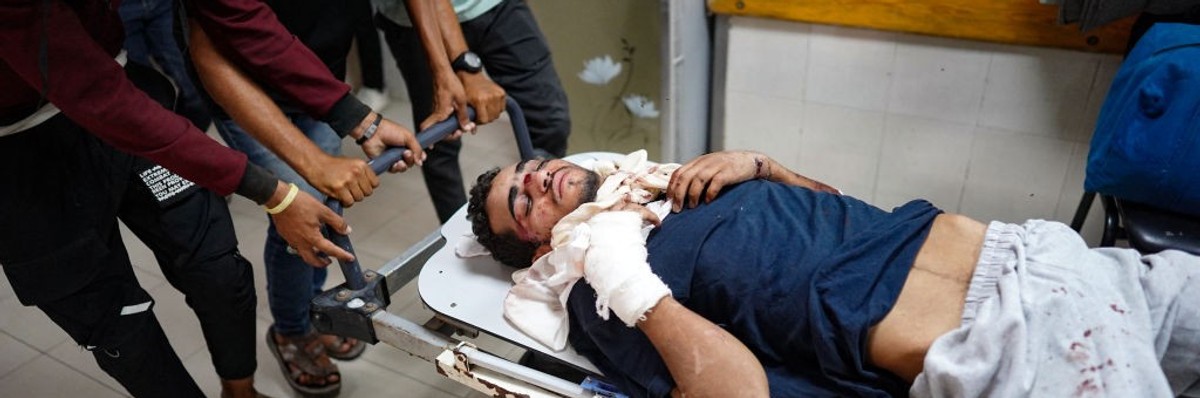
    Injured Palestinians were taken to the Al-Aqsa Martyrs Hospital for treatment following an Israeli attack in Deir al-Balah, Gaza on June 12, 2024. 
    (Photo: Ashraf Amra/Anadolu via Getty Images)

    “Israel must immediately stop its military operations and attacks in Gaza, including the assault on Rafah,” said the chair of the United Nations commission behind the investigation.

    A United Nations commission tasked with conducting an in-depth investigation of Israeli military actions in the occupied Palestinian territories concluded Wednesday that Israel’s government is responsible for multiple war crimes and crimes against humanity in the Gaza Strip, including “extermination,” torture, forcible transfer, and the use of starvation as a weapon of warfare.

    The U.N. inquiry began on October 7, the day of a deadly Hamas-led attack on southern Israel. The U.N. Independent International Commission of Inquiry on the Occupied Palestinian Territory found that Palestinian armed groups committed war crimes during their attack on Israel, including the deliberate killing and torture of civilians.

    Israel’s massive military response—launched hours after the Hamas-led attack—has caused “immense numbers of civilian casualties in Gaza and widespread destruction of civilian objects and infrastructure,” outcomes that “were the inevitable result of a strategy undertaken with intent to cause maximum damage, disregarding the principles of distinction, proportionality and adequate,” the U.N. commission said Wednesday.

    “The intentional use of heavy weapons with large destructive capacity in densely populated areas constitutes an intentional and direct attack on the civilian population,” the commission added. Many of the weapons Israel has used in Gaza were supplied by the United States.

    The new report also points to public statements by top Israeli officials as evidence that Israel’s goal in Gaza was to inflict “widespread destruction” and kill a “large number of civilians.” The U.N. panel specifically cited Israeli Defense Minister Yoav Gallant’s October announcement of a “total siege” on the Gaza Strip that would prevent the entry of water, fuel, food, and other necessities.

    The International Criminal Court’s top prosecutor has applied for arrest warrants for Gallant and Israeli Prime Minister Benjamin Netanyahu over war crimes committed in Gaza.

    Navi Pillay, the chair of the U.N. commission, said in a statement Wednesday that “Israel must immediately stop its military operations and attacks in Gaza, including the assault on Rafah, which has cost the lives of hundreds of civilians and again displaced hundreds of thousands of people to unsafe locations without basic services and humanitarian assistance.

    “Hamas and Palestinian armed groups must immediately cease rocket attacks and release all hostages,” Pillay added. “The taking of hostages constitutes a war crime.”

    The commission’s findings come less than a week after U.N. Secretary-General António Guterres informed the Israeli government that it was added to an annual “list of shame” that condemns nations for killing and wounding children in wars.

    Children have suffered horrific physical and psychological impacts from Israel’s eight-month assault on Gaza, which has killed around 15,000 children. Earlier this year, the U.N. Children’s Fund estimated that around 1,000 kids in Gaza had lost one or both of their legs as a result of Israeli attacks.

    Dozens of children were among the more than 270 Palestinians killed by Israeli forces over the weekend during a raid on Gaza’s Nuseirat refugee camp. The military operation resulted in the freeing of four Israeli hostages, but the U.N. Human Rights Office said Tuesday that “the manner in which the raid was conducted in such a densely populated area seriously calls into question whether the principles of distinction, proportionality, and precaution—as set out under the laws of war—were respected by the Israeli forces.”

    Doctors Without Borders, known internationally as Médecins Sans Frontières (MSF) said Tuesday that Israeli forces have killed more than 800 people in Gaza and wounded more than 2,400 since the beginning of June.

    “How can the killing of more than 800 people in a single week, including small children, plus the maiming of hundreds more, be considered a military operation adhering to international humanitarian law?” asked Brice de le Vingne, the head of MSF’s emergency unit. “We can no longer accept the statement that Israel is taking ‘all precautions’—this is just propaganda.”

    “Since October (and certainly before), the dehumanization of Palestinians has been a hallmark of this war,” de le Vingne added. “Catch-all phrases like ‘war is ugly’ act as blinders to the fact that children too young to walk are being dismembered, eviscerated, and killed.”

    Original article by JAKE JOHNSON republished from Common Dreams under Creative Commons (CC BY-NC-ND 3.0). 
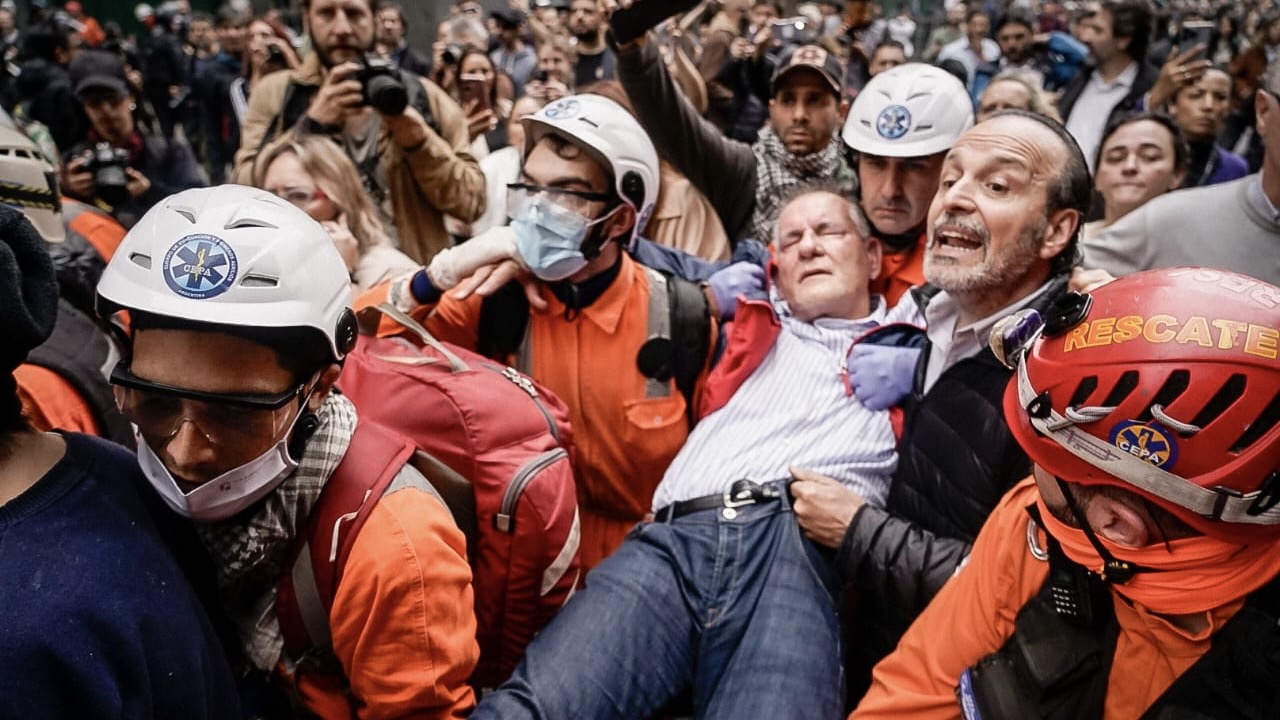
    They’re Arresting the Wrong People Inside of Congress

    Despite Mainstream Headlines, Israel’s Tents Massacre Was Not a ‘Tragic Mistake’

    UN Human Rights Office Says IDF’s Deadly Nuseirat Raid May Amount to War Crime

  • 44% of all Palestinians killed by Israel since October 7 are children

    Spread the love

    Original article by Abdul Rahman republished from peoples’ dispatch under a Creative Commons Attribution-ShareAlike 4.0 (CC BY-SA) license.

    Rallies for Palestinian Children’s Day were held across Brazil, including in São Paulo. Photo: Priscila Ramos

    Over 14,000 children have been killed and nearly 17,000 others have lost at least one or both of their parents in the Israeli bombings or ground offensives in the last six months in Gaza

    Israel has killed 14,350 Palestinian children between October 7 and April 4. This means children account for 44% of all Palestinians killed in Israel’s genocidal war on Gaza, Palestinian Central Bureau of Statistics (PCBS) said in a press release ahead of Palestinian Children’s Day.

    Women and children constitute nearly 70% of over 7,000 additional persons missing in the same period, and the majority of the over 75,000 wounded Palestinians are women and children.

    Out of a total of 455 Palestinians killed in the occupied West Bank by the Israeli forces in the same period, 117 were children.

    Over 17,000 Palestinian children have also been orphaned as a result of Israel’s genocidal attacks, according to UNICEF data, after either both or one of their parents were killed in the Israeli bombings and ground offensives since October 7.

    The ongoing genocide in Gaza has also has separated at least 17,000 Palestinian children from their parents.

    Palestinians celebrate Children’s Day on April 5 every year. Human rights groups such as Defense of Children International Palestine, Palestinian Network for Children’s Rights (PNCR) and others mark the day as International Day of Solidarity with the Palestinian Children in order to highlight Israel’s systematic crimes against them.

    Israel starves Palestinian children to death

    At least 31 Palestinian children have been starved to death in Gaza in the last couple of months. The starvation is a product of the deliberate blockade and restrictions imposed by the Israeli forces on the delivery and distribution of food and other humanitarian aid in the besieged territory. The entire population of Gaza is now facing acute levels of food insecurity

    The around 20,000 children born since October 7 in Gaza are now at severe risk of malnutrition. The prolonged lack of nutrition has raised the possibility of stunted growth for the children of Gaza.

    A large number of pregnant women in Gaza are deprived of adequate medical care as well, due to the genocide and Israel’s repeated attacks on the health facilities and workers.

    According to the PCBS, by the middle of this year, there would be around 2.4 million children below the age of 18 in the occupied Palestinian territories, 43% of the total Palestinian population in West Bank and Gaza. The population of children in Palestine is almost equally divided between the West Bank (over 1.3 million) and Gaza (over 1 million).

    Around 816,000 children in Gaza need psychological assistance due to trauma caused by the ongoing genocide. Around 620,000 have been out of school, with eight out of ten schools destroyed by the invading Israeli forces in indiscriminate bombings on civilian infrastructures and deliberate acts of sabotage. Another 133 schools are used as temporary shelters for displaced people.

    The child prisoners of Palestine

    Though since October 7, Israeli forces detained over 500 Palestinian children, some were released later. However, still there are over 200 Palestinian children in different Israeli jails. According to Addameer, 41 Palestinian child prisoners are being kept under administrative detainees.

    Palestinians children detained by the Israeli forces have often been subjected to torture and abuse both during their arrests and in the prison. In a large number of cases, Palestinian children have been treated like criminals when arrested by Israeli forces with their hands tied, blindfolded. They are often tried in military courts.

    In a report submitted last year by Francesca Albanese, UN special rapporteur on human rights in the Palestinian territories, claimed that over “10,000 Palestinian children have experienced institutionalized ill treatment during arrests, prosecutions, sentencing and consequent traumas on themselves and their families.”

    Some children released from Israeli prison recently have also testified that they were isolated in the prison and tortured and severely beaten, Addameer claimed.

    Original article by Abdul Rahman republished from peoples’ dispatch under a Creative Commons Attribution-ShareAlike 4.0 (CC BY-SA) license.