Mali defends sovereignty against a Western-backed “proxy war” by terror groups

Spread the love

Original article by Pavan Kulkarni republished from peoples dispatch under a Creative Commons Attribution-ShareAlike 4.0 (CC BY-SA) license.
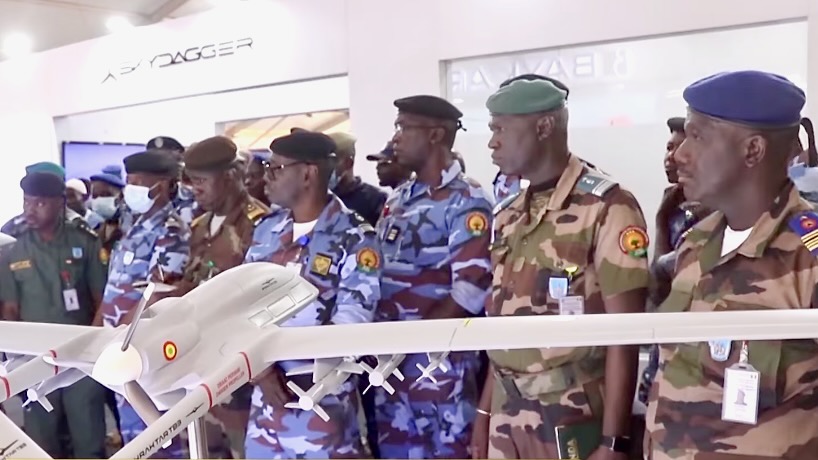
BAMEX 25 is Mali’s first international defense expo. Photo: screenshot

As panic-inducing travel advisories and doomsaying media reports prophesy the fall of Mali to an Al Qaeda affiliate attacking fuel convoys, the government has re-secured supply routes and hosted Mali’s first international defense expo in a supposedly besieged capital.

Amid a barrage of media reports prophesying the fall of Mali to an Al Qaeda affiliate disrupting its fuel supply by attacking tankers, delegates from ten African countries, Iran, and Turkey attended a defense expo in the capital Bamako from November 11 to 14.

The city was reported to be “under siege”, encircled by jihadists closing in on power. Some version of “Is Mali about to fall?” was a rhetorical question across headlines, while the Atlantic Council declared the country was “unraveling”.

Dismissing this portrayal as a scenario “concocted in the office of foreign intelligence services”, Foreign Minister Abdoulaye Diop insisted that “the fate of Mali, and the destiny of the people in the West African region will not be decided” by the media.

He made these remarks on November 12, addressing a press conference on the sidelines of BAMEX 25, Mali’s first international defense expo, aimed at building “an autonomous security architecture” for Africa in the face of “unprecedented security and geopolitical challenges”.

This expo, he said, is yet another indication of the Malian government’s priority to strengthen its defense and security to combat the threat of terror groups that were spawned across the Sahel by NATO’s destruction of Libya in 2011.

French-spawned terror groups

Mali was among the first and worst affected by these terror groups. Its former colonizer, France, which was a key participant in Libya’s destruction, then deployed its troops, ostensibly to protect Mali. Over the years, its military presence expanded across the Sahel. Alongside, the armed groups also grew in strength, increasing attacks and the area under their control.

This led to a growing perception that French troops in the region were not fighting the terror groups it helped create but guarding its own economic and political interests in maintaining its neocolonial grip over the troubled former colonies.

Amid mass protests against the French troop deployment, Mali’s France-backed regime of the then-president Ibrahim Boubacar Keïta was removed in a popular military coup in 2020. A military government replaced the regime with the support of the protest movement, trade unions, and other progressive formations.

In 2021, then-prime minister Choguel Kokalla Maïga recalled in an interview the active role played by France in handing over Mali’s territory to terror groups.

“Upon arriving in” the northern town of Kidal in 2013, “France forbade the Malian army from entering. It created an enclave,” and handed it over to Al-Qaeda affiliate Ansar al Dine and Tuareg separatists brought together, he said. Later in 2017, Ansar al Dine coalesced with other terrorist groups to form the Jama’at Nusrat al-Islam wal-Muslimin (JNIM), which became one of the most dangerous groups in the Sahel.

“It’s an enclave controlled by France. They have armed groups trained by French officers. And we have evidence of this,” Maiga added in his 2021 interview. “Mali has no access to Kidal.”

However, the new government retook Kidal in November 2023, less than a year and a half after expelling the French troops.

Read More: Withdrawal of French troops from Mali is a historic, anti-imperialist victory

“On the ground today, terrorist groups are no match for Mali’s defense and security forces,” Diop told reporters at the press conference. “There have been enormous efforts to equip Mali’s defense and security forces, which have achieved resounding successes” against the terror groups, he said, adding that this has “forced them to change their strategy and now attack softer targets.”

Attacks on fuel convoys

Early this September, the JNIM started attacks on drivers and their tankers carrying fuel from the Ivory Coast in the Sikasso region of southern Mali. “Due to disruptions in fuel supplies that are affecting the movement of school staff,” the Education Ministry suspended classes for two weeks on October 26.

“Do Not Travel to Mali for any reason due to crime, terrorism, kidnapping, unrest, and health,” the US State Department said in a travel advisory on October 25. Three days later, the department issued a second alert, insisting that its citizens in Mali “should” leave the country “using commercial aviation, as overland routes to neighboring countries may not be safe for travel due to terrorist attacks along national highways.”

Australia followed suit on October 29, warning, “If you’re in Mali, you should depart immediately using commercial means while the international airport in Bamako remains open and flights are available. If you decide to remain in Mali, be prepared to shelter in place for an extended period.” Italy and Germany also asked their citizens to leave the country.

Amid the panic-inducing travel advisories and doomsaying media reports, Mali’s president, Col. Assimi Goïta, inaugurated the country’s second Lithium mine on November 3, setting Mali en route to becoming Africa’s leading Lithium producer by 2026.

The mine is located in Bougouni, about 170km south of Bamako in the Sikasso region, where the JNIM had attacked fuel convoys in September.

Government restores fuel supply

Two days later, on November 5, residents of Bamako cheered on the streets as large convoys of fuel tankers entered the city under the protection of the armed forces. Nevertheless, France 24 persisted with headlines like “Jihadists threaten to overrun Mali as blockades continue“, “fuel blockade squeezes Mali’s military rulers“, etc.

“There have been disruptions in the supply system,” but “the state organized itself, put in place a strategic plan to resume supplies, to ensure the security of convoys … And gradually, you see that hundreds of trucks are arriving every day to resume supplies to Bamako and other localities,” Diop added in his press conference. “As I speak, Mali is able to ensure the supply of hydrocarbons and petroleum products to its population.”

However, two days after the fuel convoys started arriving, France “advised” its citizens on October 7 to leave Mali “as soon as possible using the remaining available commercial flights” because the “security situation has been deteriorating.”

Mali’s first-ever National Electronic Payments Exhibition was organized in the capital that day by the Professional Association of Banks and Financial Institutions of Mali (APBEF-Mali) and the West African Economic and Monetary Union’s Interbank Electronic Payment Group (GIM-UEMOA).

Schools reopened on schedule on November 10. That day, President Goïta inaugurated the Presidential Emergency Hospital Project to upgrade six existing health centers in Bamako to district hospitals by the end of 2026, for which a health budget of USD 349.2 million has been allocated. The inauguration also marked the start of construction of nine new hospitals, including in Bougouni, Bandiagara, and Nioro, where attacks had been reported in the recent past.

Despite these indications of improving security, the UK government claimed on November 13 that “Terrorist group Jama’a Nusrat ul-Islam wa al-Muslimin (JNIM) has implemented blockades on key routes throughout Southern and Western Mali, including the capital city of Bamako,” where the international defense expo was underway.

“These blockades are targeting fuel trucks and are enforcing checkpoints for individuals attempting to pass through them. Attacks can occur at any time,” added its travel advisory.

A proxy war

“We must not think we are simply facing terrorist groups,” Diop maintains. “No, this is a proxy war, where certain powers, cowardly and unable to confront us directly, are using terrorist groups and asymmetric forces to fight us … These terrorist groups have drones. Where do they come from? Who manufactures them? Who provides them in areas where people cannot even eat?”

Le Monde had reported last year that Ukrainian authorities are training an armed group to use drones. Spokesperson of Ukraine’s military intelligence, Andriy Yusov, had said in an interview that it provided “information, and not only information,” to armed groups fighting the state in Mali.

Earlier in 2022, Diop had written a letter to the UN Security Council, saying Mali had evidence that France was flying missions in Malian airspace to collect intelligence and airdrop arms and ammunition to terror groups.

Mali’s southern neighbor, Burkina Faso, and eastern neighbor, Niger, have also since accused France of supporting terror groups to destabilize their countries after its troops were expelled following a similar sequence of anti-France protests and popular coups.

“Africa is now the epicenter of terrorism,” Nicolas Lerner,  head of France’s General Directorate for External Security (DGSE), told France Inter radio on November 10. Calling it a threat to Europe, he insisted it “directly threatens our interests,” effectively trying to set up the case for another military intervention.

Curiously, he went on to add that while the “JNIM wants the fall of the junta and the installation of authorities who back the establishment of a caliphate,” the group itself “is not necessarily capable of controlling Mali, nor does it actually want to.”

Lerner is “saying … it is not even their intention to take Bamako … How [does he] know their intention? Is it you who gives them this intention? Is it you who commands them? Is it you who decides,” questioned Diop.

“This should help us understand how deep the collusion is today between hybrid forces. These are not terrorists – it is a proxy war. But I can assure you that Mali will endure.”

He reiterated that Mali, Burkina Faso, and Niger, which have formed the Alliance of Sahel States (AES), are fighting together, convinced that this proxy war is waged on them because they “chose to break the chain of dependency, to break the chain of subjugation to colonial domination.”

He added, “Our countries are being attacked first to break this dynamic and then to prevent other African countries from following this path. And we have understood the political message behind this.” The African Union (AU), however, has not.

“We are not reaching out to the so-called international community to come to our aid”

Amid the chorus by Western countries, the AU’s chairperson, Mahamoud Ali Youssouf, called for “a robust, coordinated, and coherent international response to counter terrorism and violent extremism in the Sahel.”

“No action can be … taken in Mali without Malians, without the consent of the Malian state, without the Malian state requesting it,” Diop retorted, affirming, “we are not reaching out to the so-called international community to come to our aid.”

“This call for international action is all the more worrying since Mali has emerged from this type of paradigm,” he added. Having expelled the French troops and asserted sovereignty, “the new paradigm [in the AES] is to trust ourselves and take charge … to ensure the security of our countries rests first and foremost on the shoulders of the people and leaders of our countries.”

Original article by Pavan Kulkarni republished from peoples dispatch under a Creative Commons Attribution-ShareAlike 4.0 (CC BY-SA) license.
Continue ReadingMali defends sovereignty against a Western-backed “proxy war” by terror groups

53% of Europe and Mediterranean Basin Impacted by Drought in Mid-May: Report

Spread the love

https://www.ecowatch.com/drought-europe-mediterranean-2025.html

From May 11 to 20, 42 percent of soils in Europe and the Mediterranean basin lacked moisture and were at a warning level, while five percent were at an alert level, indicating vegetation was not growing normally.

Countries in northern, central and eastern Europe were at high alert levels.

Roughly 19 percent of territory in Ukraine was on alert, with other countries in concerning circumstances, including nine percent of Hungary and Slovakia, 10 percent of Poland and 17 percent of lands in Belarus.

The alert level for some territories and countries was as high as 20 percent, including the Palestinian territories, Cyprus and Syria.

Several countries were experiencing drought conditions in mid-May without being at an alert level, including 98 percent of the United Kingdom. According to the UK’s Met Office, the country had its driest spring in over 50 years, as well as its warmest spring ever recorded.

Continues at https://www.ecowatch.com/drought-europe-mediterranean-2025.html

Continue Reading53% of Europe and Mediterranean Basin Impacted by Drought in Mid-May: Report

Eighty years on: Remembering the defeat of fascism – or witnessing its return?

Spread the love

Original article by Biljana Vankovska republished from peoples dispatch under a Creative Commons Attribution-ShareAlike 4.0 (CC BY-SA) license.

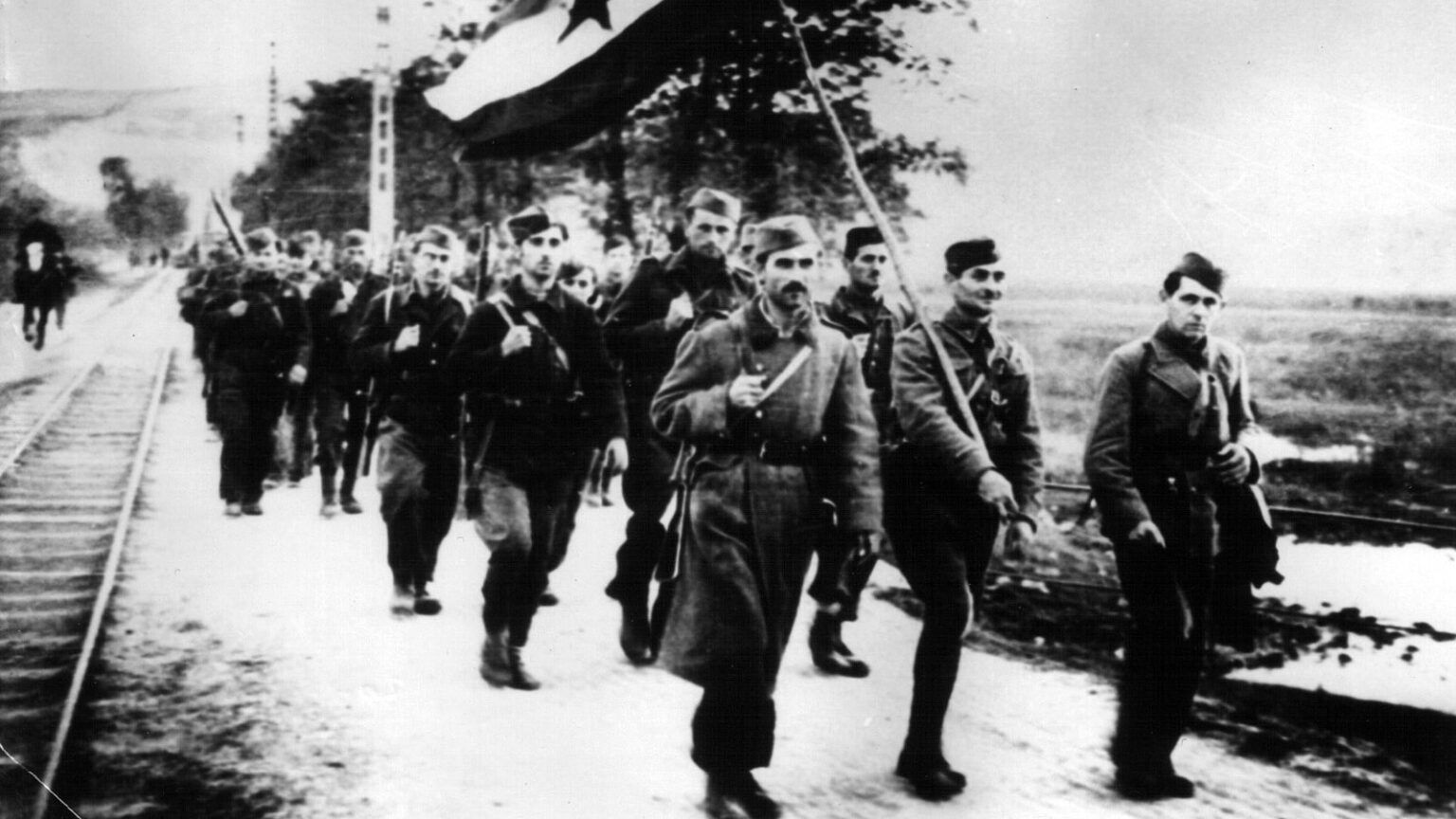
Entrance of the 7th Vojvodina Brigade of Yugoslav partisans in liberated Novi Sad, 23 October 1944. Photo: Wikimedia Commons

Neo-fascism merely adapted, disguised, and reshaped itself according to the times. In some states, we now see historical revisionism – and even glorification of local fascist or Nazi collaborators.

As we approach a major anniversary – 80 years since the defeat of fascism – a strange silence hangs over my country, Macedonia, and the broader region we now call the territory of former Yugoslavia. National authorities have been under sustained external (Western) pressure for years: May 9 must no longer be associated with the victory over fascism. Year after year, in both public memory and the education system, May 9 has been rebranded as Europe Day.

Older generations still remember, but what do younger ones know about Yugoslavia’s enormous human sacrifice, second only to the USSR, in the struggle against Evil? Almost nothing. We, the older ones, might suffer from the absence of dementia – we stubbornly remember the times when our fathers and grandfathers gave their lives for ideals that today’s youth barely even hear about.

This imposed forgetfulness on younger generations, however, goes so far that TV segments show young people unable to answer the simple question: Who was Josip Broz Tito? In Macedonia, more and more students know nothing about October 11, 1941, the Day of the Macedonian Uprising against fascism. Yet they excel in competitions where they display near-perfect knowledge of Europe. The irony is painful: the roots of patriotism and links to the most glorious moments of our not-so-distant past are not only being severed but portrayed as harmful.

A mythical and quasi-religious connection is being nurtured toward a mirage called Europe – meaning, of course, the European Union – which is idealized as a promised land, waiting with open arms. But this is no coincidence. Through its entire state-building apparatus, the EU seeks to rewrite history and implant it in the minds of new generations. In that version of history, any connection to the brutal colonial past is erased. More importantly, a veil is drawn over the fact that Europe’s imperial ambitions led to two world wars. The Second World War, whose anniversary we now mark quietly – even clandestinely, behind the EU’s back – was the anticlimax of capitalism, its degeneration into Nazism and fascism. This was not merely the result of individuals like Hitler or Mussolini, but of structural conditions that emerged from the womb of the post-World War I capitalist crisis.

The EU, falsely presenting itself as the embodiment of “Europe”, has been busy remodeling its image – until the start of the special military operation in Ukraine, it even tried to portray itself as a normative power, winning hearts and minds through soft power. It was even awarded the Nobel Peace Prize for past deeds. Yet its present and future seem to signal the revival of the very seed of evil it once claimed to oppose. The latest deep cycle of capitalist crisis first resulted in a divorce from democratic principles, but now it does not hide its hyper-imperialist and militaristic aspirations – for the sake of “self-defense” from an imagined Russian threat. Colloquially, many of us use the new word “Rusophrenia”: a belief that Russia is about to collapse and to take over the world at the same time. This term describes well the irrational view of Russia that is now entrenched in Western public opinion. It helps legitimize the new wave of militarization, even at the expense of the social well-being of Western citizens.

The rehabilitation of fascism began with its erasure from memory. Then came the glorification of the Euromaidan in Ukraine – the so-called pro-European revolution of 2014. A strange amnesia is spreading through the so-called Western world. As said, May 9 was kidnapped, and with it, textbooks, symbolic acts, and commemorations were gradually stripped of any connection to the true military victors of World War II: the Red Army and the Soviet people, who sacrificed more than 27 million lives. (Yugoslavs sacrificed more than a million people.)

It was the Soviets who liberated Berlin – twice. The final time, it was done by Mikhail Gorbachev, at a cost that Russia continues to pay today. Even the UN Secretary-General now avoids naming the Red Army soldiers who freed prisoners from the most notorious concentration camps.

It is Moscow and its allies who now stand as the only ones acting in the spirit of Orwell’s assertion that “in a time of universal deceit, telling the truth is a revolutionary act”. That truth will ring out loudly during the parade and major celebration on Red Square.

What is happening in what used to be Yugoslavia? In countries where generations were raised on narratives of brotherhood and unity, on the heroism of partisans who fought on the right side of history? First came the erosion of sovereignty and the right to self-determination. As the new religion – NATO and the EU are the only alternative and always right – was internalized, governments began distancing themselves from that part of our history. They turned instead to ancient glories or to painting a glowing future in union with the West.

To be red, to be a partisan, to be anti-fascist – gradually became suspicious, even dangerous. Our government now prides itself on alliances with the West (though it’s increasingly unclear – whose West? America’s or Europe’s?), and in distancing itself from those we once fought alongside. Former occupiers are now called “administrators”. Busts of partisans gather dust.

Anti-fascism has become uncomfortable to display – lest our Western allies recognize themselves in the mirror. So, silence prevails. Europe, the EU, is still celebrated – even as it re-militarizes, tramples basic values and human rights, and tacitly supports genocidal regimes. Confusion reigns over what to celebrate, what to remember, and why. Because, in an Orwellian world, war is peace, and peace is war.

Commemoration and historical memory matter. But just as vital is the ability to see, with eyes wide open, that the serpent’s egg still lives – and could hatch again into what millions across the world gave their lives to defeat eighty years ago. The bitter truth is that fascism was never fully defeated – except on the battlefield in 1945. Social scientists know well that the roots of fascism cannot be destroyed by arms alone. Neo-fascism merely adapted, disguised, and reshaped itself according to the times. In some states, we now see historical revisionism – and even glorification of local fascist or Nazi collaborators.

That is why the Russian initiative at the United Nations is significant. On 17 December 2024, during the 79th session of the UN General Assembly, the Russian Federation proposed a resolutionCombating glorification of Nazism, neo-Nazism and other practices that contribute to fueling contemporary forms of racism, racial discrimination, xenophobia and related intolerance. It was co-sponsored by 39 states from various regions. At last, it received 119 votes in favor, while 53 voted against. Regrettably, my country was among the latter – even though its very right to self-determination and statehood within Yugoslavia was born of the anti-fascist struggle. Perhaps for global politics, it is even more telling to examine who else voted against the resolution: Ukraine, the US, the UK, Germany, Italy, Belgium, Norway, the Netherlands, Finland, Sweden, Japan, Canada… Look at the new geopolitical map of the world, and it all becomes self-evident and telling.

According to some sources, Soviet Marshal Georgy Zhukov said, “We have liberated Europe from fascism, but they will never forgive us for it.”

They haven’t, as we now clearly see.

Biljana Vankovska is a professor of political science and international relations at Ss. Cyril and Methodius University in Skopje, a member of the Transnational Foundation of Peace and Future Research (TFF) in Lund, Sweden, and the most influential public intellectual in Macedonia.

This text was originally published by the Valdai Club and reproduced by Globetrotter.

Original article by Biljana Vankovska republished from peoples dispatch under a Creative Commons Attribution-ShareAlike 4.0 (CC BY-SA) license.

Publication should be regarded as worthy of debate rather that endorsement of the views of the author by the https://onaquietday.org blog.

Continue ReadingEighty years on: Remembering the defeat of fascism – or witnessing its return?

‘Energy security’ is being used to justify more fossil fuels – but this will only make us less secure

Spread the love

corlaffra / shutterstock

Freddie Daley, University of Sussex and Peter Newell, University of Sussex

The UK government is about to host a summit with the International Energy Agency (IEA) on the future of energy security. It does so as the world grapples with war, geopolitical realignments and trade barriers, against a backdrop of accelerating climate upheavals. One of the expected outcomes of this summit is a new, agreed definition of what constitutes energy security in the 21st century.

Common understandings of energy security have focused on making supplies reliable and affordable, with less attention paid to ensuring sources of energy are sustainable and less volatile over the medium- and long-term. This neglect compromises our collective security.

The IEA’s 31 member countries and 13 associates include most of the world’s most powerful states. Its influence means that this new definition of energy security will be used to inform government policies and investment decisions around the world. Given the cost of energy infrastructure, and the lengthy time it takes to build these projects, this definition is set to shape our future, economically and climatically.

But there is a very real risk that this definition will open the door to further investments into fossil fuel production under the guise of energy security.

Annotated world map
International Energy Agency (IEA) member and ‘association member’ countries. IEA, CC BY-SA

After Russia invaded Ukraine, governments rushed to cut their reliance on Russian fossil fuels. This caused major disruptions as prices spiked and millions were pushed into energy poverty.

Europe alone spent an extra €517–€831 billion (£444–£713 billion) on energy in 2021 and 2022, even though some imports from Russia continued through so-called “shadow fleets”. Some argued that high fossil fuel prices only embolden leaders like Putin and help fund their conflicts.

Governments responded with “energy nativism”, as they sought to secure as much energy as possible for their citizens at whatever cost. This typically meant boosting renewables and bulk buying oil and gas. In the UK’s case, it also meant the previous government issuing hundreds of new licenses to drill for oil and gas to “increase energy security” – licenses the current government says it will honour).

Shipments of liquified natural gas (LNG) were also redirected from poorer countries like Pakistan and Bangladesh towards the highest bidders in Europe and Asia. This raises the question of who exactly is becoming more energy secure and at what cost.

Meanwhile, large fossil fuel exporters like Qatar, the US and Australia ramped up production. A US official even referred to its gas exports as “molecules of freedom”. Australia has exported so much natural gas it may have to buy its own gas back from Japan at market price.

The sheer volume of investment in new oil and gas infrastructure like offshore rigs or LNG terminals, combined with long build times, has locked in higher fossil fuel production and pushed emissions to record levels. This poses significant risks for both exporters and importers, especially as future demand is uncertain and energy markets remain volatile.

Fossil fuels remain dominant

More fundamentally, continued reliance on fossil fuels is making humanity less secure. The vast majority of emissions still come from burning coal, oil or gas. Preventing climate catastrophe therefore requires us to phase out fossil fuels as fast as possible – with wealthy nations leading the charge. In their place, we’ll have to generate energy from renewable sources that do not replicate the volatility of globally traded fossil fuels.

Yet despite some progressive policies, fossil fuels remain dominant across the global economy. Investment in oil and gas today is almost double the level it must fall below if the world is to reach net zero by 2050, according to the IEA’s own modelling.

The pursuit of energy security has boosted renewables, but adding additional clean energy isn’t enough – it must ultimately displace fossil fuels entirely. This will require a whole-economy shift. That means cutting production of fossil fuels while also reducing demand, stabilising prices and building out clean energy fast enough to support the electrification of transport, industry and heating.

But supply chains for batteries, solar panels and other key technologies are vulnerable. Delays and shortages could mean electricity prices spike, sparking social unrest. This is yet another risk of getting energy security wrong: if inflationary pressures drive the immiseration of the general public, governments and their energy plans will be short lived.

The definition of energy security that comes out of the IEA summit should reflect the fact we’re now in a world of constant crises. True energy security means charting a path towards a world that is more socially, economically and environmentally secure. This means developing a well-managed global plan to phase out fossil fuels.

Freddie Daley, Research Associate, Centre for Global Political Economy, University of Sussex and Peter Newell, Professor of International Relations, University of Sussex

This article is republished from The Conversation under a Creative Commons license. Read the original article.

Continue Reading‘Energy security’ is being used to justify more fossil fuels – but this will only make us less secure

BP has been rowing back on renewables for years. So why was it helped by ‘net zero’ banks?

Spread the love

Original article by Rob Soutar republished from TBIJ under a Creative Commons Attribution-NonCommercial-NoDerivs 3.0 Unported License.

Oil companies’ move to double down on fossil fuels should come as no surprise to anyone – not least its financers

Last week, BP’s CEO Murray Auchincloss said his company had gone “too far, too fast” in its plan to transition away from fossil fuels. BP still says it aims to be a net zero company by 2050 but it will now take a different path to the one it set out in 2021 … doubling down on fossil fuels in the meantime.

Perhaps the move shouldn’t have come as a surprise. After all, BP is a commercial enterprise with a responsibility to deliver returns for its shareholders. And since Russia’s invasion of Ukraine, which led many countries to prioritise energy security over long-term sustainability, oil and gas have remained reliably lucrative.

What’s more, the company made a similar announcement two years ago, saying it would be ramping up its investments in oil and gas.

But if BP had indicated such a significant change in direction so long ago, how did it continue to raise billions from banks that said they’d only do business with “net zero” companies?

Milestone moment?

At the 2021 climate talks in Glasgow, a number of the world’s leading banks made landmark pledges: to slash the footprint of their own operations and, crucially, the emissions of their lending and investment portfolios.

It was hailed as a watershed moment. In theory, the vast stockpiles of money that had supported fossil fuel expansion would now be cut off for companies without net zero ambitions. The same year, the International Energy Agency warned that there must be no new oil and gas projects if the world is to reach net zero by 2050.

Yet throughout 2023, after it said it would invest significantly more in fossil fuels, BP raised more than $5bn with help from “net zero” banks including NatWest, HSBC and Barclays.

The deals illustrate a core problem with the banks’ net zero commitments. A key condition for companies they agreed to do business with was the existence of a “credible” transition plan. But it wasn’t always clear how the banks were assessing that credibility.

Even before Auchincloss’ announcement last week, the world-leading Grantham Research Institute assessed the credibility of oil and gas companies’ transition plans – and found that BP’s fell well short.

That lack of clarity on what was “credible” left the banks with enough wriggle room to maintain relationships with huge fossil fuel companies.

Recommended Articles

And those relationships have proved profitable. Since May 2021, global banks that have committed to net zero have poured almost $1 trillion into companies pursuing expansion of oil and gas projects that would push the world beyond its survivable limits.

Looking long-term

The policy environment has changed since Glasgow, when both fossil fuel companies and banks launched net zero targets. BP is not the only company of its kind to have “reset” its core business to oil and gas. But critics say that recent moves to boost fossil fuels and ensure quick returns are alarmingly short-sighted.

In the UK, the costs of getting to net zero are cheaper than was anticipated just five years ago, according to a recent report by the Climate Change Committee. And in a low-carbon economy, fossil fuels could nosedive – leaving the oil and gas fields currently in development as “stranded assets” with little value.

But crucially, the banks face considerable risks too. Their previous promises to work only with clients committed to the transition were made for a reason: they were feeling the pressure from climate-conscious investors.

If the banks are found to have broken these promises, they could well be held to account by regulators – not to mention see their credibility shattered in the eyes of their investors.

Reporter: Rob Soutar
Deputy editor: Chrissie Giles
Editor: Franz Wild
Fact checker: Ero Parksakoulaki
Production editor: Alex Hess

TBIJ has a number of funders, a full list of which can be found here. None of our funders have any influence over editorial decisions or output.

Original article by Rob Soutar republished from TBIJ under a Creative Commons Attribution-NonCommercial-NoDerivs 3.0 Unported License. Corrected a reference to “oil company’s” in the subheading in this version.

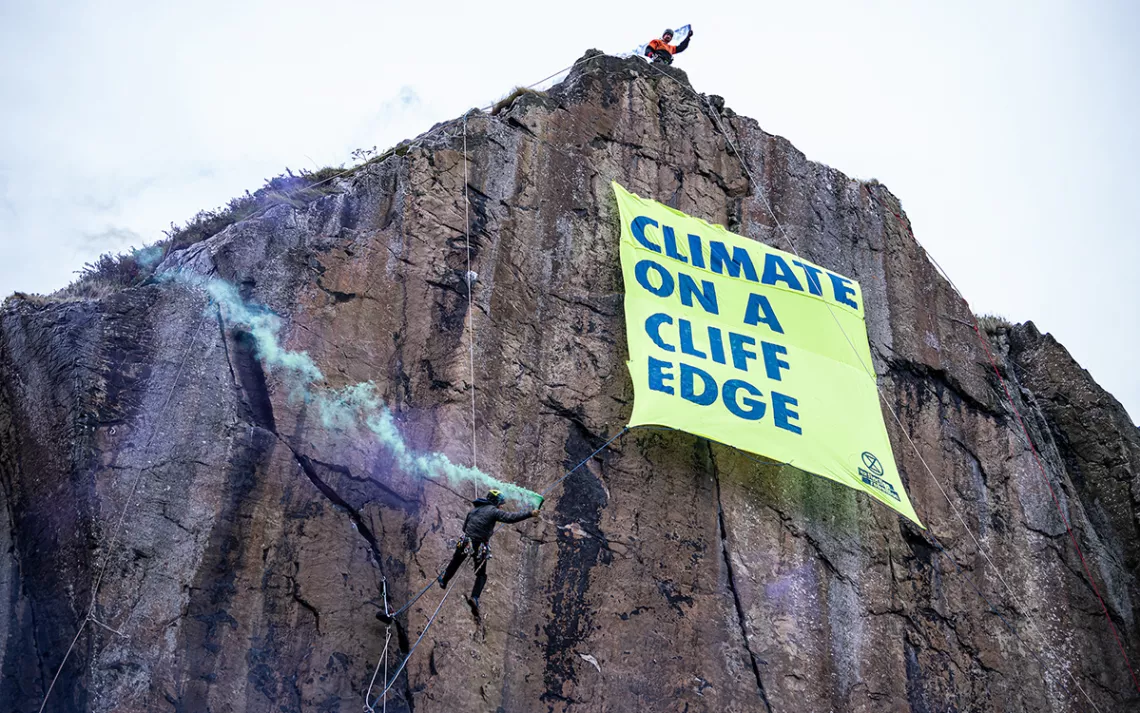
Experienced climbers scale a rock face near the historic Dumbarton castle in Glasgow, releasing a banner that reads “Climate on a Cliff Edge.” One activist, dressed as a globe, symbolically looms near the edge, while another plays the bagpipes on the shores below. | Photo courtesy of Extinction Rebellion and Mark Richards
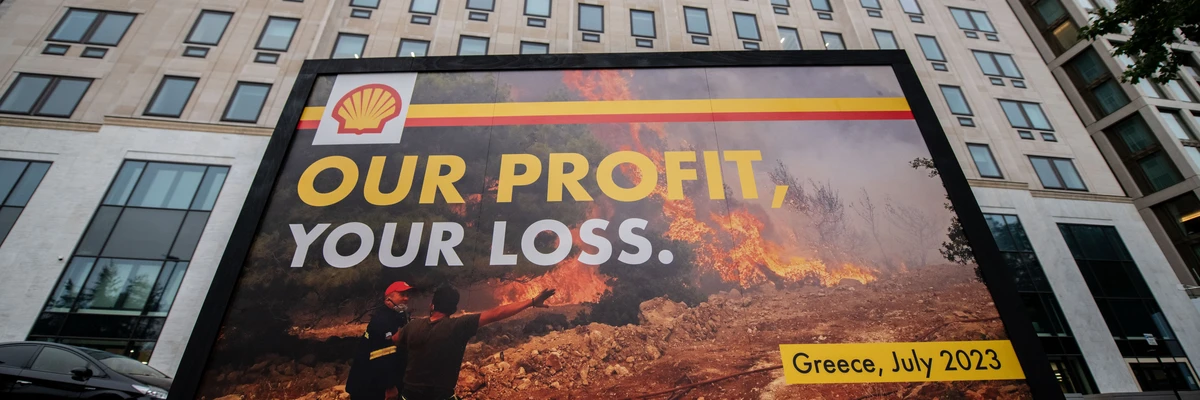
Greenpeace activists display a billboard during a protest outside Shell headquarters on July 27, 2023 in London.
Greenpeace activists display a billboard during a protest outside Shell headquarters on July 27, 2023 in London. (Photo: Handout/Chris J. Ratcliffe for Greenpeace via Getty Images)
Neo-Fascist Climate Science Denier Donald Trump says Burn, Baby, Burn.

Continue ReadingBP has been rowing back on renewables for years. So why was it helped by ‘net zero’ banks?