Will Trump’s entire presidency be as damaging as his first month?

Spread the love

Original article by Paul Rogers republished from Open Democracy under a Creative Commons Attribution-NonCommercial 4.0 International licence

Ater a disastrous press conference, it may be Trump, not Zelenskyy, who needs to watch his back
 | Andrew Harnik/Getty Images

From blowing up at Zelenskyy to fast-tracking Executive Orders, what can we learn from Trump’s recent behaviour?

Donald Trump’s presidency has barely entered its second month, and the change he has brought about has already been so significant and so rapid that it is hard to imagine how his administration will evolve in the long term.

The substantial changes are, in part, due to the extensive planning done in anticipation of his winning a second term. The 900-page Project 2025 put together by the Heritage Foundation has provided a blueprint for Trump’s far-right conservatism that, combined with the decision to act very fast, has allowed him to already issue more than sixty Executive Orders – catching opponents off-guard.

Looking to the future may be better helped by understanding both Trump’s behaviour and his overall outlook on life, with two recent examples pointing the way. Some commentators see the president as an unpredictable figurehead who is hardly able to direct affairs, but that doesn’t face up to his being the locus of power for now and, in any case, he has plenty of determined advisers who have been waiting years for his second presidency.

The first example of Trump’s behaviour was shown by his reaction to a tragedy that happened just after his inauguration, when an American Airlines flight and a US Army helicopter collided and crashed into the Potomac River close to Ronald Reagan National Airport in Washington, DC. All 67 people on board the two aircraft were killed.

While the cause of the crash is still under investigation, within hours Trump had blamed the diversity-linked hiring policies of previous Democrat administrations, claiming they had lowered personnel standards in air traffic control. A tragedy became an occasion for immediate political point scoring.

More recently, we have seen Trump use social media to promote the new ‘Trump Gaza’. The president shared a bizarre AI-generated video in which the area had been ethnically cleansed of its Palestinian population and transformed into “the Riviera of the Middle East”. Perhaps most telling is the full-colour representation of the main street, which Trump envisages as being dominated by a 60-foot high golden statue of himself.

Together, these instances point to someone who is comprehensively self-obsessed. He might be seen as an egotist or narcissist but certainly has an element of the solipsist in his make-up as well. He is, in other words, beyond egocentric.

But Trump’s impact on the world stage has to reckon with how the world is already changing, especially the rise of the global oligarchy, with vast power concentrated in the hands of a few hundred super-rich individuals. It’s clear that the president views these people as the true exemplars of success – he has formed a singularly powerful group of them around him.

Most notable among Trump’s circle of favoured oligarchs is Elon Musk, who supported his 2024 election campaign to the tune of $277m and has since been given an unofficial role in government and attended Cabinet meetings and Oval Office press conferences.

The wealth of Musk and two other oligarchs close to Trump, Jeff Bezos and Mark Zuckerberg, extends to $905bn, as US Senator Bernie Sanders reminded us last month. Writing in the Guardian, Sanders pointed out that this is “more wealth than the bottom half of American society – 170 million people”, adding that “since Trump’s election their wealth has grown by $217bn”.

This is in line with the findings in Oxfam’s 2025 Davos Report, which last week reported that while the number of people in poverty has remained near stagnant for the past 35 years, extreme wealth is surging. Four more people become billionaires each week, and the world is now on course to have five trillionaires and well over four thousand billionaires within the next decade.

The rising global oligarchy is not easily mapped with precision. Some members of the super-rich stay well out of the public eye, a few become patrons of the arts and philanthropists, but many others are heavily involved in the use of political power.

Though a degree of oligarchic power is evident in many countries worldwide, there are particular concentrations in a handful of nations, particularly Russia, China, India and the US – where Mark Twain’s quip about having “the best government money can buy” still stands.

Between Trump’s personality and his billionaire associates, the best guide to the next four years is to simply assume that ‘self’ and ‘wealth’ will be the president’s constant driving forces. It is not a happy prospect and will require persistent opposition, combined with repeated expressions of more positive ways forward. But is there anything that might limit him as he works to remake the US?

The first answer might just be his very associates. Many incredibly wealthy people are used to getting their own way, which could easily lead to disagreements sufficient to unbalance the administration. That will be much to the dislike and anger of Trump, who may well end up causing great disruption as he finds and disposes of the scapegoats who can keep the blame well away from him.

Then there is internal opposition stemming from numerous legal challenges that are already being mounted, many of them in recognition of the mass use of executive orders, which may undermine the authority of Article II of the US constitution.

Trump is also likely to run into problems due to the huge and vast array of experience and knowledge that will have been lost as a result of his administration’s decision to fire many thousands of federal employees from the Internal Revenue Service, Department of Energy, the Department of Agriculture, the Forestry Service, National Parks, US AID and elsewhere. This is eventually likely to lead to numerous mistakes and delays right across government.

Then there is the matter of US foreign policy, where the ‘Trump Gaza’ fiasco is the clearest possible indicator that Trump just does not have a clue how many people feel. Beyond that, though, is the question of Trump’s view of Vladimir Putin. It is becoming uncomfortably clear that either the Russian president has some kind of hold over Trump or else Trump really does see him as simply another very powerful and hugely rich person just like himself – a kindred spirit in a new oligarchic world of disorder.

This leads to one other question: how long will Trump even be in the White House? A clue may come from Friday’s notorious press conference with Ukrainian president Volodymyr Zelenskyy. People across the world will have seen clips of Zelenskyy being hung out to dry by Trump and his vice-president, JD Vance, but watching the entire 45-minute video, not just the blow-up, reveals a rather different element.

The conference was largely good-natured for the first 35 minutes, with Zelenskyy comfortably holding his own and Trump even praising Ukraine while doing his usual trick of claiming to be the greatest American since George Washington. It is only at the end that Vance moves in aggressively on Zelensky in a manner seemingly designed to get Trump to lose his cool.

Perhaps it is Trump, not Zelensky, who should be worried when reflecting on the experience – and who should watch his back. It may have been on the last day of February but Vance’s behaviour was not too far from the Ides of March.

Original article by Paul Rogers republished from Open Democracy under a Creative Commons Attribution-NonCommercial 4.0 International licence

Continue ReadingWill Trump’s entire presidency be as damaging as his first month?

Peace campaigners slam continued rise in British military spending

Spread the love

https://morningstaronline.co.uk/article/peace-campaigners-slam-continued-rise-in-british-military-spending

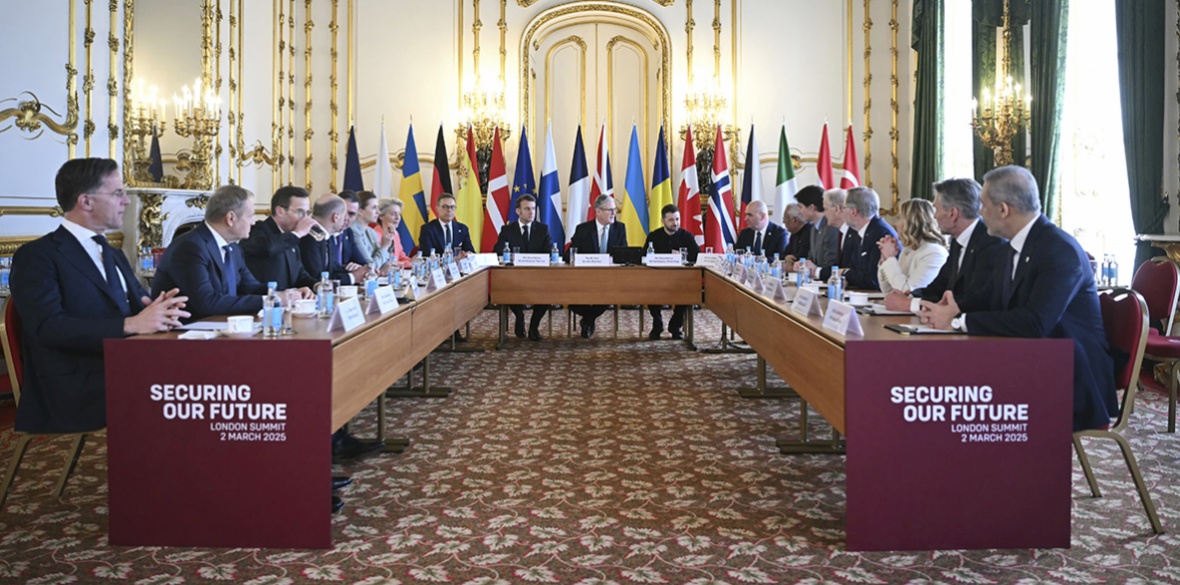
Prime Minister Keir Starmer (centre) hosts the European leaders’ summit to discuss Ukraine, at Lancaster House, London, March 2, 2025

PEACE campaigners slammed the continued rise in British military spending today as Sir Keir Starmer said Britain was ready to send troops to police a Ukrainian peace.

The Prime Minister hosted a summit at London’s Lancaster House today with European leaders, Canadian Prime Minister Justin Trudeau, Turkish Foreign Minister Hakan Fidan, Nato secretary-general Mark Rutte and the presidents of the European Commission and European Council, all showing their support for Ukrainian President Volodymyr Zelensky, who also attended.

The summit followed an extraordinary row between Mr Zelensky, US President Donald Trump and Vice-President JD Vance last week at the White House.

The US was not represented at the summit — underlining the deepening rift between European leaders and Washington.

Sir Keir told leaders it was time for them to step up and continue to support Kiev and meet a “once in a generation moment” for the security of Europe.

After the meeting he said a “coalition of the willing” could be sent to Ukraine to police a ceasefire, with British “troops on the ground and planes in the air,” but acknowledged that not all countries present had been willing to commit. He did not say which had and which hadn’t.

Article continues at https://morningstaronline.co.uk/article/peace-campaigners-slam-continued-rise-in-british-military-spending

Continue ReadingPeace campaigners slam continued rise in British military spending

‘We Are Governed by Children’: Disgust as Trump and Vance Bully Zelenskyy in Oval Office

Spread the love

Original article by Jake Johnson republished from Common Dreams under Creative Commons (CC BY-NC-ND 3.0). 

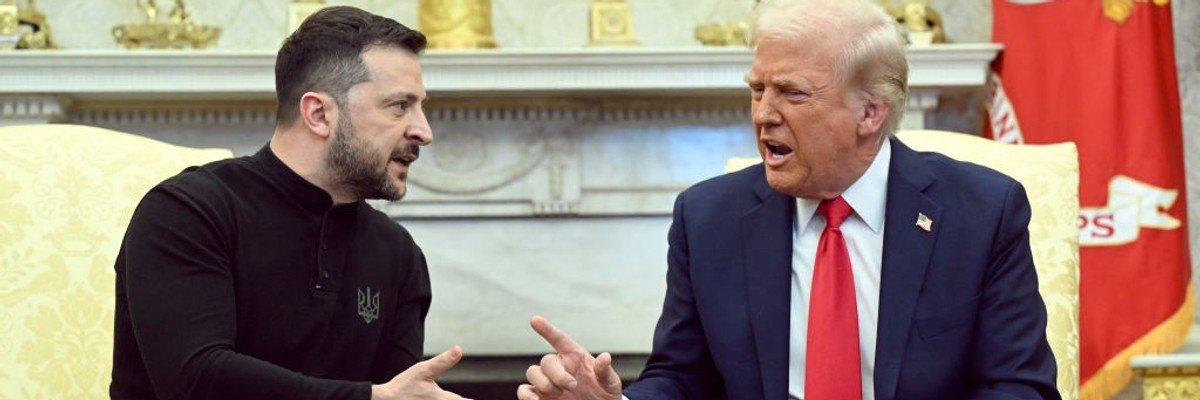
U.S. President Donald Trump and Ukrainian President Volodymyr Zelenskyy meet in the Oval Office of the White House on February 28, 2025. (Photo: Saul Loeb/AFP via Getty Images)

“An utter embarrassment for America. This whole sad scene,” wrote U.S. Sen. Chris Murphy.

A White House meeting on Friday between U.S. President Donald Trump, Vice President JD Vance, and Ukrainian President Volodymyr Zelenskyy rapidly devolved into chaos as the two American leaders took turns berating Zelenskyy with television cameras rolling and the global public looking on.

Both Trump and Vance bizarrely demanded that Zelenskyy show more gratitude for the military aid the U.S. has provided Ukraine since Russia launched its full-scale invasion in February 2022 and pressured him to accept an as-yet-undefined deal to end the war.

Vance told Zelenskyy he must “say thank you” and chided him for “trying to fight it out in the American media when you’re wrong,” but Trump intervened to say, “I think it’s good for the American people to see what’s going on here… that’s why I kept this going so long.”

“You have to be thankful,” Trump told the Ukrainian president, who has repeatedly thanked the American public for the U.S. government’s military assistance.

“You don’t have the cards,” Trump continued as Zelenskyy tried in vain to interject. “You’re buried there, your people are dying, you’re running low on soldiers.”

Insisting that Russian President Vladimir Putin can’t be trusted to uphold a bilateral cease-fire, Zelenskyy is demanding security guarantees against a future Russian attack in any agreement to end the conflict—a demand that Trump has thus far rejected.

“Your country is in big trouble,” Trump, who falsely suggested last week that Ukraine started the war, told Zelenskyy during the Oval Office meeting, which was meant to kick off talks regarding U.S. access Ukraine’s rare earth minerals.

Zelenskyy left the White House on Friday without signing a minerals deal.

“You’re either going to make a deal or we’re out,” Trump told Zelenskyy during Friday’s meeting, a clear threat to withdraw U.S. support for Ukraine. “And if we’re out, you’ll fight it out and I don’t think it’s going to be pretty.”

Observers were aghast at Trump and Vance’s conduct during Friday’s meeting, which was likened to an ambush. At one point, as Trump responded dismissively to Zelenskyy’s call for security guarantees as part of any cease-fire deal, Ukraine’s ambassador to the United States was seen with her head in her hands.

“Wow. Just wow,” said CNN‘s Dana Bash following the meeting.

Zeteo‘s Mehdi Hasan wrote on social media that it is “insane that this just happened.”

“We are governed by children,” he added.

Watch the full exchange:

U.S. lawmakers also voiced disgust over Trump and Vance’s behavior, with Sen. Chris Murphy (D-Conn.) writing that the meeting was “an utter embarrassment for America.”

Shortly after the meeting concluded, Trump took to his social media platform to accuse Zelenskyy of disrespecting the U.S. “in its cherished Oval Office.”

“He can come back when he is ready for peace,” Trump added as backlash over his treatment of Zelenskyy continued to pour in.

“Trump berates Zelensky, the leader of a democratic country courageously fighting Russian imperialism, while he allies himself with Putin, a dictator who started the bloodiest European war in 80 years,” U.S. Sen. Bernie Sanders (I-Vt.) wrote on social media.

“Sorry, President Trump,” Sanders added. “We believe in democracy, not authoritarianism.”

Original article by Jake Johnson republished from Common Dreams under Creative Commons (CC BY-NC-ND 3.0). 

Continue Reading‘We Are Governed by Children’: Disgust as Trump and Vance Bully Zelenskyy in Oval Office

Europe humiliated, but still subservient, after remarks from US officials

Spread the love

Original article by Ana Vračar republished from peoples dispatch under a Creative Commons Attribution-ShareAlike 4.0 (CC BY-SA) license.

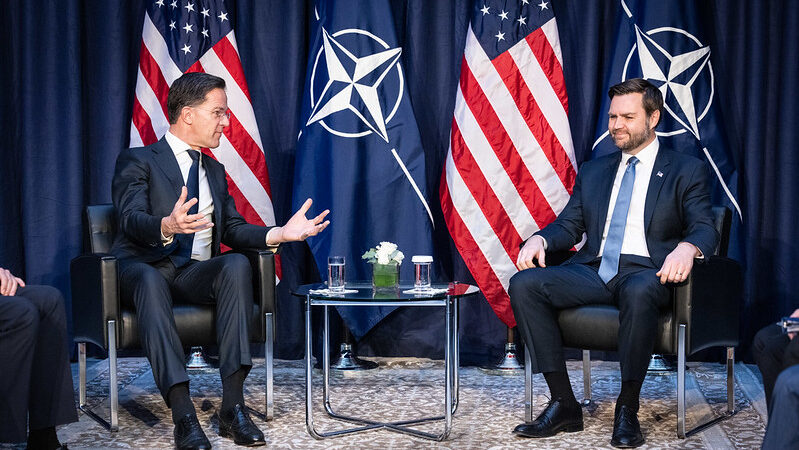
NATO Secretary General Mark Rutte meets with US Vice President JD Vance. Source: NATO/Flickr

Statements by US Vice President Vance and Defense Secretary Hegseth on the Ukraine war and transatlantic relations have left European leaders in shock

“If American democracy can survive ten years of Greta Thunberg’s scolding, you guys can survive a few months of Elon Musk,” US Vice President JD Vance told European leaders at last week’s Munich Security Conference. His remarks came during a draining week for those leaders, as Trump officials announced peace talks with Russian authorities—without European or Ukrainian involvement—while signaling they expect Europe to handle peacekeeping and being paid for their support in minerals from Ukraine.

Speeches by Vance and Defense Secretary Pete Hegseth threw European leaders into disarray, seen as not-so-subtle indications of a cooling in transatlantic relations. These interventions attacked everything from the EU’s efforts to regulate social media platforms to its approach to far-right parties in parliamentary life. In response, French President Emmanuel Macron called for an emergency summit of select regional powers on Monday, February 17 – just a day before US and Russian representatives are expected to meet in Saudi Arabia.

While Ukrainian officials and some European leaders have insisted they will not accept any deal that excludes Ukraine’s direct involvement, their stance appears to carry little weight.

Read more: Far-right surge or status quo? Understanding the 2024 European elections

At the same time, the new US administration has increased pressure on its European allies, demanding a ramping up of their defense budgets and taking on the responsibility of a potential peacekeeping mission in Ukraine. This comes as no surprise: a number of US officials, including Donald Trump himself, have said Europe does not contribute enough to NATO and essentially freeloads off the US. Vance’s speech in Munich only reaffirmed this stance, ultimately reducing high-ranking figures to tears over the apparent breakup between allies.

While the focus of European reactions to recent US statements has been on Ukraine, many leaders have admitted that more is at stake. “Yes, it is about Ukraine – but it is also about us,” European Commission President Ursula von der Leyen wrote on X. Unfortunately, the conclusion she drew going further is upsetting: “We need an urgency mindset. We need a surge in defense. And we need both of them now.”

Unlike healthcare, education, or social programs—sectors where European governments are consistently told their budgets must remain limited—military spending is expected to face no such barriers. Many European countries have already embraced the shift, with Polish officials, for example, boasting about spending close to 5% of their GDP on defense and warning of looming “wider wars” to convince other states in the region to do the same.

Read more: Elon Musk and AfD’s Alice Weidel’s align ahead of elections in Germany

Despite the apparent fracture in US-Europe relations, European leaders have shown no inclination to rethink their dependence on Washington. Instead, most have done exactly what the Trump presidency wants them to do and swiftly pledged to increase military spending. Some have even already expressed willingness to deploy troops for peacekeeping in Ukraine. What remains absent from their reactions is any consideration of a future less dictated by US interests and more aligned with the needs of the people living in Europe.

Since the beginning of the war three years ago, activists have urged Europe to reject NATO’s warmongering and prioritize peace in Ukraine alongside social justice at home. Instead, the coming surge in military budgets will almost certainly coincide with cuts to public services, further fueling the rise of the far-right—a political force that Trump officials, including Vance and Elon Musk, have (more or less) openly backed during interventions in Europe. From this perspective, unlike the conservative circles who “survived ten years of ’s scolding,” Europe’s liberal elite is unlikely to emerge from its current crisis unscathed. Whether their refusal to acknowledge the failure of their anti-people policies will push the entire region into the hands of parties like Brothers of Italy and Alternative for Germany remains to be seen.

Original article by Ana Vračar republished from peoples dispatch under a Creative Commons Attribution-ShareAlike 4.0 (CC BY-SA) license.

Elon Musk urges you to be a Fascist like him, says that you can ignore facts and reality then.
Power-mad orange gasbag Donald Trump says Burn, Baby, Burn.

Hi GT ;)

Continue ReadingEurope humiliated, but still subservient, after remarks from US officials

Miliband urges energy watchdog to act as typical bill could rise by more than £100 a year

Spread the love

https://www.theguardian.com/money/2025/feb/18/miliband-urges-energy-watchdog-to-act-as-typical-bill-could-rise-by-more-than-100-a-year

Ed Miliband, the energy secretary, has asked Ofgem to crack down on inaccurate and large bills. Photograph: Ina Fassbender/AFP/Getty Images

Exclusive: Whitehall source expects bills in England, Scotland and Wales to rise by about £9 a month over the next three months

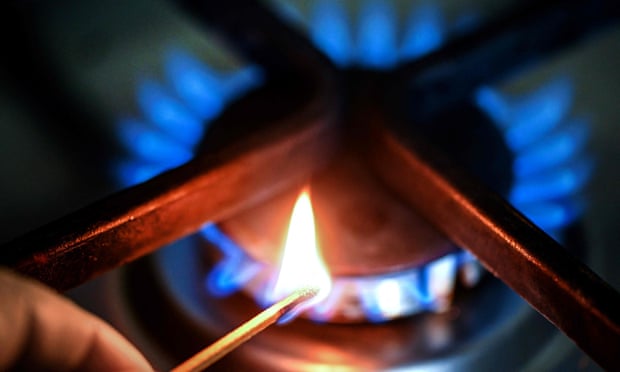
Ed Miliband has urged the energy watchdog to take swift action as it emerged that the typical energy bill could soar by more than £100 a year amid a rise in global gas prices.

A Whitehall source said they expected bills in England, Scotland and Wales to increase by about £9 a month over the next three months in another challenge to government plans to tackle the cost of living.

They blamed volatile global gas prices linked to the end of the transit deal that enabled gas to flow to Europe, through Ukraine, from Russia.

Miliband, the energy secretary, has written an urgent letter to Ofgem, saying the price rise means the energy regulator must move faster to protect consumers.

This month, gas prices hit a two-year high, exacerbated by the lack of gas storage in Britain and Europe, combined with colder weather though prices have begun to stabilise. Cornwall Insight, a consultancy which produces closely watched forecasts for the energy price cap, is set to release its latest forecast on Tuesday.

Article continues at https://www.theguardian.com/money/2025/feb/18/miliband-urges-energy-watchdog-to-act-as-typical-bill-could-rise-by-more-than-100-a-

Continue ReadingMiliband urges energy watchdog to act as typical bill could rise by more than £100 a year