Original article republished from Memo under a Creative Commons Attribution-NonCommercial-ShareAlike 4.0 International License.
Palestinians, including children, who escaped from the attacks of the Israeli army and took shelter in the Khan Yunis, located in the south of the Gaza Strip and who are struggling with hunger due to the embargo imposed on the region by Israel on the Gaza Strip, wait in line to receive meals distributed by charities while Israel’s attacks on the Gaza Strip continue uninterruptedly in Khan Yunis, Gaza on December 01, 2024 [Hani Alshaer – Anadolu Agency]
The UN, on Monday, said that local food systems in Gaza have been “devastated” by Israel’s land and air strikes, highlighting access to food as one of the most pressing concerns, Anadolu Agency reports.
Our humanitarian partners are also warning that local food systems have been devastated by military ground operations, the bombardment of civilian areas and the presence of unexploded ordnance
said UN spokesman, Stephane Dujarric, during a news conference.
He stated that “access to food remains the most critical concern raised by community members across all groups”.
Dujarric emphasized that food insecurity in Gaza is “worsening” daily, leaving people “more vulnerable”.
Describing the bakeries in Gaza as a “lifeline”, he said they are unable to remain operational due to a lack of fuel and flour.
Responding to Anadolu’s question on World Central Kitchen suspending its aid operations as well as UN agency for Palestinian refugees (UNRWA) recently halting aid via Karm Abu Salem Crossing due to security concerns, Dujarric referred to his previous comments about the ongoing lack of food, UN’s inability to distribute aid and said “the facts are pretty clear, and they’re pretty horrific”.
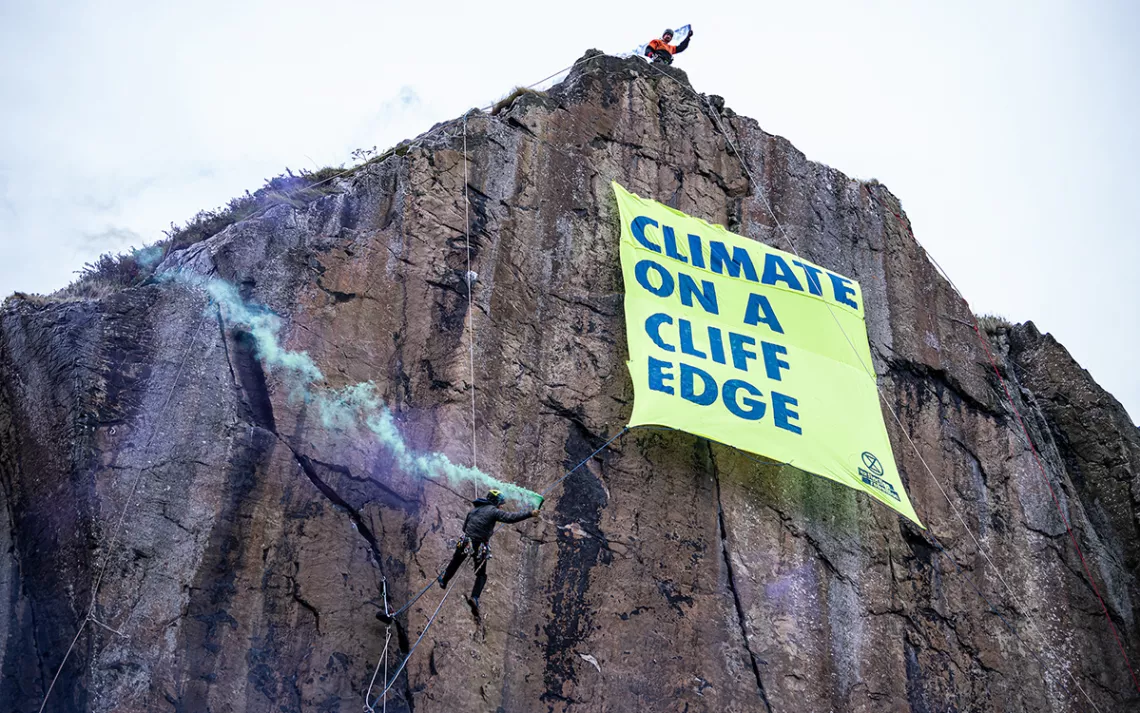
Experienced climbers scale a rock face near the historic Dumbarton castle in Glasgow, releasing a banner that reads “Climate on a Cliff Edge.” One activist, dressed as a globe, symbolically looms near the edge, while another plays the bagpipes on the shores below. | Photo courtesy of Extinction Rebellion and Mark Richards
Without action on climate crisis, far greater numbers will also experience floods, wildfires and droughts, according to report
Eight times as many children around the world will be exposed to extreme heatwaves in the 2050s, and three times as many will face river floods compared with the 2000s if current trends continue, according to the UN.
Nearly twice as many children are also expected to face wildfires, with many more living through droughts and tropical cyclones, according to the annual state of the world’s children report.
…
The report, released on Wednesday, World Children’s Day, forecasts how the climate crisis, demographic shifts (sub-Saharan Africa and south Asia are projected to have the largest child populations in the 2050s) and breakthrough technologies will affect children’s lives in the future.
The report said technologies such as artificial intelligence (AI) will bring benefits and risks to children, who are already interacting with AI embedded in apps, games and learning software. The digital divide remains stark, however. In 2024, almost 95% of people in high-income countries are connected to the internet, compared with about 25% in low-income countries.
“Children are experiencing a myriad of crises, from climate shocks to online dangers, and these are set to intensify in the years to come,” said Catherine Russell, Unicef’s executive director. “The decisions world leaders make today – or fail to make – define the world children will inherit … Decades of progress, particularly for girls, are under threat.”
Much of the emphasis of the report is on the impact of the climate crisis on children, nearly half of whom (approximately 1 billion) live in countries that face a high risk of environmental disasters. Even before they take their first breath, children’s brains, lungs and immune systems are susceptible to pollution, disease and extreme weather. As they grow, their education, nutrition, safety, security and mental health are shaped by the climate and environment.
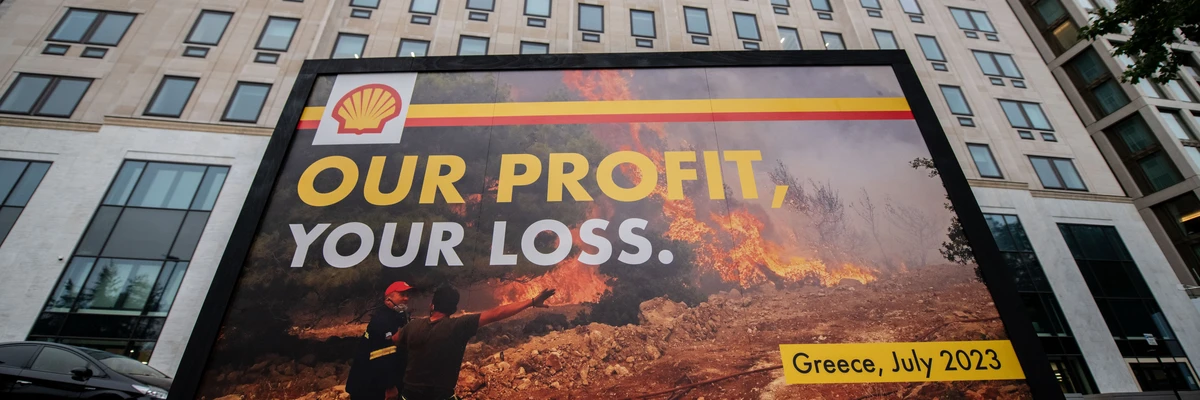
Greenpeace activists display a billboard during a protest outside Shell headquarters on July 27, 2023 in London. (Photo: Handout/Chris J. Ratcliffe for Greenpeace via Getty Images)
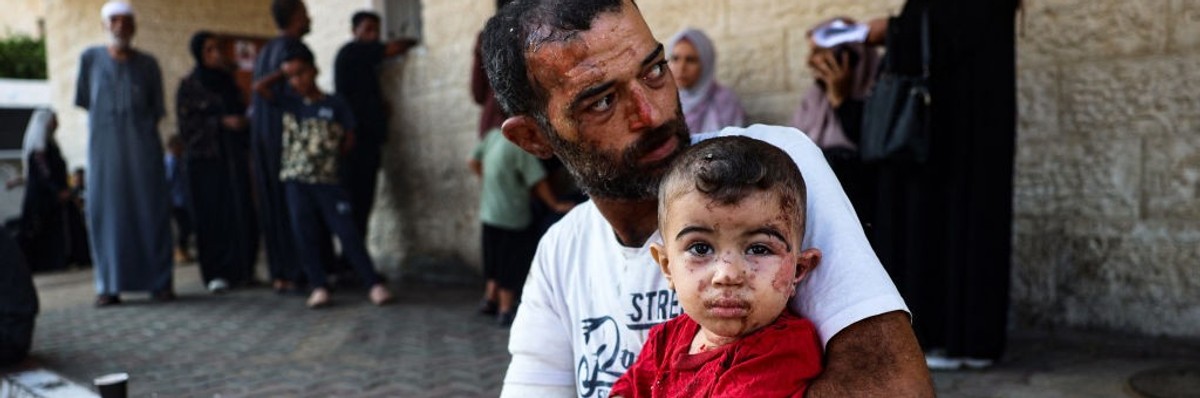
Palestinian Ahmad Yunis and his three-year-old son, Sami, who were both injured in an Israeli bombing in the Bureij refugee camp, sit outside the Al-Aqsa Martyrs Hospital in Deir al-Balah in the central Gaza Strip on September 8, 2024. (Photo: Eyad Baba/AFP via Getty Images)
“I don’t think we have seen before, a violation that is so massive, as we are seeing in Gaza now,” said one committee leader.
A United Nations committee on Thursday called out Israel for “serious violations” of the Convention on the Rights of the Child in the occupied Palestinian territories, particularly with its nearly yearlong assault on the Gaza Strip.
“The outrageous death of children is almost historically unique. This is an extremely dark place in history,” said Bragi Guðbrandsson, vice chair of the U.N. Child Rights Committee, which also released its findings on five other parties to the global treaty—Argentina, Armenia, Bahrain, Mexico, and Turkmenistan.
Since the Hamas-led October 7 attack on Israel, Israeli forces have killed at least 41,272 Palestinians in Gaza and injured another 95,551, according to local officials. Many more remain missing and are believed to be dead and buried in the rubble of bombed civilian infrastructure. The vast majority of the enclave’s 2.3 million residents have been displaced, often numerous times.
Earlier this week, the Gaza Health Ministry publicly identified 34,344 Palestinians who have been killed in the Hamas-governed enclave as of August 31. The document spans 649 pages, the first 14 of which are filled with the names of babies. In total, there are 11,355 children.
The U.N. report states that “the committee is gravely concerned about… the outrageously high number of children in Gaza who continue to be killed, maimed, injured, missing, displaced, orphaned, and subjected to famine, malnutrition, and disease, as well as the multiple displacements of the Gazan population, as a result of the state party’s indiscriminate and disproportionate attacks on Gaza using explosive weapons with wide-area effects in densely populated areas and its denial of humanitarian access, with at least 1 million children displaced, 21,000 children reported missing, 20,000 children who have lost one or both parents, 17,000 children unaccompanied or separated from their families in Gaza, dozens of child deaths due to malnutrition, and 3,500 children at risk of death due to malnutrition and lack of food.”
The panel also expressed alarm over “attacks on and destruction of hospitals, schools, residential buildings, refugee camps, and essential infrastructure, including power facilities and water tanks, by the armed forces, restricting access to health services, education, and housing for the nearly 1 million children living in Gaza.”
Guðbrandsson said that “I don’t think we can identify any measure that was taken to save children’s lives in this military operation in Gaza.”
“I don’t think we have seen before, a violation that is so massive, as we are seeing in Gaza now,” he noted. “These are extremely grave violations that we do not often see.”
Israel, which ratified the treaty in 1991, accused the committee of having a “politically-driven agenda,” in a statement sent by its diplomatic mission in Geneva.
It sent a large delegation to a series of U.N. hearings in Geneva in early September where they argued that the treaty did not apply in Gaza or the West Bank and said that it was committed to respecting international humanitarian law.
It says its military campaign in Gaza is aimed at eliminating the Palestinian enclave’s Hamas rulers and that it does not target civilians but that the militants hide among them, which Hamas denies.
Anne Skelton, chair of the U.N. committee, pushed back against Israel’s position on Thursday, telling journalists, “They were not, in our view, facing up to the reality that 17,000 children are dead and that there have been repeated attacks on schools and hospitals.”
The report also addresses Israel’s claims, saying that “the committee deeply regrets the state party’s repeated denial of its legal obligations under the convention in the occupied Palestinian territory (OPT) based on its position that the convention ‘does not apply… to areas beyond a state’s national territory’ and ‘was not designed to apply in situations of armed conflict,’ and that international humanitarian law is the relevant and specific applicable body of law in the Gaza Strip and the West Bank.”
“The committee also regrets the limited information it received on the situation of children living in the OPT due to such a position,” the 22-page “concluding observations” document continued. “The committee is of the view that the state party’s denial of the application of the convention cannot be used to justify its grave and persistent violations of international human rights and humanitarian law.”
The panel cited the International Court of Justice advisory opinion from July that found “international human rights instruments are applicable.” The ICJ—which has taken up a genocide case against Israel—also said at the time that the decadeslong Israeli occupation of Gaza and the West Bank, including East Jerusalem, is illegal and must end “as rapidly as possible.”
The new report says that the Child Rights Committee, “aligning its position with the position of the ICJ, reiterates that the convention applies to all children at all times and is directly applicable in all territories over which the state party exercises effective control, and reminds the state party of its legal obligations both under the convention and international humanitarian law concerning children in the OPT.”
Skelton also argued that “the only real way to serve children’s rights in this situation is a cease-fire.”
However, Israel has shown no signs of ending its assault on the Palestinian enclave—in fact, fears of a wider regional conflict are heightened this week due to bombings of pagers, walkie-talkies, and other devices across Lebanon, attacks supposedly targeting Hezbollah members that Israeli and U.S. officials attributed to Israel’s military and intelligence operatives.
The Child Rights Committee’s report follows U.N. Secretary-General António Guterres adding Israel to the so-called “List of Shame” of nations that kill and wound children during armed conflicts, a June decision that outraged Israeli officials but was praised by human rights advocates as long overdue.
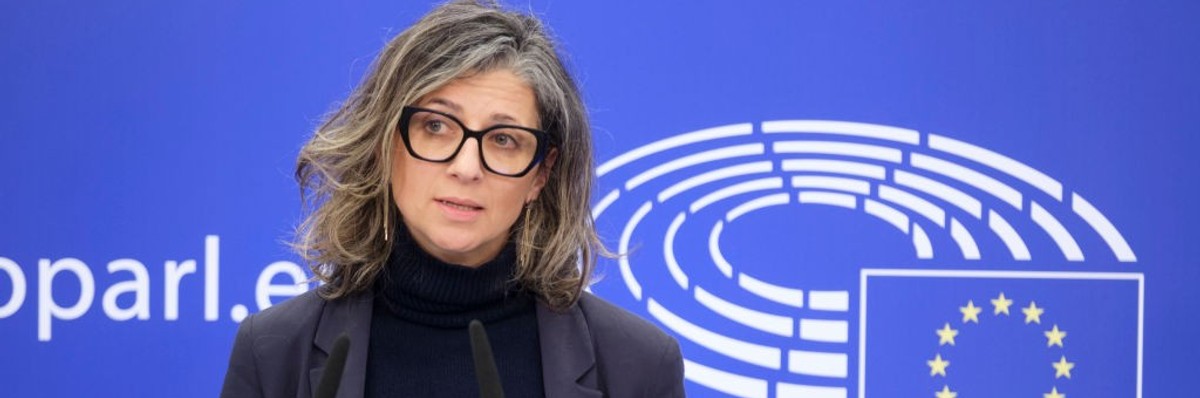
United Nations special rapporteur on the Occupied Palestinian Territories Francesca Albanese addresses the European Parliament in Brussels on April 10, 2024. (Photo: Thierry Monasse/Getty Images)
One expert even asked if Israel’s United Nations membership should be reconsidered given the country “seems to have zero respect” for the world body.
United Nations human rights experts warned Monday that Israel risks becoming an international “pariah” over its ongoing assault on Gaza—for which it is on trial for genocide at the world body’s International Court of Justice.
The special rapporteurs—who are appointed by the U.N. but do not speak on its behalf—condemned Israel’s human rights violations against Palestinians, as well as its blatant disregard for international law and multiple rulings from the ICJ.
George Katrougalos, the U.N. special rapporteur on the promotion of democratic and equitable international order and a former Greek foreign minister, said during a press conference that the “first obligation” for harmonious relations between nations “is for everybody to respect the United Nations rules.”
“This is not happening in the case of Israel,” Katrougalos noted.
"In order to be able to work… a first obligation is for everyone to respect the UN rules. This is not happening in the case of Israel"
UN Special Rapporteur @gkatr explains that if this continues Israel will become a pariah state like apartheid South Africa was pic.twitter.com/Hl790IqRWM
The United Nations agency for Palestinian relief says that around 200 of its staff members have been killed in more than 450 Israeli attacks on agency facilities since October. More than 500 Palestinians have been killed while seeking shelter under the U.N. flag.
Overall, more than 146,000 Palestinians have been killed or wounded by Israeli forces since October. Almost all of Gaza’s 2.3 million people have been forcibly displaced, and Israel’s “complete siege” has caused widespread starvation—sometimes deadly—and sickness throughout the coastal enclave.
Comparing the international community’s reaction to Russia’s ongoing invasion of Ukraine and Israel’s war on Gaza, Katrougalos stressed that “we cannot anymore stand this kind of double standards and hypocrisy.”
“I trust that the progressive and democratic citizens of Israel would not let their country become a pariah like South Africa [had] become during the times of apartheid,” he added. South Africa is leading the genocide case against Israel at the ICJ.
Francesca Albanese, the U.N. special rapporteur on the rights situation in the occupied Palestinian territory, said that “I think it’s unavoidable for Israel to become a pariah in the face of its continuous, relentless, vilifying assault of the United Nations, on top of millions of Palestinians.”
“Shockingly, in the face of the abyss reached in the OPT… most member states remained inactive at best, or [are] actively aiding and assisting Israel’s criminal conduct,” she continued.
“Should there be a consideration of its membership as part of this organization, which Israel seems to have zero respect for?” Albanese added.
Pedro Arrojo-Agudo, the U.N. special rapporteur on the rights to safe drinking water and sanitation, warned that “we are blowing up the United Nations if we don’t react” to Israel’s human rights violations.
Arrojo-Agudo added that, as with starvation, Israel is using deprivation of water as a “weapon” and disavowed Israel’s claim that Hamas—which led the October 7 attack on Israel—has “completely mismanaged water in Gaza.”
The special rapporteurs’ remarks came as representatives of U.N. member states gathered in New York for this year’s annual General Assembly. General debate sessions are set for next week.
Original article republished from MEMO under a Creative Commons Attribution-NonCommercial-ShareAlike 4.0 International License.
The World Health Organisation (WHO) announced on Monday that 540,000 Yemeni children under the age of five are severely emaciated. The WHO made its announcement in a post on X to mark World Humanitarian Day.
“Yemen faces a double burden of disease and conflict, whereby 17.8 million need health assistance, including 540,000 children under 5 with severe wasting,” said the UN-affiliated organisation. “With ongoing conflict and a collapsing healthcare system, it is crucial that we #ActForHumanity.”
The health sector in Yemen faces difficult challenges, amid great suffering experienced by most citizens who are in dire need of assistance due to the repercussions of the war that has been ongoing for a decade.