Original article republished from MEMO under a Creative Commons Attribution-NonCommercial-ShareAlike 4.0 International License.
The World Health Organisation (WHO) announced on Monday that 540,000 Yemeni children under the age of five are severely emaciated. The WHO made its announcement in a post on X to mark World Humanitarian Day.
“Yemen faces a double burden of disease and conflict, whereby 17.8 million need health assistance, including 540,000 children under 5 with severe wasting,” said the UN-affiliated organisation. “With ongoing conflict and a collapsing healthcare system, it is crucial that we #ActForHumanity.”
The health sector in Yemen faces difficult challenges, amid great suffering experienced by most citizens who are in dire need of assistance due to the repercussions of the war that has been ongoing for a decade.
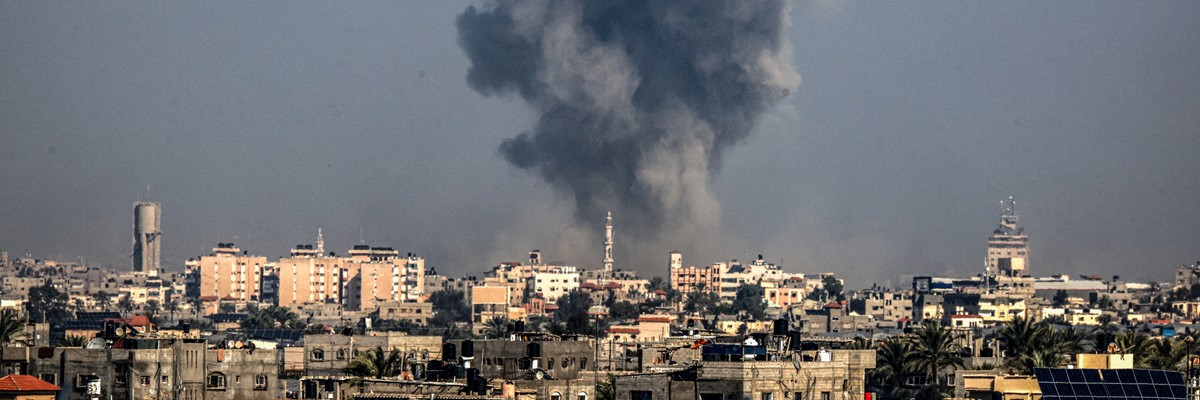
A picture taken from Rafah on January 6, 2024 shows smoke billowing over Khan Younis in the southern Gaza Strip during Israeli bombardment. (Photo: AFP via Getty Images)
“This war should never have started. But it’s long past time for it to end,” said United Nations emergency relief coordinator Martin Griffiths.
The United Nations’ emergency relief coordinator warned Friday that the threat of a broader conflict in the Middle East is growing rapidly as Israel’s assault continues in Gaza, which the U.N. official said has been rendered “uninhabitable” by near-constant airstrikes and a suffocating blockade.
“The specter of further regional spillover of the war is looming dangerously close,” Martin Griffiths, the U.N.’s under-secretary-general for humanitarian affairs, said in a statement, pointing to the humanitarian catastrophe in Gaza, mounting Israeli attacks in the West Bank, and rocket attacks on Israel. “Hope has never been more elusive.”
Griffiths, a longtime diplomat who has described the situation in Gaza as the worst humanitarian crisis he’s ever witnessed, issued his unsparing statement at the tail end of a week that saw Israel and the United States launch deadly strikes in Lebanon and Iraq, killing a senior Hamas official and the leader of an Iran-aligned militia.
On Saturday, Hezbollah responded to Israel’s drone strike on an office building in the Lebanese capital of Beirut by firing rockets at a military base in northern Israel, heightening fears of an escalatory spiral.
While the Biden administration insists it wants to avert a regional war, it continues to provide Israel with lethal military aid and oppose international efforts to enact a permanent cease-fire that analysts say is necessary to stop the conflict from spreading. The U.S. is also reportedly drafting plans to bomb Yemen in response to Houthi attacks on vessels in the Red Sea.
The Houthis have said the attacks will stop once Israel ends its catastrophic assault on the Gaza Strip.
The de facto Yemeni government has announced they are fulfilling their obligations under Article 1 of the convention on the prevention of genocide. They say that the blockade of Israeli-bound ships in the Red Sea will end when the attempted genocide ends https://t.co/1sAW8LlmkX
Griffiths said Friday that the situation in Gaza is shockingly dire, with displaced families “sleeping in the open as temperatures plummet” and the territory’s remaining medical facilities “under relentless attack.”
“The few hospitals that are partially functional are overwhelmed with trauma cases, critically short of all supplies, and inundated by desperate people seeking safety,” said Griffiths. “Infectious diseases are spreading in overcrowded shelters as sewers spill over. Some 180 Palestinian women are giving birth daily amidst this chaos. People are facing the highest levels of food insecurity ever recorded. Famine is around the corner.”
“For children in particular,” Griffiths added, “the past 12 weeks have been traumatic: No food. No water. No school. Nothing but the terrifying sounds of war, day in and day out.”
Much of Gaza has been decimated by Israeli bombs, many of which were supplied by the United States. The Euro-Mediterranean Human Rights Monitor said Friday that around 68,000 housing units in Gaza have been completely destroyed by Israeli airstrikes.
Roughly 4% of Gaza’s population—more than 90,000 people—has been killed, wounded, or left missing by Israeli attacks since October 7, the group estimated.
“It is time for the parties to meet all their obligations under international law, including to protect civilians and meet their essential needs, and to release all hostages immediately,” Griffiths said. “It is time for the international community to use all its influence to make this happen. This war should never have started. But it’s long past time for it to end.”
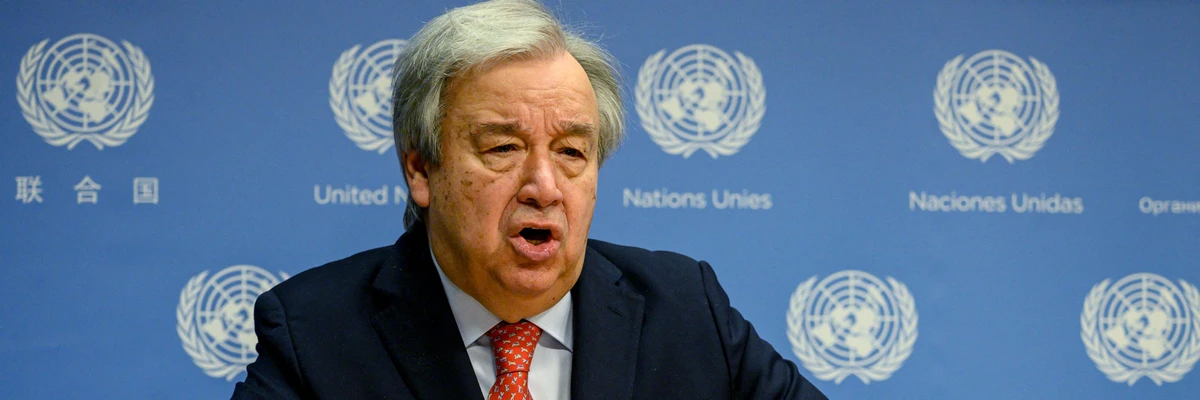
United Nations Secretary-General António Guterres discusses climate change at U.N. headquarters in New York City on July 27, 2023.
“Facing a severe risk of collapse of the humanitarian system in Gaza, I urge the council to help avert a humanitarian catastrophe and appeal for a humanitarian cease-fire to be declared.”
With over 16,000 Palestinians dead just two months into Israel’s war on the Gaza Strip, United Nations Secretary-General António Guterres on Wednesday demanded immediate action by the U.N. Security Council.
For the first time since becoming secretary-general nearly seven years ago, Guterres invoked Article 99, a rarely used section of the U.N. Charter empowering him to bring to the attention of the council “any matter which in his opinion may threaten the maintenance of international peace and security.”
U.N. spokesperson Stéphane Dujarric said that Guterres was invoking Article 99 “given the scale of the loss of human life in Gaza and Israel, in such a short amount of time.”
“I think it’s arguably the most important invocation,” Dujarric told reporters at U.N. headquarters, “in my opinion, the most powerful tool that he has.”
“The international community has a responsibility to use all its influence to prevent further escalation and end this crisis.”
Guterres wrote to José Javier De la Gasca Lopez Domínguez, the Ecuadorian president of the Security Council, that “more than eight weeks of hostilities in Gaza and Israel have created appalling human suffering, physical destruction and collective trauma across Israel and the occupied Palestinian territory.”
The U.N. chief reaffirmed his condemnation of the October 7 Hamas-led attack on Israel—in which around 1,200 people were killed and over 200 others were captured—that led to the war. He called accounts of sexual violence “appalling” and stressed that the remaining hostages “must be immediately and unconditionally released.”
He also emphasized that “civilians throughout Gaza face grave danger,” with the Israeli airstrikes and raids damaging more than half of all homes and displacing about 80% of the 2.3 million residents. Over a million of them have sought shelter at U.N. facilities, “creating overcrowded, undignified, and unhygienic conditions,” while others “find themselves on the street.”
“The healthcare system in Gaza is collapsing,” he noted, pointing out that only 14 of 36 hospitals are operating at all. “I expect public order to completely break down soon due to the desperate conditions, rendering even limited humanitarian assistance impossible. An even worse situation could unfold, including epidemic diseases and increased pressure for mass displacement into neighboring countries.”
Already, conditions in Gaza are making “it impossible for meaningful humanitarian operations to be conducted,” Guterres added. “The capacity of the United Nations and its humanitarian partners has been decimated by supply shortages, lack of fuel, interrupted communications, and growing insecurity.”
I've just invoked Art.99 of the UN Charter – for the 1st time in my tenure as Secretary-General.
Facing a severe risk of collapse of the humanitarian system in Gaza, I urge the Council to help avert a humanitarian catastrophe & appeal for a humanitarian ceasefire to be declared. pic.twitter.com/pA0eRXZnFJ
“The situation is fast deteriorating into a catastrophe with potentially irreversible implications for Palestinians as a whole and for peace and security in the region. Such an outcome must be avoided at all cost,” the U.N. leader warned. “The international community has a responsibility to use all its influence to prevent further escalation and end this crisis.”
“I urge the members of the Security Council to press to avert a humanitarian catastrophe,” he wrote. “I reiterate my appeal for a humanitarian cease-fire to be declared. This is urgent. The civilian population must be spared from greater harm.”
The United States—a supporter of Israel’s war and one of the U.N. Security Council’s five permanent members—vetoed a mid-October resolution condemning violence against civilians in Israel and Gaza and urging “humanitarian pauses” for aid delivery.
Roughly a month later, the Security Council approved a Gaza resolution that calls on all parties to abide by their obligations under international law and advocates for “urgent and extended humanitarian pauses and corridors.”
Dr. Christos Christou, international president of Médecins Sans Frontières, or Doctors Without Borders, said at the time that “the unacceptably jumbled and sluggish process finally led to the adoption of a text that does not come close to reflecting the severity of the humanitarian catastrophe in Gaza.”
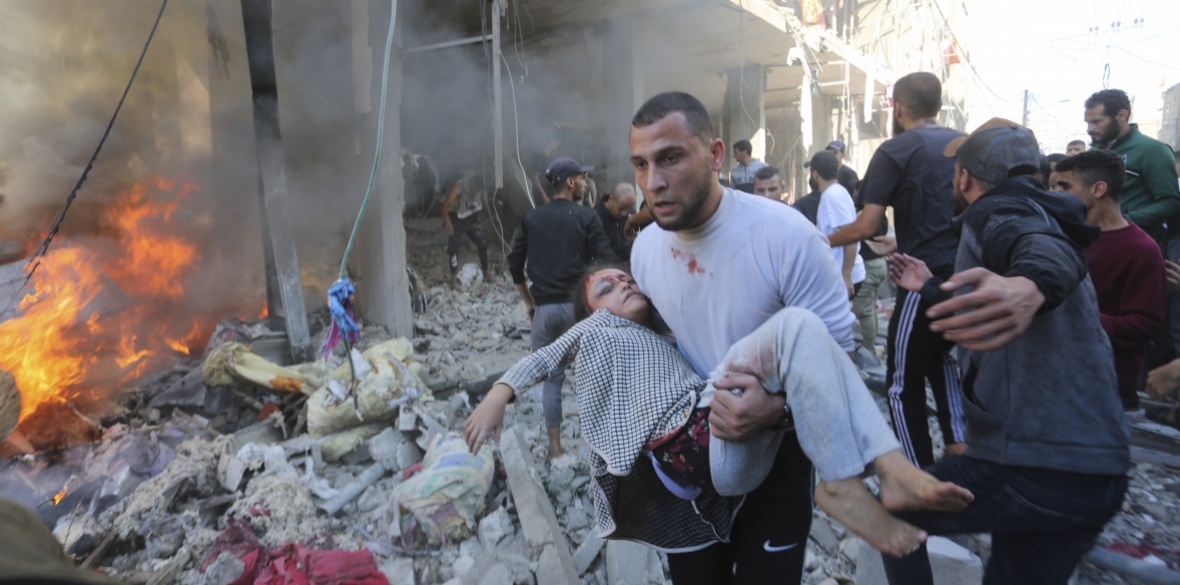
Palestinians look for survivors after an Israeli air strike destroys a building, November 17, 2023
PEACE campaigners slammed Israeli authorities and world leaders today after the United Nations warned Gaza faced the “immediate possibility of starvation.”
Even before the fast approaching winter Palestinians are already struggling to survive in desperate conditions created by a lack of fuel, which means aid agencies are unable to transport urgently needed food and medical supplies to the besieged people of the territory.
UN World Food Programme (WFP) Mideast regional spokeswoman Abeer Etefa said that, since the beginning of Israel’s retaliation against Hamas’s October 7 uprising, Gaza has received only around 10 per cent of its required food supplies each day. Dehydration and malnutrition are growing as a result, with nearly all residents in need of food.
Speaking from Cairo, Egypt, Ms Etefa said: “Food production has come to an almost complete halt, markets have collapsed, fishermen cannot access the sea, farmers cannot reach their farms.
WFP executive director Cindy McCain said: “With winter rapidly approaching, shelters unsafe and overcrowded and a lack of clean water, civilians face the immediate possibility of starvation.”