Tag: Union of Concerned Scientists

  • ‘We’re Playing With Fire’: World on Track for ‘Catastrophic’ 3.1°C of Warming

    Spread the love

    Original article by Brett Wilkins republished from Common Dreams under Creative Commons (CC BY-NC-ND 3.0). 
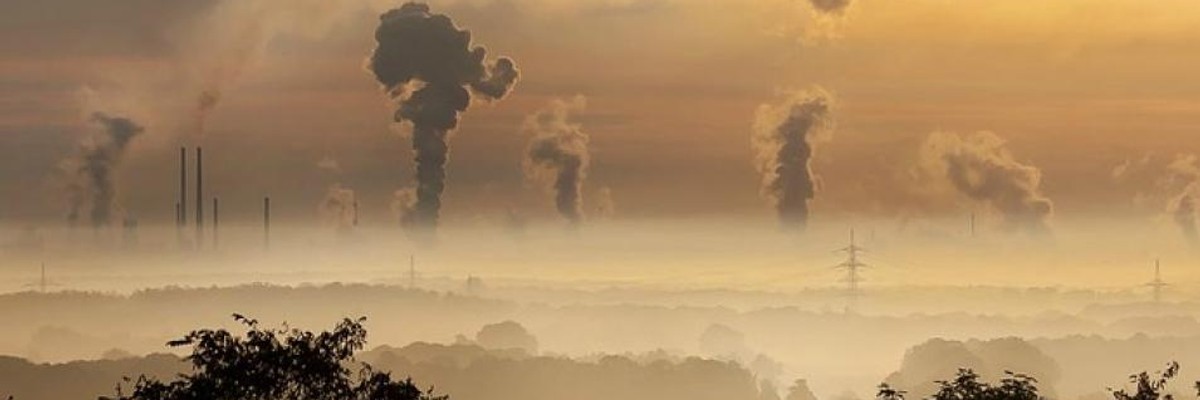
    Carbon emissions and haze are seen near factories and a power plant. (Photo: Pixabay/Creative Commons)

    “Closing the emissions gap means closing the ambition gap, the implementation gap, and the finance gap,” said U.N. Secretary-General António Guterres. “Starting at COP29.”

    The world’s nations must commit to dramatically slashing greenhouse gas emissions in the near future or risk a “catastrophic” rise in global average temperatures, a key United Nations climate report published Thursday warned.

    “It is still technically possible to meet the 1.5°C goal” set out in the Paris agreement, “but only with a G20-led massive global mobilization to cut all greenhouse gas emissions, starting today,” the United Nations Environmental Program (UNEP) said in a summary of its annual Emissions Gap Report.

    “Nations must collectively commit to cutting 42% off annual greenhouse gas emissions by 2030 and 57% by 2035 in the next round of Nationally Determined Contributions (NDCs)—and back this up with rapid action—or the Paris agreement’s 1.5°C goal will be gone within a few years,” UNEP warned.

    “Failure to increase ambition in these new NDCs and start delivering immediately would put the world on course for a temperature increase of 2.6-3.1°C over this century,” the agency said. “This would bring debilitating impacts to people, planet, and economies.”

    UNEP said “solar, wind, and forests” have the potential to help the world “get on a 1.5°C pathway.” However, “sufficiently strong NDCs would need to be backed urgently by a whole-of-government approach, measures that maximize socioeconomic and environmental co-benefits, enhanced international collaboration that includes reform of the global financial architecture, strong private sector action, and a minimum six-fold increase in mitigation investment.”

    “G20 nations, particularly the largest-emitting members, would need to do the heavy lifting,” the agency added.

    The task is daunting—according to the report, human emissions of greenhouse gases—CO2, methane, nitrous oxide, and fluorinated gases—reached a record 57.1bn tons of CO2 equivalent (GtCO2e) last year.

    “The emissions gap is not an abstract notion,” U.N. Secretary-General António Guterres stressed in a video message on the UNEP report. “There is a direct link between increasing emissions and increasingly frequent and intense climate disasters.”

    “Around the world, people are paying a terrible price,” he continued. “Record emissions mean record sea temperatures supercharging monster hurricanes; record heat is turning forests into tinder boxes and cities into saunas; record rains are resulting in biblical floods.”

    “Today’s Emissions Gap report is clear: We’re playing with fire; but there can be no more playing for time,” Guterres added. “We’re out of time. Closing the emissions gap means closing the ambition gap, the implementation gap, and the finance gap. Starting at COP29.”

    The U.N. chief was referring to the United Nations Climate Change Conference, which is set to take place next month in Baku, Azerbaijan—a nation that is “aggressively” expanding fossil fuel production.

    UNEP Executive Director Inger Andersen said in a statement:

    Climate crunch time is here. We need global mobilization on a scale and pace never seen before—starting right now, before the next round of climate pledges—or the 1.5°C goal will soon be dead and well below 2°C will take its place in the intensive care unit. I urge every nation: No more hot air, please. Use the upcoming COP29 talks in Baku, Azerbaijan, to increase action now, set the stage for stronger NDCs, and then go all-out to get on a 1.5°C pathway.

    Even if the world overshoots 1.5°C—and the chances of this happening are increasing every day—we must keep striving for a net-zero, sustainable, and prosperous world. Every fraction of a degree avoided counts in terms of lives saved, economies protected, damages avoided, biodiversity conserved, and the ability to rapidly bring down any temperature overshoot.

    Climate scientists and green groups expressed alarm over the UNEP report.

    “The Emissions Gap Report is yet another clear warning about what needs to be done and fast,” Andreas Sieber, associate director of policy and campaigns at 350.org, said in a statement. “Last year at COP28, nations agreed to transition away from fossil fuels. The report makes it crystal clear that governments must translate this decision into action in their national climate pledges if they are serious about the just energy transition.”

    Greenpeace International climate politics expert Tracy Carty said that “for 15 years, the UNEP has been sounding the alarm on the great chasm between political will for climate action and the worsening emissions trajectory fuelling rising temperatures.”

    “These reports are a historical litany of negligence from the world’s leaders to tackle the climate crisis with the urgency it demands, but it’s not too late to take corrective action,” Carty continued. “We challenge leaders to embark on wholesale change in their 2035 climate plans, to come to COP29 prepared to finance climate action and to make up for lost time.”

    Rachel Cleetus, policy director and a lead economist in the Climate and Energy Program at the Union of Concerned Scientists, issued a statement arguing that the new UNEP report “forcefully confirms that nations’ efforts to cut heat-trapping emissions have been grossly insufficient to date.”

    “Global heating records are being topped year after year, and people and ecosystems worldwide are suffering the devastation of unrelenting climate change disasters and increasingly irreversible impacts,” she noted. “To put it bluntly, decades of inadequate action have put the 1.5°C goal further out of reach and world leaders are failing their people. The consequences are profound—but the policy choices decided now are as crucial as ever to limit future harm.”

    Cleetus continued:

    The best way forward is to implement sweeping changes to the global energy system by phasing out the destructive products fossil fuel companies are peddling and investing big in renewable energy solutions to sharply curtail heat-trapping emissions. Also urgent are scaled-up investments in climate resilience to cope with impacts already locked in. Rich, high-emitting nations—including the United States—are most responsible for these calamitous circumstances. Those living in climate-vulnerable, low-income countries that contributed very little to the fossil fuel pollution driving this crisis need more than hollow words; they need wealthy countries and other major emitters to live up to their responsibilities.

    “At the upcoming U.N. climate talks, wealthy nations must significantly grow the amount of climate financing available to ensure all countries can slash their global warming emissions and prepare for the more frequent and severe climate impacts that are the punishing consequence of a warming world,” Cleetus added.

    Original article by Brett Wilkins republished from Common Dreams under Creative Commons (CC BY-NC-ND 3.0). 

  • Climate Scientist Leaves ExxonMobil’s Board With Little to Show for It

    Spread the love

    Original article by Emily Sanders, ExxonKnews republished from DeSmog.

    Susan Avery, the first climate scientist on ExxonMobil’s board, is stepping down. Credit: Tess Abbot/WHOItn (CC BY-SA 4.0).

    Advocates had hoped Susan Avery’s nomination would be a turning-point moment for the company’s climate approach. It wasn’t.

    This story was published in partnership with ExxonKnews

    When Susan Avery was first nominated to ExxonMobil’s board in 2017 after pressure from shareholder advocates to bring on a climate scientist, many hoped that her expertise could help steer the oil major in a new direction. Avery — a physicist and atmospheric scientist — had spoken during her extensive career of the need to “get off fossil fuels as much as possible.” 

    More than seven years later, Avery is set to exit her role as chair of Exxon’s Environment, Safety, and Public Policy Committee with those hopes seemingly dashed. Evidence continues to mount that the oil giant is still spreading climate disinformation to delay action on fossil fuels, and it recently sued shareholders who proposed that it pursue emissions cuts.

    Avery’s decision not to stand for re-election to the board was “for reasons unrelated to the company,” according to a February filing with the U.S. Securities and Exchange Commission. Avery, 74, is just shy of Exxon’s mandatory retirement age, though that was not cited in the filing — directors can run for re-election until they’re 75

    The end of her tenure has reignited debate about the role of a scientist on the board of a major oil company with a legacy of spreading science denial and ignoring internal expertise.

    “People wanted to give her an opportunity to change things from within, and I think there was an expectation that she would take that responsibility seriously,” said Kathy Mulvey, accountability campaign director for the Union of Concerned Scientists, a nonprofit advocacy organization that supported Avery’s nomination at the time. But Avery’s ability or willingness to change the company “certainly has not borne out in reality,” Mulvey said.

    Avery’s selection came after a shareholder proposal requested that Exxon nominate someone with a “high level of climate change expertise” for its board. The company’s unusual lawsuit against other shareholders could chill further attempts to sway its business model that way. Avery’s last day will be May 29, overlapping with the company’s annual shareholder meeting, where a growing number of outraged shareholder groups and state pension funds now plan to vote against prominent members of the board, including CEO Darren Woods. 

    With climate lawsuits against the company moving closer to trial, a growing number of states exploring legislation to make companies like Exxon pay for climate damages, and tensions with investors so high, “serving on ExxonMobil’s board is a high-stakes poker game,” Mulvey said. As Avery closes out her tenure with more than $3.8 million in compensation and stock value from the company, Mulvey said, “it’s not surprising” if Avery “decided to cash in her chips and go home.”

    Neither Avery nor Exxon responded to requests for an interview.

    Business as Usual During Avery’s Tenure

    Avery, the former president of the Woods Hole Oceanographic Institution in Massachusetts and  professor emeritus at the University of Colorado Boulder, was brought onto the board during Woods’ first month as CEO. “Avery’s leadership experience in multiple academic and scientific organizations, coupled with her breadth of scientific and research expertise, reinforce the corporation’s long-standing technical and scientific foundation,” the company said as it announced her appointment.

    At the time, Exxon was battling subpoenas from attorneys general in New York and Massachusetts, both investigating the company for concealing its knowledge about the dangers of burning fossil fuels. The oil giant was just beginning to experience the fallout of early revelations about its historic climate deception; the tip of that iceberg was unearthed by Inside Climate News, the Los Angeles Times, and Columbia Journalism School in 2015. 

    Behind the scenes, Exxon was taking a far less amenable tone in response to criticism of its climate approach.

    Kill the story,” Exxon media relations manager Alan Jeffers told Reuters’ Houston bureau chief in a 2016 email, responding to a request for comment on a Center for Media and Democracy press release accusing the American Legislative Exchange Council of abusing its nonprofit status by lobbying against climate action on behalf of Exxon.

    In the years to follow, Exxon would become the target of lawsuits from state and local governments alleging the company defrauded consumers, lawmakers, and the public in order to delay climate action and protect its oil and gas profits. Evidence shows the oil giant continued to spread anti-science disinformation and internally strategize to manipulate the public’s understanding of its role in the climate crisis well into Avery’s time on the board.

    A congressional report released last month following a years-long investigation found that Exxon and other oil majors’ campaigns of deception “evolved from denying climate science to spreading disinformation and perpetuating doublespeak.” Avery is mentioned in more than a dozen of the documents that members of Congress obtained from Exxon — but they’re almost entirely redacted. 

    The investigation found that while Exxon publicly touted its support for the Paris Agreement “since its adoption in 2015,” executives privately admitted that the company did not actually intend to meet the agreement’s goals. The oil giant’s plans are far afield from allowing it to hit those targets, according to a March analysis by think tank Carbon Tracker, which placed Exxon among the five lowest-ranking companies on its scorecard. Exxon’s climate pledges don’t align with its actions, according to one peer-reviewed study, and are “misleading at best, dishonest at worst,” according to Carly Phillips, a research scientist at the Union of Concerned Scientists.

    During Avery’s tenure, the company also used advertising firms and funded partnerships with academic institutions to lend credibility to its climate pledges and promotion of “low-carbon solutions” like algae biofuels, which the company abandoned after spending millions advertising that as a climate fix. And Exxon worked to shift blame for its role in the climate crisis to consumers, according to a study of the company’s public communications by climate disinformation experts Naomi Oreskes and Geoffrey Supran. 

    “The people who are generating those emissions need to be aware of and pay the price for generating those emissions,” Exxon’s Woods said in a recent Fortune interview.

    A November report from the International Energy Agency found that oil and gas companies account for less than 1% of clean energy investment globally. “‘When the energy world changes, so will we’ is not an adequate response to the immense challenges at hand,” the report concludes.

    But Exxon has vastly expanded its investments in fossil fuels, more than doubling its oil production in the Permian Basin after sealing a $60 billion deal to acquire Pioneer Natural Resources last year. Exxon and two other oil companies told Guyana that they plan to spend more than $12.9 billion on an offshore oil project there, the country said last summer. The company’s 2023 Global Outlook predicts an increase in methane gas use of more than 20% by midcentury. 

    In a 2021 hearing as part of a House Oversight Committee investigation, Woods refused to pledge that the company would stop funding disinformation and lobbying against climate action. 

    Exxon is expanding its investments in fossil fuels. Credit: Mike Mozart (CC BY-NC-ND 2.0)

    Like a Cancer Doctor on the Board of a Tobacco Company’

    The same committee asked Avery to testify at a later hearing, but she never did. Instead, Avery appeared to use her expertise and position to lend credibility to Exxon’s claims of climate leadership.

    “I’m proud to work on key issues related to climate risk at ExxonMobil,” she said in Exxon’s 2023 “Advancing Climate Solutions” report. “With my experience as an atmospheric scientist and a leader at a global research organization, I am committed to helping to advise the Board on public issues of significance. … The members of the [Environment, Safety and Public Policy] Committee are united in our commitment to position ExxonMobil as an industry leader in pursuing sustainable solutions that improve quality of life and meet society’s evolving needs.”

    Sarah Myhre, another climate scientist and program director for climate advocacy and democracy reform at the Glaser Progress Foundation, contends that Avery compromised her scientific integrity to “performatively greenwash one of the most horrifically damaging, nefarious, and fraudulent corporations that has ever existed.”

    “It’s like a cancer doctor on the board of a tobacco company [promoting] tobacco as a health product, something that is helping people live healthier, more vibrant lives. They’re taking all of their scientific bona fides and accreditation, and they’re using it for this outcome, which ultimately protects the tobacco company [as it] continues to kill people or damage their lives irrevocably,” Myhre said.

    Michael Mann, a climate scientist who was subject to years of attacks from climate denialists funded by Exxon, described Avery’s service to the company as a “betrayal.” 

    Avery’s decision “comes across as entirely transactional: climate scientist lends their imprimatur to the world’s largest publicly-traded fossil fuel company, under fire for their history of promoting disinformation and delay tactics, for seven years, and gets 4 million dollars in return,” Mann said in an email. “What is there that doesn’t look bad here?” 

    Silencing Dissent at Exxon

    What’s not known is whether Avery ever advised Exxon to change course. The company has a history of concealing the warnings of its own scientists and retaliating against whistleblowers — even recently. 

    “The ability of a board member to move a company forward partially depends on the multiple stakeholder voices that the company is hearing and whether they’re willing to listen to them,” said Timothy Smith, senior policy advisor at Interfaith Center on Corporate Responsibility, an organization that coordinates the work of shareholder groups. 

    Exxon’s lawsuit against two shareholder groups, filed in January, came in response to the shareholders’ proposal asking the company to limit its Scope 3 emissions, which arise from the use of its products and make up about 85% of its total greenhouse gas emissions. (Exxon’s “net zero” ambitions and emissions reduction plans don’t account for Scope 3 emissions at all.) 

    Shareholder resolutions such as these are intended for a vote by a company’s stockholders. When firms want to keep proposals off the ballot, the established process is to appeal to the Securities and Exchange Commission. Exxon, which sued instead, claimed the groups were driven by an “extreme agenda” that is “calculated to diminish the company’s existing business.”

    That claim was “really duplicitous because they know full well that this same agenda has been raised with them by other investors over the decade,” said Smith, arguing that the company has “become more confrontational and defensive rather than be a leader in this space.” 

    The shareholders, Arjuna Capital and Follow This, withdrew their proposal. But Exxon continued with its lawsuit, defending the decision in its 2024 proxy statement and arguing that the “proposal process is being abused by those who treat shareholder democracy as a venue for activism.” A judge ruled Wednesday that the case can proceed against one of the shareholders, U.S.-based Arjuna Capital, but not the Netherlands-based Follow This.

    Mulvey, of the Union of Concerned Scientists, said Exxon would rather battle its own investors than consider transparency about or a change to its fossil fuel business.

    “Not only do they continue to fight back against mandatory climate disclosure and public policies that would hold them accountable, but it is also trying to undermine the notion that those who own the company should have a say over its direction,” she said.

    Tensions could come to a head at Exxon’s annual shareholder meeting as Avery steps aside. Shareholder advocacy groups like Majority Action have urged other investors to vote against the company’s entire board of directors, which CalPERS, America’s largest pension fund, has announced it will do. The Illinois State Treasurer and California State Treasurer have made similar recommendations to their state pension funds, and the New York state pension fund plans to vote against all but two of the board members.

    “The [International Energy Agency] has laid out a plan to transform our energy system in line with the 1.5°C pathway. We’re at a critical juncture of how this is going to occur — and Exxon  appears to be hellbent on foreclosing on that urgent and necessary discussion,” said Majority Action’s senior research analyst, Bryant Sewell. “These directors have to be held accountable.”

    Original article by Emily Sanders, ExxonKnews republished from DeSmog.