Demonstrators gather outside Trump Tower on 5th Ave to raise awareness about climate change during an Earth Day Protest in New York City on April 22, 2026. (Photo by Selcuk Acar/Anadolu via Getty Images)
Putting an “utterly unqualified” person like Matthew Wielicki in charge of the National Climate Assessment, said one critic, “would jeopardize the integrity of one of the nation’s most important climate science resources.”
The Trump White House has quietly reconstituted the US Global Change Research Program—but that doesn’t mean the administration has turned over a new leaf on combating the climate crisis.
According to a Thursday report from Politico, the administration decided to bring the USGCRP, which tracks the impact of manmade climate change and produces the country’s National Climate Assessment report, back to life just a little more than a year after terminating its funding.
But there’s a twist: A source has confirmed to Politico that the USGCRP is now being headed by Matthew Wielicki, a former University of Alabama geochemist and self-described “professor in exile” who frequently attacks climate science in social media posts.
In his role, Wielicki will be in charge of writing the National Climate Assessment, a congressionally mandated report outlining the impacts that climate change is having on US infrastructure and the economy.
In an interview with Politico, Wielicki revealed that he’s been soliciting ideas for what to include in the next National Climate Assessment from X, the social media website owned by Elon Musk that is notorious for being awash in right-wing propaganda and scientific misinformation.
In the past, noted Politico, Wielicki dismissed climate research entirely, arguing that a “significant portion of the climate science literature is nothing more than stamp collecting,” while suggesting that scientists are fabricating data to give a false impression of a warming planet.
Dr. Carlos Martinez, senior climate scientist for the Climate and Energy program at the Union of Concerned Scientists, wasted no time blasting Wielicki’s appointment.
“Reconstituting the UCSGCRP only to place the National Climate Assessment under the auspices of an utterly unqualified climate science denier,” Martinez said, “would jeopardize the integrity of one of the nation’s most important climate science resources.”
Martinez emphasized that the National Climate Assessment “is not a political document” and is “supposed to be developed through a rigorous, transparent, multi-agency scientific process involving federal experts, external scientists, extensive review—including by the National Academies—and public input.”
Ryan Katz-Rosene, professor at the School of Political Studies at the University of Ottawa, said Wielicki’s appointment “sadly… is not a joke,” and that it was “like putting a Flat Earther in charge of NASA.”
Donald Trump urges you to be a Climate Science denier like him. He says that he makes millions and millions for destroying the planet, Burn, Baby, Burn and Flood, Baby, Flood.Nigel Farage urges you to ignore facts and reality and be a climate science denier like him and his Deputy Richard Tice. He says that Reform UK has received £Millions and £Millions from the fossil fuel industry to promote climate denial and destroy the planet.Orcas comment on killer apes destroying the planet by continuing to burn fossil fuels.
U.S. President Donald Trump signs an executive order related to nuclear power in the Oval Office of the White House in Washington, DC on May 23, 2025 (Photo by Win McNamee/Getty Images)
“I think the DOE’s attempts to cut corners on safety, security, and environmental protections are posing a grave risk to public health, safety, and our natural environment,” said one expert.
Less than a week after NPRrevealed that “the Trump administration has overhauled a set of nuclear safety directives and shared them with the companies it is charged with regulating, without making the new rules available to the public,” the US Department of Energy announced Monday that it is allowing firms building experimental nuclear reactors to seek exemptions from legally required environmental reviews.
Citing executive orders signed by President Donald Trump in May, a notice published in the Federal Register states that the DOE “is establishing a categorical exclusion for authorization, siting, construction, operation, reauthorization, and decommissioning of advanced nuclear reactors for inclusion in its National Environmental Policy Act (NEPA) implementing procedures.”
NEPA has long been a target of energy industries and Republican elected officials, including Trump. The exemption policy has been expected since Trump’s May orders—which also launched a DOE pilot program to rapidly build the experimental reactors—and the department said in a statement that even the exempted reactors will face some reviews.
“The US Department of Energy is establishing the potential option to obtain a streamlined approach for advanced nuclear reactors as part of the environmental review performed under NEPA,” the DOE said. “The analysis on each reactor being considered will be informed by previously completed environmental reviews for similar advanced nuclear technologies.”
“The fact is that any nuclear reactor, no matter how small, no matter how safe it looks on paper, is potentially subject to severe accidents.”
However, the DOE announcement alarmed various experts, including Daniel P. Aldrich, director of the Resilience Studies Program at Northeastern University, who wrote on social media: “Making America unsafe again: Trump created an exclusion for new experimental reactors from disclosing how their construction and operation might harm the environment, and from a written, public assessment of the possible consequences of a nuclear accident.”
Foreign policy reporter Laura Rozen described the policy as “terrifying,” while Paul Dorfman, chair of the Nuclear Consulting Group and a scholar at the University of Sussex’s Bennett Institute for Innovation and Policy Acceleration, called it “truly crazy.”
Until now, the test reactor designs currently under construction have primarily existed on paper, according to Edwin Lyman, director of nuclear power safety at the Union of Concerned Scientists, a nonprofit environmental advocacy group. He believes the lack of real-world experience with the reactors means that they should be subject to more rigorous safety and environmental reviews before they’re built.
“The fact is that any nuclear reactor, no matter how small, no matter how safe it looks on paper, is potentially subject to severe accidents,” Lyman said.
“I think the DOE’s attempts to cut corners on safety, security, and environmental protections are posing a grave risk to public health, safety, and our natural environment here in the United States,” he added.
Lyman was also among the experts who criticized changes that NPR exposed last week, after senior editor and correspondent Geoff Brumfiel obtained documents detailing updates to “departmental orders, which dictate requirements for almost every aspect of the reactors’ operations—including safety systems, environmental protections, site security, and accident investigations.”
While the DOE said that it shared early versions of the rules with companies, “the reduction of unnecessary regulations will increase innovation in the industry without jeopardizing safety,” and “the department anticipates publicly posting the directives later this year,” Brumfiel noted that the orders he saw weren’t labeled as drafts and had the word “approved” on their cover pages.
Secretly rewriting regulations is unfortunately becoming a pattern for this Admin. These changes in safety regulations are concerning, but what's even more troubling is that these decisions were made behind closed doors. Science Dems will be investigating. https://t.co/2MYazWquPk
In a lengthy statement about last week’s reporting, Lyman said on the Union of Concerned Scientists website that “this deeply troubling development confirms my worst fears about the dire state of nuclear power safety and security oversight under the Trump administration. Such a brazen rewriting of hundreds of crucial safeguards for the public underscores why preservation of the Nuclear Regulatory Commission (NRC) as an independent, transparent nuclear regulator is so critical.”
“The Energy Department has not only taken a sledgehammer to the basic principles that underlie effective nuclear regulation, but it has also done so in the shadows, keeping the public in the dark,” he continued. “These long-standing principles were developed over the course of many decades and consider lessons learned from painful events such as the Chernobyl and Fukushima disasters. This is a massive experiment in the deregulation of novel, untested nuclear facilities that could pose grave threats to public health and safety.”
“These drastic changes may extend beyond the Reactor Pilot Program, which was created by President Trump last year to circumvent the more rigorous licensing rules employed by the NRC,” Lyman warned. “While the DOE created a legally dubious framework to designate these reactors as ‘test’ reactors to bypass the NRC’s statutory authority, these dramatic alterations may further weaken standards used in the broader DOE authorization process and propagate across the entire fleet of commercial nuclear facilities, severely degrading nuclear safety throughout the United States.”
Orcas discuss Donald Trump and the killer apes’ concept of democracy. Front Orca warns that Trump is crashing his country’s economy and that everything he does he does for the fantastically wealthy.Donald Fuhrump says that Amerikkka doesn’t bother with crimes or charges anymore, not being 100% Amerikkkan and opposing his real estate intentions is enough.Elon Musk urges you to be a Fascist like him, says that you can ignore facts and reality then.
An operator works at the data centre of French company OVHcloud in Roubaix, northern France on April 3, 2025. (Photo by Sameer Al-Doumy/AFP via Getty Images)
“For any Democrat who wants to think politically, what an opportunity,” said Faiz Shakir, a longtime adviser to US Sen. Bernie Sanders. “The people are way ahead of the politicians.”
America’s biggest tech firms are facing an increasing backlash over the energy-devouring data centers they are building to power artificial intelligence.
Semaforreported on Monday that opposition to data center construction has been bubbling up in communities across the US, as both Republican and Democratic local officials have been campaigning on promises to clamp down on Silicon Valley’s most expensive and ambitious projects.
In Virginia’s 30th House of Delegates district, for example, both Republican incumbent Geary Higgins and Democratic challenger John McAuliff have been battling over which one of them is most opposed to AI data center construction in their region.
In an interview with Semafor, McAuliff said that opposition to data centers in the district has swelled up organically, as voters recoil at both the massive amount of resources they consume and the impact that consumption is having on both the environment and their electric bills.
“We’re dealing with the biggest companies on the planet,” he explained. “So we need to make sure Virginians are benefiting off of what they do here, not just paying for it.”
NPR on Tuesday similarly reported that fights over data center construction are happening nationwide, as residents who live near proposed construction sites have expressed concerns about the amount of water and electricity they will consume at the expense of local communities.
“A typical AI data center uses as much electricity as 100,000 households, and the largest under development will consume 20 times more,” NPR explained, citing a report from the International Energy Agency. “They also suck up billions of gallons of water for systems to keep all that computer hardware cool.”
Data centers’ massive water use has been a consistent concern across the US. The Philadelphia Inquirerreported on Monday that residents of the township of East Vincent, Pennsylvania have seen their wells dry up recently, and they are worried that a proposed data center would significantly exacerbate water shortages.
This is what has been happening in Mansfield, Georgia, a community that for years has experienced problems with its water supply ever since tech giant Meta began building a data center there in 2018.
As BBCreported back in August, residents in Mansfield have resorted to buying bottled water because their wells have been delivering murky water, which they said wasn’t a problem before the Meta data center came online. Although Meta has commissioned a study that claims to show its data center hasn’t affected local groundwater quality, Mansfield resident Beverly Morris told BBC she isn’t buying the company’s findings.
“My everyday life, everything has been affected,” she said, in reference to the presence of the data center. “I’ve lived through this for eight years. This is not just today, but it is affecting me from now on.”
Anxieties about massive power consumption are also spurring the backlash against data centers, and recent research shows these fears could be well founded.
Mike Jacobs, a senior energy manager at the Union of Concerned Scientists, last month released an analysis estimating that data centers had added billions of dollars to Americans’ electric bills across seven different states in recent years. In Virginia alone, for instance, Jacobs found that household electric bills had subsidized data center transmission costs to the tune of $1.9 billion in 2024.
“The big tech companies rushing to build out massive data centers are worth trillions of dollars, yet they’re successfully exploiting an outdated regulatory process to pawn billions of dollars of costs off on families who may never even use their products,” Jacobs explained. “People deserve to understand the full extent of how data centers in their communities may affect their lives and wallets. This is a clear case of the public unknowingly subsidizing private companies’ profits.”
While the backlash to data centers hasn’t yet become a national issue, Faiz Shakir, a longtime adviser to US Sen. Bernie Sanders (I-Vt.), predicted in an interview with Semafor that opposition to their construction would be a winning political issue for any politician savvy enough to get ahead of it.
“For any Democrat who wants to think politically, what an opportunity,” he said. “The people are way ahead of the politicians.”
The Environmental Protection Agency flag flies outside the EPA headquarters in Washington on Thursday, February 6, 2025. (Photo: Bill Clark/CQ-Roll Call, Inc via Getty Images)
“Donald Trump has decided that we do not deserve clean air or water, and our right to a livable and safe planet comes second to further enriching his fossil fuel friends and donors,” said one environmentalist.
The Trump administration plans to place over 100 workers who are employed with the Environmental Protection Agency’s Office of Environmental Justice and External Civil Rights on administrative leave, according to Wednesday reporting from The Wall Street Journal, which cited unnamed sources.
Other outlets have since reported on the development, including The Washington Post, which wrote Thursday that Trump appointees at the EPA told staff that they plan to close the office.
This move targeting the EPA, one the latest efforts by the Trump administration to drastically reshape federal agencies, was panned by multiple environmental organizations, who accused the White House of turning its back on vulnerable communities.
“The EPA’s environmental justice office was created to challenge the historic pattern of pollution disproportionately affecting low-income communities and communities of color,” said Chitra Kumar, managing director of the Climate and Energy Program at the Union of Concerned Scientists. Kumar was also formerly an official with the EPA Office of Environmental Justice and External Civil Rights.
“Once again, the Trump administration is sidelining both science and the nation’s most overburdened people,” she added.
Meanwhile, the Trump administration is also reportedly working to “remake” the Justice Department’s Environment and Natural Resources Division, which defends the U.S. government’s environmental actions in court and brings cases against individuals who violate federal environmental law. The Washington Post reported that Trump appointees at the Department of Justice said they plan to fire roughly 20 workers at the division, “among other actions that have sent morale there plummeting.”
The Office of Environmental Justice within the division has already “been eliminated,” and the five people working in that office have already been put on administrative leave, according to the outlet.
And in one of her first acts as U.S. Attorney General, Pam Bondi undid a Biden-era directive ordering the Department of Justice to emphasize enforcement of environmental laws in disadvantaged and low-income communities.
Trump administration attacks on what the White House deems “diversity, equity, inclusion, and accessibility” (DEIA) initiatives were expected. On his first day in office, U.S. President Donald Trump signed an executive order mandating the end of all federal DEI programs, goals, mandates, and plans. The order also specifically called for the termination, “to the maximum extent allowed by law, all DEI, DEIA, and ‘environmental justice’ offices and positions.”
“By shuttering these offices, Donald Trump has decided that we do not deserve clean air or water, and our right to a livable and safe planet comes second to further enriching his fossil fuel friends and donors,” said Sierra Club executive director Ben Jealous in a Thursday statement. “Trump has been on the job for less than a month, but every single day he is making our communities less safe.”
Like Kumar at the Union of Concerned Scientists, senior VP of environmental health at the Natural Resources Defense Council Matthew Tejada (also an alum of the EPA’s environmental justice office) said that the country’s most vulnerable communities would lose out.
“Shuttering the environmental justice office [at the EPA] will mean more toxic contaminants, dangerous air, and unsafe water in communities across the nation that have been most harmed by pollution in the past,” said Tejada. “Trump EPA is turning its back on those who need a cleaner environment more than anyone. This is a disgrace.”
Activists demanding that rich countries pay up for climate finance protest at COP29 in Baku, Azerbaijan on November 22, 2024. (Photo: Sean Gallup/Getty Images)
Critics of the “COP of false solutions” said that instead of much-needed funding, developing nations got “a global Ponzi scheme that the private equity vultures and public relations people will now exploit.”
It was early Sunday by the time the United Nations climate summit wrapped up in Baku, Azerbaijan after running into overtime to finalize deals on carbon markets and funding for developing countries that were sharply condemned by campaigners worldwide.
“COP29 was a dumpster fire. Except it’s not trash that’s burning—it’s our planet,” declared Nikki Reisch of the Center for International Environmental Law. “And developed countries are holding both the matches and the firehose.”
Recalling last year’s conference in the United Arab Emirates, Oil Change International global policy senior strategist Shady Khalil highlighted that “the world made a deal at COP28 to end the fossil fuel era. Now, at COP29, countries seem to have been struck with collective amnesia.”
“With each new iteration of the texts, oil and gas producers managed to dilute the urgent commitment to phase out fossil fuels,” Khalil said. “But let’s be clear: Rich countries’ failure to lead on fossil fuel phaseout and to put the trillions they have hoarded on the table has done more to imperil the energy transition than any obstructionist tactics from oil and gas producers.”
This year’s conference began November 11 and was due to conclude on Friday, but parties to the Paris agreement were still negotiating the carbon market rules, which were finalized late Saturday, and the new collective quantified goal (NCQG) on climate finance.
“The carbon markets in Article 6 of the Paris agreement were pushed through COP29 in a take-it-or leave-it outcome,” said Tamra Gilbertson of Indigenous Environmental Network, decrying “a new dangerous era in climate change negotiations.”
Sorry, this content could not be embedded. [yet again] X
As Climate Home Newsreported, they establish two types of markets: “The first—known as Article 6.2—regulates bilateral carbon trading between countries, while Article 6.4 creates a global crediting mechanism for countries to sell emissions reductions.”
The outlet pointed to expert warnings that “the rules for bilateral trades under 6.2 could open the door for the sale of junk carbon credits—one of the weaknesses of the previous crediting mechanism set up by the U.N. known as the Clean Development Mechanism (CDM).”
Jonathan Crook of Carbon Market Watch said in a statement that “the package does not shine enough light on an already opaque system where countries won’t be required to provide information about their deals well ahead of actual trades.”
“Even worse, the last opportunity to strengthen the critically weak review process was largely missed,” he continued. “Countries remain free to trade carbon credits that are of low quality, or even fail to comply with Article 6.2 rules, without any real oversight.”
As for Article 6.4, “much lies in the hands of the supervisory body” that’s set to resume work in early 2025, said Crook’s colleague, Federica Dossi. “To show that it is ready to learn from past mistakes, it will have to take tough decisions next year and ensure that Article 6.4 credits will be markedly better than the units that old CDM projects will generate.”
“If they are not, they will have to compete in a low-trust, low-integrity market where prices are likely to be at rock bottom and interest will be low,” Dossi added. “Such a system would be a distraction, and a waste of 10 years worth of carbon market negotiations.”
Some campaigners suggested that no matter what lies ahead, the embrace of carbon markets represents a failure. Kirtana Chandrasekaran at Friends of the Earth International said that “the supposed ‘COP of climate finance’ has turned into the ‘COP of false solutions.’ The U.N. has given its stamp of approval to fraudulent and failed carbon markets.”
“We have seen the impacts of these schemes: land grabs, Indigenous peoples’ and human rights violations,” Chandrasekaran noted. “The now-operationalized U.N. global carbon market may well be worse than existing voluntary ones and will continue to provide a get out of jail free card to Big Polluters whilst devastating communities and ecosystems.”
Sorry, this content could not be embedded. [What a surprise!] X
Chandrasekaran’s colleague Seán McLoughlin at Friends of the Earth Ireland was similarly critical of the conference’s finance deal, asserting that “Baku is a big F U to climate justice, to the poorest communities who are on the frontlines of climate breakdown.”
“COP29 has failed those who have done least to cause climate change and who are most vulnerable to climate breakdown because the process is still in thrall to fossil fuel bullies and rich countries more committed to shirking their historical responsibility than safeguarding our common future,” he said. “Now it’s back to citizens to demand our governments do the right thing. We must keep demanding the trillions, not billions owed in climate debt and a comprehensive, swift, and equitable fossil fuel phaseout. The struggle for climate justice is not over.”
Campaigners and developing nations fought for $1.3 trillion in annual climate finance from those most responsible for the planetary crisis. Instead, the NCQG document only directs developed countries to provide the Global South with $300 billion per year by 2035, with a goal of reaching the higher figure by also seeking funds from private sources.
The deal almost didn’t happen at all. As The Guardiandetailed Saturday: “Developed countries including the U.K., the U.S., and E.U. members were pushed into raising their offer from an original $250 billion a year tabled on Friday, to $300 billion. Poor countries argued for more, and in the early evening two groups representing some of the world’s poorest countries walked out of one key meeting, threatening to collapse the negotiations.”
While Simon Stiell, executive secretary of U.N. Climate Change, celebrated the NCQG as “an insurance policy for humanity, amid worsening climate impacts hitting every country,” Chiara Martinelli, director at Climate Action Network Europe, put it in the context of the $100 billion target set in 2009, which wealthy governments didn’t meet.
“Rich countries own the responsibility for the failed outcome at COP29,” Martinelli said. “The talk of tripling from the $100 billion goal might sound impressive, but in reality, it falls far short, barely increasing from the previous commitment when adjusted for inflation and considering the bulk of this money will come in the form of unsustainable loans. This is not solidarity. It’s smoke and mirrors that betray the needs of those on the frontlines of the climate crisis.”
Also stressing that “it’s not even real ‘money,’ by and large,” but rather “a motley mix of loans and privatized investment,” Oxfam International’s climate change policy lead, Nafkote Dabi, called the agreement “a global Ponzi scheme that the private equity vultures and public relations people will now exploit.”
“The terrible verdict from the Baku climate talks shows that rich countries view the Global South as ultimately expendable, like pawns on a chessboard,” Dabi charged. “The $300 billion so-called ‘deal’ that poorer countries have been bullied into accepting is unserious and dangerous—a soulless triumph for the rich, but a genuine disaster for our planet and communities who are being flooded, starved, and displaced today by climate breakdown.”
Sorry, this content could not be embedded. [Who broke the twitter/X embed?]
X
Rachel Cleetus from the Union of Concerned Scientists, who is in Baku, took aim at not only rich governments, but also the host, saying that “the Azerbaijani COP29 Presidency’s ineptitude in brokering an agreement at this consequential climate finance COP will go down in ignominy.”
Cleetus’ group is based in the United States, which is preparing for a January transfer of power from Democratic President Joe Biden to Republican President-elect Donald Trump, who notably ditched the Paris agreement during his first term.
“The United States—the world’s largest historical contributor of heat-trapping emissions—is going to see a monumental shift in its global diplomacy posture as the incoming anti-science Trump administration will likely exit the Paris agreement and take a wrecking ball to domestic climate and clean energy policies,” Cleetus warned. “While some politically and economically popular clean energy policies may prove durable and action from forward-looking states and businesses will be significant, there’s no doubt that a lack of robust federal leadership will leave U.S. climate action hobbled for a time.”
“Other nations—including E.U. countries and China—will need to do what they can to fill the void,” she stressed. “Between now and COP30 in Brazil next year, nations have a lot of ground to make up to have any hope of limiting runaway climate change.”
Ben Goloff of the U.S.-based Center for Biological Diversity called out the departing Biden administration, arguing that it “should be going out with at least a signal of its moral climate commitment, not copping out ahead of the Trump 2.0 disaster.”
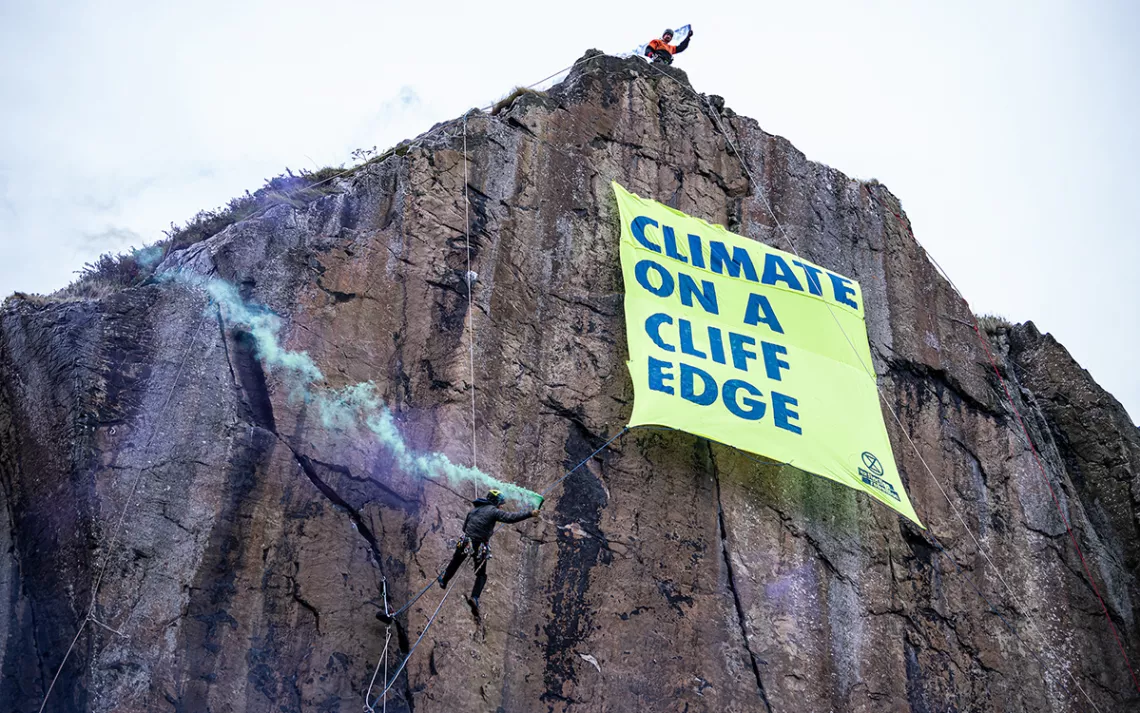
Experienced climbers scale a rock face near the historic Dumbarton castle in Glasgow, releasing a banner that reads “Climate on a Cliff Edge.” One activist, dressed as a globe, symbolically looms near the edge, while another plays the bagpipes on the shores below. | Photo courtesy of Extinction Rebellion and Mark RichardsOrcas comment on killer apes destroying the planet by continuing to burn fossil fuels.