The focus on growth to ease the UK’s economic ills will not be nearly enough, but there is a way to raise the sums needed
Never let your opponents define the terms of a debate. All too often, Labour has allowed the Conservatives and the billionaire press to demonise the notion of “tax and spend”. It went to great lengths before the election to assure voters it had no such intention. Now it drives home the message: instead, our needs will be met by “growth, growth, growth”. But tax and spend is the foundation of a civilised society.
Few of the changes this country requires can be achieved while adhering to the “tough spending rules” the new government has imposed on itself. We urgently need massive public investment in the NHS, social care, schools, environmental protection, social housing, local authorities, water, railways, the justice system and virtually all functions of government. We need a genuine levelling up, across regions and across classes. The austerity inflicted on us by the Conservatives was unnecessary and self-defeating and Labour has no good reason to sustain it.
The new government insists it is ending austerity. It isn’t. As the Institute for Fiscal Studies (IFS) pointed out in June, Labour’s plans mean that public services are “likely to be seriously squeezed, facing real-terms cuts”. Similarly, the Resolution Foundation has warned that, with current spending projections, the government will need to make £19bn of annual cuts by 2028-29. However you dress it up, this is austerity.
We are constantly told: “There’s no money.” But there is plenty of money. It’s just not in the hands of the government. The wealth of billionaires in the UK has risen by 1,000% since 1990. The richest 1% possess more wealth than the poorest 70%. Why do they have so much? Because the state does not; they have not been sufficiently taxed.
At the end of last year, the UK was officially in recession. The economy shrank by 0.3% between October and December 2023, after a previous contraction between July and September.
New figures for January 2024 show a slight improvement. But there is nothing to indicate that the UK has made meaningful progress when it comes to productivity growth – and how the UK needs to produce more goods and services if living standards and wages are to improve.
Productivity growth in the UK has been virtually non-existent since the financial crisis of 2008. It lags significantly behind countries like Germany and France, and even further behind the US.
Growing productivity is not easy. Having researched this area of the economy extensively, I’m acutely aware of the the challenges facing firms which are trying to be more productive. They include everything from investment levels and access to research and development to regional inequality and a shortage of skills.
But there are some things that could be done to improve the situation. And two of the most important ones are greater investment, and a more localised approach to the national economy.
For example, one major problem in the UK is that its labour market prioritises what economists call “flexibility” – allowing firms to hire and fire employees fairly easily (compared say with France, where it is more difficult) – and getting people into entry-level jobs. It is much less focused on training and development.
Major investment in training at all levels, from basic skills through to high-level technical and managerial skills, would make workers more productive. It would allow greater job mobility, which in turn leads to a better match between demand and supply.
The UK also needs to invest in what’s known as “capital equipment” – the stuff that businesses use to produce things. For a building company this might mean buying a JCB digger instead of shovels, or for a dressmaker it could be buying a sewing machine. Put simply, if UK industries had more kit, productivity would improve.
A recent change to capital allowances which allows firms to offset investment against tax is welcome. But companies need to know that this will stay, and not be subject to political changes and inconsistent economic policy.
Freedom to grow
So money needs to be spent, and investments need to be made. But another crucial element is that the money needs to be invested locally, in the places where people actually live and work.
To be truly beneficial, this needs close collaboration between local authorities, education providers and the private sector. Local knowledge about where certain sectors are being held back, what skills are required and where they are needed, is fundamental.
Local authorities should be able to address these issues, rather than having to constantly defer to London. This means doing two more things (neither of which have ever had national government support).
The first is simplifying the workings of local government, which is notoriously complex and a constant drag on regional productivity.
And the second is helping those local governments financially, not just in terms of the current funding crisis, but also by allowing then to plan investments in skills and infrastructure over the long term, rather than having to bid piecemeal for short term funding.
It is clear to me from the work I have done in the West Midlands area of England that the UK economy is far too centralised. Everything from access to finance and venture capital, to investment in skills and infrastructure is heavily skewed towards the south east.
Away from that region, the UK has a low level of what economists call “aglomeration economies”, where a particular industry is concentrated within a geographical area, and supported by decent infrastructure and a good supply of skilled workers.
Compared to Germany or France, public transport in the UK is expensive and patchy, meaning people in towns often can’t access employment opportunities in cities which are relatively close by. This means that we see high levels of inequality over short distances, where poverty exists close by to great wealth.
This kind of imbalance could be addressed by combining increased investment (both public and private) with a much greater willingness to understand the various British regions which make up a currently disunited kingdom. These two steps would make the whole economic system more resilient, and in the long term, more productive.
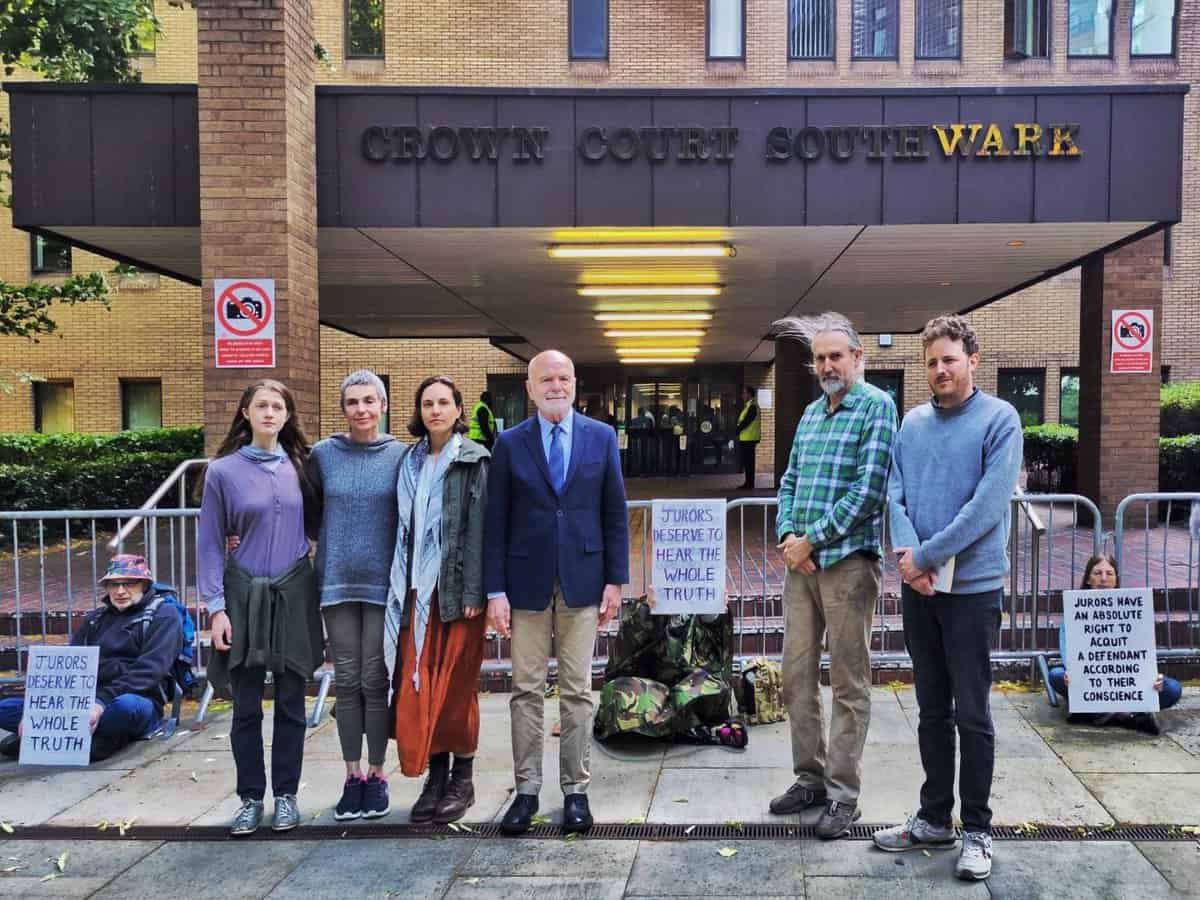
UN Special Rapporteur on Environmental Defenders under the Aarhus Convention Michel Forst attended the trial of five Just Stop Oil supporters at Southwark Crown Court. He attended as an observer because of his serious concerns.
Prosecution of five Just Stop Oil activists over M25 protest led to chaotic scenes in court and concerns about ‘judicial persecution’
As part of his role as UN rapporteur for environmental defenders, Michel Forst has been watching proceedings against climate activists at courts across Europe.
But he may not have seen anything like what unfolded at Southwark crown court in London over the past two and a half weeks, where five Just Stop Oil activists were convicted for conspiring to cause gridlock on the M25 in November 2022.
On the days Forst visited, he witnessed three of the five defendants being arrested in court and dragged to the cells, protesters outside attempting to warn jurors they were not hearing the full case and a judge desperately trying to maintain control over his courtroom.
The judge, Christopher Hehir, had ruled that information about climate breakdown could not be entered into evidence, and could only be referred to by defendants briefly as the “political and philosophical beliefs” that motivated them – which he would tell the jury were in any case irrelevant to their deliberations.
But the defendants had other plans. They sought to turn Hehir’s court into a “site of civil resistance”, causing as much disruption as necessary to ensure that if the jury could not see their evidence on climate breakdown, then the jurors could at least be in no doubt it was being kept from them.
By the time the jury retired to consider a verdict, police had been called into court no fewer than seven times, four of the five defendants had been remanded to prison and 11 others were facing contempt of court proceedings for protests outside the courtroom.
…
By the end of the trial, Whittaker De Abreu, the only one who had not represented herself, was the only defendant left in court.
As a punishment for their “persistent disruption”, Hehir slashed the time given to each defendant from one hour to 20 minutes. He further prohibited any mention of the climate crisis, the legal defences he had disallowed or the principle of jury equity – the idea that jurors can acquit based on their conscience.
As Hallam, Shaw, Lancaster and Gethin gave their speeches from behind the reinforced glass screen of the dock, they each proceeded to flout Hehir’s prohibitions, arguing they had been denied a right to a fair trial.
Hallam told jurors: “It’s blindingly obvious to us here first that you have not been given all the evidence you need. You cannot be sure of our guilt if you are not sure that you have not been given the evidence … we have received no good reason why we are not allowed to tell you what is blindingly obvious, namely what I’m not allowed to speak about. If you are not allowed to hear the blindingly obvious then it’s not a fair trial is it?”
It took just a day’s deliberations for the jury to unanimously find them guilty.
Given the recent history of UK climate protest trials, in which defendants have been sentenced to jail for merely mentioning the words “climate change”, and notwithstanding the dramatic arrests in court, Forst said he was surprised the judge gave them an opportunity to mention climate breakdown at all.
“But the little latitude they had to mention climate change was in the meantime emptied of its very meaning by the fact that, overall, the jury was told to ignore most of it,” he added.
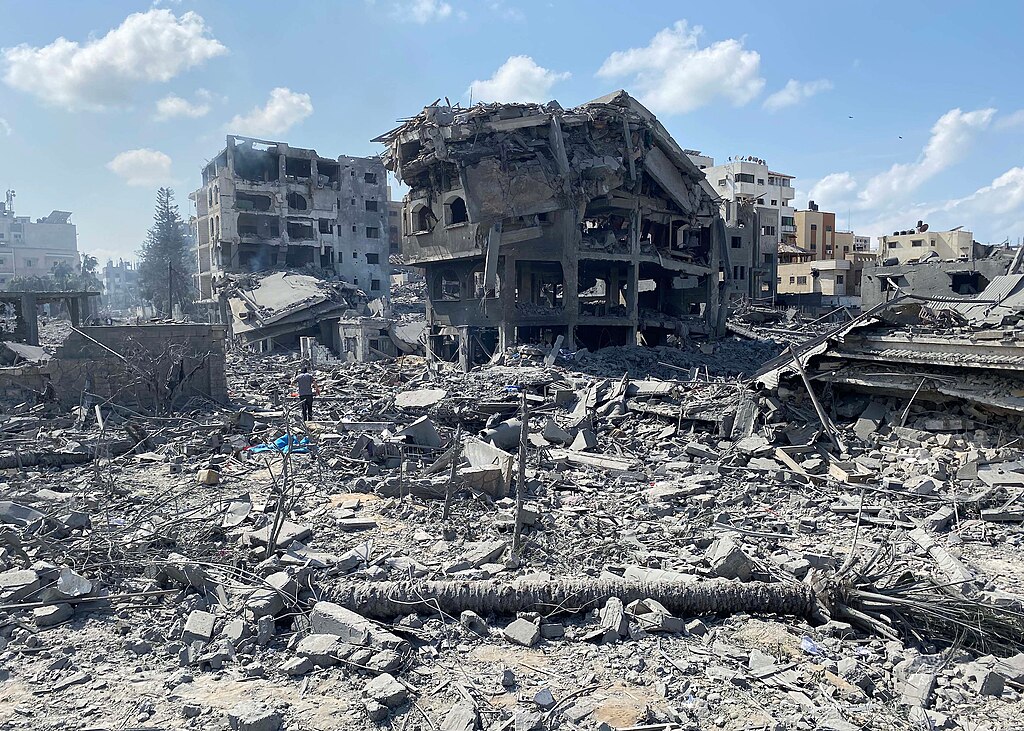
Palestinians inspect the damage following an Israeli airstrike on the El-Remal aera in Gaza City on October 9, 2023. Israel continued to battle Hamas fighters on October 10 and massed tens of thousands of troops and heavy armour around the Gaza Strip after vowing a massive blow over the Palestinian militants’ surprise attack. Photo by Naaman Omar apaimages. licensed under the Creative Commons Attribution-Share Alike 3.0 Unported license.
Britain is complicit in mass slaughter on a horrifying scale. But those campaigning for our votes pretend it’s not happening
…
This week alone, Israel has threatened “all out war” with Lebanon, while Hezbollah’s leader threatens a war “without rules or ceilings”, dangling the prospect of a far graver bloodbath than that unleashed by Israel’s genocidal rampage in Gaza. The spokesperson of the Israel Defense Forces has admitted that Hamas cannot be destroyed militarily: this amounts to a confession that the central war goal used to justify the slaughter of tens of thousands is unattainable. And the UN has released a report offering evidence as to how Israel’s bombing campaign in Gaza may have systematically violated the laws of war on protecting civilians and civilian infrastructure.
Remember: this is an onslaught that Britain’s government and opposition squarely backed at the start. Back in October, our prime minister promised “unequivocal” support for Israel for all time, while his inevitable successor, Keir Starmer, backed Israel’s right to cut off energy and water, though he later claimed he had been misinterpreted, and had never supported this. Neither political party will commit to ending arms sales, even though the chief prosecutor of the international criminal court – himself a British lawyer – has requested arrest warrants for both the Israeli prime minister, Benjamin Netanyahu, and his defence minister, Yoav Gallant, for alleged war crimes and crimes against humanity. This itself points to what should be a major domestic political scandal. Both party leaders should be scrutinised for having backed what became one of the great atrocities of our age, despite the bloodcurdling promises made by Israeli leaders from the start.
…
Given that this is a question of life and death on a colossal scale, our politicians should be forced to answer. Yet when our foreign secretary, David Cameron, was interrogated last week on the BBC Today programme, the interviewer spent the slot questioning him about trust and housebuilding. On Thursday night’s BBC Question Time leaders’ special, there was not a single question or answer on Gaza.
Of course, straight after 7/10, mainstream journalists were quick to promote the deployment of planes and personnel to support “our ally” in the region.
While the Sun splashed photos of British jets and frigates heading to the eastern Mediterranean with the headline “United We Stand”, the BBC basically reproduced a Ministry of Defence press release in its story, “UK to deploy Royal Navy ships to Middle East to ‘bolster security’.”
On 2 December, the Ministry of Defence released a short statement on UK military activity in the region, ostensibly to secure the release of (only) Israeli hostages.
The BBC, along with other news outlets, immediately ran a story repeating the MoD’s words verbatim (with a sprinkling of additional text from the Pentagon) as if these were to be innocent “surveillance flights” despite the fact that over 15,000 Palestinians had already been killed in brutal air strikes since 7/10.
This was followed by a flurry of highly bullish coverage of two further military interventions directly related to bolstering UK support for Israel – evidence of the “extensive defence and security cooperation” between the two countries that was embedded in the ‘Roadmap’ agreement signed in 2023 (and ignored by the media).
…
Censorship by omission
This lack of interest in the British government’s military links to Israel shouldn’t suggest, however, that there is nothing to investigate.
Indeed, Declassified UK has published multiple stories on the more opaque actions of the UK government that have been largely ignored by mainstream news including the deployment of a British spy team in Israel since 7/10, the dozens of flights by UK military aircraft to Israel in this period, the surveillance activities in support of Israel and the training of Israeli military personnel in the UK. Almost none of these have been followed up in broadcast bulletins and articles.
There is one area, however, in which the media do appear to have engaged with this topic: British arms sales to Israel that, according to the Campaign against Arms Trade, amount to £576 million since 2008.
That there were 2,648 stories mentioning “arms sales to Israel” and “UK” between 7 October and 19 June 2024 might suggest this is a major area of concern for journalists.
Not so fast. 85% of all stories appeared after 1 April when three UK citizens were among seven aid workers killed when Israeli jets attacked the food convoy they were managing.
For the 177 days between 7/10 and 1 April, the media (with the exception of the Scottish National, Guardian and BBC Parliament) showed little inclination to open up discussion on the issue.
Despite serious concerns that, through its exports of weapons to the Israeli military, the UK is complicit in ongoing war crimes, major news outlets only started to show an interest in the topic once British people, not Palestinians, were the story.
…
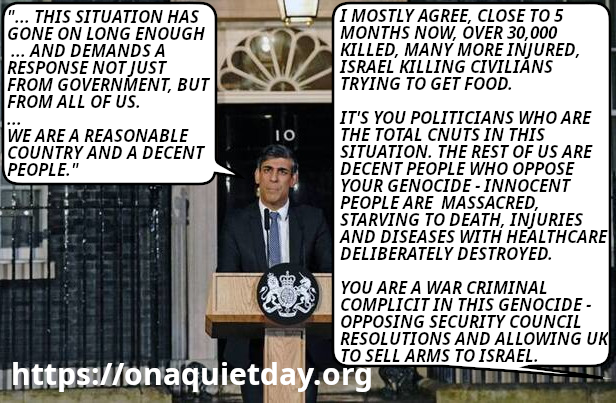
Response to Rishi Sunak’s extremism speech at Downing Street 1 March 2024. Second version of this image with text slightly altered.Zionist Keir Starmes is quoted “I support Zionism without qualification.” He’s asked whether that means that he supports Zionism under all circumstances, whatever Zionists do.