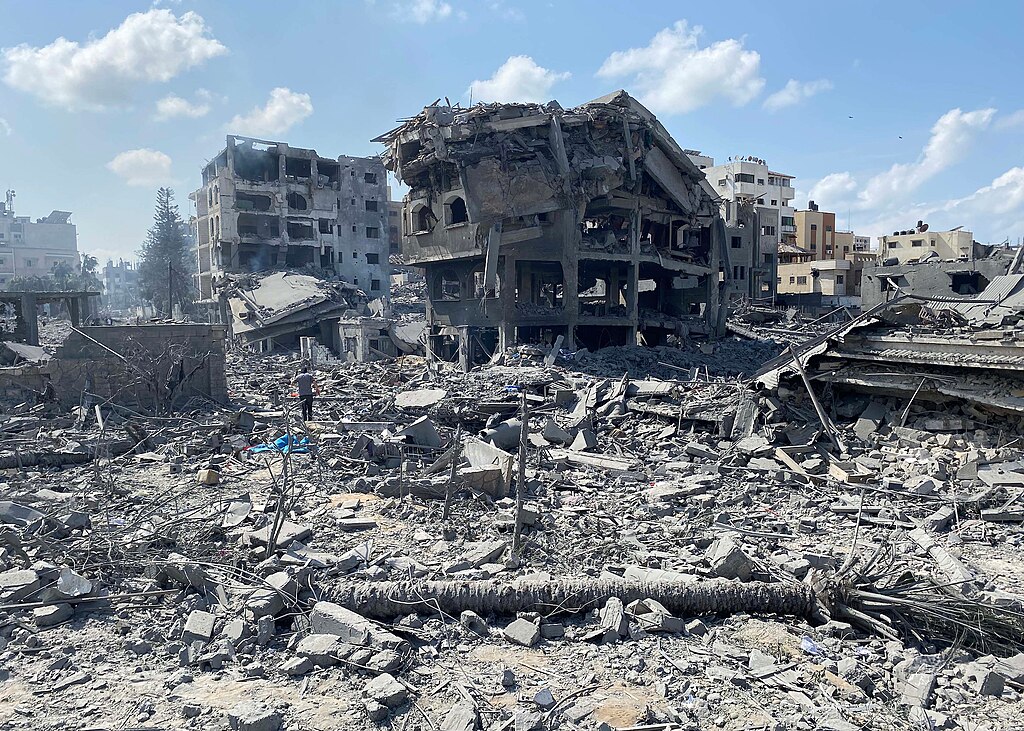
Palestinians inspect the damage following an Israeli airstrike on the El-Remal aera in Gaza City on October 9, 2023. Israel continued to battle Hamas fighters on October 10 and massed tens of thousands of troops and heavy armour around the Gaza Strip after vowing a massive blow over the Palestinian militants’ surprise attack. Photo by Naaman Omar apaimages. licensed under the Creative Commons Attribution-Share Alike 3.0 Unported license.
Britain is complicit in mass slaughter on a horrifying scale. But those campaigning for our votes pretend it’s not happening
…
This week alone, Israel has threatened “all out war” with Lebanon, while Hezbollah’s leader threatens a war “without rules or ceilings”, dangling the prospect of a far graver bloodbath than that unleashed by Israel’s genocidal rampage in Gaza. The spokesperson of the Israel Defense Forces has admitted that Hamas cannot be destroyed militarily: this amounts to a confession that the central war goal used to justify the slaughter of tens of thousands is unattainable. And the UN has released a report offering evidence as to how Israel’s bombing campaign in Gaza may have systematically violated the laws of war on protecting civilians and civilian infrastructure.
Remember: this is an onslaught that Britain’s government and opposition squarely backed at the start. Back in October, our prime minister promised “unequivocal” support for Israel for all time, while his inevitable successor, Keir Starmer, backed Israel’s right to cut off energy and water, though he later claimed he had been misinterpreted, and had never supported this. Neither political party will commit to ending arms sales, even though the chief prosecutor of the international criminal court – himself a British lawyer – has requested arrest warrants for both the Israeli prime minister, Benjamin Netanyahu, and his defence minister, Yoav Gallant, for alleged war crimes and crimes against humanity. This itself points to what should be a major domestic political scandal. Both party leaders should be scrutinised for having backed what became one of the great atrocities of our age, despite the bloodcurdling promises made by Israeli leaders from the start.
…
Given that this is a question of life and death on a colossal scale, our politicians should be forced to answer. Yet when our foreign secretary, David Cameron, was interrogated last week on the BBC Today programme, the interviewer spent the slot questioning him about trust and housebuilding. On Thursday night’s BBC Question Time leaders’ special, there was not a single question or answer on Gaza.
Of course, straight after 7/10, mainstream journalists were quick to promote the deployment of planes and personnel to support “our ally” in the region.
While the Sun splashed photos of British jets and frigates heading to the eastern Mediterranean with the headline “United We Stand”, the BBC basically reproduced a Ministry of Defence press release in its story, “UK to deploy Royal Navy ships to Middle East to ‘bolster security’.”
On 2 December, the Ministry of Defence released a short statement on UK military activity in the region, ostensibly to secure the release of (only) Israeli hostages.
The BBC, along with other news outlets, immediately ran a story repeating the MoD’s words verbatim (with a sprinkling of additional text from the Pentagon) as if these were to be innocent “surveillance flights” despite the fact that over 15,000 Palestinians had already been killed in brutal air strikes since 7/10.
This was followed by a flurry of highly bullish coverage of two further military interventions directly related to bolstering UK support for Israel – evidence of the “extensive defence and security cooperation” between the two countries that was embedded in the ‘Roadmap’ agreement signed in 2023 (and ignored by the media).
…
Censorship by omission
This lack of interest in the British government’s military links to Israel shouldn’t suggest, however, that there is nothing to investigate.
Indeed, Declassified UK has published multiple stories on the more opaque actions of the UK government that have been largely ignored by mainstream news including the deployment of a British spy team in Israel since 7/10, the dozens of flights by UK military aircraft to Israel in this period, the surveillance activities in support of Israel and the training of Israeli military personnel in the UK. Almost none of these have been followed up in broadcast bulletins and articles.
There is one area, however, in which the media do appear to have engaged with this topic: British arms sales to Israel that, according to the Campaign against Arms Trade, amount to £576 million since 2008.
That there were 2,648 stories mentioning “arms sales to Israel” and “UK” between 7 October and 19 June 2024 might suggest this is a major area of concern for journalists.
Not so fast. 85% of all stories appeared after 1 April when three UK citizens were among seven aid workers killed when Israeli jets attacked the food convoy they were managing.
For the 177 days between 7/10 and 1 April, the media (with the exception of the Scottish National, Guardian and BBC Parliament) showed little inclination to open up discussion on the issue.
Despite serious concerns that, through its exports of weapons to the Israeli military, the UK is complicit in ongoing war crimes, major news outlets only started to show an interest in the topic once British people, not Palestinians, were the story.
…
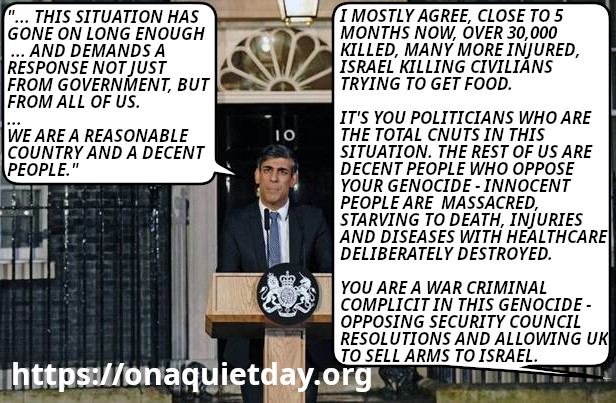
Response to Rishi Sunak’s extremism speech at Downing Street 1 March 2024. Second version of this image with text slightly altered.Zionist Keir Starmes is quoted “I support Zionism without qualification.” He’s asked whether that means that he supports Zionism under all circumstances, whatever Zionists do.
Britain tested nuclear weapons in the Pacific in the 1950s. (Photo: Yui Mok / Alamy)
The lavish spending would continue under Labour.
Britain spends a larger portion of its military budget on nuclear weapons than any other state, a major report published today reveals.
Rishi Sunak’s government is putting 12 per cent of defence expenditure – equivalent to £12,000 every minute – towards the UK’s arsenal of at least 225 warheads.
Sunak increased spending on nuclear weapons last year by 17 per cent to £6.5 billion – a greater increase than any other nuclear power except the US.
Over the last five years UK expenditure rose by a staggering 43 per cent.
The startling figures appear in new research by the International Campaign to Abolish Nuclear Weapons (ICAN), a widely respected group that was awarded the Nobel Peace Prize in 2017.
ICAN calculates that Britain is the world’s fourth highest spender on nuclear weapons after the US, China and Russia.
Nuclear Starmer
The group’s report comes at a time when the Labour leadership is championing nuclear weapons. The party’s manifesto states: “Our commitment to the UK’s nuclear deterrent is absolute.”
This spending commitment is in stark contrast to Keir Starmer’s extreme caution when it comes to investing in public services.
The party describes the “independent nuclear deterrent” as “the bedrock of Labour’s plan to keep Britain safe”.
However, it is far from independent. Regular flights from the US carry material that are essential ingredients of Britain’s Trident nuclear missile system.
A Mutual Defence Agreement (MDA) between Britain and the US enshrines Whitehall’s reliance on the Pentagon for essential technology.
The agreement, which is due to be renewed this year, is incorporated in US law. Yet it has no legal status in Britain and has never been the subject of a substantial debate or vote in parliament.
The Liberal Democrats’ policy is identical to those of the Conservatives and Labour, saying they will “maintain the UK’s nuclear deterrent with four submarines providing continuous at-sea deterrence”.
The Scottish National Party has a long record of being opposed to nuclear weapons, which it says are “wrong strategically, morally and financially.”
It adds that it supports long-term investment in the Trident submarine base in Faslane as a conventional military base.
The Green party says it would “dismantle Britain’s entire Trident nuclear deterrent and remove all foreign nuclear weapons from UK soil.”
A pro-Palestinian protester holds a sign during a national demonstration to mark the 76th anniversary of the Nakba on May 18, 2024 in London. (Photo: Mark Kerrison/In Pictures via Getty Images)
“As long as Israel is killing Palestinian civilians in apparent contravention of international law, the U.K. government has a responsibility to stop selling it arms.”
As government data showed the British government has approved more than 100 arms licenses for Israel since it began bombarding Gaza in October, the humanitarian group Oxfam on Thursday joined a legal case demanding the U.K. High Court intervene in the country’s continued weapons sales in the interest of protecting Palestinian civilians.
Oxfam said the court “has been presented with evidence that Israel is not complying with the legal obligations that apply during armed conflict.” Human rights experts have said for months that Israel is blocking crucial humanitarian aid and failing to take steps to protect civilians, as in its recent attacks on encampments in Rafah and at Nuseirat refugee camp, where at least 274 Palestinians were killed in the Israel Defense Forces’ operation to rescue four Israeli hostages.
Oxfam joined Palestinian human rights group Al-Haq and U.K.-based Global Legal Action Network (GLAN) in calling on the High Court to order the Secretary of State for Business and Trade to suspend all licenses of weapons and military equipment for Israel, and to stop granting new licenses.
At a Royal Courts of Justice hearing on Thursday, Oxfam was granted permission to act as an intervener and provide a witness statement outlining the conditions the group has seen in Gaza since October.
“Gaza is fast becoming completely uninhabitable,” said Halima Begum, chief executive of Oxfam Great Britain. “More than 37,000 people have been killed and a further 84,000 have been wounded, the majority children. At least 500,000 Palestinians in Gaza are facing famine and children are dying of starvation. As long as Israel is killing Palestinian civilians in apparent contravention of international law, the U.K. government has a responsibility to stop selling it arms.”
Begum called on the U.K. to use “all the diplomatic leverage it has to push for an immediate and lasting cease-fire.”
Oxfam joined the legal case days after the United Nations Security Council adopted a resolution endorsing a U.S.-backed cease-fire proposal. U.S. Secretary of State Antony Blinken on Thursday accused Hamas of holding up the cease-fire deal by proposing more amendments to the agreement, while Hamas said it had only proposed counter-revisions to changes made by Israeli officials.
Meanwhile, Israeli attacks continued in Rafah, Gaza City, and other parts of the enclave.
“Morally, the U.K. should not be fueling this onslaught by selling Israel more weapons,” said Begum. “It is vital that the bombardment of Gaza ends, so that Oxfam and our fellow humanitarian agencies can safely deliver life-saving aid to civilians on the scale that is so urgently required.”
The U.K. has licensed at least £489 million ($624 million) of military exports to Israel since 2015, and the country provides about 15% of the components of the F-35 stealth bomber aircraft being used by Israel in Gaza.
On Tuesday, after the government released new figures regarding U.K. arms sales to Israel, Begum said the British government is engaging in “a remarkable feat of intellectual compromise” as it claims to support peace efforts in Gaza “while facilitating the supply of even greater flows of weapons to one of the belligerents.”
“It is a comprehensive failure in the U.K.’s moral leadership and the values of humanity for which this country is still known on the global stage that the government has granted more than 100 new licenses for arms sales to Israel,” said Begum. “This has occurred in the unequivocal knowledge that tens of thousands of innocent Palestinian children and their parents are being killed by Israel’s prosecution of the war in Gaza.”
Tim Bierley, campaigner for Global Justice Now, noted that “it’s clear to most people that the U.K. must cut off the supply of arms” to Israel as it faces an International Criminal Court investigation into its actions in Gaza. A YouGov poll last month found 55% of Britons supported suspending arms sales to Israel for the duration of the fighting in Gaza, including 40% of Conservative voters and 74% of Labour Party supporters.
“Despite the breathtaking scale and brutality of Israel’s war crimes in Gaza, the U.K. has given the green light to huge shipments of weapons to the country, including components for military aircraft and guns,” said Bierley. “The leaders of many countries, including Canada, the Netherlands, and Spain, have taken steps to [halt arms sales], but the British government has opted instead for complicity in war crimes. We must not accept this as normal.”
The High Court is scheduled to hold a judicial review hearing about a potential intervention in arms sales in October.
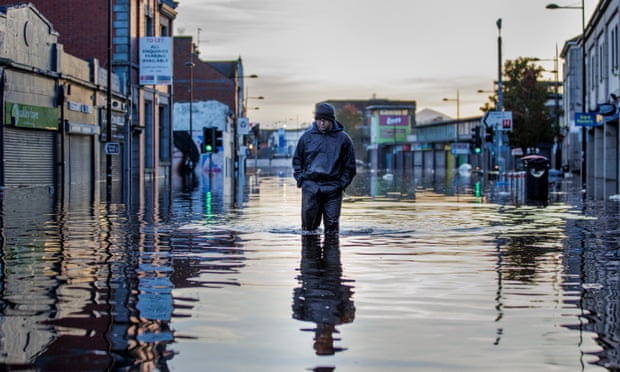
A man wades through flood water in Downpatrick, Northern Ireland, in November. Photograph: Liam McBurney/PA
Winter downpours also made 20% wetter and will occur every three years without urgent carbon cuts, experts warn
The seemingly “never-ending” rain last autumn and winter in the UK and Ireland was made 10 times more likely and 20% wetter by human-caused global heating, a study has found.
More than a dozen storms battered the region in quick succession between October and March, which was the second-wettest such period in nearly two centuries of records. The downpour led to severe floods, at least 20 deaths, severe damage to homes and infrastructure, power blackouts, travel cancellations, and heavy losses of crops and livestock.
The level of rain caused by the storms would have occurred just once in 50 years without the climate crisis, but is now expected every five years owing to 1.2C of global heating reached in recent years. If fossil fuel burning is not rapidly cut and the global temperature reaches 2C in the next decade or two, such severe wet weather would occur every three years on average, the analysis showed.
The experts behind the study warned that work to protect the populations of the UK and Ireland was still “sorely lacking” and poor and vulnerable people were hardest hit. For example, dehumidifiers provided to dry out flooded homes were not used by some because of high energy costs, while others could not afford to replace losses of frozen food after storms cut power supplies.
The analysis, conducted by climate scientists working as part of the World Weather Attribution group, compared how likely and how intense the wet winter was in today’s heated world with how likely it would have been in a world without high levels of carbon emissions. Warmer air can hold more water vapour and therefore produce more rain. Hundreds of “attribution studies” have shown how global heating is already supercharging extreme weather such as heatwaves, wildfires, droughts and storms across the world.
“The seemingly never-ending rainfall this autumn and winter across the UK and Ireland had notable impacts,” said Dr Mark McCarthy, a climate scientist at the UK Met Office and part of the WWA team. “In the future we can expect further increases – that’s why it is so important for us to adapt to our changing climate and become more resilient.”
Dr Sarah Kew, a researcher at the Royal Netherlands Meteorological Institute and also part of the WWA team, said: “The UK and Ireland face a wetter, damper and mouldier future due to climate change. Until the world reduces emissions to net zero, the climate will continue to warm, and rainfall in the UK and Ireland will continue to get heavier.”