Tag: United Nations

  • ‘Historic, But So, So Late’: Israel Added to UN’s Child-Killing ‘List of Shame’

    Spread the love

    Original article by BRETT WILKINS republished from Common Dreams under Creative Commons (CC BY-NC-ND 3.0). 
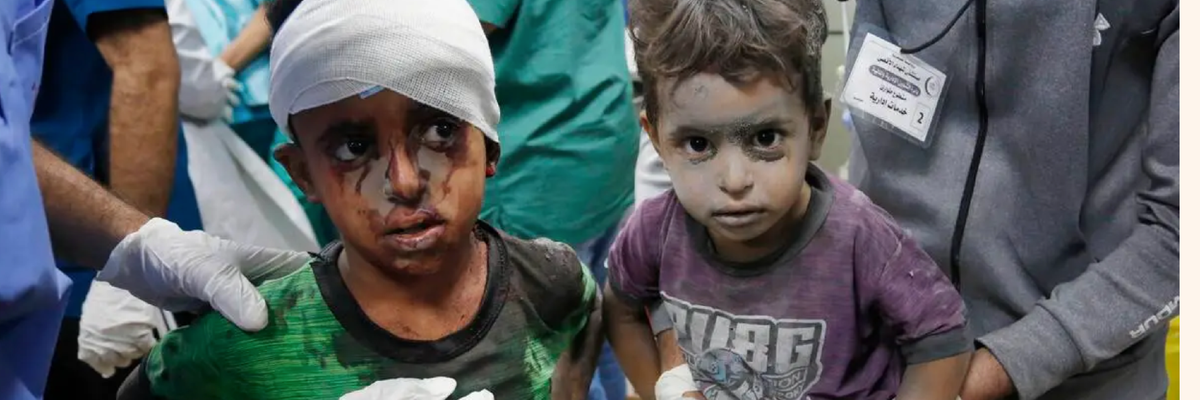
    Palestinian children injured in Israeli attacks on Al-Maghazi refugee camp are brought to al-Aqsa Martyrs Hospital in Deir Al-Balah, Gaza on November 5, 2023.  (Photo: Ashraf Amra/Anadolu Agency)

    “It took a genocide that killed 15,000 children and maimed and scarred thousands more but the U.N. has finally and rightly added Israel to its List of Shame,” said one Palestinian observer.

    United Nations Secretary-General António Guterres informed Israel on Friday that, for the first time, it is being added to the so-called “List of Shame” of countries that kill and injure children during wars and other armed conflicts, a decision that infuriated Israeli officials but was welcomed by human rights defenders as long overdue.

    The Secretary-General Office’s annual Children and Armed Conflict report—which is likely to be released publicly later this month—has included countries and militant groups such as Afghanistan, al-Qaeda, Boko Haram, Iraq, Islamic State, Myanmar, Russia, Somalia, Syria, and Yemen. This is believed to be the first time the list has included a nation hailed by Western governments as a democracy.

    “It took a genocide that killed 15,000 children and maimed and scarred thousands more but the U.N. has finally and rightly added Israel to its List of Shame,” Palestinian political analyst Nour Odeh said on social media. “Arms embargo NOW!”

    Meanwhile, Israeli Prime Minister Benjamin Netanyahu said that “the U.N. has put itself on the blacklist of history today when it joined the supporters of the Hamas murderers.”

    “The IDF is the most moral army in the world and no delusional decision by the U.N. will change that,” added the prime minister, who International Criminal Court Prosecutor Karim Khan is seeking to arrest along with Israeli Defense Minister Yoav Gallant for alleged crimes including extermination.

    This year’s 2024 List of Shame will also include Hamas, which led the October 7 attack that left more than 1,100 Israelis and others dead, including 38 children. Around 30 minors were also kidnapped by Hamas, all of whom are believed to have been freed. Khan wants to arrest three leaders of Hamas, whose members are accused of extermination, rape, and other crimes.

    In retaliation, Israel launched an assault and siege on theGaza Strip—now on its 244th day—killing more than 36,700 Palestinians including at least 15,000 minors, according to Palestinian and international agencies. Some children have allegedly been sexually abused and executed by Israeli troops.

    More children were killed in Gaza in the first four months of the war than in four years of conflict worldwide, in what Philippe Lazzarini, who heads the U.N. agency for Palestinian refugees, called a “war on children… their childhood, and their future.”

    There are also tens of thousands of children among the more than 83,000 Palestinians wounded by Israeli bombs and bullets in Gaza. Hundreds of thousands of children have been forcibly displaced by Israel’s bombardment and invasion, but there’s no safe place for them to go.

    The Israeli blockade of Gaza and obliteration of its healthcare infrastructure have exacerbated what the U.N.’s top food official has called a “full-blown famine” in the north and widespread starvation throughout the strip. Dozens of children have starved to death.

    Israel’s conduct in the war is under investigation by the International Court of Justice in The Hague in a genocide case brought by South Africa and supported by more than 30 other nations and regional blocs.

    The U.N. Children’s Fund (UNICEF) calls Gaza the most dangerous place in the world for children. The perils are not only physical; the annihilation of Gaza has also wrought tremendous psychological damage upon its children, many of whom have survived multiple Israeli campaigns.

    According to UNICEF, more than 17,000 Gazan children are now orphans, with some having lost their entire families to Israeli attacks. International medical workers have coined a new acronym for these children: WCNSF, or, wounded child, no surviving family.

    Between 2000 and the start of the Gaza war, Israeli forces killed more than 2,300 children throughout Palestineaccording to Defense for Children International-Palestine. Prior to the current war, the highest number of Palestinian children killed in one year was 546 in 2014, when Israel carried out its Operation Protective Edge invasion of Gaza.

    Despite all this killing, Israel was perennially given a pass from the List of Shame.

    “Including Israel in the List of Shame is an urgent necessity to put an end to its severe and horrific violations and to protect the rights of Palestinian children. It is also crucial for maintaining the integrity and credibility of U.N. mechanisms, which are at risk of erosion due to double standards,” said Radhya Al-Mutawakel, who heads the Yemen-based group Mwatana for Human Rights.

    Al-Mutawakel asserted that blacklisting Israel sends “a clear message that the U.N. stands firmly for the protection of children’s rights worldwide and will not tolerate violations against them” and also conveys “that the U.N. deals uniformly with all parties involved in grave violations against children, regardless of the perpetrators’ identities or the children’s backgrounds.”

    Numerous Palestine advocates said Israel’s inclusion on the list of shame underscores the urgency of halting shipments of weapons used to kill Palestinian children.

    “Israel is a terrorist nation,” said British union leader Howard Beckett. “Arms embargo. Sanctions. Hague.”

    Original article by BRETT WILKINS republished from Common Dreams under Creative Commons (CC BY-NC-ND 3.0). 
  • Morning Star: Fight the far right to commemorate the D-Day heroes

    Spread the love

    Republished from https://morningstaronline.co.uk/article/editorial-fight-far-right-commemorate-d-day-heroes

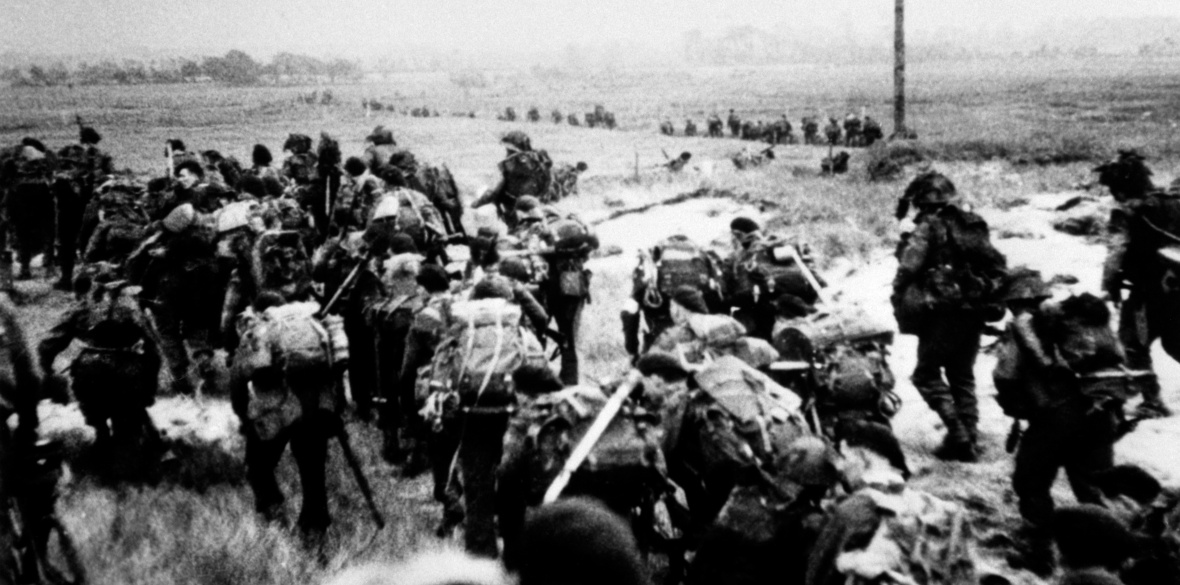
    Royal Marine commandos moving off the Normandy Beaches during the advance inland from “Sword” beach, June 6, 1944

    WITH the Tories and Labour exchanging blame over Channel crossings, we mark 80 years since a Channel crossing of a different kind.

    On June 6 1944 British, US and allied troops crossed the Channel to open a second front against the Nazis in Europe, something the Soviet Union, which had borne the brunt of the war against fascism for the previous three years, had long urged.

    Veterans are arriving in Normandy for commemorations of this heroic chapter in Europe’s liberation. Modern hostilities overshadow celebration of the anti-Nazi alliance of the 1940s, with the US and Britain criticising France for inviting Russia because of its invasion of Ukraine, though they themselves have never been excluded from World War II memorials while laying waste to countries from Vietnam in the cold war to Afghanistan, Iraq and Libya more recently.

    These diplomatic divisions raise a question we should be asking our own politicians. Have you any right to claim the inheritance of anti-fascist victory if you are dismantling its achievements?

    The world war against fascism was the crucible of international institutions as we know them today. The United Nations was established in a joint declaration by Britain, the United States, the Soviet Union and China on January 1 1942: it formalised the alliance against the Axis powers Germany, Italy and Japan, and a condition of membership was to declare war against Nazi Germany and its allies.

    The foundation of the UN and new treaties like the Geneva Conventions of 1949 (on the conduct of war) and 1951 (on the treatment of refugees) expressed hope that a more civilised world order would stop any future descent into Nazi barbarism.

    These agreements are not perfect, and powerful countries have often ignored them. But their existence is a legacy of the sacrifice made by those who gave their lives to smash fascism on D-Day, or at the battles of Stalingrad or Berlin, or among the heroic resistance movements that sprang up across Nazi-occupied Europe.

    Politicians talk now as if the rules are outdated: the refugee conventions were drawn up by people who couldn’t conceive of the scale of “irregular” migration today. It isn’t true: World War II and its aftermath saw huge population displacement, the uprooting of millions of people. The Refugee Convention of 1951 set out universal obligations to refugees because of these horrific experiences.

    Those obligations are ones governments across Europe, including ours, are trying to erase. The end of EU search-and-rescue operations, the active persecution of civil rescue crews by states like Italy, have fatally undermined the binding responsibility to aid anyone in distress at sea. The odious Nigel Farage clearly approves, having insulted brave volunteer lifeboat crews by calling the Royal National Lifeboat Institution a “migrant taxi service” for presuming to save people from drowning.

    Farage has never yet been elected, but his ability to call the tune at Westminster is as great as ever if the first leaders’ debate is anything to go by: with Labour’s Keir Starmer calling Rishi Sunak, the PM of the Rwanda deportations scheme and the Bibby Stockholm prison barge, “the most liberal prime minister we have ever had on immigration.”

    This is gutter politics, and a betrayal of what the D-Day heroes fought for. But so, at home, is the systematic destruction of the NHS and welfare state built after defeating fascism, fruits of a victorious people’s war and a recognition that fascism had emerged from a Europe wracked by poverty and unemployment.

    It is no coincidence that today, with living standards falling, public services failing and the brazen theft of our wealth by an ever smaller corporate elite, the far-right politics of grievance and hate are on the march across the continent.

    The real commemoration of D-Day must be to mobilise against them. For peace and socialism, against fascism and war.

    Republished from https://morningstaronline.co.uk/article/editorial-fight-far-right-commemorate-d-day-heroes

  • UN Warns Israeli Ground Invasion Rafah Will Lead to ‘Slaughter of Civilians’

    Spread the love

    Original article by BRETT WILKINS republished from Common Dreams under Creative Commons (CC BY-NC-ND 3.0). 
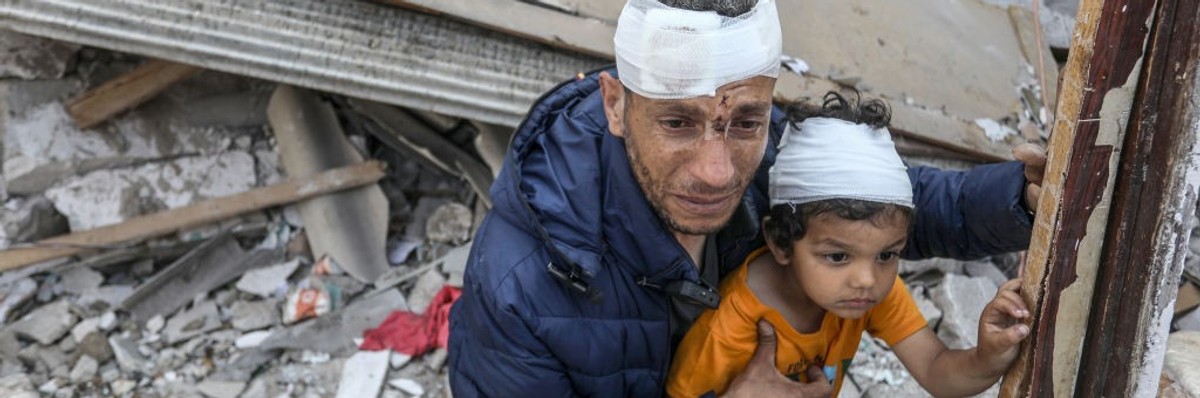
    Palestinians wounded in Israeli attacks on Rafah attempt to collect belongings from bombed-out homes on May 1, 2024 in the southern Gaza city. 
    (Photo: Abed Rahim Khatib/Anadolu via Getty Images)

    “The simplest truth is that a ground operation in Rafah will be nothing short of a tragedy beyond words,” said a top U.N. aid official. “No humanitarian plan can counter that.”

    The United Nations’ humanitarian aid agency warned Friday that an Israeli ground invasion of Rafah would put hundreds of thousands of Palestinians “at imminent risk of death.”

    “Any ground operation would mean more suffering and death” for the approximately 1.5 million Palestinians—including around 1.2 million people forcibly displaced from other areas of the embattled enclave—sheltering in Gaza’s southernmost city, U.N. Office for the Coordination of Humanitarian Affairs (OCHA) spokesperson Jens Laerke told reporters in Geneva on Friday.

    “The hundreds of thousands of people who are there would be at imminent risk of death if there is an assault,” he added, warning of not only “a slaughter of civilians, but also at the same time an incredible blow to the humanitarian operation in the entire strip, because it is run primarily out of Rafah.”

    According to PoliticoIsrael has shared with the U.S. government its plan to move the civilian population out of Rafah ahead of a looming ground assault the Wall Street Journal reported earlier on Friday could begin next week.

    Conditions in Rafah are already dire. The city—which was home to fewer than 300,000 people before the war—is now one of the most densely populated places on the planet. Hundreds of thousands of refugees are crowded together in tents and other makeshift shelters. Water and other necessities are in desperately short supply. According to James Elder, the global spokesperson for the United Nations Children’s Fund (UNICEF), there is approximately one toilet for every 850 people in Rafah and one shower for every 3,500 people.

    “Try to imagine, as a teenage girl, or elderly man, or pregnant woman, queueing for an entire day just to have a shower,” Elder wrote for The Guardian this week.

    There are nearly 600,000 children in Rafah, nearly all of whom are “injured, sick, malnourished, traumatized, or living with disabilities,” UNICEF executive director Catherine Russell said Wednesday.

    Dr. Rik Peeperkorn, who represents the U.N. World Health Organization in the illegally occupied Palestinian territories, on Friday called contingency response plans for a Rafah invasion a “Band-Aid” solution.

    “It will absolutely not prevent the expected substantial additional mortality and morbidity caused by a military operation,” he stressed.

    Israel’s 210-day assault on Gaza in retaliation for the October 7 attacks has already killed at least 34,622 Palestinians—a large majority of them civilian men, women, and children—while wounding more than 77,800 others, according to Palestinian and international officials. At least 11,000 other Gazans are missing and presumed dead and buried beneath the rubble of the more than 370,000 homes and other buildings destroyed or damaged during the war.

    That means around 5% of Gazans have been killed or wounded during Israel’s onslaught, the U.N. Development Program and the U.N. Economic Commission for Western Asia said in a report published Wednesday. The agencies called this an “unprecedented” level of casualties in modern warfare and said it would take until at least 2040 to restore all the homes destroyed or damaged during the war.

    As many as 90% of Gaza’s 2.3 million people have also been forcibly displaced by Israeli forces, who despite a January International Court of Justice (ICJ) order to prevent genocidal acts continue to block adequate humanitarian aid from reaching the starving people of Gaza.

    Despite pleas and protestations from world leaders including U.S. President Joe Biden, Israeli Prime Minister Benjamin Netanyahu has vowed to invade Rafah to “eliminate Hamas’ battalions there.”

    Earlier this week, far-right Israeli Finance Minister Bezalel Smotrich called for the “total annihilation” of Gaza, specifically mentioning Rafah. The South Africa-led case against Israel at the ICJ has centered similar statements of intent to destroy Palestinians—which are key to proving the crime of genocide—made by Israeli officials since October.

    Meanwhile, Israeli forces have ramped up aerial attacks on Rafah in what is likely preparation for a ground invasion. Palestinian and international media reported Friday that an overnight Israeli airstrike on a home killed at least eight people, mostly children.

    “After almost seven months of brutal hostilities that have killed tens of thousands of people and maimed tens of thousands more, Gaza is bracing for even more suffering and misery,” U.N. Under-Secretary-General for Humanitarian Affairs and Emergency Relief Coordinator Martin Griffiths said earlier this week.

    “The world has been appealing to the Israeli authorities for weeks to spare Rafah, but a ground operation there is on the immediate horizon,” he continued. “For the hundreds of thousands of people who have fled to Gaza’s southernmost point to escape disease, famine, mass graves, and direct fighting, a ground invasion would spell even more trauma and death.”

    “The simplest truth is that a ground operation in Rafah will be nothing short of a tragedy beyond words,” Griffiths added. “No humanitarian plan can counter that. The rest is detail.”

    U.S. officials have also privately sounded the alarm over the likely consequences of an Israeli invasion of Rafah.

    In March, according to a leaked cable obtained by The Intercept, members of the Bureau for Humanitarian Assistance at the U.S. Agency for International Development warned the State Department that a Rafah invasion “could result in catastrophic humanitarian consequences, including mass civilian casualties, extensive population displacement, and the collapse of the existing humanitarian response.”

    Original article by BRETT WILKINS republished from Common Dreams under Creative Commons (CC BY-NC-ND 3.0). 
  • Gaza war: ‘no evidence’ of Hamas infiltration of UN aid agency, says report – but US and UK dither on funding while famine takes hold

    Spread the love
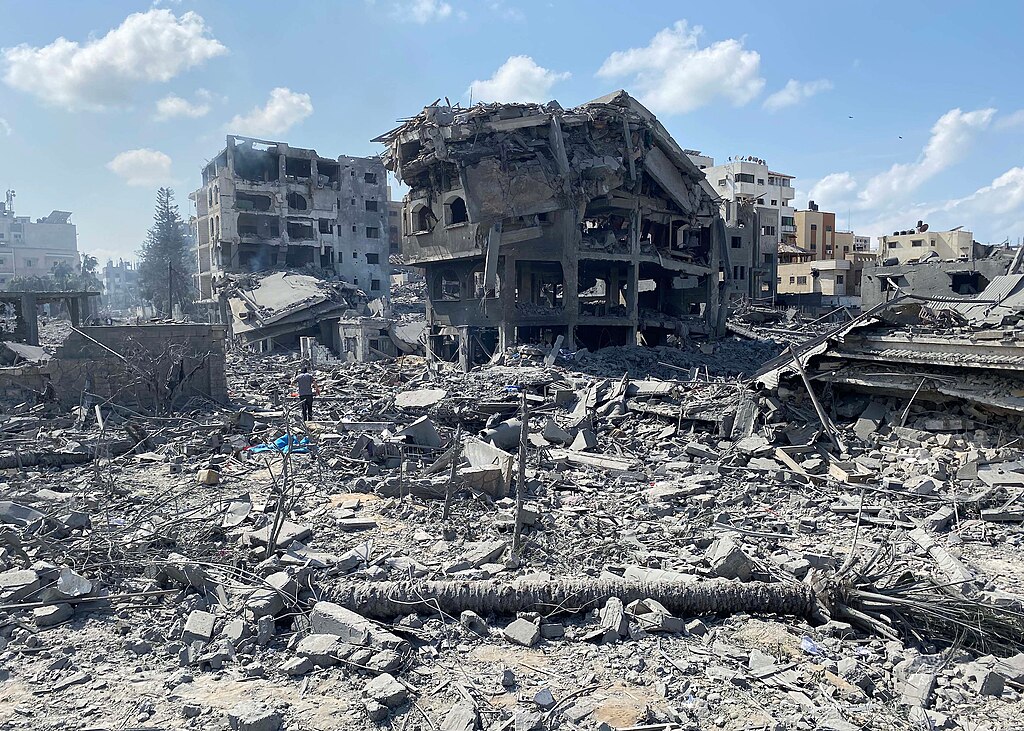
    Palestinians inspect the damage following an Israeli airstrike on the El-Remal aera in Gaza City on October 9, 2023. Israel continued to battle Hamas fighters on October 10 and massed tens of thousands of troops and heavy armour around the Gaza Strip after vowing a massive blow over the Palestinian militants' surprise attack. Photo by Naaman Omar apaimages. licensed under the Creative Commons Attribution-Share Alike 3.0 Unported license.
    Palestinians inspect the damage following an Israeli airstrike on the El-Remal aera in Gaza City on October 9, 2023. Israel continued to battle Hamas fighters on October 10 and massed tens of thousands of troops and heavy armour around the Gaza Strip after vowing a massive blow over the Palestinian militants’ surprise attack. Photo by Naaman Omar apaimages. licensed under the Creative Commons Attribution-Share Alike 3.0 Unported license.

    Anne Irfan, UCL

    Germany has become the latest country to resume its funding to Unrwa, the United Nations agency that provides essential relief services to nearly 6 million Palestinian refugees. The decision came after an independent review found no evidence to support Israel’s claim that the agency has been infiltrated by Hamas.

    Germany is the agency’s second-biggest funder – and the move is especially striking in view of its extremely close political alignment with Israel, which is now coming under increasing strain.

    All eyes are now on the US, the agency’s largest supporter, to see if it will reinstate the US$350 million (£280 million) it typically provides each year. Meanwhile in the UK, MPs have written to foreign minister David Cameron, demanding that funding is restored “without delay”.

    Reaction from the Israeli government has been hostile. In a statement, Israel’s foreign ministry spokesman said that “this is not what a true and comprehensive investigation looks like”, adding “it is impossible to say where Unrwa ends and Hamas begins”. The Israeli government did not provide any further detail or evidence for this claim.

    Israel alleged in January that 12 of Unrwa’s 13,000 employees in Gaza had participated in the October 7 attacks. Shortly afterwards, the government went on to claim that hundreds of Unrwa employees are members of Hamas or Islamic Jihad, in breach of the UN’s neutrality principles.

    In response, Unrwa commissioner-general Philippe Lazzarini immediately fired nine of the accused 12 (of the other three, two are dead and one is missing). Meanwhile, the UN secretary-general, António Guterres, ordered an independent review into Unrwa’s neutrality practices.

    That review was chaired by former French foreign minister Catherine Colonna and carried out by staff of Nordic research bodies – the Swedish-based Raoul Wallenberg Institute of Human Rights and Humanitarian Law, the Norwegian Chr. Michelsen Institute and the Danish Institute for Human Rights.

    The report makes good reading for Unrwa. Colonna and her team described its work as an “indispensable lifeline” for Palestinians and noted the agency’s robust neutrality framework.

    Crucially, they also found that Israel has provided no evidence for its allegations that a significant number of Unrwa employees belong to militant groups.

    Donor response

    In response to the original Israeli allegations, 16 governments paused or suspended funding to the agency. This threw Unrwa’s work into an escalating crisis. With the agency having already suffered from a serious financial deficit for many years, management warned that it could run out of money entirely in a matter of weeks.

    The withdrawal of core funds heightened the humanitarian catastrophe in Gaza, where Unrwa provides essential services to 87% of the population, including food assistance to 1 million Palestinians. The UN special rapporteur on the right to food advised that the defunding made famine in Gaza inevitable.

    Not long afterwards, a group of aid organisations confirmed that human-made famine has now taken hold.

    With the Colonna report finding no evidence to support the allegations, serious questions are now raised about the speed with which so many states withdrew their funding. Many governments had already reinstated funding for Unrwa after Colonna’s interim report was released last month. These included Australia, Japan, Finland, Iceland,
    Sweden and Canada.

    Since the final report’s publication, EU humanitarian chief Janez Lenarcic has called on others to follow suit. But there are so far no signs that the US – Unrwa’s biggest donor for decades – will.

    Congress recently passed a budget banning any financing of Unrwa for the next 12 months. This means there is little possibility of a policy reversal, even if the Biden administration was amenable to it. By the time that budget expires in March 2025, the next US presidential election may have returned the White House to Trump – who completely defunded the agency during his previous presidency.

    The UK government has also so far resisted calls to reinstate funding to Unrwa, meaning there may be a limit to the Colonna report’s impact on this front.

    Israel’s stance

    The accusations levelled against Unrwa in January follow years of Israeli attacks on the agency. The prime minister, Benjamin Netanyahu, first called for Unrwa to be disbanded back in 2017 and has repeated his demand regularly since then.

    Observing this, several observers, including Omar Shakir, the Israel-Palestine director at Human Rights Watch, have concluded that the Israeli discourse on Unrwa is really driven by the political objective of undermining Palestinian refugee rights.

    They may now point to further evidence of this in the Colonna report, which notes that although Unrwa has provided Israel with its staff lists annually since 2011, the government had never previously raised any concerns.

    The report also throws further doubt on Netanyahu’s post-war plan for Gaza, which proposes that Unrwa be shut down and replaced by other international aid groups. It is unclear how this would work in practice, as Israel has provided no specifics.

    What’s more, Colonna and her team found that Unrwa actually has “a more developed approach to neutrality than other similar UN or NGO entities” – raising questions about whether neutrality is really the issue here.

    Amid the political discussions, it is crucial not to lose sight of what is at stake. A man-made famine is threatening lives across the Gaza Strip. More than 2 million Palestinians are struggling to survive after Israeli attacks have killed more than 34,000 people over the past six months.

    With Unrwa providing a critical lifeline, any decision about its funding has serious repercussions – with the most vulnerable people in Gaza paying the ultimate price.The Conversation

    Anne Irfan, Lecturer in Interdisciplinary Race, Gender and Postcolonial Studies, UCL

    This article is republished from The Conversation under a Creative Commons license. Read the original article.

  • ‘Progress Almost Invisible’: World Set to Produce 220 Million Tonnes of Plastic Waste

    Spread the love

    Original article by JAKE JOHNSON republished from Common Dreams under Creative Commons (CC BY-NC-ND 3.0). 

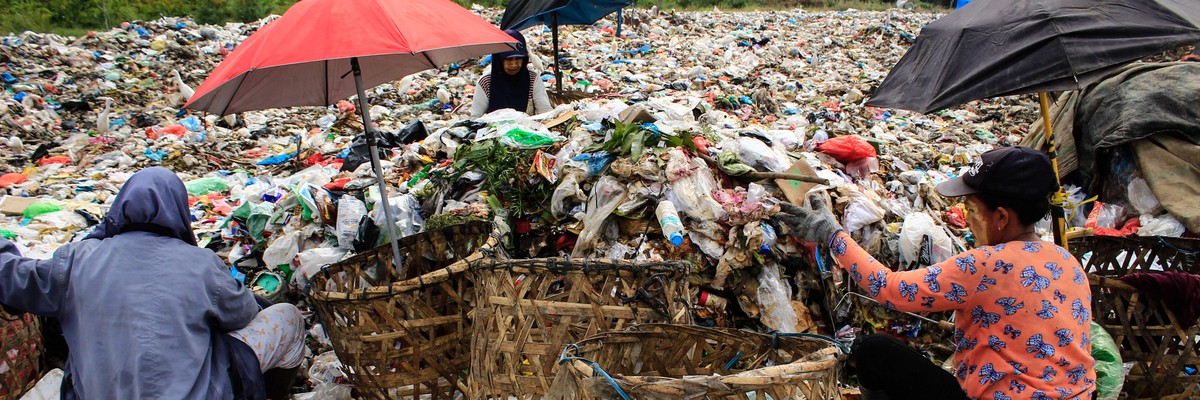
    People collect plastic waste at a landfill in North Sumatra, Indonesia on March 27, 2024.  (Photo: Kartik Byma/AFP via Getty Images)

    “The question for every government now is this—will you negotiate a treaty to protect the health of your people; or will you negotiate a treaty to protect the profits of the fossil fuel industry?”

    A report released Thursday estimates that countries worldwide are on pace to generate 220 million tonnes of total plastic waste this year, a finding that comes as governments are set to convene in Ottawa, Canada later this month to hash out a binding global treaty to limit the toxic pollution that is inundating waterways and communities across the planet.

    The new report from EA – Earth Action (EA) projects that Plastic Overshoot Day—the point at which the amount of plastic waste produced exceeds the capacity of global management systems—will arrive on September 5 this year. Over a third of the total plastic waste created this year will end up in nature, according to the analysis.

    On average, each person globally contributes 28 kilograms of plastic pollution per year. Previous research has shown that just 20 companies are responsible for more than half of the world’s total single-use plastic waste.

    “The findings are unequivocal; improvements in waste management capacity are outpaced by rising plastic production, making progress almost invisible,” EA co-CEO Sarah Perreard said in a statement Thursday, criticizing the “assumption that recycling and waste management capacity will solve the plastics crisis.”

    That assumption has been peddled for decades by the fossil fuel industry, which has a major interest in thwarting attempts to curb the production, use, and waste of plastics. Nearly all plastic is made from chemicals sourced from fossil fuels.

    Sian Sutherland, co-founder of A Plastic Planet, said the new report underscores that “plastic pollution has set humanity on the road to ecological and humanitarian disaster.”

    “We have a narrow window of opportunity this year to create a global plastics treaty that will protect not only our ocean, our air, our soil but our own children,” said Sutherland. “The question for every government now is this—will you negotiate a treaty to protect the health of your people; or will you negotiate a treaty to protect the profits of the fossil fuel industry? Viable solutions are already available at scale, giving us materials and systems that work in harmony with nature, not against it.”

    “Close to 50% of the world’s population currently lives in areas where waste generated has already exceeded the capacity to manage it.”

    Late last year, the third round of U.N. plastics treaty talks ended without a breakthrough as major oil-producing countries such as Saudi Arabia obstructed the proceedings, the fossil fuel industry worked to sabotage the negotiations, and the U.S. declined to forcefully push for a global pact that meaningfully curtails plastics production.

    The U.S. is among the world’s leading generators of plastic waste, producing nearly 100 kilograms per capita each year. The U.S. and other rich nations also export tremendous amounts of plastic waste around the world, undercutting efforts to tackle the pollution crisis.

    A Greenpeace International survey released earlier this month found that two-thirds of the U.S. public wants a global plastics treaty that bans single-use plastic packaging. A separate poll commissioned by WWF and the Plastic Free Foundation showed that 88% of global citizens support banning “unnecessary single-use plastic products” such as shopping bags.

    In an op-ed for Euronews Green on Thursday, Perreard of EA wrote that “whilst policy has been mooted, schemes devised, and initiatives launched, plastic has continued to rise, and our planet and its people have sat under an ever-darkening cloud of pollution that showers its toxic consequences upon us.”

    “Close to 50% of the world’s population currently lives in areas where waste generated has already exceeded the capacity to manage it, with the figure projected to rise to 66% by 5 September,” Perreard noted. “With the fourth round of negotiations in Ottawa at the end of this month, we can no longer ignore the facts, we can no longer afford to resist the change that should be set in motion through the treaty.”

    Original article by JAKE JOHNSON republished from Common Dreams under Creative Commons (CC BY-NC-ND 3.0).