UN Puts Out ‘Truly Damning Report Card’ for Climate Action Before Global Summits

Spread the love
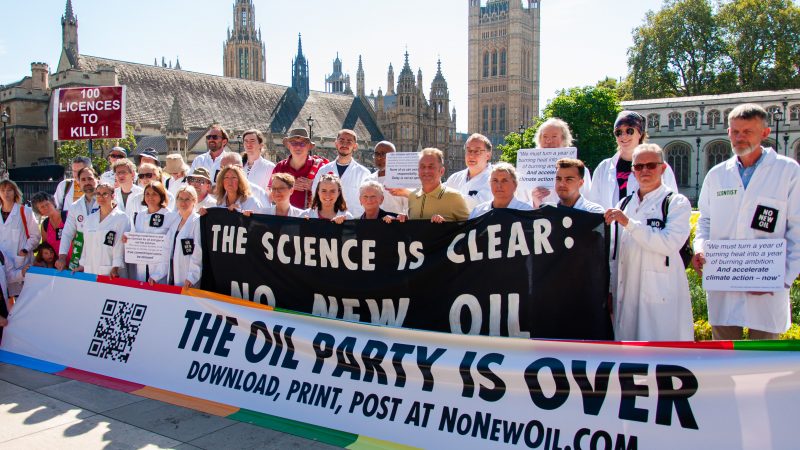
Scientists protest at UK Parliament 5 September 2023.

Original article by JESSICA CORBETT republished from Common Dreams under Creative Commons (CC BY-NC-ND 3.0). 

“This report is a wake-up call to the injustice of the climate crisis and a pivotal opportunity to correct course,” said one expert.

“The United Nations’ polite prose glosses over what is a truly damning report card for global climate efforts. Carbon emissions? Still climbing. Rich countries’ finance commitments? Delinquent. Adaptation support? Lagging woefully behind.”

That’s how Ani Dasgupta, president and CEO of the World Resources Institute, began his response to a “global stocktake” report released Friday by the U.N. Framework Convention on Climate Change (UNFCCC) ahead of two global summits.

“This report is a wake-up call to the injustice of the climate crisis and a pivotal opportunity to correct course,” Dasgupta continued. “We already knew the world is failing to meet its climate goals, but leaders now have a concrete blueprint underpinned by a mountain of evidence for how to get the job done.”

“There are a few bright spots worth celebrating,” he noted. “But overall, the report finds there are more gaps than progress—gaps that can only be erased by transformational change across systems like energy, food, land, and transport. The future of our planet depends on whether national leaders use this stark assessment as a catalyst for bold systems transformation.”

“This report makes clear that President Biden is squandering precious time every second he fails to take bold action on fossil fuels.”

The UNFCCC report comes nearly eight years after countries finalized the Paris climate agreement, which aims to keep global temperature rise this century below 2°C, relative to preindustrial levels, with a more ambitious target of 1.5°C.

“The global stocktake was designed under the Paris agreement to assess our global response to the climate crisis and chart a better way forward,” the UNFCCC explained Friday. “The global stocktake is held every five years and is intended to inform the next round of nationally determined contributions to be put forward by 2025.”

Data collection began in 2021, ultimately resulting in more than 170,000 pages of written submissions and over 252 hours of meetings and discussions. The new synthesis report summarizes 17 key technical findings from the discussions.

“I urge governments to carefully study the findings of the report and ultimately understand what it means for them and the ambitious action they must take next,” said U.N. Climate Change Executive Secretary Simon Stiell. “It’s the same for businesses, communities, and other key stakeholders. While the catalytic role of the Paris agreement and the multilateral process will remain vital in the coming years, the global stocktake is a critical moment for greater ambition and accelerating action.”

As University College London professor of climatology Mark Maslin explained, the report “makes it clear that the Paris agreement was a game-changer” but also countries’ greenhouse gas (GHG) emission reduction pledges are not in line with the 1.5°C target.

“The U.N. estimates that… we need to reduce global GHG emissions by 43% by 2030 and further by 60% by 2035 compared to 2019 levels and reach net-zero [carbon dioxide] emissions by 2050 globally,” Maslin summarized. “This is a huge ask given that greenhouse gas emissions were at their highest level ever in 2022.”

“All the technology exists to undergo the net-zero transformation but the huge increases in renewables, [electric vehicles], and batteries [have] to be even more rapid to make the huge cuts suggested by the U.N.—estimates are we need everything to happen five times faster,” he added.

The UNFCCC publication was released in preparation for the U.N. Climate Change Conference (COP28)—scheduled for November and December in Dubai, United Arab Emirates—where the first global stocktake will conclude.

“This global stocktake report provides clear direction on how we can meet the expectations of the Paris agreement by taking decisive action in this critical decade,” said COP28 President-Designate Sultan Al Jaber—whose selection for the summit post is controversial because he also heads the UAE’s Abu Dhabi National Oil Company. “We must urgently disrupt business as usual and unite like never before to move from ambition to action and from rhetoric to real results.”

The report also comes just ahead of U.N. Secretary-General António Guterres’ Climate Ambition Summit scheduled to begin on September 20 in New York City. In response, activists have planned the March to End Fossil Fuels on September 17.

Organizers of the NYC march are calling on U.S. President Joe Biden to stop federal approvals for new fossil fuel projects and repeal permits for “climate bombs” like the Willow project and the Mountain Valley Pipeline; phase out oil and gas drilling on public lands and waters; declare a climate emergency; and provide a just transition.

Advocacy groups supporting the march issued fresh demands for action on Friday in response to the UNFCCC publication.

“This report makes clear that President Biden is squandering precious time every second he fails to take bold action on fossil fuels,” said the Center for Biological Diversity’s Jean Su, who previously authored a document detailing how an emergency declaration would empower the administration to tackle the climate crisis. “Every day we’re seeing and feeling the harms of fossil-fueled climate change from extreme heat to deadly wildfires and devastating floods.”

“As leader of the world’s largest oil and gas producer, Biden has more power than anyone to stop expanding the fossil fuels driving this deadly crisis,” Su added. “Ahead of the U.N.’s Climate Ambition Summit, thousands of people will be in the streets of New York on September 17 for the March to End Fossil Fuels. This is the perfect opportunity for Biden to declare a climate emergency, use all his executive powers to phase out fossil fuels, and finally secure a legacy as a climate leader.”

“We need the biggest players to use their power to avert climate chaos, and to flex their muscle to protect human life rather than protecting corporate polluters.”

Greenpeace International policy coordinator Kaisa Kosonen on Friday called out governments across the globe, declaring that “our house is burning down and the people with the power to save us are still sipping coffee pretending it’s not happening.”

“No government can claim they didn’t know how to fix the climate problem,” she said. “They’ve been thrown a lifesaver again and again by scientists, and now we have this report. What the world is waiting for is action; leadership. We need the biggest players to use their power to avert climate chaos, and to flex their muscle to protect human life rather than protecting corporate polluters.”

Looking toward COP28, Kosonen argued that “at this year’s U.N. climate summit, governments must agree to end the use of oil, gas, and coal in a fast and fair way and make the polluters pay. Leaders can no longer smile and claim they support the Paris agreement and its 1.5°C warming limit, if they fail to give fossil fuels an end date and continue their expansion.”

“The solutions are ready—renewables are now the cheapest power source—but we’ve got to push the fossil fuel industry out of the way,” she stressed. “Fossil fuel corporations are holding us hostage, but their time’s up.”

The UNFCCC report and resulting calls for action follow a series of scientific findings throughout the week that also generated demands for a swift end to fossil fuels, including that Antarctica is warming more quickly than models project, this summer is the hottest on record, and last year greenhouse gas concentrations, global sea level, and ocean heat content all hit record highs.

Original article by JESSICA CORBETT republished from Common Dreams under Creative Commons (CC BY-NC-ND 3.0). 

Continue ReadingUN Puts Out ‘Truly Damning Report Card’ for Climate Action Before Global Summits

Illegal migration bill to become law: what you need to know

Spread the love

Avery Anapol, The Conversation
The UK government has succeeded in passing its illegal migration bill. After a series of late-night votes and months of controversy, the bill is now set to receive royal assent and become the Illegal Migration Act 2023. The following round-up will give you the key details of the bill and the analysis of the academic experts who have written about it for The Conversation.

The illegal migration bill is the central pillar of Rishi Sunak’s plan to stop small boat crossings, one of his five promises as prime minister. On its journey to becoming law, the bill faced opposition from the House of Lords, Conservative backbenchers in the House of Commons, activists and organisations who support refugees in the UK, and the United Nations.

A key facet of the bill – the Rwanda migration partnership – remains in legal limbo. The Court of Appeal ruled that Rwanda would not be able to fairly and accurately assess refugees’ asylum claims if they were sent there from the UK, and that therefore the plan was unlawful. The government will appeal this decision at the Supreme Court.

But regardless of whether the appeal is successful, the act sets the stage for future migration partnerships, where asylum seekers who enter the UK irregularly (such as by small boat) may be sent to another country the government deems “safe”.

This act is the second major immigration law passed in the last 15 months. The Nationality and Borders Act, enacted in April 2022, was the Boris Johnson government’s plan to fix a “broken” asylum system. But after it failed to have any discernible impact on the number of people making the dangerous journey across the Channel in small boats, the government introduced the illegal migration bill.

Erica Consterdine, an immigration policy expert at Lancaster University, has explained the difference between the two pieces of legislation for us. She describes the new law as “the most extreme piece of immigration legislation to date”. It will effectively ban asylum seeking in the UK, by requiring the home secretary to detain and deport anyone who enters the UK illegally (most asylum seekers), before their cases can be considered.

This would include potential victims of modern slavery. One of the most controversial aspects of the legislation is that it would deny modern slavery protections to anyone who enters the UK illegally. This is, as expert Alex Balch from the University of Liverpool explains, because the government has accused asylum seekers of falsely claiming to be modern slavery victims in order to avoid deportation.

The House of Lords tried to soften these parts of the bill through a series of amendments, but was ultimately defeated by the government.

Legal concerns

From the moment it was announced, critics have said the illegal migration bill would clash with the UK’s human rights obligations. The home secretary, Suella Braverman, said herself that the bill would “push the boundaries” of international law.

Helen O’Nions, an expert in human rights law at Nottingham Trent University writes that the provisions in the bill hinge on a “shaky interpretation” of the UN Refugee Convention of 1951, an international treaty that sets out the rights of refugees. While international refugee law is difficult to enforce, there are a number of issues in the bill that are likely to face prolonged legal battles.

It’s notable that these two migration policies have been passed under two ethnic minority home secretaries, and endorsed by other ministers who are the descendants of immigrants themselves. Politics researchers Neema Begum (University of Nottingham), Michael Bankole (King’s College) and Rima Saini (Middlesex University) have dug into this phenomenon and argue that the appearance of ethnic diversity in government is used to prop up hard right views on immigration and race.

Will it even work?

At the heart of the act is the government’s claim that people won’t come to the UK to seek asylum if they know they will be detained and deported to Rwanda or elsewhere. But there is very little evidence) to show that this approach of “deterrence” would be effective, writes Peter William Walsh, a researcher at Oxford University’s Migration Observatory.

Explaining the logistical problems with the proposals, he says that with the future of the Rwanda partnership uncertain, it’s not clear how the “detain and remove” approach will actually be put into practice.

The trauma of the asylum system

This new legislation comes against the backdrop of an asylum “backlog” – tens of thousands of applications that have not yet been decided, leaving people uncertain about their future in the country.

This longform article by Steve Taylor, senior lecturer in psychology at Leeds Beckett University, details the physical and psychological impacts of being stuck in the UK’s asylum system. Taylor’s interviewees described experiences of trauma, suicidal thoughts, hostility and threats, from years spent in asylum limbo.

And, as he points out, the act “is predicted to lead to more long-term detention”. This will come at high cost to taxpayers, and to the human lives caught up in the policy. The Conversation

Avery Anapol, Commissioning Editor, Politics + Society, The Conversation

This article is republished from The Conversation under a Creative Commons license. Read the original article.

Continue ReadingIllegal migration bill to become law: what you need to know

Morning Star: On Victory Day, oppose the erasure of the international alliance that defeated fascism

Spread the love

Pablo Picasso’s ‘Guernica’.

During the Spanish Civil War, the Republican forces were made up of assorted factions such as communists, socialists, anarchists, and others with differing goals. Yet they were united in their opposition to the Nationalists, led by General Francisco Franco, who sought a return to pre-Republican Spain based on law, order, and traditional Catholic values.[9]

Guernica, a town in the province of Biscay in Basque Country, was seen as the northern bastion of the Republican resistance movement and the center of Basque culture. This added to its significance as a target.[10] Around 4:30 p.m. on Monday, 26 April 1937, warplanes of the Nazi Germany Condor Legion, commanded by Colonel Wolfram von Richthofen, bombed Guernica for about two hours.

https://en.wikipedia.org/wiki/Guernica_(Picasso)

There are many derivatives of ‘Guernica’ – often as public murals – since it has achieved iconic status of anti-war and anti-Fascist symbolism.

Morning Star: On Victory Day, oppose the erasure of the international alliance that defeated fascism

VICTORY DAY, celebrating the surrender of Nazi Germany, should be an occasion for international unity.

Time zone differences mean a surrender effective from 11.01pm Central European Time on May 8 1945 is celebrated on May 8 in the West and May 9 in the East, but it was the same victory, won by a people’s war in which the “big three,” Britain, the United States and the Soviet Union, played the main military role.

Victory over fascism laid the basis of the modern international system. Britain, the US, the Soviet Union and China coined the term United Nations to describe the Allies in 1942, declaring a “common struggle against savage and brutal forces seeking to subjugate the world.”

To join the UN, a country had to declare war on Nazi Germany, fascist Italy and imperial Japan. International law as we know it flows from the anti-fascist war.

That system is under threat as never before. The Russian invasion of Ukraine has become a proxy war, in which Nato weaponry, equipment, training and actual special forces are engaged.

On Victory Day, we should strike a light against the gathering dark. Honour the memories of all who fell to defeat fascism. Oppose the rewriting of history, and the march to war.

Morning Star: On Victory Day, oppose the erasure of the international alliance that defeated fascism

Continue ReadingMorning Star: On Victory Day, oppose the erasure of the international alliance that defeated fascism

‘What Betrayal Looks Like’: UN Report Says World on Track for 2.7°C of Warming by 2100

Spread the love
Dixie Fire in California

A home burns as flames from the Dixie Fire tear through the Indian Falls neighborhood of unincorporated Plumas County, California on July 24, 2021. (Photo: Josh Edelson/AFP via Getty Images)

https://www.commondreams.org/news/2021/09/17/what-betrayal-looks-un-report-says-world-track-27degc-warming-2100

“Whatever our so-called ‘leaders’ are doing,” said Swedish climate activist Greta Thunberg, “they are doing it wrong.”

JAKE JOHNSONSeptember 17, 2021

The United Nations warned Friday that the planet is barreling toward 2.7°C of warming by the end of the century, a nightmare scenario that can be averted only if policymakers take immediate and sweeping action to slash greenhouse gas emissions.

Even if the 191 parties to the Paris climate accord meet their current commitments, global greenhouse gas emissions will still rise 16% by 2030 compared to 2010 levels, according to a new report published by the U.N. Framework Convention on Climate Change (UNFCCC).

“Failure to meet this goal will be measured in the massive loss of lives and livelihoods.”

The goal of the 2015 Paris agreement is to limit global warming to below 2°C—and preferably to 1.5°C—above pre-industrial levels. An analysis released earlier this week found that the climate targets and actions of just one country—The Gambia—are in line with the critical 1.5° goal.

“This is what betrayal looks like,” Swedish climate activist Greta Thunberg tweeted in response to the latest U.N. findings. “Whatever our so-called ‘leaders’ are doing, they are doing it wrong.”

Patricia Espinosa, executive secretary of U.N. Climate Change,

said in a statement that the international community must “peak emissions as soon as possible before 2030 and support developing countries in building up climate resilience.”

“The 16% increase is a huge cause of concern,” said Espinosa. “It is in sharp contrast with the calls by science for rapid, sustained, and large-scale emission reductions to prevent the most severe climate consequences and suffering, especially of the most vulnerable, throughout the world.”

The U.N. analysis came as U.S. President Joe Biden met with world leaders and announced that the United States is partnering with the European Union in an effort to cut methane emissions—a powerful driver of global warming—by nearly 30% by the end of the decade.

In its landmark report last month, the Intergovernmental Panel on Climate Change (IPCC) emphasized that a “strong, rapid, and sustained” reduction in methane emissions is necessary to prevent the worst of the planetary crisis.

The IPCC also estimated that keeping global warming to 1.5°C above pre-industrial levels would require a 45% reduction in carbon dioxide emissions by 2030—a mark that the international community is currently on track to miss badly, according to the new U.N. report.

António Guterres, the secretary-general of the U.N., said in a statement Friday that 2.7°C of planetary heating would be “catastrophic” and that world leaders are “rapidly running out of time” to act.

“This is breaking the promise made six years ago to pursue the 1.5°C goal of the Paris agreement,” said Guterres. “Failure to meet this goal will be measured in the massive loss of lives and livelihoods.”


Our work [Common Dreams] is licensed under Creative Commons (CC BY-NC-ND 3.0). Feel free to republish and share widely.

Continue Reading‘What Betrayal Looks Like’: UN Report Says World on Track for 2.7°C of Warming by 2100