Tag: United Nations

  • ‘Disgraceful’: US Abstains After Watering Down UN Gaza Resolution

    Spread the love

    Original article by Brett Wilkins republished from Common Dreams under Creative Commons (CC BY-NC-ND 3.0).
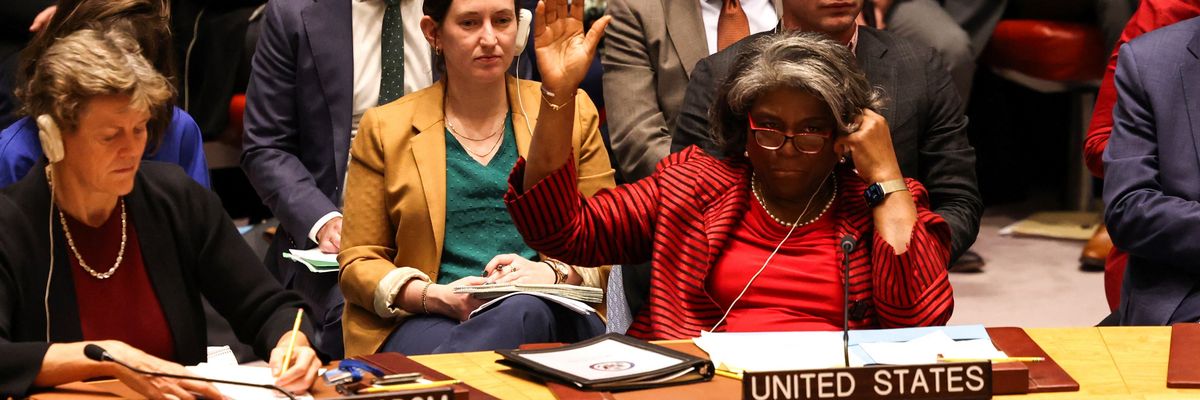
    U.S. United Nations Ambassador Linda Thomas-Greenfield abstains during a vote on a Security Council resolution on Gaza, on December 22, 2023 in New York. (Photo: Charly Triballeau/AFP via Getty Images)

    “Given the staggering death toll—with more than 20,000 killed in over two months—and the horrifying scale of destruction and devastation in Gaza, this is simply unacceptable,” said the head of Amnesty International.

    The United States on Friday abstained from voting on a U.N. Security Council resolution that it repeatedly stonewalled and lobbied to weaken in the face of intense international opposition as Israeli forces continue to kill hundreds of Palestinians daily.

    The newly passed resolution—which was introduced by the United Arab Emirates—calls for “urgent and extended humanitarian pauses and corridors throughout the Gaza Strip for a sufficient number of days to enable full, rapid, safe, and unhindered humanitarian access.”

    Thirteen Security Council members voted in favor of the resolution. Russia joined the U.S. in abstaining.

    The resolution calls for “urgent steps… for creating the conditions for a sustainable cessation of hostilities,” language that’s weaker than an earlier draft’s call for an “urgent and sustainable cessation of hostilities.”

    “Biden’s changes will help ensure that Israel’s slaughter in Gaza continues while minimizing the U.N.’s insight into what increasingly appears to be a genocide.”

    Also removed from the final version was language condemning Israel’s indiscriminate attacks on Palestinian civilians, tens of thousands of whom have been killed, wounded, or left missing during 77 days of Israeli onslaught.

    The vote came just after Russia proposed an amendment that would have restored language calling for an “immediate cessation of hostilities” to the resolution. The U.S. vetoed the amendment.

    Earlier this month, the U.S. vetoed a separate Security Council resolution calling for a Gaza cease-fire. That resolution was later approved by the U.N. General Assembly in a 153-10 vote.

    “It is disgraceful that the U.S. was able to stall and use the threat of its veto power to force the U.N. Security Council to weaken a much-needed call for an immediate end to attacks by all parties,” Amnesty International secretary-general Agnès Callamard said in a statement.

    “This is a much-needed resolution—all efforts to address the unprecedented humanitarian catastrophe in Gaza must be welcomed—but it remains woefully insufficient in the face of the ongoing carnage and extensive destruction wrought by the government of Israel’s attacks in the occupied Gaza Strip,” Callamard continued. “Nothing short of an immediate cease-fire is enough to alleviate the mass civilian suffering we are witnessing.”

    “Given the staggering death toll—with more than 20,000 killed in over two months—and the horrifying scale of destruction and devastation in Gaza, this is simply unacceptable,” she added.

    In a statement giving a “qualified welcome” to the resolution, Mary Robinson—a former U.N. high commissioner for human rights and Irish president who currently chairs The Elders—said: “Agreement on this weak and overdue U.N. Security Council resolution is better than another U.S. veto. But the test of the resolution’s success will be how many lives are saved.”

    “This is a much-needed resolution—all efforts to address the unprecedented humanitarian catastrophe in Gaza must be welcomed—but it remains woefully insufficient in the face of the ongoing carnage and extensive destruction wrought by the government of Israel’s attacks in the occupied Gaza Strip,” Callamard continued. “Nothing short of an immediate cease-fire is enough to alleviate the mass civilian suffering we are witnessing.”

    “Given the staggering death toll—with more than 20,000 killed in over two months—and the horrifying scale of destruction and devastation in Gaza, this is simply unacceptable,” she added.

    In a statement giving a “qualified welcome” to the resolution, Mary Robinson—a former U.N. high commissioner for human rights and Irish president who currently chairs The Elders—said: “Agreement on this weak and overdue U.N. Security Council resolution is better than another U.S. veto. But the test of the resolution’s success will be how many lives are saved.”

    Lamenting that the resolution “became increasingly meaningless” as U.S. President Joe Biden “managed to delete the call for suspension of hostilities,” Trita Parsi, co-founder and executive vice president of the Quincy Institute for Responsible Statecraft, said on social media Friday that “Biden’s changes will help ensure that Israel’s slaughter in Gaza continues while minimizing the U.N.’s insight into what increasingly appears to be a genocide.”

    “Biden is effectively running war crimes management for Israel,” he added.

    Original article by Brett Wilkins republished from Common Dreams under Creative Commons (CC BY-NC-ND 3.0).

    Comment by dizzy: The United States under President Biden has repeatedly succeeded in frustrating attempts to stop and has thereby facilitated Israel’s Fascist-like genocidal atrocities and war crimes in Gaza. We need to stop Israel’s war crimes and remove this ability from the United States at the UN Security Council.

  • ‘We Are Complicit’: Sanders Urges Biden to Curb Israel Military Aid

    Spread the love
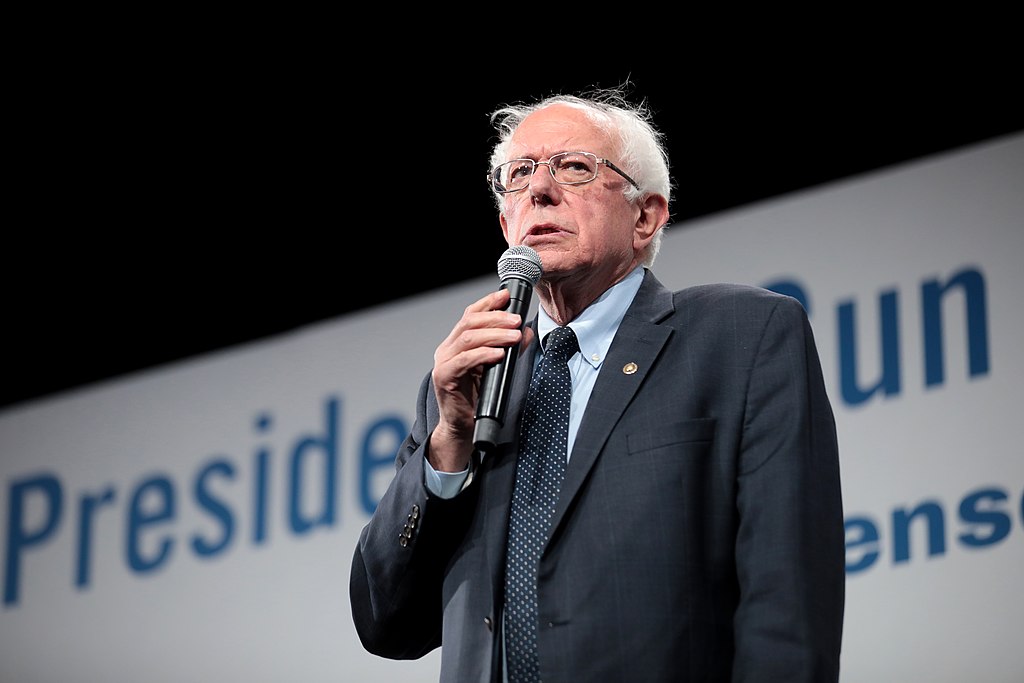
    U.S. Senator Bernie Sanders speaking with attendees at the Presidential Gun Sense Forum hosted by Everytown for Gun Safety and Moms Demand Action at the Iowa Events Center in Des Moines, Iowa. Image by Gage Skidmore from Peoria, AZ shared under the Creative Commons Attribution-Share Alike 2.0 Generic license.
    U.S. Senator Bernie Sanders speaking with attendees at the Presidential Gun Sense Forum hosted by Everytown for Gun Safety and Moms Demand Action at the Iowa Events Center in Des Moines, Iowa. Image by Gage Skidmore shared under the Creative Commons Attribution-Share Alike 2.0 Generic license.

    Original article by JAKE JOHNSON at Common Dreams shared under Creative Commons (CC BY-NC-ND 3.0). 

    Israeli atrocities in Gaza are being carried out by “bombs and equipment produced and provided by the United States and heavily subsidized by American taxpayers,” the Vermont senator wrote.

    Calling the Netanyahu government’s ongoing assault on the Gaza Strip “immoral” and illegal under international law, U.S. Sen. Bernie Sanders on Wednesday urged President Joe Biden to drop his support for the portion of a supplemental foreign aid package that would give the Israeli military more than $10 billion in unconditional assistance.

    Sanders (I-Vt.), who has faced backlash from Palestinian rights advocates for rejecting calls for a permanent cease-fire in Gaza, also pushed Biden to “support efforts at the United Nations to end the bloodshed, such as the recent resolution, vetoed by the United States, that would have demanded an immediate humanitarian cease-fire, the unconditional release of all hostages, and full humanitarian access.”

    The senator’s letter to Biden was made public a day after the U.S. joined just nine other nations in voting against a U.N. General Assembly resolution calling for a cease-fire. The nonbinding resolution passed overwhelmingly, leaving the U.S. “increasingly isolated in its steadfast support of a war that seems to have no rules and no limits,” as the executive director of Doctors Without Borders put it following Tuesday’s vote.

    “The U.S. must not provide $10 billion in military aid for Netanyahu’s right-wing government to conduct their horrific war against innocent Palestinians.”

    Sanders argued in his letter that “while there is a moral case for a military response against a brutal terrorist attack, it is clear that the Netanyahu government’s current campaign is being conducted in a deeply immoral way.”

    “Israel’s reliance on widespread and indiscriminate bombardment, including with massive explosive ordinance in densely populated urban areas, is unconscionable,” Sanders wrote. “This constitutes not just a humanitarian cataclysm, but a mass atrocity. And it is being done with bombs and equipment produced and provided by the United States and heavily subsidized by American taxpayers.”

    “Tragically, we are complicit in this carnage,” the senator added, pointing to a recent Amnesty International investigation showing that the Israeli military used U.S.-made munitions to bomb two family homes in the Gaza Strip in October, killing 43 members of two families—including 19 children.

    Sanders went on to criticize the Biden administration’s timid response to Israel’s massacres in Gaza, writing that the U.S. has “done little but ask nicely while continuing to enable” the Netanyahu government’s devastating military campaign.

    “While it is appropriate to support defensive systems that will protect Israeli civilians against incoming missile and rocket attacks,” Sanders argued, “it would be irresponsible to provide an additional $10.1 billion in military aid beyond these defensive systems as contained in the proposed supplemental foreign aid package.”

    Sanders asked Biden to “withdraw” his support for that element of the larger aid package to stop fueling “the continuation of the Netanyahu government’s widespread, indiscriminate bombardment.”

    Biden said Tuesday that Israel’s “indiscriminate bombing” of the Gaza Strip is costing the country support on the world stage, but administration officials made clear Wednesday that the U.S. “has no plans to shift its position and draw any red lines around the transfer of weapons and munitions to Israel,” CNN reported.

    Original article by JAKE JOHNSON at Common Dreams shared under Creative Commons (CC BY-NC-ND 3.0). 

  • As disasters and heat intensify, can the world meet the urgency of the moment at the COP28 climate talks?

    Spread the love

    Shutterstock

    Brendan Mackey, Griffith University

    Eight years ago, the world agreed to an ambitious target in the Paris Agreement: hold warming to 1.5°C to limit further dangerous levels of climate change.

    Since then, greenhouse gas emissions have kept increasing – and climate disasters have become front page news, from mega-bushfires to unprecedented floods.

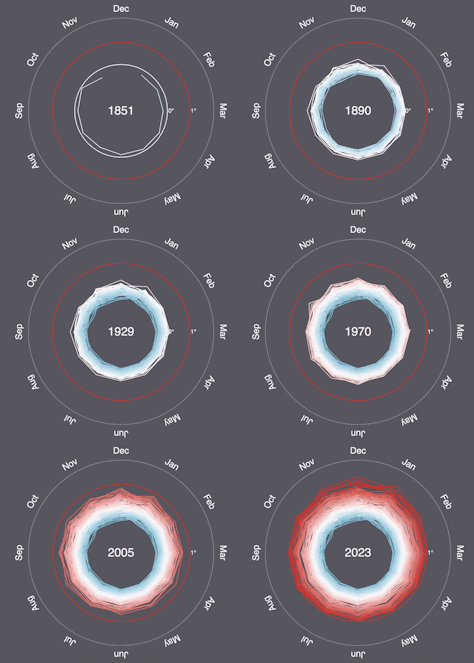
    In 2023, the world is at 1.2°C of warming over pre-industrial levels. Heatwaves of increasing intensity and duration are arriving around the world. We now have less than 10 years before we reach 1.5°C of warming.

    This week, the COP28 climate talks will begin against a backdrop of evermore strident warnings from climate scientists and world leaders. United Nations chief António Guterres has warned climate action is “dwarfed by the scale of the challenge” and that we have “opened the gates of hell”. In his latest climate letter, Pope Francis quotes bishops from Africa who dub the climate crisis a “tragic and striking example of structural sin”.

    Global monthly land and ocean anomalies from 1850, relative to the 1901-2000 average
    Global monthly land and ocean anomalies from 1850, relative to the 1901-2000 average.
    NOAA, CC BY-SA

    In the United Arab Emirates, the 198 nations in the UN’s climate framework will gather for COP28. Can we expect to see real progress – or half-measures?

    Watch for these three key issues facing negotiators.

    1. Taking stock of progress on climate action

    This year, a critical issue will be the global stocktake, the key mechanism designed to ratchet up climate ambition under the 2015 Paris Agreement. This is the first time each nation’s emission cut targets and benefits from climate adaptation or economic diversification plans have been assessed.

    The stocktake reveals what track we are on. Do the combined emission cut promises from all countries mean we can limit warming to 1.5°C? If not, what is the “emissions gap” – and how much more ambitious do nation’s emission reductions need to be?

    There’s been progress, but not nearly enough. If all national emissions pledges became a reality, global warming would peak between 2.1-2.8°C.

    That leaves an emissions gap of around 22.9 gigatonnes of carbon dioxide equivalent over the period to 2030.

    It is very good that the worst-case scenarios – unchecked warming and 4+ degrees of global heating by 2100 are now looking unlikely. But a 2°C world would bring unacceptable harm and irreversible damage.

    We’ll need much more ambitious targets and support to cut global greenhouse gas emissions 43% by 2030 and 60% by 2035 compared with 2019 levels if we are to reach net zero CO₂ emissions by 2050 globally. A major measure of COP28’s success will be whether the major emitting nations agree on more ambitious emission reduction actions.

    2. Who pays for climate loss and damage?

    For decades, nations have wrestled over the fraught question of who should pay for loss and damage resulting from climate change.

    Now we’re close to finalising arrangements for the new Loss and Damage Fund. This will be the second major issue for negotiators at COP28.

    So far, governments have drawn up a blueprint for the new fund. Expect to see debate over who will manage the fund – the World Bank? A UN agency? – and whether emerging economies such as China will provide funds. To date, there’s no target for how much money the fund will hold and disburse. The blueprint must be formally adopted at COP28 before it can begin operating.

    Why a new fund? Other climate finance commitments are aimed at cutting emissions or helping societies adapt to climate impacts. This fund deals specifically with the loss and damage from the unavoidable impacts of climate change, like rising sea levels, prolonged heatwaves, desertification, the acidification of the sea, extreme weather and crop failures.

    Think of the damage from the unprecedented floods in Pakistan or Libya, for instance.

    libya flood, image of destroyed city with floodwater from air
    Libya’s devastating floods in September killed thousands.
    Shutterstock

    3. Where’s the climate finance?

    A major issue in climate negotiations is how countries can transform their economies so they are “climate ready”, with lower emissions and boosted resilience. For developing countries, this requires massive levels of investment and new technologies to let them “leapfrog” fossil fuel dependency.

    This is likely to be a critical sticking point. To date, climate finance has flowed too slowly. Under the Paris Agreement, rich countries promised to provide funds of A$150 billion a year every year. This has been slow in coming, though it is nudging closer, with $130 billion flowing in 2021.

    Unless we see significant progress on climate finance – including making the Loss and Damage Fund a reality and meeting the existing commitments – we’re unlikely to see progress on other key issues such as ratcheting up emission cuts under the stocktake mechanism, phasing out fossil fuels and work on preserving biodiversity.

    How do you build a 198-government consensus?

    One reason climate negotiations advance slowly is the need for consensus.

    All 198 governments must agree on each decision. This means any one nation or group of countries can block a proposal or force the wording to be changed in order for it to be approved.

    The votes of less wealthy countries – including small island nations and least developed countries – therefore carry as much weight as the G20 nations, who account for about 85% of global GDP. This has in the past worked to increase the level of climate action, including the focus on 1.5°C as the global warming target.

    The COP28 President is Sultan Ahmed al-Jaber, who has attracted controversy due to the fact he heads the Abu Dhabi National Oil Company. Expect to see considerable debate over wording. Will governments agree to the “phasing down of fossil fuels” or just the “phasing down of unabated fossil fuels”?

    It might sound like quibbling but it’s not – the second option, for instance, implies the heavy use of yet-to-be-proven carbon capture and storage technologies and offsets.

    Sultan al-Jaber has, to his credit, promoted some progressive agenda items including a focus on the conservation, restoration, and sustainable management of nature to help achieve the goals of the Paris Agreement.

    Here, there are welcome commonalities with the major global biodiversity pact struck late last year, the Global Biodiversity Framework, aimed at stemming the extinction of species and degradation of ecosystems. Healthy ecosystems store carbon and help people adapt to the climate change already here.

    As nations prepare for a fortnight of intense negotiation, the stakes are higher than they have ever been. Now the question is – can the world community seize the moment? The Conversation

    Brendan Mackey, Director, Griffith Climate Action Beacon, Griffith University

    This article is republished from The Conversation under a Creative Commons license. Read the original article.

  • Gaza facing ‘immediate possibility of starvation,’ UN warns

    Spread the love

    https://www.morningstaronline.co.uk/article/gaza-facing-immediate-possibility-of-starvation-un-warns

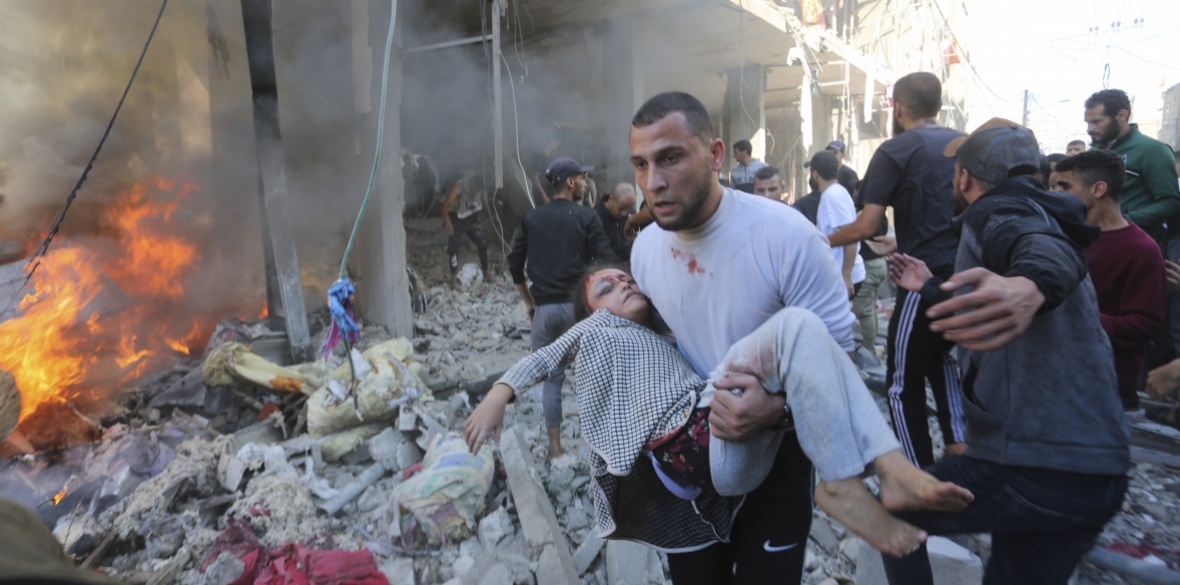
    Palestinians look for survivors after an Israeli air strike destroys a building, November 17, 2023

    PEACE campaigners slammed Israeli authorities and world leaders today after the United Nations warned Gaza faced the “immediate possibility of starvation.”

    Even before the fast approaching winter Palestinians are already struggling to survive in desperate conditions created by a lack of fuel, which means aid agencies are unable to transport urgently needed food and medical supplies to the besieged people of the territory.

    UN World Food Programme (WFP) Mideast regional spokeswoman Abeer Etefa said that, since the beginning of Israel’s retaliation against Hamas’s October 7 uprising, Gaza has received only around 10 per cent of its required food supplies each day. Dehydration and malnutrition are growing as a result, with nearly all residents in need of food.

    Speaking from Cairo, Egypt, Ms Etefa said: “Food production has come to an almost complete halt, markets have collapsed, fishermen cannot access the sea, farmers cannot reach their farms.

    WFP executive director Cindy McCain said: “With winter rapidly approaching, shelters unsafe and overcrowded and a lack of clean water, civilians face the immediate possibility of starvation.”

    https://www.morningstaronline.co.uk/article/gaza-facing-immediate-possibility-of-starvation-un-warns