Tag: United Nations

  • After Ending in Overtime, COP29 Called ‘Big F U to Climate Justice’

    Spread the love

    Original article by Jessica Corbett republished from Common Dreams under Creative Commons (CC BY-NC-ND 3.0). 
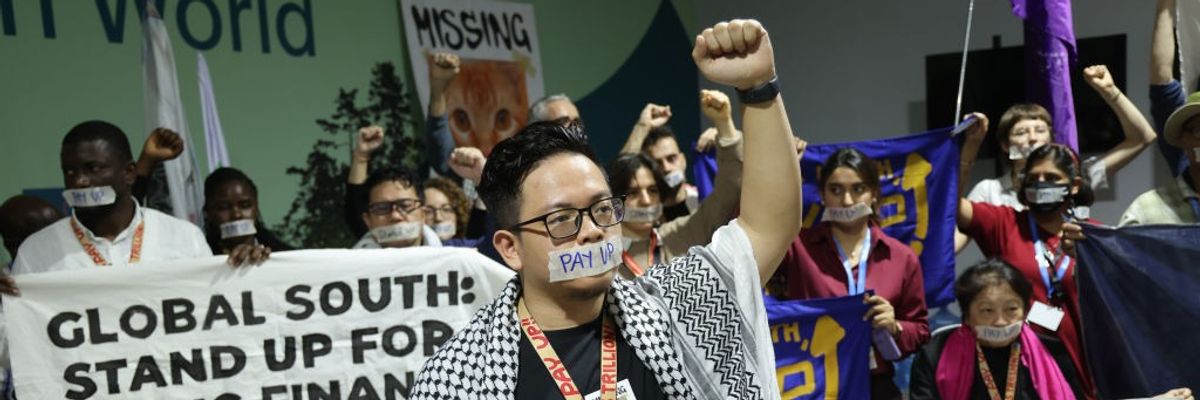
    Activists demanding that rich countries pay up for climate finance protest at COP29 in Baku, Azerbaijan on November 22, 2024.
     (Photo: Sean Gallup/Getty Images)

    Critics of the “COP of false solutions” said that instead of much-needed funding, developing nations got “a global Ponzi scheme that the private equity vultures and public relations people will now exploit.”

    It was early Sunday by the time the United Nations climate summit wrapped up in Baku, Azerbaijan after running into overtime to finalize deals on carbon markets and funding for developing countries that were sharply condemned by campaigners worldwide.

    “COP29 was a dumpster fire. Except it’s not trash that’s burning—it’s our planet,” declared Nikki Reisch of the Center for International Environmental Law. “And developed countries are holding both the matches and the firehose.”

    Recalling last year’s conference in the United Arab Emirates, Oil Change International global policy senior strategist Shady Khalil highlighted that “the world made a deal at COP28 to end the fossil fuel era. Now, at COP29, countries seem to have been struck with collective amnesia.”

    “With each new iteration of the texts, oil and gas producers managed to dilute the urgent commitment to phase out fossil fuels,” Khalil said. “But let’s be clear: Rich countries’ failure to lead on fossil fuel phaseout and to put the trillions they have hoarded on the table has done more to imperil the energy transition than any obstructionist tactics from oil and gas producers.”

    This year’s conference began November 11 and was due to conclude on Friday, but parties to the Paris agreement were still negotiating the carbon market rules, which were finalized late Saturday, and the new collective quantified goal (NCQG) on climate finance.

    “The carbon markets in Article 6 of the Paris agreement were pushed through COP29 in a take-it-or leave-it outcome,” said Tamra Gilbertson of Indigenous Environmental Network, decrying “a new dangerous era in climate change negotiations.”

    https://twitter.com/CarbonMrktWatch/status/1860405796321808760?ref_src=twsrc%5Etfw%7Ctwcamp%5Etweetembed%7Ctwterm%5E1860405796321808760%7Ctwgr%5E5fe69782d84f448776aec8c54957a7ea2579c856%7Ctwcon%5Es1_c10&ref_url=https%3A%2F%2Fwww.commondreams.org%2Fnews%2Fcop29-baku

    Sorry, this content could not be embedded. [yet again]
    X

    As Climate Home Newsreported, they establish two types of markets: “The first—known as Article 6.2—regulates bilateral carbon trading between countries, while Article 6.4 creates a global crediting mechanism for countries to sell emissions reductions.”

    The outlet pointed to expert warnings that “the rules for bilateral trades under 6.2 could open the door for the sale of junk carbon credits—one of the weaknesses of the previous crediting mechanism set up by the U.N. known as the Clean Development Mechanism (CDM).”

    Jonathan Crook of Carbon Market Watch said in a statement that “the package does not shine enough light on an already opaque system where countries won’t be required to provide information about their deals well ahead of actual trades.”

    “Even worse, the last opportunity to strengthen the critically weak review process was largely missed,” he continued. “Countries remain free to trade carbon credits that are of low quality, or even fail to comply with Article 6.2 rules, without any real oversight.”

    As for Article 6.4, “much lies in the hands of the supervisory body” that’s set to resume work in early 2025, said Crook’s colleague, Federica Dossi. “To show that it is ready to learn from past mistakes, it will have to take tough decisions next year and ensure that Article 6.4 credits will be markedly better than the units that old CDM projects will generate.”

    “If they are not, they will have to compete in a low-trust, low-integrity market where prices are likely to be at rock bottom and interest will be low,” Dossi added. “Such a system would be a distraction, and a waste of 10 years worth of carbon market negotiations.”

    Some campaigners suggested that no matter what lies ahead, the embrace of carbon markets represents a failure. Kirtana Chandrasekaran at Friends of the Earth International said that “the supposed ‘COP of climate finance’ has turned into the ‘COP of false solutions.’ The U.N. has given its stamp of approval to fraudulent and failed carbon markets.”

    “We have seen the impacts of these schemes: land grabs, Indigenous peoples’ and human rights violations,” Chandrasekaran noted. “The now-operationalized U.N. global carbon market may well be worse than existing voluntary ones and will continue to provide a get out of jail free card to Big Polluters whilst devastating communities and ecosystems.”

    https://twitter.com/duycks/status/1860458500058501255?ref_src=twsrc%5Etfw%7Ctwcamp%5Etweetembed%7Ctwterm%5E1860458500058501255%7Ctwgr%5E5fe69782d84f448776aec8c54957a7ea2579c856%7Ctwcon%5Es1_c10&ref_url=https%3A%2F%2Fwww.commondreams.org%2Fnews%2Fcop29-baku

    Sorry, this content could not be embedded. [What a surprise!]
    X

    Chandrasekaran’s colleague Seán McLoughlin at Friends of the Earth Ireland was similarly critical of the conference’s finance deal, asserting that “Baku is a big F U to climate justice, to the poorest communities who are on the frontlines of climate breakdown.”

    “COP29 has failed those who have done least to cause climate change and who are most vulnerable to climate breakdown because the process is still in thrall to fossil fuel bullies and rich countries more committed to shirking their historical responsibility than safeguarding our common future,” he said. “Now it’s back to citizens to demand our governments do the right thing. We must keep demanding the trillions, not billions owed in climate debt and a comprehensive, swift, and equitable fossil fuel phaseout. The struggle for climate justice is not over.”

    Campaigners and developing nations fought for $1.3 trillion in annual climate finance from those most responsible for the planetary crisis. Instead, the NCQG document only directs developed countries to provide the Global South with $300 billion per year by 2035, with a goal of reaching the higher figure by also seeking funds from private sources.

    The deal almost didn’t happen at all. As The Guardiandetailed Saturday: “Developed countries including the U.K., the U.S., and E.U. members were pushed into raising their offer from an original $250 billion a year tabled on Friday, to $300 billion. Poor countries argued for more, and in the early evening two groups representing some of the world’s poorest countries walked out of one key meeting, threatening to collapse the negotiations.”

    While Simon Stiell, executive secretary of U.N. Climate Change, celebrated the NCQG as “an insurance policy for humanity, amid worsening climate impacts hitting every country,” Chiara Martinelli, director at Climate Action Network Europe, put it in the context of the $100 billion target set in 2009, which wealthy governments didn’t meet.

    “Rich countries own the responsibility for the failed outcome at COP29,” Martinelli said. “The talk of tripling from the $100 billion goal might sound impressive, but in reality, it falls far short, barely increasing from the previous commitment when adjusted for inflation and considering the bulk of this money will come in the form of unsustainable loans. This is not solidarity. It’s smoke and mirrors that betray the needs of those on the frontlines of the climate crisis.”

    Also stressing that “it’s not even real ‘money,’ by and large,” but rather “a motley mix of loans and privatized investment,” Oxfam International’s climate change policy lead, Nafkote Dabi, called the agreement “a global Ponzi scheme that the private equity vultures and public relations people will now exploit.”

    “The terrible verdict from the Baku climate talks shows that rich countries view the Global South as ultimately expendable, like pawns on a chessboard,” Dabi charged. “The $300 billion so-called ‘deal’ that poorer countries have been bullied into accepting is unserious and dangerous—a soulless triumph for the rich, but a genuine disaster for our planet and communities who are being flooded, starved, and displaced today by climate breakdown.”

    https://twitter.com/ciel_tweets/status/1860478431139447077?ref_src=twsrc%5Etfw%7Ctwcamp%5Etweetembed%7Ctwterm%5E1860478431139447077%7Ctwgr%5E5fe69782d84f448776aec8c54957a7ea2579c856%7Ctwcon%5Es1_c10&ref_url=https%3A%2F%2Fwww.commondreams.org%2Fnews%2Fcop29-baku

    Sorry, this content could not be embedded. [Who broke the twitter/X embed?]

    X

    Rachel Cleetus from the Union of Concerned Scientists, who is in Baku, took aim at not only rich governments, but also the host, saying that “the Azerbaijani COP29 Presidency’s ineptitude in brokering an agreement at this consequential climate finance COP will go down in ignominy.”

    Cleetus’ group is based in the United States, which is preparing for a January transfer of power from Democratic President Joe Biden to Republican President-elect Donald Trump, who notably ditched the Paris agreement during his first term.

    “The United States—the world’s largest historical contributor of heat-trapping emissions—is going to see a monumental shift in its global diplomacy posture as the incoming anti-science Trump administration will likely exit the Paris agreement and take a wrecking ball to domestic climate and clean energy policies,” Cleetus warned. “While some politically and economically popular clean energy policies may prove durable and action from forward-looking states and businesses will be significant, there’s no doubt that a lack of robust federal leadership will leave U.S. climate action hobbled for a time.”

    “Other nations—including E.U. countries and China—will need to do what they can to fill the void,” she stressed. “Between now and COP30 in Brazil next year, nations have a lot of ground to make up to have any hope of limiting runaway climate change.”

    Ben Goloff of the U.S.-based Center for Biological Diversity called out the departing Biden administration, arguing that it “should be going out with at least a signal of its moral climate commitment, not copping out ahead of the Trump 2.0 disaster.”

    Original article by Jessica Corbett republished from Common Dreams under Creative Commons (CC BY-NC-ND 3.0). 

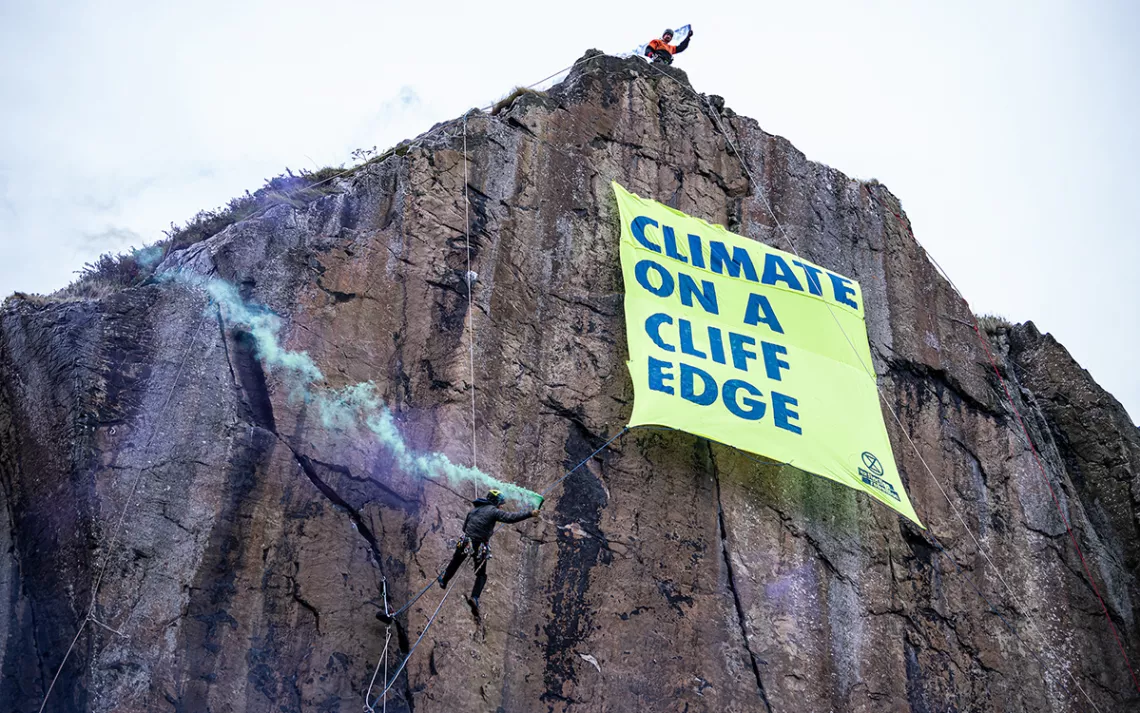
    Experienced climbers scale a rock face near the historic Dumbarton castle in Glasgow, releasing a banner that reads “Climate on a Cliff Edge.” One activist, dressed as a globe, symbolically looms near the edge, while another plays the bagpipes on the shores below. | Photo courtesy of Extinction Rebellion and Mark Richards
    Experienced climbers scale a rock face near the historic Dumbarton castle in Glasgow, releasing a banner that reads “Climate on a Cliff Edge.” One activist, dressed as a globe, symbolically looms near the edge, while another plays the bagpipes on the shores below. | Photo courtesy of Extinction Rebellion and Mark Richards
    Orcas comment on killer apes destroying the planet by continuing to burn fossil fuels.
    Orcas comment on killer apes destroying the planet by continuing to burn fossil fuels.

  • Pope Francis Urges Genocide Probe of Israel’s War on Gaza

    Spread the love

    Original article by Brett Wilkins republished from Common Dreams under Creative Commons (CC BY-NC-ND 3.0).

    Pope Francis speaks on December 25, 2023 in the Vatican City.(Photo: Alessandra Benedetti/Corbis via Getty Images)

    The pontiff’s call comes as the International Court of Justice is reviewing evidence in a South Africa-led genocide case against Israel.

    In a new book set to be released this week, Pope Francis I endorsed a genocide investigation into Israel’s war on Gaza—which has killed or maimed more than 150,000 Palestinians and forcibly displaced, starved, or sickened millions more over the past 13 months.

    “In the Middle East, where the open doors of nations like Jordan or Lebanon continue to be a salvation for millions of people fleeing conflicts in the region: I am thinking above all of those who leave Gaza in the midst of the famine that has struck their Palestinian brothers and sisters given the difficulty of getting food and aid into their territory,” the pontiff wrote in his latest book, which goes on sale in some countries on November 19.

    “According to some experts, what is happening in Gaza has the characteristics of a genocide,” the Pope added. “It should be carefully investigated to determine whether it fits into the technical definition formulated by jurists and international bodies.”

    https://twitter.com/VaticanNews/status/1858112095260131496?ref_src=twsrc%5Etfw%7Ctwcamp%5Etweetembed%7Ctwterm%5E1858112095260131496%7Ctwgr%5Eb6e2c072f49b719695cfba9fd09043a86ba065ff%7Ctwcon%5Es1_c10&ref_url=https%3A%2F%2Fwww.commondreams.org%2Fnews%2Fpope-gaza-genocide

    Sorry, this content could not be embedded.
    X

    The Pope’s words echo last week’s finding by a United Nations expert panel that Israel’s annihilation of Gaza is “consistent with the characteristics of genocide.”

    The International Court of Justice—a U.N. organ—is currently weighing a South Africa-led genocide case against Israel backed by more than 30 nations and regional blocs as well as hundreds of groups and experts around the world.

    Meanwhile, the prosecutor of the International Criminal Court is seeking arrest warrants for Israeli Prime Minister Benjamin Netanyahu and former Israel Defense Minister Yoav Gallant, as well as three former Hamas leaders assassinated by Israel, for alleged war crimes and crimes against humanity, including extermination.

    Many juristsscholars, and other expertsincluding some of Israel’s leading Holocaust historians—have called Israel’s policies and actions in Gaza genocide. Early in the war, Raz Segal—an Israeli historian and professor of Holocaust and genocide studies at Stockton University in New Jersey—called Israel’s Gaza onslaught “a textbook case of genocide.”

    Numerous world leaders and other international officialsartistsentertainers, and others—including half of Democratic voters in the United States surveyed in May—also agree that Israel is committing genocide in Gaza.

    Many Palestinian Christians have been killed, injured, or otherwise harmed by Israeli forces during the bombardment, invasion, and siege of Gaza. With just 800 to 1,000 people believed remaining in Gaza, members of the world’s oldest Christian community warned early in the war that they were “under threat of extinction.”

    In their most infamous attack on Gaza Christians, Israeli forces bombed the 12th century Saint Porphyrius Greek Orthodox Church, Gaza’s oldest, in October 2023, killing 18 Palestinians including numerous children. Among the victims were two women and an infant related to former Republican U.S. Congressman Justin Amash of Michigan.

    After an Israeli sniper fatally shot an elderly woman and her daughter on the grounds of a Catholic church in Gaza City last December, Pope Francis condemned what he called an act of “terrorism.”

    Amid the death and destruction wrought by Israel’s assault on Gaza, last December’s Christmas celebrations were canceled in Bethlehem, the purported birthplace of Jesus Christ.

    “How can we celebrate when we feel this war—this genocide—that is taking place could resume at any moment?” asked Palestinian Lutheran pastor Munther Isaac at the time.

    Original article by Brett Wilkins republished from Common Dreams under Creative Commons (CC BY-NC-ND 3.0).

    Biden’s Faith and Support for Genocide in Gaza

  • Tlaib Demands Blinken Resign Over Failure to Hold Israel Accountable for Gaza Genocide

    Spread the love

    Original article by Brett Wilkins republished from Common Dreams under Creative Commons (CC BY-NC-ND 3.0). 

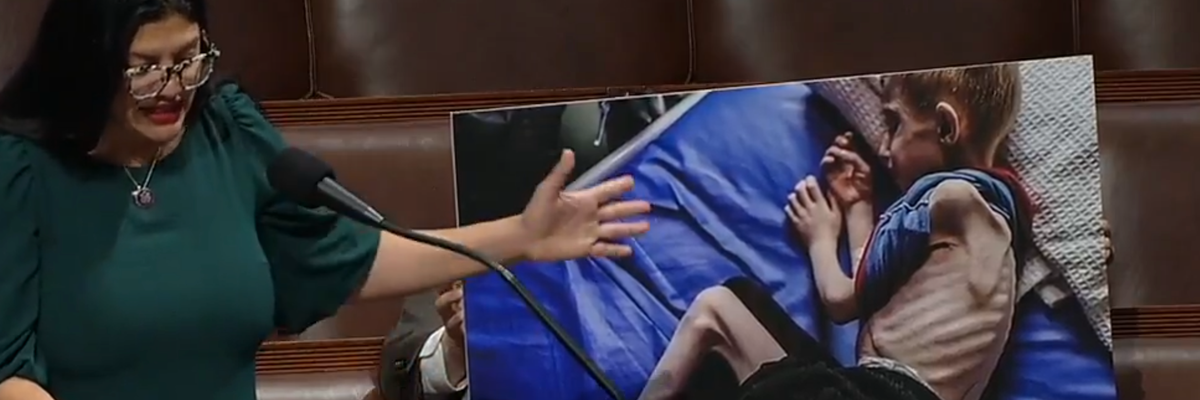
    Congresswoman Rashida Tlaib (D-Mich.) gestures toward a photo of Fadi al-Zant—a Palestinian boy from Gaza who nearly died of starvation—during a speech in the U.S. House of Representatives in Washington, D.C. on November 14, 2024. (Photo: Rep. Rashida Tlaib/X screen grab)

    “No nation blocking U.S. humanitarian assistance can receive U.S. weapons,” said Rep. Rashida Tlaib. “The Biden administration cannot pick and choose when they comply with our own laws.”

    Progressive Democratic Congresswoman Rashida Tlaib of Michigan on Thursday urged U.S. Secretary of State Antony Blinken to resign for breaking federal laws against arming human rights violators by lavishing Israel with tens of billions of dollars in American weapons used to harm Palestinians—more than 150,000 of whom have been killed or maimed in Gaza.

    Speaking on the floor of the U.S. House of Representatives in Washington, D.C., Tlaib—the only Palestinian American member of Congress—argued that “Secretary Blinken has continued to lie to Congress and should resign.”

    “U.S. law is very clear. No nation blocking U.S. humanitarian assistance can receive U.S. weapons,” she stressed. “The Biden administration cannot pick and choose when they comply with our own laws.”

    https://twitter.com/RepRashida/status/1857134002651779378?ref_src=twsrc%5Etfw%7Ctwcamp%5Etweetembed%7Ctwterm%5E1857134002651779378%7Ctwgr%5Ee2bbfbaa85d1ffba4b27e150b11c4126f21d372a%7Ctwcon%5Es1_c10&ref_url=https%3A%2F%2Fwww.commondreams.org%2Fnews%2Frashida-tlaib-blinken-resign

    Sorry, this content could not be embedded.
    X

    The Foreign Assistance Act of 1961 and Leahy Laws prohibit military aid to security forces that commit gross human rights violations, although in practice, the U.S. has sent weapons to many countries guilty of grave abuses, including the perpetrators of several genocides.

    Tlaib disdainfully referred to the Biden administration’s deadline for Israel to improve humanitarian conditions in Gaza or face a possible suspension of arms transfers.

    “I want to talk about, quote, Biden’s 30-day humanitarian deadline,” she said. “The Biden administration has continued to ignore reports from its own experts, international human rights organizations, and the United Nations that the Israeli government is blocking humanitarian aid in Gaza.”

    Although the deadline passed earlier this week without full Israeli compliance with any of the 19 demands made by Blinken and Defense Secretary Lloyd Austin, the State Department determined that Israel is not violating U.S. law, sparking global outrage.

    “The Israeli government is using starvation as a weapon of war,” Tlaib said.

    Earlier this year, as Gazan children began dying from malnutrition and lack of medical care, the International Court of Justice in The Hague—which is weighing a South Africa-led genocide case against Israel—ordered Israeli authorities to stop blocking aid from entering Gaza. Critics accuse Israel of flouting this and two other Gaza-related ICJ orders.

    Pointing to a photo of Fadi al-Zant, a 6-year-old Gaza boy who nearly starved to death, Tlaib continued: “Look at this picture. It is evident that blocking U.S. humanitarian aid… is happening, and it is a blatant violation… of the Foreign Assistance Act.”

    “The Israeli government is using starvation as a weapon of war.”

    “In a letter to the Israeli government on October 13, Secretary Blinken acknowledged that the Israeli government is violating U.S. law by blocking aid and gave them 30 days to comply,” she noted. “The letter demanded that 350 trucks be allowed into Gaza per day. And guess what? According to Israel’s own data and own government, only 57 trucks were allowed into Gaza per day in October.”

    “On November 1, top United Nations officials said, ‘The entire Palestinian population in northern Gaza is at imminent risk of dying from disease, famine, and violence,’” she added. “This week… Secretary Blinken exposed his lie by announcing that there will be no change to any policy, despite admitting that the Israeli government has still failed to comply with all of their demands.”

    Members of Israeli Prime Minister Benjamin Netanyahu’s far-right Cabinet have suggested that Blinken personally endorsed Israel’s policy of bombing aid trucks.

    Palestinian groups and individuals in Palestine and the U.S. unsuccessfully sued President Joe Biden, Blinken, and Austin for their failure to prevent and complicity in Israel’s genocide.

    Also on Thursday, U.S. Sen. Elizabeth Warren (D-Mass.) condemned the Biden administration’s failure to take any punitive action against Israel for its assault on Gaza, which a United Nations panel that same day called “consistent with the characteristics of genocide.”

    “Despite [Israeli Prime Minister Benjamin] Netanyahu’s failure to meet the United States’ demands, the Biden administration has taken no action to restrict the flow of offensive weapons,” Warren said in a statement. “The failure by the Biden administration to follow U.S. law and to suspend arms shipments is a grave mistake that undermines American credibility worldwide.”

    https://twitter.com/masspeaceaction/status/1857164965301420183?ref_src=twsrc%5Etfw%7Ctwcamp%5Etweetembed%7Ctwterm%5E1857164965301420183%7Ctwgr%5Ee2bbfbaa85d1ffba4b27e150b11c4126f21d372a%7Ctwcon%5Es1_c10&ref_url=https%3A%2F%2Fwww.commondreams.org%2Fnews%2Frashida-tlaib-blinken-resign

    Sorry, this content could not be embedded.
    X

    “If this administration will not act, Congress must step up to enforce U.S. law and hold the Netanyahu government accountable through a joint resolution of disapproval,” Warren asserted, adding that she has endorsed resolutions led by Sen. Bernie Sanders (I-Vt.) and others aimed at blocking a series of proposed arms sales to Israel. Sanders said Wednesday that he will soon seek a floor vote on the resolutions.

    “There is no longer any doubt,” Sanders said Wednesday, “that Netanyahu’s extremist government is in clear violation of U.S. and international law as it wages a barbaric war against the Palestinian people in Gaza.”

    Original article by Brett Wilkins republished from Common Dreams under Creative Commons (CC BY-NC-ND 3.0). 

  • ‘We Need a Shift’: Climate Leaders Demand End of COP Dominated by Petrostates, Big Oil Lobby

    Spread the love

    Original article by Jake Johnson republished from Common Dreams under Creative Commons (CC BY-NC-ND 3.0). 

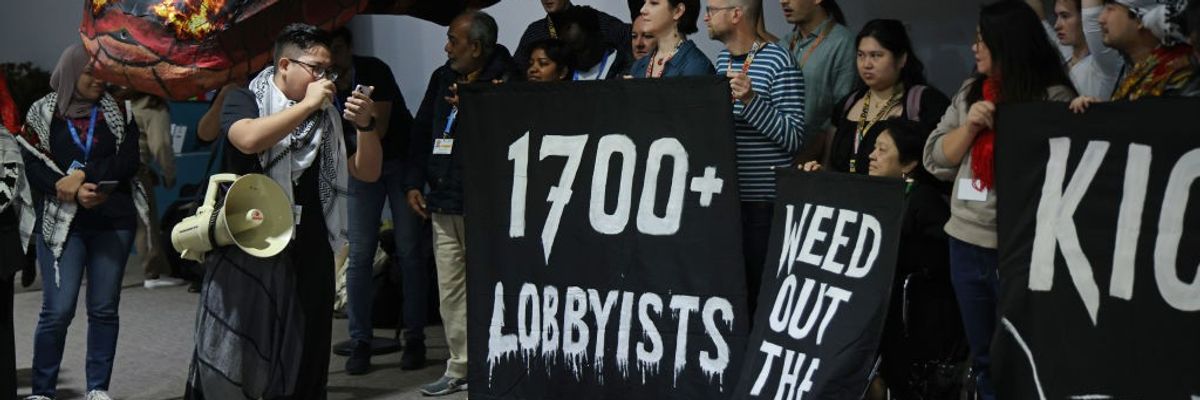
    Activists protesting against fossil fuel lobbyists in attendance at COP29 hold a demonstration on November 15, 2024 in Baku, Azerbaijan. (Photo: Sean Gallup/Getty Images)

    “It is now clear that the COP is no longer fit for purpose,” a coalition of scientists and advocates wrote as more than 1,700 fossil fuel lobbyists swarmed COP29 in Azerbaijan.

    The crushing influence of petrostates and fossil fuel industry lobbyists has rendered the annual United Nations climate conference unfit to deliver the kinds of sweeping changes needed to avert catastrophic warming, a coalition of leading scientists, advocates, and policy experts warned in an open letter released Friday as the first week of the COP29 summit in Baku, Azerbaijan came to a close.

    Acknowledging that the COP process has achieved “important diplomatic milestones” and “a remarkable consensus” on climate targets over nearly three decades of international negotiations, the coalition wrote that the policy framework produced by dozens of U.N. summits is not sufficient to solve the pressing crises facing humanity in an age of runaway warming and large-scale climate devastation.

    “Science tells us that global greenhouse gas emissions must be reduced by 7.5% annually to have any chance of staying within the 1.5°C threshold, a prerequisite for the stability of our planet and a livable future for much of humanity. In 2024, the task is unequivocal: Global greenhouse gas emissions must be reduced by 4 billion tonnes,” reads the letter, whose signatories include former U.N. Secretary-General Ban Ki-moon, former U.N. Framework Convention on Climate Change executive secretary Christiana Figueres, Club of Rome global ambassador Sandrine Dixson-Declève, and Potsdam Institute for Climate Action Research director Johan Rockström.

    “Twenty-eight COPs have delivered us with the policy framework to achieve this, but it is now clear that the COP is no longer fit for purpose,” the letter continues. “Its current structure simply cannot deliver the change at exponential speed and scale, which is essential to ensure a safe climate landing for humanity.”

    The letter calls not for a complete abandonment of COP but rather “a fundamental overhaul” that would enable the U.N.-led summit “to deliver on agreed commitments and ensure the urgent energy transition and phase-out of fossil energy.”

    The coalition of experts and advocates recommended a number of reforms for future COP summits, including “strict eligibility criteria to exclude countries who do not support the phase-out/transition away from fossil energy,” new “mechanisms to hold countries accountable for their climate targets and commitments,” and changes to limit the influence of fossil fuel lobbyists and ensure equitable representation.

    “At the last COP, fossil fuel lobbyists outnumbered representatives of scientific institutions, Indigenous communities, and vulnerable nations,” Figueres said in a statement Friday. “We cannot hope to achieve a just transition without significant reforms to the COP process that ensure fair representation of those most affected.”

    Rockström added that “there is still a window of opportunity for a safe landing for humanity, but this requires a global climate policy process that can deliver change at exponential speed and scale.”

    “Planet Earth is in critical condition,” he said. “We have already crossed six planetary boundaries.”

    “2024 marks yet another year at COP where we see those fighting the climate crisis outnumbered by those that have contributed to it the most—the fossil fuel industry.”

    The open letter was released in the wake of a new analysis from the Kick Big Polluters Out coalition showing that at least 1,773 fossil fuel lobbyists have been granted access to the COP29 summit—giving the industry primarily responsible for the global climate emergency more representation than nearly every country present at the talks in Baku.

    According to the Kick Big Polluters Out coalition, the fossil fuel industry has more representation at COP29 than the 10 most climate-vulnerable nations combined.

    Additionally, The Guardian reported Friday that “at least 132 oil and gas company bosses and staff were invited” to COP29 as “guests” by Azerbaijan’s government and “given host country badges.”

    “2024 marks yet another year at COP where we see those fighting the climate crisis outnumbered by those that have contributed to it the most—the fossil fuel industry,” said Joseph Sikulu of 350.org. “How can we achieve the ambition that is needed to save our homes when these negotiations are continually flooded with fossil fuel lobbyists? There is a ban on tobacco lobbyists from attending the World Health Organization’s summit, why is that not the case for the fossil fuel industry at COP?”

    “We demand that the upcoming COP presidencies set clear rules against the presence of fossil fuel interests at the negotiating table,” Sikulu added. “Our lives depend on it.”

    Al Gore, the former U.S. vice president, joined climate advocates on Friday in decrying Big Oil’s capture of the U.N. climate summit.

    “It’s unfortunate that the fossil fuel industry and the petrostates have seized control of the COP process to an unhealthy degree,” said Gore.

    Lamenting that the follow-through on COP28 commitments to transition away from fossil fuels has been “very weak,” Gore said he believes “one of the reasons for that is that the petrostates have too much control over the process.”

    Original article by Jake Johnson republished from Common Dreams under Creative Commons (CC BY-NC-ND 3.0). 

    Experienced climbers scale a rock face near the historic Dumbarton castle in Glasgow, releasing a banner that reads “Climate on a Cliff Edge.” One activist, dressed as a globe, symbolically looms near the edge, while another plays the bagpipes on the shores below. | Photo courtesy of Extinction Rebellion and Mark Richards
    Experienced climbers scale a rock face near the historic Dumbarton castle in Glasgow, releasing a banner that reads “Climate on a Cliff Edge.” One activist, dressed as a globe, symbolically looms near the edge, while another plays the bagpipes on the shores below. | Photo courtesy of Extinction Rebellion and Mark Richards

  • The world prepares to vote against the US blockade on Cuba

    Spread the love

    Original article by Pablo Meriguet republished from peoples dispatch under a Creative Commons Attribution-ShareAlike 4.0 (CC BY-SA) license.

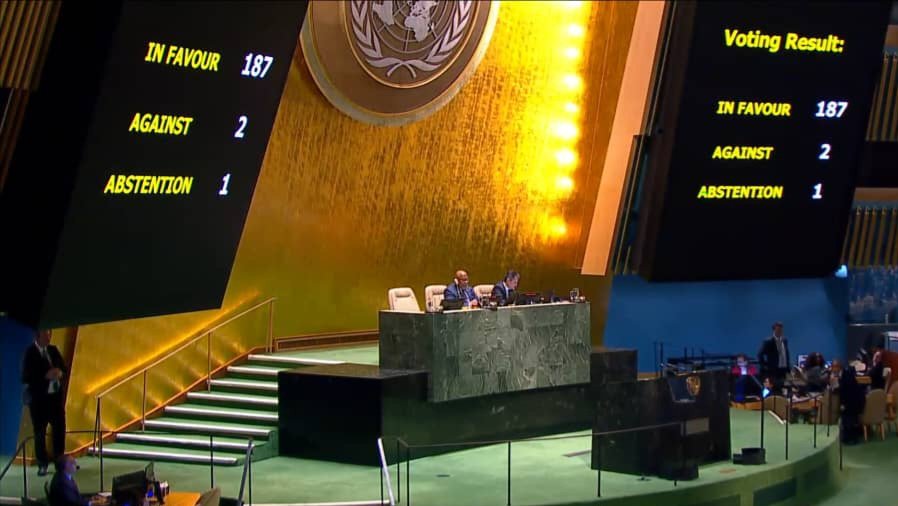
    In 2023, 187 nations voted in favor of lifting the US blockade against Cuba (Photo: Bruno Rodríguez Padilla via X)

    The US blockade on Cuba has been widely condemned by the majority of the world, yet in recent years, instead of lifting it, successive US administrations have made it worse.

    On October 29, the United Nations General Assembly began a series of debates to discuss the resolution on the long-standing economic blockade applied by the United States against the island of Cuba. Since the 1960s, the United States has systematically punished the Cuban people through a stringent blockade on its economy for having declared and built a political and economic model different from the one advocated and directed by the United States. The vote on the resolution will take place on Wednesday, October 30.

    On more than 30 occasions, the United Nations Assembly has discussed the blockade against Cuba, which costs the island 5 billion dollars annually, according to some estimates. Every year the resolution is proposed and the whole world, through the vote of the absolute majority of the member countries of the United Nations General Assembly, has condemned the imperialist attitude of the United States towards Cuba.

    This year, several regional platforms including, the Community of Latin American and Caribbean States (CELAC), the Association of Southeast Asian Nations, the Organization of Islamic Cooperation (OIC), the Non-Aligned Movement (NAM), the Caribbean Community (CARICOM), among others, announced their support for Cuba at the United Nations General Assembly in the face of the criminal blockade.

    In this regard, the Russian delegate Vasily Alekseyevich Nebenzya said at the UN Assembly on Tuesday, “We continue to strongly advocate for the immediate lifting of the illegal embargo that has been imposed by the United States against Cuba for more than 62 years.”

    The Mexican representative to the UN, Héctor Vasconcelos, stated in the session that he categorically rejects the blockade against Cuba and that it is in direct violation of international law. “It is time to open a new chapter and allow Cuba to participate fully in the global community without the restrictions imposed by this unjust and inhumane blockade,” Vasconcelos declared.

    Almost all countries, except the United States, Israel, and one or two other governments allied with Washington’s policy, vote against the blockade and request the elimination of the sanctions against the socialist country. This, for many, reflects the anti-democratic attitude of the US government, which claims to represent the highest values of human rights and global cooperation, although, in this type of case, it scandalously ignores the demands of the vast majority of countries in the world.

    For his part, the Cuban Secretary of State, Bruno Rodríguez, expressed his gratitude for the support given on October 29 by more than 30 delegations that expressed their desire for the United States to lift the blockade against Cuba: “We are grateful for the statements made by the 31 delegations that took the floor at the United Nations General Assembly, demanding the end of the US blockade against Cuba. Tomorrow [October 30] we will continue the debate and the vote against this genocidal policy will take place.”

    The blockade tightens

    Despite this enormous show of support for Cuba, the United States insists on the economic measure. It has even gone so far as to radicalize it, as happened during the administration of Donald Trump, who applied 243 new sanctions, including the removal of certain travel categories which allowed individual US citizens to visit the island, and included Cuba in the list of state sponsors of terrorism, which further hindered the development of the Cuban economy.

    Instead of reversing the measures of his predecessor and returning to the opening policy started by Barack Obama, Biden maintained the more stringent measures against Cuba. In 2023, the US Department of Homeland Security added an additional coercive measure, stating that the ESTA visa waiver program, used largely by citizens of Europe, would be denied to anyone from eligible countries if they had traveled to Cuba anytime after July 2021. In essence, a direct punishment to anyone, even beyond US borders, who dares to visit the Caribbean nation.

    A history of systematic political-economic punishment

    The first time the US government applied an economic embargo on Cuba was in 1958, during the dictatorship of Fulgencio Batista. Although the Cuban Revolution overthrew that military government, the US government punished the Caribbean Island again in 1960.

    In the beginning, the restrictions did not include food and medicine, but from 1962, during the radicalization of the Cuban Revolution, the embargo became almost absolute. Cuba’s natural and historical trading partner, both because of its large territorial extension and its purchasing power, had been the United States.

    In 1959, 73% of Cuban exports were destined for the United States, which shows the enormous impact that the decision had on the island, aimed at promoting the fall of the government led by Fidel Castro. Nevertheless, the USSR and Cuba reached several economic agreements that allowed the island to somehow withstand (never easily) the portentous US punishment.

    However, after the dissolution of the USSR, the blockade began to acquire increasingly challenging characteristics. This is even more so if one takes into account that since 1992,  through the Cuban Democracy Act, the US government has not only prohibited US companies from trading with Cuba but also sanctioned any third party that does business with Cuba.

    This makes any attempt to overcome the economic crisis induced by outside powers even more difficult. In addition, the US government in 2021 decided, without adequate technical justification, to include Cuba among the countries sponsoring terrorism.

    It is foreseeable that Cuba will again feel the backing of international solidarity in the coming days, although the US government will ignore the request of the international community and continue to punish a small country that did not accept to be dominated and undertook a socialist revolution just a couple hundred miles south of the most powerful capitalist country in history.

    Original article by Pablo Meriguet republished from peoples dispatch under a Creative Commons Attribution-ShareAlike 4.0 (CC BY-SA) license.