President-elect Donald Trump speaks at the US Capitol Building in Washington, DC on 8 January, 2025 [Nathan Posner/Anadolu Agency]
An Israeli television channel has revealed that US President-elect Donald Trump sent a message to officials in Tel Aviv, urging Israel to avoid any “unnecessary” escalation and refrain from statements that could lead to regional conflicts, particularly during the transition period before his administration begins.
Channel 12 reported that Trump’s aides informed Israeli officials that the incoming US administration aims to achieve stability in the Middle East, focusing on fostering “peace” between Israel and Lebanon and maintaining the ongoing ceasefire.
In his discussions with Israeli officials, Trump emphasised that he had no intention of engaging in new wars during the early days of his presidency, as he intends to prioritise addressing domestic issues in the United States.
According to the channel, Trump has personally begun intervening in efforts to secure the release of Israeli captives held in the Gaza Strip. He has expressed significant interest in resolving this issue before officially taking office.
The report also mentioned that Trump’s special envoy to the Middle East, Steven Witkoff, met with Israeli Prime Minister Benjamin Netanyahu to discuss the next steps. Following this meeting, it was decided that the heads of Mossad and the Israeli Security Agency (Shin Bet) would be sent to Qatar to engage in direct negotiations.
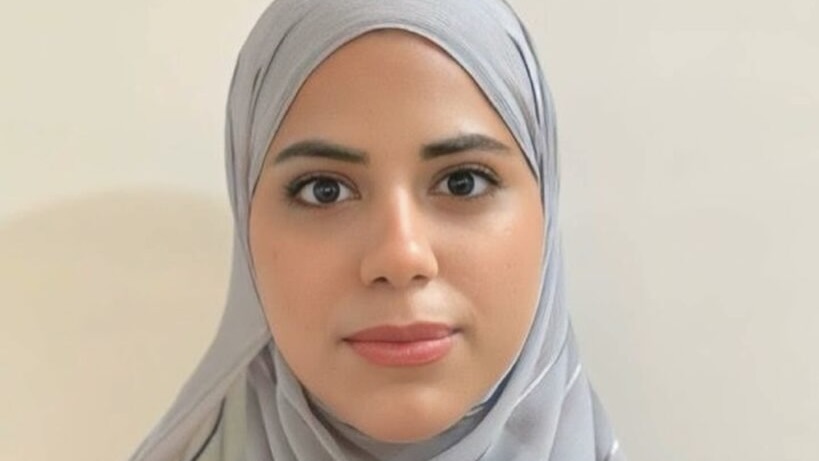
Shatha al-Sabbagh was shot in the head by a sniper a day after interviewing victims of the Palestinian Authority’s security campaign in the Jenin refugee camp.
A sniper from the Palestinian Authority’s security forces killed female journalist Shatha al-Sabbagh in Jenin refugee camp on Saturday, December 28. Shatha (22) was on her way to a grocery shop close to her house along with her two little nephews, her mother, and a sister-in-law, when the sniper shot her in the head, according to Shatha’s mother, who witnessed the incident.
The bereaved mother held the Palestinian Authority’s security forces fully accountable for murdering her daughter. She also considered the incident a targeted assassination as a barrage of bullets was fired by the security forces at people in the street, who tried to rescue Shatha, including her mother.
Shatha’s mother believes that her daughter was killed deliberately because the day before her death, she had interviewed families in Jenin refugee camp as part of a report. Among the people she interviewed was the family of a child who was killed by the PA’s security forces, and a family whose house was set on fire by the forces during its ongoing campaign against the camp.
Shatha’s father also said during an interview with the local news platform Falasteen Post that the street where they live and where Shatha was killed, has been under full control of the PA’s security forces for over 26 days, and that no resistance fighters have been present there during that entire period. Her father’s testimony refuted the claims of the PA’s security forces, who claimed that Shatha was killed by one of the fighters affiliated with Jenin Brigade.
Shatha’s brother-in-law, Suhaib Merei, whose two little children, his sister, and his mother-in-law (Shatha’s mother) were with Shatha when she was shot, reiterated the same circumstances about the killing incident. Merei added that the sniper was only 20 meters away from where Shatha and the rest of family were standing.
He added that unlike the rest of the camp, where the electricity has been cut off by the PA for around one month, the street lights were working because the street has remained under the control of the PA’s security forces since the campaign began. Therefore, the sniper was able to distinguish that those walking were three women with two babies.
For his part, the spokesperson of the PA security forces, Anwar Rajab, condemned the killing of Shatha and accused “outlaws” of being responsible for the crime, a claim which has been refuted by Shatha’s family.
On Monday, December 30, Rajab refused to have a discussion with Shatha’s mother on Al Jazeera Mubasher. Once he saw her on the air, he withdrew from the interview. Rajab justified his withdrawal and refusal to confront Shatha’s mother by saying that he was not informed that she would be part of the interview. The Palestinian security official accused Al Jazeera of being unprofessional, and further explained that he was unwilling to discuss anything about the incident with Shatha’s mother considering her current emotional condition.
PA’s siege of Jenin refugee camp
The PA began a large-scale security campaign in Jenin refugee camp in early December, which explicitly aims at prosecuting what the PA calls “outlaws”. Though, according to analysts and Palestinian grassroots, the campaign seeks to crush resistance groups within the camp in collaboration with the United States and Israel.
Residents of Jenin refugee camp have accused the PA’s security forces of killing six Palestinian citizens in the camp since the beginning of their campaign. The murdered citizens include Mohammad al-Amer (12), Majd Zeidan (16), Ribhi Shalabi (19), Shatha Sbaagh (22), Mohammad Abu Libdeh (25), and Yazeed Jaysah (28).
Residents have also reported that as part of their campaign PA’s security forces have shut off water and electricity in several areas. Some have reported that houses have been targeted by rocket-propelled grenades (RPGs) and set on fire by the forces. People in the camp labeled the stifling siege imposed on them as a “collective punishment”.
It is worth mentioning that the PA has reportedly prohibited foreign media outlets from entering the camp and that all reports coming out from there are being posted online by activists, journalists, and residents, including the families of the victims, or via local media outlets.
Meanwhile, the PA mourned five personnel of its security forces stating that they were killed in clashes with “outlaws” during the campaign carried out in Jenin refugee camp.
In an attempt to cover up the crimes committed in the camp, the PA’s government institutions have allegedly called their staff to participate in demonstrations to show support for the security campaign against Jenin refugee camp. In addition, videos attributed to some Palestinian security personnel were posted online, showing them bragging about verbally and physically abusing Palestinian citizens, who reportedly criticized the PA’s campaign in Jenin on social media networks.
Despite the fact that Israel has violated all peace treaties signed with the PA, including the Oslo Accords for decades, the PA has continued to submit to Israel’s endeavors in the West Bank. The ongoing campaign in the Jenin camp, seemingly on behalf of the Israeli Occupation Forces which are simultaneously carrying out the genocide in Gaza, has further eroded the PA’s legitimacy among the Palestinian people as a body advocating for the Palestinian people and their liberation.
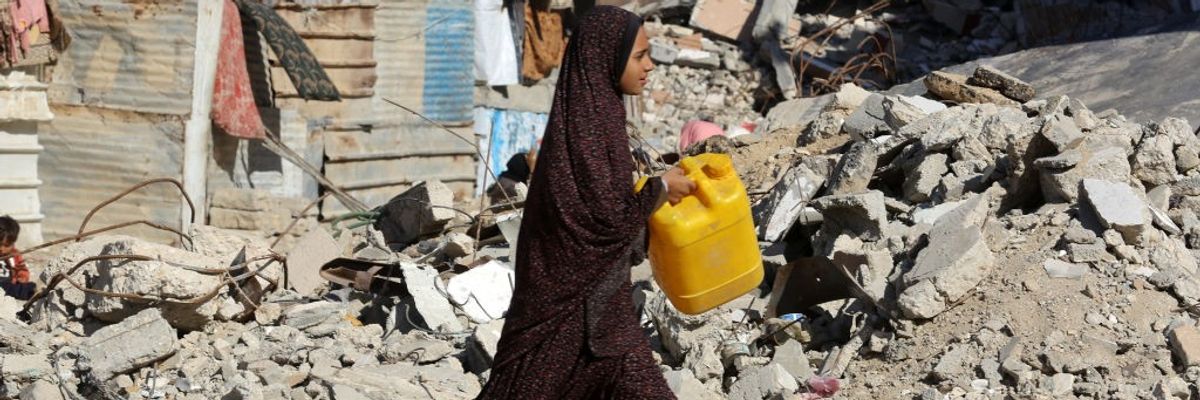
A Palestinian girl carries an empty jerry can amid the ruins of Khan Yunis, Gaza on December 4, 2024. (Photo: Abed Rahim Khatib/Anadolu via Getty Images)
“This isn’t just negligence; it is a calculated policy of deprivation that has led to the deaths of thousands from dehydration and disease,” said the rights group’s director.
A Human Rights Watch report published Thursday accuses Israel of “extermination and acts of genocide” in Gaza “by intentionally depriving Palestinian civilians there of adequate access to water, most likely resulting in thousands of deaths.”
Mirroring language used in Article II of the Genocide Convention to define the crime of genocide, HRW said that Israeli officials “have deliberately inflicted conditions of life calculated to bring about the destruction of part of the population in Gaza” by deliberately denying Palestinians “access to safe water for drinking and sanitation needed for basic human survival.”
“Israeli authorities and forces cut off and later restricted piped water to Gaza; rendered most of Gaza’s water and sanitation infrastructure useless by cutting electricity and restricting fuel; deliberately destroyed and damaged water and sanitation infrastructure and water repair materials; and blocked the entry of critical water supplies,” the report states.
“In doing so, Israeli authorities are responsible for the crime against humanity of extermination and for acts of genocide,” HRW continued. “The pattern of conduct, coupled with statements suggesting that some Israeli officials wished to destroy Palestinians in Gaza, may amount to the crime of genocide.”
NEW: For over a year, the Israeli government has deliberately denied Palestinians in Gaza the minimum water needed for survival, most likely resulting in thousands of deaths.A calculated policy.An act of genocide. 🧵⤵️www.hrw.org/news/2024/12…
HRW “also found that some statements from senior Israeli officials calling for cutting water, fuel, and aid, in tandem with their actions, have amounted to direct and public incitement to genocide.”
According to the report:
Immediately after the attacks in southern Israel by Hamas-led Palestinian armed groups in Gaza on October 7, 2023, which Human Rights Watch has found amounted to war crimes and crimes against humanity, Israeli authorities cut all electricity and fuel to the Gaza Strip. On October 9, then-Defense Minister Yoav Gallant announced a “complete siege” of Gaza, stating, “There will be no electricity, no food, no water, no fuel, everything is closed.”
That same day, and for weeks thereafter, Israeli authorities cut off all water and blocked fuel, food, and humanitarian aid from entering the strip. Israeli authorities continue to restrict the entry of water, fuel, food, and aid into Gaza and to cut Gaza’s electricity, which is required to operate life-sustaining infrastructure. This continued even after the International Court of Justice (ICJ) issued provisional measures in January, March, and May 2024 ordering Israeli authorities to protect Palestinians in Gaza from genocide and, in so doing, provide humanitarian aid, specifying in March that this includes water, food, electricity, and fuel.
HRW detailed how Israel “also barred nearly all water-related aid from entering Gaza, including water filtration systems, water tanks, and materials needed to repair water infrastructure,” and how Israeli forces “have deliberately attacked and damaged or destroyed several major water, sanitation, and hygiene (WASH) facilities.”
“Based on interviews with healthcare professionals and epidemiologists, it is likely that thousands of people have died as a result of the Israeli authorities’ actions,” the report states, adding that deaths are in addition to the more than 45,000 Palestinians directly killed by Israeli bombs and bullets.
HRW added that hundreds of thousands of Gazans have contracted diseases and ailments attributable to a lack of access to safe and sufficient water, including diarrhea, hepatitis A, skin diseases, and upper respiratory infections.
“Water is essential for human life, yet for over a year the Israeli government has deliberately denied Palestinians in Gaza the bare minimum they need to survive,” HRW executive director Tirana Hassan said in a statement. “This isn’t just negligence; it is a calculated policy of deprivation that has led to the deaths of thousands from dehydration and disease that is nothing short of the crime against humanity of extermination, and an act of genocide.”
Without naming any specific nations, the report notes that “several governments have undermined accountability efforts and continue to provide the Israeli government with arms despite the clear risk of complicity in serious violations of international humanitarian law.”
The United States is Israel’s main arms supplier and diplomatic ally, approving tens of billions of dollars worth of weapons transfers, vetoing several United Nations Security Council cease-fire resolutions, and threatening international officials seeking to hold Israel accountable for its crimes.
“Governments should not contribute to the grave crimes that Israeli officials are committing in Gaza, including crimes against humanity and genocidal acts, and should take all steps possible to prevent further harm,” Hassan said. “Governments arming Israel should end their risk of complicity in atrocity crimes in Gaza and take immediate action to protect civilians with an arms embargo, targeted sanctions, and support for justice.”
Zionist Keir Starmer is quoted “I support Zionism without qualification.” He’s asked whether that means that he supports Zionism under all circumstances, whatever Zionists do.
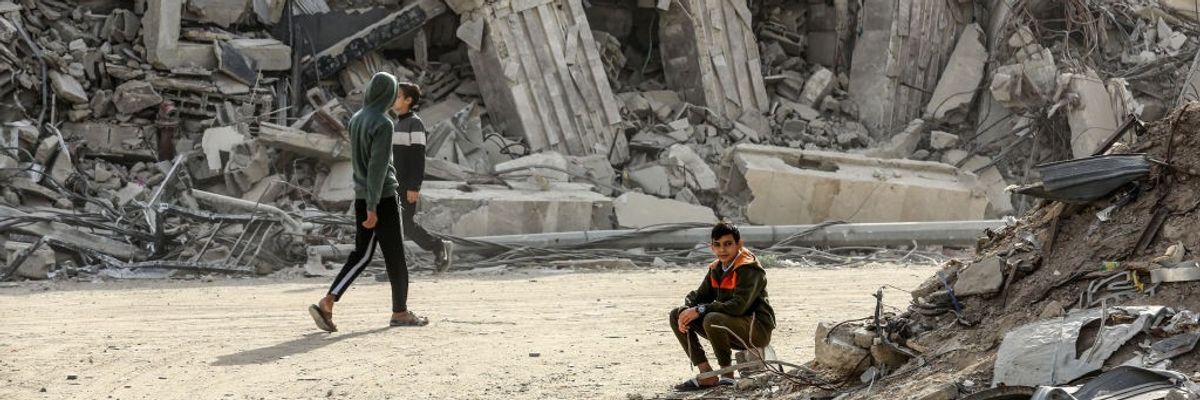
Palestinians are surrounded by buildings destroyed by Israeli attacks in Khan Younis, Gaza on December 10, 2024. (Photo: Abed Rahim Khatib/Anadolu via Getty Images)
“Failure to do so not only risks our leverage in ceasefire negotiations, it undermines our country’s own national security and weakens America’s commitment to human rights as a cornerstone of our foreign policy.”
Twenty progressives in the U.S. House of Representatives on Tuesday wrote to top Biden administration officials arguing that “the United States government must suspend offensive weapons” to Israel over its destruction of the Gaza Strip, citing federal and international law.
Led by Reps. Summer Lee (D-Pa.) and Greg Casar (D-Texas), the incoming Congressional Progressive Caucus chair, the lawmakers began by thanking U.S. Secretary of State Antony Blinken and Secretary of Defense Lloyd Austin for their October 13 letter threatening to cut off weapons to Israeli Prime Minister Benjamin Netanyahu’s government if it did not dramatically improve humanitarian conditions in Gaza.
“However, despite your administration acknowledging that the Netanyahu government did not fully address the United States’ concerns over Gaza and has failed to meet all of the conditions stipulated in this letter, the State Department decided not to take further action, including the suspension of offensive military assistance, to ensure full compliance,” the Democrats wrote.
“We believe continuing to transfer offensive weapons to the Israeli government prolongs the suffering of the Palestinian people and risks our own national security by sending a message to the world that the U.S. will apply its laws, policies, and international law selectively,” they continued. “Furthermore, a failure to act will put Israeli lives in danger by prolonging Netanyahu’s war, isolating Israel on the international stage, and creating further instability in the region.”
The new letter comes just over a month away from President Joe Biden leaving office and follows one from last week signed by 77 House Democrats—including Casar—that demanded “a full assessment of the status of Israel’s compliance with all relevant U.S. policies and laws, including National Security Memorandum 20 (NSM-20) and Section 620I of the Foreign Assistance Act.”
This one goes further, explicitly urging the Biden administration to suspend offensive military transfers and warning that “failure to do so not only risks our leverage in cease-fire negotiations, it undermines our country’s own national security and weakens America’s commitment to human rights as a cornerstone of our foreign policy.”
“We remain committed to saving Palestinian and Israeli lives. This means doing everything possible to prioritize the release of hostages, secure a lasting cease-fire deal, and move toward long-term peace,” the 20 progressives concluded.
In addition to Lee and Casar, Tuesday’s letter was signed by Democratic Reps. Jamaal Bowman (N.Y.), Cori Bush (Mo.), Joaquin Castro (Texas), Lloyd Doggett (Texas), Veronica Escobar (Texas), Jesús “Chuy” García (Ill.), Al Green (Texas), Sara Jacobs (Calif.), Pramila Jayapal (Wash.), Hank Johnson (Ga.), Jim McGovern (Mass.), Alexandria Ocasio-Cortez (N.Y.), Ilhan Omar (Minn.), Mark Pocan (Wis.), Ayanna Pressley (Mass.), Delia C. Ramirez (Ill.), Rashida Tlaib (Mich.), and Bonnie Watson Coleman (N.J.).
It came on the same day as a lawsuit filed by Palestinians and Palestinian Americans accusing the U.S. State Department of creating “unique, insurmountable processes to evade the Leahy Law requirement to sanction abusive Israeli units.”
As of Tuesday, the 14-month Israeli assault on Gaza in retaliation for the Hamas-led October 7, 2023 attack has killed at least 45,059 people and wounded another 107,041, according to local officials. Israel’s slaughter and starvation of Palestinian civilians have led to a genocide case at the International Court of Justice as well as International Criminal Court arrest warrants for Netanyahu and his former defense minister, Yoav Gallant.
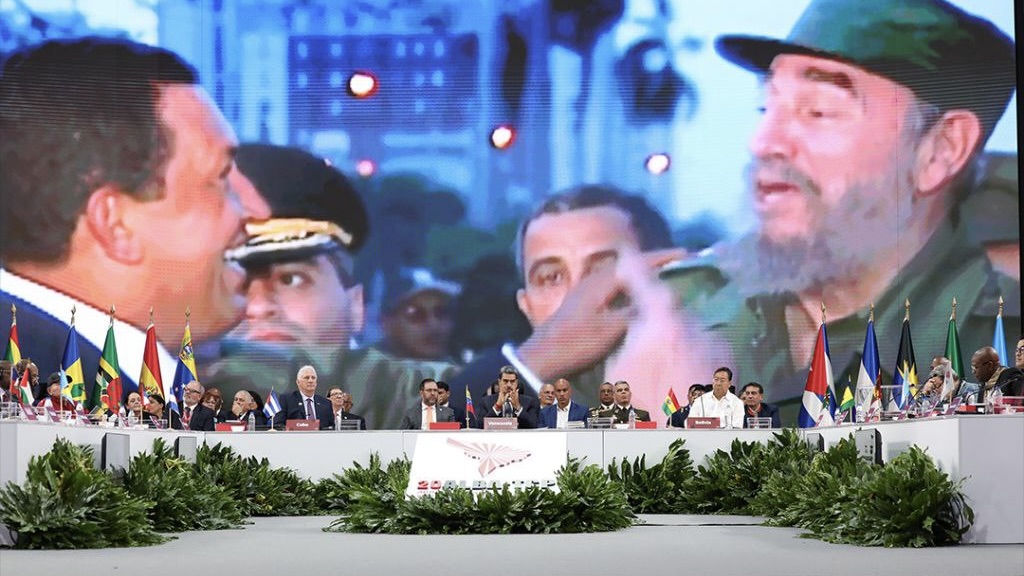
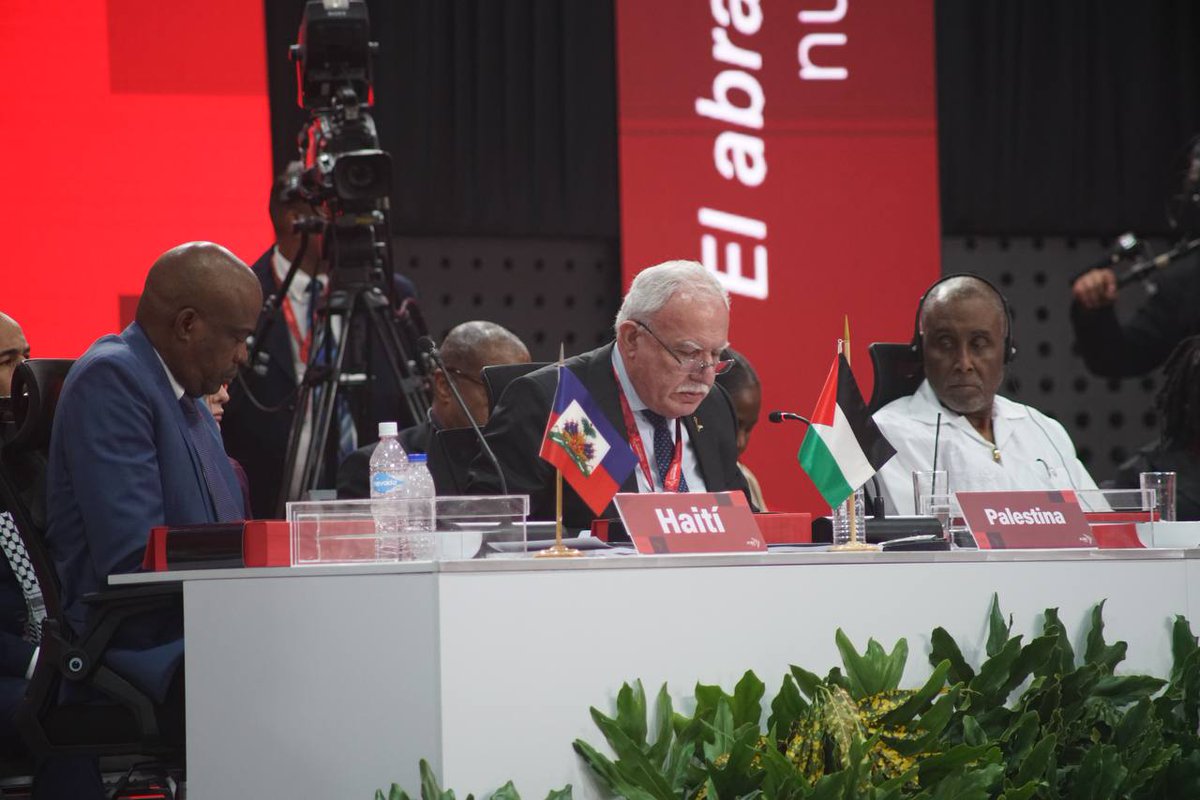
Heads of State Summit of ALBA-TCP in Caracas, Venezuela. Photo: ALBA-TCP
ALBA-TCP was founded in 2004 in an attempt to counter the US proposal of creating a “free trade zone of the Americas
December 14 marked the 20th anniversary of the creation of the Bolivarian Alliance for the Peoples of Our America-People’s-Trade Agreement (ALBA-TCP). ALBA-TCP was created in 2004 as a geopolitical alternative to the devastating advance of neoliberalism in the region.
The project was founded on December 14, 2004, in Havana by Cuban President Fidel Castro and Venezuelan President Hugo Chávez. Currently, the organization has 10 member countries and four countries considered “special guests.” In 2006, Bolivia signed its membership; in 2007, Nicaragua; in 2008, Dominica; in 2009, Antigua and Barbuda and St. Vincent and the Grenadines; in 2014, St. Kitts and Nevis and Grenada; and in 2021, St. Lucia. The special invited countries are Syria, Haiti, Suriname, and now Palestine.
To commemorate the 20 years, social movements, political parties, and heads of state gathered in Caracas, Venezuela for the 24th Heads of State Summit as well as parallel meetings. The event was attended by the host, Venezuelan President Nicolás Maduro; Bolivian President Luis Arce; Cuban President Miguel Díaz-Canel; Nicaraguan President Daniel Ortega; Prime Minister of St. Vincent and the Grenadines, Ralph Gonsalves; Prime Minister of Dominica, Roosevelt Skerrit; and the Prime Minister of Antigua and Barbuda, Gaston Browne.
Independence and solidarity among countries
In their addresses during the Summit on December 14, the heads of state and invited countries stressed the importance of solidarity among countries seeking alternative ways of development and the need for unrestricted solidarity among people struggling against imperialist attacks. They also demonstrated their support for Nicolás Maduro and his victory in the last presidential elections.
Miguel Díaz-Canel said “We reiterate the strongest support for the Bolivarian revolution, led by President Nicolás Maduro…We also call for the elimination of the blockade against Cuba …We cry out for a free Puerto Rico and declare our solidarity with Haiti, our Cuban doctors are there…We reiterate our demand for a ceasefire in Gaza and condemn the attacks perpetrated by Israel against Lebanon, Syria, and Iran.”
The Bolivian President, Luis Arce, highlighted the historical importance of ALBA in its fight against economic projects promoted by the United States such as the FTAA (Free Trade Area of the Americas): “The embrace of Hugo Chávez and Fidel Castro not only marked history but also manifested the defeat of the hegemonic project of the FTAA. ALBA was born, ALBA placed the human being at the center, promoting that a better world is possible. Bolivia reaffirms, once again, its commitment to ALBA-TCP, because it is a resistance that raises its voice against the unjust and criminal blockade against Cuba…ALBA is also a firm voice against the arbitrary and unilateral measures imposed against Venezuela and Nicaragua, which affect the welfare of our peoples.”
Nicolás Maduro said, “We must win the battle of life and truth in the streets, networks, media, and walls, as well as in the conscience and spirituality of the people.” He also added the importance of the struggle of the people to be masters of their destiny without imperial impositions or impositions of any kind. In the same line of discourse, Nicaraguan President Daniel Ortega said “From Nicaragua we reaffirm our commitment to ALBA. We will continue to fight the battle.”
The Prime Minister of Dominica, Roosevelt Skerrit stated “We congratulate the electoral triumph of President Nicolas Maduro on July 28. We wish him all the best…We also want to reaffirm our solidarity with the people of Cuba, a brave people for whom we have our greatest respect and love; we will never cease to lend our voice against the United States to eliminate the blockade against Cuba.”
Ralph Gonsalves, Prime Minister of St. Vincent and the Grenadines, harshly criticized US interference in the development of the past Venezuelan elections “Perhaps [the US government] thinks it is superior,” he said in this regard. He also stressed that the creation of ALBA-TCP was a fundamental invention for the emancipation of the American people, “ALBA is the product of the geniuses of our peoples.”
Inclusion of Palestine to ALBA-TCP
At the current summit, it was announced that Palestine had been included as a “brotherly country” and was included as a “permanent guest”. According to the resolution of the Heads of State, ALBA-TCP condemns the attacks against the Palestinian population and the “illegally occupied territories” and rejects “the merciless and inhuman genocide committed by the State of Israel, the occupying power, as well as its plan of spoliation, invasion, and domination.” Likewise, they denounced the support of several governments currently collaborating with the actions of the Israeli army and called for an “immediate ceasefire…From the heart of the peoples and governments of this alliance, we declare Palestine a brother country of the ALBA-TCP, and reaffirm our commitment to the defense of the Palestinian cause, which is the defense of humanity,” reads the resolution.
In this regard, Riyad al-Malki, advisor to the President of State for International Affairs of Palestine said “History will remember those who stood on the side of justice, ALBA’s lasting solidarity with Palestine is a testimony of freedom and collective resistance.” Furthermore, Malki added “This Alliance is a living testimony of collective integration to challenge imperialism and ensure a just world. These values resonate with the Palestinian struggle, an end to the illegal occupation.”
A call for counter-hegemonic struggle
The joint document signed by all the countries highlights the historical importance of ALBA-TCP in the struggle for a more equitable world: “Twenty years after this giant step, we pay homage to the founding leaders, Hugo Chávez Frías and Fidel Castro Ruz, who adopted that December 14, 2004, in Havana, Cuba, the vision of the future embodied in the founding documents of ALBA, which have allowed us to walk united until the present, animated by the ancestral force that led our peoples to be free and that encourages us to continue integrated in this Alliance for Life.”
Similarly, it was stressed that the existence of this multilateral organization operates as a possibility to create a region that resists the impositions of the most developed countries: “Today, we want to ratify before our peoples, the counter-hegemonic, democratic, anti-imperialist and anti-fascist nature of our Alliance and renew our commitment to help and protect each other, to continue building together a future of shared goals under the founding principles of complementarity, cooperation, social justice, defense of our sovereignty and solidarity.”
In this sense, Luis Arce stressed that “In the face of the challenges of a world threatened by fascism and neo-fascism, ALBA is not an option, ALBA is a necessity that must continue with firm steps, reaffirming the founding principles of solidarity, justice, and cooperation…ALBA is not only an alliance, it is a promise for the future, a living resistance, an instrument for the most dispossessed, and a reminder that together, as peoples, we are invincible.”
Objectives and principles of ALBA-TCP
According to ALBA’s official website, the fundamental objective of the project is “to achieve integral development, ensure social equality and contribute to guaranteeing the quality of life, good living, independence, self-determination and identity of the peoples.” For this very reason, the principles of ALBA-TCP propose that political decisions be made horizontally and take into account the economic differences of its members without meaning that the importance of each of the members is underestimated.
The principles shared by the countries are “trade and investment should not be ends in themselves, but instruments to achieve sustainable development; special and differentiated treatment, according to the level of development of the various countries; economic complementarity and cooperation; cooperation and solidarity; the creation of the Social Emergency Fund; the integrative development of communications and transportation; the sustainability of development; energy integration; the promotion of investments of Latin American capital in the region; the defense of Latin American and Caribbean identity and culture; respect for intellectual property; and the agreement of multilateral positions and in negotiations with countries and blocs in other regions.”